A little landscaping at home in Second Life

Island Myvatn

A this blog shows, I enjoy playing around with houses, either building my own or kitbashing those I purchase; another thing I enjoy is landscaping and “SL gardening”. I love fiddling around and building an environment around my SL homes that both fits with them and adds ambience to them (at least in my eyes, others might think otherwise!). I’m not sure what the attraction is; perhaps I’m compensating for the fact that in the physical world, the only manner in which I’m remotely green-fingered is when I dip a hand in in tin of paint…

In February, I picked up the InVerse Orlando House (see: The InVerse Orlando House in Second Life), which just happened to be of a length and height such that it pretty much “slotted into” the split-level landscape I’d established from my previous InVerse house, the Tarzana (see: An Inverse House in Second Life), and which (at the time) I didn’t want to change too drastically.

However, the hands of the clock march inexorably forward, and the itch to re-develop the gardens more in keeping with the Orlando – with it’s mansion-like presence of tall columns, shading terraces and railed verandas – grew. So for the last week and as time has allowed I’ve been gradually re-working things to both better present the house and better integrate the Mesh Romance Flower Cottage by FelixvonKotwitz I’d picked up roughly around the time of the Orlando purchase (see: A Romance Cottage in Second Life) that has made a cosy little summer house-come-garden folly.

Isla Myvatn

Over the years, I’ve been fortunate enough to gather something of a library of landscaping kits, tools, plants, and so forth, and have developed a number of “go to” creators I most frequently turn to for my needs. These include (as they have the most relevance here):

  • Alex Bader: I don’t think anyone does landscaping kits as comprehensively as Alex under his Studio Skye brand. Landforms, cliffs, shorelines, beaches, rivers, streams, waterfalls, ponds, woodlands, forests, plants, and so on; together with a host of buildings, structures and textures to boot, Studio Skye can be a one-stop shop, and I’ve been using Alex’s items for over a decade.
  • Cube Republic: Cube is another creator with a prolific output that  is coupled to at eye for detail and a solid sense of care in working with mesh. His plants are second to none, and he also offers a range of landscaping kits and has venture into the world of EEP settings as well. Like Alex, he also offers texture packs and structure kits such that between the two of them, I can pretty much always find what I need.
  • Sasaya (Sasaya Kayo): through her HPMD (HappyMood) brand, Sasaya offers a range of general trees and shrubs that are well-optimised, look good and relatively low LI. Her shrubs and flowers / grasses are often ideal for landscaping / wild gardens.
  • Kriss Lehmann: again, Kriss again offers a range of plants and garden kits through his Botanical brand, together with structures of assorted types (his Forest Ruins Tower has been a long-standing part of many of my past landscaping) and items that help bring a garden to life.
Isla Myvatn

There are other brands I use – We’re Closed for trees with LI is a factor, for example – but the above tend to by my go-to brands. I particularly like Cube, Alex and Kris, as their items tend to be optimised such that linking parts of their kits can help in managing LI (indeed, I’m surprised as to how many don’t understand the benefits of considered linking to help manage LI, but that’s a subject for another blog post I’ve had sitting in my Drafts folder for so long, it has probably taken root).

But, back to the garden. With the previous house, I’d focused on using the Studio Skye Zen Garden Kit to give something of a wild garden look. For this time around, I’ve kept some of this, but also opted for a more formal approach with lawns and planters to the front of the house, some of which extends to the back garden, with the Zen elements mixed in, together with a wilder look to the rear. For this I focused on kits from Studio Skye – notably the Tiered Garden Wall Building Set, which offers a lot of flexibility when using wall shapes to break up a space and to create planters.

Isla Myvatn

While terraforming can be used for hills and raised areas, particularly in private estates where terraforming is allowed, it can also be problematic if you don’t have terraforming rights, or where issues of texture matching, smoothing, etc., are concerned.  To this end, I opted to use the Studio Skye Land Forms Building Set One to provide clifftop hills and slopes running down to the house and around it. While mesh forms like this will inevitably lead to somewhat angular slopes in places, with care and blending, a reasonably consistent finish can be obtained, and without spending hours in smoothing terrain and facing the potential for blurred-looking ground as a result of morphing and raising the terrain.

Alongside of these came elements from Kris Lehmann, such as his Edged Brick Path (which sits will with the likes of Studio Skye Tiered Garden Wall set, with shrubs from HPMD – although for flowers, I admit I opted for Kayle Matzerath’s ~*GOD*~ Lumenaria Flower Fat Pack, which offers (me, at least, as I’ve been using them since encountering them at 2013’s Fantasy Faire) a good solution for garden flowers in planters, although they can decimate at moderate camera distances.

Isla Myvatn

Something that can add a good deal of depth to a home setting is the use of wildlife / animals. This does have to be excessive – but the sight of song birds here and there can really help with bringing a garden to life – particularly if you’re using an ambient sound scape that includes bird song. Two of my preferred creators in this regard are:

  • Morgan Garret (Fishgod): while I am not sure if he is still active in Second Life, Morgan Garret created the Grizzly Creek brand that includes some of the most detailed birds from around the world I’ve owned. They are naturally animated, their song works with that of any ambient sound scape, and they are incredibly life-like. At 3LI apiece, they aren’t going to eat into your land capacity.
  • │T│L│C│Animals: operated by Lautlos and True Redrose, this is another excellent source of birds and fish – and other animals. Some of their waterfowl might need a little resizing, but if you have a pond or lake, I cannot rate them highly enough – particularly as their ducks, geese, fish, etc., can be set to swim on / under both Linden Water or other water planes.
Isla Myvatn

Obviously, there are other brands out there as well – JIAN being one –  just as there are for landscaping and plants. The ones I list above are the ones that suit my needs and have allowed me a happy week of playing with kits and landscaping at home. Which in turn has given me the excuse for writing the above 🙂 .

The InVerse Orlando house in Second Life

The InVerse Orlando House – the (first?) arrival of 2022 at Isla Myvatn

So I ended up back at Novocaine Islay’s InVerse store recently, where I was supposed to be there helping her make decisions about a new house she’d been considering. But, unfortunately for you, whilst paging through one of the rezzers there, I came across a house design that piqued My curiosity. I say “unfortunately for you”, because after carrying out so checks and measuring, I realised it could be a good fit for the home island – and so here you are, wading through another house review 🙂 .

The house in question is the Orlando, modern style of house that has a certain look to it that whilst not “Scandinavian” per se, has a look that is well suited to somewhere like Second Norway. I’m not sure how long Novocaine has had it on the market, but it is currently only available via the InVerse in-world store. The living space is split over two full floors, each split into two rooms, with additional space provides by balconies and terraces, including a covered one to the side of the house that includes a swimming pool sheltered by the extended roof of the house.

The Inverse Orlando (furnished version) straight out of the rezzer

The overall footprint for the building is 26 metres wide by 22 deep, with added “tongue” to the front aspect forming a large step that brings the overall depth of the building out to almost 26 metres. Within this footprint, the interior living space is just under16.4 metres in width and some 18 metres in depth. The ground floor, served by a single front door, presents a lounge area running the full width of the front of the house and some 8.2 metres in depth, with the staircase to the upper floor to one side and large picture windows to both the front aspect and to the pool patio. Behind this sits a kitchen / dining area approximately 12 metres wide and 8 metres deep and with windows overlooking the pool to the side and to the rear aspect.

On the upper floor are two interconnected room, each approx. 8.2 metres square, and both individually served by a landing that runs to one side of them. One of these rooms has a balcony to the front aspect, and both have windows overlooking the covered pool, a large skylight in the roof over the pool allowing ambient light into both. The second room also has windows to the rear aspect, and the upper floor is completed by a side balcony also accessed from a door leading off of the front-to-back landing hallway. The entire default finish of the house is a mix of wooden framing, white brick and grey and white stucco, with a tiled and highly attractive waveform roof.

The default furnishings on the Orlando’s lounge. Note the baked light / shadows from the windows on the flooring

As with many of Novocaine’s houses, two versions are included in the exceptionally modest price of just L$349. One of these is the bare-bones house with controller, and the other comes will furnishings and additional décor. Which you option to use is a matter of choice; the furnishings supplied are acceptable enough for those looking for an out-of-the-box home, although the style is perhaps more towards low LI than the finer aesthetics of design (although this didn’t stop me from using some of the elements from the furnished version!).

The bare bones house tops-out at 83 LI (including lighting and house control system), with the furnishings increasing this by a further 77, in the process offering drapes for most of the windows, plants, a lounge suite of sofa and armchair, a galley kitchen with basic 4-place tabled and chairs, a large bath with bathroom vanity fittings, a double bed with side tables and lamps, a fireplace with scripted fire and various sideboards and with rugs, plants and picture throughout, a basic web TV, with the majority of the fittings complete with animations – including for the kitchen and even in one of the rugs!

I preferred to use mix of the supplied furniture and fittings – sideboard and fireplace in the lounge, for example – with my own furniture. Note also, the re-textured floors to avoid the baked sunlight / shadow effects

Something new to me with this design is the inclusion of an additional control element in the furnished version: a texture changer than allows the user to turn the shadows cast by the furnishings on the floors on and off. This is only practical if you don’t move the supplied furnishings around (or replace them), but it’s a novel idea. A pity it didn’t also extend to the baked sunlight / shadows on the floors as well.

What attracted me to the Orlando lay in the overall build quality, which – with the odd caveat here and there – is pretty darned good – and the fact that, like the Tarzana I picked up in October 2021 and reviewed here, it is ideal for modding and tweaking.  For example, for anyone who has a waterfront home and who may not want the included swimming pool, it and the patio area under the roof can be removed, and, with the addition of a new house base and additional support under the outer wall of the pool space, a small, covered dock can be made. I found it offers sufficient space for a pier and a boat up to the size of my Bandit 460AK cabin cruiser (reviewed here) – and I came close to actually using the house in this configuration on the waterfront of Isla Myvatn.

The floor-to-ceiling height of the Orlando, coupled with the structure’s width meant it almost perfectly fitted the space vacated by the Tarzana, and matched the elevated back garden

However, and (again) as I’ve covered in these pages, I’ve spent a far amount of time building a stepped Zen garden and elevated spots at one end of the home island, integrating them with the upper floor of whichever house I’m using, starting with Fallingwater and then continuing with the InVerse Tarzana house.

On measuring things like floor-to-ceiling space, and overall size, I realised that the Orlando would more-or-less slot right into the space that had been occupied by the Tarzana and aligned with the paths of the elevated garden. All I needed to do were a couple of minor adjustments to the lengths of walls in the garden and add an extension to the garden down one side of the house to replace the pool terrace I put together for the Tarzana. The design of the Orlando also meant it was easy to install an additional door at the back of the house to access the gardens. Such was the fit, the mods and adjustments (with some re-texturing) took less than an hour to complete – so, lucky me!

Another view of the rear of the Orlando, showing the mods I made to the top of the stairs, adding an additional door to access the back gardens

The re-texturing was largely due to me wishing to remove the baked sunlight and shadows from the floors to the front of the house, plus some roughness of some of the wall and ceiling textures. Doing so isn’t essential, it was just a personal choice and down to the niggles I have with things like “sunlight” being baked on surfaces. Use of specularity is also a  little odd in places – such as on the roof – but again, easily fixed by setting it to None on those faces that do look out-of-place.

However, given the price of the unit, dwelling on the negatives is a little churlish – we’re talking the price of a cup of coffee overall! – and the attractiveness of the design is hard to overstate. Those looking for a house that offers cosy living space with some flexibility and a pool with poses, the Orlando could be just the thing.

SLurl Details

A Romance Cottage in Second Life

Mesh romance flower cottage by Felix in its default appearance

As regulars to this blog know I like playing with my home islands and land, frequently swapping house, kitbashing and modding units I’ve purchased to create something if not unique, then at least comfortable to me. As such I’m always on the lookout for units and builds that appeal, be it by paging through the Marketplace, visiting in-world stores or in writing about and photographing regions across Second Life.

It was whilst doing the latter – writing about and photographing a region – that I spotted a build that lodged itself in my head.

And the cottage as it appears on Isla Myvtn, with some adjustment to the surrounding rocks

The region in question was Carrowmore, a fabulous design lead by Pleasure Ò Raigàin (vVEdanaVv), as covered in A trip to an Irish corner of Second Life. Within that region, Pleasure had tucked a building by FelixvonKotwitz Alter: the Mesh romance flower cottage. True, a good part of the appeal within Carrowmore was the manner in which Pleasure had blended the cottage and its surrounds into her setting – but there was something about the cottage itself that attracted me and set my mind towards integrating it into the home island.

The cottage actually comes in a number of variants – autumn, winter, a version (Maple Tree) with a different landscape layout – and the one I plumped for after seeing it at Carrowmore: what might be called the “summer version”, which comes with the highest land impact (193)  largely due to the included plants and flowers (all of which are mesh models rather than low-poly textured faces) – something which plays in its favour for those of us who cannot resist kitbashing.

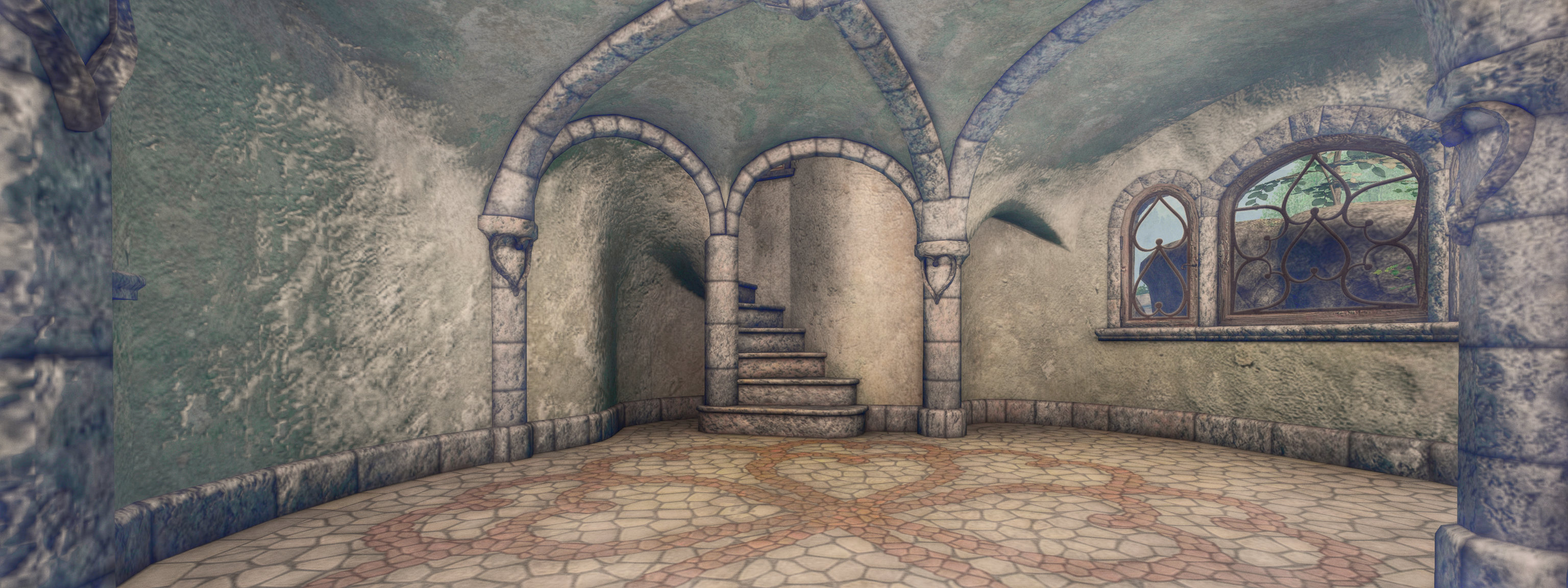
The lower floor of the cottage as it looks unfurnished

And when it comes to kitbashing / modding, Fleix has put together the perfect package with this cottage. The core of the model comprises a base that combines a grass and flower textured outer element and a central cobbled section complete with a path that passes over the “grass”. Atop this sit the circular, brick-built cottage.

What is refreshing here is that Felix has avoided baking shadows into either the building or the base; this means that while the cottage is intended to sit within circle of cobbles (so they almost form a narrow footpath around the cottage). But if required, the cottage can be moved  around on the base – something that turned out to be important for my design.

The base mesh and prim (proving the physics) as I’ve used them and some additional rock formations from the kit to provide an “extension” to the build

Surrounding the cottage is a ring of grass and moss-topped rocks on and over which Felix has placed those flowers and trees, to present a secluded setting ringed by rocks and plants that embrace the cottage, welcoming people into its two rooms – ground and upper. These are not large enough to make for a primary house, but they does make for a nice little romantic retreat or garden summer house, as I have. And with its alcoves and offset staircase, the ground floor has enough room to make it cosy hideaway, whilst the fact the semi-circular stairway is offset means it doesn’t intrude into the circular upper floor room.

What’s more, the rock formations, plants and trees are all individual, making it possible to change it up as required; plants can be removed or replaced to reduce LI, the rock formations can be moved around to create a larger space, if required. In the case of my home island, the modularity of the model allowed me to open-out the rock formations a little, reposition a couple and use a copy of the base mesh and prim to create a second secluded spot as a little outdoor annex for the cottage, the two connected by path and rocky arch.

The cottage on the upper garden among the trees and rocks

At L$695 (or L$595 for either the autumn or winter versions) and available both in-world at Felix’s store – where you can also view it through a rezzing system – and on the Marketplace, this is a superb little model, excellent as it stands or as a model ready for modding.


What’s in a name – or how I came to be Inara Pey

I was recently asked if I’d ever written a piece on how / why I chose my Second Life name – and the short answer is “no, not in one place”. But, for what little it might be worth, I thought I’d sketch out the core influences in how I became “Inara Pey”.

As some (many?) have likely already guessed, the short answer is my first name was lifted directly from the character of “Inara Serra” in the short-lived TV series Firefly, and as portrayed by Morena Baccarin in her first television series role. However, there is a little more behind the exact reasons for the choice.

I’ve made so secret of the fact that this account was not my first plunge into Second Life – I’d signed-up previously, paddled around for a while without really being sure what I was doing or why, or even really understanding much about the platform. I’d also put zero effort into my avatar name, simply picking pretty much the first name that popped into my head whilst looking at the sign-up pages, and then paring it with the first name that was shown to be “available” from the provided list on the page. As such, I never really grew into the name.

So when I decided to give things another go several months after I’d initially stopped logging in, I genuinely gave thought beforehand to the kind of first name I am could feel at home / identify with, and which might help serve my desire to spend some of my in-world time poking at areas of the platform I’d since learned about, rather than simply bumbling around like a square peg in a round hole. In this latter regard, I’ve also made no secret of the fact I have been involved in adult D/s, including having several essays and assorted pieces published on the subject of D/s relationships and the psychology of D/s personalities, and so wanted to see how this world translated into SL.

The character of Inara Serra from Firefly, as portrayed by Morena Baccarin, served as a sort-of “inspiration” for my avatar name

These factors combined with my love of all things science fiction – including thoroughly enjoying Firefly – caused me to somewhat gravitate towards the name of Inara Serra. I already appreciated the character’s nature – strong, independent and insightful, and with a clear lean into Buddhism – and her backstory. As sometime who also likes to read / learn about mythologies, the name also had appeal due to its (primary) link to HittiteHurrian mythology (as the goddess / protector the wild animals of the steppe, a deity somewhat corresponding with the Greek Goddess Artemis) and because in some circles the name is said to have equated to “Exquisite Hero” in Ancient Egyptian.

Thus, not only did the name fit with my thoughts of what I might like to poke at in SL, it lay well within the sphere of several on my own interests, and the nature of “Inara Serra” was one I genuinely liked and could potentially identify with without wanting to simply appropriate it for the needs of any form of role-play, sci-fi or otherwise.

The explanation for “Pey” is much simpler. As noted at the top of this piece (and most users are probably aware), back in those days, anyone joining SL could select an account / avatar name through the use of the free selection of a first name and the one-time selection a last name from a defined list that LL would periodically update. “Pey” was a name that was available and which I liked. And so, Inara Pey was born.

If the above does sound long-winded, I would say the fact that I’ve remained engaged with Second Life for the last 16 is – in all honesty – thanks in no small part down to the fact I found the name some comfortable, and have thus been able to inhabit her to the point I cannot conceive of being without her presence in my life.

Postscript: I should have added this prior to publishing, and as part of the conclusion. I actually have an alt. It also has the first name “Inara”, and came about in 2008, after a severe issue with my account meant I was unable to stay logged-in for more than a handful of minutes at a time for a number of days – until LL support could clear the problem. Since then, that alt has never really advanced beyond a basic avatar, and while I use it for testing viewers, going to in-world meetings, etc., as friends will confirm, I cannot identify with it to the point of referring it as “Ms. Breen” (note the sci fi connection again, this time with the last name…), as it feels like “someone else”. As such, other folk can always identify me when I’m using it, as the avatar’s tag carries the cunning disguise “Inara Pey incognito”!

Second Life 2021/22: the Lab’s review & preview (with my own notes!)

Stock image

On Thursday, December 23rd, Linden Lab published their review of 2021, which also included a quick look ahead to 2022. As it is also my custom to offer a personal look back over a year as it drawing to a close, I thought that this year I’d focus a little on the Lab’s review and offer thoughts of my own as well.

Linden Lab: Departures and Arrivals

As the official blog post notes, 2021 has been a year of transition for the Lab in terms of management and senior positions.

New Owners: 2021 saw Linden Research Incorporated (aka Linden Lab) and its subsidiary, Tilia Inc (Tilia Pay) under new ownership in the form of Brad Oberwager, J. Randall (Randy) Waterfield and Raj Date. Of the three, Mr. Oberwager (Oberwolf Linden) has been perhaps the most visibly hands-on of the three, taking up the Executive Chair on the Lab’s management team. He also brought in his long-time colleague, Cammy Bergren to take up a new (to the company) position of Chief of Staff. I offered something of a summary of the three new owners largely using their official bios from LL) in January 2021, which included some speculation on my part that Raj Date might be focused somewhat on Tilia (and he did take up a board position with that company – as did Brad Oberwager).

Ebbe Altberg: 1964-2021

Ebbe Altberg: Mr. Oberwager’s more direct involvement with running the company may have been due in part to Ebbe Altberg’s health situation as much as Mr. Oberwager’s approach to the businesses he takes on. As CEO, Ebbe’s presence at the Lab had always been large in the public eye, and late 2020 / early 2021, was conspicuously marked by his apparent absence. Of course, as we now all know, illness was taking its toll, and Ebbe sadly passed away in June 2021, and as the Lab’s end-of-year post notes, his absence is still keenly felt.

Ebbe’s passing did give rise to speculation as to who the next CEO might be / when a new CEO would be announced. However, given Brad Oberwager and Cammy Bergren’s presence within the management team, I’ve never been convinced the Lab actually needed to look elsewhere for a CEO (or promote from within); both are accomplished CEOs of small businesses in their own right. Also, given the fact that overall ownership of the company was still relatively new, it’s reasonable to assume bringing in a new face / ideas / point of view to run things could have complicated matters unduly.

That said, part of me had been wondering as the year wore on as to whether r not we would see Cammy Bergren slip into the CEO’s role – and, allowing for her commitments elsewhere, I still wonder if that might not yet be the case.

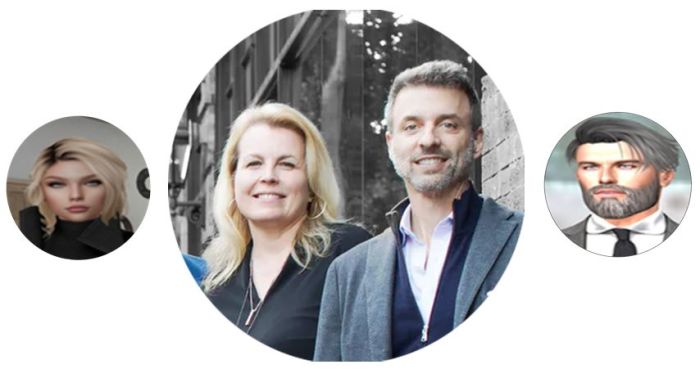
Linden Lab’s Chief of Staff, Cammy Bergren (centre left) and Board member / Executive Chairman, Brad Oberwager (centre right) are Participating in Team 2 for Bid A linden Bald through their respective avatars, Cammy Linden and Oberwolf Linden, seen flanking them

Oz and Mojo: February 2021 saw the departure of Oz Linden from the Lab, as retirement beckoned him. As the official blog post notes, Oz had been instrumental in driving key decisions and implementations of Second Life’s development for over a decade, culminating with overseeing the physical transition of the platform to run within an environment operated by Amazon Web Services (AWS). Oz’s influence on the technical development of SL – particularly as Sansar came into being in 2014-2019 cannot be under-estimated, as I noted in my own farewell to him.

Replacing him as Vice President of Engineering, and arriving in July 2021, is Andrew Kertesz, aka Mojo Linden, whom I offered something of a “hello!” to in August. After getting his feet reasonably under the desk, Mojo started to attend in-world user group meetings, demonstrating he is quickly getting up to speed with the many challenges – technical and non-technical – facing the platform in its continued development and growth, and has some ideas of his own – some of which I’ve noted in these pages.

The changing face of the Lab’s VP of engineering: (l) -Scott Lawrence (Oz Linden), who retired in February 2021, and Andrew Kertesz (Mojo Linden), who joined in July 2021

One notable name missing from the list of those departing Labbies in the official blog post is that of April Linden, who departed the Lab at the start of November. Originally a member of the Engineering Team, the group of engineers responsible for keeping the servers that run all of SL’s various services purring (or grinding) along, April rose to lead the team, reporting to Oz and becoming the public face of explaining What Went Wrong and Why with highly informative blog-posts – including the bumpy bits of 2021!

Technical Front

While there were no significant new features released in 2021, the development and engineering teams have been busy. With the initial transition to AWS completed at the end of 2020, the past year has been focused on bedding-in / optimising SL within its new environment and trying to leverage the improved capabilities of the AWS environment to improve performance, server management, etc. So a lot has been going on under-the-hood, and it will continue into / through 2022, starting with a server operating system upgrade.

The performance work has also involved the viewer as well, although it has yet to reach de-facto release status. This work includes improvements to threading within the viewer’s code and a re-working of avatar rendering. Other performance improvements in development include some by TPV developers that the Lab is interested in potentially adopting / adapting that could further help with overall viewer performance, and I’ll be taking these through my User Group meeting summaries in 2022.

2021 saw the arrival of some long-term projects, including the initial deployment of multi-factor authentication – a welcome move, despite some of the criticism levelled at it. Where the viewer is concerned, the most notable long-term project to finally surface is the  360º capture capability, and look forward to it becoming more widely available in TPVs. Those who may not have read them can catch my overviews of the project viewer version and the release version of this viewer (both are the same in terms of use), and WordPress users might be interested in my piece on embedding 360 images into WordPress.

Picking at the Rest

The Lab’s blog post also touches on the likes of Linden Homes deployments, which this year saw the release of the Chalet and Fantasy themes, and the promise of the Newbrooke theme to come in 2022 – quite possibly in a revised form, given the reactions to the preview region seen (briefly) at the RFL of SL Xmas Expo. While I was initially unimpressed by the Fantasy theme, I have to admit to finding the community centre for the the theme perhaps the most visually engaging of such centres yet offered.

Linden Fantasy Homes – Community Centre

In terms of Linden Homes, one thing I would like to see from the Lab during 2022 is the “finishing off” of coastal areas around the north / north-west side of the Log Homes regions.

Looking Ahead

In looking ahead to 2022, LL point to a number of projects, including the implementation of Premium Plus, the “upper tier” of Second Life subscriptions that was put on hold for a number of reasons in 2020. The post also mentions further performance improvements, better avatar optimisation and continued work on the New User Experience – some of the work on the latter being surfaced in 2021, such as the viewer Guidebook and the new Welcome Islands that are part of the ongoing A/B testing. Plus there’s the much-promised work to overhaul and improve Search

However, three things on the Lab’s bullet point list for 2022 particularly caught my eye:

  • Avatar “expressiveness” that brings camera-based gestures and movement to your avatar for a whole new level of interaction and connectedness.
  • A new mobile viewer to enhance and improve your Second Life experience.
  • Improved materials and terrain.

The Avatar “expressiveness” project is something not (so far as I can recall) previously mentioned. I’ll reserve comment on this until I know more about it; not that I’ll be able to use it unless I go get a camera for my home desktop, I guess. All I’ll say here is that this might in in response to others jumping onto “the metaverse” bandwagon, and a desire to make SL’s avatars more appealing to a wider range of possible use cases.

The reference to a new Mobile viewer (my emphasis) rather than “client” or “app” has me wondering if, given the suspension of work on the iOS app a couple of months back, LL are now looking towards a streaming option for the viewer, rather than a “companion app” (as their mobile work has thus far been called. As such, I’ll be attempting to keep an eye and ear out for more on this.

Improved materials and terrain is interesting, as the question of terrain was raised at the last CCUG meeting of 2021, but not as a project under active consideration; rather it was raised as a discussion point to get feedback on what people might like to see if LL were to work on SL terrain. So things seem to have moved on this.  Thing like materials (and things like PBR) have been indicated as potential areas of work by the Graphics team, so it will be interesting see what materialises through 2022.

SL and “the Metaverse”

Ever since the announcement about Facebook / Meta pivoting to focus on “building the metaverse”, there have concerns / predictions that Meta will at some point acquire LL. Frankly, while the Lab is right to watch “the metaverse” hype, I don’t put any stock in the likes of Meta wishing to acquire the company, simply because LL for the most part doesn’t have IP that’s worth acquiring. Nor, given the likes of Meta have established user bases in the hundreds of millions, is LL’s user base really worth anything. What, potentially, is of value comes down to two things: skillset among staff, and Tilia Pay. And in the case of staff / skillset, there’s no need to acquire the entire company to gain them – head-hunting / poaching is far more effective. Tilia is an interesting question – but it is one best left to another post. In terms of “the metaverse” as a whole, it is fair to say it is still early days – but frankly, and pushing the hype to one side, I tend to share John Carmack’s view on things:

I have pretty good reasons to believe that setting out to build the metaverse is not actually the best way to wind up with the metaverse.

– John Carmack, October 2021

Capitalism being what it is, if the likes of Meta, Epic, Nvidia et al do build their versions of “the metaverse”, I doubt they’ll offer any form of open frontier beloved of the metavangelists. Rather they’ll be another series of walled gardens, large and small; an environment in which there is no reason why something like SL cannot continue to survive and even enjoy modest growth. Of course, the day may come when a single entity – our equivalent of Innovative Online Industries – attempts to gobble up all the opposition and establish themselves as “the metaverse” – but I doubt that is anywhere near being on the horizon (and I equally doubt they’d start with acquiring the likes of LL).

My Predictions for SL and 2022

Well, actually, I don’t have any, other than the obvious: Second Life will continue to chug along; LL will role out updates and improvements that will please some, aggravate others and possibly pass right over the heads of a few. Attempts will be made to try to grow the user-base, in part through yet more “partnerships” of the Film Threat / Titmouse / Zenescope variety with, I’m tempted to say, less-than-stellar results. For the majority of us as users, the year will likely be “business as usual”, unless the utterly unexpected pops up. And I’ll continue to eclectically blog on SL, technical (as best I can!) and non-technical.

On reaching fifteen in Second Life

Yup fifteen years as Inara Pey; I’m pretty sure that in SL terms, that officially make me a OAP – where can I claim my pension? 🙂 .

Usually I try to write something on the occasion my rezday, but this year I really don’t have a lot more to say than I noted in 2020, I continue to log in (pretty much daily), I’m still blogging – and appreciative of all who read my ramblings and take the time to offer comments / feedback. I’m still enjoying kitbashing, building, landscaping, exploring et al. So really, not that much has changed in the last year :).

Sadly, unlike many others this year, I don’t have any stats from Linden Lab that I can share about my on-line times, etc., (not that I set much stock by such things as they always seem to have an air of elitism about them (or maybe that’s me just being crabby 🙂 ). That said, were I to approximate the amount of time I spend in SL, the answer would likely be “too much!”, as I don’t think there has been a day in the last 36-ish months (at least!) when I haven’t logged-in.

I’m not sure if that reveals something about me or about Second Life – or both. Admittedly, a lot of the time when I am logged-in, I’m actually parked somewhere, either blogging about it or something else, or actually off away dealing with physical world matters (like stuff that pays the bills, given I work from home), but at least my avatar can impersonate an answer machine for catching incoming IMs!

I’ve certainly not got a lot to reflect on SL-wise or personally; things have chugged along on both front pretty much “as is” throughout the year. Platform-wise, as the work on “bedding in” SL at AWS draws to some kind of initial completion, there will hopefully be a lot more to play with and ponder in 2022, but we’ll see.

On the personal side, I did make the decision early-ish in the year (with thanks to Vinyl for giving me little nudges!) to re-engage in some of the things I was involved in years ago, and this has been fun. I’m still happily settled in Second Norway (with my Linden home as a useful bolt hole from region restarts and the like!); after some 15 months since moving, I have absolutely no hesitation the estate and Vanity and her team to anyone looking for a island parcel with plenty of open water access for sailing / boating / flying, but which maintains its own sense of tranquillity by being off the more regular boating / sailing routes.

One of the things I’m still enjoying is playing with the home island – kitbashing house models, scratching building (in prims) and landscaping

Back in 2016, I pondered on whether a decade of virtual living was really enough, and that perhaps it was time to consider stepping away. Truth be told, I still have such thoughts from time-to-time; I think any of us who have been engaged in SL for an extended length of time has similar thoughts. Yet, here I am, half as much again beyond that point, still enjoying the many forms of freedom of expression SL offers all of us.

In this regard, when we discuss SL, much is made of its “secret sauce”, with people pointing at this or that. To be honest, I don’t believe there is a single “secret sauce”; rather it is – like many recipes – made up of multiple ingredients, of which one of the core items is that freedom of expression (which in some technical respects is also SL’s Achilles Heel). With all the hype and yack-yack around “the metaverse” we’ve seen this year, this freedom we enjoy in SL – be it to create, to generate an income, to role-play, to use SL as an artistic outlet, to socialise (and find romance) – is what really already separates SL from anything we might see spawned by the likes of Meta, Microsoft, Google, Nvidia, et all.

This doesn’t mean I think those “big players” won’t succeed – likely they’ll all end up with there own walled gardens of various sizes. Rather, I mean that I just don’t see any of them being remotely interested in offering such broad-based freedoms of expression we have with SL. Thus, and while such freedoms may not be something the vast majority are looking for in this age of instant gratification, I tend to feel that there enough people with a similar outlook as those of us who remain engaged in SL year-on-year such that if LL can find a balanced means to market SL and make initial engagement smoother for those who are out there who can appreciate SL’s potential, then there is no reason why this walled garden cannot continue to flourish in its own modest corner of the digital landscape for the enjoyment of users and the pockets of investors, unnoticed by those now rushing to put their own stamp of authority in “the metaverse”.

Obviously, whether or not I’m right in thinking this will be revealed in time. For now, I think I’ll just got on with getting the start of my sixteenth year in SL kick-started!