Second Life 2022/23: the Lab’s review & preview (with my own notes!)

Stock image

On Friday, December 23rd, Linden Lab published their review of 2022, which also included a quick look ahead to 2023. As this time of year when, in the past, I’ve offered a (sometimes multi-part) personal look both back and forward, I this that this year, as with 2022, I’d take a look at the Lab’s look back / look forward and add some of my own thoughts as well.

Linden Lab: People and the Media

2022 got off to something of a bang when on Thursday, January 13th, 2022 Linden Lab officially announced that High Fidelity Incorporated was now an official investor in the company.

This news was significant on a number of levels; most particularly the fact that the arrangement meant that Philip Rosedale, one of the original co-founders of Linden Research (aka Linden Lab), would be supporting the company’s development and direction as a special Strategic Advisor role whilst maintaining his role as CEO and co-founder of High Fidelity Inc.

Philip Rosedale: inwards investment to LL and a role as Strategic Advisor

At the time the new was made public, I speculated whether – given the deal involved the transfer of patents from High Fidelity, a company specialising in spatial audio in virtual spaces – this might see a re-vamp of Second Life’s voice / audio capabilities to encompass the full spatial audio offered by Hi Fi. Well, as it turned out that was a case of barking up the wrong (Linden) tree!

One of the immediate outcomes of this announcement was a renewal of interest in Second Life on the part of tech media, was assorted interviews with Philip Rosedale and also Executive Chair Brad Oberwager; in this, Philip Rosedale’s influence cannot be underestimated.

As the co-founder of Second Life, one of the longest-running immersive virtual worlds, and one of the first  to try to recapture the genie with the founding of High Fidelity of 2013, he has remained true to the ideals of establishing “the metaverse”, and very vocal in his views on privacy, user security and rights, opposition to the idea of ad-driven platforms and approaches wherein the user is the product, whilst also offering clear-sighted views on virtual currencies and the UGC market – as a look through his Twitter profile will reveal. This makes him well-placed to discuss “the metaverse” as a would with reporters and columnist – and in doing to, to place Second Life front-and-centre in their minds.

Second Life users got to hear from Philip directly after the announcement, when he was a guest with Brad Oberwager (with whom he is good friends) on Lab Gab (video and summary here), and also via a Twitter Space event he hosted (summary and audio extracts here – sadly the original event is no longer available via Twitter). More widely, he was a key voice in a four-part podcast series by the Wall Street Journal: How to Build a Metaverse,

User Benefits

2022 saw some interesting user benefits popping out across the months. The arrival of both the Premium Plus and Plus subscription plans, bracketing the original Premium, are both well-known, and both have proven popular. While there are no active plans to do so at present, it has been indicated that other subscription package options might be considered, with some within the Lab somewhat keen on an a-la carte approach: you pay for the options you select from a list. IF this were to come to be at some point in the future, it could prove interesting (just please do not expect anything like it in 2023!).

Other subscription-based “benefits” made available in 2022 were the removal of VAT surcharges on Monthly and Quarterly (where applicable) payment options, levelling the cost of subscriptions for those in VAT-paying countries (VAT was removed from annual payment some time ago); and the reduction in tier fees payable on Mainland parcels of 8192 sq m and above, up to a full region. In terms of payments, the cost of Name Changes for Premium members was reduced to US $34.99 (+VAT), whilst the capability was made available to Plus and Basic account holders at the original US $49.99 (+ VAT).

Technical Front

Unlike 2021, 2022 saw the Lab working a lot more on user-facing updates and capabilities (2021 being devoted to optimising SL server and simulator performance on AWS). Much of this is is recorded in the Lab’s review, but I’d venture to suggest the most impactful aspect of this work has been the release of the Performance Improvements, and the adoption of these updates by the majority of TPVs, bringing significant boost to viewer frame rates as a result of a lot of code and thread refactoring. This work in turn has paved the way for more improvements, supported by work by Beq Janus of the Firestorm team, in the upcoming Performance Floater / Auto-FPS RC viewer, which should be promoted to release status early in 2023.

This work also cleared the way for a significant project which did not quite make it to release status in 2022: the PBR Materials / Reflection Probes project, which will see Second Life move to utilising the glTF 2.0 specification for runtime asset delivery format, intended to bridge the gap between 3D content creation tools and modern graphics applications. This is important because the specification provides a more fluid and predictable workflow from tools like Substance Painter, Blender, et al, into Second Life than can be achieved through the current mixed-format approach to content creation and import.

The initial element of the project focuses materials use (together with the implementation of Reflection Probes) provides a recognised approach to supporting physically-based rendering (PBR) in SL, whilst the glTF specification as a whole from content creation in external tools right the way through to importing that content (including replacing the Collada .DAE model format with glTF as some point down the road.

Sample of PBR materials and detail (r), compared to SL’s “legacy” materials (l). Image courtesy of Runitai Linden’s PBR work 

This work could revolutionise how Second Life looks indoors and out going forward; in addition, it pushes the platform to a position where it is potentially, much easier for content creators familiar with other platforms to dip their toes into a possible (for them) new market in which to sell their creations.

A key thing with the glTF / PBR work is the manner in which the Lab has engaged with the community: the viewer development work has been relatively open for creators to join-in with, see and test; feedback and suggestions have been actively sought, and the work has very much had a element of users and the Lab working together to bring about a capability that is not only needed, but which will be welcomed and used.

Reflection probes are invisible objects which produce a cubemap of a defined area to generate “reflections” of that environment on suitable, local surfaces (in this case, the two spheres). Image courtesy of Runitai Linden’s PBR work

This collaborative approach has also been evident in the other major technical project for 2022: Puppetry. Originally called “avatar expressiveness”, this started as a means of capturing head and arm movement via webcam and having the avatar mimic them. However, thanks to user involvement and testing, the project has been revised and improved, allowing the support of multiple hardware devices for capture, and extending the range of capture close to full-body.

Puppetry is a project championed by Philip Rosedale, and could well leverage knowledge and experience gained by High Fidelity, several of who transferred into Linden Lab as a part of Hi-Fi’s start-of-year investment, including Leviathan Linden (who was also once Andrew Linden, one of the original LL employees) who was working on the concept as far back as 2014, as the video below demonstrates – with Andrew providing backing vocals. Within it, it’s not the quality of the avatars that is important, it is the way the guitar strumming matches the music, and the facial expression match Emily’s as she sings (although capturing facial isn’t currently part of the SL puppetry project).

Another project imitated in 2022 – or at least previewed – is all-mesh Starter Avatars. First revealed at SL19B the intent is for this avatars is to ease the pain-points new users face in trying to get their heads around selecting, and customising existing avatar bodies and heads. Given the Lab hopes this project will both encourage a new ecosystem on clothing and accessories created by the community for use with the new avatars but also see these avatars as being a stepping-stone to help new users get settled and then move on to more commercial offerings, it is going to have to step a fine line.

Also, taking their all-in-one nature as seen at SL19B, I’m admittedly curious how these new avatars will make converting from them to use “commercial” mesh bodies / heads any less confusing than it is at present for people shifting from system / starter avatars to commercial offerings.
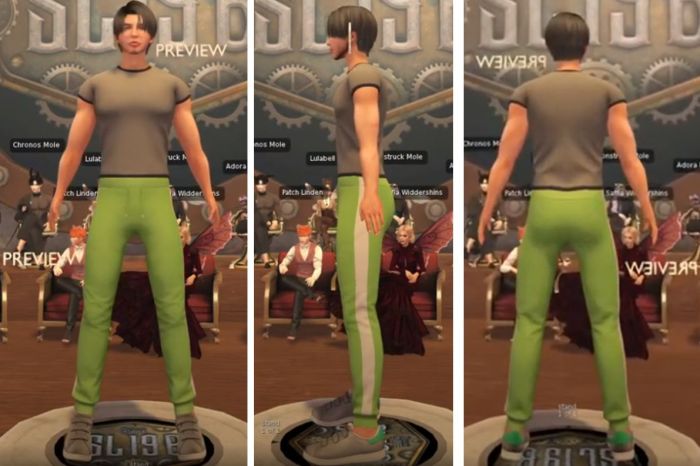
A preview version of the new, single mesh (head-to-toe) avatar, revealed at SL19B and a part of the new user experience work underway at Linden Lab

Looking Ahead

In looking ahead to 2023, LL pointed to a number of project / initiatives, some of which were anticipated (new user experience et al); further performance improvements (including those noted above) and further scripting improvements.

A couple of surprises with the list, however, were mention of:

  • New centralised “hubs” to better connect residents to the communities that match their passions and interests.
  • First peek at a world and avatar centred mobile-first Second Life experience.

The second of these is intriguing, given the start-stop-push-to-the-side nature of the iOS “SL Mobile” app project. Whether this hint means LL a have been back working on this and expanding its capabilities on the QT, or whether it might mean they’ve opted to buy-in a solution or turn to a streaming solution (which in turn potentially offers the highest fidelity with the viewer in terms of rendering), isn’t clear. All three have been hinted at as possible directions at various points in 2022, and – assuming an equitable price plan could be developed – it’s not as if LL doesn’t have exposure to viewer streaming options, thanks to the Pelican project of around 12 years ago, or (more particularly) the short-lived SL Go solution provided by OnLive.

The centralised hubs is an interesting in terms of its implementation; LL is already revamping the entire “land journey” for users – how to obtain mainland, lease a region from LL directly through to how to find and rent late from private estates – so there is a question here as to whether this new hubs will be hooked into this work, providing a means for users to more easily obtain land and become a part of a community. Or, might it be a means to offer added value to Community Gateways – or even a revamp of Place Pages (which never really took off) to make them more responsive to communities and groups – thus offering both the means to access these new hubs from without SL as well as from within.

Not mentioned in the official blog post are the plans for the Marketplace. With MP Search updated, the road is apparently clear for the 2023 deployment of Marketplace Styles: allowing multiple versions of an object (e.g. different colours of the same jacket or dress) to appear in a single listing. There is also the mention that 2023 might also see the start of work to build a completely new Marketplace and (eventually) migrate users to it. Just don’t expect the work to be completed in 2023 (if it does get started).

Continue reading “Second Life 2022/23: the Lab’s review & preview (with my own notes!)”

Happy Holidays to All!

Wishing you all a very Peaceful and Happy Holiday Season, with my sincere thanks for reading / following my random thoughts through another year!

Sixteen years in Second Life

Om my Water Horse Anipet

So I’m sweet sixteen! Or at least my avatar is – would that it applied to me once more…

When I reached 15 continuous years in SL I really had little to say (although I managed to say it in around 900 words!), as not that much had changed with me personally over the course of 2021 – and SL itself had remained fairly well balanced.

2022 has been slightly different – there have been new features and capabilities deployed to Second Life, with LL working to try to increase the platform’s appeal and engaging with users in the development of new features. True, some of the planned work hasn’t quite come to fruition and so won’t be popping up until 2023 – but one project in particular should over time very much change how SL looks for the better. 

On the “personal” SL front, things have changed a little. While blogging takes up a lot of my time – thank you to everyone who follows and supports and helps me along that journey – the second half of the year has allowed me to spend a lot more time enjoying the company of those closest to me (notably Imp, who has given me endless reasons to smile and laugh – there’s a reason I’ve given her that nickname!). That said, things in the physical world have been turned upside down on a number of occasions through the year, resulting in blogging efforts taking a back seat here and there. 

But that said, I’m still nicely settled within Second Norway (and still recommend it to anyone looking for land they’ve like to rent and establish a home within), although I’ve not actually done as much sailing, boating or flying as I’d like. Regulars may have noticed (and been breathing a sigh of relief at the fact) that I’ve not been boring people with write-ups of the latest changes in house and / or island design. Not that I’ve stopped; I’ve simply reverted to building things from scratch, rather than using any rebuilds as an opportunity to review a particular commercially available house designs – although admittedly, the current house was heavily inspired by Cory Edo’s Jura Waterfront Cottage, a genuinely stunning design which (unfortunately) didn’t quite marry up to my kitbashing needs, so I opted to build from scratch whilst keeping the look of that design in mind.  

One thing I had considered doing this year was to take time out to look at some of the other worlds I’ve visited in the past. However, the truth of the matter is, there is nothing out there (outside of OpenSim) which offers the broad creative richness and freedoms as Second Life; not just in terms of content creation, but in how we expression our personalities, how we interact, how we have fun, what we can do to encourage and support others (in-world and out-world), and so on. Thus, I just haven’t felt the incentive to do so. As I said on occasion of my 15th rezday, I really don’t see anything like Second Life emerging from the haze of verbiage people call “the metaverse” any time soon. 

In this regard, I am far more excited – even as a comparative lay person – by the new features and capabilities Linden Lab is working on to further enhance SL. I’ve particularly appreciated the performance boosts we’ve seen in the viewer thanks to the Performance improvements work, and have appreciated the efforts to bring users directly into the fold in developing things like support for glTF 2.0-compliant PBR materials / reflections probes (which lays the foundations for even greater glTF compliance in the future, making content creation for Second Life a lot more predictable when using external tools and workflows), and the Puppetry Project work, both for the capabilities it can bring to a range of SL activities and for the foundations it lays for potential future enhancements to the platform.  

Other than that, I really don’t have too much to say on the occasion of my rezday – other than maybe one day I’ll get a card / cake from Linden Lab like others do on their rezday *sigh* – but for now  I’ll shut up and return this blog to its usual schedule! 🙂 .

Blog navigation update, August 2022

Blog updates: the new Tutorials menu

During a recent conversation on matters SL and this blog, the subject of tutorials came up. While the details aren’t important, it was commented that the person I was talking to hadn’t realised I’ve written a number of tutorials, one of which turned out to be precisely what they had been looking for.

This is actually my fault; while I have written a fair number of tutorials and mini-guides to various aspects of Second Life, in a past update to the blog navigation menu, I opted to place the tutorials list under the “SL” heading – and frankly, haven’t done a good job of maintain it. Hence it has been easy to miss.

To rectify this, I’ve made a couple of changes to the menu system, that will hopefully make things easier to find, and also help keep the menus from extending beyond them limits of most people’s browsers (sadly, WordPress menus do not use intelligent wrapping).

In short the changes are:

Tutorials Section

  • Presents a menu of Second Life tutorial categories (shown in the banner image for this article).
  • Clicking the menu title or the top-level item in the drop-down – Tutorials Index – will both display a list of all tutorials written for this blog and a list of the official Second Life University video.
  • Clicking on the title of any menu item with a right-pointing caret (“>”) will open the Tutorial Index at a list of tutorials related to the menu item title.
  • Hovering over any menu item with a right-pointing caret (“>”) and dragging the mouse to the right will open a drop-down menu of the tutorials related to that item.
    • Clicking on an individual tutorial title will then open it in your browser.

Blog Bits & Contact

This heading now encompasses the Contact Me form which previously appeared in the menu bar, as the first item in the drop-down displayed when hovering over the option.


I will be adding to the Tutorials index as I work back through the blog an pick up any stragglers I’ve missed – and obviously with any further tutorials / guides as they are written. As always, I hope these changes will help make this blog more of a useable resource.

The InVerse Nizza house in Second Life

My modified InVerse Nizza: re-textured throughout (bar the water of the pool!) at Isla Myvatn

As is my wont, I started getting the itch to fiddle around with another house design at Isla Myvatn. As regulars to these pages know, I tend to shunt my way between house designs roughly every 5-6 months, if for no other reason than the fact I enjoy kitbashing (as well as scratch building).

My recent choices have revolved around matching the house with the “split-level” design on my island home, with its low-lowing front lawns, gardens and boat moorings, and raised back garden and hills, the house sitting between the two with a two-storey front aspect and the upper floor opening on to the garden to the rear.

As a result, my two previous house choices came from Novocaine Islay’s InVerse brand, as they pretty much suited the lay of the land in terms of vertical dimensions and the minimal changes required to the land to get them both to “fit”. And after looking around, I happened to settle upon another InVerse house for this rebuild: the Nizza.

My Nizza house with, (inset) the original – note that I didn’t bother using the gazebo supplied with the house and seen in the foreground of the inset image. Also note the changes to the upper floor left-side room, and general re-texturing.

Featuring a roughly rectangular footprint of some 41.3 m by 13.85 m, including the large overhanging upper floor balconies, the house has a total of 6 rooms: a large living area accessed directly from the front doors, with linked dining area and kitchen opening off to one side with an angled frontage. Above the latter is a bedroom and adjoining bathroom; the bedroom and dining being linked by a spiral staircase. Above the lounge, and separated by a small upper floor hallway, is a smaller room with balcony access. The hall itself provides access to a roof deck and swimming pool via a second spiral stairway.

At L$449, the house represents very good value, including as it does  3 variants: an unfurnished version (with additional plants and lighting) at 118 LI; and two fully furnished versions at 253 LI, one of which has baked shadow textures and the other doesn’t, with all three coming with a gazebo and various plants and basic indoor / outdoor lighting. InVerse furnishing are passable if not outstanding, so for those looking for a “first house” with all the basic trimmings and who have at least 2048 sq m or land, the house represents pretty good value.

The Nizza living room as modified by myself with the fireplace divider and an added window to the side aspect, with the original (inset) showing the supplied finish and furniture and the window to the rear aspect, which I removed as it would effective be “underground” and below the level of my island’s back garden.

That said, InVerse build quality can be a mixed bag; texture choices can be a little off-putting, and this design in particular has some overly-glossy specular maps applied that result is some weird finishes to surfaces under various ambient lighting (e.g. stonework looking like it’s been coated in plastic). This wasn’t an issue for me, as I have a tendency to re-texture things, but if you have a fussy eye, then little niggles like these make taking a look at InVerse homes at their in-world store essential when considering them as a purchase if you are fussy-eyed like me.

A more obvious shortfall with this house for some (myself included) is that it has been designed with an “average” avatar height in mind. My avatar is far from oversized, but I did find that the arches linking several of the rooms were too low, as were the supplied lighting fittings. As such, I found it necessary to re-work the archways to eliminate the visual aspect of the top of my avatar’s head passing through the woodwork when passing “under” them, and to also replace the interior lighting with simple projected lighting.

The rear of the Nizza at Isla Myvatn: note the door to the garden I’ve added (just to the right of the garden statue), and further along the rear of the house, a spiral stairway linking the garden with the rooftop pool and deck.

Fitting the house into the existing Isla Myvatn landscape required a few adjustments to the garden space, but the changes to the house were relatively easy: the replacement of the rear windows and walls with blank walls on the lower floor, the addition of a rear door on the upper floor to access the garden (and which could be handily placed alongside the stairs to the rooftop area).

The interior spaces of the house are such that they offer a lot of internal space that can be used in a variety of ways – the furnished versions, for example, utilise the individual upper floor room as a house office, for example. For my part, I altered the position of the archway between the living room and dining area to create a little more space between it and the front doors to the house, and also added a fireplace room divider to the lounge to break things up a little  and offer a little space for my (inevitable) baby grand and guitar.

A closer view of the rear of the house, showing the added back door serving the raised back garden and the spiral stairs to the pool, compared to the original (inset), showing the “wooden” mid-point I removed to add the new door serving the garden

Overall, the Nizza is a fair design. Perhaps not as polished as either the Tarzana (reviewed here) or Orlando (reviewed here), my two previous InVerse houses in that it does require a little more work by the fussy-eyed (like me!) to adjust the texturing and some of the (minor) issues with the design, but nonetheless a good starter house / unit suitable for kitbashing. Plus, it again seems pretty mealy-mouthed to complain about the house given the price! Even so, and to repeat myself – do be sure to see the house in-world before committing to buy it.

Related Links

Second Life’s Spotlight on … me!

The full banner image from Spotlight, taken in the garden of Isla Myvatn, my island home in SL

I generally try to avoid trumpeting myself in these pages, so I hope folk will forgive me for doing a little tooting of my horn here.

Back at the start of 2022 – January 4th, in fact –  Strawberry Linden extended an e-mail invitation to me to participate in Spotlight, the Lab’s weekly official blog post series that highlights the work and lives of Second Life residents, and which originally kicked-off with Bryn Oh back in November 2021.

I’m not sure what happened – crossed wires, lost e-mail or something else – but the invitation went AWOL somewhere along the way. So I was both pleased and flattered to have the opportunity to participate again, Berry kindly forwarding her original questions to me once more, and inviting me for a photoshoot for the main profile image in the piece.

The finished article appeared on April 13th, 2022, and if you’re so minded, you can read it here. I’d just like to thank Strawberry for the original invite, producing the profile photo, and putting the piece together.