Versu is reborn!

versuOn Friday June 6th, Emily Short announced through her blog that Versu, the interactive fiction engine she and Richard Evans developed while working at Linden Lab, and which was cancelled as a part of the Lab’s product review in February 2014, will now continue, and that Blood & Laurels, the interactive novel she has been working on for 15 years, will be launched on June 12th.

Following the announcement of Versu’s cancellation by the Lab, many of us speculated whether it  might be allowed to live on separately to the Lab’s involvement, and Emily herself confirmed she was talking to the Lab on matter of IP. However, hopes this might happen seemed to have been completely dashed in March, when the Lab said no to any idea of selling the IP involved. However, they’ve since had a change of heart.

The notification that this is the case came in the form of a blog post which first appeared on the  new Versu wesbite, and then reblogged on Emily’s site, which is where I came across it.

The announcement reads in part:

Nu-versu-1
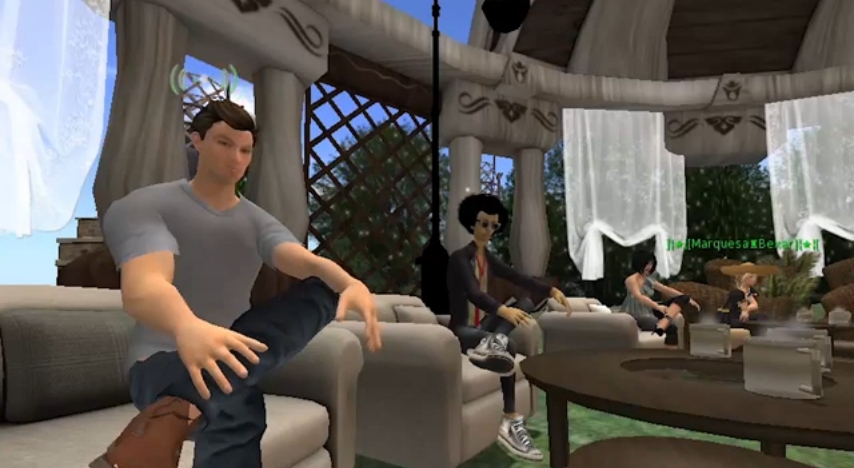
Versu was lauched to considerable acclaim prior to being cancelled by Linden Lab. Now it is set to continue (image from the Versu website)

Until February of this year, the Versu project had its home at Linden Lab, exploring the possibilities of interactive storytelling with advanced character AI by Richard Evans (Sims 3, Black and White) and dialogue modeling by Emily Short (Galatea, Alabaster), as well as work by authors Jake Forbes (Return to Labyrinth) and Deirdra Kiai (Dominique Pamplemousse).

When the Lab decided to refocus its offerings and cut support for Versu, the project was only three days from launching a Roman political thriller called Blood & Laurels. Blood & Laurels represented a significant step forward in complexity and depth from previous Versu stories: a large cast of characters, a richly branched two-part storyline, and over 240,000 words of interactive content — of which a player is likely to see only about 7% in a given play through. Character behaviour and relationships were modeled with at least as much fidelity as in earlier examples, but in a context with much higher narrative stakes. What other characters think of you affect whether your character lives or dies, thrives or fails — and those relationships are driven by both large and small decisions.

After Versu’s cancellation, it looked for a long time as though neither the underlying technology nor the finished stories had a future. However, we are delighted to be able to announce that Linden Lab has negotiated a new arrangement that will allow us to release these stories and explore a future for the engine.

The Versu blog post reveals that Blood & Laurels has been made possible by a language called Prompter, which is used by Versu and has been designed by Graham Nelson of Inform fame. Graham is also now a part of the new Versu team, joining Emily and Richard Evans.

Emily Short and Richard Evans are joined by Graham Nelson, the man behind the Inform IF language, and the creator of the Promptor language used by Versu
Emily Short and Richard Evans are joined by Graham Nelson, the man behind the Inform IF system, and the creator of the Prompter language used by Versu

Blood & Laurels is set to be followed by Bramble House, an interactive fantasy story written by  Jake T. Forbes, the author of Return to Labyrinth, a four volume graphic novel sequel to the Jim Henson film Labyrinth, and the English-language versions of the best-selling manga series Fullmetal Alchemist, Fruits Basket, One Piece and others.

Bramble House focuses on the character of 15-year-old Penny, who is “bound in service to the witch Stregma, forced to deal with everything from mundane dishwashing to evicting monstrous guests”. In it, the reader takes on the role of Penny, progressing through various situations and events in two stories set within the Bramble House world.

There is no publication date available as yet for the title.

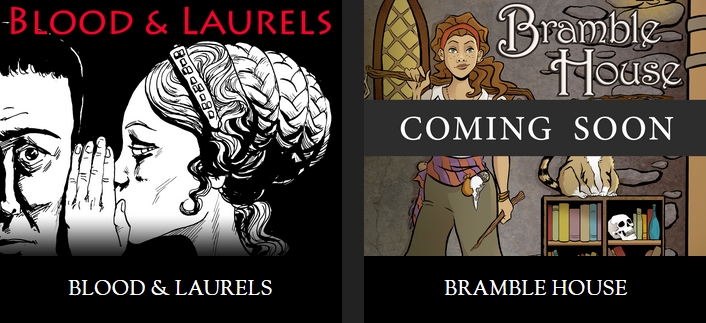
Blood and Laurels (due June 12th) and Bramble House will be the first two titles released under the new Versu banner
Blood and Laurels (due June 12th) and Bramble House will be the first two titles released under the new Versu banner (from the Versu website)

The new titles will be appearing on the iOS platform. At the time of writing, it is not clear as to whether there are still plans to make Versu and its titles available for the Android platform; the website only goes so far as to state, “While we would like to support Android, we do not currently have an Android version available.”

This is excellent news for all with an interest in or passion for interactive fiction. Congratulations are extended to Emily, Richard and Graham with the launch to this new venture, and kudos, as well, goes to Linden Lab for reversing their decision on the Versu IP and allowing the project to continue.

Be sure to listen-in to an upcoming edition of the Drax Files Radio Hour interviews, when Drax will be talking to Emily Short about interactive fiction, Versu and more!

Related Links

Patterns: all change for a new experience

LL logoUpdate, October 9th, 2014: Linden Lab announced that development work on Patterns has been discontinued.

Patterns, Linden Lab’s slowly maturing sandbox game for the PC and Mac saw a new release on Friday May 9th. The update brings with a host of new features, including the promised new user interface, which I previewed in April.

Version 0.7 requires acceptance of the Lab’s Terms of Service, which tends to be the case with each major update of the game. Once this has been done, the changes to the game are evident right from the start, with the new right-hand sidebar now managing both logging-in to the game / creating an account and launching the game options, which now comprise five options:

  • Create: allows you to create new worlds using the basic worlds provided with Patterns, or using your own existing worlds, either saved locally or previously published to the Patterns Cosmos
  • Explore: allows you to explore the worlds in the Cosmos and access them. Worlds are defined in terms of featured, recently uploaded, and popular with users
  • Find Multi-player allows you to quickly find any multi-player games which are in progress
  • Tools: allows you to launch tools associated with Patterns. This is currently the Materials Editor, which I first looked at back at the start of January 2014 and then again in a little more detail and the end of that month
  • Settings: access the game’s settings: controls, keys, graphics and audio.

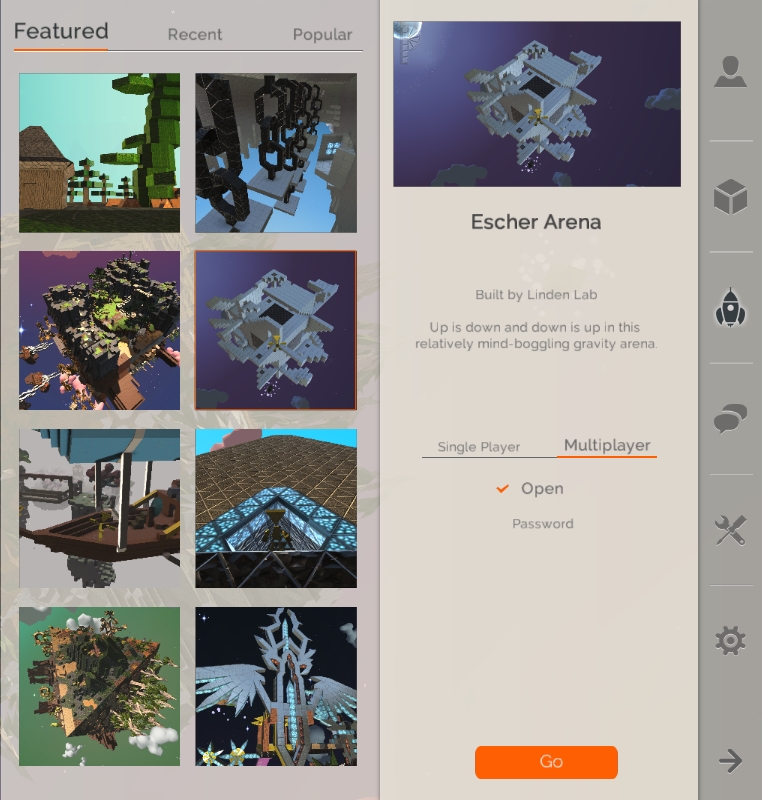
The Create, Explore and Multi-player options preview available worlds in tabs, each world having its own thumbnail (if available) which, when clicked, displays more information on that world. This makes previewing worlds and selecting interesting ones for game play a lot more informative than earlier Patterns versions.

It's a lot easier to preview Patterns worlds - your own or those in the Cosmos - with the new release of Patterns
It’s a lot easier to preview Patterns worlds – your own or those in the Cosmos – with the new release of Patterns

You can also opt to open any world in both the Create and Explore modes as either single player or multi-player. When starting a world in multi-player mode, you can either leave it set to “open”, allowing it to be displayed in the Multi-player tab such that anyone can select it and join the game (up to the maximum number of four players), or you can set a password against it, which other players have to use in order to access the game (handy for when you want to keep a game among friends).

The streamlined UI makes selecting shapes, materials and models a lot easier, and also offers a cleaner overall UI. At the bottom of the Patterns window is a tool bar area which has a toggle option on the left which switches it between elements and materials, and each of which have ten placeholders apiece, which can be used to store your preferred elements and materials ready for immediate use. an Inventory icon on the right of the toolbar will open your full inventory of shapes, materials and models, allowing you to quickly drag and drop them into the placeholders, replacing anything previously stored in any given placeholder, making selecting and swapping shapes to suit your needs fast and easy.  ESC closes the inventory window and returns you to the game play.

When used in-game, ESC will pause the game and call-up additional options, but in a slightly different format to previous releases, with everything other than the option to save the world to your hard drive now also located in the right-hand sidebar. These options include the familiar game settings, the respawn world option, help, and a new scene settings option.

The scene settings option provides access to a number of tabs which allow you to adjust a number of options associated with a world – how gravity works, what appears in the sky, fog effects, lighting (direct, reflections, etc.), SSAO blurring, and so on.You can also use this option to add your own materials packs to a world as well. A video from SandovalCurse (aka happyhappygaming on YouTube) of the Curse team provides and overview of the scene setting options.

Continue reading “Patterns: all change for a new experience”

Patterns: of UIs and passwords

LL logoUpdate, October 9th, 2014: Linden Lab announced that development work on Patterns has been discontinued.

In March I reported on plans to overhaul the Patterns user interface at some point in the future. These plans took a step closer to being revealed on April 5th, when Sandoval Curse (aka HappyHappyGaming on YouTube), keeper of the Patterns community on Curse, issued an initial sneak peek at the current updates to the UI. The changes are both extensive and appear to be exceptionally well thought through.

While the video comes with a warning that it shows elements of the UI from a Patterns nightly build, and are thus subject to possible change, what is presented suggests that the team are looking to make using Patterns a look easier and the ability to move between elements of the UI and modes of operation a lot more fluid, while at the same time offering a less cluttered build / play space.

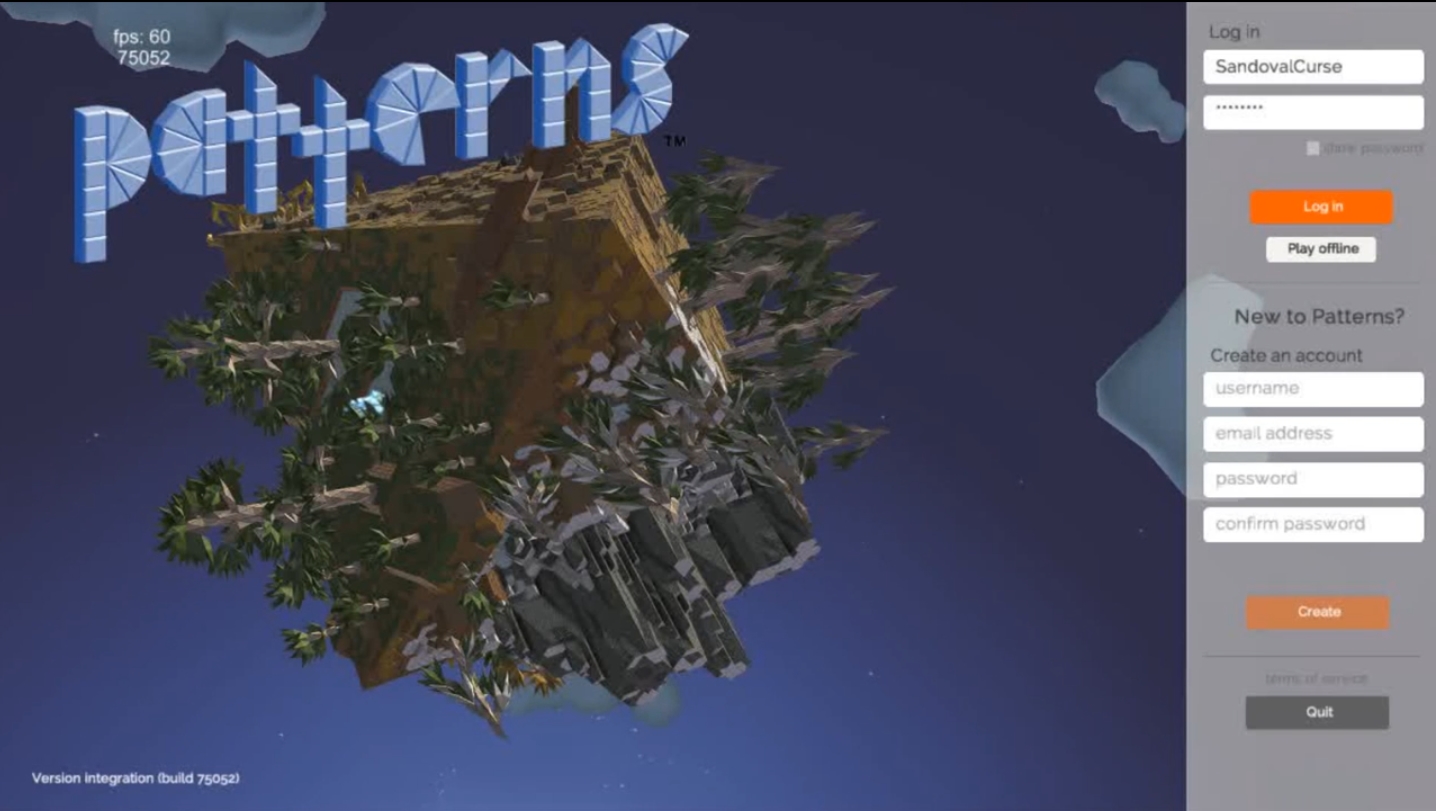
The changes to the UI are evident right from start-up, with the log-in panel moved over to become  sidebar on the right, which also doubles as a game mode launcher once a player is logged-in.

The new log-in panel looks set to become a sidebar for both logging-in to Patterns and for launching game modes
The new log-in panel looks set to become a sidebar for both logging-in to Patterns and for launching game modes (click for full size without so much screen cap blurring)

Once logged-in, the panel allows the player to select from world building, continuing game play, accessing the Patterns tools (I assume these are the shape forge and the substance editor) and change their settings.

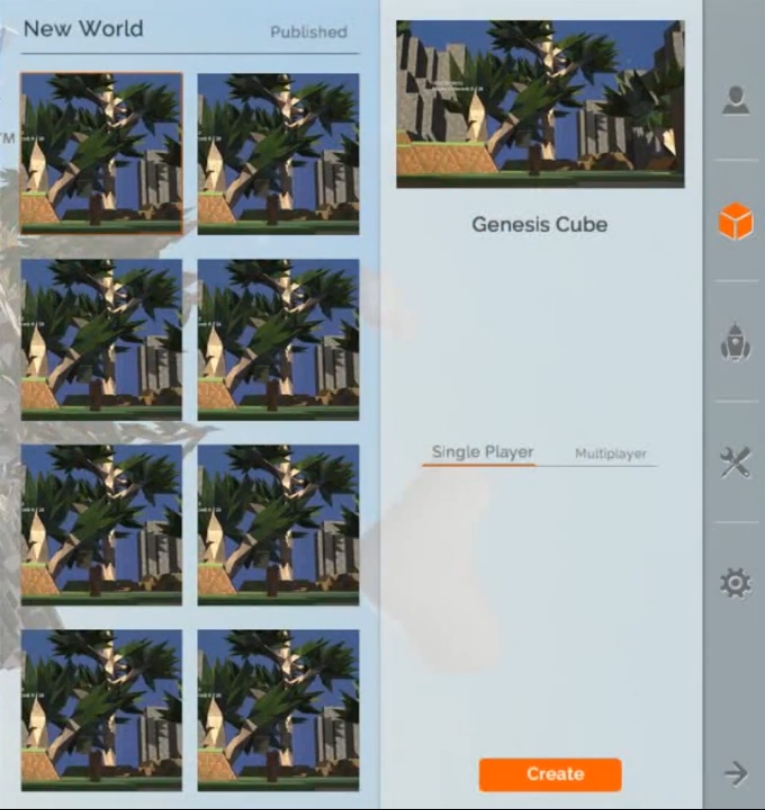
Selecting any of these options many display a further slide-out panel. For example, clicking on the world building option displays a list of available worlds in the Cosmos the player can use as a template, together with options to select either single (default) or multi-player modes.

Selecting existing worlds as templates when building worlds is a lot slicker
Selecting existing worlds as templates when building worlds is a lot slicker (click for full size without so much screen cap blurring)

Inventory and shape / substance management has been completely overhauled, with a new inventory bar at the bottom of the screen which allows for much easier toggle between shapes, materials and models, as well as offering a cleaner drag-and-drop panel when applying materials to shapes, etc.

The new inventory bar allows easier toggling between shapes and elements / substances. Where appropriate, it appears to open a panel for easier drag-and-drop of materials and substances onto shapes
The new inventory bar allows easier toggling between shapes and elements / substances. Where appropriate, it opens a panel for easier drag-and-drop of materials and substances onto shapes (click for full size without so much screen cap blurring)

In-world game controls have been revised somewhat, making shape and model manipulation easier as well as trying to make it easier to move, rotate or delete things. I might be wrong in saying this, as it is hard to tell from the video (and any settings Sandoval uses), but it looks as if the default third-person camera angle may also have been revised.

According to the video, not only may things change between now and the UI being released, but there is a lot more still to be demonstrated, and a further sneak peek video is promised. This being the case, and in lieu of being able to fiddle with things directly, I’ll leave you with Sandoval’s video.

Password Recovery

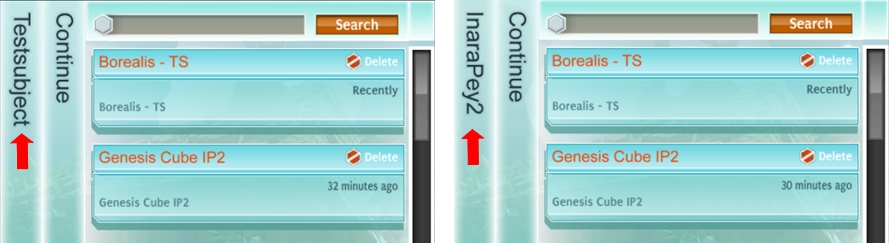
Nalates Urriah has a piece up on Patterns password recovery, drawing on a video posted to YouTube. The short version is: there isn’t a password recovery option. The support team’s advice, should you forget your password is to create a new account. However, this isn’t necessarily as bad as it sounds. Passwords are only required to access the Cosmos. You can still play offline without logging-in. What’s more, even if you do create a new account and password, you should still have access to all the worlds you have built yourself, whether playing offline or when logged-in to the Cosmos.

If you forget your Patterns password (or user name), you should be able to create a new account and still access your existing world builds (tested usin Patterns build 0.06a via Desura and Steam)
If you forget your Patterns password (or user name), you should be able to create a new account and still access your existing world builds (tested using Patterns build 0.06a via Desura and Steam)

The only pain I can see with this – and admittedly, I’m no longer a regular Patterns player – is that if a player is well-known as a Patterns world builder, any worlds you upload to the Cosmos after an account change will obviously be linked to the new account name, and so may not be instantly recognisable to other players. Also, those who regularly play in the multi-player mode will have to advise other players of any change in order to ensure they receive invitations into games.

Related Links

VWBPE 2014: Ebbe Altberg keynote – “The Door is Open” (full transcript)

On Friday April 11th, Ebbe Altberg, Linden Lab’s CEO, addressed a packed amphitheatre at the 2014 Virtual Worlds Best Practice in Education (VWBPE) conference in Second Life. Some 200 people were in attendance in SL, with around 100-150 on the live stream channel for what was almost a 90-minute session, entitled Reconnecting with the Education Market, and which comprised an opening statement from Ebbe, followed by an extended Q&A / discussion session.

The following is a transcript of the session, which includes all questions asked via the moderator, Phelan Corrimal (given in italics). The video is the VWBPE official video, recorded by Mal Burns, and my thanks to him for making it available. Timestamps within the transcript notes indicate the points in the video at which Ebbe’s comments can be heard.

The Summary

Click the timestamp to go the relevant section

  • 0:05:38: Terms of Service – “I am working with my Legal Counsel to try to try to figure out how we can make it more obvious – or very obvious – that the creators of the content own the content … we’re working on some simple tweaks to the language to make that more explicit.”
  • 0:07:26: Brand – “We have an incredible breadth of content creators for all kinds of purposes, and this is kind-of unique with Second Life, and I think it’s incredibly important to support everybody and what they want to do.”
  • 0:08:59: The Metaverse and LL – ” There might be some people who might be interested in my position on the metaverse and OpenSim and interoperability, and that whole category.”
  • 0:11:09: Integrating new capabilities – “Some of you might be interested in what kind of integration we can do to make it easier for you to use Second Life in the context that you want to use it.”
  • 0:12:04: Improving SL – “And then I think we still have a tremendous about of work still to be done – actually, a tremendous amount of work has already been done; Second Life today is so much better than it was two years ago.”
  • 0:16:16 Future technologies  – “A little talk about future tech. Many of you have hopefully seen that we are obviously actively developing for technologies that we believe will have substantial mass appeal; Oculus being one.”
  • Questions and Answers / Discussion:
    • 0:21:12 – Are the community liaisons with Linden Lab about to be re-introduced?
    • 0:23:39 – Tier Breaks for Support and Mentor Groups
    • 0:26:28 – Do you feel that communications between Linden Lab employees and content creators are important?
    • 0:31:09 – On users having a voice in the development process
    • 0:35:36 – On Marketing SL, Overcoming Perceptions and Getting People Engaged in SL
    • 0:41:24 – On Opening-up The L$ Beyond Second Life
    • 0:44:44 – Making the Viewer Easier to Use & the Relationship with TPVs
    • 0:48:19 – On a Distributable Version of Second Life
    • 0:50:08 – Is there any hope that shared media, MOAP [Media On A Prim] can be fixed for Mac users soon?
    • 0:50:42 – On Second Life and High Fidelity
    • 0:53:49 – On Network Issues affecting some APAC Countries, Latency & Geographic Distribution
    • 0:56:16 – On Exporting Content
    • 1:01:15 – On the Teen Grid, Student Security and Younger People Accessing SL
    • 1:04:12 – What are Linden Lab’s plans for mainland?
    • 1:05:42: – On Office Hours, Lindens In-world and Community Engagement
    • 1:13:54 – Is the Barrier to VW Mass Adoption Technical, Or Something More?
    • 1:17:26 – On Acquisitions in the Technology Market
    • 1:20:12 – On Encouraging Lindens to Join Groups and Communities
    • 1:22:03 – A Takeaway Message for Educators (and all of us)

0:01:59 Hello everybody. I can’t hear you, but I can sure see you! It’s an incredible sea of people here [approx. 180-200 across four regions]. I’m very excited to be here, very happy for all the work that people are doing to put this conference together. Not only this session but all the other sessions you’re doing through the week. I did pop-in just the other day and listened to Philip, which many of you here might have done as well, and I just wanted to say that I’m really excited to be here.

I’m not going to spend most of this hour just talking. I will be saying a few things up front … putting some topics on the table to discuss and then very much looking forward to it being an interactive conversation between us. I’m mostly here to learn, not necessarily to tell, although I will be speaking about some things that I think matter to you, and some of the things that are going on first.

0:03:06 First, I feel very strongly that the education sector, the education market, is a very important partner of Second Life, and that it’s important to us to make it a great product for all of you. I know many of you have tried and been successful and many of you have tried and maybe not been successful in doing the things you wish you could do, and I’m here to learn more about what we can do to make you successful in the future.

I think the education sector helps us a lot of ways, in that if we can provide a great service to you, you can become great evangelists for the platform, and also in many times I think you are pushing in research and thinking about how to use environments and technologies like this differently from your main consumers. So you’re a very important group of people for us to stay in touch with and learn from and collaborate with.

Continue reading “VWBPE 2014: Ebbe Altberg keynote – “The Door is Open” (full transcript)”

Patterns to get new “cleaner” UI

LL logoUpdate, October 9th, 2014: Linden Lab announced that development work on Patterns has been discontinued.

With recent focus being on the axing of three of LL’s initial new product offerings – and particularly Versu – it is easy to forget that the longest-running of LL’s moves to diversify is still out there, and actually has yet to officially launch in a release mode.

I’m of course talking about Patterns, LL’s PC / Mac game / content building sandbox application. This first appeared in September 2012, although there had been clues as to its name, if not what it would be about, as far back as July 2012, when Rocky Constantine spotted what appeared to have been a slight boo-boo.

I’ve not followed Patterns as closely as perhaps I could, but I have tried to provide periodic updates under my Patterns tag (menu: News-Updates-Opinion > Linden Lab > LL Products > Patterns), including recent notes on it gaining the ability for users to edit and create their substances, followed by support for materials.

The original Patterns UI

While still in its “Genesis” form, Patterns has built-up a small but strong following in the gaming community and via the likes of Desura and Steam. Many of those who have purchased Patterns have provided feedback and input to the game’s development over the last 18 months, which have seen new capabilities added, functionality improved and a number of enhancements to the UI.

The Patterns UI as seen during a Liverstream event with members of the Patterns team (lower right)
The Patterns UI as seen during a Livestream event with members of the Patterns team (lower right)

On March 18th, 2014, the Patterns team revealed that as part of the run-up to release (which had originally been indicated as being “late 2013” when the Genesis version first appeared, but has yet to have a date firmly pinned to it), the UI will shortly be getting potentially its most radical overhaul yet, aimed at “optimizing the play space by cleaning up the real estate”, and which will see the move of the tools, substances, and shapes into “one clean area at the bottom of the screen, where you’ll be able to quickly toggle between each of these different toolbars with ease by hitting the Q or E buttons on your keyboard.”

Patterns: extensive UI overhaul coming soon

There’s currently no ETA on when the new UI will appear in Patterns, but the team are promising more sneak peeks in the future as work continues. Also coming in the future, I assume under a separate cover, is the Patterns scripting capability, which should further enhance the application’s creative capabilities.

I’ll endeavour to update as further releases are made for those of you still following Patterns.

Lab says “no” to an independent future for Versu

One of the original Versu titles

Following the Lab’s move to axe Creatorverse, dio and Versu, I raised the question with Emily Short and the Lab on whether it might be possible for Versu to continue. I wasn’t alone in cogitating the idea, several others raised the same question, such as Ciaran Laval.

At the time I made my enquiries, Emily confirmed that discussions were underway while the Lab were reticent  to comment – understandably, simply because discussions were in progress.

On Saturday March 8th, and true to her promise that she would blog on the matter when she was in a position to do so, Emily issued a brief update, stating:

So for those who were curious, Linden has now given me a definite no about selling me the codebase and IP.

In reply to a comment expressing the hope that this won’t spell the end of Emily’s forays into social IF, she replied in part:

This is definitely not the end of my trying to build more socially-focused IF [interactive fiction], and we did learn a huge amount about how to make that work, not just in terms of a technical engine but in terms of authoring approaches. So there are things that can be built on even without access to the code or IP.

There is understandably a huge amount of disappointment involved here as well.  Blood and Laurels, the latest title Emily had been developing for Versu, represents the culmination of a concept she had been periodically working on for some fifteen years, and she acknowledges that she was really excited to see it finished. Even so, Emily remains pragmatic:

Still, on a total scale of possible bad things to have happen to one, it’s not very far along the bad thing spectrum. So we go on to the next.

Whether the Lab’s decision was based on them seeing a possible means of using the IP and code elsewhere is unknown. However, as Tateru Nino points-out in a further comment, that while regrettable, the decision by Linden Lab is actually a logical business decision, as whether it is used or not, the Versu IP represents a company asset. Even so, if the IP and code is destined to sit on a shelf unused, it is a shame a way could not be found to allow the project to survive. While it may not fit the Lab’s “shared creative spaces” model, the IF market does represent a viable niche market, and Versu itself represented a unique approach to presenting IF – and of even reaching beyond it into other fields of use.

While I never got to use Versu, of all the initial new product offerings from the Lab, it was the one that intrigued me the most; I’ll miss it.