Back Alley Art Gallery, September 2024: Tripp Foxtail
I recently made my first trip to the Back Alley Gallery, operated and curated by ZED (Zee Malus), racoon extraordinaire and Racoon Emperor of No Dumpire in which the gallery is located 🙂 . I was there to view a most extraordinary art exhibition by an artist I’m ashamed to say I had not previously come across in Second Life (at least not that I’m consciously aware of doing). That artist is Tripp Foxtail, and the Exhibition is the appropriately entitled The Very Human Art of Tripp Foxtail.
And when I say the art is extraordinary – I mean precisely that; it is simply and completely captivating in both content and production.
Within Second Life, Tripp is a multi-talented individual who likes to give of his time to others. He is a Second Life mentor, a builder (and inventor – you may have heard of his sobriquet, The Mysterious Mechanic), store owner, designer of public spaces such as Traveller Station, where one might set out on many travels across Second Life, and Diver’s Station, where people can travel to and between a number undersea public spaces (just dive into the water and hit the portals!). However, in the physical world, Tripp is first and foremost and exceptionally talented illustrator-artist.
Back Alley Art Gallery, September 2024: Tripp Foxtail
I’m a fine art illustrator, working on paper, canvas and digitally, employing a wide array of physical mediums including ink, acrylic paint, airbrush, pastel, photography and watercolour. I love experimenting with all kinds of processes like glass engraving, print making, and digital 3D Fractals.
I believe that human creativity is a sacred practice through which we may reach the numinous domain of the transcendent; therefore, AI is never used in the production of my art.
– Tripp Foxtail, describing his art
Within The Very Human Art, Tripp presents a fabulous walk through his artistry, including the likes of pen-and-ink illustrations, digital painting, fractal work, graphite drawings, pieces captured from within Second Life, and a presentation of how he has used his art in support of physical-world non-profits to help raise awareness of multiple causes.
Back Alley Art Gallery, September 2024: Tripp Foxtail
The latter alone makes this exhibition a must see for anyone remotely interested in the power of art to communicate, featuring as it does samples of his Endangered Species Bookmark Collection created as a fundraiser for the World Wildlife Fund. It also offers further insight into Tripp’s nature and desire to help, support and encourage; in addition, it further adds to this being a very personal exhibition, something which can be seen through the additional graffiti-like commentary placed by Tripp on the walls of the gallery which explain some of his work and influences, and which carry quotes from other artists which might be side to reflect Tripp’s view of his art.
But what makes this exhibition so extraordinary is in the manner of presentation of the pieces; something which Tripp calls “optique”. In the very simplest of terms, it is the subtle layers of a piece. These might come is just a pair of images (one forming the “picture” and the second appearing to have been lighted “etched” on the “glass of the picture); other might be more more deeply layers, with individual layers perhaps differing in their contrast / transparency.
At first glance, this might cause the eye to respond with a feeling that the art isn’t quite in focus. However, when the camera is moved across an image, this layer brings an immediate sense of depth and life to it, to the point where it seems tactile in nature as well as presenting a unique sense of life and motion. In this, if you have a joystick or SpaceNav or similar you use with SL, I strongly recommend you use it to swing your camera across the pieces; for those no so fortunate, use of Alt-Cam to focus in a piece and then using the camera control to slide or swing the camera across it can offer a similar result.
Back Alley Art Gallery, September 2024: Tripp Foxtail
With a dip into Tripp’s fractal art – including nots on how he produces it – The Very Human Art is an exceptional exhibition which should be seen in order to be properly and fully appreciated. In this, I would recommend dropping in sooner rather than later, just in case. Whilst the invitation I received was posted to an in-world art group on September 20th, 2024, according to a notice at the entrance to the gallery the exhibition opened on August 31st, 2024. As exhibitions at the gallery appear to run for a month as a time, this could mean The Very Human Art is nearing the end of its time at the gallery; ergo, best to hop along now rather than miss it!
Logos representative only and should not be seen as an endorsement / preference / recommendation
Updates from the week through to Sunday, September 22nd, 2024
This summary is generally published every Monday, and is a list of SL viewer / client releases (official and TPV) made during the previous week. When reading it, please note:
It is based on my Current Viewer Releases Page, a list of all Second Life viewers and clients that are in popular use (and of which I am aware), and which are recognised as adhering to the TPV Policy. This page includes comprehensive links to download pages, blog notes, release notes, etc., as well as links to any / all reviews of specific viewers / clients made within this blog.
By its nature, this summary presented here will always be in arrears, please refer to the Current Viewer Release Page for more up-to-date information.
Note that for purposes of length, TPV test viewers, preview / beta viewers / nightly builds are generally not recorded in these summaries.
Official LL Viewers
Release viewer: version 7.1.10.10800445603, formerly the DeltaFPS RC, dated September 11, promoted September 17promoted August 26.
Performance boosts. Memory management has been optimized and users will experience a higher FPS across various systems. A comprehensive range of bug fixes are also provided. This includes better PBR material handling and resolving frequent crashes. See the release notes for more.
UI for scheduling region restarts now available via a new button located in the Region/Estate floater. (Note: there is currently an issue with scheduled region restarts working correctly and a fix is due to come in the next server release).
Mindful Cove, September 2024 – click any image for full size
The Destination Guide recently led me to visit Mindful Cove, an interesting Full private region with something of a double life. On the ground, it offers a natural setting in which to relax and explore and – it you are interested – join in the local music and mediation session (subject to available guides). Up in the sky, it offers a new user orientation centre, allowing it to a part of the Second Life Community Gateway programme.
Mindful Cove is a Second Life Community Gateway with a focus on mental health resources.. We offer plenty of fun, interactive resources for New Residents, and a tranquil space for all SL Residents to come and enjoy.
– From Mindful Cove’s About Land description
Mindful Cove, September 2024The region design is largely designed by Ella Pavlona on behalf of the Mindful Cove group. The ground level are offers an open wilderness with a backdrop of off-region mountains which, together with the sequoia-like trees, give it the sense of being somewhere in North America. The Landing Point offers a fair amount of information on the local group, events in the region, and the all-important teleport board up to the orientation area.
From the Landing point, exploration of the ground level setting is simply a case of following your feet; there is a trail that loops around the setting, starting as a dirt track leading away from the Landing Point. This will take visitors around to the group’s main headquarters, with a café, meeting rooms, lounges, etc.
Mindful Cove, September 2024Beyond this, the trail continues over a stream to an outdoor events area, which I gather hosts the music events and other activities (details on the notice boards to be found there and at the landing point and elsewhere). From here the path gets a little wilder and harder to follow, but it is worth persevering as the region is photogenic and you might come across peddle boats to rez and ride, places to sit and pass the time, and so on.
Find your way across the eastern stream as it passes close the the Landing Point (there are stepping stones!), and although trail offers further opportunities for exploration and / or relaxing – although I would suggest a few more would not go amiss in helping to attract visitors. Within its screen of high hills, this eastern and southern part of the region has a very calming sense of remoteness to to and makes for an engaging space in which to wander and take photos.
Mindful Cove, September 2024
The orientation air follows the look and feel of the ground level, with a country trail circling a wooded lake. It also follows the familiar approach to teaching new users about the viewer and its controls and key aspects of Second Life: via a follow, read, and try orientation walk.
In this case, learning takes the form of following the trail as it takes the user through a series of lessons: basic avatar movement / navigation suing the keyboard and / or a mouse, progressing through camera controls, sitting, discovering how to make friends, join groups, communicate in text and / or voice, and so on and so forth. Information boards are provided in English, and despite being on transparent panels (which gives them a nice sense of floating) are very clear and easy to follow.
Mindful Cove, September 2024
The approach may seem pedestrian (no pun intended) to some; but the fact is, it works; there is nothing better than learning at your own pace, and I would suggest that by-and-large it is potentially somewhat more successful than having an orientation area loaded with “helpers” or “mentors” all with an eagerness to help – which can be a little overwhelming for some new users. Of course, a lack of mentors does mean a lack of people of whom questions can be asked; but again, I’d suggest this is not a significant loss – again, people are liable to be less nervous or embarrassed with any mistakes they make if they don’t feel they have someone watching them – possibly critically.
The orientation walk at Mindful Cove travels roughly half-way around a central lake, ending at a pair of building with an outdoor terrace area with a rezzing, new starter gifts and additional information. This also provides a teleport back down to the ground level, while beyond it is space into which the orientation walk could expand.
Mindful Cove, September 2024
To be honest, I’m not sure how much use the orientation area gets, or how active mindful Cove is as a Community Gateway (but then, LL don’t seem to be as engaged with the programme as they were when it relaunched in 2017). No-one was making use of the orientation area during my visits, which could make it an ideal place to take anyone you bring into SL yourself and want to let them try the lessons, or come across a new user struggling with the viewer. Again as already noted, the lessons are nicely laid out and easy to follow, and the location pleasant enough and quiet enough such that that might welcome the opportunity of work through ay of the lessons that are relevant to them and reach a place where they feel more at home in-world and with the viewer.
Taken as a whole, Mindful Cove is an interesting / pleasant visit with some nice opportunities for photography and for participating in any events held there (there were two music events for September, so not sure what October will bring). The region has a evening sky EEP setting across both the ground level and orientation area (although I used my own EEP when photographing the former), and the landscape on the ground is nicely laid out and accompanied by a suitable soundscape, so do have local sounds enabled.
Over a decade ago, I wrote about a stunning exhibition of fractal art entitled Cathedral Dreamer (see: Fractal dreams in Second Life). At the time, it was my first introduction to the artist’s work – although by no means his first installation within Second Life -, and the start of a wellspring of admiration I’ve had for his work ever since.
Long before AI became the “in thing” for artistic expression, the artist in question was working with software tools to produce the most amazing fractal pieces, genuine cathedrals, palaces – even cities – of the imagination modelled in 2D, together with magnificent vehicles and spacecraft. Nor did his creativity stop there; combining images with narrative and setting, his work came to weave together broad canvases of art, story and the imagination to take us both on journeys through space and time whilst giving us pause for thought.
SLEA – Everlast, by Gem Preiz, September 2024
Installations such as Heritage: Vestiges (January 2016, reviewed here), and its sequel, Heritage: Wrecks (May 2016, reviewed here), sought to allegorically and artistically ask us about how the past may have informed us in bequeathing structures and memories to us, and how we might in turn inform our descendants in far future age in what we bequeath in terms of structures and edifices. He has also used his art to encourage us to explore aspects of philosophy (The AnthropicPrinciple, April 2017, reviewed here) and also moved into 3D builds and installations such as Skyscrapers (April 2020, reviewed here) and the fabulous Sapiens (January 2018, reviewed here), an exploring the nature of humanity and human society, and of consciousness and thought.
That artist is Gem Preiz, and the above is just to touch on his work in the years since my first encounter with Cathedral Dreamer. I mention it all intentionally, not because Gem really needs any introduction, but because he has opened a new installation within Second Life, which will remain in place for (I believe) around six months. It is a piece which – whilst far from being Gem’s last in SL, I’m sure – in many respects brings things somewhat “full circle”, returning o the theme through which I first encountered his work, as he noted to me when inviting me along to view the new installation:
Hello Inara. 10 years ago, you wrote a blog post about someone dreaming of cathedrals 🙂 . I finally managed to build one in 3D! It’s now visible “for real”, built in my way [with] prims and minimal textures … I hope you will have time to visit.
SLEA – Everlast, by Gem Preiz, September 2024
And so it is that I jumped over to visit Everlast, a single installation of impressive size (28,913 Land Capacity and occupying a Full region leveraging the Lab’s Full region Land Capacity bonus) in which Gem has truly become the Cathedral Dreamer.
It’s a build that encompasses many signatures of his work, past and present: the use of prims over mesh; the minimalist use of colour which a focus on gold (which has been the colour of choice found within several of his more recent installations and exhibitions), the use of geometry and geometric forms which echo the geometry from which fractal grow, thus providing a subliminal link to his 2D fractal art (none of which is displayed here, an unusual move for Gem, but understandable given the overall LI of the installation) – and of course, his love for architectural design.
SLEA – Everlast, by Gem Preiz, September 2024
As a region-wide build, Everlast does require a fairly long draw distance to take it all in from the outside, but this can be stepped down own inside the main structure, if required. Those running on non-PBR viewers should also ensure that the Advanced Lighting Model (ALM – Preferences → Graphics) is enabled in their viewer for the best viewing experience, and if you’re able to do so, Shadows should be enabled – although these are not strictly required in terms of general viewing.
The build itself really comprises four elements – the surround, with its little pyramid structures; the covered cloister-like walks surrounding the main build, the garden between these “cloisters” and the main structure, and the soaring beauty of the cathedral-like main structure in the centre. The geometry expressed throughout all of these elements draws everything together and becomes marvellously obvious when the entire installation is seen from above. It is also something visible within the cathedral itself through inlaid floor patterns, the lines of columns and – most particularly – the floor designs themselves.
SLEA – Everlast, by Gem Preiz, September 2024
Ultra-modern in appearance, the cathedral nevertheless harkens back to the great Norman cathedrals in multiple subtle ways whilst also looking to the future. Its minimalist styling – plan white walls with gold coloured elements given both an impression of newest and, conversely, great age, marking the installation a beautifully timeless. In this, the outlying pyramids also add a sense of age, recalling as they do past civilisations. There is also a sense the building is incomplete: seating is scarce, the walls unadorned, etc. But again, as Gem notes in his introduction to the installation, this is intentional:
Some things don’t ever last long, others are everlasting. Some deserve to be forgotten, others deserve a shrine.
“Everlast” is a build which was meant to never be finished. Winter froze it in its whiteness and shades of gold.
Of of this makes for a place not only of artistic expression which has been beautifully conceived and executed, but also of personal contemplation and reflection. It’s is an installation not only to be seen, but experienced. As such, I recommend Everlast for your appreciation. Do go visit.
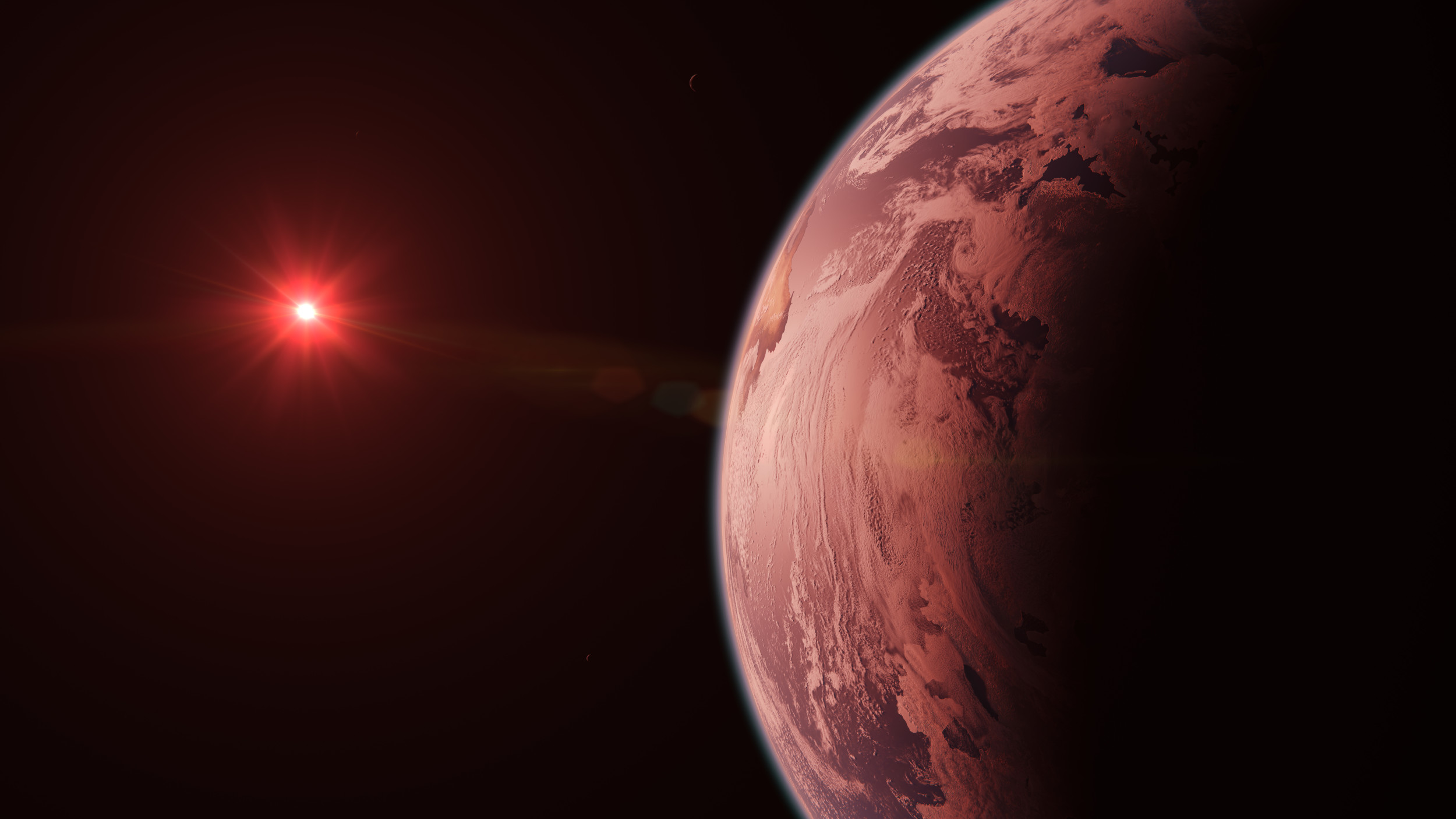
An artist’s impression of one of the TRAPPIST-1 planets in the star’s habitable zone. Credit: unknown
Scientists have once again been turning their attention to the TRAPPIST-1 planetary system – this time to try to find evidence of technosignatures – artificial radio transmissions if you will – emanating from the system.
TRAPPIST-1 is a red dwarf star some 40 light years from Earth which had been previously known by the less exotic designation 2MASS J23062928-0502285. The name change came about in 2017, after extensive observations led by the Transiting Planets and Planetesimals Small Telescope (TRAPPIST) system revealed the star had no fewer than seven roughly Earth-sized planets orbiting it (see: Space update special: the 7-exoplanet system). The discoveries marked the star as a prime contender for the study of exoplanet systems, not only because of its proximity to our own Sun or the number of planets orbiting the star, but also because three of the seven planets lay within the star’s “Goldilocks zone” – the region where everything is kind-of “just right” for liquid water to exist and – perhaps – life to potentially take hold.
However, there have always been caveats around any idea of any of the planets harbouring liquid water, much less life, the most obvious being whether or not they have an atmosphere. One problem is that red dwarf stars tend to be rather violent little fellows in comparison to their size, prone to extreme solar events which could, over time, simply rip away the atmospheres of any planets orbiting. Another, more intrinsic problem is that a new study suggests that it might be harder to confirm whether or not the TRAPPIST-1 planets have any atmospheres because the means by which scientists have generally used to try and identified whether or not tidally locked exoplanets might have atmospheres could well be flawed – of which more in a moment.
True-colour illustration of the Sun (left) next to TRAPPIST-1 (right), both to scale relative to one another. TRAPPIST-1 is darker, redder, and smaller than the Sun, being slightly larger than Jupiter. Via: Wikipedia
The issue of TRAPPIST-1 ripping away an atmospheres its planets may have had is a mixed one: on the one side, all of the planets orbit their parent star very closely, with orbits completed in periods measure from just 2.4 terrestrial days to 18.9 terrestrial days; this puts them well inside the “zone of violence” for any stellar outbursts from the star. On the other, TRAPPIST-1 is old: estimates put it at around 7.6 billion years old, or more that 1.5 times the age of our Sun, and it might be a much as 10 billion years old. This age means that as red stars go, it is actually quite staid, and may have passed through it more violent phase of life sufficiently long ago for the atmosphere of the more distant planets orbiting it, including those in the habitable zone where life may be able to arise, to have survived and stabilised.
One of the most interesting aspects of the TRAPPIST-1 system is that, even though they are tidally locked, two of the planets within the star’s habitable zone TRAPPIST-1e and TRAPPIST-1f – could actually have relatively benign surface temperatures on their surfaces directly under the light of their star, with TRAPPIST-1e having temperatures reasonable close to mean daytime surface temperatures here on Earth and TRAPPIST-1f matching average daytime temperatures on Mars. Thus, if they do have dense enough atmospheres, both could potentially have liquid water oceans constantly warmed by their sun, and the regions in which those oceans exist could experience relatively temperate weather and climate conditions.
An illustration of the TRAPPIST-1 system scaled to match the inner solar system. Three of the TRAPPIST-1 planets – e, f, and g, sit within the tiny star’s habitable zone, where liquid water might exist on them. Credit: NASA
Since the discovery of the seven planets, there have been numerous studies into their potential to harbour atmospheres and much speculation about whether or not they might harbour life. However, the idea that any life on them might have reached a point of technological sophistication such that we might be able to detect it is – if we’re being honest – so remote as to be unlikely simply because of the many “ifs” surrounding it. However, that doesn’t mean we shouldn’t try to find out; for one thing, there is the intriguing fact that if any civilisation has arisen to a level of technology similar to ours on any of the planets, the relative proximity of the entire system means that it might have made the jump between them and achieved something of a multi-planet status.
Again, the chances of this being the case are really remote – but if it has happened, then there would likely be communications passing back and further the planets. Assuming that such communications are made via artificially modulated radio frequencies, we might be able to detect them from Earth. At least, this has been the thinking of a team of radio astronomers, and they’ve been putting the idea to the test using a natural phenomenon called planet-planet occultation (PPO). A PPO is when one planet comes between two others – in this case one of the TRAPPIST-1 planets and Earth.
The theory is that if the two alien words are communicating one to the other, then during a PPO, any radio signals from the planet furthest from Earth (planet “b” in the illustration below) direct at the occulting planet (planet “c”), would “spill over” their destination and eventually pass Earth, allowing us to detect them. Note this doe not mean picking up the communications themselves for any form of “translation” (not that that would be possible), but rather detecting evidence of artificially modulated radio frequencies that might indicate intelligent intent behind them.
An example of planet-planet occultation (PPO): as planets “b” and “c” pass around their star, “c” will periodically occult (pas in front of) “b” relative to Earth. When this happens, it might be possible it detect radio signals passing from “b” to “c” (if they exist. Credit: Tusay, et al
To this end, a team of radio astronomers the latter’s Allen Telescope Array (ATA), originally set-up by the SETI Institute and the University of California, Berkeley, to listen to the TRAPPIST-1 system and gathered some 28 hours of data across several potential PPO events involving different planets in the TRAPPIST-1 system. In doing so, they collected some 11,000 candidate signals coming from the general proximity of the TRAPPIST-1 system. These event were then further filtered down using computer modelling to some 2,000 potential signals that could be directly associated with 7 PPO events. These 2,000 signals were then analysed to determine if any were statistically unusual enough to suggest they might be of artificial origin – that is, potential radio transmission.
Sadly, the answer to this was “no”, which might sound like a lot of work for no result; but just imagine if the reverse had been true; further, now the concept of using PPO events in this manner has been tested, it lends itself for potential use with other multi-planet systems orbiting relatively nearby stars.
The Problem of Atmospheres
Now, to circle back to the question of atmospheres on tidally locked planets. As noted above, such planets always have one side permanently facing their parent star and the other always pointing away into space, as the rotation of the planet is precisely in sync with its orbital motion around the parent star. This means that – again as already noted – if there is any atmosphere on such a planet, it might result in some extremes of weather, particularly along the terminator between the two sides of the planet.
However, if the atmosphere is dense enough, then conditions on the planet might not only be capable of supporting liquid water, they might also result in stable atmospheric conditions, with less extreme shifts in climate between the two sides of the planet, and while the weather would still be strange, it would not necessarily be particularly violent; thus, such planets might be far more hospitable to life than might have once been thought. And herein lays a problem.
To explain: exoplanet atmospheres are next to impossible to directly observed from Earth or even from the likes of the James Webb Space Telescope (JWST). Instead, astronomers attempt to observe the spectra of an exoplanet, as this reveals the chemical composition of any atmosphere that might be surrounding it. But tidally-locked planets tend to be orbiting so close to their parent star that trying to obtain any atmospheric spectra is hard due to the interference of the star itself. Instead, a different technique is used.
Computer-generated rendering of how the tidally locked world TRAPPIST-1f might look when viewed from its star, assume it has an atmosphere that might support liquid water on its surface. Credit: NASA
As a tidally locked planet passes between Earth and its parent star it presents its dark side directly to us, allowing astronomers by dint of knowing the nature of the star itself, to calculate the temperature of the planet’s dark side. Then, as it moves around to the far side of the star relative to Earth, we get to measure its “light” side. Again, as the nature of the star and its light / temperature are “known”, it is possible to extrapolate out the likely temperature of the “light” side of the planet. With this done, the two temperatures can be compared, and if they are massively different, then – according to the thinking to date – viola! The planet has no atmosphere; but if the difference between the two is not drastically different, than it’s likely the planet has a nice, dense atmosphere.
Except a new study currently awaiting peer review points out a slight wrinkle in this approach. In it, researchers show that yes, while a dense atmosphere on a tidally-locked exoplanet would moderate the planet’s global temperatures and thus remove extremes, it could also result in the formation of upper atmosphere clouds across much of the dark side of the planet. Such clouds would have two outcomes: on the one hand, they would help retain heat within the atmosphere under them, keeping it much warmer than would otherwise be the case and making the entire planet potentially far more hospitable to life. On the other, they would “reflect” the coldness of the upper atmosphere such that when we attempt to measure the temperature of the planet’s dark side, we are actually measuring the temperature of the cold upper layers of the clouds, not the temperature of the atmosphere below them. This would result in the dark side temperatures appearing to be far lower than is actually the case, leading to the incorrect conclusion that the planet lack any atmosphere when this is not the case.
How clouds could make a planet appear airless. Credit: Powell, et al, Nightside Clouds on Tidally-locked Terrestrial Planets Mimic Atmosphere-Free Scenarios
What’s the impact of this? Well, allowing for the study to pass peer review – and the author’s note that more work in the area is required, it could mean that we have dismissed numerous smaller, solid exoplanets as being unsuitable for life because “they have no atmosphere” when in fact they could in fact do so. Thus, there might be more potentially life-supporting planets than previously considered.
Clef des Champs, September 2024 – click any image for full size
Update, April 2025: Chef de Champs has closed. SLurls have therefore been removed from this article.
Flicking through my notes in the week, I came across La Clef des Champs, by Rose Siabonne, a place I’ve visited a number of times, and which I’d actually convinced myself it was somewhere I’d revisited fairly recently. I was therefore utterly surprised when my notes revealed that “fairly recently” actually meant “nigh on five years ago”!
How time flies when it comes to Second Life 🙂 . Ergo, I suggested to W that we bounce our way over and have a look to see what might have changed. So off we went.
Clef des Champs, September 2024
I first visited the setting back in May 2018, when it occupied a Homestead region. However, within a month of that post the setting had relocated to a quarter parcel on a Full private region, prompting me to drop in once again. By December 2019, and after a short absence whilst Rose focused on a homestead design she called Hors du Temps (May 2019), La Clef des champs returned later that year, this time covering an entire Full region and prompting my further visit.
Now simply called Clef des Champs, the setting remains on a Full private region, with the majority of the landscaping within this iteration by BeautifulDisaster Requiem, although touches by Rose ensure all the spirit and feel of the past iterations of the setting are very much still in evidence. However, one change from my previous visit is that the setting now appears to include a number of residential rentals; these appear to be confined primarily to the east and southern sides of the region, and so don’t interfere with public explorations, whilst as long as people keep their eyes open, the risk of invading privacy is equally remote.
Clef des Champs, September 2024
The landing point now sits in the south-west corner of the region, on the edge of a little hamlet which is very mindful of parts of France (and includes a boules court!). Primarily designed by Rose, this offers a little café in which to pass the time, and one or two little touches those familiar with earlier iterations of Clef des Champs might recognise (and which help with a sense of continuity between iterations).
From here, a walk northwards winds its way over grasslands and (via boardwalks) across the local wetlands before turning eastwards. These wetlands are fed by falls dropping from the region’s central highlands and offer a home to local waterfowl whilst a houseboat permanently moored close the the foot of the falls (“permanently”, given the boardwalks now appear to block its exit to open water) and several places to sit located around the edge of the waters all provide excellent vantage points from which to observe the waterfowl – or simply has a cuddle.
Clef des Champs, September 2024
Having passed the wetland, the eastward path skirts the feet of the central rocky plateau, passing over a little stream to carry on around the landscape, presenting paths over to the rental properties to the south and east in the process. Screened by trees and shrubs from the rest of the setting, the latter are easily avoided by keeping to the flower-covered banks of the larger stream reaching outwards from the plateau’s falls.
A fallen tree trunk here provides a convenient bridge to cross the waters of the steam and reach the steps and trail leading up into the rugged hill. At the top. multiple places to pass the time might be found – including within the hilltop folly – and a rope bridge might lead you to a hot tub sitting on the south cliffs as they form a curtain between the inner lands of the region and the public beach.
Clef des Champs, September 2024
When circumnavigating the main upland plateau, do keep your eyes peeled for the romantic cavern hidden within the rocks at its base. Do also keep an eye out for the teleport pads dotted around (not that they are hard to miss!). As well as offering shortcuts to areas on the ground level of the region, they also provide access to the Autumn and Winter sky platforms, each of which offers its own little retreat.
Between the plateau and the screen of rocky cliffs to the south, the landscape is cut through by the meandering, if fast-flowing, stream as it makes its way back towards the west to eventually exit into the waters beside the little hamlet. As it does so, it passes through a verdant land of tall trees, flowers, grasses and woodland where trails equally meander, and at least one camp site awaits discovery.
Clef des Champs, September 2024
Throughout all of this, the landscaping is highly amenable to photography and lends itself nicely to a range of EEP settings – I’ve used my own for the pictures here – and the soundscape adds depth to the setting. There are also multiple places to sit and pass the time; some of which are mentioned above, but more of which await discovery.
There was some redecorating (seasonal changes) going on during the second half of my re-visit, so its is possible some details may change between this article going out and you reading it – but if so – then that’s another reason for visiting, no? 🙂 .







 Inara Pey: Living in a Modemworld