Susurrous, October 2024 – click any image for full size
Note: As of at least December 2024, Susurrous has been switched to Group Only access and the Group is closed to enrolment.
It’s been a while since I’ve visited a region design by Talia (Natalia Corvale), a designer with – as I’ve noted before – an eye for creating region designs that are wonderfully attractive, rich in natural detail, and evocative of places that one might find tucked away whilst on global travels. In fact the last time I covered one of her designs was in 2021; so I was delighted to be able to drop into her most recent design, Susurrous and spend some time exploring.
Occupying a Full region, the setting is both Talia’s home in Second Life and a public space offered for people to explore, take photographs and simply relax within, with Talia requesting visitors respect it as both public and her home.
Susurrous, October 2024
Bounded on all four sides by wooded hills of a region surround, the setting is separated from them by water, framing it as a broad, semi-rugged island with an autumnal feel which links it neatly to the more distant hills despite the waters sitting between the two. This is a place utilising mesh landscape elements and changes in elevation which enhance its look and feel as a location deep withing a rugged countryside, such as found on the north American continent.
The Landing Point is tucked into north-west corner of the region where the land is at its lowest. It sits on a deck close to where the land makes a final short rocky drop into the waters below. An arrival sweeper gently encourages those new arrived to move along the deck toward the steps down to ground level. From this little headland, a sea of yellowing grass rolls inland, interspersed with trees, a little stream bubbling its way from the southern uplands as it sloshes its way down over little steps of rock towards open waters.
Susurrous, October 2024
Across the stream, and reached via a couple of bridges spanning it, is a cosy cabin with a barn and small greenhouse relatively close by, giving the impression this is all a homestead farm. It’s not clear what the produce from it might be, but some of could be connected with the sale of alpaca fleece, while another seasonal product appears to be pumpkins, making it the kind of place Linus Van Pelt might appreciate spending time within at the end of October 😀 .
The homestead has a nice sense of being lived-in, from the interior furnishings through the clothes drying on the lines outside, to little details such as a shirt draped over the handle of an axe with its blade embedded in a tree stump, as if whoever had been welding it worked up a sweat and then and stripped to the waist before wandering off to get a drink.
Susurrous, October 2024
The southern border of this little farm lies along the bank of another stream as it cuts a gully to reach the west side of the region, spanned by a bridge reaching out from the farm to connect to the grassland on the other side. A little group of buildings from a short arc on the far side of the gasses from the stream, and sit is if someone once tried to establish a little huddle of businesses here. Whether the attempt succeeded or not is a matter of conjecture; for now the majority lie deserted; now this came to be is a story for your imagination to create when visiting – perhaps whilst sitting in the little bar which has managed to survive in the shell of the old oyster shop.
Much of the southern and eastern sides of the region are elevated, starting with a high plateau along the southern edge of the setting. This runs from the eastern cliffs almost all the way to the grassland on which the would-be hamlet sits. A grassy incline and rocky wall link the two, the incline offering a way up the former from the latter. Climbing half way to the top, the incline ends alongside a pool of water fed from the rocks above, and which in turn feeds the two streams below. From here, a broad shoulder to grass leads the way to where stone steps take over, curving their way up grass and rock to pass a terrace. Just beyond this, the steps are in turn replaced by a wooden stairway as it climbs to a treehouse cunning disguised as a cabin sitting atop a wooden platform extending out from the plateau’s edge.
Susurrous, October 2024
The top of the plateau offers a broad expanse of grass dotted with trees, two of which support the two halves of a tree house (in the literal sense of a house built in the boughs of a tree 🙂 ), and another carries a large platform with seating surrounding its trunk and suspended from the boughs above it. It is on this plateau I found a couple of rideable horse from Water Horse – although given they are rideable, and so might get moved around by those using them, you might come across them elsewhere in the region. As one was available, I mounted it and headed east and then along a trail running along the top of a flat-topped ridge pointing north.
Susurrous, October 2024
I’ll admit the trail was a little unfriendly to horseback riding in a couple of places, but with the little trial and error, I found myself making my way past more locations to sit (one being a cabin down on another shoulder of the plateau, and best reached from the western end of the uplands, after crossing the stream there to the trail rising to run along it). Towards the northern end of the ridge, the path dropped down a steep slope and into the north-east corner of the setting.
This forms a roughly square expanse of grass and shrubs, overlooking water on three sides: the waters to the east and north, and the mouth of an inlet cutting into the land from these northern waters. Tucked into one corner of this flat table of rock and grass sat a large open-air deck with seating and a fireplace for warmth, and sitting semi-secluded behind shrubs and bushes. Facing it from across the grass and sitting about the inlet mouth sat a large café offering further respite for weary travellers.
Rather than visit the deck or the café – which offers both indoor and outdoor seating, I instead switch-backed my way down grassy inclines the the banks of the inlet, and made for the covered bridge spanning it.
A shack at the head of the inlet displays a sign offering boat rentals and the sail of fishing bait, but given the bridge sits so low over the water, fishing is probably the better option of the two to pick. For my part, I crossed the bridge and then cantered up the slope to where the meadow flowed back towards the landing point and the stream forming one boundary to the farm. I headed for one of the bridges to the latter, finally leaving my good-natured horse at the barn there.
Nor does this complete a look at the region: as noted earlier, there are multiple places to sit and pass the time, some of which are easy to stop, others more cleverly tucked away and need to be sought out. Throughout the entre region the landscaping is exceptionally well done and the opportunities for photography manyfold, with the local animals (domesticated and wild) offers a further sense of life throughout.
My one minor niggle with Susurrous lies in the fact that scripts are disabled. While the choice of capabilities available to people entering a region is entirely the choice of the region holder, and there are a couple of horses (that I saw) in the region which can be ridden, it would nevertheless be nice if those who have them to be able to add their own horse to their avatar and enjoy a canter / walk around the setting.
However, the above does not in any way spoil the fact that Susurrous is a beautiful setting, the landscaping very well put together to present an entirely natural and eye-catching environment at it slopes down from the the southern and eastern uplands to the north-western coastline before the land makes its final rocky drop into the surrounding waters. The accompanying soundscape is subtle and helps to further immerse visitors, whilst the multiple places to sit offer plenty of opportunities for relaxing and taking photographs.
Logos representative only and should not be seen as an endorsement / preference / recommendation
Updates from the week through to Sunday, October 20th, 2024
This summary is generally published every Monday, and is a list of SL viewer / client releases (official and TPV) made during the previous week. When reading it, please note:
It is based on my Current Viewer Releases Page, a list of all Second Life viewers and clients that are in popular use (and of which I am aware), and which are recognised as adhering to the TPV Policy. This page includes comprehensive links to download pages, blog notes, release notes, etc., as well as links to any / all reviews of specific viewers / clients made within this blog.
By its nature, this summary presented here will always be in arrears, please refer to the Current Viewer Release Page for more up-to-date information.
Note that for purposes of length, TPV test viewers, preview / beta viewers / nightly builds are generally not recorded in these summaries.
Official LL Viewers
Release viewer: version 7.1.10.10800445603, formerly the DeltaFPS RC, dated September 11, promoted September 17 – NO CHANGE.
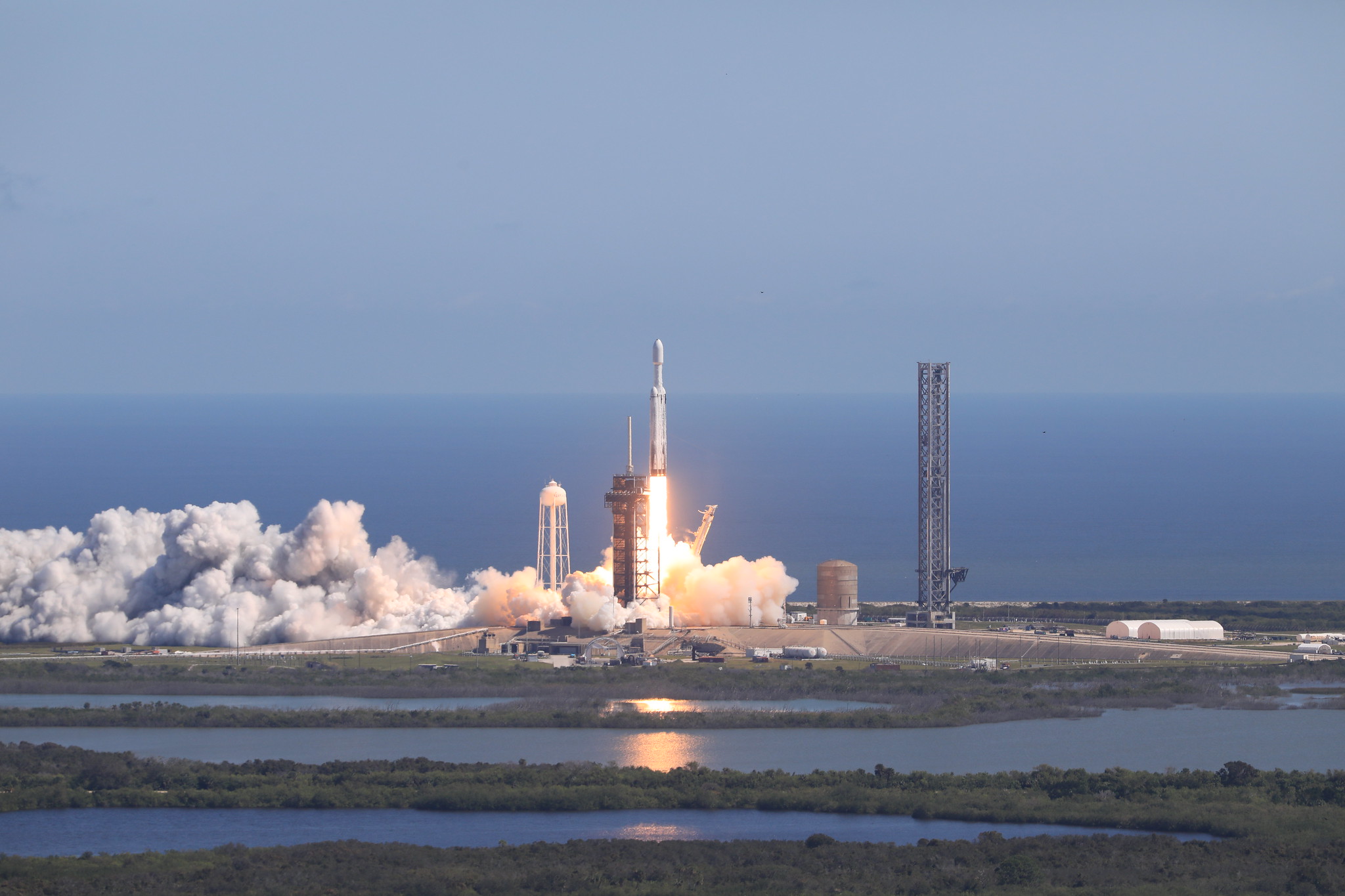
A Falcon Heavy rises from LC-39A at Kennedy Space Centre, lifting NASA’s Europa Clipper space vehicle on the first leg of a 5.5 year trip to Jupiter. October 14th, 2024. Credit: NASA
NASA finally got its flagship Europa Clipper mission away on Monday, October 14th, with the lift-off of its Falcon Heavy booster having been delayed four days, courtesy of Hurricane Milton.
The launch occurred at 16:06 UTC from the SpaceX launch facilities at LC-39A, Kennedy Space Centre. It marked the start of a 5.5 year flight to Jupiter for the spacecraft, which as I covered in a recent Space Sunday article will study Jupiter’s icy moon of Europa for about 4 years. It will be joined in this effort by Europe’s JUICE mission, which although launched 18 months ahead of the NASA mission, will arrive a year after it, and will also study Jupiter’s two other “icy world” moons: Ganymede and Callisto.
Once at Jupiter, Europa Clipper – the spacecraft – will orbit the planet, not the moon, making periodic fly-bys of the latter. As I previously explained, this is to both minimise its exposure to the extremely harsh radiation regime immediately surrounding Jupiter (and enclosing Europa) which would burn-out the vehicle’s electrical systems in about 6 months, and also to maximise the time available for it (between 7 and 10 days, rather than mere minutes were it orbiting Europa) to transmit the data gathered during each fly-by back to Earth.
A simplified diagram showing how Europa clipper will use an orbit around Jupiter to periodically fly-by Europa and gather data, minimising its exposure to Jupiter’s hard radiation regime (red and orange) and maximising its time for transmitting data to Earth. Credit: NASA
The mission is one of NASA’s most expensive robotic undertakings yet, with an estimated total lifecycle cost (including the four years of operations studying Europa) of US $5.2 billion.
Following launch, none of the three core stages of the rocket – all of them Falcon 9 first stages – were slated for recovery, and five minutes after lift-off the upper stage of the rocket separated and fired its engine whilst also jettisoning the payload shroud protecting the Europa Clipper spacecraft, as it continue to carry the latter up to an initial orbit.
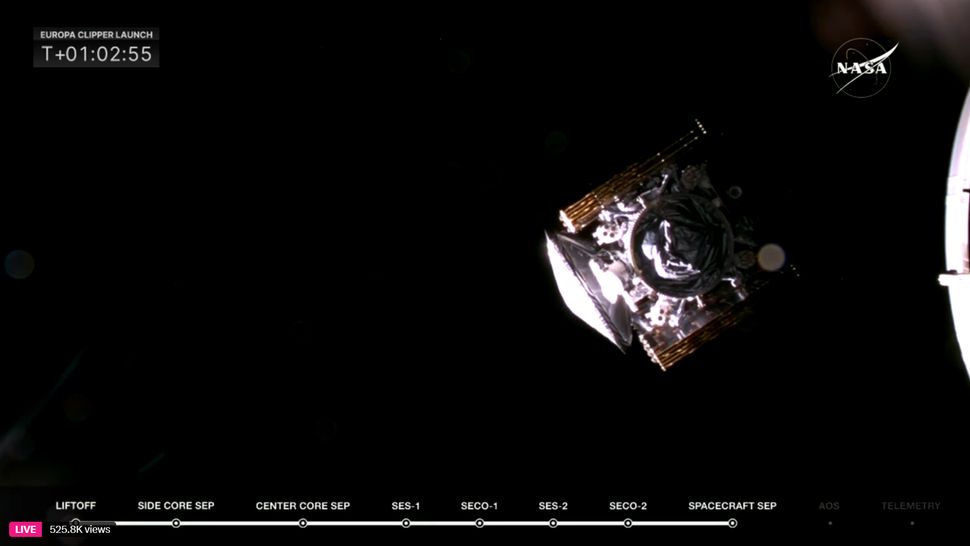
This parking orbit was used to carry out checkouts on the space vehicle as it coasted around the Earth for some 40 minutes prior to the upper stage motor re-lighting for a three minute burn to push its payload onto its initial trajectory away from Earth. Payload separation then came just over an hour after launch, temporarily breaking communications with the spacecraft which had up until that point been using the communications relay on the Falcon upper stage to report its status.
Europa Clipper, solar arrays still stowed, departs its Falcon upper stage, just over an hour after launch. Credit: SpaceX
Signal acquisition took five minutes as the spacecraft had to first “warm up” its communications systems via its onboard batteries. Once the signal had been obtained, initial flight data information and vehicle operating telemetry were returned to mission control at the Jet Propulsion Laboratory, California, the latter revealing a minor problem in the spacecraft’s propulsion system, but which was not interfering with general operations.
We could not be more excited for the incredible and unprecedented science NASA’s Europa Clipper mission will deliver in the generations to come. Everything in NASA science is interconnected, and Europa Clipper’s scientific discoveries will build upon the legacy that our other missions exploring Jupiter — including Juno, Galileo, and Voyager — created in our search for habitable worlds beyond our home planet.
– Nicky Fox, associate administrator, Science Mission Directorate at NASA Headquarters, Washington
With the initial check-out complete, the command was sent for the vehicle to start unfurling its two huge solar array “wings”, the largest NASA has ever flown on a deep space mission (with a total vehicle/ array span just slightly smaller than that of Europe’s Rosetta mission). This was a gentle operation, finally completed some 6 hours after launch, allowing the craft to start generating up to 600 watts of electrical output.
The spacecraft is now heading away from Earth on a heliocentric orbit which will allow it to fly-by Mars in March 2025 prior to a return to Earth in December 2026. It will use Earth’s gravity to assist it on its way to Jupiter, which it will reach in April 2030.
Skyrora First UK Vertical Launch?
Scottish rocket start-up, Skyrora Now looks to be taking pole position in the race to be the first entity to launch a commercial rocket from British soil. In October, the company announced that after months of delay – not all of them related to itself – it expects to receive a launch vehicle license from the UK’s Civil Aviation Authority (CAA) in December 2024 or January 2025. This will allow its first launch to take place in the spring of 2025, from the UK’s SaxaVord Spaceport located on the Lamba Ness peninsula of Unst, the most northerly of the inhabited Shetland Islands.
Based in Edinburgh, Scotland, Skyrora has been operating since 2017, and already has something of an impressive record, developing two sub-orbital test bed vehicles Skylark Nano and Skylark Micro, which helped pave the way for their Skylark L two-stage sub-orbital rocket, capable of lifting payloads of up to 60 Kg to attitudes of around 100km for micro-gravity research.
Skyrora’s suborbital Skylark L rocket mounted on its mobile paunch platform on the Langanes peninsula, Iceland, ahead of the October 8th, 2022 launch. Credit: Skyrora
The company is also working on the tree-stage version of the vehicle, called the Skylark XL, capable of placing payloads of up to 315 kg into a 500-km low-Earth orbit (LEO). In addition, Skyrora has also been developing its own 3D printed engines for its rockets, and plans to offer a “space tug” vehicle along with Skylark XL. This tug will be capable of remaining in orbit post-launch and used to either remove space debris from orbit, and / or replace / maintain satellites in orbit by giving them a little boost.
I’ve covered Skyrora a couple of times in this column, notably in October 2022, when the company attempted its first Skylark L launch. This actually took place from Iceland (as regulatory approval for hosting launches from UK soil had not at that time been granted), and whilst it was ultimately unsuccessful as a result of a software error, it did demonstrate a further unique aspect of Skylark L: a fully mobile launch platform and control facility allows the company to ship a rocket and its launch systems pretty much anywhere in the world and complete a launch without the need for any permanent supporting launch infrastructure.
As well as flying the Skylark L from SaxaVord, Skyrora also intend to use the facilities at the spaceport for its Skaylark XL original launcher, thus becoming one of a number of commercial ventures set to use SaxaVord, which gained its operator’s license from the CAA in May 2024.
A photograph of the Fredo launch facility (with construction work still on-going around it) at SaxaVord Spaceport. Occupying the launch stand is the core stage of a RFA Once booster, constructed by Rocket Factory Augsburg in preparation for its first static fire engine test, which took place in June 2024, utilising 4 of its 9 motors. Credit: Shetland News
In fact, at the time the license was granted, it was widely anticipated that Germany’s Rocket Factory Augsburg (RFA) would be the first to launch from the site. Holding a long-term lease on the facilities most northerly launch pad – called Freddo – RFA commence static fire tests of the first stage of the rocket they hoped to fly, in June 2024, with an initial test of 4 of the nine motors. They then planned a further test of all nine engines in August 2024, with the aim of then assembling the entire vehicle and launching at the end of summer. Unfortunately, and as I reported at the time, the second static fire test resulted in the complete loss of the stage 38 second after motor ignition. RFA now expect to make their first launch attempt from SaxaVord in August 2025.
Starliner: 1st Operational Flight Postponed
Following the uncrewed return for Boeing’s CST-100 Starliner Calypso at the end of a frustrating Crew Flight Test (CFT) which saw significant issues with the vehicle’s service module and its propulsion systems, NASA has confirmed it will not have the vehicle participate in either of the planned crew rotation flights planned for 2025.
The news is hardly surprising; NASA wants to give Boeing and their propulsion system partner Aerojet Rocketdyne as much time as possible to fully diagnose and correct a multitude of problems with the service module propulsions systems – from overheating, through leaks in purge systems to unexpected wear-and-tear on valves – and then determine how best to get the system properly certified for operational use.
September 6th, 20214, the uncrewed Starliner vehicle, comprising the capsule Calypso and a service module, back away from the International Space Station (ISS) under automated control at the start of a belated return to Earth for Calypso. Credit: NASA
In July 2024, prior to Calypso returned to Earth, the US Space Agency made an initial decision to swap the planned crew flights for 2025. Originally, Starliner 1, carrying a crew of four to the ISS, had been due to fly in February 2025 – but NASA swapped that out in favour of SpaceX Crew 10. This left Starliner 1 occupying the late July / early August slot; however, as well as swapping the slots over, NASA also instructed SpaceX to bring forward preparations for its 2026 Crew 11 flight, thus allowing the agency to to seamlessly swap to flying a crew on SpaceX Crew Dragon if Starliner was not in a position to fly a full mission.
Now, in the wake of further deliberation, NASA has opted to fly the July/August 2025 mission using SpaceX Crew 11, meaning the earliest Starliner is likely to fly an operational mission to the ISS will be 2026. However, this does not mean Starliner will not fly at all in 2025; rather it means that NASA have given themselves and Boeing additional space in which to fly a further Crew Flight Test of the vehicle, should the agency decided one is warranted ahead of any final vehicle certification, and to be able to plan and fly any such mission again with minimal disruption to existing schedules.
Space Debris and Re-Entry: Hazards and Pollution
There is an estimated 150 million pieces of space junk / debris orbiting the Earth ranging in size from around 1 cm across to entire satellites and spent rocket stages, all of which constitutes a growing hazard for space operations, crewed and uncrewed. An increasing number of operational satellites routinely have to change altitude / velocity to avoid collisions with such objects – or at least, with those that can be accurately tracked.
On top of that there are hundreds of millions of pieces of debris in the millimetre(-ish) range zipping around the Earth we simply cannot track, but which pose and equal amount of danger – witness what happened to Soyuz MS-22 in December 2022, which what is believe to be a millimetre-sized piece of Micrometeoroid and Orbital Debris (MMODs) punched its way through a vital cooling system radiator.
A visualisation showing a number of satellites believed to have made orbital changes in order to avoid collisions with tracked orbital debris (red) and a number which also made significant manoeuvres consistent with avoiding a threat of collision threat (grey) in a given period. Credit: Leo Labs.
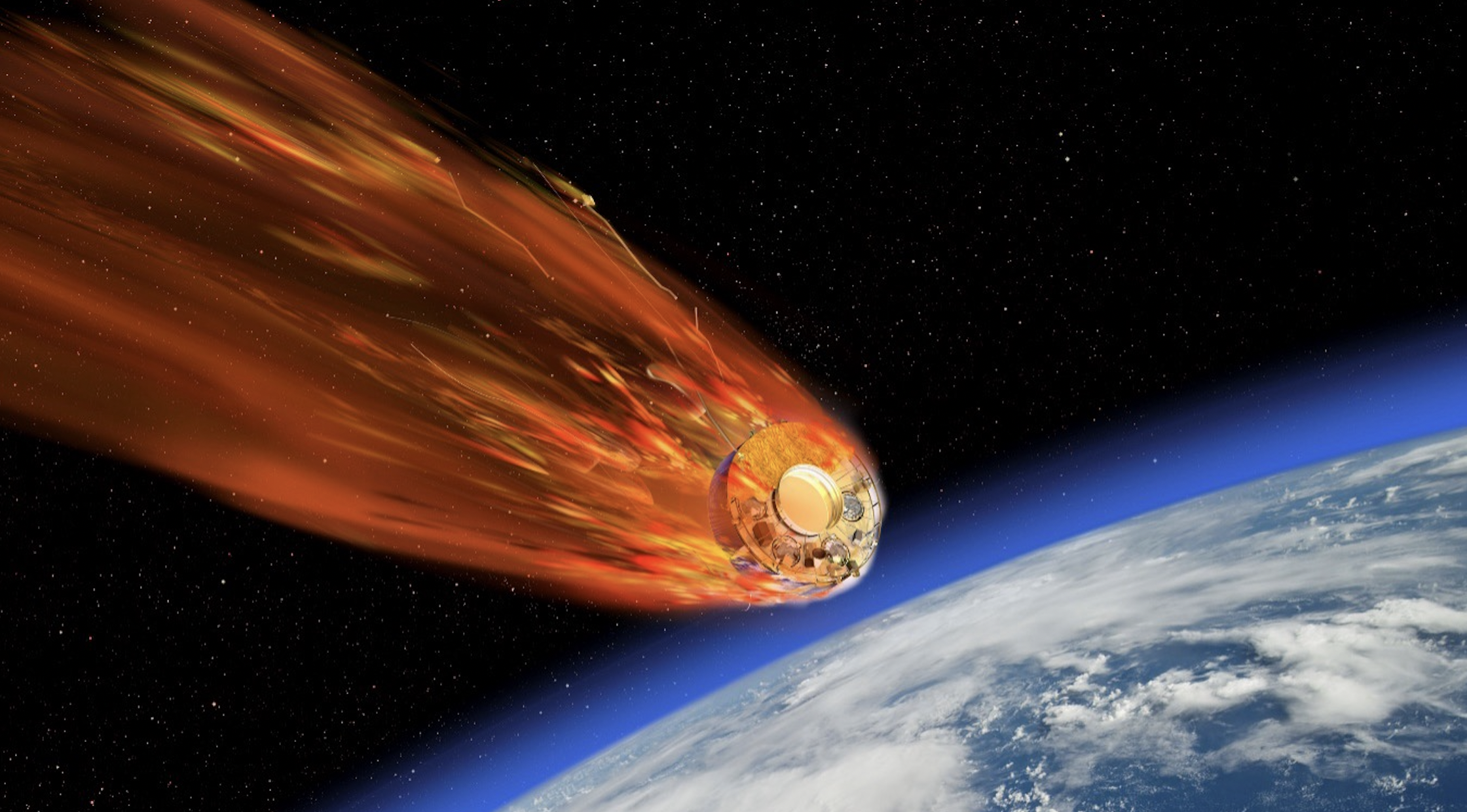
Things like MMODs are really hard to mitigate, and while getting rid of larger debris is a problem multiple companies are actively working on, by far the most common means of disposing of unwanted satellites and used bits of rockets and spacecraft is to push them back into the upper atmosphere and let them burn up. However, there is now growing evidence that this approach is neither wise or sustainable, with studies revealing increasing signs that doing so beginning to have a lasting detrimental impact on the atmosphere, and by extension, the climate, both of which are already subject to other aspects of space launch activities.
In just 10 years, the volume of satellites and rocket elements burning-up in the upper atmosphere has doubled. In their wake they leave soot from engine exhausts, aluminium oxides capable of altering the planet’s thermal balance in favour of faster greenhouse warming (as well as the return of ozone destruction). In particular, three separate studies have shown that concentrations of aluminium oxides in the mesosphere and stratosphere — the two atmospheric layers above the lowest layer, the troposphere have been measurably rising in the same period. One of these reports goes so far as to note that if the current rate of disposal of space junk through atmospheric burn-up continues for as little as 20-30 more years, the volume of aluminium oxides in the upper atmosphere could increase by 650%.
Satellites from low-orbiting constellations and mega constellations occur almost daily – and can occur multiple times in a given 24-hour period – resulting in tonnes of incinerated and climate-harmful dust being deposited in the upper atmosphere. Image credit: ESA
And this rate of disposal is not to much likely to continue in the next couple of decades – but increase, thanks to the ever increasing number of “megaconstallations” of thousands of satellites in low Earth orbit.
To take Starlink as an example (and as cited by UK-based Space Forge). Since 2019, SpaceX has launch thousands of Starlink satellites which are supposed to be able to remain in orbit for 5 years before re-entering the atmosphere. However, such has been the pace of development, SpaceX has been actively disposing its older, unwanted Starlink units by de-orbiting them to to make space for newer units, reaching a point where they are now responsible for some 40% of all debris re-entering the Earth atmosphere and being incinerated. This equates to half a tonne of incinerated trash – much of it aluminium oxide – being dumped in the mesosphere and stratosphere every day, just by Starlink. And that’s just with an operational fleet of 6,000 satellites; what – researchers ask – will it be like if SpaceX are allowed their requested 40,000 units in orbit?
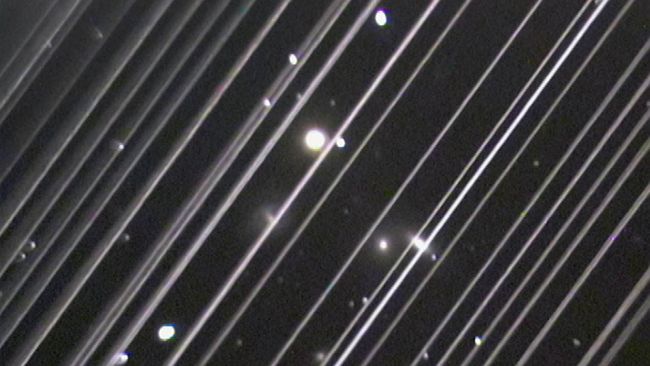
Light pollution caused by SpaceX’s Starlink megaconstellation, as seen in this short-period exposure captured by the Lowell Observatory, Arizona, is the most visible form of pollution these satellites and others like them produce – but it is far from the most impactful. Credit: Victoria Girgis / Lowell Observatory
And while they are singled-out, SpaceX are not alone, both One Web and Amazon are deploying their own (admittedly fewer in number) constellations which will also likely go through the same continuous evolution at Starlink; then there are military constellations, European constellations and the potential huge Chinese Thousand Sails megaconstellation. Thus, the issue is not going to be diminishing any time soon.
Already researchers have calculated that the amount of ozone depletion directly related to space launch operations is slowly increasing. Not only are there far more satellites being pushed back into the atmosphere – there are more rocket stages going the same way, filled with soot, aluminium oxides, alumina particles in general and chlorine, which are all being dispersed in the upper atmosphere. Again, to take SpaceX as an example: they are performing some 100 launches a year when less than a decade ago the total number of global launches was maybe two dozen. That’s 100 extra upper stages burning up in the atmosphere – from just one company. Add that to the pollutants pushing into the atmosphere during launch from the liquid kerosine SpaceX uses with Falcon 9 and Falcon Heavy, and it is understandable why researchers pin around 12% of ozone depletion from space related activities just on SpaceX.
But again, the company is hardly alone – and through a switch to methane (which despite itself being a greenhouse gas, burns so cleanly in rocket motors so as to produce very little measurable pollution in the scheme of things), they are attempting to reduce that aspect of their footprint. ESA, Roscosmos, JAXA, ULA, NASA, the Indian space industry – even the likes of Virgin Galactic – continue to dumping harmful waste products into the atmosphere through their use of solid rocket motors and hybrid propellants in their launch vehicles / space planes. These perhaps doe the most significant damage to the atmosphere each and every time they are used.
The problem here, of course is how to regulate without suffocating. And it that, the issue of atmospheric pollution as a result re-entry burn-up is particularly thorny. For while there are multiple national requirements and international agreements relating to environmental protection in countries operating launch services, none of them extend to protecting the atmosphere against the potential harmful impact of using it as a convenient trash incinerator.
Burrow Coffee Co,, October 2024 – click any image for full size
Ever had a thorough conviction that you’ve done something, only to find out when you check that you have – you find you haven’t? Welcome to my world. Admittedly, I bounce around SL a lot, and occasionally I arrive somewhere and think, “Oh, this would be nice to write about!” – only to discover I already have, and what’s more, it is still as it appeared when I originally wrote about it – making a re-blog a bit moot.
However, in the case of the Burrow Coffee Co, I’d convinced myself that I’d written about it. And so dropped in a couple of times before it dawned on my that actually I hadn’t in fact written about it, at all. So it’s only fair I put things to rights now and – well, write about it!
Burrow Coffee Co,, October 2024
Sitting within a Full private region leveraging the Land Capacity bonus, this is a setting offering a mix of venues for events, places to hang-out with friends or enjoy a retreat with someone close, and places to explore, all beautifully put together by Aria Christen with the support of other members of the Burrow Coffee Co management team. In turns of land coverage, the setting occupies around one-third of the total region area, the rest being given over to open waters to the south and east. These waters actually mark three other parcels in the region, at least two of which appear to have locations in the air (one being a private residence, and other the home of the Spruce brand by Spruce Evergreen), and so play no further role in this article.
The Landing Point sits on a C-shaped dock and the western end of the island. As well as playing host to several moored boats, this also has a series of noticeboards for such things as contacting staff, learning about the setting’s sponsors and obtaining information on the local events – including being able to open the setting’s event calendar. A path sets off inland from between two of these noticeboards, complete with a sign offering an assurance that you’re not lost – you’re simply here; which when you think about it, is generally the best place to be.
Burrow Coffee Co,, October 2024
Not far beyond this, the path divides, one arm continuing in a northerly direction as it passes under a rocky arch, the other turning eastwards. Take the former, and you’ll pass by way of a little camp site amidst the trees and offering one of the many hang-out spots mentioned above as being throughout the setting. Beyond this the path drops down the the north coast of the island and a deck built out over the shingles of the shoreline. Here, quiet times can be hand on rocking chairs whilst watched from the waters by one of the stars of 1975’s Jaws 😀 .
Eastwards, the trail hugs the feet of squat cliffs, slowly rising against them via short sequences of steps and rises in the land until it reaches a broad plateau on which the coffee house has been built, sharing the space with outdoor terraces and an adjoining pub space, which also serves as one of the venues for music within the buildings.
Burrow Coffee Co,, October 2024
The coffee house and pub are an expansive, well-designed space, the mix of interior and exterior areas blending perfectly together to present a sense of space without feeling in any way sprawling; of privacy for hanging out with friends without any sense of being isolated or cut off from the rest of the activity within the grounds or the coffee house or pub. To put is simply: this is genuinely a place to be enjoyed, where relaxation and casual conversations should mix easy with humour, light-hearted fun and music.
Cushioned by trees on all sides, the Barrow Coffee house and pub also have a uniquely warm and intimate feel to them, despite their collective size. Those seeking further intimacy of company and / or nature, need only follow the path on the west side of the gravelled seating area forming the front aspect of the coffee house. Quickly using the trees as a curtain between itself and the buildings and this providing the sense of easy intimacy with nature, the path turns north as a rugged little trail, stopping briefly at a wrought iron gate. Beyond this sits a delightful garden offering a mix of eastern and western influences, prior to a gravel path making its way down steps on the garden’s north side and thence back eastwards.
Burrow Coffee Co,, October 2024
Following the northern cliffs of the island and a short distance back from their edge, the path crosses a wooden bridge hinting that once there might have been waters flowing out from under the rocks on which the coffee house stands, and which flowed under the bridge to then hurl itself over their edge to the sea below. On the far side of the bridge, the path flows around a fountain where time might be spent sitting at a table and passing the time, before hurrying on towards a pergola-topped deck built out over the rocks where a part of the cliffs appears to have collapsed. Nor is this the end of meanderings, for the path continues on to drop those who tread its route gently onto the sands of a ribbon of beach along the island’s east side.
Those climbing the path from the landing point to the coffee house might also notice that as it reaches the latter, so too does it branch, the little lanterns which have marked the route up the path turning their lines to march back down again. No sooner do they start, than the path further splits, quickly descending to the right to reach an impressive boardwalk-come-breakwater snaking around the coast and providing fine views over the open waters to the surrounding hills, and offering places to sit and opportunities to enjoy refreshments.
Burrow Coffee Co,, October 2024
At its western end, this boardwalk also descends to the beach, where a narrow neck of sand passes between rocks and water to join with the arm of not taken as it completes its journey down to the beach, thus allowing visitors the opportunity to circumnavigate the entire island by following any of the three trails leading to and from the sands.
Throughout all of this is much more to be discovered and seen. Birds ride the thermals as the wind crosses the water and rides up the island’s flanks; cats might be found here and there, silently commanding all they see in that subtle way that cats do; koi swim in rocky ponds; foxes watch passers-by and the colours of autumn bring a richness of warmth in which visitors can wrap themselves. And for those not wishing to walk, there is a network of teleport boards waiting to carry them from point-to-point.
Burrow Coffee Co,, October 2024
Lovingly crafted and brought together, the Burrow Coffee Co., setting is – in a word – superb.
Mad Hatter’s Tea Room, September 2024 – blog post †
The following notes were taken from my audio recording and chat log transcript of the Content Creation User Group (CCUG) meeting held on Thursday, October 17th, 2024. There was no livestream or video for this meeting
Meeting Purpose
The CCUG meeting is for discussion of work related to content creation in Second Life, including current and upcoming LL projects, and encompasses requests or comments from the community, together with related viewer development work. This meeting is held on alternate Thursdays at Hippotropolis.
Meeting dates and times are recorded in the SL Public Calendar, and they re conducted in a mix of Voice and text chat.
The notes herein are a summary of topics discussed and are not intended to be a full transcript of the meeting.
Official Viewers Update
Release viewer: version 7.1.10.10800445603, formerly the DeltaFPS RC (multiple performance fixes, etc), dated September 11th, promoted September 17th.
Release Candidate: ExtraFPS RC, version 7.1.11.11074622243, September 30.
Aesthetics improvements: new Antialiasing setting – SMAA; Contrast Adaptive Sharpening; Khronos Neutral Tone Mapping (can be changed to ACES via the RenderTonemapType Debug setting).
Near-Term Viewer Release Roadmap
ExtraFPS work remains focused on bug fixes.
The first maintenance RC to follow ExtraFPS will be the Maint B viewer, which will include updates put on hold during the focus on performance issues plus additional updates, some of which may be further “post-PBR” performance / aesthetic improvements.
Maint B, as noted previously in these summaries, will have updates to help with Linux support / builds.
Maintenance C is also being put together, but updates changes have not yet be specified, outside of a desire to keep the changes separate to Maint B in the interests of keeping updates easier to manage.
Avatar LookAt / Eye Tracking in the Viewer
A conversation relating to avatar eye movement / use of Look At cross hairs (& the resultant drama it can cause (“Stop perving me!”), and whether because of the latter, the capability should be removed completely from the viewer.
The core problem is, even though the option for a user to see their own LookAts in the Official viewer is disabled by default, the data (cross hairs and avatar name) is broadcast to surrounding viewers, resulting in unwarranted drama (“Stop perving me!” or “You’re on the wrong viewer!”).
Various viewers handle this situation in different ways; some follow the SL viewer, other’s provide means to see the LookAt crosshairs from others whilst supressing their own LookAt data (e.g. so I can see your LookAt crosshairs (if not supressed), but you cannot see mine – possibly leading to more drama).
Given this, LL sought the best way to reduce the level of upset: remove the LookAt broadcast altogether, or limit it / make it subject to having be physically turned on through a debug. The consensus of replies appeared to be to limit it / disable it behind a setting.
This conversation also crossed-over into avatar head movement tracking the movements of the mouse (e.g. you move the mouse up to the menu bar and your avatars head tracks upwards, then you move to a toolbar to the side or bottom of the window, and your avatar’s head again tracks).
This is perhaps more immersion-breaking that Look Ats (drama on the latter notwithstanding) and as some TPVs allowing such head movement to be disabled, there was a consensus that this should be disabled / removed from the viewer.
Graphics Team Work
PBR Terrain Transforms and PBR Terrain Painting
PBR terrain transforms: As per my week #38 update, PBR terrain Texture transforms for applying scale, offset and rotation to any one of the four PBR terrain materials, have been developed for use in the viewer.
Currently the viewer-side options are setting behind debug flags.
The simulator support for this work is currently targeting the Barbeque simulator update, which is due to start deployment after the WebRTC simulator deployments.
PBR Terrain Painting: the work on PBR terrain painting (see my week #31 update for a summary and previous status) has been “shelved” for the foreseeable future.
While no specific reason for this was given at the meeting, it seemed implied that this work has been superseded by the need to focus on other work for the time being.
General glTF / Graphics Comments
In response to a question about additional glTF work, Runitai Linden confirmed that user-made shaders will not be supported, but blend shapes and (possibly) animation of texture coordinate transforms from Blender.
Displacement maps won’t be supported for the time being as their is no available glTF specification for them.
Given the percentage of people not using PBR enabled viewers, LL is considering adding a simulator-side update that can detect a non-PBR viewer, and then take the base colour and Normal layer from the PBR material and move them to the Blinn-Phong parameter, so users on those viewers will at least see some surface detail on PBR objects rather than only seeing then a flat grey surfaces or untextured prims.
In Brief
A fair portion of the meeting was taken up with issues pertaining to the New User Experience / Marketplace issues – both of which those Lindens (Engineers) at the meeting were unable to directly address as these areas are outside of their remit.
† The header images included in these summaries are not intended to represent anything discussed at the meetings; they are simply here to avoid a repeated image of a gathering of people every week. They are taken from my list of region visits, with a link to the post for those interested.
DREAMS, October 2024 – click any image for full size
Following the recommendation of Carelyna, I hopped over to the Portal Area within the Full region of Color Alchemist, and the home of the brand of the same name operated by Delain Canucci, and the portal area provides access to her store, to Inspire Space park (where Delain is also one of the creators) and to a quite fabulous ground level build. Entitled DREAMS, it stands as a reflection of Delain’s love of creativity, fantasy and art – and it is a fabulous environment, rich in detail, with echoes of various fantasy classics together with a little humour to help things along.
This years journey through the enchanted Elven land of Dreams, venturing deeper into a mysterious region—a realm of ancient Magic Gardens, where vibrant, glowing nature pulses with the power of mages.
– DREAMS About Land description
DREAMS, October 2024
To visit DREAMS from the portal area, click on the portal itself and accept the local Experience, and you’ll be teleported down to the starting point for explorations. To experience the setting at its best, you will require either a PBR enabled viewer or, if using a pre-PBR version of a viewer, have Advanced Lighting Model (ALM – Preferences → Graphics) enabled. Draw distance should be set reasonably high (notes displayed at the setting recommend 205 metres, but given the general layout, this is not 100% required; it can still be enjoyed at 128m Draw Distance, for example).
Shadows are also recommended if your viewer can handle them; but again, this should not be a showstopper if your viewer is not shadows-friendly. Do, however, enable local sounds and, if you fancy a musical accompaniment to your explorations, then the audio stream can be turned on as well to provide music from Cinemix.
DREAMS, October 2024
A single path winds outward from the arrival point and the portal, presenting a single way forward. However, it quickly branches to offer multiple options for exploration, and which you take is entirely up to you. The most colourful runs through the centre of the setting, a garden of gorgeous and exotic blooms large and small; a place where giant butterflies spread their wings, fae folk flitter and sit and rabbits hop. But there are also ways rising bey slope and steps, branching and dipping into tunnels or slipping past the maws of great caverns.
Within the latter might be found creatures more fey than fair; giant spiders, strange monsters, grinning imps and more. Passage through a tunnel will once again bring you to a colourful garden, but not before passing an rocky chamber hiding its own secret. Pass another way from the arrival point, and the way will become darker and more twisted, the air heavy as if one had stepped into Mirkwood. Here spiders might also be found, but so might one come across deer and standing stones and a path to a high alter of sorts on which a glowing figures stand upon magical symbols.
DREAMS, October 2024
Elsewhere, giant carved figures guard a garden within the gardens, a place mindful of Elven folk and where water plays. A short distance away an baker’s cottage sits on a nub of rock, its thatched roof aglow inviting visitors to cross the bridges leading to it and perhaps attempt to step inside – or at least rest on the rocking chairs on the cottage porch. It is one of the bridges lined to the bakery that will carry you to (or bring you from) the dark woodland realm, passing by way of Cerberus.
This Mirkwood-like realm is not only a place of spiders, hooded figures and signs of strange magic, it is also where strange forest creature roam, tall as Ents yet not Ents, eyes and hearts glowing. However, it you do want to see an Ent, then find your way to a cliffside path and you will fall under the gaze of one as it looms above the path as the latter will take you back towards the yellow-roofed baker’s cottage.
DREAMS, October 2024
Find your way to the cemetery, and you will also likely find the way to the floating castle and the treasure awaiting within. But be careful – as the path might also lead your to the sea monsters lurking within the green mist at the edge of the land.
I didn’t spot too many places to sit within the setting; however, the point here perhaps is not to sit and watch, but to explore and find; as such the lack of such spots didn’t bother me. In fact, I found the setting so enchanting, I decided to put together a short video – hope you like it and the selected piece of music I’m used for it.








 Inara Pey: Living in a Modemworld