Purple Moon Ashes, August 2025 – click and image for full size
Purple Moon Ashes is a Full private region developed as a public space encompassing fantasy and magic, designed by Elguaje70 and DjDDB. It drew my attention after I noted it in the Destination Guide due to the use of items created by Elicio Ember, whom regulars to the pages will know, is both a close friend and a creator of elven-themed designs I never fail to find gorgeously attractive.
Surrounded by off-region hills, Purple Moon Ashes is a setting which becomes increasingly more attractive the longer one spends time within it – although I would note that the Shared Environment available at the time of my visit differed substantially from the EEP settings used in the Destination Guide entry for the region and – in my personal option – didn’t display the region at its best. This being the case, and after a little experimentation, I opted to use one of my personal “fallback” EEP settings for the photographs shown here.
Purple Moon Ashes, August 2025
It is a pleasure to invite you to explore this wonderful Purple Moon Ashes, a place where magic lives from the first moment you arrive; enjoy the dragon ride and the gondola ride. Come and discover how much more magic you can experience.
– Purple Moon Ashes About Land Description
The core of the region comprises a circular lake dominated by a central water / ruins feature which includes two large stone water serpents gushing water from their mouths. Three circular dance floors extend out over the lake from the surrounding largely circular, land enclosing the waters. Each of these platforms is placed roughly equidistantly around the circumference of the lake and each offers two points of access to the shallow waters, allowing visitors to walk to the central feature if they so wish.
Purple Moon Ashes, August 2025
Outside the lake, the land surrounding it offers multiple points of interest, all neatly linked by footpaths and flower trails. The Landing Point sits on a plateau on the north-west quadrant of the region and is home to one of the teleport boards offering quick links to the major locations within the region (although I recommend using your pedal extremities to explore!) and the dragon ride mentioned in the About Land description. It also hides the region’s secrets below it – but I’ll leave it to you to discover the way into them 🙂 .
There are two ways down from the top of the plateau, each utilising elements created by Elicio. One runs gently down to the western side of the region, before a glass footpath directs explorers south and then east, where it is possible to climb the long finger of a rising promontory, which itself turns back to the north as it comes to the eastern side of the setting.
Purple Moon Ashes, August 2025
The second way down from the plateau is on its north side, passing by way of a large dance area build atop a smaller plateau of rock rising from the sea. Steps from here descend to join another glass path lain among the wildflowers as it travels eastwards to reach a large domed pavilion at it furthest extent, and beyond which the trail becomes one of grass and flowers.
It is this second route down from the plateau which offers one of the opportunities to take one of the region’s gondola tours (just to the left of the raise walkway from the last set if steps descending from the plateau). These tours are point-to-point, and so also allow visitors to reach specific destinations within the region. Boats are suitable for singles or couples, and sitting in a gondola will display a dialogue box of the destinations available from each embarkation point.
Purple Moon Ashes, August 2025
As each tour ends at the embarkation point for another, it is possible to use them in sequence to view the region, hopping from one boat to the next at each stop. It is via these gondolas that the narrow spit of land running along the north side of the region is best reached (“Forest Love”).
There is a good degree of repetition across the region in terms of statues and architecture – unicorns large and small, benches with statues, winged fairies spouting water, Elicio’s elven arches and glass walkways, stone gazebos with giant daisy-like places to sit within them, etc. These all work thematically and act as motifs for the region, offering opportunities for the imagination to invent suitable backstories for the setting.
Purple Moon Ashes, August 2025
Also to be found through the setting are multiple places to dance, including couples poseballs tucked away here and there as well as the more familiar dance systems hanging in the air over the more obvious dance locations. From the advertising I caught during my visit, I gather the region is also home to live music events. Details of these, I assume, are available through the local Group – but it appears this requires contacting either Elguaje70 or DjDDB in order to join.
With places to sit scattered throughout (including about the sail vessel and within the aforementioned caves), Purple Moon Ashes provides multiple reasons to not only explore, but also to relax and unwind within its borders. The local sounds are not intrusive, and the setting lends itself to a wide variety of EEP options.
Logos representative only and should not be seen as an endorsement / preference / recommendation
Updates from the week through to Sunday, August 4th, 2025
This summary is generally published every Monday, and is a list of SL viewer / client releases (official and TPV) made during the previous week. When reading it, please note:
It is based on my Current Viewer Releases Page, a list of all Second Life viewers and clients that are in popular use (and of which I am aware), and which are recognised as adhering to the TPV Policy.
This page includes comprehensive links to download pages, blog notes, release notes, etc., as well as links to any / all reviews of specific viewers / clients made within this blog.
By its nature, this summary presented here will always be in arrears, please refer to the Current Viewer Release Page for more up-to-date information.
Outside of the Official viewer, and as a rule, alpha / beta / nightly or release candidate viewer builds are not included; although on occasions, exceptions might be made.
Elven Falls Art Collective: Julana Allen and Eta: Where the Flowers Are
Currently open at the Elven Falls Art Collective is an exhibition by Julana Allen (Julana Teichmann) and eta (etamae) entitled Where the Flowers Are.
The name is apparently a reflection of Julana’s love of Joan Baez, and the art is a mix of AI images created by Julana, mounted on frames created by eta (I believe I’m correct in saying), together with additional 3D elements by eta. The exhibition is spread across two floors of the gallery space, with an elevator teleport linking the two levels.
Elven Falls Art Collective: Julana Allen and Eta: Where the Flowers Are
Offered primarily in monochrome (there is a well-considered use of colour in places), the images are – as might be gathered from the exhibition’s title – focused on flowers and plants; although not exclusively so. All of the work is finished using PBR materials, so using a PBR-capable viewer is recommended for viewing the exhibit as intended by the artists.
What is most striking about the images, for me at least, is the manner in which they are been processed. This gives them an extremely tactile look, as if they have been etched. This is further enhanced by the manner in which they have been mounted, eta’s backings helping to give depth and substance to each piece.
Elven Falls Art Collective: Julana Allen and Eta: Where the Flowers Are
A further attractive element within the exhibition space lay with the 3D elements provided by eta. Comprising circles, curving lines, teardrop forms, spheres, and flowing glass-like forms, the perfectly counter the harder lines of the picture frames and mounts, enhancing the presence of nature within the exhibition, as found within Julana’s images.
There is so much to find with the individual pieces, from single-frame narratives (e.g. Scent of a Woman) to reflections on Nature’s order of things (e.g. Busy) to reflections on Nature’s ability to please and inspire (e.g. Smile). This further adds depth found with Where the Flowers Are.
Elven Falls Art Collective: Julana Allen and Eta: Where the Flowers Are
A “overhead” view of the Milky Way galaxy showing the estimated orbits of both our Sun (yellow dots) and the 3I/ATLAS comet (red dots) as both orbit around the galaxy’s centre. Credit: M. Hopkins, Ōtautahi-University of Oxford team
Well, that didn’t take long. A couple of weeks back I reported on 3I/ATLAS, the latest interstellar wanderer to be located passing through the solar system after 1I/ʻOumuamua (discovered in October 2017) and 2I/Borisov (discovered in August 2019), and as with both of those events, theories are surfacing that 3I/ATLAS is actually alien technology.
Most of this speculation around is easy to ignore as it has bubbled up within the morass of conspiracy theories and bots-gone-wild vacuum once called “Twitter”. These “ideas” include notions that the alien intelligences behind these “probes” are actually trying to study / bombard Mars, simply because two out of the three objects (2I/Borisov and 3I/ATLAS) happen to (have) pass(ed) somewhat close to Mars). There’s also the claim that the object “must” be of alien origin because it “comes unusually close to Venus, Mars and Jupiter”.
An animation of the hyperbolic trajectory of 3I/ATLAS (blue) through the Solar System, with orbits of planets shown. Credit: Catalina Sky Survey.
Similarly, the idea that it is a comet fragment has been pooh-poohed by the conspiracy theorists on the grounds “it has no tail” – despite the fact that the even in the blurred images thus far captured of the object indicate it is surrounded by a cloud of outgassed material, albeit it one without major volatiles – as yet.
However, the reason most of the claims are now being made about 3I/ATLAS relate to a paper co-authored by “noted Harvard astronomer” Avi Loeb, and which appeared on the (non-peer reviewed) preprint server arXiv. In it, Loeb and his co-authors claim – without substantive evidence – that it could be alien tech on a potentially hostile mission to spy on Earth.
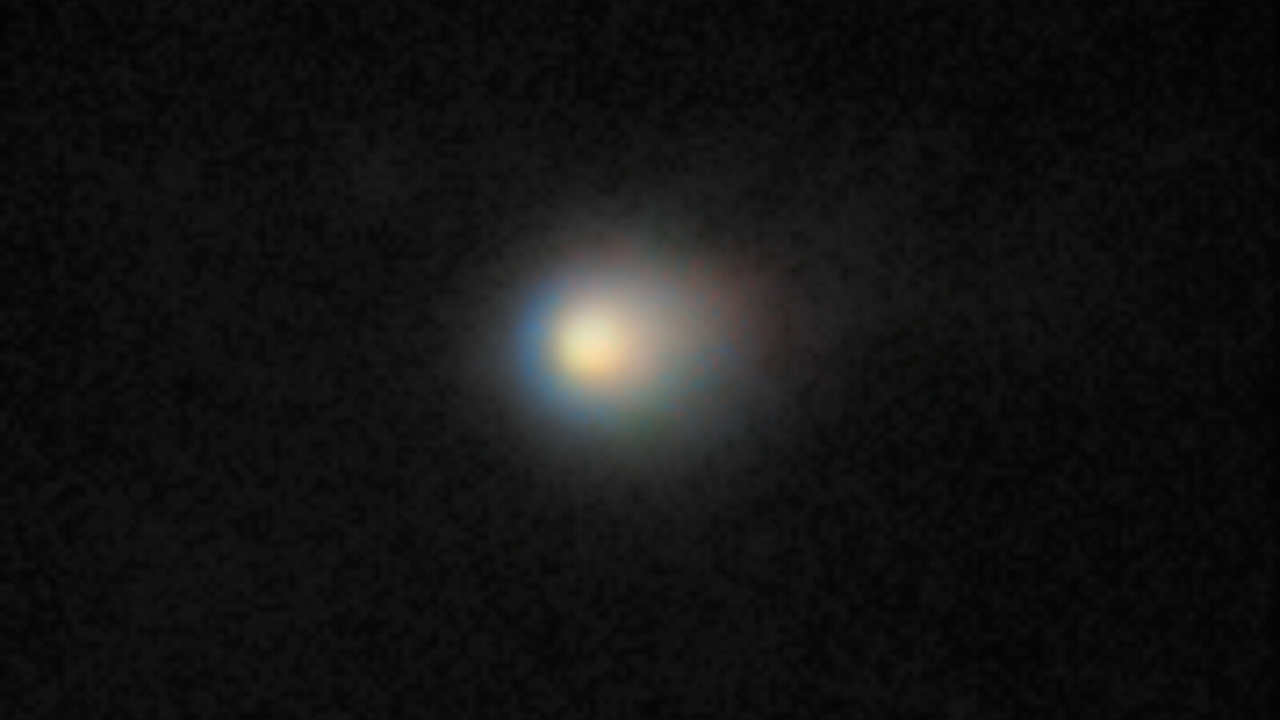
An image of 3I/ATLAS show the bright nucleus and surround haze of gas and dusty. Credit: International Gemini Observatory/NOIRLab/NSF/AURA/K. Meech with image processing by NSF NOIRLab
This is not the first time Loeb has made such claims: he did pretty much the same when 1I/ʻOumuamua passed through the solar system. He also led a 2023 expedition to the Pacific Ocean that claimed to have recovered pieces of possible alien technology left by an unconfirmed “interstellar meteorite” – claims which have been largely debunked since.
One of the biggest issues with this theory – outside of the fact that Loeb and his colleagues offer no substantive evidence for their claims other than speculation worthy of science fiction – is that if 3I/ATLAS is intended to spy on Earth, it’s doing so in an odd way: at perihelion, for example, Earth is pretty much on the opposite side of the Sun to the object, meaning that while it will be brightly lit, that same sunlight will practically blind any instruments on the object from making meaningful optical observations of Earth across the majority of the light spectrum when 3I/ATLAS is at its closest to Earth.
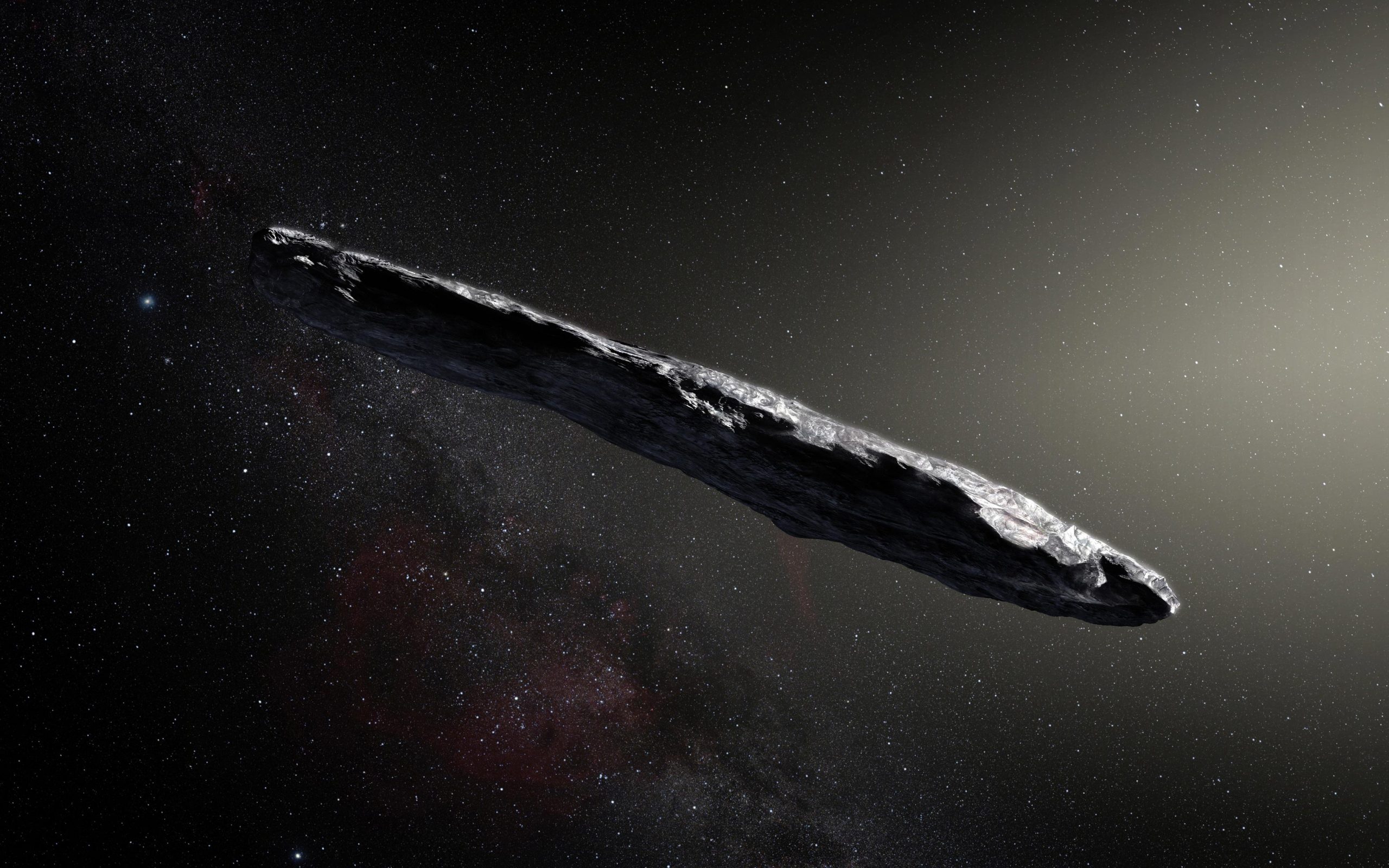
An artist’s impression of 1I/’Oumuamua, which passed through the solar system in 2017, and which was also postulated as an alien probe by Avi Loeb.
In a blog post following the appearance of the paper on arXiv, Loeb’s responded to this critique by proposing that passing on the opposite side of the Sun relative to Earth is intentional on the part of the “probe’s” builders, as it allows them to deposit “gadgets” around Venus, Mars and Jupiter “unseen” from Earth, and these gadgets could then make their way to Earth undetected, and carry out their planned missions.
Most of the scientific community has responded to these claims in an appropriate manner: with a loud collective raspberry; a response which has caused to Loeb, again in his blog post to concede that, “By far, the most likely outcome will be that 3I/ATLAS is a completely natural interstellar object, probably a comet”, thereby largely deflating the “theories” put forward in his own paper.
Astronomers all around the world have been thrilled at the arrival of 3I/ATLAS, collaborating to use advanced telescopes to learn about this visitor. Any suggestion that it’s artificial is nonsense on stilts, and is an insult to the exciting work going on to understand this object.
– Chris Lintott, Professor of Astrophysics, University of Oxford,
co-researcher into the origins of 3I/ATLAS
Smithsonian Pushes Back Against Proposed Shuttle Move
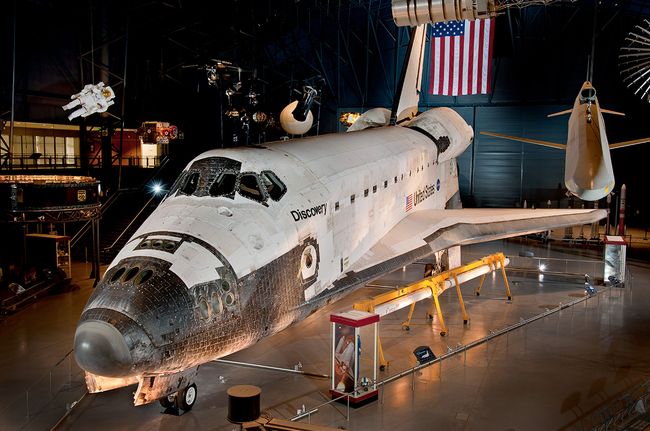
OV-103 Discovery on display in the James S. McDonnell Space Hangar at the National Air and Space Museum Steven F. Udvar-Hazy Centre in Chantilly, Virginia. Credit: Smithsonian Institution/Dane Penland
The so-called One Big Beautiful Bill Act (OBBBA) from the Trump administration contains hundreds of provisions, many of which might best be described as controversial and damaging – such as causing 10.9 million middle Americans to lose health insurance coverage, increasing the US budget deficit by US $2.8 trillion and further exacerbate inequality among the American population by creating the largest upward transfer of wealth to the rich in US history.
Given all this, it seems trivial that the OBBBA is stirring up a potential fight between the Smithsonian Institution on one side, and Congress and the White House on the other. But that’s precisely what is now unfolding.
The Discovery orbiter tribute which hangs in Firing Room 4 of the Launch Control Centre at NASA’s Kennedy Space Centre in Florida, celebrating all of the vehicle’s missions and many accomplishments. Credit: NASA/Amy Lombardo
At the heart of the issue is the space shuttle Discovery, OV-103. The third of NASA’s former fleet of shuttles, Discovery is perhaps the most famous, having flown 39 times in a career spanning more than 27 years and aggregating more spaceflights than any other spacecraft as of the end of 2024.
Following the Columbia tragedy of February 1st, 2003, the decision was made to retire the three remaining operational orbiter vehicles – Discovery, Atlantis and Endeavour – in 2011 and offer them up to institutions interested in displaying them as a part of America’s heritage. As a part of the arrangement it was agreed that those institutions awarded one of the vehicles would house their vehicle in a suitable climate-controlled indoor display space built at their own expense, and meet the US $28.8 million cost of decontaminating one of the vehicles and preparing it for both transportation to, and display within, said space.
In March 2011, NASA announced the Smithsonian Institute had been selected to receive Discovery, which would be displayed at its Steven F. Udvar-Hazy Centre alongside Washington’s Dulles International Airport. Later that year NASA confirmed that Atlantis would remain with NASA and and installed within a purpose-built facility at the Kennedy Space Centre Visitor Complex, whilst Endeavour would be transferred to the California Science Centre in Los Angeles.
Discovery “facing off” with the test article vehicle OV-101 Enterprise outside to the Smithsonian’s Udvar-Hazy Centre, Dulles Airport. Discovery replaced Enterprise as the Smithsonian’s shuttle exhibit in 2012, with Enterprise transferred to the ownership of the Intrepid Museum in New York City. Credit: Autopilot via Wikipedia
During the entire competition, NASA’s Johnson Space Centre (JSC), Houston, Texas, demonstrated little interest in obtaining any of the vehicles, and nor did any major museum institution within Texas. Now, Texas senators Ted Cruz and John Cornyn want to change that in what they see as a vote-gaining (for Cornyn) and populist move to wrest Discovery from the Smithsonian and plonk it down at the Space Centre Houston Museum adjacent to the Johnson Space Centre.
The two launched their effort in April 2025 with their wildly misnamed Bring the Space Shuttle Home Act in April 2025 (if anywhere is “home” for a shuttle orbiter, it is either Kennedy Space Centre – which, as noted, already has Atlantis – or possibly Palmdale, just north of Los Angeles, California where the orbiters were built – and again, Los Angeles has the Endeavour). So popular was the bill in the Senate that it practically vanished without a trace, until the Trump administration kindly folded it into a provision within the OBBBA for reasons unknown.
Under the OBBBA provision, US $85 million is set aside for the transfer of a “space vehicle” to Texas, with Acting NASA Administrator Sean Duffy ordered to nominate which vehicle no later that August 4th, 2025, with the transfer to be completed by January 2027. Whilst Discovery is not specifically named in the provision, there is little doubt at the Smithsonian or elsewhere that it is the “space vehicle” in question.
Discovery on display in the James S. McDonnell Space Hangar at the National Air and Space Museum Steven F. Udvar-Hazy Centre. Credit: Elliott Wolf, via Wikipedia
For its part, the management at the Smithsonian Institute noted that under the agreements to display the orbiter vehicles, NASA ceded all rights, title, interests and ownership for the vehicles to the institutions responsible for their future care. Ergo, they state, Sean Duffy has no legal mandate to arbitrarily reclaim and transfer any of the vehicles – a position supported by the Congressional Research Service (CRS), a nonpartisan arm of the U.S. Library of Congress. And while the Smithsonian is partially funded via Congressional appropriations, it sits as distinct from all federal agencies, allowing it to operate independently and without congressional intervention, a long-standing legal precedent having established that artefacts donated to the Institution are not federal property, even if they were originally government funded.
However, legal precedent has been shown to mean little to the Trump Administration. Nor does the Smithsonian’s management have a final say in matters. That resides with the 17-strong Board of Regents. This comprises the Chief Justice of the Supreme Court (John Roberts), the Vice President of the United States, and three political appointments from the Senate and the House, and nine so-called citizen regents (appointed by the President). Given the political weight within the Board of Regents leans towards the Republican side of things (five to three), the nine citizen regents are seen as having the final say in whether or not the Smithsonian accedes to any demand to give up Discovery for relocation, or is willing to go to court over the matter.
At the time of writing, it was unknown as to which way the Board will go. However, there are some significant challenges facing any potential move of the orbiter, some of which could put it at risk of sever damage or require extensive (and potentially costly) logistics.
First is the problem of actually physically moving Discovery from Washington to Houston. During their service life, shuttle orbiters were moved across large distances using a pair of heavily modified 747 airliners called Shuttle Carrier Aircraft (SCA). However, both of these aircraft were retired in 2012. The first, N905NA is no longer flightworthy, and has spent 13 years as part of a static display with the orbiter mock-up Independence on its back, outside the Visitor Centre at JSC. The second, N911NA, a 747-100SR, was initially transferred to NASA’s Dryden Flight Centre, where it provided spare parts for NASA’s airborne Stratospheric Observatory for Infrared Astronomy (SOFIA), with the shell of the aircraft later given on long-term loan to the Joe Davies Heritage Airpark in Palmdale, California.
NASA’s Shuttle Carrier Aircraft (SCA) N905NA (foreground) and N911NA captured in a rare formation flight over Edwards Air Force Base, California in 2011. Credit: NASA/Carla Thomas
Thus, in order to move Discovery by air, one of these aircraft would have to be fully refurbished, flight-tested and re-certified – which is not going to be a short-term or low-cost undertaking. As an alternative, it has been suggested that Discovery could be transferred by sea.
However, this introduces multiple issues. Even the coastal waters of the North Atlantic are hardly noted for the gentleness of their weather, so Discovery would require the use of a special barge with a suitable (and purpose-built) structure to protect the orbiter from the elements. No suitable commercial barge currently exists within US, and while the US military does have one barge that is large enough, it would require extensive modifications in order to carry Discovery safely. The CRS estimates that the cost of this could amount to some US $50 million.
On top of this are the uses of getting Discovery from Dulles International Airport to a suitable barge embarkation point, and again from the debarkation point in Texas to JSC. This would have to be done by road – and is no trivial matter. When Endeavour was moved just 19 kilometres by road from Los Angeles International Airport to the California Science Centre in 2012, the move took over a year to plan and six days to execute at a cost of US $14 million in today’s terms.
By contrast, moving Discovery from Dulles to a suitable barge embarkation point would require a road journey of between 48 and 160 kilometres, depending on which embarkation point would prove the most feasible for the use of said barge, potentially adding between US $30 to $110 million to the transport costs. Assuming the barge could be brought to the Baywater Container Terminal, Houston, and Discovery safely off-loaded there, a further road journey of some 14 km would then be required to get it to JSC.
Finally, none of this includes the cost of actually constructing a suitable building in which to display Discovery, which CRS estimates is liable to cost the US taxpayer at least US $325 million. All of which adds up to spending a lot to essentially appease a couple of political egos by an administration that is allegedly trying to reduce government fiscal expenditure; particularly when Discovery already has a more than adequate home.
Dutch Coast, August 2025 – click any image for full size
Back in July I received an invitation from Dama (Damatjo Magic) to visit her Homestead region of Dutch Coast, and I’m embarrassed to say it’s taken a better part of a month for me to take her up on the offer.
The majority of the region is offered as a largely public, low-lying sandy island, dotted with birch, eucalyptus, oak and aspen, the upper reaches of the island (such as they are), carpeted with grass and flowers, providing spaces for the local sheep to graze.
Dutch Coast, August 2025
I say the “majority” of the island is open to the public, because there is a private house on the south side, sitting on a large deck and exhibiting something of a Tuscan style to it.
This is one of two private residences in the region, the other sitting on a little island tucked into the south-west corner of the region and which is, I believe, Dama’s private home.
Dutch Coast, August 2025
Outside of these, two other buildings are to be found on the main island, both of which appear to be open to the public. I’m not 100% sure on this, but I didn’t see any privacy notices associated with either.
The Landing Point sits towards the east side of the island, just above the eastern beach as it runs north-to-south, dotted with places to sit – including a beach shack and a small pier. Arcing around to the southern side of the island, the sands become separated from the sea by rocks in the run towards the private house mentioned above.
Dutch Coast, August 2025
To the north, the beach passes around the larger of the two houses which appear open to the public. From here the sands carry on to the second beach house, where rocks once again separate the sand from the sea as the coast runs along the west side of the region and back towards the private house.
The rocks may look desolate, but they are home for a pod of seals that have chosen them as a place to bask in the sun.
Dutch Coast, August 2025
Such is the design of the island that exploration is a simple matter of wandering on foot and appreciating the landscape and wildlife. There are plenty of places for sitting and passing the time for those who so wish, and there are a lot of little details to be appreciated throughout.
Easy on the eyes, with a sunset style of EEP settings and rounded-out by a subtle soundscape, Dutch Coast is an easy, gentle and calming visit. My thanks to Dama for the invitation!
The following notes were taken from my chat transcript + the video recording by Pantera (embedded at the end of this summary) of the Third-Party Developer meeting (TPVD) held on Friday, August 1st, 2025. My thanks to Pantera as always for providing it.
Meeting Purpose
The TPV Developer meeting provides an opportunity for discussion about the development of, and features for, the Second Life viewer, and for Linden Lab viewer developers and third-party viewer (TPV) / open-source code contributors to discuss general viewer development. This meeting is held once a month on a Friday, at 13:00 SLT at the Hippotropolis Theatre.
Dates and times are recorded in the SL Public Calendar, and they are generally conducted in text chat.
The notes herein are a summary of topics discussed and are not intended to be a full transcript of the meeting.
A RFP for replacing Autobuild in the viewer build process.
A RFP for replacing the Havok convex hull decomposition mechanism with an open-source equivalent.
The former RFP is as removing Autobuild as a significant barrier / burden to those trying to learn how to the build the viewer. Suggestions for preplacement include pure Cmake, or using Vcpkg or Conan for dependency management, or vendor dependencies in the repo, etc.
Related to this, Brad Linden has started an experimental branch simplifying LL development environment. In is not ready for general use, but the idea is that the Build Instructions in the README should “just work” and not require having Autobuild installed or set up properly ahead of time. The is part of on-going work to overhaul the viewer build process.
The latter RFP above is part of the Lab’s aim to remove the Havok sub-library from the viewer, which also includes a means to still visualise the navmesh.
The above sparked a short conversation on the viewer build process.
Experimental Rewards / Bounty System
LL has launched an experiment rewards programme offering monetary rewards against certain Github issues.
These rewards are not meant to replace regular open source development, but rather to drive contributions on items LL have been unable to get much traction on.
In Brief
LL has also open sourced the LSL definitions project, the authoritative definition of LSL library functions, types, etc. It is used to perform codegen in the server, building out the bindings for LSL and SLua, and also drives the LSL editor tooltips.
PR Appearance fixes#3492 is still requiring attention from linden Lab, and is currently stalling the work on getting RLV into the official viewer.
† The header images included in these summaries are not intended to represent anything discussed at the meetings; they are simply here to avoid a repeated image of a gathering of people every week. They are taken from my list of region visits, with a link to the post for those interested.







 Inara Pey: Living in a Modemworld