Space Sunday: back to Betelgeuse and some updates

Betelgeuse is the red supergiant star in the shoulder of Orion. After decades of guessing, study and data-gathering, the long-theorised companion star thought to be orbiting Betelgeuse has been imaged – the bright dot in the left inset, marked by cross hairs. The circle marks were Betelgeuse should be in the image, but it has been removed (but shown in the centre inset), to make the companion more obvious in the image. Credit: ESO/M. Montargès et al. (background star field for illustration only, via skysurvey.org).

In 2019/2020 I covered, the excitement caused by the apparent and sudden dimming of Betelgeuse, the variable red supergiant in the constellation of Orion, when the star dropped from being the 10th brightest object in the night skies to the 27th before it recovered in early 2020. At the time there was much speculation on whether we were seeing the first signs the star had undergone a supernova explosion some 600 years ago (roughly the time it takes the light from the star to reach us). Obviously, this wasn’t the case, and the “great dimming” as it is now called was eventually pinned on something more mundane.

To put it simply, massive red giants like Betelgeuse are comparatively short-lived, in the order of 10-20 million years, rapidly burning through their stocks of hydrogen, and successively heavier elements in turn. As they do so – and before they reach a point where the fusion process can no longer be sustained as the energy to power it exceeds the amount of energy produced by it, causing the star’s core to collapse under its own gravity in less than a second and then immediately exploding outward again in a supernova – they go through some notable changes. Firstly, as each fusion cycle – helium, carbon, etc. – occurs at higher and higher temperatures, the red giant massively expands into a red supergiant. Secondly, they become violent, throwing off massive amounts of super-heated gas.

Betelgeuse, at around 8.5 million years of age is well into both of these phases; it expended its supply of hydrogen a very long time ago, expanding to its present size  of around 600-700 times bigger than the Sun. and it is periodically throwing off vast amounts of super-heated gas into space. With regards to the latter, it is now largely agreed that it was one of these clouds of material which caused the illusion of the “great /dimming”.

Thrown out by Betelgeuse so long ago it had long since cooled to the point it could not be seen from Earth, the cloud gradually drifted in front of our view of Betelgeuse during 2019, giving the impression the star was dimming dramatically. Then, as the dust then moved out of our line-of-sight with Betelgeuse in early 2020, the star appeared to return to its expected luminosity.

An artist’s impression of the 2019/2020 “great dimming”. At some point in the past, a large mass of superheat gas was ejected from Betelgeuse close to the direction in which Earth lay relative to the star (l). Over time, this material and cooled to a point where it could not longer be seen from Earth (2). In 2019, the cloud of dust came between Earth and our view of Betelgeuse, giving the impression the star had dramatically dimmed. Credit: Elizabeth Wheatley, STScl

As mundane as the explanation for the “great dimming” might be, it nevertheless caused a renewed interest in another of Betelgeuse’s mysteries: does it have a companion star orbiting it? It’s a question astronomers have been trying to answer for almost 100 years; but the very nature of Betelgeuse – its pulsing variability which makes even accurately determining its distance from Earth difficult (it’s thought to be about 640 light-years away, with a margin of error of +/- 146 light years); the huge and glowing masses of super-heated gases surrounding it, etc., – make finding any companion exceptionally difficult.

However, 2024 two separate studies carried were out in the wake of the “great dimming”, examining the gas clouds and the star’s coronasphere to see if there was evidence for either being affected the mass of a stellar object passing through them. Both studies yielded positive results but came to very different conclusions. The first study concluded the companion was either a white dwarf stellar remnant roughly the size of Earth or a neutron star some 10-20 km across. Either way, it likely had a mass roughly equitable to the Sun. However, the second study concluded the companion was almost equitable in size and mass to the Sun, and orbiting Betelgeuse so close it will likely be consumed by the larger star within 10,000 years.

Following up on these studies in 2025, a NASA team observed Betelgeuse using the Gemini North Observatory in Hawai’i. They pretty much confirmed the second of the 2024 studies: there did appear to be a companion star orbiting very close to Betelgeuse; however it appeared to be an F-type pre-main sequence star with roughly 1.5 to 1.6 times the mass of the Sun. Such was the NASA team’s confidence in their findings, they informally named the star: Siwarha, meaning “her bracelet” in Arabic, reflecting the fact that Betelgeuse means “the hand of al-Jawzā”. The name was subsequently accepted by the International Astronomical Union (IAU).

A visualisation created by the National Optical-Infrared Astronomy Research Laboratory using data captured via the Gemini North Observatory in 2025, showing Betelgeuse, minus its coronasphere (which would otherwise obscure the companion star with its own brightness) in orange; and in blue, the light of its companion star: Siwarha. Credit: NASA Ames / NOIRLab

More recently, a team of astronomers used the data from the NASA study to calculate where Siwarha would be at the furthest distance its orbit would carry from Betelgeuse as seen from Earth, and the time at which this would occur. They used these calculations to direct the European Southern Observatory’s Very Large Telescope (VLT) cluster in Chile to observe Betelgeuse at the specified time to try to both image Siwraha and gather more data that might be used to better characterise it.

The results were both satisfying and a little mystifying. On the one hand, Siwraha was exactly where the calculations said it would be, and the team were able to image it. However, the data gathered by the VLT’s instruments suggest Siwarha is a B-type main-sequence star some three times the mass of the Sun and between 2 and six times its size – in other words, very different to the star indicated by the NASA study.

There could be many reasons for this; as noted, trying to identify a stellar body which would effectively be little more than a marble compared to Betelgeuse’s soccer ball, and in so dynamic a region of space, isn’t easy. So as the VLT team note, more observations are required to better understand Siwarha’s nature. But in the meantime, it would seem that the 100-year-old question on whether or not Betelgeuse has a companion has been affirmatively answered.

An enlarged view of Siwarha showing its coronasphere (larger dot in the cross hairs and the bright dot of the star itself. Betelgeuse (which would be where the circle is located) has been digitally removed, to make Siwarha clearer. Credit: ESO/M. Montargès et al.

And what of the potential of Betelgeuse going supernova? Given its age and characteristics, astronomers agree that – if it hasn’t happened in the last 600-ish years – it will happen in the next 100,000. However, if it has happened within the last 600-ish years, our first indication will not be a sudden blossoming of light in the night (or even daytime, it will be that bright) sky. Instead, the first signs of its supernova will come invisibly in the form of a blast of neutrinos hitting a global network of detectors called the SuperNova Early Warning System (SNEWS) located deep underground.

This is because when the core of  a star destined to go supernova collapses, it generates a massive burst of neutrinos ahead of the actual supernova event. These travel outward at almost the speed of light, unhampered by the intervening matter of the the star. The light and energy created by the supernova, however, does have to propagate up through those layers of stellar matter, taking several hours to do so. Thus, this neutrino blast will reach us hours ahead of any light from the supernova, and SNEWS will be able to trace their point of origin.

Updates

The Rescuer in need of Rescuing

In June I covered the daring attempt to rescue a NASA satellite – the Neil Gehrels Swift Observatory – from re-entering Earth’s atmosphere in October 2026 and burning up, by using another spacecraft to link up with it and gently push it up to a higher orbital altitude (see: Space Sunday: NASA – a rescue attempt, costs & infrastructure).

The mission got off to a good start. The rescue vehicle, built by Arizona-based Katalyst Space Technologies and called LINK, carried into space by a Pegasus XL air-launched rocket, successfully reached its initial orbit. Once there, it was able to deploy its solar panels for power and enter a period of check-out, calibration and commissioning before starting on its way to rendezvous with the Swift Observatory. However, on July 28th, NASA announced things had gone a little sideways: two out of the three reaction wheels on the spacecraft have ceased functioning, and its cold gas thrusters are also suffering a “loss of functionality”.

A set of an artist’s renderings of LINK in space and rendezvousing with Neil Gehrels Swift Observatory, ready to gently push it up to a safe operating altitude before atmospheric drag causes it to re-enter the atmosphere and burn up. Credit: Katalyst Space

Reaction wheels are a means to precisely control  the orientation of satellites and spacecraft where the use of thrusters isn’t precise enough and / or could lead to excessive propellant depletion. The failure aboard LINK means it is now slowly spinning and only able to achieve intermittent communications with Earth. Further, the issue with the cold gas thrusters means that these cannot be reliably employed to slow the spin and correct LINK’s orientation.

At the time of writing, both Katalyst and NASA are working through the issues in order to recover the spacecraft. At the same time, and as a back-up measure, work is being carried out to reconfigure the software controlling LINK’s more powerful and propulsive ion thrusters so that if necessary, they might be used in a manner similar the vehicle’s cold gas thrusters, firing short, gentle bursts at appropriate times in the spacecraft’s slow tumble and bring it under control.

And in a twist of history, in 2022, the Swift Observatory also suffered a failure within its reaction wheels, causing NASA to place it in a “safe” mode until the matter was resolved and the observatory could resume normal operations. Hopefully, the same will be true for LINK.

Thar’ She Floats!

It’s probably more than apparent that I’m (one of many) not convinced that SpaceX’s Starship / Super Heavy system is actually a viable commercial launch system with a genuine ROI. It is most certainly not the vehicle that will “take humanity to Mars” or anywhere else in the wider solar system or realistically deliver on any of the other promises made by the SpaceX CEO. However, credit does fall where credit is due.

“I’m still floating better than I ever did. Looking like a true survivor, coming back from outer space” – Starship S40 in the Indian Ocean, 5 days after splashing down. Credit: SpaceX (and apologies to Elton John!)

As I covered in my previous Space Sunday update, the system completed its 13th integrated flight test (IFT-13) on July 24th which achieved the majority of its stated goals, potentially clearing the way for an orbital launch attempt with IFT-14. However, perhaps the most remarkable thing about IFT-13 is the fact that on splashing down in the Indian Ocean, Starship S40 didn’t exit this world by blowing up in the manner of its predecessors, but gently keeled over to float on its back.

And it is still afloat, which is equally remarkable, and speaks to its overall structural integrity. Having taken the time to careful study the vehicle following its splashdown – particularly the condition of its heat shield tiles – SpaceX has indicated it may try to attempt a recovery of the 52-metre long, 100-tonne vehicle by towing to Australia – a distance of around 1,200 km – where it can be transferred to a suitable ocean-going barge for transfer back to the United States!

ESCAPADE’s Long Road to Mars Captures the Moon and Earth

In November 2025, and on its second flight, Blue Origin’s New Glenn rocket sent two small NASA satellites built by Rocket Lab on behalf of NASA on their (indirect) way to Mars (see: Space Sunday: New Glenn “welds” it on second flight!).

The mission, called ESCAPADE (Escape and Plasma Acceleration and Dynamics Explorers) is intended to orbit Mars with the two satellites (informally called Gold and Blue) in a study of the planet’s magnetosphere and how solar wind contributed to the loss of most of the planet’s atmosphere. However, under the original plan, the two 1/2 tonne satellites were supposed to have been launched with NASA’s 16 Psyche mission in 2023, effectively hitching a ride with that spacecraft which would make a fly-by of Mars. However, changes to the 16 Psyche mission meant ESCAPADE could no long launch with it, and so it eventually departed Earth outside of the normal 26-month optimal Earth-Mars launch windows.

This meant that as launched the two satellites could not reach Mars directly. Instead, they were placed on a looping flight around the Sun-Earth L2 position before swinging back towards the Earth-Moon system in first of two fly-bys. This took place in early July 2026, and was used to calibrate the imaging systems on both vehicles, by capturing images of the Earth-Moon system in natural light, ultra violet and infrared.

The Earth (l) and the Moon (r) imaged by an ESCAPDE spacecraft during the July fly-by. Earth is 584,600 km from the spacecraft and the Moon 186,100 km. However, the false perspective of the image appears to suggest Earth and the Moon are roughly the same size, and Earth is the nearer of the two to the spacecraft. Credit: NASA

Both Earth and the Moon are 8% sunlit crescents in the image, with the Sun just out of frame to the observer’s right. The image also presents a comparison of albedo (reflectivity), with Earth is around 30% reflective overall thanks to sunlight being reflected off of the planet’s cloud tops. Meanwhile the Moon is a dull 7%.

When seen in the infrared, the difference is more apparent: even the side of Earth apparently in shadow shines with a temperature range of -43o and -10o, which might sound low in this age of global warming, but remember it is the night side of the planet and includes the temperature of the oceans there. By contrast, the Moon’s shadowed side is -173.3o.

ESCAPADE image showing Earth (l) and the Moon in infrared wavelengths. Credit: NASA

Currently, both satellites are on the outward leg of a shorter loop away from Earth. They will return in November and perform a close gravity-assist flyby which will set them on course to reach orbit around Mars in September 2027.


Natthimmel’s undersea world of Sula Sgeir in Second Life

Natthimmel – Sula Sgeir, July 2026 – click any image for full size

Sula Sgeir – or Sùlaisgeir in Gaelic – is one of the most remote isles to be found in the British Isles. Less than a kilometre in length and about 200 metres across including a headland, it is marked by high cliffs, frequently inhospitable weather, and remains uninhabited by humans for most of the year.

The island is most famous for its population of gannets, and (more infamously) for the annual autumnal ‘guga’ hunt for young  gannets by men from the Isle of Lewis, 70 kilometres away, where the bird is considered a delicacy.

Natthimmel – Sula Sgeir, July 2026

I mention all of this because Sula Sgeir is the name given to the latest Natthimmel region build by Konrad Rune and Saskia Rieko, this time additionally assisted by Art Oluja (Artistik Oluja) who has added a fantastic soundscape to the setting.

However, rather than focusing on the actual island of Sula Sgeir and its bloody and callous hunt, Natthimmel’s Sula Sgeir focuses on an underwater environment through which visitors can engage in their own far more pleasant adventures: diving, swimming and exploring the ocean depths either freely or aboard a 2-seat mini sub or on a “jelly(fish) ride”.

Natthimmel – Sula Sgeir, July 2026

The Landing Point is a small deck on an outcrop of rock rising above the waves and loomed over by a gigantic Moon. While this island is small, it does contain the skeletal remnants of a great dome standing behind it – a possible hint of a waiting mystery?

The deck includes givers for a swimming HUD, the “jelly ride” (which is a wearable vehicle by Art), and a rezzer for the mini sub. The latter is of Konrad’s design, and a neat little 2-seaters for sharing with someone or simply enjoying on your own.

Natthimmel – Sula Sgeir, July 2026

Beneath the waves is a strange and haunting world, one in which it is very easy to take on the spirit of Jacques Cousteau when exploring its depths.

However you opt to go, once you are underwater it is essential you have local sounds enabled to add to the sense of immersion as you move amidst fields of tall seaweed, forests of twisted corals, and over an almost alien landscape of strange luminant aquatic plant life.

Natthimmel – Sula Sgeir, July 2026: “We cruised on, slowly descending to leave most sunlight behind, our headlamps spearing the darkness. At first there was nothing, then, slowly out of the watery haze, giant and majestic figures emerged…”

In the shallower waters, sunlight attempts to probes the water, shafts of light spearing down. Elsewhere it is possible to spot the red glow of ocean floor vents and the now quiet mouths of fumaroles gaping wide, the heat that may have once caused them to once belch clouds of mineral-rich gases long since moved on.

As visitors skirt jellyfish and schools of fish, the flickering, hazy light will eventually reveal the giant denizens of this world. A trio of giant manta rays appear to holding a council session; humpback whales slowly emerge through veils of shimmering, fading sunlight, whilst the ghostly forms of blue whales appear from within the forests of seaweed and kelp-like growths.

Natthimmel – Sula Sgeir, July 2026: “as we slowly circled the motionless leviathans, we realised they were not alone. To figures floated listlessly, victims of some catastrophe we had yet to understand, and the whales remained, bodies inclined with heads down, as if mourning this tragic passing…”

This is a place holding secrets as well. The humpback whales have their great heads dipped as if in mourning, the lifeless forms of two divers in deep sea gear with airlines detached and the visors of their helmets glowing eerily, floating before them, caught in a state of neutral buoyancy before they could reach the surface. What happened to these poor souls is open the question – perhaps they are connected to the secret hidden in deeper waters.

Then there are the glowing fronds and planets and the strange blue veins to be found in some of the rocks. What do they signify?

Natthimmel – Sula Sgeir, July 2026

It is to the north and west where this ocean’s secret lays. Here, the the sea floor falls away sharply and sunlight is left behind. At first it appears to be an abyssal deep where not even the whales stray, leaving only the tall fonds and watery growths. But then, from between the growths comes a dance of light, a flash which demands attention.

Close on this lone point of light and it will reveal itself as an abandoned deep ocean structure, its domed roof mindful of the wrecked dome at the region’s Landing Point. Pipes run into it from the surrounding seabed, but what might it be? And what is it lying within, expanding and contracting slowly as if in respiration?  Those are questions to be answered by your own imagination.

Natthimmel – Sula Sgeir, July 2026: “Our descent into this strange world continued, slowly approaching the limits of our dive capabilities. We were about to come to a halt and start an ascent when something loomed up from the sea floor, something which should have been impossible: a structure apparently made by human hands…” 

For my part, I will only suggest that getting down to this strange structure is possibly best done using one of Konrad’s mini subs. Whilst a little choppy on the controls, they handle well enough, and going down into the depths of the setting in one definitely heightens the sense of mystery and deep-diving adventure.

My only other observations would be to make sure you obtain introductory notecard at the Landing Point – it contains a backstory touching on the mysterious nature of Sula Sgeir. Also, as if it needs mentioning, do make sure you use Natthimmel’s Shared Environment when visiting, and for the best immersion, make sure you are running a PBR capable viewer.

Natthimmel – Sula Sgeir, July 2026

I have never failed to be impressed by the designs Konrad and Saskia create for Natthimmel, and this remains the case with Sula Sgeir. Fascinating, and engaging, it is a genuinely captivating aquatic environment given additional life by Art’s soundscape, and definitely not a destination to be missed.

Slurl Details

Abstractions of Gorky Park and of memories and emotions in Second Life

IMAGOLand and Galleries: Kirjat Umarov – The Autumn Sun at Gorky Park and other Stories
If I had to say where I felt most alive in my life, or name the place I long for most, or the one I would want to visit again, the answer is: Moscow.

So notes artist and Second life resident Kirjat Umarov in introducing his exhibition The Autumn Sun at Gorky Park and other Stories, which opened at Mareea Farrasco’s IMAGOLand & Galleries on July 21, 2026.

This is a very personal collection of pieces, centred on a celebration of Gorky Park, which Kirjat notes he has been able to visit in both in spring and winter whilst in Moscow, but never in autumn. Thus within this exhibition we have original art which starts from the idea of imagining Gorky Park in the months of autumn, and which broadens into so much more.

IMAGOLand and Galleries: Kirjat Umarov – The Autumn Sun at Gorky Park and other Stories

This is not, however, a series of “traditional” paintings of landscapes directly reflecting the park and its physical structures as we might see them (photos of which can be found in one corner of the exhibition space). They are abstract in nature, suggesting through their use colour – the yellows and golds of autumn, the pale blues of colder autumnal sky, the greys and darker colours of autumn’s wetter moments.

At the same time, the colours are a reflection of memories of Gorky Park and Kirjat’s life as a whole; the warmer, bright shades representing happier times, the darker colours hinting a times apart or times of sadder thoughts. Within several of the pieces are blocky forms, silhouetted outlines: a church, suggestions of a city’s skyline. They serve both as echoes of the city and nation in which the park sits, and of those more personal memories and emotions.

IMAGOLand and Galleries: Kirjat Umarov – The Autumn Sun at Gorky Park and other Stories

Thus, within all of the pieces lay – as Kirjat calls them – “painted memories”, real or imagined, both from his own experiences and of emotions that might be felt on seeing a familiar place but dressed in the colours of a season for the first time. In this way, they draw us into them and interpret them, gently putting our imaginations to work as they provoke the senses. They create snippets of stories which might be shaped by our own emotions and memories to produce new stories; stories which are not necessarily bound to Gorky Park or Mother Russia. The paintings simply invite us to drift through the libraries of our own memories of places visited, times remembered, times missed, and the seasonal colours of emotion and imagine.

An engaging selection of original physical world art.

Slurl Details

Farewell to Grauland in Second Life

Grauland / Primary Colors, September 2024 – click any image for full size

MorganaCarter, who is one of multiple people who have pointed me to various regions and parcels over the years, dropped me an IM directing me to Jim Garand’s Grauland Flickr group, and specifically to an image and message simple in form, but very saddening:

Grauland Is Gone.
Say Good Night
The Party Is Over
Grauland: Spires of Sector 7, June 2026

Many people in SL have regarded Grauland as a favourite location; a place to visit and enjoy, each new iteration bringing something special to our digital world.

For more than seven years I’ve routinely visited it to appreciate Jim’s work and to blog about it. And while I didn’t managed to captures every single version of the region which arose in that time, I did cover 30 – and I will genuinely miss being able to visit it and see what else has come forth from Jim’s fertile imagination.

Grauland, March 2019

The builds Jim has presented with Grauland were always unique, although there were certain themes to which he would return – sci-fi, urban, minimalist, industrial -, but no single design ever re-tread exactly the same path as any previous design.

My first visit was in March 2019; I think that was to the first region build Jim had opened to the public – but I could well be wrong on that. At that time, the region was leaning heavily into a landscape-as-gallery, featuring things like an arrangement of great concrete blocks (a geometric motif which would oft appear in Jim’s designs in various guises), an indoor galley and outdoor 3D displays.

Grauland, July 2020

Art always remained a part of Grauland, be it front-and-centre, as in March 2020 with Grauland Castle and Art Park and again in July of that year in which an ancient henge, modern architecture and statuary all combined with the landscape, or with June 2021’s Grauland Falls; sometimes it was more subtle, as with October 2021’s Grauland’s Lights, where geometrics forms and a cityscape served to highlight the use of lighting in Second Life; sometime it even appeared to be a natural part of the architecture or urban space – a graffiti-marked statue here, wall paintings there…

Grauland / Corsair Island, July 2024

As well as offering unique designs, Grauland could also present places inspired by locations in the the physical world – tropical islands, deserts, urban centres and industrial outlands and more. Iceland in particular became the focus of two designs (both favourites of mine, as I’ve always loved the times I’ve spent in that country) – July 2023’s Grauvik and February 2025’s Grauvik 2 – both of which were set on a fictional island just off the Icelandic coast.

Grauland, January 2023

As noted earlier, Grauland also took us to places far away from Earth. Some of these carried with them the opportunity for visitors to create a back story to account for the mystery which might be implied within them (November 2023’s  Grauland / The Deity Machine) or engage their their sense of adventure, as with January 2023’s visit to a space station and a Mars-like planet, together with The Grauland Cluster (September 2025) and June 2026’s visit to the Spires of Sector 7.

One – The Last Trees, from April 2024 – might be seen as gentle warning about the perils of unchecked global warming here on Earth, whilst Arrakis / Fremen Home in May 2025 offered a take on Frank Herbert’s Dune.

Grauland, January 2020

One of my favourite industrial designs Jim produced was Grauland / Primary Colors (September 2024), a marvellous setting in which primary colours were very much part and parcel of the build, often in the most subtle of ways (just look at the use of red on the locomotive), and which very cleverly gave a hint as to where it might reside were it in the physical world thanks to an advertising board.

Grauland, January 2022

Grauland is going to be missed by many, and there is so much more that might be written about it, but I’ll close here with the words I left for Jim on the Grauland Flickr group – if you’re also a fan of his work, I hope you’ll leave some words of appreciation as well -, and a couple more images.

Will always appreciate the work you put into Grauland, Jim, and in being able to visit and blog. Many, many, thanks for all the time and effort and consistently building special places for us all to enjoy.
Grauland Grauvik, July 2023

The Grauland Cluster, September 2025

Related Links

2026 week #31: SL CCUG meeting summary

Hippotropolis Campsite: venue for CCUG meetings
The following notes were taken from:

  • My chat log and audio recording  of the Content Creation User Group (CCUG) meeting of Thursday, July 30th, 2026.
  • Please note that this is not a full transcript of the meeting but a summary of key topics.
Table of Contents

Meeting Purpose

  • The CCUG meeting is for discussion of work related to content creation in Second Life, including current and upcoming LL projects, and encompasses requests or comments from the community, together with related viewer development work.
    • This meeting is generally held on alternate Thursdays at Hippotropolis and is held in a mix of Voice and text chat.
  • Dates and times of meetings are recorded in the SL Public Calendar.

Official Viewer Status

General Viewer Notes

  • While viewer 26.3 is now available as a Release Candidate viewer, it does not include all the hoped-for performance improvements (particularly with some of the texture streaming work.
    • This was because of time constraints in getting the updates tested across as many hardware configurations as possible.
    • As a result, this work will be held over for the Graphics Care Package (GCP) viewer.
  • The GCP viewer is a lot of fixes and improvements around PBR and correcting issues within it as far as possible. It is hoped that this viewer, which has been suffering a lack of resources, will start to move forward once more in the near future.
  • Various pull requests (PRs) are now being looked at and worked on (e.g. semi-transparent media on a prim), but no guarantees as to when these might surface in a viewer.

Lua Updates

  • There is a new versions of the Lua editor viewer, as noted above.
  • This includes a new version of the VSCode plugin.
    • This has a much tighter integration with the viewer.
    • It is possible to select multiple objects in-world and open them for examination in a Visual Studio panel and then manipulate them (e.g. stop scripts, remove scripts or notecards) subject to permissions.
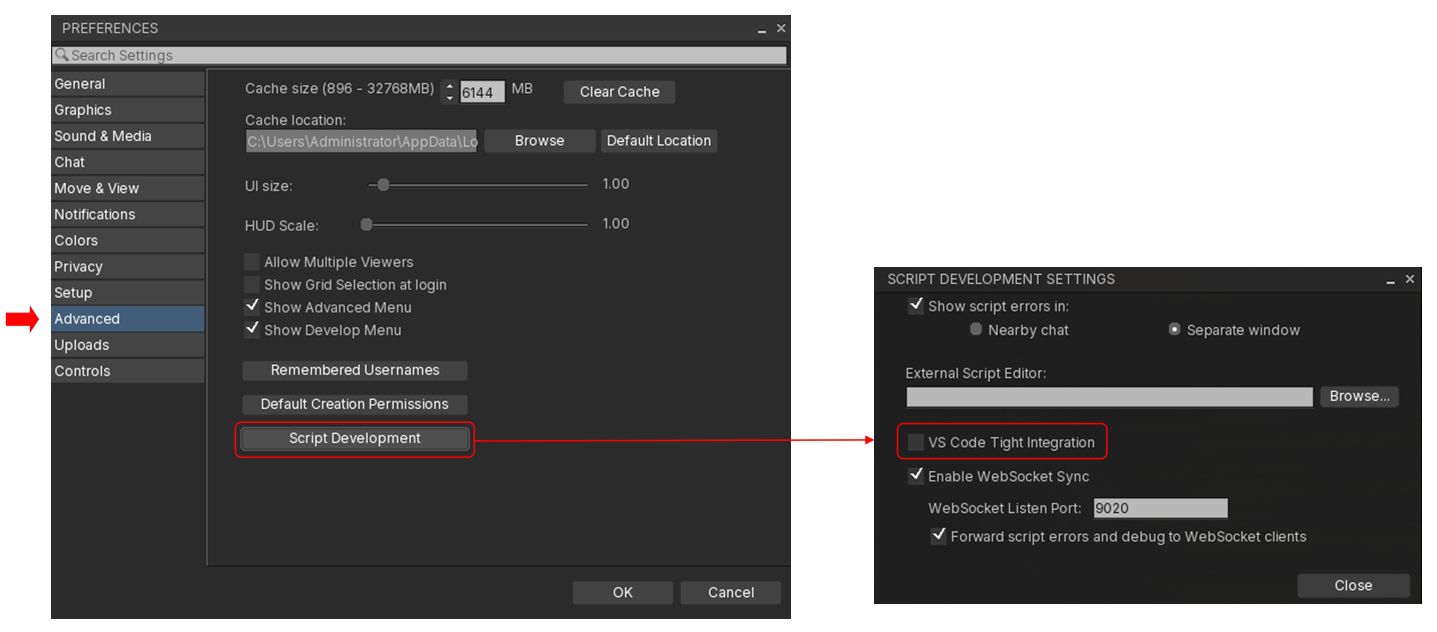
  • These new features do need to be enabled for use in the viewer:
    • Preferences → Advanced → Script Development → Script Development Settings floater → check VS Code Tight Integration.
Enabling tight VS integration on the most recent Lua editor viewer
  • Rider Linden is actively looking for bug reports on both the viewer and the VS Code plugin.
  • Note that the above does not mean that Lua is grid-wide.
    • Server-side support for Lua scripting remain available only in those regions with the required back-end code.
  • Currently, the hope is to:
    • Have the Lua editor got to beta / Release Candidate status after the 26.3 viewer is promoted to release status, with the caveats again being a) viewer priorities may change; b) at the time the viewer reaches beta / RC, Lua code support in the viewer still may still be restricted to those regions running on simulators with the required back-end support.
    • Have the back-end support for Lua deployed grid-wide “some time” during quarter 3 2026 (e.g. between this meeting and the end of September 2026)
  • Official Linux support remains with the Lua editor viewer as its first release.

General Discussion

  • Discussion on mesh improvements are continuing internally at LL. This is something the Lab wants to get done, but it may not be something that surfaces in the near future. Once the internal discussions have led to decisions, then more details will be put to the CCUG for discussion.
  • The game_control code now might not ship with the Lua editor viewer given the additional back-end work Leviathan Linden has agreed needs to be done (see my notes from the previous Leviathan Office Hours meeting).
  • A demonstration of a means to export scripts from a HUD to an external app to assist with HUD creation / positioning / testing was demonstrated (videos here, here, here and here). The end goal for the project – making it available to others and how, was not too clear.
  • The above led to the subject of SVG support in the viewer being again raised.  This is seen by Geenz as being “something that could be interesting at some point”, but the Lab is “a ways off” of having time for the work outside of MOAP.
    • In the meantime, Callum Linden is looking at MOAP + SVG support and what can be done there.
  • Viewer-native (aka “official”) PBR support for Bakes on Mesh (BoM):
    • Geenz noted there is interest at LL in providing this, but there there are various pre-requisites and consideration to be worked through, together with priority.
    • One example of this is: considering how to combine PBR BoM with Blinn-Phong, with a prerequisite being PBR specular support in the viewer (which is due to be a part of the GCP viewer).
    • There is also some need for work on BoM in general, such as improving elements of the UX.
  •  glTF lights:
    • glTF lights are described as “still a ways out”, but SL is getting radiometric units per the glTF specification for the Sun and Moon as a part of the GCP viewer.
    • Point and spotlights are a “much bigger ask” requiring additional wire protocol work and updating object parameters. As such, there is work in advance which needs to be completed in order to make point and spot lighting “doable”.
  • The above touched on shadow casting, which was seen as a combination of being something that might have to wait for the graphics API / Vulkan work, and as requiring sufficient controls and settings so as to allow users to adjust it for performance on their hardware.
  • A pull request (PR) to add the ability to take screen shots with a transparent background only showing avatars, Animesh, particles from the avatar, objects sat on, and selected objects (eliminating green screens) has been put forward and looks like it is going to be accepted.
  • A question was asked if the consensual system at the Adult Welcome Hub (see my review here) will be made available to content creators for use grid-wide. There is apparently a Feature Request asking for this, and it is under review.
  • Geenz requested that if people know of regions  parcels with pre-PBR EEP settings which look “broken” when viewed on a PBR viewer rather than a non-PBR viewer (e.g. things seem to be unnatural dark or objects are unnaturally glowing, etc., when see on a PBR viewer but not on a pre-PBR viewer such as non-PBR versions of Firestorm), to please for LMs to him for investigation. This does not include PBR EEP settings looking differently on pre-PBR viewers, etc.

Next Meeting

Gazing into The Looking Glass in Second Life

The Looking Glass, July 2026 – click any image for full size

It has been a decade(!) since I last visited The Looking Glass, the stunning region that is home to creative genius of Marcus Inkpen and Sharni Azalee, supported by ColeMarie Soleil.

It’s been a place which has captured imaginations time and again down the years, and has been on my list of places to revisit for a fair while, particularly since the more recent graphical and performance improvements made to the viewer.

The Looking Glass, July 2026

For those who may not be familiar with the work of Marcus (aka artist, musician, writer and actor J. Matthew Root) and Sharni, they are two long-time Second Life creators with a focus on fantasy designs.

Those who participate in the annual Fantasy Faire will likely be more than familiar with their work; between them they have over a decade and more, produced marvellous regions for that event.

The Looking Glass, July 2026

For his part, Marcus specialises on architecture, while Sharni creates everything from furnishings and décor items to plants and flora to mystical and fantasy elements, many of which are used to bring life to their designs, as is amply demonstrated in the Fantasy Faire worlds and within The Looking Glass.

Both are incredibly talented artists, and I’ve had the pleasure of witnessing their work in the past as both a reviewer and judge of University of Western Australia art events (now sadly gone from SL), in which Sharni’s work has been justifiably the recipient of multiple awards.

The Looking Glass, July 2026

The Looking Glass offers a truly marvellous means of immersion into their combined work. Almost everything within the region has been created by either Sharni or Marcus, and can be found in The Looking Glass (TLG) store, which is perfectly blended into the setting, residing as it does within a number of buildings.

However, the region isn’t merely a showcase of designs; it is a world to be explored from its waterfront Landing Point through to the islands serenely floating in the sky. Within it can be found places of romance such as the ballroom, places to share in the company of someone close, gardens of fae and magical delights, places for celebrating dance and music, corners of mystical goings-on – there is even a hidden crystal chamber awaiting discovery (among other hidden places).

The Looking Glass, July 2026

And, of course, there is the citadel climbing nigh-on 200 metres into a sky slowly brightening in response to a rising Sun.

With hundreds of windows lit from within and staring all around, the citadel alone is a place of wonder in its design and size and as a place of exploration and discovery. Not only does it feature the core of The Looking Glass store (with more to be found within the Basilica and the Feed your Head store close by), it houses an art gallery recalling Fantasy Faire Builds by Marcus and Sharni from times past, together with an exhibition of Marcus.

The Looking Glass, July 2026

To help people find their way around, there are teleport stations, but for initial explorations, I really recommend stating on foot; the stations are plentiful enough to be easily found during on-foot explorations.

That said, there are areas within the region which do require the teleport system to reach them. Chief among these are the upper reaches of the citadel, which include a Library with an outdoor space and neighbouring room However, the teleports do not connect to all the points of interest; some, such as the floating islands and upper reaches of the citadel (which I believe are open to the public) appear to require flying to reach them.

The Looking Glass, July 2026

Stretching out from the citadel tower and diagonally across the region is a great bridge, its arches taller than any of the buildings clustered to either side of it. Easily spanning woodland at water channels, the bridge extends out to the events amphitheatre whilst  offering a magnificent, lantern-lit look back at the great tower.

With its own dome of stars twinkling under the lavender-tinged sky and cross which blazing meteors arc, this is another magical place. As well a offer a stunning view at the citadel, the bridge offers an excellent vantage point to look out over the town and lands below, providing a marvellous view of the great open-air ballroom in its ring of ruins.

The Looking Glass, July 2026

A ramp curls around the tor on which the amphitheatre stands, providing access both to and from the ground. I do suggest walking up (or down, if you come to the amphitheatre from the citadel) it and through its tunnel.

Keep your eyes peeled as you do, and you might find the entrance to one of the hidden secrets of The Looking Glass. Another is to be found here as well, just be prepared to get a little wet when accessing it J .

The Looking Glass, July 2026

The Looking Glass is a place of great beauty and a huge attention to detail. Tucked away throughout are corners presenting places of retreats along with the floating islands. There are also touches of whimsy to be found as well – who knew hobbits drove VW Beetle convertibles, for example!

There are also more semi-hidden places to steal away to, some of which add a certain sense of character and life to the setting. Several of the buildings, far from being mere display pieces are furnished, with one or two heightening the sense of mysticism present throughout.

The Looking Glass, July 2026

Even some of those which are not furnished have been set to enhance the feeling that this is a place where times and life passes: lights shining from windows, fires visible in hearths – even a bureau tucked into the small bay of a house, topped by an ornate Moroccan tea set and softly lit by a lamp, gives the impression someone is at home.

To summarise – a genuine work of art from the tallest tower to the most hidden of chambers. Timeless, it sits as a song to the creative potential of Second Life.

The Looking Glass, July 2026

Slurl Details