In keeping with statements made in recent user group meetings, Linden Lab has announced changes to the the Second Life minimum system requirements for both Windows and Apple MacOS operating systems which are to take effect from Saturday, July 1st, 2023. Specifically, from that point onwards, Linden Lab / Second Life will no longer support:
The 32-bit version of the Windows operating system.
Any version of MacOS below 10.13 High Sierra.
Available stats for Windows suggests that the percentage of users running the 32-bit version is in the low single-digit numbers by percentage – and many who are running it do so on hardware capable of supporting the 64-bit version. The stats for MacOS version below 1013 are less clear, but High Sierra has been generally available since 2017.
With these changes it is further noted that:
Users running the viewer on the 32-bit Windows will still be able to access Second Life after July 1st, 2023 – however, they will not be supported by the Lab’s support teams if they have viewer difficulties.
User on versions of the MacOS preceding 10.13 will need to upgrade their operating system to a newer version to access future Second Life viewer updates.
The steps are being taken to allow the Lab to focus on stability, performance and maintaining compatibility with the most up-to-date technologies, as well as viewer security considerations.
To help those users either running Windows 32-bit or an older version of MacOS maintain parity with the SL minimum system requirements from July 1st, 2023 onwards, the Lab provides the following advice:
Second Life 32-bit Windows Viewer Users:
Ensure your computer meets the system requirements for the 64-bit Viewer.
Back up your preferences and settings before making the transition.
Download and install the 64-bit version of the Second Life Viewer.
MacOS Users Older than 10.13:
Check the Apple support website for information on upgrading your operating system.
Upgrade to a supported version of MacOS that meets Second Life’s minimum requirements.
Before upgrading, backup your important files and make sure your system is compatible with the newer version of MacOS.
For full details on the changes, please refer to the official blog post. Concerns / feedback should directed to Linden Lab, as I am unable to address support issues.
NordShore, May 2023 – click any image for full size
It’s been some six years since I had the pleasure to visit NorderNey, the always photogenic region held and designed by Jacky Macpherson, my last visit having been in 2017 (see: A return to NorderNey in Second Life). One reason for this is that it has actually been closed for a while – I’m not sure precisely how long – and Jacky has been spending some of her time on other projects, including designing regions for others, including Vally Lavender (see: Time at Valium Creek in Second Life, from 2020) and VUK Store (see: A visit to VUK in Second Life, from 2019), as well as her own (see: A Nutmeg Getaway in Second Life, again from 2020).
So when Shawn Shakespeare informed me Jacky was back with a “Nord”-related build, I decided to leap over and take a look recently and at a time when I really should have been a-bed! NordShore, a Homestead region design, may not be a direct continuation of NorderNey, but it does have that titular link, and there is a styling about it that does bring to mind past iterations of NorderNey. It is also a build carrying a soft echo of Gateway – Nutmeg, linked to above, although it remains entirely unique to itself.
NordShore, May 2023
For inspiration with this design, Jacky turned to the oft gentle, oft rugged county of Cornwall, England; a place that can be both a holidaymaker and tourist magnet and also a place of unspoiled, remote-seeming beauty. It is these latter aspects of Cornwall Jacky has used to fire her imagination, sprinkling her ideas with little Tuscan touches; and while she specifically mentions Cornwall’s coastline as her point of inspiration, elements of the build – to me – also carry hints of the county’s moorlands.
Presented as a low island with a rugged, rocky shoreline for the most part, rising from the surrounding sea and caught under a summer’s sky entirely in keeping with those often see around Britain’s coast, it is not hard to think of NordShore as being a little place sitting just off the shoreline of south-west England; far enough away from mainland to offer a sense of escape, yet close enough to make living here less of a hardship than in might otherwise be the case.
NordShore, May 2023
Along its grassy back, the island is home to a lighthouse, a small cottage and a barn. It’s possible – if not likely – the cottage may have once been the home of a lighthouse keeper, being separated from it by a short track as the lighthouse stands on a small headland at the south-eastern tip of the island. However, it doesn’t appear as if the cottage has been maintained in its original role, instead having the feel of a place now given over to being a home for those caring for the island’s horses and sheep, perhaps as a result of the lighthouse being converted for automated operation at some point.
Whatever the reason, the cottage is a cosy place which appears to have been extended and refaced – or perhaps entirely rebuilt – to give it a distinctly Tuscan look and feel. Inside, a wood-burning stove offer warmth in winter, the armchairs before it sitting with a game of backgammon between them – although the cat occupying one of the chairs doesn’t appear to be too interested in it. A large, comfortable sofa sits across the room, guarding the doors leading to the kitchen where another kitty appears determined to get some milk – possibly more than it bargained for, if not careful!
NordShore, May 2023
A track runs from the east side of the cottage, past steps running down to a little cove, and then onwards to a working barn built in the same style as the cottage. Behind and slightly above the barn the back of the island is matted with tough wild grass, bursts of wild flowers and shrubs, here and there punched through by rocky outcrops. It is here, with the fenced enclosure for sheep, the further dusty tracks and the smattering of trees, that I found myself thinking of parts of Bodmin Moor than anywhere along Cornwall’s coast.
Which is not to say the northern end of the island looks out-of-place or different to the southern half. Far from it; this is a setting that flows together as a singular whole; but it does speak to Jacky’s power to fire the imaginations of visitors to see things that are both in keeping with her vision but which carry it in, perhaps, other directions.
NordShore, May 2023
With sheep and horses grazing and gulls wheeling in the sky whilst cormorants sit on the rocky shore and eyeing the rolling tide for any fish carried too close to land and thus making for a quick, swooping snack, the island also features other visitors to Cornwall’s shores: seals. These appear to have laid claim to the northern end of the island’s shore, perhaps feeling it offers seclusion and safely from unwanted approaches thanks to the surrounding rocks.
A single path slips gently down between said rocks to reach one of their basking grounds, a route which means they have more than ample time to slip into the sea should their peace be disturbed. Not that they need be disturbed: those seeking a dip in the sea can do so via both the east and west sides of the island, each of which is marked by rough beaches that slide easily into the waters before them, and which can be easily reached by following the local trails as the cross the island’s back.
NordShore, May 2023
Finished with a gentle soundscape and – needless to say – lots of opportunities for photography, NordShore is a delight to visit.
Logos representative only and should not be seen as an endorsement / preference / recommendation
Updates from the week through to Sunday, May 21st, 2023
This summary is generally published every Monday, and is a list of SL viewer / client releases (official and TPV) made during the previous week. When reading it, please note:
It is based on my Current Viewer Releases Page, a list of all Second Life viewers and clients that are in popular use (and of which I am aware), and which are recognised as adhering to the TPV Policy. This page includes comprehensive links to download pages, blog notes, release notes, etc., as well as links to any / all reviews of specific viewers / clients made within this blog.
By its nature, this summary presented here will always be in arrears, please refer to the Current Viewer Release Page for more up-to-date information.
Note that for purposes of length, TPV test viewers, preview / beta viewers / nightly builds are generally not recorded in these summaries.
Official LL Viewers
Release viewer: Maintenance S RC viewer, version 6.6.12.579987, dated May 11, promoted May 16.
Terrygold has always been and complex and expressive artist, her work often touching on matters of politics, ecology, the environment and more, her installations often a treatise of a theme intended (and succeeding) in getting the grey matter going. Some of her more recent works – Empty Chairs, Rain, IWould – have contained autobiographical elements and reflections on life.
Such is the case – if only in part, perhaps – with My Friend, an installation which opened on May 20th. Given that they are somewhat autobiographical, these more recent installations can be difficult to follow; not because the narrative is particularly confusing, but simply because the subject matter is so personal. Such is the case with My Friend; but also, like Empty Chairs, Rain, and IWould, it has a message that can resonate deeply.
Terrygold: My Friends, May 2023
However, before getting into the installation itself, a quick detour into viewer settings. Terry’s work relies heavily on ambience, and the local environment is an important part in My Friend, so make sure you have your viewer set to Use Shared Environment (World → Environment →), and that Advanced Lighting Model (ALM) is enabled (Preferences → Graphics). Terry also advises the Shadows are set to Sun/Moon+Projectors, which can place an additional render load on a system; however, as this appears to be for the projected lights – which work just as well with just ALM enabled, so don’t fret if your system cannot hand Shadows. For the benefit of other, do please remove any facelights.
The installation combines three elements – a story presented in text, 2D images, and 3D dioramas, which in turn are combined into three parts. In the first, the story and images continue the broader narrative found in Terry’s earlier instalments, the narrative mixing with images to present the opening idea of how life can be shaped by memories and dreams. From here, on turning a corner, the story segues into a different narrative, one which may well leave the more autobiographic elements behind. It deals with reflections and memories of a lost friendship – and what might have been a first, and ultimately unrequited / lost, love. Finally, and on the upper level of the installation, we are invited to share in some of the memories that form recollections of that friendship.
Terrygold: My Friends, May 2023
The darkened environment reflects both the subtext of dreams used to open the installation and the fact that for many of us, memories most vividly come at night, in the darkened period between the lights going out and sleep arriving, leaping out unbidden. Here, the darkness of the setting causes the images Terry uses to illustrate her story do much the same: their muted colours leaping from wall to eyes, reflecting that way in which those memories mentioned above flash into being.
In travelling through the art and story, we are drawn into a tale of a precious friendship held by one person towards another, and the mixing of positive and negative emotions that so often ebb and flow through the interactions which mark that friendship, and its eventual – perhaps inevitable – end. I don’t want to spoil the story by saying too much; however, there are elements throughout that will doubtless echo with us as we progresses through the lower level – for who has not had a certain friendship / love that has become framed by regret? What I will note is that all of the images presented have been created in Second Life and sans post-processing of any description, instead relying entirely on the available environment settings.
Terrygold: My Friends, May 2023
At the end of the story, two round openings offer access to a stairway leading to the upper level and a parkland sitting in darkness, pools of light illuminating little vignettes reflective of the story below (most notable the two bicycles).
Exactly how autobiographical the friendship elements within the My Friend might be is not for me to say; they could just as easily be born of the imagination. That is for Terrygold to reveal (or not!). But taken as a whole, My Friend is an evocation and nuanced story in both art and words.
The Hubble Space Telescope, the Chandra X-Ray Observatory and the Spitzer Space Telescope. Credits: NASA
They are the grande dames, so to speak, of space-based astronomy, observatories launched into orbit around Earth and the Sun to provide us with unparalleled insight into the cosmos around us, born of ideas dating back to the early decades of the space age. They form three of the four elements of NASA’s Great Observatories programme, and all operated, or continue to operate well beyond their planned life spans; they are, of course, the Hubble Space Telescope (HST – launched in 1990), the Chandra X-Ray Observatory (CXO and formerly the Advanced X-ray Astrophysics Facility or AXAF – launched in 1999), and the Spitzer Space Telescope (SST, formerly the Space Infrared Telescope Facility or SIRTF – launched in 2003).
Today, only Hubble and Chandra remain operational. The fourth of the observatories (and 2nd to enter space after Hubble), the 16.3-tonne Compton Gamma Ray Observatory (CGRO), had its mission curtailed in June 2000, after just over 9 years, when it suffered an unrecoverable gyroscope failure. With fears raised that the failure of a second unit could leave the observatory unable to control its orientation, the decision was made to shut it down and de-orbit it in a controlled manner so it would break-up on entering the atmosphere and any surviving parts fall into the Pacific Ocean, rather than risk an uncontrolled re-entry which could shower major pieces of the observatory over populated areas.
Whilst the “youngest” of the surviving three observatories, Spitzer was placed into a “safe” mode in January 2020, ending 16.5 years of service. By then, the nature of the observatory’s orbit – it occupies a heliocentric orbit, effectively following Earth around the Sun – were such that it was having to perform extreme rolls back and forth in order to carry out observations and then communicate with Earth, and these were affecting the ability of the solar arrays to gather enough energy to charge the on-board batteries. The “safe” mode meant that Spitzer could continue to recharge its batteries and maintain electrical current to its working instruments, potentially allowing it to be recovered in the future. However, while it is true that Hubble and Chandra continue to work, neither is without problems.
Hubble orbits close enough to Earth that even at over 500km, it is affected by atmospheric drag, causing it to very slowly but inexorably lose altitude. This used to be countered through the semi-regular servicing missions, when a space shuttle would rendezvous with HST to allow astronauts to carry out work, and then gently boost the telescope altitude using its thrusters. But the shuttle is no more, and the last such boost was in 2009 to 540 km; currently Hubble is at around 527 km, and at the present rate of decent, it will start to burn-up in another 10-15 years. However, a boost now could see Hubble – barring instrument / system failures – continue to operate through the 2050s.
The Hubble Space Telescope sitting on its holding platform in the cargo bay of the space shuttle Atlantis in 2009, seen through the orbiter’s rear deck windows during the 5th and final (and most extensive) servicing mission. Credit: NASA
Chandra, meanwhile, faces a different challenge. It lies in a highly elliptical orbit around the Earth, varying between 14,508 km at its closest and 134,527 km at its most distant. It has therefore been operating untended for its entire operational life, and is starting to show signs of wear and tear. In 2018, it suffered a glitch with one of the gyroscopes designed to keep it steady during observations (and orient it to look at stellar objects). Whilst the gyroscope was recovered, it was put into a reserve mode lest it fail again. This led to fears that should a second gyro fail, either orientation control might be lost if the 2018 gyro fail to come back on-line correctly to take over the work. Also, and while the main science instructions are in good order, they are aging and presenting concerns as to how well they are actually doing.
Ideas for both boosting Hubble’s orbit and carrying out a robotic servicing of Chandra have been floated for the last few years – but there are now signs both might actually get potentially life-extending missions.
In December 2022, NASA issued an RFI on how Hubble’s orbit could be boosted, and have received eight responses, one of which has also been publicly announced and would seem to offer potential. It involves two companies: Astroscale Holdings and Momentus Space, a US-based company. The former is in the business of clearing space junk from Earth’s orbit, and has already flown prototype vehicles capable of doing this in orbit. This includes the ability to carry tools to mate or grapple junk and then move them. Momentus, meanwhile, are in the satellite servicing business and recently demonstrated a small “space tug” in orbit that was largely successful in meeting its mission goals (7 out of nine small satellites deployed into individual orbits).
In their proposal, the two companies indicate Momentus would provide a variant of their tug, and Astroscale a dedicated capture tool designed to use the grapple holds on Hubble. Following launch, the Momentus craft would self-guide itself to Hubble’s orbit and rendezvous with it using the Astroscale mating tool. Once attached, the Momentus vehicle would use its thrusters to gently raise Hubble’s orbit by 50 km, then detach. The vehicle could then be used to remove orbital debris in orbits approaching Hubble, thus protecting it from the risk of collision.
NASA has yet to comment on any of the proposals received under the RFI, but the Momentus / Astroscale option, using equipment already being flight-tested and refined and which is of relatively low-cost, would appear to be a real option.
A similar, but more expensive and complex idea has been proposed by Northrop Grumman – the company effectively responsible for building Chandra – to help keep the X-Ray observatory going. This would involve the construction and deployment of a “mission extension vehicle”, a “space tug” capable of departing Earth and gradually extending and modifying its orbit to rendezvous with Chandra and link-up with it, taking over the operations related to orienting and steadying the platform using gyros, potentially extending the mission by decades.
This is important because Chandra has already proven invaluable in supporting the James Webb Space Telescope (JWST) which operates in the infra-red. The ability to observe targets in both X-ray and infra-red can reveal a lot more about them.
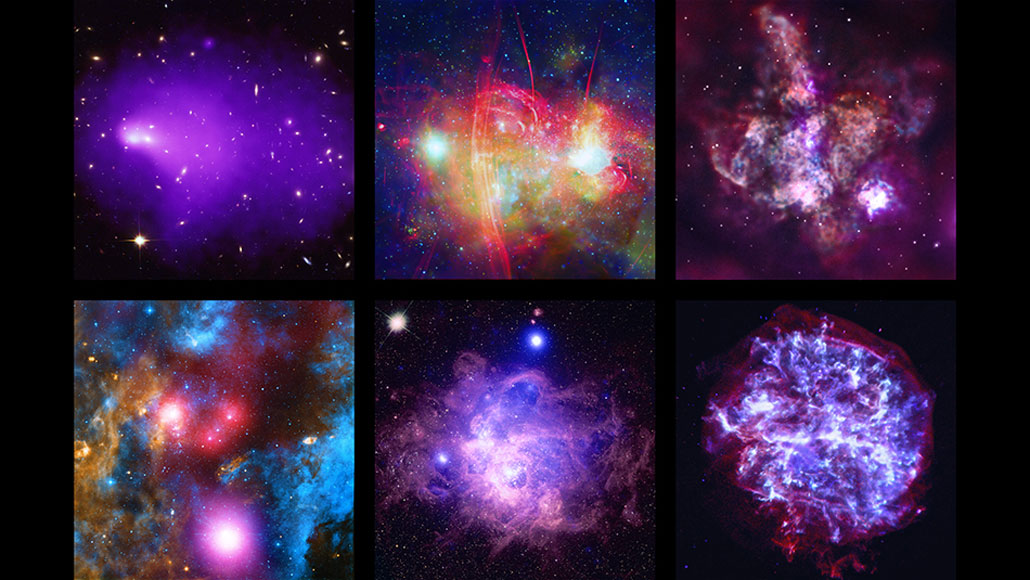
A set of X-ray images of regions of space – including supernova remnants and merging galaxies – captured by the Chandra X-ray Observatory, released by NASA in 2009 to celebrate the telescope’s 20th anniversary. Credit: CXC/NASA, SAO
NASA has given no word on whether it would finance such a mission, although Northrop Grumman has apparently forwarded the results of its own study on the idea to the US agency. However, given the most recent U.S. decadal survey in astrophysics, released in 2021, included mention of a new X-ray telescope to replace Chandra, a servicing mission – even one this complex – capable of extending Chandra’s operations for decades at a fraction of the cost of a new telescope, which itself would take years if not decades to develop, could be highly attractive.
Bay City Fairgrounds, Bay City 15th Anniversary, May 21st 2023
Bay City, the first major project undertaken by the Moles of the Linden Department of Public Works (LDPW), will be marking its fifteenth anniversary on Sunday, May 21st, 2021. Citizens of Bay City and residents of Second Life are invited to join in with the celebrations, which will include the traditional parade down “Route 66,” followed by a live music event in the Bay City fairgrounds.
First opened for initial viewing in May of 2008 and with parcels throughout the city being auctioned soon after, Bay City has shown itself to be one of the highlights of Second Life: a blending of Linden infrastructure and a strong, friendly community of involved residents who give the area its unique charm.
Celebratory activities will kick-off at noon SLT with a parade line-up at the band shell in Bay City – Harwich. At 12:30 SLT, the parade will make its way down Route 66, and proceed to the Bay City Fairgrounds in the North Channel region. DJ GoSpeed Racer will be providing the music throughout the parade, which will be followed by at live concert from 13:30 SLT onwards at the fairgrounds.
The line-up for the concert this year comprises (all times SLT):
13:30-14:30: Jesie Janick – who has herself been active in Second Life for 15 years.
14:30- 15:30: Maximillion Kleene – a Bay City favourite returning once more to the City’s anniversary celebrations.
15:30-16:30: AleyKat (Aleylia Resident).
As usual, celebration goods, including parade float bases and ideas, are available at the Bay City Community Centre, in the Daley Bay region for those who wish to be a part of the parade. Ample viewing areas are provided. The music event is also open to all who desire to attend — not only Residents of Bay City
About Bay City and the Bay City Alliance
Bay City is a Mainland community, developed by Linden Lab and home to the Bay City Alliance. The Bay City Alliance was founded in 2008 to promote the Bay City regions of Second Life and provide a venue for Bay City Residents and other interested parties to socialize and network. It is now the largest Bay city group, and home to most Residents of Bay City.
Each year, in honour of Bay City’s founding, Bay City residents come together with this special celebration.






 Celebratory activities will kick-off at noon SLT with a parade line-up at the band shell in
  Inara Pey: Living in a Modemworld