A seaborne Ashemi Rising in Second Life

Ashemi Rising, August 2023 – click any image for full size

It’s been a further two-ish years since I’ve had the pleasure of visiting an iteration of Ashemi, a place constantly reborn out of the imaginations of  Ime and Jay Poplin (Jayshamime) (and oft with the support of Shaman Nitely, who invited me to one of the first iterations of the region nigh-on seven years ago!). Throughout its many different version, the setting has tended to present or at least heavily lean into Sino-Japanese and Asian influences, and while these can be see scattered throughout this latest return, it’s probably not unfair to say that the setting also draws as much on western influences as those from the east, bringing both together in a manner which is engaging to the eye and camera.

Perhaps the best way to describe Ashemi Rising, as this setting is called for this iteration, is that of a repurposed oil or natural gas platform sitting out in blue waters somewhere. Repurposed, because gone are the derricks and drilling and recovery equipment, etc., from the broad working decks and levels of the platforms, and in their place has – for whatever reason – grown an entire community, with places of business, what appears to be private homes (I would note that they are not actually private – the entire setting is open to exploration – they are just dressed to look like folk live within them), entertainment spaces and gardens.

Ashemi Rising, August 2023

That said, some of the original elements of the formal use of the platforms have remained: stairways still zigzag their way up the outer edges of the various levels as they once did to allow workers to move easily between them without have to climb over / around / under / past machinery of a size and with (in some cases) a motion which might cause the unwary passer-by to have a squishy (if potentially brief) encounter with heavy plant should equipment and individual end up inadvertently find themselves occupying the same space at the same time. There’s also a helipad, and even some of the internal work spaces and offices within the various levels remain, if also repurposed.

This is actually a dual platform set-up. Presumably at one time one the platforms acted as the working platform with actual derrick and drilling equipment and the other either as an ancillary platform; possibly a pump station for transferring oil or gas from storage to tankers to take it to land (something suggested by the large pipes passing along the underside of the walkway connecting the two), or perhaps as an accommodation platform for off-shift crew, allowing them to eat, relax and sleep at least with some buffer of space between them and the noisy, wet / mucky working rig.

Ashemi Rising, August 2023

It is this connecting walkway between the two platforms which forms the landing point for the setting. It’s not hard to imagine this once having been much narrower, perhaps only as wide as the pipes running under it, but which has been widened (and fenced) to meet the rigs’ new function and provide a broader, safer, crossing between them both, complete with separate foot and vehicular throughways. Admittedly, it does appear to have become something of a dumping ground, whilst the recent arrival what appears to be a bolide which has partially buried itself in the asphalt covering part of the walkway may well have given rise to some jitters among those using the crossway, even if it does speak to the robustness of the build, having buried itself in the structure rather than blasting clean through or exploding on it and causing who knows what amount of additional damage.

The platforms towering over either end of this walkway have been individually named Ashemi and Ashemi Rising. Of the two, the former – and slightly less complex – platform offers up the suggestion that it might have once been largely devoted to crew accommodation or storage. I say this because it is has something of a cleaner look to it; not that it is in any way pristine, but more a case of it doesn’t have the appearance of having had quantities of drilling fluid (“mud”) sloshed across its decks or ever having been home to any form of opening through its levels for the Kelly lines / drill bits to run through (while the pipe work under the lowest deck suggests again, it may have been for gas / oil storage, if not for accommodation and recreational areas.

Ashemi Rising, August 2023

Now the main deck of this platform serves as a public space, dominated t one end by a huge aquarium, the mezzanines above it offering more open spaces from which to observe whatever is going on below as they rise up to garden spaces, together with the old helipad. True, drums marked as containing hazardous material are to be found, and some of the NPC personnel are in hazmat suits, but with the lighting, the dancers (also NPCs), seating, etc., all watched over by the local equivalent of a Borg queen, it’s hard to see this as a “dangerous” location.

At the other end of the walkway, Ashemi Rising carries far more of a “working” look too it, its flanks duelled and greyed with wear. The main decks or levels look like they might once have  surround a central work well, complete with what might have been an opening for drilling pipes and the Kelly lines. This also has something of an organic feel to it that the Ashemi platform lacks, despite the fact it is home to gardens and greenery.

Ashemi Rising, August 2023

By that I mean a lot of the structures on Ashemi Rising have a look of spontaneity about them; that they’ve popped up simply out of whim or the the need to offer more space to folk moving in (notably in the construction of a couple of apartment-like blocks) or simply the desire to shorten the walk between two points through the use of a hastily thrown-together bridge of rope and wood. It is also here that the more out-of-the-way habitat spaces – cabins, really – might be found, clinging to the tall legs of the platform. They sit high above the water to avoid unexpected bath times should the weather whip up the waves, yet far enough below the main decks to discourage people from dropping in without invitation. The hover bikes and craft parked on them give a clue as to how the “owners” might get to / from them – but for the visitor wishing to pop down to own, the trusty sit TP works just as well.

With its greater number of levels, nooks, walkways and buildings (some with interiors and general spaces (keep an eye out of Ime’s little gallery!), Ashemi Rising is liable to require the most in the way of exploration. It is also the place where the most nods to various sci-fi, fantasy and Anime genres might also be found. These run from the fairly obvious / semi-corporate, through the likes of William Gibson (in written and screen form) to more little-known shows (Total Recall 2070, anyone?) among the western influences. Even Starbucks gets an indirect mention!

Ashemi Rising, August 2023

From The Hive, the club occupying the main deck adjacent to the connecting walkway between the two platforms, it is possible to make one’s way upwards by ramp, steps and catwalks to the upper levels, each with its own richness of content to attract the eye. However, and as is the case with Ashemi, down shouldn’t be ignored as an option; the lowermost level of both platforms each presents a large cargo elevator that is also suitable for human use. Whether part of the original build or not, I’ve no idea – let your imagination decide for you – but both provide access to floating docks at water level which are most clearly not a part of the original rig designs.

These form makeshift wharves and moorings for a range of small vessels, including sampans and old motor cruisers, as well as offering a small market space – presumably where visiting trawler  / fishing boat owners can trade their freshly caught fish for other supplies. In addition, some of the locals have also decided to set-up home here and away from the nose and confines of the rigs overhead. Although I’m not sure the partially-devoured and slowly rotting whale carcass floating a short distance from the wharves offers the most delightful of scents if the wind happens from that direction!

Ashemi Rising, August 2023

With androids and robots as well as the NPCs, together with hover bikes and flying cars (and boats, in at least one instance – and I do not mean the type given to having wings and the like!), Ashemi Rising presents an interesting cyberpunkesque / potentially dystopian world with plenty of questions hanging around it: are the rigs inhabited as a result of a Waterworld type of need? Why else have folk opted to live here? A commune escaping the drudgery of land-based life? Thus, it offers much for the imagination to create a plethora of possible back-stories. It is also, needless to say, highly photogenic!

SLurl Details

  • Ashemi (Queen Dreem, rated Moderate)

2023 SL SUG meetings week #34 summary

Orcinus Isle, June 2023 – blog post

The following notes were taken from the Tuesday,  August 22nd Simulator User Group (SUG) meeting. They form a summary of the items discussed and is not intended to be a full transcript. A video of the entire meeting is embedded at the end of the article for those wishing to review the meeting in full – my thanks to Pantera for recording it.

Meeting Overview

  • The Simulator User Group (also referred to by its older name of Server User Group) exists to provide an opportunity for discussion about simulator technology, bugs, and feature ideas.
  • These meetings are conducted (as a rule):
  • They are open to anyone with a concern / interest in the above topics, and form one of a series of regular / semi-regular User Group meetings conducted by Linden Lab.
  • Dates and times of all current meetings can be found on the Second Life Public Calendar, and descriptions of meetings are defined on the SL wiki.

Server Deployments

  • No deployments for the major simulator channels this week, but all simhosts will be restarted.
  • There may be a small deployment to the Snack channel (Yondercane), to test changes to the way avatar arrivals in a region are handled (see below).

Dog Days Roll-Back

  • On Wednesday, August 16th, the Blueteel RC channel was updated with update 581292 (“Dog Days”).
  • During testing, it was discovered the update was causing some worn attachments were being renamed “Object” when edited whilst attached while retaining the correct name when seen in Inventory / detached to Inventory.
  • However, if such an attachment was dropped in-world, it would be renamed “Object”. As this was deemed to not be optimal, the update was rolled back.
  • If all goes according to plan, an attempt to re-deploy the release will be made in week #35.

Viewer Updates

The glTF / PBR Materials viewer, updated to version 7.0.0.581368, on August 22nd. All other available official viewers remain as follows:

Note: the alternate viewer page also lists “Win32+MacOS<10.13 – 6.6.12.579987” as an RC viewer. However, the Win 32 + pre-Mac OS 10.13 was promoted to release status on July 5th, and viewer version 6.6.12.579987 points to the Maintenance S viewer, promoted to release status on May 16th.

Avatar Arrival Update and Other Simulator Work

This is a first pass at working to improve avatar arrivals (AA) in regions and reduce the amount of “freezing” may occur whilst the arrival is processed, with further work indicated in the future, Monty Linden described this part of the work thus:

AA is the first part of an effort to tune the simulator’s main processing loop. There are *many* causes of very long frames currently. One of the worst offenders is avatar attachment handoff and rezzing at region crossings and teleports. AA attempts to break up and time bound that process, particularly when multiple avatars are involved in a crossing, allowing the frame to complete more closely to the scheduled time. [The] goal is to improve interactivity and responsiveness to those *not* involved in the RC/TP at the expense of those crossing having their glorious collections of stuff attached a bit more slowly. This first pass includes some of that monolithic execution breakup and some tuning.

Monty went on to note that the AA update will only be deployed for testing / data gathering prior to being withdrawn rather than being expanded to additional channels, whilst he continues to work on the matter in the background and possibly expands the scope of the work to include things like better script optimisations and hand-offs during teleports / crossings, etc.

This led to an extended discussion on region crossings / teleports which extended across most of the meeting, with Rider Linden noting he’ll attempt to have a list of regions on the channel for the meeting next week (assuming the deployment goes ahead), so that interested parties can test both teleports into them and regions crossings between them. This in turn entered into better / alternate means of script scheduling / management (and refactoring the former to reduce some of the simulator load), together with options for improved attachment / messaging, etc., handling.

As an aside to this work, Monty indicated he is working on a diagram showing the simulator main processing loop which could be published for public consumption, once it has been cleaned-up.

Potential for Improving Vehicle Control Options

Rider Linden raised this towards the end of the meeting for discussion, thus:

We’ve been having some discussions internally about taking controls and expanding the number of keys available and perhaps even allowing analogue input for movement to the simulator. Leviathan and I would love to get some feedback on how people would use that and how you’d like to see something like that work.

To which Leviathan added:

I’ve solicited for input and have received a bunch of input and ideas. I think the first sub project in that direction will be to try to expose raw game controller input (joysticks and buttons) to LSL. With regards to keyboard controls, if you look at all of the feature requests over the years, ultimately people want access to just about ALL of the keys. I was worried about the ability to make a keylogger in SL, however Signal thinks that wouldn’t really be a problem.

The majority of the feedback was for capabilities to be added to enable a broader range or controllers rather than trying to expand keylogging capabilities exponentially, although keystroke capture and use appears to be more of a focus for Leviathan.

Please refer to the last 10-12 minutes of the video for this discussion.

† The header images included in these summaries are not intended to represent anything discussed at the meetings; they are simply here to avoid a repeated image of a rooftop of people every week. They are taken from my list of region visits, with a link to the post for those interested.

Reflections on art and geometry in Second Life

ArtCare Gallery, August 2023: Scylla Rhiadra – Geometries of the Human

Currently open at Carelyna’s ARTCARE Gallery is Second Life is another exploration of the human condition through art by Scylla Rhiadra. Scylla is an artist who has a reputation for getting the grey squishy stuff located within the upper portion of our skulls firing on all cylinders – and for that very reason, I always enjoy spending time within her exhibitions, even if it does mean the four cylinders of my own little brain have to work overtime….

Geometries of the Human is a deftly layered collection of images, thoughts, quotes and themes which offer the visitor opportunities to consider the exhibition along several parallel – and overlapping – lines. The most visual of these themes / lines is the relationship between art and geometry – the latter being perhaps one of the most important (and certainly one of the oldest) branches of mathematics. It is one which has and does hold influence over many aspects of our lives, as Scylla points out in her introductory notes for the exhibition: it has applications in the majority of the sciences (including other branches of mathematics), in architecture, design, and – of course – art. Thanks to the Fibonacci sequence, it is also very present in the natural world.

ArtCare Gallery, August 2023: Scylla Rhiadra – Geometries of the Human

It is geometry which so often gives art its form. Perhaps the most obvious influences here are those of ratio and proportion – the former notably through the use of the Golden Ratio / Fibonacci sequence, the latter most famously embodied within da Vinci’s Vitruvian Man, which brilliantly brings together mathematics and anatomical science and combines them with art (both classicism, and naturalism). Both individually and jointly, ratio and proportion can do much to give a sense of depth and / or sense of balance which more readily give pieces that have an intrinsic  – if indefinable – appeal.

Geometry therefore helps gives structure to art – much as it does the worlds, the very cosmos, around us. However, the fact that it does can actually be a limitation, particularly through slavish adherence. The rule of thirds, for example, and clearly a geometrical imposition, is intended to offer a rule of thumb within the visual arts; yet all too often it is taken as an immutable rule, any violation of which lessens the finished work – potentially to the point where it should not be considered art. Whilst the first of these views might (to a point, again it depends on the artist’s overall goal) be seen as “true”, the latter most certainly is not.

ArtCare Gallery, August 2023: Scylla Rhiadra – Geometries of the Human

Thus, within the pieces – and their accompanying descriptions – Scylla presents an engaging exploration of the relationship of geometry and art which is both a celebration of the beauty their interaction can create, and a questioning of the enforced rigidity and limitations they can place on art through consideration of the aesthetics of geometry alone when composing an image, painting or drawing. This leads directly into a wider  context of the exhibition: a questioning of perspectives and – and this is purely my term, not Scylla’s – slavish adherence to doctrines.

At the end of the day, geometry is purely a tool or tool set – an undeniably useful one which has allowed humanity to evolve in terms of knowledge, technology, science and understanding. But like any tool or tool set, it is not all-encompassing; like much in science, it is far from static. Whilst it is perhaps the most widely recognised, Euclidean geometry is far from alone, and since the 1800s in particular, differential geometry (through the likes of the Theorema Egregium and Riemannian geometry), together with computational and discrete geometry, play key roles in our understanding of the cosmos and science (even general relativity is underpinned by non-Euclidean geometry), and can lend themselves to art. Ergo, allowing oneself to be constrained by a specific set of rules or concepts is perhaps not the best position to take.

ArtCare Gallery, August 2023: Scylla Rhiadra – Geometries of the Human

This is as fundamental a truth in life as it is in science (and art). We are not uniform creatures; each of us is more than shape or form or colour; we have folds and volume (depth). We might all be the result of the same biological processes, but none of us is mass produced; we are all truly unique. And it is in our differences to one another – however those differences might be manifested – that we are perhaps the most precious, because it is through the understanding – and acceptance – of what makes us different which can lead to the best understanding of one another.

For me, this is aptly stated within What Would You Be without Me?, together with the accompanying quote attributed to Dürer alongside it. Yes, an understanding of geometry and its attendant use of ratio and proportion clear enhance the artist’s work – but it is still the subject of that work which should be central to it. Without such a focus, the work is diminished, emptied; the use of geometry pointless. Similarly, if we are unwilling to accept others can have outlooks on life different to our own, and instead seek to ostracism and “other” them simply because of they are “different”,  then we diminish ourselves as well, becoming – if I might mangle Shakespeare here somewhat: a walking shadow, a poor player that struts and frets his hour upon the stage … full of sound and fury, signifying nothing.

ArtCare Gallery, August 2023: Scylla Rhiadra – Geometries of the Human

Having a belief system or guidelines is not a bad thing – again, without our understanding of geometry, the world we’ve created and our understanding of it and the cosmos in which it sits, would potentially be a very different place. But to quote Scylla – too strong a faith in anything is dangerous. It can blind us to the beauty of creativity and artistic freedoms – and rob us of understanding and wisdom that might be vital to our future existence.

As I noted towards the start of this piece Geometries of the Human is a deftly and deeply layered exhibition, one in which both art and the words accompanying it offer nuanced opportunities for reflection on ideas on life and expression great and small. In its viewing, it is not so much an exhibition which should been seem so much as absorbed – and it is obviously thoroughly recommended to anyone who appreciates art with a message (and a conscience).

SLurl Details

2023 SL viewer release summaries week #33

Logos representative only and should not be seen as an endorsement / preference / recommendation

Updates from the week through to Sunday, August 20th, 2023

This summary is generally published every Monday, and is a list of SL viewer / client releases (official and TPV) made during the previous week. When reading it, please note:

  • It is based on my Current Viewer Releases Page, a list of all Second Life viewers and clients that are in popular use (and of which I am aware), and which are recognised as adhering to the TPV Policy. This page includes comprehensive links to download pages, blog notes, release notes, etc., as well as links to any / all reviews of specific viewers / clients made within this blog.
  • By its nature, this summary presented here will always be in arrears, please refer to the Current Viewer Release Page for more up-to-date information.
  • Note that for purposes of length, TPV test viewers, preview / beta viewers / nightly builds are generally not recorded in these summaries.

Official LL Viewers

  • Release viewer,  version 6.6.13.580918, formerly the Maintenance T RC viewer, promoted July 14 – No Change.
  • Release channel cohorts (please see my notes on manually installing RC viewer versions if you wish to install any release candidate(s) yourself).
    • Maintenance V(ersatility) RC viewer updated to version 6.6.14.581315 on August 15.
    • Inventory Extensions RC viewer updated to version 6.6.14.581357 on August 14.
  • Project viewers:
    • No updates.

Note: The Alternative Viewers page appears to have suffered a hiccup, listing version 6.6.12.579987 as the “Win32+MacOS<10.13” RC viewer.  However, the Win 32  + Pre-MAC OS 10.3 viewer was actually version 6.6.13.580794, promoted to release status on July 5; 6.6.12.579987  was the version number assigned to the Maintenance S RC viewer promoted to release status on May 16th.

LL Viewer Resources

Third-party Viewers

V6-style

V1-style

  • Cool Viewer Stable release updated to version 1.30.2.24 and Experimental Branch updated to version 1.31.0.2, both on August 19 – release notes.

Mobile / Other Clients

  • No updates.

Additional TPV Resources

Related Links

Space Sunday: of comets and of landers

An image from 20th December 2011, showing long period comet C/2011 W3 (Lovejoy) as seen from the European Southern Observatory’s Paranal Observatory in the Atacama Desert, Chile (the two structures are two elements of the Very Large Telescope at Paranal). Discovered on 27th November 2011 by Australian amateur astronomer (and comet hunter) Terry Lovejoy, C/2011 W3 is, like C/2023 P1 Nishimura (below), believed to have originated at some point in the past in the Oort Cloud (although it has likely made at least 6 passes around the Sun). Whether C/2023 P1 will have an impressive a tail as it reaches perihelion remains to be seen. Credit: Guillaume Blanchard

Astronomy is a field of observation / science / study that is pretty much open to anyone with a passion and understanding of things celestial to make a contribution, whether amateur or professional in the field.

Take Hideo Nishimura, for example. As an amateur astronomer living in Kakegawa, Japan, he decided to take advantage of the clear skies overhead on August 11th, 2023 and take some photographs of the sky using his telescope and imager. It wasn’t the first time he’s done this – like many other amateur astronomers he gets enormous pleasure out of imaging and studying the night sky. However, the results caused a little more excitement than expected in the Nishimura household when Hideo noticed that in one of his images, taken towards the direction of the setting Sun showed an object that shouldn’t have been there. After contacting the International Astronomical Union, which followed-up his observations via the Minor Planet Centre, Hideo was informed he has discovered a comet making what is likely to be its first – and only – passage through the inner solar system.

Now called C/2023 P1 Nishimura in his honour, the comet is believed to be an object originating in the Oort cloud, and was knocked out of its distant orbit around the Sun by collision or some other interaction, and has been gradually “falling” towards the Sun ever since.

Such objects are not uncommon – the “C” in the title of such objects indicates they likely originate from the Oort cloud and either end up passing through the solar system and long-period comets (i.e. taking anything from a couple of hundred years to several thousand to loop around the Sun) such as C/2011 W3 (Lovejoy) seen at the top of this article. However, occasionally,  some end up accumulating sufficient velocity during their inward “fall” towards the Sun that rather than looping around it and staying in an elongated orbit, they are accelerated like a pebble out of a slingshot, escape the Sun’s influence altogether, to eventually vanish into interstellar space.

And that’s exactly what C/2023 P1 Nishimura looks set to do (the 2023/P1 in the title indicated its year of discovery and the fact it was the first such object to be discovered in the first half of August (the IAU splitting the months in two alphabetically for objects like comets – So January 1th through 15th is A; then January 16th to 31st is B, with February 1st through 15th C, and so on, with both I and Z ignored to avoid confusion with 1 and 2).

C/2023 P1 Nishimura (centre and naturally green-tinted), photographed by amateur astronomer Dan Bartlett from his back garden in June Lake California, USA on August 15th, 2023, using a Celestron EdgeHD 35.6 cm Schmitt-Cassegrain telescope and a Zwo ASI2600MC Pro imager. Via Astrobin

Currently, the comet is at a magnitude of around 9.4, meaning it can only be seen using telescopes of 15cm or larger. However, as it approaches the Sun, it is expected to grow much brighter, potentially becoming visible to the naked eye at around a magnitude of 4.9 in the period September 10-15th (during which time it will be at its closest to Earth, around 0.85 AU distant) and may by that time demonstrate a tail.

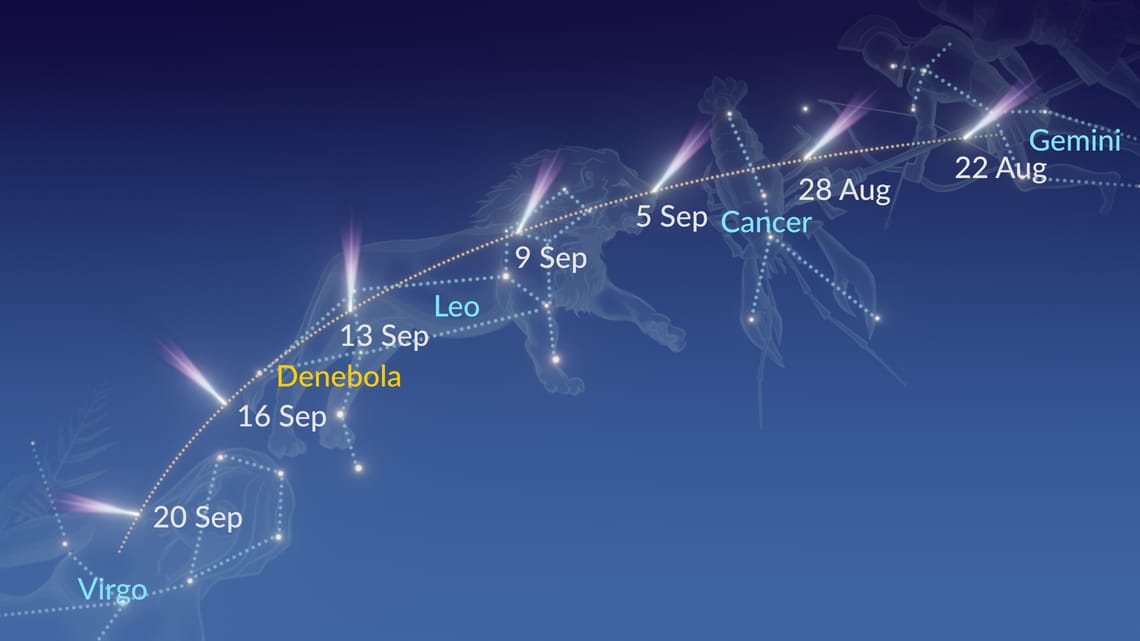
Between September 10th and 12th, period, the comet will be visible for a few hours before dawn in the constellation Leo. From September 13th, it will transition to being an evening object visible immediately after sunset. It will reach perihelion (closest approach to the Sun) on September 18th, when it will appear to be in the constellation of Virgo, about 12° away from the Sun. Perihelion is also the point at which C/2023 P1 Nishimura faces its greatest threat: in passing around the Sun, it is possible the differential forces of its acceleration and the Sun’s gravity might cause it to break up.

C/2023 P1 Nishimura’s progress across the sky. Credit: Vito Technology, Inc.

Following perihelion the comet will start to move away from the Sun – and out of the solar system – offering those in the northern hemisphere with perhaps the best opportunities to view it, although it will diminish in brightness quite rapidly, and once again require a telescope to see it from October onwards.

Those who are interested in astronomy and use apps as an adjunct to their skywatching might like to know that both Sky Tonight and Star Walk 2 apps (the latter may require the purchase of an add-on), provide the comet’s trajectory and brightness in real-time, giving you the most accurate and up-to-date information on where to view it

These are some of the upcoming dates for observations. Note that use of naked eye, binoculars, etc., and visibility in general dependent on factors such as eyesight, location, amount of light pollution, etc.):

Date Magnitude / Visibility Approx location / status
August 26 9.2 – telescope Enters the constellation Cancer
September 5 6.9 – binoculars with 7x magnification or above Enters the constellation Leo
September 7 6.3 – binoculars / possibly naked eye Passes 0°16′ away from the star Ras Elased Australis (mag 3.0) in the constellation Leo
September 9 6.3 – binoculars / possibly naked eye Passes 0°20′ away from the star Adhafera (mag 3.4) in the constellation Leo
September 9 5.6 – binoculars / possibly naked eye Passes 0°20′ away from the star Adhafera (mag 3.4) in the constellation Leo
September 13 4.3 – naked eye Reaches its closest approach to the Earth at a distance of 0.29 AU in the constellation Leo
September 15 3.7 – naked eye Passes 0°10′ away from the star Denebola (mag 2.1) in the constellation Leo
September 16 3.4  – naked eye Enters the constellation Virgo
September 18 3.2 – naked eye Reaches perihelion the constellation Virgo (do not use optical aids when looking towards the Sun while it is above the horizon)
September 22 4.3 – naked eye Passes 1°30′ away from the star Porrima (mag 2.7) in the constellation Virgo
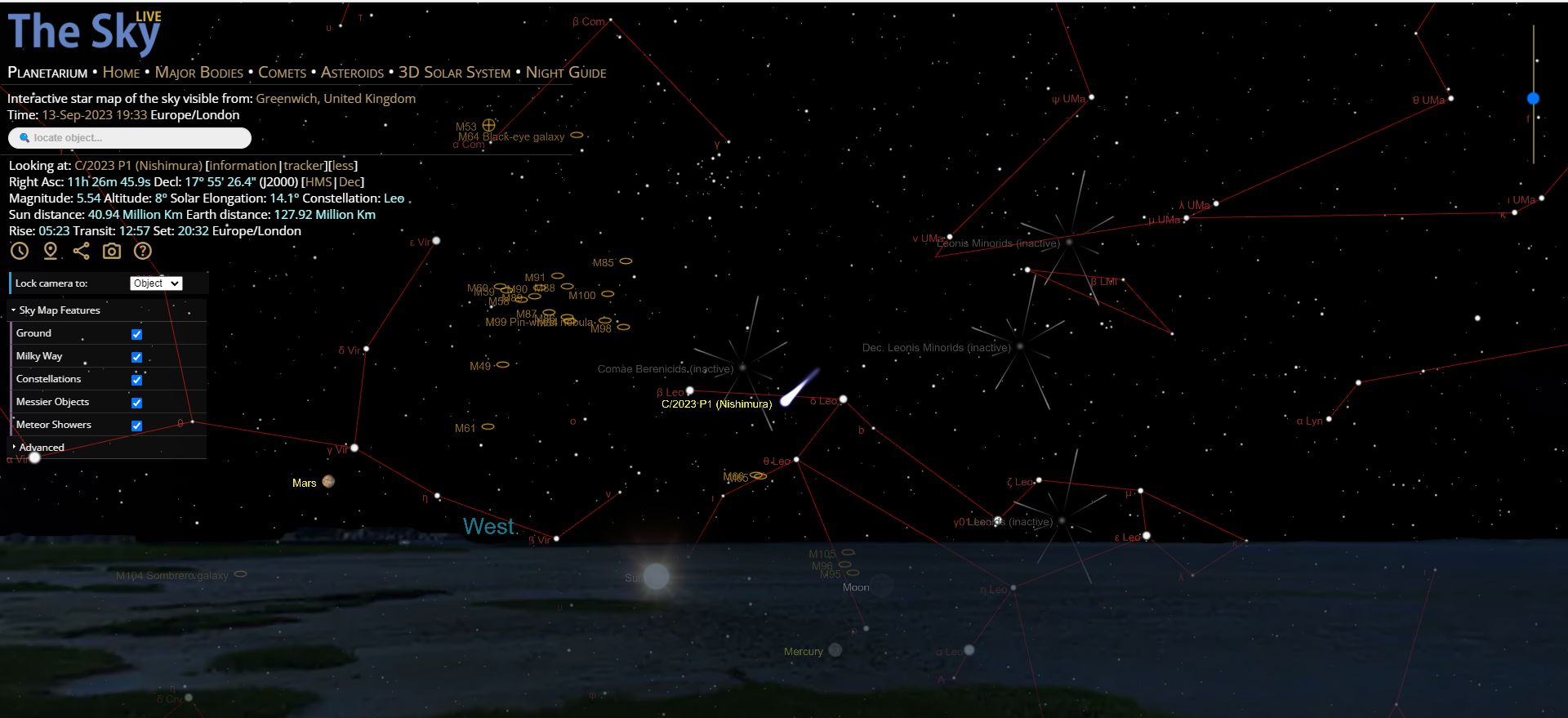
A projection of C/2023-P1’s position at 18:33 UTC, as seen from a location near :London, UK, as offered by The Sky Live – click for full size

Lunar Missions Update

My recent Space Sunday pieces have been in part covering two robotic missions to the surface of the Moon – India’s Chandrayaan-3 and Russia’s Luna-25.

Whilst having launched almost a month after Chanrayaan-3, Luna-25 – by dint of using a more powerful launch vehicle coupled with a somewhat more direct (“spiral”) flight to the Moon – actually arrived in a position from which a landing attempt could be made first.

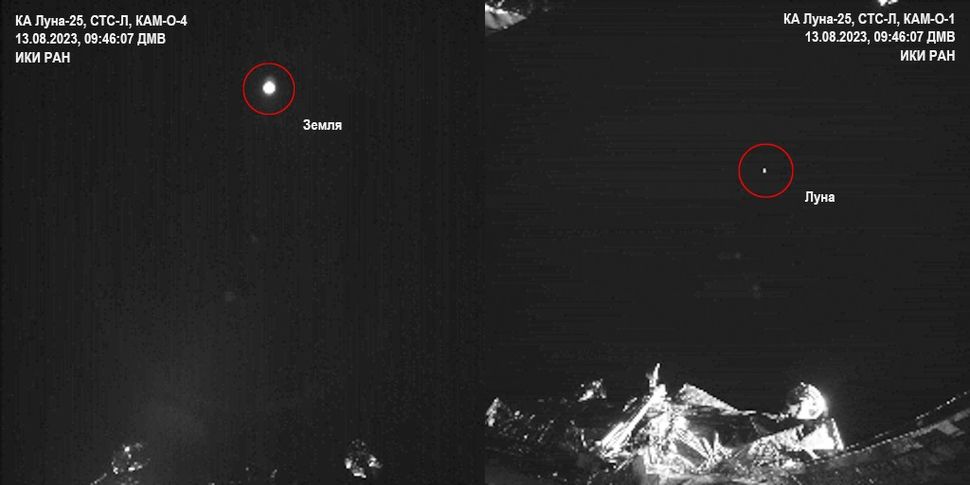
An image taken on August 13th, 2023 from Russia’s Luna-25 mission as the spacecraft spiralled away from both the Earth (circled left) and the Moon (circled right) so it could “drop” towards the latter and enter an orbit from which it could reach the Lunar South Polar Region. Credit: Roscosmos

Thus, on August 19th, 2023 (UTC) the Russian lander – which had performed flawlessly throughout the mission to this point – commenced an engine burn which unfortunately did not go well.

Thrust was released to transfer the probe onto the pre-landing orbit During the operation, an emergency situation occurred on board the automatic station, which did not allow the carrying out of the manoeuvre within the specified conditions.

– Roscosmos statement on Luna-25 released via Russia’s Telegram messaging service

The command to start the manoeuvre was sent at 23:10 UTC on August 19th, the engine burn intended to orient and position the vehicle ready for a decent and landing on August 21st. However, direct communications with the vehicle were lost at or around 23:57 UTC.

Later on August 20th, Roscsomos issued an update in which it was confirmed that all attempts to re-establish communications contact with the vehicle had failed, and the a preliminary review of the flight data received prior to contact terminating suggested the craft had deviated from its flightpath during the engine burn sufficiently that it afterwards crashed into the Lunar surface – although at the time of writing, investigations into the loss were obviously still very much in the initial phases.

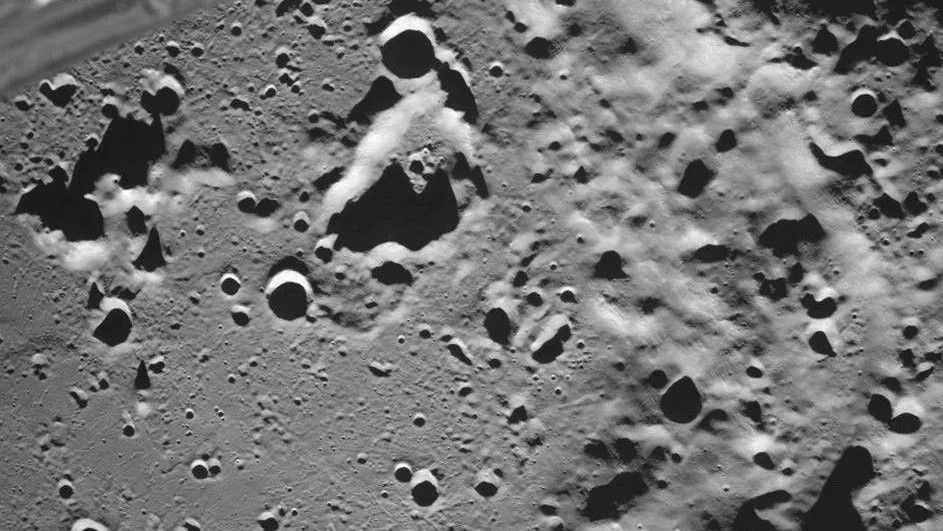
The first detailed image of the lunar surface returned by Luna-25, on August 16th, 2023. It shows a portion of the Lunar South Polar Region from the far side of the Moon. Credit: Roscosmos

Meanwhile, on August 17th, the Chanrayaan-3 lander / rover combination launched by the Indian Space Research Organisation (ISRO) in July successfully separated from their propulsion module, 12 days after initially arriving in an extended lunar orbit. Separation placed the lander / rover combination under their own power and allowed them to start their final set of manoeuvres in preparation for a descent and landing. The first of these was performed on August 19th, when the Vikram lander made the first of the small adjustments needed to bring it down to the 100 km altitude from which the landing attempt will be made on August 23rd.

In PR terms, both of these missions are relatively “high stakes” for both Russia and India. Chanrayaan-3 is intended to overcome the loss of the lander/rover combination which crashed onto the Moon on September 6th, 2019 as a part of the highly ambitious Chanrayaan-2 mission. That loss still overshadows the fact that the third element of the mission, the lunar orbiter, continues to orbit the Moon carrying out its own very successful science mission. In this, it will be joined by the Chanrayaan-3 propulsion module, which although not by definition a satellite, nevertheless carries a small suite of instruments intended to study Earth’s atmosphere from afar, and – according to the ISRO – also scan exoplanets to assess their potential for habitability.

Luna 25, meanwhile, was intended to herald Russian’s return to independent deep-space exploration 47 years after its last lunar mission (Luna-24) and 34 years since its last attempt at an interplanetary mission (Phoboos 2) – both of which were soviet-era missions. It was also intended to demonstrate Russia’s ability to be a major player in the China-led International Lunar Research Station (ILRS) – the launch of the mission even having one of the senior Chinese officials for that programme, Wu Yanhua present.

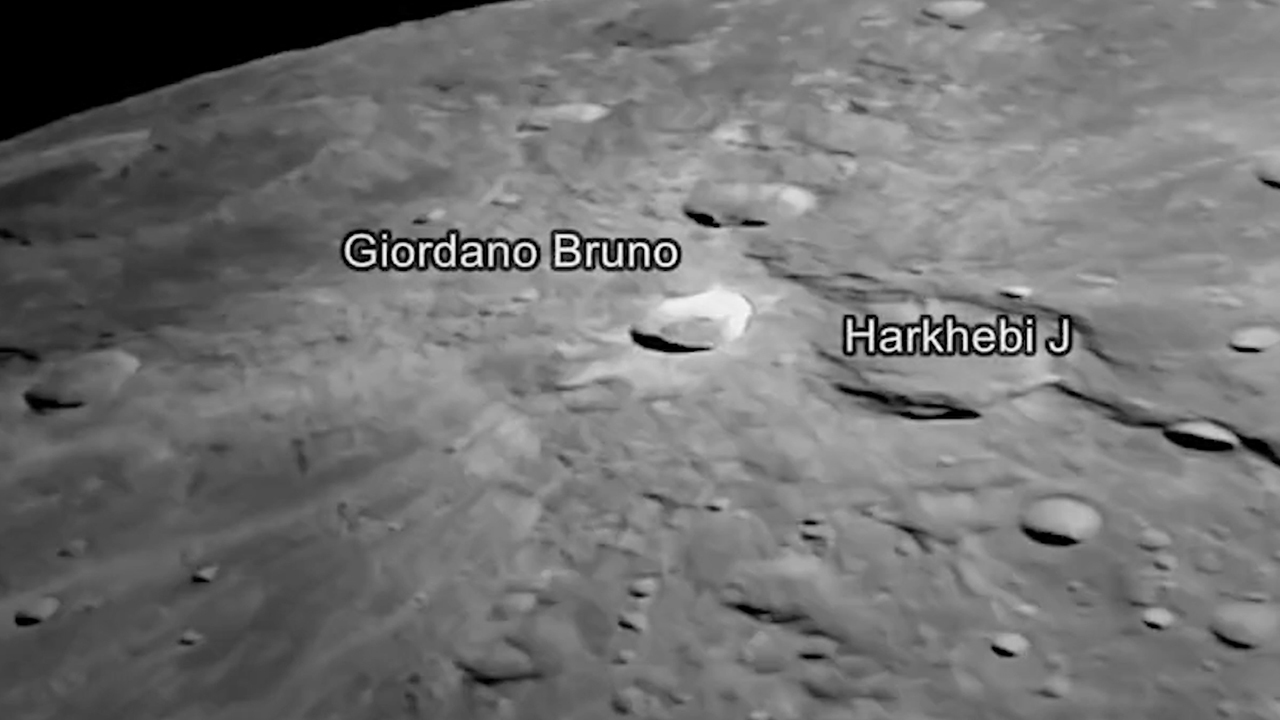
An image returned by the Vikram lander, following its separation (with its rover vehicle) from the Chanrayaan-3 propulsion module on August 17th. This show a portion of the lunar far side, featuring the 22-km wide crater Giordano Bruno. This was created by an impact which may have been witnessed by monks at England’s Canterbury Cathedral in 1178. Close by to the North-west (north is at the bottom of this image) is the much older impact crater Harkhebi-J, lying within the still older Harkhebi walled plain, the remnant of a much older impact site. Credit: ISRO. 

These are far from the only missions heading for the Moon over the next few years. Japan, for example, is due to launch its Smart Lander for Investigating Moon (SLIM) vehicle on August 25th (UTC). This is a technology demonstrator designed to make exploration more precise and economical, and which is cadging a ride on the H-IIA launch of Japan’s X-Ray Imaging and Spectroscopy Mission (XRISM, pronounced “crism”) space telescope.

Unlike Luna 25 and Chanrayaan-3, SLIM will not be going to the lunar South Pole, but will be heading for a group of volcanic domes located in Oceanus Procellarum, 18oN of the lunar equator, where it will attempt to guide itself to a landing close to the Marius Hills Hole, a lunar lava tube entrance. Nevertheless, its landing will be as challenging as those for any mission to the Moon, and the loss of Luna 25 reminds us that lunar exploration is still a hazardous undertaking.

Also heading to the Moon – this time in November – will be Nova-C lander, the first private mission to the Moon to be carried out by Intuitive Machines under the mission title IM-1. Selected as a part of NASA’s  Commercial Lunar Payload Services (CLPS) programme, the mission will deliver a suite of science instruments and mini-rovers to at Malapert A near the lunar south pole. I’ll likely have more on this mission and Japan’s XRISM and SLIM in a future update.

2023 week #33: SL CCUG meeting summary: glTF PBR; Senra

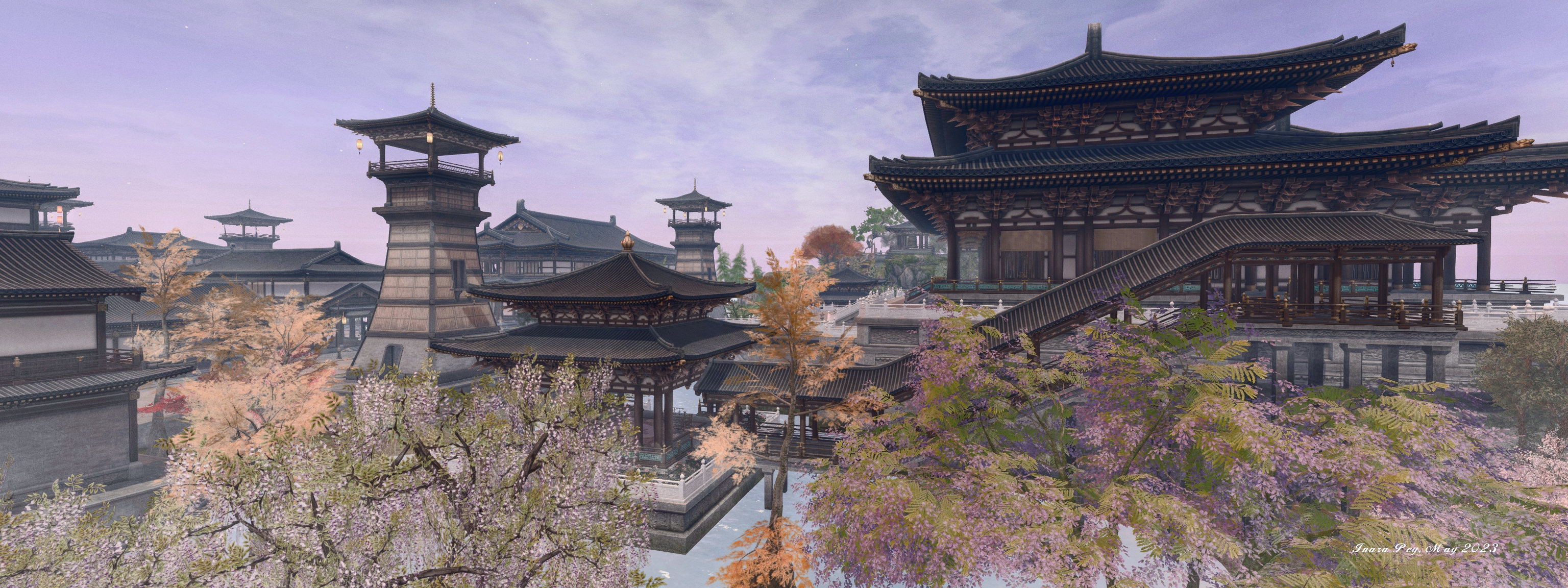
Chang’an, May 2023 – click any image for full size – blog post

The following notes were taken from my audio recording and chat log transcript of the Content Creation User Group (CCUG) meeting held on Thursday,  August 17th, 2023. 

  • The CCUG meeting is for discussion of work related to content creation in Second Life, including current and upcoming LL projects, and encompasses requests or comments from the community, together with viewer development work.
  • As a rule, these meetings are:
    • Held in-world and chaired by Vir Linden.
    • Conducted in a mix of voice and text.
    • Held at 13:00 SLT on their respective days.
    • Are subject to the schedule set within the SL Public Calendar, which includes locations for both meetings (also included at the end of these reports).
    • Open to all with an interest in content creation.

Additional note: this meeting suffered several drop-outs (for whatever reason) plus my own Internet connection also went out; as such this is not a complete reflection of the meeting and all topics.

Viewer Status

General Viewer Notes

  • There are a couple of issues with the Inventory Extensions RC viewer which need to be addressed before this progresses to being ready for promotion to release status.
  • The internal discussions on font changes in the Emoji viewer (see my last CCUG / TPV meeting summary) will likely be split into a separate project, allowing the Emoji viewer to progress forward as it is.

glTF Materials and Reflection Probes

Project Summary

  • To provide support for PBR materials using the core glTF 2.0 specification Section 3.9 and using mikkTSpace tangents, including the ability to have PBR Materials assets which can be applied to surfaces and also traded / sold.
  • The overall goal is to provide as much support for the glTF 2.0 specification as possible.
  • Up to four texture maps are supported for PBR Materials: the base colour (which includes the alpha); normal; metallic / roughness; and emissive, each with independent scaling.
  • In the near-term, glTF materials assets are materials scenes that don’t have any nodes / geometry, they only have the materials array, and there is only one material in that array.
  • As a part of this work, PBR Materials will see the introduction of reflection probes which can be used to generate reflections (via cubemaps) on in-world surfaces. These will be a mix of automatically-place and manually place probes (with the ability to move either).
  • The viewer is available via the Alternate Viewers page.

Further Resources

General Status

  • The communications bloat driven by multiple script-driven glTF materials updates generating multiple connections between the viewer and the simulator (thus impacting performance) continues to be addressed. The outcome of this work is liable to result in protocol changes as and when the work is complete.
  • A number of permission-related fixes have been implemented.

Lighting / Ambient Lighting

  • The issue over the rendering changes the glTF project will bring to Second Life. It has been well-established that the PBR system removes the forward render pipe (aka “non-Advanced Lighting Model (ALM)”) from the viewer’s renderer.
  • Equally, over the last several meetings (and as noted in my CCUG summaries covering PBR) there has been discussion on the fact that PBR utilises HDR + tone mapping with rendering  / lighting. This is a significant change to Second Life, particularly when it comes to the amount of rendered ambient light (until now SL has rendered a lot of additional ambient light), resulting in two related issues:
    • Because it is intended to mimic real-world ambient lighting, environments rendered on the PBR viewer with HDR + tone mapping enabled can look a lot darker than when viewed with a non-PBR viewer, and baked lighting really does not work (and can end up looking very bad) – scripted / direct lighting is required – something for which many store owners and users in general might not be prepared.
    • While disabling the ambient HDR rendering is possible within the PBR viewer (potentially eliminating the above issues), it conversely results in any PBR content within the scene looking “bad” or “broken”, risking content creators trying to find workarounds to the glTF specification in order to make their content “look good” under either lighting condition – something they absolutely should not do.
  • Discussions are still on-going at the Lab on how best to handle this conflict between PBR and non-PBR rendering as the latter is deployed and gradually gains broader use. As a part of this, it has been recognised that one of the most direct means to alert users is via communication.
  • To this end, a form of “best practices” and guidelines for PBR are being developed with the intention to make them available to users in advance of PBR being fully deployed / released. Expect to (hopefully) hear more about this via future CCUG meetings.

Mirrors

  • Geenz Linden is currently refactoring the Hero probes which will be automatically selected for generating higher resolution reflections based on an avatar’s proximity to a planar mirror surface (and initially limited to 1 (or possibly 2 per scene  – the second being for Linden Water reflections, but this has yet to be confirmed).
  •  This work will see the Hero probes treated as their own class of reflection probes with their own filtering, etc., to avoid conflicts (debugging, etc.) with the “general” reflection matte manger. This will also better support the higher resolution of the Hero probes and possibly allow for additional Hero probes to be supported within the viewer in the future.

Building Tools

  • PBR will see a significant change to the Edit / Build floater as the project becomes more widely deployed, and this has started internal discussions at LL about the state of the in-world build tools, and what might be done to improve them for general use. Ideas put forward at the meeting included:
    • More flexible means of cutting holes in prims (e.g. offset from the Z axis of the prim), such as through the introduction of a Boolean support.
    • Making text entry within the floater consistent (e.g. clicking on some fields, the existing content is highlighted for over-writing, in others it isn’t).
    • Inclusion of a prim alignments capability (as found in some TPVs) as a default tool + making the alignment more flexible that just to the sides / edges of the bounding boxes of the objects.
    • A broader range of primitive shapes (e.g. simple step units) and improved tools for torturing prims to produce custom shapes.
    • Better exposure of some of the build options on the official viewer (e.g. making the Local Textures option a radio button option in the Texture tab, rather than hidden in a drop-down) to make them more visible.
    • Also making it clearer that an object includes Local Textures, such as via a pop-up, to remind the creator to apply an actual texture to the affected face(s).
    • Better tools  / support for making clothing.
    • Better UDIM support for UV maps.
  • These idea will be fed back into discussions at LL.

Senra Avatars

[Note: this section is abbreviated as I lost my Internet connection for some 14 minutes of the meeting & this was followed by the meeting being disrupted a further 2 times.]

  • Further discussion over the continued confusion / concern over the Senra avatar system (outside of the ongoing disquiet over the licensing agreement), including:
    • Frustration / confusion over the amount of conflicting information being offered by Linden Lab – e.g. the dev kit application form states applicants “must” own a store but Patch Linden has stated in a forum post that owning a store “is not” a requirement.
    • Negativity on the use of an application requirement at all:
      • Some see it as presenting an unnecessary barrier for some (e.g. users who just want to create Senra-related items for their personal, rather than commercial, use).
      • Concerns over privacy / security with the devkit application form being outside of SL (where it is subject to potential abuse) rather than – as with the Mesh Upload Status form  – being included within the Secondlife.com dashboard,  where it would be both secure and firmly linked to an account.
    • Further questioning as to why AvaStar has been determined to be a core requirement for the devkit, rather than simply relying on Blender.
  • More general frustration was voiced at the idea that the “Senra team” only appear to be willing to engage through the forum threads on the topic, and then only in what is perceived as being a narrow focus of engagement, with no-one appearing willing to attend the CCUG meeting – which given Linden Lab want creators to produce content for Senra would seem to be a pretty good place for them to actively address feedback in real time, at least in lieu of any Senra-focused meeting(s).

In Brief

  • While they are not in anyway directly connected or related, Cosmic Linden noted that her work on enabling PDR materials as terrain textures in the viewer is being used as a testbed for possible approaches to enabling PBR with avatar Bakes on Mesh – although the latter is not currently an active project.

Next Meeting

† The header images included in these summaries are not intended to represent anything discussed at the meetings; they are simply here to avoid a repeated image of a gathering of people every week. They are taken from my list of region visits, with a link to the post for those interested.