Space Sunday: Psyche and an eclipse

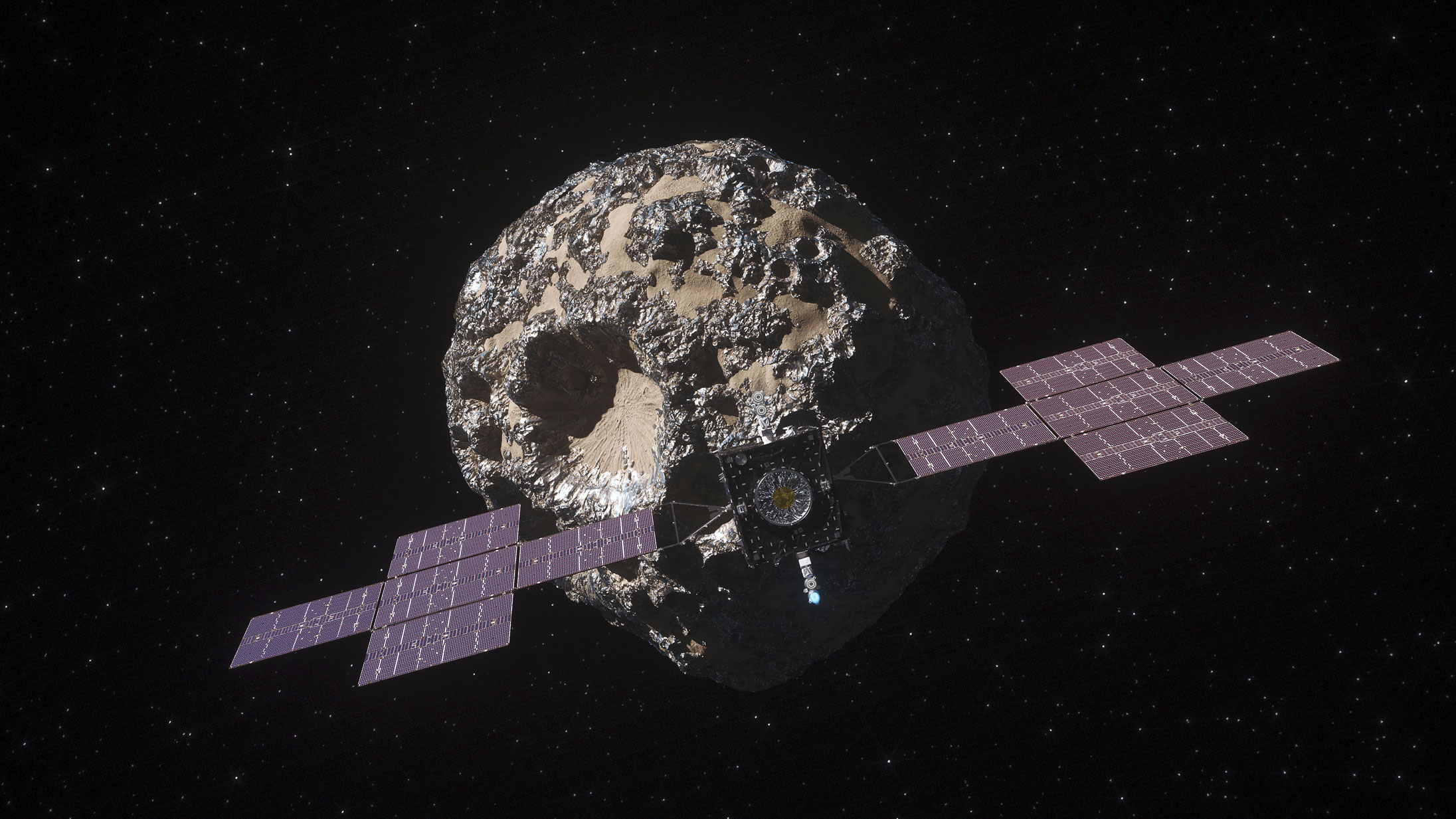
An artist’s impression of the Psyche mission spacecraft observing and mapping the asteroid 16 Psyche. Credit: NASA

Asteroids have been something of a focus for Space Sunday of late, and they’re going to be again this week. Or at least, one is: 16 Psyche, as this is the target for a NASA mission which, if all goes according to plan, will launch from Kennedy Space Centre on October 12th, 2023.

16 Psyche was discovered by the Italian astronomer Annibale de Gasparis on 17th March 1852, and is named for the ancient Greek goddess of the soul. It has a shape consistent with that of a Jacobi ellipsoid, and measures some 278 km x 238 km x 171 km as it orbits the Sun between Mars and Jupiter once every 4.9 years at an average distance of 437 million km (2.92 AU). It is also the 16th minor planet to be found in the solar system by order of discovery (hence the 16 in its name).
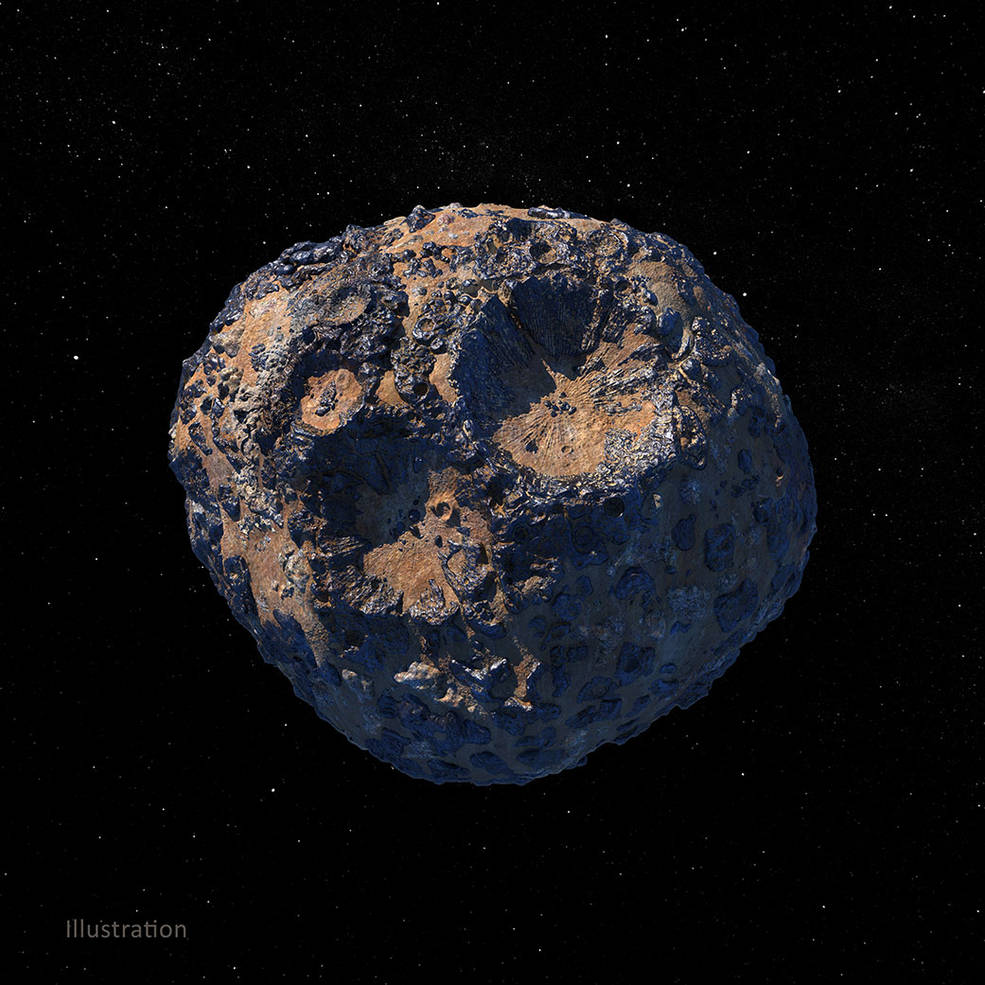
What 16 Psyche might look like. Credit NASA

But what makes 16 Psyche a subject for detailed study is the fact that it is the largest and most massive M-class asteroid – a class of asteroids which appear to contain higher concentrations of metal phases (e.g. iron-nickel) than others within the asteroid belt – yet discovered in the solar system. So massive in fact, that it was long theorised that it was the exposed core of a protoplanet.  These are bodies thought to have been created during the early history of the solar system from the collision and coalescing of planetismals, and which may have gone on to play a role in the formation of the inner planets of the solar system (in fact, for a time in the early 20th century, the coalescing of planetismals into protoplanets and protoplanets into planets was thought to be the process by which all planets were created, an idea long since proven incorrect; planetary formation is far more complex than things bumping into one another and gluing themselves together).

Thus, it is also possible that whilst a protoplanet, 16 Psyche evolved along lines which had nothing to do with planetary formation; thus, studying it might either help in our understanding of planetary formation and / or enable us to more fully understand the unique processes at work within these tiny (in terms to their relationship with planets) bodies, and the mechanisms which ultimate gave rise to their form and nature. Most intriguingly, a mission to 16 Psyche might even point to a different story as to how objects in the solar system formed.

What we do know about 16 Psyche’s surface details, based on observations via the European Southern Observatory’s Very Large Telescope in the Atacama Desert, Chile. Credit: ESO

Hence the upcoming NASA mission and spacecraft which bear the asteroid’s name. First proposed in February 2015 by Arizona State University, the idea was awarded a US $13 million grant under the agency’s ongoing Discovery Programme to allow the basic concept to be fully evaluated and the initial design for the spacecraft determined. As a result of this, the mission was officially adopted into the Discovery Programme at the start of 2017 with a budget capped at $1 billion.

At that time, the mission was targeting a later 2023 launch date; but such was the confidence in the vehicle’s development cycle that this was revised to a July 2022 launch opportunity. This would allow for a much faster mission, drastically reducing the transit time to 16 Psyche, allowing the spacecraft to reach it in 2026, rather than 2029 as would be the case with a 2023 launch. Unfortunately, COVID-19 intervened to delay the construction and testing of the spacecraft, forcing NASA to push the launch date back to October 5th, 2023. Then in September 2023, this was delayed a further week to allow time for adjustments made to the operational parameters for the spacecraft’s cold gas thrusters (used to orient the craft when manoeuvring) to be properly checked and verified.

Psyche (as in the spacecraft) will commence its journey atop a SpaceX Falcon Heavy rocket due to lift off from Pad 39A, Kennedy Space Centre, Florida at 14:16 UTC on October 12th. Once the craft has separated from the Falcon Heavy’s upper stage, it will deploy its massive solar arrays – a span totalling 25 metres and 7.3 metres across at its widest. Capable of generating 21 kilowatts of electricity whilst in the vicinity of Earth (which will decrease over distance to between 2.3-2.4 kilowatts when the spacecraft is orbiting 16 Psyche), these panels will not only provide electrical power to Psyche’s instruments, but will also power the vehicle’s primary propulsion system.

A US SPT-140 Hall-effect thruster being tested at NASA’s Jet Propulsion Laboratory. Credit: NASA/Caltech

This comes in the form of four Hall-effect SPT-140 thrusters which will be used individually rather than collectively during the cruise stages of the mission, to both propel the spacecraft to its destination and slow it for orbital insertion around 16 Psyche. Each thruster uses some of the electricity generated by the solar panels to generate an electromagnetic field, which is in turn used to direct and accelerate a stream of inert xenon gas ions, expelling it as an exhaust mass to propel the craft.

The force of this exhaust is not huge – it’s about equal to that felt when holding an AA battery on the palm of the hand – but the key thing is, it can do so for weeks, and with a tiny amount of fuel, allowing for a constant acceleration, reducing the transit time to the asteroid compared to conventional meaning of transit (i.e. using momentum imparted by the launch vehicle coupled with multiple planetary flybys) and at a fraction of the propellent load (1 tonne or 10%)  that would be required if conventional chemical motors were to be used.

Even so, the journey to 16 Psyche will still the 2.6 tonne spacecraft take 5 years 10 months. The first part will be a 2-year, 7-month outward spiral around the Sun so the spacecraft can perform a flyby of Mars in May 2026. This will allow it to both accelerate and swing itself onto a trajectory which crosses that of 16 Psyche in 2029, allowing the vehicle to slow itself into an initial orbit around the asteroid in August of that year.

During the initial part of the outward cruise, the spacecraft will be used to demonstration a potential new deep space communications technology – DSOC (“dee-sock”), the Deep Space Optical Communications system. This is a laser-based system which, if it works as planned, will increase communications performance and efficiency between Earth and a spacecraft in deep space by between 10 and 100 times, simply because of the removal of signal attenuation compared to radio signals and the greater bandwidth / throughput rates lasers can provide. DSOC will initially be tested through the first 12 months of the mission and, subject to results, the demonstration may be extended into the second year of the vehicle’s cruise phase, allowing the capability to be tested over distances of up to 2.5 AU.

On arrival at 16 Psyche, the spacecraft will enter the first of five orbital regimes (one if which it will use twice) in order to thoroughly map and study the asteroid. In particular, these will attempt to probe any magnetic field the asteroid might have (the presence of such a field would greatly lend itself to the idea the asteroid is in fact the core or partial core of a protoplanet). They will also enable the craft to completely map the surface of 16 Psyche and determine its surface composition and properties.

Orbit Duration Inclination Period Duration Mission
A 92 days 90º 32.8 hours 700 km Magnetic field characterization and preliminary mapping
B(1) 92 days 90º 11.6 hours 303 km Topography and magnetic field characterization
D 100 days 160º 3.6 hours 75 km Determining the chemical composition of the surface
C 100 days 90º 7.2 hours 190 km Gravity investigations and Magnetic field observations
B(2) 100 days 90º 11.6 hours 303 km Topography and magnetic field characterization
Psyche orbital operations at 16 Psyche, 2029-2031. Credit: NASA

Given the nature of the spacecraft and allowing for its overall condition towards the end of the primary mission, it is possible that the Psyche mission could be extended beyond this initial 21-month period.

The launch of the Psyche mission will be broadcast by NASA TV, and can be watched via the link / preview below.

October 2023 Annular Eclipse

On Saturday, October 14th, 2023, nearly one billion people across the United States and the northern countries of South America will be able to watch an annular eclipse of the Sun (or at least a partial eclipse) – as the Moon crosses the Sun’s face as seen from Earth the last solar eclipse for 2023.

Annular solar eclipse seen from Chiayi in southern Taiwan on June 21st, 2020. Credit: Alberto Buzzola

An annular eclipse difference from a total eclipse in that the Sun is never completely hidden by the Moon. In the case of October 14th, this will be because  the Moon will be 4.5 days past apogee (the point where it is  farthest from Earth, and so the tip of its umbral shadow cone misses Earth by around 19,200 kilometres, so the disk of the Moon will appear too small to completely cover the Sun; around 48% of the Sun’s diameter remains visible all around the Moon’s disk, creating what can sometime be a spectacular “ring of fire”.

Those able to see an annular eclipse in the United States are located along a line commencing in Oregon and passing directly through Nevada, Utah, New Mexico  and Texas whilst touch the northeast of California and Arizona and the southwest of Colorado. In South America, the line of the eclipse passes through Mexico Nicaragua, Columbia and northernmost Brazil and touches on Costa Rica, Panama and Venezuela. Further afield, people will see a partial eclipse.
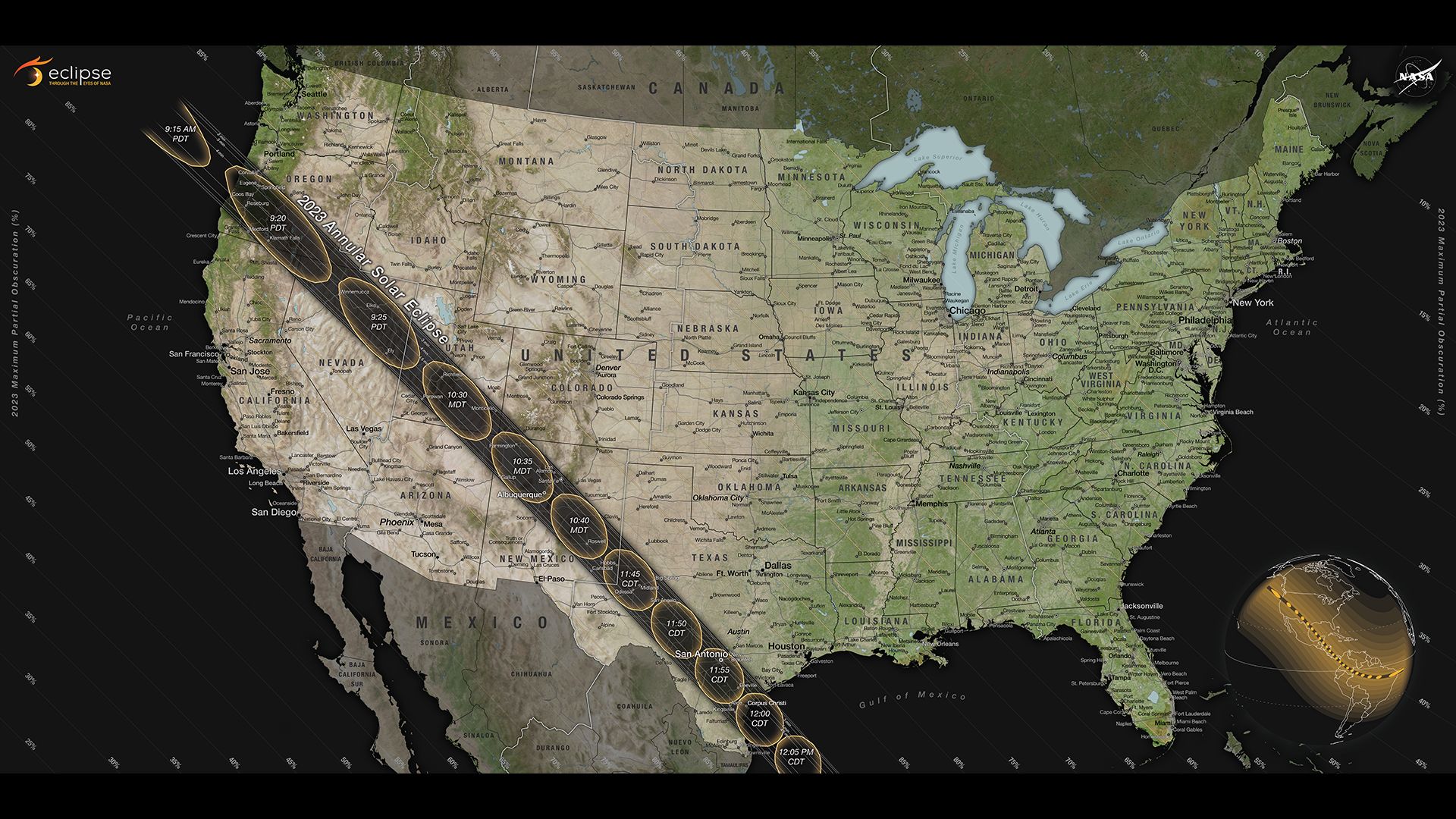
Track and times of the October 2023 annular eclipse across the United States (track across South America shown inset). Credit: NASA Scientific Visualization Studio

However, for those wishing to track the event, NASA’s 2023 Eclipse Explorer offers an interactive map detailing when and where the eclipse will be visible, including the path and duration of annularity (the areas from which the ‘ring of fire’ can be seen), allowing users to dive into the eclipse viewing experience like never before. Both the Time And Date and Virtual Telescope will be livestreaming the eclipse around the globe, as will Slooh via their You Tube Channel.

Of course, if you live along the line of the eclipse, you can always view it live. If you opt to do so (assuming the whether is clear), then remember: never look directly at the Sun either and especially through a telescope or binoculars or camera – don’t even use ordinary sunglasses. To view the eclipse safely you must use solar filters at all times on any optical equipment you are using to observe the Sun and / or wear solar eclipse glasses, regardless of whether your location will experience a partial solar eclipse or an annular solar eclipse. Serious eye damage and even blindness can result if you do not otherwise.

Also, don’t expect things to go really dark in the manner of a total eclipse or to be able to witness the Sun’s corona: that ring of the Sun’s disk peeping around the Moon may be small, but it is still bright enough to prevent that. But it will still be a spectacular event to see, and enthusiasts will go to whatever section of the eclipse track is most easily accessible for them in order to witness it.


Seanchai Library: The Bradbury Project in Second Life

Seanchai Library 2023

Ray Bradbury (August 22, 1920 – June 5, 2012) is perhaps best known as a science-fiction and futurist/speculative fiction author responsible for titles such as  Fahrenheit 451 (a book perhaps of special relevance currently), and his short-story collections The Martian Chronicles, and The Illustrated Man. However, he cast his writing net far wider, dipping into coming-of-age stories, screenplays, television scripts, poetry and both fantasy and dark fantasy. In the latter categories we have (the semi-autobiographical) Something Wicked This Way Comes, and The Halloween Tree.

It is this last story in particular, together with Bradbury’s creation of Green Town which form the latest chapter in immersive, event-driven projects developed and staged by Seanchai Library entitled, appropriately enough, The Bradbury Project.

The Halloween Tree

Running through until November 16th, with activities commencing on Monday, October 10th and running through until October 30th, The Bradbury Project will feature readings of The Halloween Tree by Seanchai staff and their friends together with entertainment provided by eClipse Club & Resort, and additional self-guided activities available for anyone who visits through until the project closes on November 16th, 2023.

Th Halloween Tree is the story of eight boys as they attempt to rescue their friend on Halloween night. Under the guidance of the mysterious Carapace Clavicle Moundshroud, they travel through time and space, learning about different cultures, and the role that the fear of death, ghosts, and hauntings has played in shaping civilisations down the ages, and which has contributed to much that is encompassed in modern-day Halloween activities.

The Project take place across two levels within the Seanchai Library home parcel, and for the best enjoyment, visitors to the Project should make sure their viewer is set to Use Shared Environment (World menu → Environment). Also, anyone visiting who isn’t already a member of either the Caledonian Studios or the Quantum Products SL experiences should join them when a dialogue to do so is displayed, as they will allow for a more seamless experience whilst exploring the Project’s locations.

The two levels for the event present interpretations of Bradbury’s Green Town and elements from The Halloween Tree, with both levels the focus of the Project’s events and activities.

The first of these – reached via the teleport portal close to the Library’s main landing point – is a corner of the outskirts of Green Town. Based on his birthplace of Waukegan, Illinois, Green Town was a fictional construct Bradbury used to juxtapose the comforting familiarity of Small Town America with the mysterious (and sometimes dark) events within several of his novels – including The Halloween Tree.

Two further portals with the Green Town setting provide access to the Project’s second level. This contains settings such as the home of Carapace Clavicle Moundshroud, esq., a good portion of the ravine just outside of Green Town, and the Halloween Tree itself. Of the two teleport portals connecting to this level, I recommend making your way to the the one within the first part of the Ravine on the edge of Green Town and using that when exploring.

Bradbury Project Activities and Events

Activities

  • “Where’s Mr. Lurky?” – Explore The Bradbury Project – everywhere from the main landing in Town, to the Kite Barn and The Halloween Tree. Look for the funny little black guy with the grinning purple face as you explore, and keep count! Full details for this hunt are available within The Bradbury Project locations.
  • Nosferatu on TV in the Halloween Open House – Town Level.
  • The Play Park in Green Town.
  • The Interactive Bradbury Library at Moundshroud’s House.
The Bradbury Project: Green Town

Readings and Entertainment

  • Readings of The Halloween Tree as follows:
    • 19:00 SLT every Tuesday of the event (October 10th, 17th and 24th), featuring Shandon Loring, Faerie Maven-Pralou, and Kayden O’Connell.
    • 13:30 SLT every Sunday of the event (October 15th, 22nd and 29th), featuring David Abbot, Gloriana Maertens, and Caledonia Skytower.
  • Music entertainment (via folk from eClipse Club & Resort) will be offered on the following dates (all times SLT):
    • 19:00-21:00 Friday, October 20th: DJ Momma Hoi.
    • 19:00-21:00 Saturday, October 21st: DJ Iniry Vaher.
    • 19:00-21:00 Sunday, October 22nd: DJ Caledonia Skytower.
    • 21:00-23:00 Thursday, October 26th: DJ Tiger Pawz.
    • 21:00-23:00 Monday, October 30th: DJ JAdmiral Maelstrom.

In addition, other Seanchai Library events may take place at the Project, including additional readings of Bradbury’s work, so keep an eye on the Seanchai Library website.

The Bradbury Project: The Halloween Tree

The Bradbury Project has been built by Dagmar Kohime, Gloriana Maertens, Stevie Basevi-Morane and Caledonia Skytower. All tips received by the Project will be donated to Reading is Fundamental.

SLurl and URL Details

2023 week #40: SL CCUG meeting summary: PBR and combat / gaming

Sonder, August 2023 – blog post

The following notes were taken from my audio recording and chat log transcript of the Content Creators User Group (CCUG) meeting held on Thursday, October 6th, 2023.

  • The CCUG meeting is for discussion of work related to content creation in Second Life, including current and upcoming LL projects, and encompasses requests or comments from the community, together with viewer development work.
  • As a rule, these meetings are:
    • Held in-world and chaired by Vir Linden.
    • Conducted in a mix of voice and text.
    • Held at 13:00 SLT on their respective days.
    • Are subject to the schedule set within the SL Public Calendar, which includes the location for the meetings.
    • Open to all with an interest in content creation.
  • The notes herein are drawn from a mix of my own chat log and audio recording of the meeting, and are not intended to be a full transcript.

Viewer Updates

The Maintenance W RC viewer updated to version 6.6.16.582075 on October 5th. The rest of the current official viewers in the pipelines remain as:

  • Release viewer, version 6.6.15.581961, promoted October 2 (formerly the Inventory Extensions Viewer).
  • Release channel cohorts:
    • glTF / PBR Materials viewer, version 7.0.0.581684, September 8.
    • Emoji RC viewer, version 6.6.15.581551, August 31.
    • Maintenance V(ersatility) RC viewer, version 6.6.15.581557, August 30.
  • Project viewers:

glTF Materials and Reflection Probes

Project Summary

  • To provide support for PBR materials using the core glTF 2.0 specification Section 3.9 and using mikkTSpace tangents, including the ability to have PBR Materials assets which can be applied to surfaces and also traded / sold.
  • The overall goal for glTF as a whole is to provide as much support for the glTF 2.0 specification as possible.
  • Up to four texture maps are supported for PBR Materials: the base colour (which includes the alpha); normal; metallic / roughness; and emissive, each with independent scaling.
  • In the near-term, glTF materials assets are materials scenes that don’t have any nodes / geometry, they only have the materials array, and there is only one material in that array.
  • As a part of this work, PBR Materials will see the introduction of reflection probes which can be used to generate reflections (via cubemaps) on in-world surfaces. These will be a mix of automatically-place and manually place probes (with the ability to move either).
  • The viewer is available via the Alternate Viewers page.

Further Resources

General Status

  • There has been a reported issue with animated textures on glTF materials which is under investigation.
  • Work is focused on clearing the backlog of niggling issues. Part of this is a glTF update which clarifies glare on transparent surfaces (e.g. things like glass and the degree of glare / sheen on it) which is helping for properly define this property (index of refraction), rather than leaving it up to artistic licence.

Mirrors

  • Mirrors are a part of the glTF / PBR materials project, but something of a separate tranche of work.
  • The idea is provide the means to have via high resolution reflections (i.e. mirrors) within a scene.
  • Initially only one active mirror surface per scene will be active for any viewer.
  • The process will use the PBR reflection probes mechanism, combined with a automated “Hero Probe” mechanism which with generate high resolution (512×512) “reflections” for the mirror.
  • The system will operate on the basis of avatar / camera proximity to a mirror surface triggering the closest reflection probe to become a “Hero Probe” for that avatar / camera. This means that if there are multiple mirrors placed within an environment, only the one closest to a given avatar / camera will be active and display the “reflections” generated by the reflection probe.
  • Depending on testing and performance, the number of mirrors might be expanded to two – one for mirror surfaces and one for Linden Water to generate high resolution water reflections where appropriate.

Status

  • Geenz Linden is working on performance improvements within the viewer. There is a target than an active real-time mirror should not exceed cutting a viewer’s frame rate by more than 50% at the highest impact.
  • Culling has been updated so that objects that are physically behind a mirror are no longer reflected by the mirror.
  • Shader work is in progress to get mirror reflections generally looking better visually.

Combat and Gameplay

  • Rider Linden confirmed he is adding a new function and event to llRezObject per the discussion in this forum thread about features for combat gameplay.
  • He also referenced his idea for moving Second Life damage from being a function of a script o being a function of the object, per his comments at the Simulator User Group meeting, and if possible this will include “negative damage” (or health recovery, if you prefer!).
  • A request was made to have a means to cap or better manage damage in some way, in order to prevent scenarios where it is possible to have a single bullet strike a object on which (say) five avatars are seated and have them all be killed (100% damage each), wherein in reality the bullet would only kill one and (maybe) wound another (so instead of all of them getting 100% damage, it is capped to each of them only getting X%). This request grew out of feature request BUG-231985, “Incoming LL Damage Cap”.

In Brief

  • BUG-234493 “Add an “until shortcut key released” option to gestures so we can do properly user-mappable keys” has been raised as a means of potentially making gestures more versatile, particularly in gameplay / combat, but also other areas, such as vehicle control options (e.g. creating a gesture to raise / lower the forks on a forklift truck and have the creator free to bind that to whatever keys / controller button(s) they like), etc.
  • A wide-raging discussion on the ability to create large-scale games in Second Life to attract a new audience, running from the technicalities involved and the need for more integrated toolsets (e.g. viewer-side scripting for HUD creation; and updated physics engine) through the ideas for a type of Second Life Endowment for the Arts (SLEA) but focused on content creation specifically targeted at encouraging people in to SL, to various ideas for new specialist simulator / region types, such as on demand regions and “game / event / entertainment” region types that can be instanced on the basis of demand.
    • The majority of this discussion was among users, the Lindens at the meeting not being in a position to comment on policy or revenue matters.

Next Meeting

† The header images included in these summaries are not intended to represent anything discussed at the meetings; they are simply here to avoid a repeated image of a gathering of people every week. They are taken from my list of region visits, with a link to the post for those interested.

Louvre’s Power of Water in Second Life

NovaOwl Sky Gallery, October 2023: Louvre – Agua

Open through October at the NovaOwl Sky Gallery is an exhibition of art by Louvre (Iamlouvre), a physical world artist who is now making her mark in Second Life, having joined (I believe) in 2021. This is the first time I have witnessed at exhibition of her work, and found it to be richly expressive.

Entitled Agua (the Spanish for “water”), this is an exhibition which fully embraces the space in which it displayed, Louvre demonstrating that as well as being a skilled artist, she has an innate sense of space and design, offering an environment that neatly folds itself around the exhibition’s theme, with the art split between the two levels of the gallery.

Water symbolises much more than an infinite space where we lose ourselves
when we look to sea. Water symbolises transformation, Life. All of us are water.  

– Louvre (Iamlouvre)

NovaOwl Sky Gallery, October 2023: Louvre – Agua

On the upper level, prints of her work are mounted on easels and walls, some of the latter backed by curtains of water tumbling to the floor below. On the lower level, this water spreads across a floor decorated with squares, some just below the surface other rising above it. All offer a sense of being stepping stones, encouraging visitors to make their way across them. These squares and mirrored by cubes and blocks climbing up the walls, the shimmering curtains of water visible in the gaps between them.

Close to the gallery entrance, sixteen cubes present sixteen paintings by Louvre, each painting repeated on all six faces of the cubes. Further back sit two larger cubes, each with an image of one of her paintings projected within it whilst further pieces are mounted on easels in an intentionally understated display, the entire level dominated by a single piece entitled Submarine.

Almost all of the paintings might be seen as portraits of a most unique kind. Few present a complete individual; rather they present images wherein the subjects are blurred or obscured, as if seen through a sheen of water, or with their subjects incomplete of cracked and fractured. In amongst them are paintings of a more abstract nature, but even these contain a sense of water-like fluidity and motion.

NovaOwl Sky Gallery, October 2023: Louvre – Agua

All of this is heavily suggestive of the opening lines of Louvre’s description for Agua, of water giving, being and transforming life. But there is more here as well, as Louvre goes on to note:

Water is also the tears produced by pain and sorrow. It is the force of the DANA flood that just hit my city. Washing away the homes of many neighbours and friends, taking within it their daily objects and their homes. Never in all my life have I been able to contemplate a greater disaster so closely. 
Water is the effort of my hands helping them, to the point of exhaustion, with water and more water.

– Louvre (Iamlouvre)

Storm Dana lashed Spain with torrential rain in early September, causing widespread flooding, particularly in the region of Castilla La-Mancha, home to the cities of Madrid and Toledo, with water levels rising such that streets, major transport arteries  – and most particularly, homes were overwhelmed. Such was the force of the water in places that cars were overturned or smashed together and evacuations were ordered. At least two deaths occurred, and several more people were reported missing.

NovaOwl Sky Gallery, October 2023: Louvre – Agua

It is this devastation, this sense of loss Louvre conveys through her paintings through their blurred / missing / incomplete elements. This reflection of Dana’s destruction is – as Louvre notes – very personal. She has witnessed the loss and hurt it has caused, and sought to help alleviate it through practical support for those around her hit by the storm’s ferocity. That this has also triggered her creativity through her art additionally completes the circle represented by Agua: that as a force of nature, water has the power to both positively and negatively bring about transformative experiences in life.

SLurl Details

October 2023 SL Web User Group (WUG) meeting summary

The Web User Group meeting venue, Denby

The following notes cover the key points from the Web User Group (WUG) meeting, held on Wednesday October 4th, 2023. They form a summary of the items discussed and is not intended to be a full transcript. A video of the entire meeting is embedded at the end of the article for those wishing to review the meeting in full – my thanks to Pantera for recording it.

Meeting Overview

  • The Web User Group exists to provide an opportunity for discussion on Second Life web properties and their related functionalities / features. This includes, but is not limited to: the Marketplace, pages surfaced through the secondlife.com dashboard; the available portals (land, support, etc), the forums.
  • As a rule, these meetings are conducted:
    • On the first Wednesday of the month and 14:00 SLT.
    • In both Voice and text.
    • At this location.
  • They are open to anyone with a concern / interest in the above topics, and form one of a series of regular / semi-regular User Group meetings conducted by Linden Lab.
  • Dates and times of all current meetings can be found on the Second Life Public Calendar, and descriptions of meetings are defined on the SL wiki.

Linden Homes Web Store Refresh

[Video: 1:01-2:21]

  • In 2022, LL commenced and overhaul of the “land journey” bringing all aspects of land “ownership” and land information – purchasing regions, renting or purchasing Mainland; obtaining a Linden Home and information on how to go about renting land from a private estate, etc., into a more fluid and updates set of web pages.
  • The first phase of this work went live in early 2023 with the launch of the Second Life Land Portal, with the promise that the Linden Homes web store would be the next element to be overhauled. This work has actually been underway for some time, and while “not 100% done” it will be released “very soon”.
  • Key elements of the new store include:
    • It is mobile device friendly.
    • It is accessible to anyone to view Linden Homes, whether logged-in or not (although, obviously obtaining a home still requires a subscription account).
    • It offers images and information on all the Linden Home styles in a browsable format and other information pertinent to obtaining a Linden Home.

Marketplace Updates

[Video: 2:30-7:02]

Since the September meeting:

  • Marketplace reviews have been updated so that aggregates of star ratings will now be rounded up, rather than always rounded down (e.g. where the aggregate of all star ratings on a product review might total 4.8, it would be rounded down to 4.5 – now it will be rounded up to 5. This change is being monitored, and further adjustments might be made.
  • Changes have also been made to the “Top Selling” report offered to Merchants to better match the “Top Selling” listing Merchants can generate for their products. In short:
    • The Top Selling listing was based on items sold in the previous 30 days; however, the Top Selling report was based on all products over the lifetime of the store.
    • The latter has now been revised to show both “best selling” over the lifetime of the store and the best selling items during the previous 30 days.
  • The work in archiving-off MP items which had not sold in 2 months and the store owner has not actively logged-in to the MP in two years has received a final tidy-up, with all related demos for the archived items also being archived as well.
  • Support have been furnished with assorted documentation and support notes for the MP so they can more thoroughly assist with reported MP issues.
  • Further bug fixing through September, but no details as several of the bugs were security-related.

In Brief

Please refer to the video for more on these items, and other points raised in the meeting.

  • [Video: 13:52-33:14] Marketplace gifting: an extended discussion on Merchants having the option to restrict items in their store which can be gifted to others.
    • The primary reason stated for this was on the matter of fraud wherein someone obtains Linden Dollars fraudulently, uses them to gift items to their main or alt accounts, then when the use of the illicit L$ is uncovered by the Lab, the amount is removed from the merchant’s account, and the merchant has no way to recover the goods.
    • Regardless of the pros can cons of gifting and matters of fraud, etc., there is a case to make that merchant creators should have the option to be able to disable gifting on specific products listed on the MP if they so wish, rather than being forced to opt-in to having all their products listed on the MP available for gifting.
  • [Video 38:50-end] A further discussion of the idea first raised at a recent CCUG meeting for LL to create their own version of Flickr-style site specifically for SL users to share their photos. Several reasons were noted for this:
    • It could become a potential revenue source for LL. Flickr is split between limited Free accounts and more flexible (with additional capabilities) subscription-based  Pro accounts, so the idea would be for LL to follow a similar model, a limited service provided to Basic account users, and Premium and Premium Plus having access to more advanced features (e.g. ability to live-link, support for a greater number of images per account, etc). It is believed by proponents of this idea that people using Flickr Free accounts would be more prone to pay for the advanced features were they to be offered by LL, rather than paying Flickr.
    • It is seen as a means for merchants to gain an additional revenue stream (linking images on the service directly to MP listings), and to potential to offer selected bloggers  / photographers featuring their products to revenue share off of any sale.
    • Whilst not an impractical idea (and although not raised at the meeting) there are obviously questions of actual ROI for the Lab in running such a platform / service against the cost of developing, implementing and maintaining such a service.
    • Again, please refer to the video for this discussion.
  • Some anger from a new meeting attendee on the fact that the WUG meeting is mixed text / voice and no warning of this is given through official channels (e.g. the User Group meetings page on the wiki, the SL Public Calendar or in any forum / feed / social media reminders for the meeting. It was agreed that pages and notifications will be updated to include the voice aspect of the meeting.

Next Meeting

  • Wednesday, November 1st, 2023.

2023 SL SUG meetings week #40 summary

Kuroshima, July 2023 – blog post

The following notes were taken from the Tuesday, October 3rd Simulator User Group (SUG) meeting. They form a summary of the items discussed and is not intended to be a full transcript. A video of the entire meeting is embedded at the end of the article for those wishing to review the meeting in full – my thanks to Pantera for recording it.

Meeting Overview

  • The Simulator User Group (also referred to by its older name of Server User Group) exists to provide an opportunity for discussion about simulator technology, bugs, and feature ideas.
  • These meetings are conducted (as a rule):
  • They are open to anyone with a concern / interest in the above topics, and form one of a series of regular / semi-regular User Group meetings conducted by Linden Lab.
  • Dates and times of all current meetings can be found on the Second Life Public Calendar, and descriptions of meetings are defined on the SL wiki.

Server Deployments

  • On Tuesday, October 3rd, simhosts on the SLS Main channel were restarted without any code update.
  • On Wednesday, October 4th, the RC channels will be similarly restarted without any change to the simulator version.
  • A new simulator RC (dubbed “Fall Colours”) is due to go to QA in week #41, and then to deployment in week #42 (commencing Monday, October 16th).

Viewer Updates

The Inventory Extensions RC viewer, version 6.6.15.581961, and issued on September 28th, was promoted to de facto release status on Monday, October 2nd, 2023.

The rest of the current viewers in the pipeline remain as:

  • Release channel cohorts:
  • Project viewers:

Potential for Games Controller Use

Further to recent meetings, Leviathan Linden gave the following update.

Just a quick update on the “game controllers input exposed to LSL” project before everyone starts teleporting around: (1) I was having trouble getting game controller events from SDL2 (Simple DirectMedia Layer) to the viewer, but finally figured out what was blocking them –> SDL2 will work for us. (2) I’m working on getting the data streamed from the veiwer to the simulator in a new message. (3) After that I need to shuttle the data to the relevant scripted objects (attachments and seats only, for now). The new script event for the data is already written. (4) I hope to get a test region up and a compatible viewer available for download tomorrow. If I manage it then I will announce on the Scripting channel on the SecondLife Discord server for anyone who wants to try it out.

Region Crossing Code Tests

There was a further round of region crossing tests led by Maestro and Monty Linden, this two using two pairs of regions apiece using different simulator configurations, and intended to test avatar / vehicle physical crossings. As we all know, avatars entering a region that is busy / active with other avatars, can have an impact on simulator performance – which although not as bad as it once was thanks to an earlier tranche of this work a few years ago, is still a problem. The aim of this work is to smooth things even further for both teleports and direct crossings.

In Brief

  • Rider Linden raised the question of changing the Second Life damage system, and its potential impact on combat and similar systems (potentially removing the the need for scripts in bullets, for example):
Right now damage is a property of a script… what would be the impact of making that a property of the prim [instead]? It would remain script accessible/settable I’m just changing where it is stored. The big drawback would be that right now it would appear you could have multiple scripts apply damage… you’d lose that capability. The damage change is just the one ambiguity that I need to resolve before I go forward with something larger. But I’m going to save most of that discussion for next week. … I just want it bumping around inside people’s skulls for a bit

So, if you are into combat in SL – attending next week’s meeting might be beneficial.

  • As a side-note to the above, this change would also potentially allow negative values, which basically heal the target.

† The header images included in these summaries are not intended to represent anything discussed at the meetings; they are simply here to avoid a repeated image of a rooftop of people every week. They are taken from my list of region visits, with a link to the post for those interested.