2023 week #46: SL CCUG meeting summary: PBR status & current release plan

Le’eaf Forest Retreat, September 2023 – blog post

The following notes were taken from my audio recording and chat log transcript of the Content Creators User Group (CCUG) meeting held on Thursday, November 16th, 2023.

  • The CCUG meeting is for discussion of work related to content creation in Second Life, including current and upcoming LL projects, and encompasses requests or comments from the community, together with viewer development work.
  • As a rule, these meetings are:
    • Held in-world and chaired by Vir Linden, in accordance with the dates and times given in the the SL Public Calendar, which also includes the location for the meetings.
    • Conducted in a mix of voice and text..
    • Open to all with an interest in content creation.
  • The notes herein are a summary of topics discussed and are not intended to be a full transcript.

Official Viewers Status

No updates for the latter part of the week, with the current crop of official viewers being:

  • Github Actions (GHA) RC viewer, version 6.6.16.6566955269, issued October 20 (with major CEF update and number version numbering) and promoted on October 25.
  • Release channel cohorts:
    • Maintenance X RC, version 6855926535, issued November 14 – usability improvements.
    • Maintenance Y, version 6.6.17.6855930358, issued November 14 – My Outfits folder improvements; ability to remove entries from landmark history.
    • glTF / PBR Materials viewer, version 7.0.1.6750600769, November 11.
    • Maintenance-W RC viewer, version 6.6.17.6709258523, November 9.
    • Maintenance V(ersatility) RC viewer, version 6.6.16.582201, October 16.
    • Emoji RC viewer, version 6.6.15.581551, August 31.
  • Project viewers:

General Notes

  • The PBR viewer now appears to be the no 1 on the runway for promotion to release status – see the notes below for more.
  • The next viewer LL is hoping to promote after PBR is the Emoji RC viewer.
  • As there are now four Maintenance RC viewer in the pipeline (V, W, X, and Y), it is likely some of them will be merged together to reduce the load on the release schedule.

glTF Materials and Reflection Probes

Project Summary

  • To provide support for PBR materials using the core glTF 2.0 specification Section 3.9 and using mikkTSpace tangents, including the ability to have PBR Materials assets which can be applied to surfaces and also traded / sold.
  • The overall goal for glTF as a whole is to provide as much support for the glTF 2.0 specification as possible.
  • Up to four texture maps are supported for PBR Materials: the base colour (which includes the alpha); normal; metallic / roughness; and emissive, each with independent scaling.
  • In the near-term, glTF materials assets are materials scenes that don’t have any nodes / geometry, they only have the materials array, and there is only one material in that array.
  • As a part of this work, PBR Materials will see the introduction of reflection probes which can be used to generate reflections (via cubemaps) on in-world surfaces. These will be a mix of automatically-place and manually place probes (with the ability to move either).
  • The viewer is available via the Alternate Viewers page.

Further Resources

Grid-Wide Deployment and Viewer Release

  • Following a meeting this week, the current plan from the Lab is to deploy PBR Materials grid-wide on the simhosts during the first week after US Thanksgiving (so week commencing Monday, November 27th, 2023).
  • Currently, all RC simhost have been updated to the PBR simulator code which leaves only the SLS Main channel to go.
  • The plan is also to promote the PBR RC viewer to de facto release status that same week.
  • Note that these plans are subject to late-breaking issues or other requirements not getting in the way of things.

Recent Work

  • Fixes are progress for what are seen as to remaining notable issues:
    • One to correct the issue with normal maps uploaded via the glTF uploader always coming out square post-upload  and with lossy compression.
    • One to correct the issue of not being able to revert an Alpha mode from blend or mask to opaque without having to save the material back to inventory after making the change in order for it to apply properly.
  • There are some additional bugs within the system, some of which do have fixes in the works, but these aren’t seen as having significant impact, and will be subject to release with the first maintenance update to PBR Materials.
  • That said, there some issues which have been identified, but will not be addressed until the first PBR maintenance viewer is issued. These include:
    • A “slim minority” of users with very, very large inventories and Friends lists may find some objects in a scene do not render when logging-in. Currently, the steps for correcting this are to a) re-log, and if that fails to resolve the problem, b) clear cache.
    • Some users on Macbooks and / or Apple Silicon systems may experience poor performance on the PBR viewer.
  • For those interested – this is the list of currently open issues for PBR.

General PBR Discussion

  • BUG-234235 “[PBR] alpha blend on water is acting a bit like invisiprim” – this is being worked on, and is seen as somewhat related to another change under consideration: environmental haze.
    • Currently, local lights are not affected by environmental haze. Runitai Linden is working on a change that will make local lights responsive to haze (e.g. if you are in a foggy environment, lights at an increasing distance from your camera position will appear fainter and fainter due to the influence of the fog).
    • This work will likely be surfaced in the first PBR viewer maintenance release.
    • The reason this is related to BUG-234235 is that it will also require an adjustment to water haze as well, and this should resolve the issue reported in the bug (haze will essentially get its own render pass, with a single shader being used for both atmospheric and water haze, rather than them requiring separate render passes).
  • Future work on glTF will allow for more greater control of lighting sources, such as lamps, etc., and provide for luminosity to be defined in terms such as lumens. However, this work will depend on glTF scene import, which will be worked on in the next tranche of work, together with HDRI import / export (which is not as yet on the glTF implementation roadmap).
  • A Materials folder is to be added to the system library and available through the Library section of inventory.

In Brief

  • A Feature Request has been filed to allow system-generated sounds to be overridden by Experiences to provide more immersive sounds (e.g. on entering a door and being teleported, the sound heard might be the creaking of the door opening, rather than the ding-sing-whoosh of the default teleport sound – which can only currently be disabled on a per viewer basis by the user). See (and Watch) BUG-234682 “Override UI sounds within the scope of experience keys” for more.

Next Meeting

† The header images included in these summaries are not intended to represent anything discussed at the meetings; they are simply here to avoid a repeated image of a gathering of people every week. They are taken from my list of region visits, with a link to the post for those interested.

Of art and Silence in Second Life

Melusina Parkin: Secret Shores, Nitroglobus Roof Gallery, November 2023

This will be the second of two recent art reviews in these pages presenting a joint coverage of art exhibitions running through November / December 2023, although unlike my last (see: Artistic reflections on the human form and intimacy in Second Life), they are not connected by some subjective and potentially nebulous cooked up in side my little noggin; this time they are very much jointed at the hip, because by the same artist and encapsulating the same core theme. Coincidentally, one of these exhibitions is also taking place at Nitroglobus Roof Gallery, curated by Dido Haas, which was also the location for one of the two exhibitions reported on in the above-linked review.

The artist in question is Melusina Parkin, and the exhibitions are Silent Shores and Silent Landscapes, with the former presented within the main hall at Nitroglobus, and the latter within Melu’s own gallery space. In terms of total number of images, the larger of the two is Silent Landscapes, offering a total of 48 images, whilst Silent Shores presents 16 pieces in what might be called a subset of some of those found at Meulsina’s Place, but offered in a much large format, allowing us to be drawn more deeply into them.

Melusina Parkin: Silent Landscapes, Melusina’s Place, November 2023

Given they are connected, I’m going to cover both exhibitions as if they were a single whole; however, were I pushed pushed to give a suggestion as to the order in which they should be viewed, I would recommend visiting Silent Landscapes first. It is here that the complete collection can be seen together with Melu’s own thoughts on how the collection came into being. Silent Shores, with its use of large format images, then allows for that deeper sense of engagement mentioned above.

I’ve oft commented on Melu’s work in these pages, particularly noting her use of tight focus and angles within her photographs to concentrate the eye and mind on a specific item or element within an image, thereby limiting our frame of reference whilst simultaneously opening the image up in a manner which springboards the imagination into framing its own narrative around the piece, rather than restricting us to interpreting the story the artist wished to convey. It’s a technique I much admire, inviting as it generally does the mind to take free flight.

Melusina Parkin: Secret Shores, Nitroglobus Roof Gallery, November 2023

Here, Melu does much the same in terms of allow her audience to view each piece and formulate a narrative around it, if they so wish. However, in terms of style, she uses a reverse approach, pulling the camera back, as it were, from her more usual tight focus and closed angles to offer us – quite literally- broad horizons into which landscapes and costal settings flow and fade. Thus, we are presented with images with the suggestion of the infinite  – and yet which are intimate and personal thanks to her use of soft tones, horizon haze and a deep sense of depth present within piece.

This sense of intimacy-without-open-spaces wraps within it a subtle yet deep sense of solitude enhanced by the fact that nary an image offers so much as a bird is the sky or creature on the ground. Even the man-made objects apparent in some of the pieces come across as natural elements within each setting, rather than something interjected into it.

Melusina Parkin: Silent Landscapes, Melusina’s Place, November 2023

The result of this is that each piece draws us into it in a very personal way; these are not images of places unknown, this are places reflective of mood and feeling; they exude a silence we all, at times, desire or have felt; times when Nature allows us to be true to ourselves in thought, and where we can accept the feelings we might otherwise repress – or at least lose in the daily hubbub of life. In this, silence can be a deep and calming friend.

Given this, these are also images that carry something personal to Melusina, as she notes in her introduction to Silent Landscapes whilst also noting the power of silence itself:

Silence isn’t only a matter of hearing; it can be depicted by an image. Lonely landscapes, fuzzy or faint images suggest [a] lack of noises or voices. Silence is absence; absence is peaceful, but can also be sad.  I shot and collected dozens of images of solitary landscapes that show silences; their slight sadness and their relaxing mood match the inspiration of many of the thousands [of] photos I took in many years of SL Photography. So, I consider these pictures as a summary of the deepest feelings I wanted to express in my work. 

– Melusina Parkin, Silent Landscapes

Melusina Parkin: Secret Shores, Nitroglobus Roof Gallery, November 2023Which, at the end of the day, is really what needed to be said. Evocative, personal – to those viewing them and to the artist, albeit in a myriad of different ways as they speak to each of us – Silent Landscapes and Silent Shores form an engaging and slime collection of SL photographic art which can speak to all who witness them.

SLurl Details

2023 SL SUG meetings week #46 summary

 Triple Sweet Café, September 2023 – blog post

The following notes were taken from the Tuesday, November 14th Simulator User Group (SUG) meeting. They form a summary of the items discussed, and is not intended to be a full transcript. A video of the meeting is embedded at the end of this summary, my thanks as always to Pantera for recording the meeting and providing it.

Apologies for the lateness of this summary, RL is not playing nice at the moment.

Meeting Overview

  • The Simulator User Group (also referred to by its older name of Server User Group) exists to provide an opportunity for discussion about simulator technology, bugs, and feature ideas.
  • These meetings are conducted (as a rule):
  • They are open to anyone with a concern / interest in the above topics, and form one of a series of regular / semi-regular User Group meetings conducted by Linden Lab.
  • Dates and times of all current meetings can be found on the Second Life Public Calendar, and descriptions of meetings are defined on the SL wiki.

Server Deployments

  • No deployments for SLS Main channel, but the simhosts were restarted.
  • Wednesday, November 15th should have seen the deployment of the PBR Material simulator support to all RC channels.
    • Please remember: if you have anything that uses PBR materials and you rez that object (or wear it) on a non-PBR simulator,  the PBR Materials will be stripped from the object and forgotten.
  • There are currently internal discussions on whether or not to deploy the simulator support for PBR before or after US Thanksgiving.

Viewer Updates

Two new Maintenance viewers were issued on Tuesday, November 14th:

  • Maintenance X, version 6855926535, comprising viewer usability improvements.
  • Maintenance Y, version 6.6.17.6855930358, comprising improvements to the My Outfits folder (display thumbnails on hover) and to remove entries from landmark history

The rest of the official remain unchanged at the start of the week:

  • Github Actions (GHA) RC viewer, version 6.6.16.6566955269, issued October 20 (with major CEF update and number version numbering) and promoted on October 25.
  • Release channel cohorts:
  • Project viewers:

Game Controllers

  • The simulator code for the game controller support is now in the “Fall Colours” simulator RC update, which is currently scheduled as the first simulator RC deployment in December.
  • The viewer code needs further work, including:  keyboard mapping to controller input channels; the ability to set the dead zone of various axes; support for “less common” controllers; additional UI to work alongside existing support options (e.g. SpaceNavigator).
    • In terms of the SpaceNavigator, the project will not include an update to support the latest 3dconnexion drivers, as it is felt this will break expected behaviour for the SpaceNav mouse in SL – the aim is to continue to support SpaceNav as is.
  • This work does not, as yet, include the ability to control avatar motion, although there was additional discussion around this.
  • Expansions to inputs have been filed in Feature Request BUG-234678.
  • There was also significant discussion on game controller / LSL interactions.
  • When available via the Alternate Viewers pages, the viewer will has a MacOS build as well. Meanwhile, documentation on the game controller work can be found on the SL wiki, and this includes Github link for downloading a pre-release version of the Windows viewer.

SL Combat

  • A further general discussion on updating SL’s support for combat gaming, most of which has been covered in recent SUG summaries here (e.g. adjusting the avatar bounding box and hit box when crouching  / seating (so the form allows for crawling under object, for example, and the latter makes for a small target).
  • Camera control options:
    • A new request was for a native means to set the camera to follow remote objects (e.g. RC vehicles) rather than having to relay on “janky” scripts to achieve the capability.
    • There were also requests for offsetting mouselook view (see VWR-28745 for an example of such a request).
    • Rider suggested updates to the camera control mechanism and positioning might be better suited to an update to scripted camera capabilities he is considering (but not anywhere close to being in a position to discuss in terms of what might / can / cannot be done).

In Brief

  • A lot of requests for updates to SL terrain, including updating the textures and improving the resolution (which should hopefully be covered by the PBR terrain support Cosmic Linden is developing, which should also reduce texture stretching as the heightmap is morphed); full terrain painting (not currently on the books); a general smoothing terrain deformations to make movement, etc., smoother.
  • Region Crossing: following the most recent pile-on tests, Monty Linden is working on some updated code, which he is trying to get onto Aditi (the Beta grid) on server channel DRTSIM-565, however there is a bug he needs to hammer on first.
  • Monty is also working on “an EventQueueGet thing”, which he hopes to get on to Aditi on DRTSIM-577.
  • Further requests for a means of masking Linden Water from the interiors of object – see BUG-227965 as a reference for this.
  • There was a request to be able to adjust the centre of mass for a linkset (e.g. a vehicle). While this can be done to some degree via prim cutting, it is not so possible with mesh; how it would be handled is unclear, but Leviathan Linden indicated he would kick some ideas around.
  • somewhat/ sort-of related to the above, a Feature Request has been filed to allow control of where a vehicle rotates from without having to do prim hackery – see BUG-234649, an update to SVC-6619). It was noted this could be useful for objects other than vehicles alone.

† The header images included in these summaries are not intended to represent anything discussed at the meetings; they are simply here to avoid a repeated image of a rooftop of people every week. They are taken from my list of region visits, with a link to the post for those interested.

A trip to The Hamptons in Second Life

The Hamptons, November 2023 – click any image for full size
 Inspired by Northern East Coast or Western European landscapes, with plenty of hide aways to cuddle and relax from the crowd and the noise.

So reads the introduction to Haye Aya’s Homestead Region of The Hamptons, which I recently had the chance to hop over and see, courtesy of the Destination Guide.

For those unfamiliar with the name, “The Hamptons” tends to refer to that part of the eastern end of Long Island, centred on the towns of Southampton and East Hampton. It is regarded as one of the historical summer colonies of the north-eastern United States, and the region has a long history, although it is perhaps most known for its patronage by the wealthy and politically-connected. For example, both sides of Jacqueline Bouvier Kennedy Onassis‘ family resided there, her parents were married in East Hampton, and she was born at Southampton Hospital (although admittedly, this was more by accident; her parents happened to be visiting family in East Hampton from New York at the time of her birth).

The Hamptons, November 2023

However, whilst the may well be little corners of their namesake which caught Haye’s eye, it is important to note that, as per the About Land description, her actual inspiration for the region’s design is much broader; so much so that anyone living along the north-east coast of north-eastern North America or in north-western Europe is going to feel a sense of familiarity about the setting. Certainly, there are no rolling beaches or sandy vistas, nor are there any great houses standing proud over the landscape; instead, The Hamptons offers a natural, somewhat rugged setting with the primary aim of offering people places whether they can spend time as individuals, couples or in small groups, and simply relax.

This it does by minimising the use of buildings within the region, instead focus on walks and trails leading to all the various public spots visitors might discover. Those buildings which are present here primarily form a strange little parade at the landing point, a cobbled area which appears to have become home to an assortment of bric-a-brac down the years, with a old piano, filing cabinets and desk on nodding terms with nearby balloons, an old water channel buoy, plastic chairs and – curiously – a table set for a rather enticing dinner.

The Hamptons, November 2023

A short walk to the north from here will bring visitors to a tall bridge spanning one of the watery gorges which collectively split the setting into an archipelago of high-sides islands. A boardwalk runs along a part of the cliff top by the bridge, providing access to stairs running down to the water’s edge and one of the many cuddle-points: a rowing boat pulled up into the shallows. Another such sitting spot longs out over the sea a little further away from the bridge. Meanwhile, an equally short walk to the south from the landing point will bring visitors to a thicket of hedges cast across the path, together with the yellow stripes of ban-lines marking this end of the island as off-limits to those not invited.

No such restrictions per se lie on the far side of the bridge, where the next island is topped by an old mind tunnel cuts into its heart. Two paths flank the sides of the hill, one leading to what may have once been an outbuilding related to whatever was being hewn out of the mine’s large central chamber, with a further board walk beyond it allowing visitors to reach another space in which to hang out.

The Hamptons, November 2023

The other path around the hill ends at a large trestle extending out over the gorge below, and is the reason for my qualifying this island being free from restrictions to travel. It supports a small greenhouse-come-potting shed, but this and the deck on which it sits are not intended to be reached via the path; instead the way to them is from Haye’s private house / workspace, thus they appear to be an extension to it and not a public space.

The third of the islands in the group offers a largely open, flat top bordered here and there by boardwalks running along its edges. Swings and sofas offer places to sit and pass the time, whilst the southern portion of the island features a little tiered garden and further hangouts, all of it with a lean towards an Oriental touch, something continued on the final and smallest of the islands. This takes the form of a small Japanese style house sitting within a modest, semi-wild garden. Simply furnished, it sits within its own parcel, so not sure if it is intended for a specific use – it does not appear to be restricted in terms of access.

The Hamptons, November 2023

All of which makes for an easy-going visit and opportunities to relax and / or take photos. There are one or two small edges to the place that might be smoothed out, and the use of ban lines rather than a more subtle request for privacy might upset some, but on the whole, a pleasant visit for an afternoon or evening.

SLurl Details

2023 SL viewer release summaries week #45

Logos representative only and should not be seen as an endorsement / preference / recommendation

Updates from the week through to Sunday, November 12th, 2023

This summary is generally published every Monday, and is a list of SL viewer / client releases (official and TPV) made during the previous week. When reading it, please note:

  • It is based on my Current Viewer Releases Page, a list of all Second Life viewers and clients that are in popular use (and of which I am aware), and which are recognised as adhering to the TPV Policy. This page includes comprehensive links to download pages, blog notes, release notes, etc., as well as links to any / all reviews of specific viewers / clients made within this blog.
  • By its nature, this summary presented here will always be in arrears, please refer to the Current Viewer Release Page for more up-to-date information.
  • Note that for purposes of length, TPV test viewers, preview / beta viewers / nightly builds are generally not recorded in these summaries.

Official LL Viewers

  • Release viewer version 6.6.16.6566955269, formerly the Github Actions (GHA) RC viewer, version , issued October 20, promoted October 25 – No Change.
  • Release channel cohorts:
  • Project viewers:
    • No updates.

LL Viewer Resources

Third-party Viewers

V6-style

  • Kokua updated to versions 6.6.16.51702 (no RLV) and 6.6.16.55167 (RLV variants) on November 11 – release notes.

V1-style

  • Cool VL viewer updated to version 1.30.2.36 (Stable) and version 1.31.0.13 (Experimental) on November 11 – release notes.

Mobile / Other Clients

  • No updates.

Additional TPV Resources

Related Links

Space Sunday: Frank Borman – first to the Moon

Fank Borman during Suiting-up for the Apollo 8 mission, December 1968. Visible but blurred in the background is his crewmate, Jim Lovell. Credit: NASA (via You Tube)

Just a week after the passing of Apollo astronaut Ken Mattingly (see: Space Sunday: Remembering Ken Mattingly), came the news that another pioneering hero of spaceflight, Frank Borman, had passed away at the age of 95.

Born in Gary, Indiana on March 14, 1928 as the only child of Edwin Otto and Marjorie Borman, Frank Frederick Borman II considered Tucson, Arizona to be his home town after his family moved there whilst he was very young in order to ease the numerous sinus and mastoid problems he suffered in the colder, damper environment of Indiana.

By the age of 15 and in the mid-1940s, he was playing football for the high school team and, thanks to local flight instructor Bobbie Kroll, who took a shine to his enthusiasm for aviation, he has his student’s flying certificate and was a member of a local flying club. His aim was to levering his football playing into a scholarship so he might attend an out-of-state university offering a good course in aeronautical engineering.

Unfortunately, this did not work out and with graduation approaching and his family unable to afford to send him to a suitable university, he determined he’s have to enlist in the Army and later use his right to a college tuition under the GI Bill. However, a family friend persuaded local congressman Richard F. Harless to add Borman’s name to a list of nominees he was going to put forward for a slot at the US Military Academy, West Point.

Borman’s official 1950 West Point yearbook photo. Via Wikipedia

Despite having little chance of being offered the slot – his was the fourth and last name on the list, after all – Borman took the entrance exam, and passed. Shortly afterwards, hostilities in the Pacific ended, and astoundingly, those on the list ahead of him opted to forego military service, gifting the slot to him.

Graduating West Point in June 1950, Borman returned home to Tucson on leave prior to commencing his formal basic training. Whilst there, he arranged to meet Susan Bugbee, whom he had dated in high school. She had recently graduated from the University of Pennsylvania with a degree in dental hygiene. Rekindling their relationship, they were married on July 20th, 1950.

Achieving his goal of training as a fighter pilot, Borman attended combat flight school throughout most of 1951, based at Nellis Air Force Base, Nevada. Whilst there, Susan gave birth to their first son, Frederick Pearce Borman, in October of that year. Two months later, Borman found his flying career potentially shattered after he suffered a perforated eardrum whilst on a dive bombing training flight and doctors grounded him indefinitely as a result.

It took him a year to convince his seniors his ear had healed without any danger of further ruptures,  and he was capable of flying. During that time, he was assigned to ground duties at Clark Air Base in Philippines, where Susan gave birth to their second son, Edwin Sloan.

By 1960 and with a Masters degree under his belt – which he obtained in just a year rather than the usual 3 – Borman had been back in the pilot’s seat for eight years, clocking up some impressive experience, all of which resulted in his selection for training USAF Experimental Flight Test School. Graduating from it April 1961, he was immediately selected as one of five Air Force students to attend the first class at the Aerospace Research Pilot School. However, NASA also announced they were seeking nine candidates for their second astronaut intake, so Borman, along with fellow student James McDivitt and instructor Thomas Stafford obtained permission to apply, and all three were formally accepted as a members of the “Next Nine” (Group 2) NASA astronaut candidates in April 1962.

At NASA, Borman became known for his focus and tenacity – and for have something of an ego. He was initially selected to fly with Mercury veteran Virgil “Gus” Grissom on the first long-duration flight of Gemini. However, their pairing as the back-up crew for Gemini 3, the first Gemini Project crewed mission, led to tensions such that when astronaut chief Donald “Deke” Slayton wanted to promote both men to the prime crew slots on the mission after original mission commander Alan Shepard was diagnosed with Ménière’s disease, Grissom stated he would only fly the mission if Borman were replaced as his pilot.

Complying with the request, Slayton replaced Borman with John Young. This scored two goals: it ended the friction between Grissom and Borman and it allowed him to appoint Borman as commander of the long-duration Gemini flight – now designated Gemini 7 – with Jim Lovell as his pilot, the two getting on well together. Plans changed just two months ahead of Gemini 7’s December 1965 launch, when Gemini 6 was cancelled while the crew of Walter Schirra and Thomas Stafford were actually in their capsule preparing for launch.

The reason for this was Gemini 6 has been due to perform rendezvous and docking tests with a uncrewed Agena Target Vehicle launch just ahead of it. However, the Agena had exploded shortly after launch, leaving Gemini 6 without a docking target. However, rather than drop the mission entirely, mission planners decided Gemini 6 – re-designated as Gemini 6A – could launch a few days after Gemini 7, with Schirra and Stafford using it as their rendezvous and docking target.

Borman agreed to this change, but drew the line at any idea of the two craft physically docking; he and Lovell didn’t have the time they’d need to learn the required procedures, even if their vehicle were to be the passive element of any docking. He also mixed the idea that Lovell and Stafford should perform and joint EVA and swap vehicles, pointing out this would require Lovell to wear a Gemini EVA suit for several days, something for which it was not designed. Conceding these points, mission planners settled on the basic rendezvous idea, and Gemini 7 lifted off on December 4th, 1965, with Gemini 6A following on December 15th – three days later than planned.

Gemini 7 with Borman and Lovell aboard, as seen from Gemini 6A, shortly after their initial rendezvous, December 15/16, 1965, when the two craft are approximately 10 metres apart. Credit: NASA

During the intervening period, Borman and Lovell completed all the major aspects of their mission – which were related to matter of crew hygiene, nutrition, fitness, diet, etc., during a lunar mission – and were keen to see Gemini 6A arrive. This it did some 13 hours after launch, with Schirra initially bringing the craft alongside Gemini 7 at a distance of 40 metres before spend the next 4.5 hours performing a series of rendezvous manoeuvres, at times coming as close as 30 cm (1 ft) to Gemini 7 as he practiced docking manoeuvres and assessed flight control precision. After this, he moved Gemini 6A some 16 km away to allow both crews to get some rest without any worry their vehicles might collide.

After just over 24 hours in orbit, Gemini 6A fired its retro-rockets and re-entered the atmosphere, splashing down in the North Atlantic to be recovered by the USS Wasp. Meanwhile Borman and Lovell continued in orbit, becoming concerned as their craft started experiencing a mounting series of niggling issues and malfunctions as it started to reach the limits of its operational endurance. Despite this, both men remained in good spirits, even joking with their recovery crew – their December 18th splashdown was close enough to that of Gemini 6A that the USS Wasp was also assigned to their recovery – that they’d been together so long, the Wasp’s Captain might as well marry them!

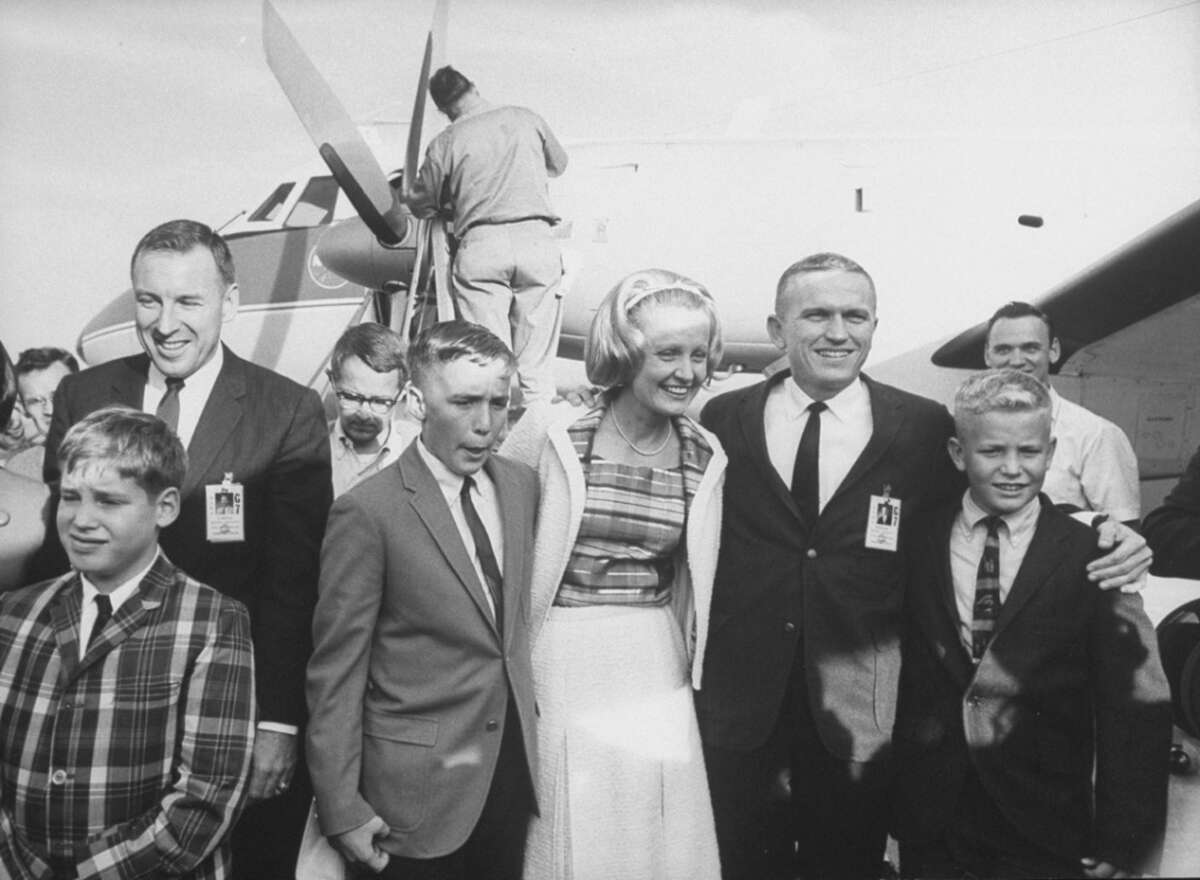
James Lovell (left, with son Jay) and Frank Borman (right, with wife Susan and sons Frederick and Edwin), following the successful flight of Gemini 7

Continue reading “Space Sunday: Frank Borman – first to the Moon”