
On Wednesday April 1st, 2026, NASA’s Artemis 2 mission launched on a 10-day cruise to the Moon and back (with time initially spent in Earth orbit), carrying a crew of four to test the capabilities and facilities of the Orion Multi-Purpose Crew Vehicle (MPCV). The mission was a key preparatory step to send crews to the surface of the Moon, starting with the flight of Artemis 4, currently targeting a 2028 launch.
In the first part of this 2-part series I covered Artemis 2 from launch to TLI. Here I complete the voyage in summary form.
Whilst marked by a number of on-going space health experiments, video calls to Earth and performing sundry tasks and s few minor fixes, the outward trip from Earth to the Moon was pretty much a claim affair. A 17.5 second mid-course correction manoeuvre was performed automatically by Integrity, the Orion spacecraft, on mission day 5 – which was actually the first to be performed, the initial correction burn having been cancelled due to Integrity being so precisely on course whilst under its own flight control software.

Day five also saw the crew test their dual-purpose Orion Crew Survival System (OCSS) suits – the orange-coloured space suits the crew wore during the Artemis 2. Designed for quick donning, the suits function as a contingency safety system during the crew’s time aboard and Orion spacecraft, providing up to 144 hours of life support in the event of a cabin depressurisation.

In their second role, the suits are intended to act as water survival suits in the event of an emergency evacuation of an Orion vehicle post-splashdown. In this role, the suits are intentionally coloured “international orange” so as to be more clearly visible in the water – just like survival suits used on ocean-going cargo vessels, oil rigs, deep sea fishing vessels, etc They additionally have inbuilt flotation devices. Each OCSS is custom made to fit an individual astronaut.
Day five also saw a series of discussions with Mission Control on the upcoming loop around the Moon to review lunar surface targets for observation and photography during the flyby and finalise observation techniques.
On flight day 6, Integrity officially entered the influence of the Moon, with lunar gravity now the dominant force in shaping the vehicle’s trajectory. Until now, Integrity had effectively (if slowly) been decelerating, due to the “pull” of Earth’s gravity behind it, effectively cruising at a few thousand kilometres an hour at it approached the Moon. Now, under the Moon’s influence the craft would start to very slowly accelerate, allowing the Moon’s gravity to swing it around the Moon and lob it back towards Earth without any significant engine burns.

Around the Moon
At 23:00 UCT on April 6th, Artemis 2 made its closest approach to the Moon, passing some 6,545 kilometres above the Moon’s far side. Shortly thereafter Integrity reached a distance of 406,771 kilometres from Earth, breaking the record for the furthest any humans had been from Earth and set by the crew of Apollo 13 in 1970. At this point, Integrity officially started its flight back towards Earth.
During the loop around the Moon, Artemis 2 was in communications black-out with Earth due to the bulk of the Moon being between the spacecraft and Earth, effectively blocking all signals. This blackout lasted 40 minutes, and ended with a successful recovery of comms and telemetry at the expected time.
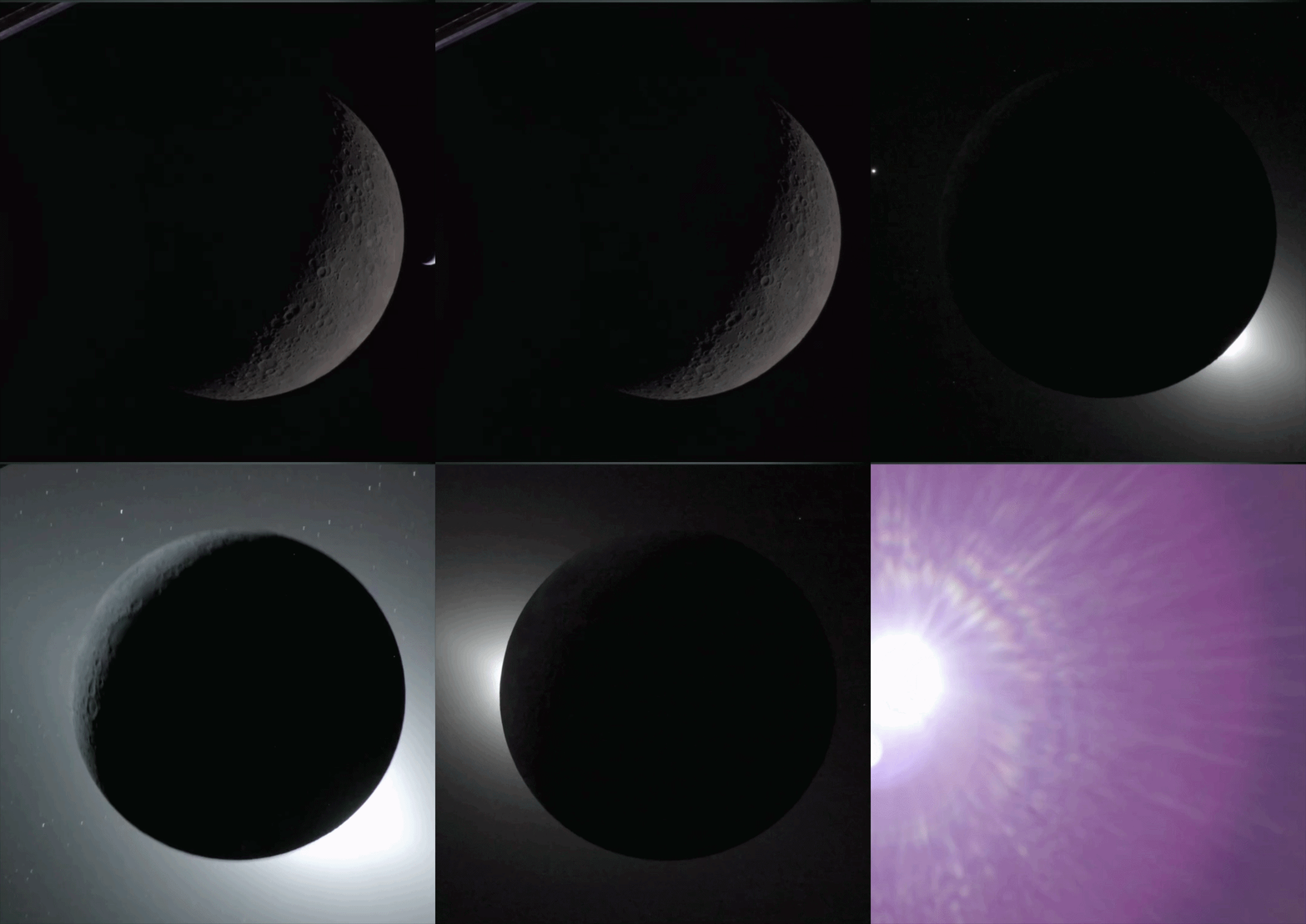
Following the comms blackout, the crew of Artemis 2 witnessed a solar eclipse from deep space as the bulk of the Moon came between them and the Sun. This allowed the crew to observe both the eclipse from a unique perspective, and witness a number of “impact flashes” of meteoroids striking the semi-dark lunar surface facing them. The Moon was not fully dark as the Earth was off to one side relative to Integrity, and so was reflecting sunlight back onto one hemisphere of the Moon, bathing it in “Earthlight”.
Also during the flight around the Moon, the crew christened two previously unnamed craters on the Moon. They named one for their spacecraft, Integrity, whilst the second was – in a poignant moment – named Carroll, in honour of Reid Wiseman’s late wife, who passed away from cancer in 2020.

Between flight day 7 and flight day 9, Orion departed the Moon’s sphere of influence on its free return trajectory towards Earth, once again slowly accelerating. For most of Day 7 the crew were engaged in debriefing calls with Earth, recording their observations, feelings and emotions during their trip around the Moon whilst memories and reactions were still fresh. They also put in a call to astronauts aboard the International Space Station (ISS).
A further planned use of manual control by Wiseman and Pilot Victor Glover on Day 8 was cancelled in order to allow mission managers conduct a data-gathering exercise related to a non-critical helium leak within the Orion’s European Service Module (ESM), so that they might better analyse the issue post-mission. Two final trajectory adjustment burns were carried out on Days 9 and 10, lasting 8 and 9 seconds respectively. Most of Day 9 saw the crew packing and stowing experiments and equipment in readiness for re-entry and splashdown.
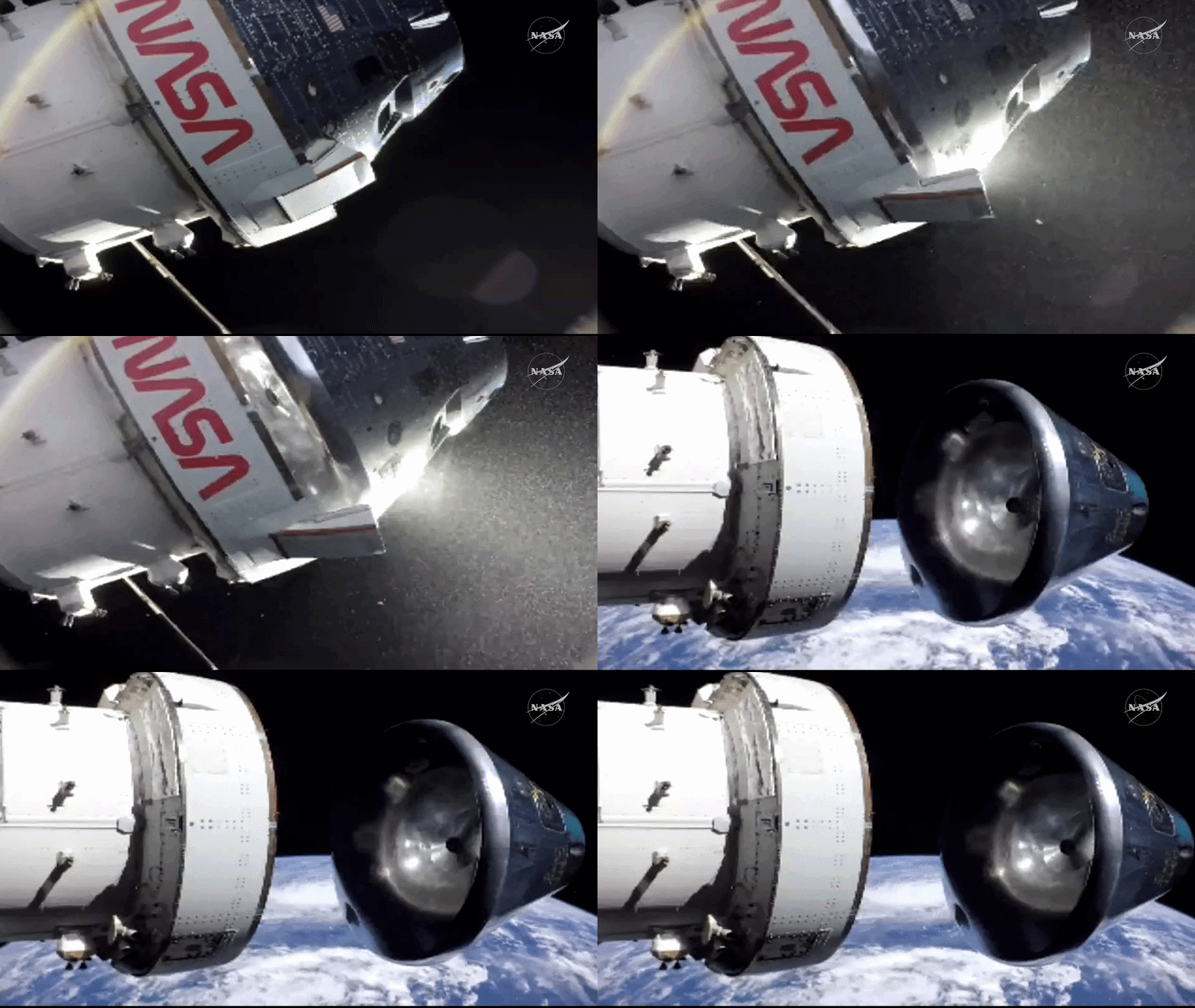
Following the course correction burn on Day 10, the ESM was jettisoned, its work done. The reaction control thrusters system (RCS) on Integrity then operated in sequence over 19-seond period, both manoeuvring the capsule away from the ESM and orienting it in readiness foe atmospheric re-entry.
EDS: Entry, Descent and Splashdown
Day 10 saw the most critical elements of the mission unfold: atmospheric entry, descent and splashdown. During Artemis 1, and as I’ve covered in numerous Space Sunday pieces, post-recovery, the heat shield showed some disturbing issues. As well as the expected ablation damage to the heat shield, it also showed signed of deep scoring and charring, with relatively large holes apparently seared through the heat shield material.
After extensive analysis, it was determined that an error in the fabrication process for the initial heat shields for Artemis 1 through 3 had resulted in pockets of gas being trapped in the layers of ablative material. Due to the original re-entry profile for Orion, as used on Artemis 1, which saw the vehicle “skip” in and out of the upper atmosphere to reduce its velocity prior to actual re-entry, these gases ended up being super-heated several times, weakening the heat shield’s structure and eventually blowing holes up and out of it as they outgassed.
While the fabrication process for the heat shields was revised to mitigate any issues of gases becoming trapped – Artemis 2, due to time constraints, would have to fly with its original heat shield. To compensate for this, NASA altered the mission’s re-entry profile to be more Apollo-like: a single direct re-entry. Whilst this might increase stresses on the vehicle and crew, it would reduce the time over which any trapped gases in the heat shield might have expand and contract and weaken its overall integrity, thus increasing the risk of failure.
As it turned out, the heat shield (subject to post-flight inspection) did its job in this new re-entry profile and protected Integrity and its crew, all of which descended by parachute post re-entry to splashdown off the coast of California, where a recovery operation overseen by the USS John P. Murtha out of San Diego saw the recovery of both crew and the space vehicle. Following initial medical checks on the Murtha, the four crew were then flown to the mainland for further check-ups, prior to proceeding on to the Johnson Space Centre in Texas to be reunited with families and loved ones.

Research related to Artemis 2 will continue post flight, and some of it will continue to focus directly on the four crew, comprising functional check-out tests, simulated space walks, exercises, etc., to further gain insight into the human body’s ability to adapt to low gravity operations and work, and its ability to recover from them. As well as this, all four will be a part of a media circus for some time to come. To them, and all those involved in Artemis and Artemis 2 – congratulations.
What Comes Next?
Originally, Artemis 2 was to be followed by the first attempt at landing an Artemis crew on the Moon. However, this idea both spoke to an unwarranted gung-ho attitude on the part of Artemis management at NASA (no crewed pre-testing of the lunar landing system (called the Human Landing System, or HLS) in Earth orbit), and assumed the mission would actually have a lunar landing vehicle (from SpaceX) available to meet its 2027 launch date.

In taking over at NASA, Jared Issacman saw the gung-ho approach of Artemis 3 as a step too far, and so – with Congressional and White House approval – determined Artemis 3 should be an Earth-orbiting testy of the HLS vehicle by a crew. Also, in keeping with his predecessor, Sean Duffy, he indicated that SpaceX was no longer the sole provider of the Artemis 3 HLS; but would directly face off against Blue Origin, who had been awarded a HLS contract by order of Congress after NASA changed the scope and rules of the original HLS contract to favour SpaceX.
Given that the SpaceX HLS continues to exist as little more than a few disparate elements (such as the crew elevator – largely developed by NASA) and pretty computer renderings, this move to include Blue Origin – who are actively testing elements of their HLS, Called Blue Moon Mark 2 with NASA astronauts – is a wise one, given the SpaceX CEO appears to believe time frames and delivery dates are purely functions of his ego.

As it is, this year should see Blue Origin fly a Blue Moon “pathfinder” mission to the Moon. This will see a scaled-down version of the Blue Moon cargo lander fly a payload from NASA to the Moon, allowing it to test the flight control, navigation, and data communications systems and avionics which will all be part of both the Blue Moon Mark 1 cargo vehicle and Blue Moon Mark 2 HLS. If successful, the mission could put Blue Origin in a strong position to provide the HLS vehicle for both Artemis 4 and Artemis 5.
However, even if one (or both) HLS vehicles get successfully tested in Earth orbit in 2027, it does not mean NASA will be ready to send astronauts to the lunar surface – there is another hurdle to overcome, one entirely of NASA’s own making: cryogenic orbital refuelling.
To explain: while techniques for transferring hypergolic propellants between space craft has long been available (the ISS, for example, routinely takes on propellants for its manoeuvring thrusters), cryogenic propellant transfer in space is entirely new. It’s not been used before simply because cryogenic propellants are not exactly stable. For one thing, they don’t like heat (and in space, in direct sunlight it s very hot). Heat makes them revert to a gaseous state, expanding their volume. This puts greater and greater pressure on the tanks holding them, such that if the gas isn’t vented to some degree, everything is going to quickly vanish in a brilliant (if silent – in space, no-one can here you go pop!) explosion.

Cryogenic propellants are also heavy in their liquid state, making them somethings of a deadweight if you’re attempting to lift them to orbit rather than burning them as a means to get to orbit. This latter point means that in order just to get to Earth orbit or to the Moon, the SpaceX HLS and Blue Moon Mark 2 (respectively) must launch without the fuel needed to get to the Moon, land a crew and get them back to lunar orbit. Thus, the fuel must be ferried to them post launch.
For Blue Origin, this means launching a Blue Moon HLS to lunar orbit, but without the propellants it needs to operate between lunar orbit and the Moon’s surface. Instead, these must be delivered by a “tanker” craft called the Cislunar Transporter, being developed by Lockheed Martin. But here’s the catch: the Cislunar Transporter has to be launched without the propellants it needs to get to the Moon or those it must transfer to the waiting HLS. So, once in orbit it also has to be “refuelled” by at least two Blue Origin New Glenn rockets.
And if that sounds complicated – SpaceX much do much the same with their HLS, which will launch with only sufficient propellants needed to get to Earth orbit. After this it must either make up to sixteen individual dockings with Starship “tankers” to take on the propellants it needs to reach the Moon and perform its duties there, or it must rendezvous with a (also yet to be built) “orbital fuel depot” previously filled with the propellants it needs by multiple Starship “tanker” flights.
And this is where boil-off comes into play: all of these approaches will result in large volumes of cryogenic propellants spending a lot of time in direct sunlight, turning back to a gaseous state, expanding and requiring venting to prevent their storage tanks rupturing. So techniques and entirely new technologies need to be developed and tested in order to reduce the overall boil-off issues lest more time is spent on “tank top-up” missions than in actually sending humans to the Moon. Further, no-one knows if large volumes of cryogenic propellants can easily be pumped from one vehicle to another in microgravity.
Thus, even though Artemis 2 has been a huge success and NASA is turning its attention to Artemis 3, the programme as a whole still has some hefty hurdles to clear before it is close to being ready to send humans back to the surface of the Moon, and at the current rate of progress, I cannot see all those hurdles being cleared by “early 2028 – less than 2 years from now – when Artemis4 is supposed to launch on its crewed mission to the lunar surface.

 Inara Pey: Living in a Modemworld