Logos representative only and should not be seen as an endorsement / preference / recommendation
Updates from the week through to Sunday, August 10th, 2025
This summary is generally published every Monday, and is a list of SL viewer / client releases (official and TPV) made during the previous week. When reading it, please note:
It is based on my Current Viewer Releases Page, a list of all Second Life viewers and clients that are in popular use (and of which I am aware), and which are recognised as adhering to the TPV Policy.
This page includes comprehensive links to download pages, blog notes, release notes, etc., as well as links to any / all reviews of specific viewers / clients made within this blog.
By its nature, this summary presented here will always be in arrears, please refer to the Current Viewer Release Page for more up-to-date information.
Outside of the Official viewer, and as a rule, alpha / beta / nightly or release candidate viewer builds are not included; although on occasions, exceptions might be made.
Official LL Viewers
Default viewer 2025.05 7.2.0.16729091892, issued August 5, promoted August 8 – New.
glTF mesh import ( should have similar constraints to COLLADA upload, but does not support a unified material upload solution).
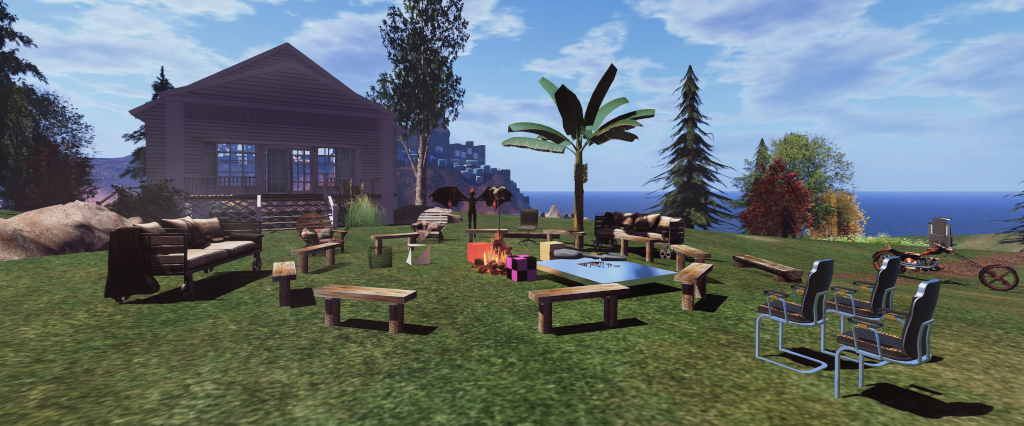
Oscarton Forest Park, August 2025 – click any image for full size
I recently received an invitation from William Gide to visit Oscarton Forest Park, a setting designed by William and his SL partner, Dekon Carter.
Comprising a number of parcels spanning two regions within the south-east of Heterocera, the park offers around a quarter of a region of a landscaped setting with something of a unique history.
Oscarton Forest Park, August 2025
The Park started life as a “COVID sanity project”, helping William – who designed the majority of the ground level elements – cope with lockdown by allowing him to exercise his creativity. Since then, the park has remained open as a public setting which visitors can use as a place to enjoy a sense of nature and recharge their batteries.
Given this, there are a number of distinct Landing Points to be found throughout the park. For the purposes of this piece, I’m going with the “main entrance”, so to speak, as it is here visitors can obtain a notecard with landmarks to the main hangouts within the setting.
Oscarton Forest Park, August 2025
Bordered by part of the SLRR to the west and a river gorge to the south, the latter spanned by a bridge leading to what I believe to be William and Dekon’s private home, the public park runs northward. Passing a vegetable garden, the landscape opens out to offer a choice of possible exploration routes, the clearest being the main path.
The latter sweeps out to the east side of the park, passing between two Chinese lion statues, the first of multiple pieces of sculpture awaiting discovery as one explores the park. In making its sweep, the footpath skirts the lower end of the forest, a copse of silver birch. However a trail also runs through the birch trees, almost doubling back on the main path to drop down to where a trail points to the north and west, winding through the forest proper.
Oscarton Forest Park, August 2025
The main footpath, meanwhile descends to where a bridge spans one of the parks streams, joining another path as it follows the bank of the stream northwards. Passing by way of a secluded cabin, this path eventually drops down to the setting’s camp site prior to making a sharp left turn to arrive at the octagonal pavilion.
This pavilion can also be reached via one of the many paths branching off from the second trail mentioned above, all of which pass various places to hang-out and also admire some of the large wood sculptures to be found among the trees.
Oscarton Forest Park, August 2025
The northern end of the park includes two newer elements. The first is the Oscarton Forest Café. Occupying a large building by Cory Edo, on its east side this overlooks one of the park’s bodies of water and the pavilion beyond. On its west side, the café offers a terrace with seating a view of any passing trains.
Steps lead down from the terrace to a stone footpath and walls forming a border to the park, looking like it may have been some form of ancient fortification. Tucked within a part of these works – which also run along the northernmost extent of the park – is the Oscarton Forest Park Reflection Cove, described as a place for meditation.
Oscarton Forest Park, August 2025
Also to be found within these walls is a Zen garden watched over by two large rune stones, whilst the woods in this northern extent of the park also hide the teleport platform up to the sky platform – but I’ll leave that for you to find.
Offered with a richness of detail, Oscarton Forest Park is an idyllic location, and for a first-time public build, is exceptionally pleasing to the eye and rich in opportunities for photography and for relaxing.
Oscarton Forest Park, August 2025
My thanks to William for the invitation to visit; I really enjoyed doing so.
Jim Lovell in a cropped version of his 1969 official NASA portrait
On Friday, August 8th, NASA confirmed the passing of James A. Lovell, who alongside the crew of Apollo 11, could well be the most famous of the Apollo astronauts. During his career at NASA he flew into space fours times and to the Moon twice – although he was destined to never set foot on the latter, despite being a mission commander.
Born in Cleveland, Ohio on March 25th, 1928, James Arthur Lovell Jr., was the only child of James Lovell Snr., a Canadian expatriate, and Blanche Lovell (née Masek), who was of Czech descent. Following the death of his father in a car accident in 1933, James and his mother moved to Milwaukee, Wisconsin, where he developed an interest in aircraft and rocketry as a teenager. After graduating high school, Lovell enrolled in the US Navy’s “Flying Midshipman” programme, which enabled him to attend the University of Wisconsin and study engineering – something he could not otherwise have been able to afford. As his Navy stipend was fairly meagre, he supplemented his income working a local restaurant as a busboy and wishing dishes.
In 1948, Lovell’s hoped-for career as a potential naval aviator almost came to an end when the Navy announced it was cutting back on the number of students being accepted through the “Flying Midshipman” programme. However, with the aid of local Congressman John C. Brophy, Lovell was able to turn this downturn in his career into a positive, by being accepted into the United States Naval Academy, Annapolis, where he was able to both continue his studies and secure himself a US Navy commission upon his graduation.
This happened in 1952, with Lovell gaining a Bachelor of Science degree and a US Navy commission as an ensign. He was then selected for aviation training. However, prior to commencing flight training, he married his long-term sweetheart, Marilyn Lillie Gerlach, who had transferred to George Washington University in Washington, D.C., so she could be near him while he was at Annapolis.
Jim and Marilyn Lovell, circa 1965. Credit: unknown
In February 1954, Lovell completed his flight training and was assigned as a night fighter pilot operating out of Virginia, prior to being moved to the aircraft carrier USS Shangri-La during her third commissioning as US Navy fleet carrier. Sailing in the western Pacific and completing 107 carrier sorties, Lovell was again reassigned in 1956, this time to provide transition training for pilots moving over to the new generation of Navy jets entering service.
This work qualified Lovell for selection as a trainee test pilot in 1958, and he joined a class with included future fellow astronauts Walter “Wally” Schirra Jr and Charles “Pete” Conrad Jr. After six months of training, Lovell graduated at the top of the class – which should have assured him a role as a test pilot. Instead, he found himself pushed into Electronics Testing, and assigned to work on airborne radar systems.
This prompted him to join Schirra and Conrad in applying to join NASA’s first astronaut intake, the three being part of a batch of 110 test pilots initially selected for consideration as potential astronauts. Ultimately, Schirra was the only one of the three to be selected to become one of the Group One Mercury Seven astronauts; Conrad blew his chances by rebelling against a number of the psychological tests, finding them objectionable, whilst Lovell missed out when a temporarily high bilirubin count stopped his selection.
Returning to naval duties, Lovell became the Navy’s McDonnell Douglas F-4 Phantom II programme manager, followed by a stint as a flight instructor and a safety engineering officer. Then in 1962, NASA started the selection process for the Group Two astronaut intake (the so-called “New Nine”, as the media would eventually dub the nine selected by NASA). Both Lovell and Conrad re-applied, the latter a lot more contrite this time around, together with John Young, who had served under Lovell on the F-4 Phantom 2 programme.
Lovell was informed he has been selected as one of the “New Nine” in September 1962. The following month, he and his family moved to the Clear Lake City area near Houston, Texas, where the new Manned Spaceflight Centre was being built.
NASA’s “New Nine” (officially the Group Two astronaut intake) in 1962, with Jim Lovell in the centre of the standing row. Flanking Lovell to the left and right respectively (and from the left) are: Elliott M. See, James A. McDivitt, Edward H. White II and Thomas P. Stafford. In the front row (left to right) are: Charles Conrad, Jr, Frank Borman, Neil Armstrong and John Young. Credit: NASA
Following initial training, carried out alongside the original Mercury Seven, Lovell was selected as backup pilot for the Gemini 4 mission, with Frank Borman, another of the “New Nine” selected as backup commander. This placed Borman and Lovell in line to fly the Gemini 7 mission as the prime crew.
Gemini 7 launched on December 4th, 1965, and would become the longest space mission undertaken until Soyuz 9 in 1970. In all, Gemini 7 lasted 14 days and completed 206 orbits of Earth. It was primarily intended to solve some of the problems of long-duration space flight, such as stowage of waste and testing a new lightweight spacesuit which might be used for both Gemini and Apollo, but which both men found to be impractical.
One significant “late change” to the mission came in the last two months prior to launch. Gemini 6, with “Wally” Schirra and Thomas Stafford, had been planned to take place in October 1965. The goal of that mission was to perform a series of dockings with an Agena target vehicle. However the mission was scrubbed when the Agena for the mission suffered a catastrophic failure following separation from its launch booster, destroying itself. As a result, Gemini 6 was initially cancelled.
Gemini 7, with Lovell and Borman aboard, as seen from Gemini 6A, and the later closes to a distance of some 7 metres. Credit: NASA (digitally enhanced to remove light reflection from the cockpit window of Gemini 6A)
However, such was the importance of on-orbit rendezvous and docking to the Apollo programme, the decision was made to re-designate Gemini 6 as Gemini 6A, and launch it eight days after Gemini 7. This allowed Schirra and Stafford to perform an on-orbit rendezvous (but no docking) with Gemini 7, that latter remaining a passive target for Gemini 6A whilst Schirra and Stafford manoeuvred their vehicle.
Following their launch, Borman Lovell performed their own rendezvous manoeuvre: following separation from their Titan II launch vehicle, Borman turned their craft around and flew in formation with the expended Titan II for fifteen minutes before moving away to start their mission proper. This included each man having the opportunity to doff his spacesuit and test working in shirt sleeves in the vehicle, and then donning it in a space little bigger than the front seat of a car. These tests greatly contributed to Apollo crews being able to fly to the Moon and back in their shirt sleeves, only wearing their pressure suits during critical phases of the mission, Lovell and Borman finding the revised Gemini spacesuit cumbersome, and long-term work inside a spacecraft whilst wearing a pressure suit too restrictive and uncomfortable.
Another view of Gemini 7 from Gemini 6A, at a distance of around four metres, as the two craft perform a station-keeping exercise. Credit: NASA
The rendezvous with Gemini 6A took place on December 15th, 1965, same day as Gemini 6A launched. At the time, Gemini 7 was “parked” in a circular 300 km orbit, allowing Gemini 6A to “chase” it, with Schirra allowing his vehicle’s autopilot to carry out some of the manoeuvring before taking over and bringing Gemini 6A to some 40 metres separation from Gemini 7. For the next 270 minutes Gemini 6A performed a series of rendezvous manoeuvres with Borman and Lovell, sometimes coming as close as 30 centimetres (1 foot) of Gemini 7. Station keeping between the two craft was so good that during one such manoeuvre, Gemini 6A was able to remain in place alongside Gemini 7 for 20 minutes with any need for control inputs.
Following completion of these tests, Gemini 6A returned to Earth the day after its launch. Gemini 7, meanwhile, continued on what Borman and Lovell would later describe as the “boring” part of the mission, prior to re-entry, splashdown and recovery on December 18th.
Gemini 7 set Lovell up to command the final Gemini mission in the programme, Gemini 12, with one Edwin E “Buzz” Aldrin Jr., as his pilot. Lovell would later describe the mission as being a means to “catch all those items that were not caught on previous flights.” One of these was to need to carry out a series of EVA tests – with Aldrin, as pilot, selected to leave the confines of the vehicle’s cramped cabin and carry them out.
Similar EVAs had been attempted in other Gemini flights, but none had really succeeded for a variety of reasons. For Gemini 12, equipment – notably tethering restraints on the Gemini vehicle – had been greatly improved, and a new underwater training capability had been introduced, allowing Aldrin to gain familiarity with being weightless through neutral buoyancy ahead of the mission – something which would go on to be a staple of human spaceflight training at NASA.
A shorter 4-day duration mission, Gemini 12 lifted-off on November 11th, 1966. The following day Lovell and Aldrin completed a rendezvous and docking with the Agena target vehicle, launched just 1 hour and 39 minutes ahead of them. Aldrin completed a 2 hour 20 minute EVA whilst the Gemini spacecraft was docked with its Agena target vehicle, successfully meeting all of his objectives, and the two men carried out a series 14 scientific experiments prior to returning to Earth on November 16th, 1966.
“Buzz” Aldrin (left, with cap) and Jim Lovell celebrate the end of their Gemini 12 mission aboard the recovery vessel, USS Wasp. Credit: unknown
Following the tragedy of the Apollo 1 fire, the Apollo Command Module went through a significant re-design, including the hatch mechanism which had effectively trapped the Apollo 1 crew in their burning vehicle, leading to their deaths. As a result, the updated vehicle had to go through a series of ground-based qualification tests. One of these tests formed Lovell’s next “mission” – spending 48 hours bobbing around the Gulf of Mexico in Command Module test article CM-007A along with Stuart Roosa and Charles Duke Jr , testing its seaworthiness, the efficiency of its floatation devices and dealing with any potential small leaks of seawater entering the vehicle.
With the Apollo programme attempting to get back on track after Apollo 1, Lovell was assigned as back-up Command Module Pilot (CMP) for Apollo 9. He was then promoted to the prime crew when Michael Collins had to be removed as prime CMP so he could receive surgery for a spinal bone spur. This move reunited Lovell with Frank Borman, Apollo 9’s commander.
Apollo 9 was intended to be the second half of a pair of missions designed the test the the Apollo Lunar Module (LM), Apollo 8 doing so in a low Earth orbit, and Apollo 9 in a high-perigee orbit. However, with work on the Lunar Module running well behind schedule, the decision was made to scrap the high-perigee test mission, and instead carry out one low orbit test flight of the Lunar Module. To achieve this, the Apollo 8 and Apollo 9 crews were swapped. The Apollo 9 crew would now fly the LM tests, delayed to allow time for the Lunar Module to be completed; Borman and his crew, as Apollo 8, would fly a mission to and around the Moon as a part of a final check-out of the Command and Service modules on long duration flights.
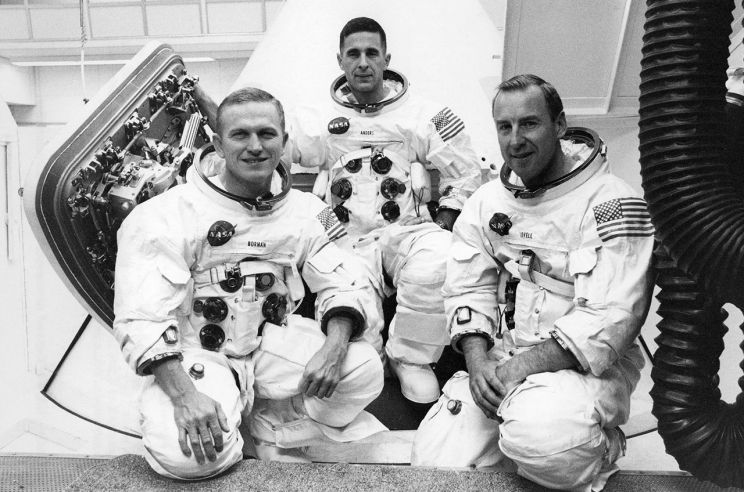
Lovell (right) poses with Frank Borman (left) and William Anders at the hatch of their Apollo 8 Command Module, ahead of that mission. Credit: NASA
Launched on December 21st, 1968, Apollo 8 was a landmark mission in a number of respects:
The first crewed flight of the Saturn V launch system.
The first crewed mission to ever leave low Earth orbit and enter he gravitational sphere of influence of another celestial body.
The first crewed mission to enter lunar orbit.
The first humans to be entirely cut off from Earth as their vehicle passed around the Moon.
The first humans ever to witness “earthrise” – the Earth rising over the limb of the Moon, something almost impossible to see from the surface of the Moon where the Earth is either above or below the horizon.
The “earthrise” phenomenon was first witnessed as Apollo 8 came around from behind the Moon at the end of its fourth orbit. All three men were busy with various observations, with Anders taking black and white photos of the lunar surface when he happened to look up, and gasp in surprise.
Oh my God, look at that picture over there! There’s the Earth coming up. Wow, is that pretty! … You got a colour film, Jim? Hand me a roll of colour, quick, would you?
– William Anders, Apollo 8, on witnessing “Earthrise” for the first time
Taking a colour film cassette from Lovell, Ander loaded it into his camera and took the picture destined to become famous the world over, later selected by Life magazine as one of its hundred photos of the 20th century.
Earthrise: the shot that enraptured the world. Credit: William Anders / NASA
Entering lunar orbit, and after checking the status of the spacecraft following the orbital insertion burn of the Service Module’s main engine, Lovell provided the very first close-up description of the lunar surface as seen with unaided human eyes.
The Moon is essentially grey, no colour; looks like plaster of Paris or sort of a greyish beach sand. We can see quite a bit of detail. The Sea of Fertility doesn’t stand out as well here as it does back on Earth. There’s not as much contrast between that and the surrounding craters. The craters are all rounded off. There’s quite a few of them, some of them are newer. Many of them look like—especially the round ones—look like hit by meteorites or projectiles of some sort. Langrenus is quite a huge crater; it’s got a central cone to it. The walls of the crater are terraced, about six or seven different terraces on the way down.
– Jim Lovell, Apollo 8, offering the first close-up description of the Moon
As they rounded the Moon for the ninth of ten times, on Christmas Day 1968, the crew of Apollo 8 made a second television broadcast to Earth. It concluded with each of the three men reading verses from the Book of Genesis describing the creation of the Earth; given what they had witnessed with “earthrise” the passages seemed particularly fitting.
During their trip home, the crew were informed they had presents hidden aware in their vehicle, courtesy of Chief of the Astronaut Office, Donald “Deke” Slayton: a Christmas dinner with all the trimmings, all specially packed together with a miniature bottle of brandy for each man. Borman ordered the bottles to remain sealed until after splashdown to avoid any risk of alcoholic impairment during re-entry and splashdown – all of which occurred without incident on December 27th, 1968. However, no warning was required: all three men kept the bottles unopened as keepsakes for years.
As prime crew for Apollo 8, Lovell was automatically selected as commander on the back-up crew for Apollo 11. Under the crew rotation rules established by “Deke” Slayton, this assignment in turn meant Lovell would command Apollo 14.
However, fate again intervened, as it had in so many ways during Lovell’s career. Apollo 13 was to have been commanded by Alan Shepard, marking his return to flight status after being grounded for several years. However, Slayton’s boss, George Mueller, Director of Manned Space Flight, refused to sign-off on Shepard’s selection for the mission, believing Shepard had not had sufficient training. Because of this, Slayton asked Lovell if he and his crew of Thomas Kenneth “Ken” Mattingly (who would later be replaced by John “Jack” L. Swigert Jr.) and Fred Haise Jr., would be willing to swap seats with Shepard and his crew, to give the latter more training time.
Lovell’s response to the request was to become one of the greatest unintentional understatements of the 20th Century: “Sure, why not? What could possibly be the difference between Apollo 13 and Apollo 14?”
As well all know now, Apollo 13 was to have quite a lot of difference between it and Apollo 14 – and any other Apollo mission NASA flew, becoming as it did potentially the most famous Apollo lunar mission alongside that of Apollo 11, but for very different reasons.
“We have a problem here.” – CMP Jack Swigert. “This is Houston, say again please,” – CapCom Jack Lousma. “Houston, we’ve had a problem,”- CDR Jim Lovell.
– From the communications between the Apollo 13 command module and Mission Control, immediately following the explosion within the oxygen tanks of Apollo 13’s Service Module
The wreck of the service module after it had been jettisoned. The blown-out panel and extensive damage to the fuel cell rack and oxygen tank shelf below then can be seen. Credit: NASA
The safe recovery of the Apollo 13 crew following an explosion within the Service Module’s oxygen tank 2 is the stuff of legend so much so, that rather than dwelling on it here, I’ll refer readers to my article on the occasion of its 50th anniversary –Space Sunday: Apollo 13, 50 years on.
Apollo 13’s flight trajectory would result in Lovell, Haise, and Swigert gaining the record for the farthest distance that humans have ever travelled from Earth to date. It also made Lovell one of only three Apollo astronauts, along with John Young and Eugene Cernan, to fly to the Moon twice – although unlike Cernan and Young, he was never destined to set foot on its surface. In all, he accrued 715 hours and 5 minutes in space flights on his Gemini and Apollo flights, a personal record that stood until the Skylab 3 mission in 1973.
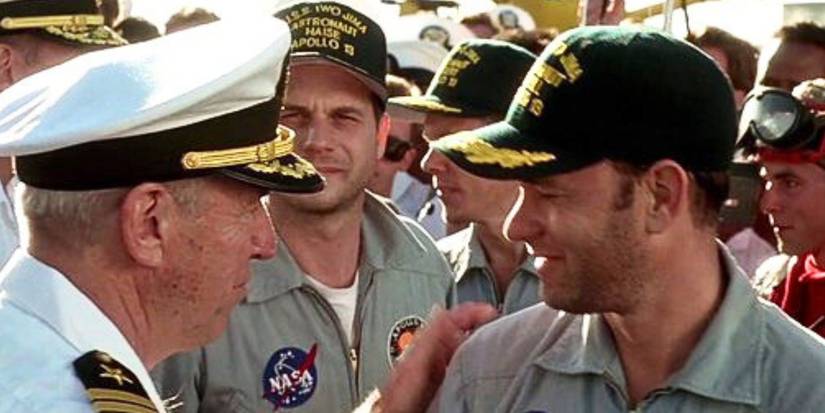
Jim Lovell, in a cameo role and US Navy whites, greets “himself” (in the form of Tom Hanks) after the recovery of the Apollo 13 crew by the USS Yorktown in Ron Howards 1995 film, Apollo 13. Credit: Universal Studios
Following his retirement from NASA in 1973, Lovell had a successful business career, taking on both CEO and President positions for a number of corporations, and serving on the board of directors of several more. In 1999, he and his family opened Lovell’s of Lake Forest, a restaurant in Lake Forest, Illinois, where the family settled. The head chef was James “Jay” Lovell, his oldest son, who took over the business in 2006, and ran it through until in closed in 2014.
Lovell and his wife Marilyn remained married through until her passing in August 2023 at the age of 93. Mount Marilyn in the Montes Secchi was named in her honour by Lovell in during the Apollo 8 mission, with the name later officially adopted. Lovell has a small crater on the lunar farside named for him.
Lovell passed away at the age of 97 at his home in Lake Forest, Illinois. He is survived by his four children, Barbara, “Jay”, Susan, and Jeffrey.
The following notes were taken from my audio recording and chat log of the Content Creation User Group (CCUG) meeting of Thursday, August 7th, 2025. Please note that this is not a full transcript, but a summary of key topics.
The CCUG meeting is for discussion of work related to content creation in Second Life, including current and upcoming LL projects, and encompasses requests or comments from the community, together with related viewer development work.
This meeting is generally held on alternate Thursdays at Hippotropolis.
Dates and times of meetings are recorded in the SL Public Calendar, and they are conducted in a mix of Voice and text chat.
Official Viewer Status
Default viewer 7.2.0.16729091892, issued August 5, promoted August 8 – New.
glTF mesh import (should have similar constraints to COLLADA upload, but does not support a unified material upload solution).
Fixes related to memory allocation, inventory floater, world map and Picks performance.
Fixes for OpenJPG, PBR Texture Panel Repeats per meter improvements and sky ambient colour not blending during day cycle among others.
Fixes for image rendering.
Second Life Project Lua Editor Alpha (Aditi only), version 7.1.12.14888088240, May 13 – No Change.
2025 glTF Mesh Uploader
There were multiple requests for the behaviours within the glTF mesh uploader that do not much the COLLADA .DAE uploader to be revised so that they do conform with the latter.
These had to be shut down, largely due to technically limitations within SL’s internal mesh formats.
The hope is that over time, these limitations can be “peeled” back, and mesh import as a whole improved, most likely by using a new internal mesh format.
No details on what the new internal format will be, as this is still subject to internal discussions at the Lab, but the aim is to make things easier for both content creators and content consumers.
2025.06 Viewer
The next viewer in development is 2025.06, which is described as “not very ground breaking”.
It contains a lot of work and bug fixes original intended for the Maintenance C viewer from 2024, and prior to the viewer release process being revised.
The key feature in this viewer will be Inventory Favourites.
Currently, the viewer is going through a stabilisation process with the aim of releasing an RC Beta as soon as possible.
The aim of the 2025.06 release is to raise the cadence of official viewer releases. This is seen as beneficial on a number of counts:
It allows individual releases to become more iterative in nature, building capabilities and allowing better response to feedback from users.
It breaks the cycle of long delays between viewer releases while the Lab tries to deliver an entire project in a single viewer drop.
It will hopefully allow the Lab to be more nimble with releases, allowing them to come back to major updates and adjust them / add to them based on longer-term feedback, rather than appearing to simply drop a project into a viewer release and then never come back to it with significant updates / improvements.
In Brief
Removing Scale From LI Calculations (Recap/Update):
Signal Linden highlighted a Feedback Ticket he has raised, proposing the removal of scale from Land Impact calculations, which has been touched upon at the last couple of SUG meetings.
However, numerous caveats / issues with the proposal arose as it was further investigated, including potential impacts on physics, issues for streaming calculations, etc., all of which caused a slow-down in the idea.
Rider Linden provided an update, noting that scale land impact is so closely tied into an object’s triangle count that there is no easy way to extricate the two, leading to the risk of small items with a high tri count suddenly exploring in their LI is scale was removed from the equation.
Support for Vertex Animation Textures (VAT) – a means to create complex and non-traditional animations in real time using textures and shaders to achieve the visuals on the GPU, thus having a much lighter performance impact on the CPU when compared to traditional skeletal mesh animations.
Allowing for the complexities of SL, concern was raised over use of VAT “overloading other systems”, with the view that providing support for blend shapes could actually be preferable.
However, given the age and complexity of the SL internal mesh format, adding things like blend shape support (and / or) vertex support, is seen as a “pretty involved effort” with a number of potential complications.
The above led to a more general discussions on animations for things like plants, the LI cost of Animesh and how it precludes it from widespread use; the balance between having lots of animated elements in-world versus potential performance cost; options for baking animations into meshes, etc.
The reason this happens is that (unlike Blinn-Phong, where the offset, scale and rotation are set against the object surface) with glTF materials, that are set against the material itself (as per the relevant glTF specification extension); ergo, changing the material reset them.
This behaviour could potentially be changed through the addition of an override to give more consistency in behaviour between PBR materials and Blinn-Phong; however, any such update comes down to a matter of prioritisation. This prompted an invitation to any interested open source developer to submit a suitable update.
One concern over a possible solution is the need for additional UI elements in what is already regarded as a complicated Build / Edit floater.
Support 16-bit grayscale terrain import: this has been acknowledged by the Lab as a problem that needs to be addressed, but as yet, there has not been the opportunity to take a deep look into possible causes of issues with the RAW terrain file import, and what the correct solution(s) might be.
Nothing on the cards for further .glTF extensions at this time, however, with the glTF importer now in the release viewer “the door is open to a lot more possibilities for what we could do” (e.g. removing the “old” .glTF importer used purely for materials and allowing the “new” importer to handle them, making it much easier to add further .glTF extensions in the future).
A general discussion on scripted animation, inverse kinematics (IK), puppetry, and similar. In short:
Puppetry remains frozen.
It is recognised the proper IK would allow for a range of capabilities (e.g. animation retargeting)
A general discussion on controls and the game_control work. As the latter is Leviathan Linden’s project, and he was not at this meeting, I’ll leave updates on this to the Server User Group summaries.
Athenaeum, August 2025 – click any image for full size
In talking to Dema Fairport at the Content Creator’s User Group recently, I was reminded that it’s been six years since my last visit to her engaging, Adult-centric and richly landscaped region of Athenaeum (see The scenic glory of Athenaeum in Second Life).
Part of the reason for this is because the major parts of the region are well-established, and only subject to the most subtle of changes – which can made blogging a little difficult. Not that the region should change just for the sake of blog posts; it has scenic beauty which is captivating to both the eye and the camera which could so easily be lost with any large-scale changes.
Athenaeum, August 2025
That said, six years is a long time between visits, so I was keen to wander around once more just for my own interest; and because so much time has passed, I thought I’d offer another write-up for the benefit of those who might not be familiar with the region or its beauty.
The virtual home of the real life Carter/Johnson Library which is owned by Viola Johnson. The library is a collective history of various kinky communities who have chosen to live and love differently. Come explore the Museum and Photo Gallery, take a walk through the lands, or find a place with that special someone to enjoy some relaxing time together or some special kinky time. Photographers Welcome, please be respectful of all.
– Dema’s description of Athenaeum
Athenaeum, August 2025
The (to me) familiar elements within the setting comprise the Carter/Johnson Library, mentioned in Dema’s description, the manor house, the pool house, most of the major structures, including the main bridges and footpaths, and the overall lie of the land, cut through as it is bye channels and a river.
The Landing Point for the setting is on the west side of the region and takes the form of a deck built over the water and home to a café, which I understand from Dema is a new feature of the setting. This sits close the aforementioned Carter/Johnson Library buildings, which itself is worthy of some expansion.
Athenaeum, August 2025
Existing in the physical world, the Carter/Johnson Library and Collection, is a 501(c) (3) organisation founded by Carla Viola “Mama Vi” Johnson (September 9th, 1912 – January 31st, 2006). It forms a collective history of various communities who have chosen to live and love differently. The collection includes thousands of leather, fetish, S/m, kink and alternate sexuality books, magazines, posters, art and more, dating back to the 1700s and chartered to bring this history to the communities it serves.
It is the Library and Collection which supports Athenaeum within Second Life, with the Library within the region recreating of one of the Library’s physical world exhibitions charting the history of BDS and kink from the 1500s to modern times – and offering a glimpse of times early than the 1500s.
Athenaeum, August 2025
A short walk from the museum is a gallery devoted to the work of New York fetish photographer Darque. Also to be found in the plaza and gardens housing the library and gallery is a quiet outdoor seating area complete with playable chess and draughts (or checkers, if you prefer).
Eastwards from the museum and gallery, a cinder path rises into the region’s central uplands to join a broad bridge spanning a gorge to provide access to the manor house is it sits on a high plateau. For those who prefer, a grass trail leads up to where wooden cabins surrounded by tall pines overlooks the north coast beach. One of the two cabins offers a wooden stairway down to the beach, but another way to reach it is to head north from the landing point, following the signs to the camp site out on the north-west headland.
Athenaeum, August 2025
The manor house itself remains much as I originally found it in 2018, when I noted:
Within its rooms are leather arm chairs, great bookcases filled with tomes awaiting reading, fires in the hearths, bottles of port and cigar humidors on some tables, coffee and After Eight mints on others, and just the most subtle of hints as to some of the activities that might follow conversations in these rooms; activities which themselves might be enjoined in the rooms above, going by their décor.
– This blog, August 2018
Athenaeum, August 2025Again surrounded by trees – Athenaeum is, among other things, a woodland haven – the manor house also features a terrace area for music events, with an adjacent pool. This terrace overlooks a precipitous drop on its west side and one of the region’s smaller islands, whilst on its north side it looks over the channel separating the manor’s high perch from the low-lying museum.
The plateau on which the manor house stations hides a secret. To be honest I didn’t work out how to get down to it and back, and resorted to cheating with a sit TP. I assume there is a hidden TP I missed. Another couple of places I don’t remember from previous visits. One was a smaller house sitting on an island to the south-east, is an outdoor ceremonial area one an island tucked into the north-east corner of the region.
Athenaeum, August 2025
Whether all of these are new additions since my last visit or not, I can’t say; six years is a long time; visits, and memory can play tricks. But that aside, Athenaeum is a richly engaging a beautifully put together region offering a lot to see and appreciate, regardless of one’s interest (or otherwise) in kink.
In fact, such is the overall low-key nature of the region’s BDSM elements, Athenaeum can be enjoyed without reference to it more adult nature, offering as it does a beautiful environment with multiple places to sit and pass the time, and plenty of opportunities for photography.
The following notes cover the key points from the Web User Group (WUG) meeting, held on Wednesday August 6th, 2025. These notes form a summary of the items discussed and is not intended to be a full transcript. The official video is embedded at the end of this summary.
Meeting Overview
The Web User Group exists to provide an opportunity for discussion on Second Life web properties and their related functionalities / features. This includes, but is not limited to: the Marketplace, pages surfaced through the secondlife.com dashboard; the available portals (land, support, etc), and the forums.
As a rule, these meetings are conducted:
On the first Wednesday of the month and 14:00 SLT.
Meetings are open to anyone with a concern / interest in the above topics, and form one of a series of regular / semi-regular User Group meetings conducted by Linden Lab.
Dates and times of all current meetings can be found on the Second Life Public Calendar, and descriptions of meetings are defined on the SL wiki.
Updates
The Marketplace team hope to release the mobile responsive marketplace search updates in the next week or so.
Note this updates is only for MP search, but there will be future Mobile updates for Marketplace in due course.
Time is being given to some general web property quality of life updates.
Work is continuing on some technical upgrades to critical internal services, defined as “not very glamorous but help keep things running smoothly”.
New bank pay-out options are due to be deployed “in the next week or so” for Brazil, Canada , France, Germany, Lithuania, Malaysia, the UK, the USA and Turkey.
CasperVend integration: reported as “no official updates but we do want to take it on soon”.
Kali Linden noted that she has been working with Casper to develop product specifications for integrating some CasperTech features in to the Marketplace.
Marketplace variants / styles (i.e. multiple option for a product (such as different colours) in a single listing: the Marketplace team has yet to “get back” to this, and the request was for people to keep asking about it.
A request was made for a formal means for AI-generated content to be properly disclosed on MP listings. The broad response to this was content disclosure has generally been treated as being differed to the creator.
The group was asked that if they could create one web feature in SL, what would it be? Responses included:
A 3D SL Map.
Marketplace:
An ability to users to see a 3D preview of assets on the Marketplace.
Formal inclusion of item creation date (not listing creation date) and and the date on which the item was last updated for Marketplace listings. This has actually been looked into, and a plan to offer something “more stable” for creation date is in development, but last update date requires more work.
Filter options for removing specific creators / stores from Marketplace searches. This is acknowledged as being a popular request, and something the Lab wants to look into.
Ability to search the MP by body type. This is something that has been specified internally, and so seen as as something that could be delivered in the future.
Multiple Marketplace wish lists / favourite lists. Again, this has received a lot of requests and is being thought about.
A request for multiple stores under one account. This was seen as a nice idea, but currently hard to implement.
Making the Land Use Fees page more intuitive, and perhaps include a way to calculate group bonus, etc.
The use of AI agents to assist in Marketplace searches was raised, in order to increase accuracy of results, etc.
There is nothing specific in the works for this.
Training AI tools for Marketplace search was seen as a major undertaking, simply because of the size of the MP, and that search could generally be improved a lot more directly without necessarily requiring the use of AI tools.
A discussion on people’s favourite / least favourite things in Second Life during the past week which flowed into a general conversation – refer to the video for details.







 Inara Pey: Living in a Modemworld