Space Sunday: a test flight and a telescope

Starship IFT-10: the moment before splashdown, as seen from the buoy-mounted remote camera. Credit: SpaceX

On Wednesday, August 26th, 2025, SpaceX undertook the 10th integrated flight test (IFT) of its Starship / Super Heavy combination. Overall, the flight achieved all of its stated goals, which should be taken as a step forward – to a degree.

Those goals were broadly the same as the previous failed launches: place a Starship vehicle into a sub-orbital trajectory, carry out a deployment of eight Starlink satellite simulators, attempt a brief restart of one the vehicle’s Raptor engines and test a number of different materials for possible use as future heat shield elements to help protect a Starship vehicle through atmospheric (re-)entry.

The launch itself came at 23:30 UTC on August 26th, some two days later than planned, and following two scrubbed attempts. The first of these was due to an unspecified issue with ground systems, which prevented the original planned launch on August 24th. The second scrub came on August 25th, the result of poor weather around the Boca Chica launch facility and along the route of initial ascent.

While not a hindrance to this particular flight, both of these issues illustrated a weakness in the entire idea of “rapid reusability” for the Starship / Super Heavy, in which boosters and Starship craft are supposed to be turned around on the pad within hours following a flight, and then re-launched – an idea utterly dependent upon ground systems (and those on the vehicles) not having significant issues and the weather cooperating with the launch schedule 100% of the time.

Starship IFT-10 lift-off, August 26th, 2025. Credit: SpaceX

Anyway, on August 27th, everything came together and the stack of booster and ship lifted-off more-or less on time at 23:30 UTC. The initial ascent through Max-Q was largely smooth, although one of the booster’s 33 Raptor motors did fail a minute and a half into the flight – an event which did not impact the booster’s performance.

At 2 minutes 36 seconds, MECO (most engines cut-off) was reached, the two rings of Raptor engines on the booster shutting down, leaving only the gimballed three central motors running. Two seconds later, the six motors on the Starship ignited, and a hot-staging occurred, the Starship separating from the booster, the latter immediately vectoring away from the Starship in it “boost-back” burn. This is normally required to put the booster on a descent back towards the launch facility for capture by the launch tower. As no such capture was planned for this flight, the boost-back instead put the booster into a free-fall, engine-first drop back towards the Gulf of Mexico and a planned splashdown.

At 6 minutes 20 seconds after launch the booster performed a final landing burn. This comprised an initial firing of the inner 13 motors of of the booster before quickly cutting back to three motors. Normally, this would be the 3 centre engines on the booster, which can be gimballed to provide directional thrust.

IFT-10: the Super Heavy booster shuts down the last of its Raptor engines after hovering above the waters of the Gulf of Mexico. Credit: NASASpaceflight (not affiliated with NASA)

However, for this flight only two of the gimballed motors were used, together with one of the motors on the inner ring of 10 fixed engines. This was to test the booster’s ability to hold station and steer itself in the event of one of the three central motors being out-of-use during the final descent during an actual post-launch capture attempt. As a result, this final burn offered an impressive demonstration of the booster’s hover capability, as it came to a halt at around twice its length above the surface of the Gulf of Mexico. The motors were then shut down, leaving the booster to drop unpowered into the water, exploding on impact.

Following separation, the Starship vehicle continued on into its sub-orbital trajectory. Just under 19 minutes after launch, the payload slot designed specifically for Starlink deployments and of no use for anything else, cranked open successfully, allowing the deployment of the eight Starlink simulators to commence. The entire deployment of the 4 pairs of satellite simulators took some 7 minutes to complete from initial slot opening to slot closure.

IFT-10: Starlink v3 simulator deployment, showing a satellite simulator being ejected through the Starship’s payload slot (arrowed). Credit: SpaceX

The final element of the sub-orbital part of the flight was the re-lighting of a single Raptor motor. This was literally just a re-ignition and shutdown, shortly before the vehicle commenced it atmospheric re-entry. The latter utilised a much higher angle of attack that has been seen with previous flights. In part, this was to test whether such an approach would decrease the plasma flow over the forward aerodynamic flaps, which on previous flights have suffered major issues of burn-through and failure.

This, coupled with alterations made to the positioning of the forward flaps for the “Block 2” vehicle design, appeared to work; the forward flaps survived the re-entry period pretty much unscathed. However, the choice angle of attack exposed the stern of the vehicle – the engine skirt and stern flaps – to greater dynamic forces and plasma flow, and as re-entry proper commenced, there was a sudden energetic event within the engine bay. The exact cause of the event is unclear at the time of writing, but it resulted in part of the engine skirt being blown out and the port side aft aerodynamic flap suffering damage.

IFT-10: the moment of the energetic event within the Starship vehicle’s engine skirt. Credit: SpaceX

As a result, the affected flap suffered a degree of burn-through that might not otherwise have occurred. Fortunately, this did not result in a complete failure with the flap, or affect the vehicle’s control, but the overall event could be indicative of potential vulnerabilities related to high angle of attack re-entry profiles and the need for SpaceX to further refine re-entry parameters to avoid excessive damage at either end of the ship.

That said, the vehicle did go on to complete its descent through the atmosphere, the aerodynamic flaps fully able to maintain the vehicle’s attitude and pitch through to the final kilometre of the descent. At this point the flaps folded back against the vehicle’s hull as the centre motors were re-lit and the vehicle performed a “flip up” manoeuvre, pointing its motors towards the sea as it performed a powered splashdown, prior to toppling over and exploding.

A view of the disturbed plasma flow at the back of the port-side aft aerodynamic flap and the start of burn-through on the flap. Credit: Space Zone, utilising a video capture of IFT-10 from SpaceX

These final moments of the flight were captured from a remotely operated camera mounted on a buoy deployed by SpaceX at the target landing site – the Starship vehicle actually coming down within metres of its intended splashdown point. This footage revealed strange discolouring across the vehicle’s heat shield: white around the nose and payload bay and vivid orange around the cylinder of the propellant tanks. SpaceX later indicated that both were the result of testing different materials or possible future heat shield use.

In the case of the white decolourisation, it was stated that some of the alternate material tiles had failed to prevent the insulation between them and the hull of the vehicle form becoming  heated to the point where it melted and flowed out over the heat shield. The orange was later blamed on a single metal tile fitted high on the vehicle’s main cylinder, which was super-heated by the nearby re-entry plasma, spreading oxidised metal particles over the heat shield.

Whilst the flight did meet all of its primary goals, IFT-10 is, in reality, something of a qualified success, further demonstrating the continued prioritisation of SpaceX goals – developing a system for deploying Starlink satellites over meeting contracted obligations for NASA: namely developing and prototyping the Human Landing System (HLS) required by the Artemis programme and moving forward with the not insignificant issue of large-scale cryogenic propellants between orbiting Starship vehicles, again a vital requirement for Artemis 3 and Artemis 4. Of the latter, the SpaceX CEO will only commit to stating the company will solve this “eventually” – despite the fact the company is expected to have HLS flight-tested and ready for Artemis 3 and to have solved the propellant transfer issue within the next two years if NASA is to avoid further delays to Artemis.

Nancy Grace Roman Passes Test Deployments

NASA’s latest space telescope – the infra-red Nancy Grace Roman Space Telescope (shortened as the Roman Space Telescope or RST) took two more significant steps forward in early August when the Solar Array Sun Shield (SASS) that will both provide the telescope with power and shield its electronics and instruments from excess solar heat, together with the Deployable Aperture Cover (DAC), which both protects the telescope primary optics aperture during launch and then shade the aperture for receiving too much sunlight and spoiling observations.

The tests were carried out on August 7th, and 8th, respectively at NASA’s Goddard Space Centre, where the telescope has been undergoing integration and testing. They were carried out using a rig able to simulate the microgravity conditions the telescope will be in during an actual deployment.

The first test was to confirm four of the telescopes six solar panels would fold out from their stowed launch positions on either side of telescope’s body. Spring-loaded, each panel unfolded over a 30-second period after being triggered by non-explosive actuators. To help dampen the effect of each panel’s deployment, there was a 30-second pause between each deployment, after which, the panels were examined by engineers to confirm the panels had correctly deployed and ready for operation.

The four outer panels of the Roman Space Telescope’s Solar Array Sun Shield (SASS) fully deployed alongside the centre two panels mounted along  the back of the telescope. Credit: NASA Goddard / Sophia Roberts and Scott Wiessinger

Following this, the DAC’s deployment mechanism was successfully tested, the cover successfully unfolding to provide the noted shadow protection over the optic’s aperture to prevent sunlight entering it, and must do so without itself snagging or blocking the telescope’s field of view.

Intended to operate in a halo orbit around the Sun-Earth L2 position, the 4-tonne telescope has a stated primary mission encompassing a search for extra-solar planets using gravitational microlensing;  probing the chronology of the universe and growth of cosmic structure with the end goals of measuring the effects of dark energy, the consistency of general relativity, and the curvature of space-time.

A further aspect of RST’s mission will be as part of a growing network of ground and space-based observatories tracking and understanding potentially dangerous asteroids and comets that could threaten our planet. From its Sun-Earth L2 halo orbit, the telescope will use its sensitive near infrared vision to study near Earth objects (NEOs), the asteroids and comets whose orbits bring them close to our planet. Not only will RST be able to identify NEO for tracking by other telescopes and observatories, it will be able to determine their size, shape, composition and exact orbital paths, allowing the potential for a possible collision with Earth and the likely results to be fully assessed. This aspect of the mission will particularly see the RST work in collaboration with another new facility – the Earth-based Vera C. Rubin Observatory in Chile, which has also featured in these pages.


2025 week #35: SL TPVD meeting summary

Dutch Pavilion, June 2025 – blog post

The following notes were taken from my chat transcript + the video recording by Pantera (embedded at the end of this summary) of the Third-Party Developer meeting (TPVD) held on Friday, August 29th, 2025. My thanks to Pantera as always for providing it.

Meeting Purpose

  • The TPV Developer meeting provides an opportunity for discussion about the development of, and features for, the Second Life viewer, and for Linden Lab viewer developers and third-party viewer (TPV) / open-source code contributors to discuss general viewer development. This meeting is held once a month on a Friday, at 13:00 SLT at the Hippotropolis Theatre.
  • Dates and times are recorded in the SL Public Calendar, and they are generally conducted in text chat.
  • The notes herein are a summary of topics discussed and are not intended to be a full transcript of the meeting.

Official Viewers

  • Default viewer 2025.06 7.2.1.17108480561 – August 29 – NEW.
    • Inventory Favourites System, plus assorted new features.
    • Improvements to avatar system; camera and movement; chat; voice; content creation tools.
    • Mesh uploader updates.
    • Text & UI polish.
    • Fixes for Environment and Rendering; stability and crashes; UI.
    • System improvements.
  • Second Life Project Lua Editor Alpha (Aditi only), version 7.1.12.14888088240, May 13 –  No Change.

Viewer 2025.07

  • Currently in development.
  • Will include “proper Discord support” for those with a Discord account  – further clarification to follow as the viewer is developed; and possibly Apple Silicon support.

In Brief

  • Meeting update: the TPVD and Open-Source Developer meeting will be merging. The combined meeting will be held once every two weeks, and utilise the TPVD meeting time slot and location. This merge comes into effect on Friday, September 12th, 2025.
  • Code merge policy update:
    • This is intended to better align merging release branches into develop with git flow.
    • LL should now merge code in a given release branch on a fairly regular basis moving forward – so no more waiting for things to go into main before merging up into develop, and moving forward, the Develop branch should always have the latest code LL intends to release in the near future.
    • The latest release code will always be in the main branch.
    • Project branches are still TBD on how they will be handled, as there are often things that need a lot more work before they’re ready for general consumption.
  • The latest version of Autobuild defaults to 64 bit, allowing viewer compilers to remove AUTOBUILD_ADDRSIZE from their build environments.
  • User Joe Magarac (animats) has been working on viewer-side “infinite draw distance” using mesh / sculpt imposters for surrounding region (e.g. one region, 4 region, 16 region, 64 region, etc., – currently only terrain), with each imposter having its own UUID and an a Land Impact of 1 LI.
    • This work is in test within his own Sharpview viewer (not on general release), and will be made available to other viewers.
    • Geenz Linden has been following the work, and has an alternate view on achieving the same result (e.g. having the simulator specify a UUID message to an imposter object which any viewer can then just load and display as required, rather than having everything driven from the viewer), and has suggested the work could benefit for a more collaborative approach.
    • This resulted in a general discussion on project status, possible direction, options for imposter creation, possible issues of content protection if imposters include content information (e.g. buildings), etc, which ran through most of the meeting. Please refer to the video for details.

Next Meeting

  • Friday, September 12th, 2025 at the Hippotropolis Theatre (combining with the Open-Source Developer meeting, per the above notes).

† The header images included in these summaries are not intended to represent anything discussed at the meetings; they are simply here to avoid a repeated image of a gathering of people every week. They are taken from my list of region visits, with a link to the post for those interested.

Julana’s Spirit of Imago in Second Life

IMAGOLand Galleries: Julana Allen – Minimalista – The Spirit of Imago

Mareea Farrasco is a multi-talents individual: artist, photographer, gallery owner and curator, and creator of her own public spaces at IMAGOLand, which is also home to her gallery spaces.

In all of these capacities, I’ve featured Mareea and her work in these pages on numerous occasions; but this one is special, featuring as it does a celebration of Mareea’s IMAGOLandas seen through the eyes of artist Julana Allen (Julana Teichmann).

IMAGOLand Galleries: Julana Allen – Minimalista – The Spirit of Imago

I was only recently introduced to Julana’s work thanks to her collaboration with Eta (etamae), Where the Flowers Are, which opened at he Elven Falls Art Collective at the start of August 2025 (see: Where the flowers are in Second Life), and it was a pleasure to see her celebration Mareea and IMAGOLand within Minimalista – The Spirit of Imago.

For those unfamiliar with IMAGOLand, the ground level of the region is maintained by Mareea as a public space , the face of which can change from time-to-time, but which always presents a sense of peace and serenity. Within her exhibition, Julana offers a personal and captivating look at IMAGOLand’s beauty as currently presented within the region. From trees turning to gold as the year turns to autumn; from horses grazing to art both free-standing and painted on walls, Julana uniquely captures the look and feel of the region.

IMAGOLand Galleries: Julana Allen – Minimalista – The Spirit of Imago

As I noted when writing about Where the Flowers Are, Julana has a gift for art and photography, and a talent for post-processing, something which can give her pieces a tactile sense. Here, this combination of vision, framing and post processing which brings a depth of life to each piece, making it not so much an image to be viewed, so much as experienced. This is further enhanced by the space in which the exhibition is mounted, which has been decorated by Julana in reflection of Mareea’s creativity.

A thoroughly magical celebration in art; and if you’ve not visited IMAGOLand of late, I recommend viewing Minimalista – The Spirit of Imago, and then dropping down to ground level and touring the region to experience it for yourself and appreciate the context of Julana’s work.

IMAGOLand Galleries: Julana Allen – Minimalista – The Spirit of Imago

SLurl Details


August 2025 SL Mobile UG meeting summary

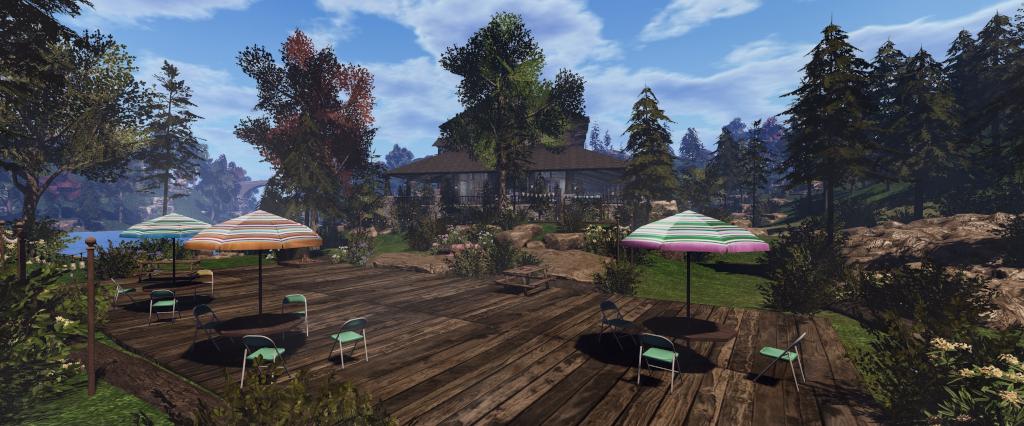
Campwich Forest grounds: location for the Monthly Mobile User Group (MMUG)
The following notes were taken from the Thursday, August 28th 2025 Monthly Mobile User Group (MMUG) meeting. These notes should not be taken as a full transcript of the meeting, which was largely held in Voice, but rather a summary of the key topics discussed.

The meeting was recorded by Pantera, and her video is embedded at the end of this summary – my thanks, as always to her in providing it.

Table of Contents

Meeting Purpose

  • The Mobile User Group provides a platform to share insights on recent mobile updates and upcoming features, and to receive feedback directly from users.
  • These meetings are conducted (as a rule):
    • The last Thursday of every month at 12:00 noon SLT.
    • In Voice and text.
    • At Campwich Forest.
  • Meetings are open to anyone with a concern / interest in the above topics, and form one of a series of regular / semi-regular User Group meetings conducted by Linden Lab.
  • Dates and times of all current meetings can be found on the Second Life Public Calendar, and descriptions of meetings are defined on the SL wiki.

Resources

Release Updates

[Video: 0:00-8:33]

Current Releases

Version: 2025.7.560 (Android) – July 23 / 0.1.557 (iOS) – July 22.

Updates

  • Work has been focused on the next release of Mobile, including pushing updates to the Alpha group of users (those who were part of testing from the start). Two Alpha group updates for the release have gone out so far, and a third is expected “shortly”.
  • A key aspect of the next release is improving overall stability, both in itself and how it deals with “shaky” Internet connections, etc.
    • Feedback from the Alpha testers is that this work is yielding performance improvements (e.g. faster frame rates, lower battery use) on Android, and it is hoped the same holds true for iOS.
  • Network connection stability has been a particular area of work for the last 2 months.
    • Unlike apps which can download data in advance, cache it and then call upon it, Second Life Mobile requires far more of a constant stream of data due to its dynamic nature, and so is far more susceptible to signal interruptions / conflicts with other apps for bandwidth use, etc.
    • Thus, the work has been to try to make the Mobile app far more robust in how it maintains network connectivity and continues to function through such interruptions, doing all that is required of it.
    • The work has taken time and effort to get through, but it is hoped that the majority of it is now complete, and the rest can b wrapped-up within the next month.
  • Work has also been put in to trying to resolve a number of known issues (e.g. streaming audio quality on iOS devices).
  • As such, while there will be new features in the next release, the overall focus of work for the present is on performance, stability and bug fixing.
  • Additionally, a couple of further issues have been identified with avatar rendering, and so effort will be put into addressing these.

Upcoming New Features

[Video: 8:33-14:57]

  • Achievements: giving “visual rewards” to users for moving around in the Mobile app and trying-out actions, etc.
    • Details vague, as the team did not wish to give “too much away and spoil the surprise”.
    • Achievements are currently and specifically aimed towards new users.
    • They triggered automatically in some manner on completing a basic task within the app, after which a new View option is unlocked in the menu, allowing users to see available achievements and the particular level they are “at” for an achievement.
  • Camera improvements (as noted in the July meeting):
    • Reset Camera button, which will be displayed when the two-finger swipe to detach the camera from the avatar is used.
    • Rotate around current camera position when the camera is detached from the avatar.
    • Zoom in and out from the current camera position when detached from the avatar.
    • First-person (Mouselook) view.

General Feedback / In Brief

[Video 14:57-End]

Please refer to the video for details on the following and other questions which may have had a simple “yes” or “in progress” reply.

  • Conflicts between pinch actions for zooming and the joystick control for movement:
    • The joystick event capture area covered a good portion of the lower left side of the screen. Because of this, pinch or swipes commencing / overlapping this area can trigger the joystick  and avatar movement.
    • As the joystick fades to transparency between uses, this can cause confusion for users, as they start a pinch / swipe action within the lower left corner of their device screen which appears “empty”, and accidentally trigger the joystick capture event, causing their avatar to move.
    • Because of this, the joystick function is to be changed so that it is always visible, in the hope that users will not commence gestures within its event capture area.
    • It is hoped that keeping the joystick visible at all times will also alleviate new users becoming confused as to how to move their avatar when the joystick is transparent.
    • This led to a discussion across the last 15 minutes of the meeting on ways to completely disable avatar movement when not required.
  • Alpha transparencies not rendering correctly:
    • Potentially due to a number of issues (the transparent texture not being fully JPG2000 conformant; the renderer not correctly recognising the alpha channel, etc.).
    • This is known about and is being looked at to try to resolve. In the interim further reports on the problem and where encountered are requested.
  • A request was made for feedback on any quality of life issues users experience (e.g. problems with changing outfits, UI issues, etc.), as these are likely to become more of a focus as the current work on performance / stability / network improvements comes to an end.
  • Feedback requested from Alpha testers with the upcoming update (anticipated for Friday, August 29th) include: network stability (particularly when the connection switches from wifi to cellular or vice-versa) – which results in noticeable issues (such as an inability of TP); general reports of unexpected with general use – quality of life, avatar loading, avatar movement issues, etc.

Date of Next Meeting

Appreciating Fern & Fable – Bramblewood, in Second Life

Fern & Fable – Bramblewood, August 2025 – click any image for full size

Hailing from the UK, Sylvia Sable is the creator of Moonless Designs landscaping, and who demonstrates her creativity and artistry in this regard  through her Full region. Called Fern & Fable, the region is described by Sylvia thus:

Fern & Fable is a public space I rebuild whenever the mood takes me, each time opening a new chapter with its own theme and story. From a fantasy realm, to the dust of an apocalypse.

– Sylvia Sable

Fern & Fable – Bramblewood, August 2025

For the current iteration, the region presents Bramblewood, a setting which is at its core inspired by the landscape, towns and villages found in northern England, but which it is not unfair to say incorporates influences and aspects far beyond England’s green and pleasant land – if I might use the words of William Blake.

Once upon a time, in the northern reaches of the UK, there were villages bound by stone walls and iron railings, their strength tested by war and time. Cotton mills that once thundered with industry have been re-purposed into gentler spaces, and winding walking trails now weave through fields and hills where locals and visitors find their peace. Here milkmen set bottles by the door before dawn, farms breathe life into the land, and the pub’s hearth glows with welcome at day’s end. Bramblewood is my telling of that story – a Northern UK Village inspired setting where history lingers in every wall and lane.

-Sylvia Sable

Fern & Fable – Bramblewood, August 2025

The reason I suggest the setting draws – intentionally or otherwise – on other physical world locations is for several reasons.
Take the mountainous region surround for example; whilst the north of England does have the Pennines, the mountains surrounding Bramblewood are perhaps taller and more rugged than might be found along England’s backbone and for me, brought to mind Scotland’s Grampians. Similarly, parts of the built-up area of the setting and some of the low-lying areas perhaps have hints of North America and Europe.

However, this should not be taken as a negative critique of the region’s design; there are practical reasons why some aspects might well suggest places further afield than England’s northern counties. If nothing else, apart from iconic “British” elements such as the old red Post Office telephone boxes and the familiar red columns of Post Office letter (mail) box, thatched cottages, things that are quintessentially “England village” in tone and look are far outnumbered by other items sold through the Marketplace and in-world, thus some mixing is entirely natural. More to the point, the mixing of elements and styles give Bramblewood a further sense of being a special place in time and space.

Fern & Fable – Bramblewood, August 2025

The setting takes up roughly two-thirds of the region, with an open body of water to the south. The land is further split between a larger and smaller land mass, the latter sitting to the west, a tongue of land connecting it to the larger area. This western area pays homage to the north of England’s heritage as the cradle of the industrial revolution, being the home of large factory / warehouse buildings, the entire area updated as an event space.

The eastern end of the island is home to the main village / town setting. This again mixes elements, some of which are to be found in English country villages – dry stone walls, the aforementioned telephone and letter boxes, a cottage and local pub (with a further outdoor event space). Other elements perhaps lean more towards the United States (road signs, pumpkins for Halloween), which as noted, give the village and unique look and feel.

Fern & Fable – Bramblewood, August 2025

The middle of the setting is given offer to a open space of natural beauty, richly wooded and with paths and trails meandering through it, a stream tumbling down from the hills, waterfalls serving a river, camp sites, fishing spaces and plenty of opportunities for exploration and photography.

It is within this parkland that the Landing Point is located, presenting the richest opportunity for exploration and discovery. And discovery is the best way to appreciate both the beauty of Fern & Fable – Bramblewood and Sylvia’s design skills- so why not pay a visit yourself?

Fern & Fable – Bramblewood, August 2025

SLurl Details

Owl’s Shadow and Light in Second Life

Michiel Bechir Gallery: Owl Dragonash – Marked by Shadow, Moved by Light

Currently open within one of the exhibition spaces at Michiel Bechir Gallery, operated and curated by Michiel Bechir, is Marked by Shadow, Moved by Light, an intriguing exhibition by photographer artist, gallery curator, music afficionado and blogger, Owl Dragonash.

Owl is a veritable tour de force within Second Life. As a founder of galleries – notably Cloud Galleries and Maison de la Chouette – and host and promoter of live music events across the grid, Owl works tirelessly to bring people and communities together and bring artists and musicians to the attention of a wider audience. As an artist-photographer in her own right, Owl is often featured in exhibitions and art events, as well as having her own Flickr stream.  However, Marked by Shadow, Moved by Light is something special; perhaps an experiment in approach and technique and the use of shadow and light, but one rich in content and enigmatic in presentation and meaning.

In Marked by Shadow, Moved by Light, I explore embodiment in flux – how light carries form, how shadow reveal emotion; how we carry markings both chosen and inherited. Each piece captures a moment of stillness within transformation.

– Owl Dragonash

Michiel Bechir Gallery: Owl Dragonash – Marked by Shadow, Moved by Light

Comprising 10 pieces, this is an collection of what might best be called primal images. From black-and-white through pieces predominantly using primary colours to the use of more natural tones, all ten are richly expressive and also highly tactile in their finish. Each is evocatively titled, helping to nudge our thinking in a certain direction, but it is in that use of colour, light, shadow and finish that captivates and engages. As Owl goes on to note in her artist’s statement:

The stripped illumination suggests something primal and performative – like camouflage, ritual paint, or the imprint of memory. Wings, horns and hooves hint at hybrid identities –  creatures caught between wildness and wonder. 

– Owl Dragonash

This within this collection we have a dual thrust: on the one hand, we have images that evoke a vein of fantasy and imagination all too common to the entire human existence, touching on themes of paganism, mysticism, mythology, mixing into some pieces more “modern” adult themes. The latter is particularly expressed within Suspension of Will, Bloodlight Offering and Feathered Restraint; all three of which are additionally nuanced in their mixing of adult themes and ideas of transformation and sacrifice.

Michiel Bechir Gallery: Owl Dragonash – Marked by Shadow, Moved by Light

On the other hand, these images offer a subtle and unique mirror on the ability for Second Life to become the vessel of transformation for each and everyone of us; allowing us to become whatever we like and experience whatever might draw us to itself. The use of colour, light and shadow further invoke and enhance on two levels as well. Firstly, it does indeed evoke the ideas of body painting and through it the creation of hybrid identities for the purposes of ritual, etc. Secondly, the combination of the three – light, shadow and colour – reflects how our wants and desires and hopes for engagement and / or transformative are given form within the digital realm.

In all, and as stated, an intriguing and highly engaging exhibition, well worth visiting and exploring. Should you do so, note that Owl suggests Marked by Shadow, Moved by Light should be seen with the viewer’s environment is set to Midnight.

Michiel Bechir Gallery: Owl Dragonash – Marked by Shadow, Moved by Light

SLurl Details