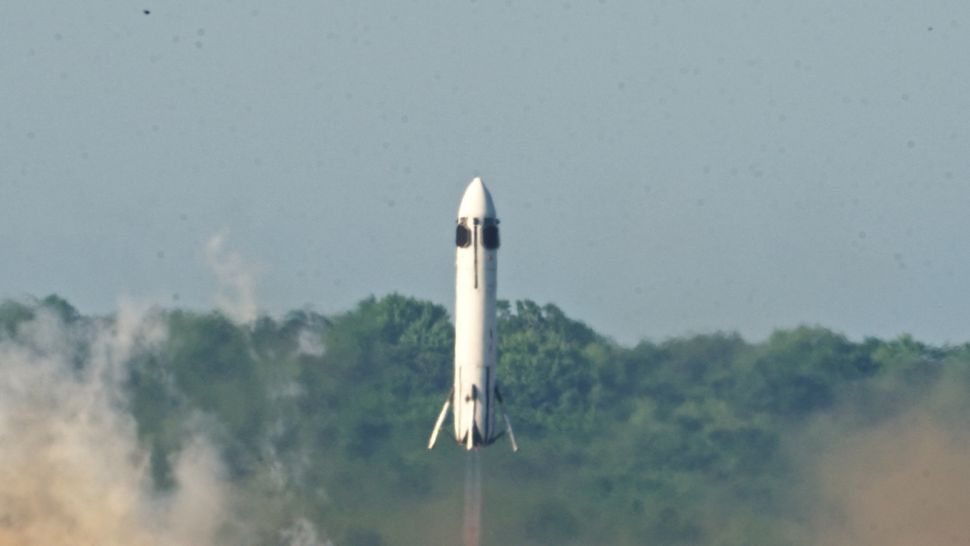
Honda is known for many things: cars, motorcycles, engines, power tools robots, bicycles, aircraft, rocket motors – and now reusable rockets.
The company only formally announced its interest in entering the world of reusable launch systems in 2021, and since then things have been a little quiet. Well, up until this past week, that is; on Tuesday 17 June 2025, Honda’s research and development arm, Honda R&D Co., Ltd., announced the successful launch and landing of its first experimental reusable rocket.
The announcement appeared to come out of left-field for many in the space media – with the success, inevitably, being contrasted to that of SpaceX, a company with more than 20 years in the business, and not to Honda’s advantage; something that’s a little unfair given the head-start SpaceX has – and possibly unwise, given Honda’s abilities.
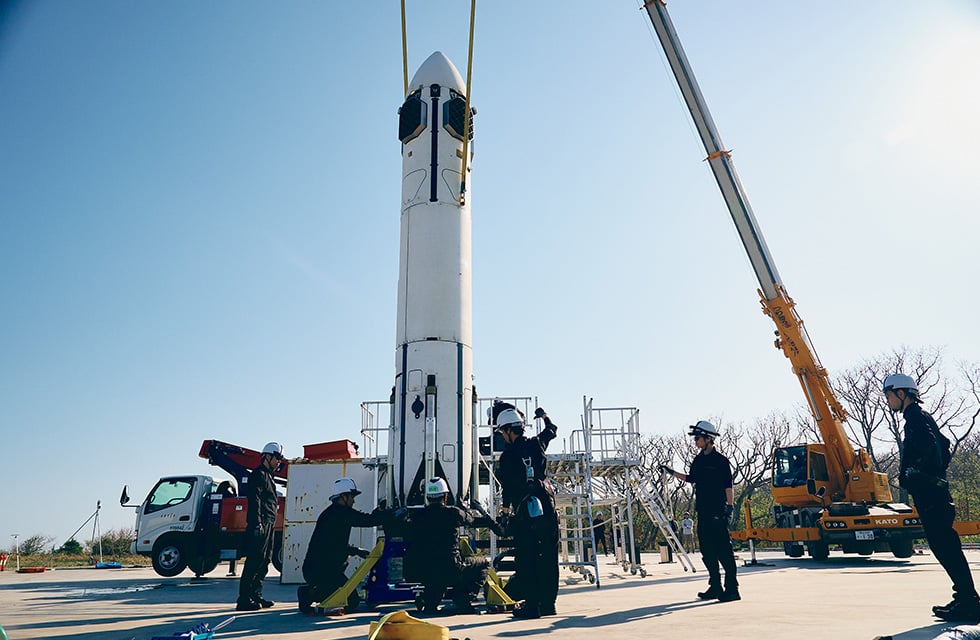
The vehicle, measuring 6.3m tall and 85 cm in diameter and with an all-up launch mass of 1.3 tonnes, was launched out of Honda’s facility in Taiki, Hokkaido. It rose to an altitude of 271.4 metres, before making a controlled descent to land just 37 centimetres from its target. It is the first step towards a stated goal for Honda to make a full sub-orbital launch by 2029. The launch was intended to carry out a range of aerodynamic tests and gather data, and Honda defined it as being a complete success.
Honda’s involvement in developing a launch vehicle is part of the overall goal of the Japanese government to double its space industry’s turnover to US $55.20 billion per annum by 2030.This will be through a combination of government-driven space activities managed by JAXA, the Japan Aerospace Exploration Agency, and subsidising private endeavours, including launch and satellite systems. However, while its is a goal Honda seemingly intends to support, the company is the first to admit that at this point in time, it has no clear goals for commercialising its reusable launch system once fully developed.
Even so, the company has the size and power to achieve a lot, and potentially become a major player in the commercial launch business.
The Search for Planet Nine – New Evidence?
I’ve written about the search of “Planet Nine” on numerous occasions as evidence for and against its existence have bounced back and forth down the years, but now a new study has identified possible candidates which might prove its existence.
As a quick recap: were it to exist, Planet Nine would be roughly 5–10 times the mass of Earth, orbiting somewhere between 400–800 times farther from the Sun. The problem here is that whilst it may well be big, it is so far away from the Sun that it will reflect very little sunlight, making it hard to detect via conventional means.
Because of this, theories as to the planet’s possible orbit and location have to a large part depended on mathematical models and some degree of assumption based on the orbits of clusters of large Kuiper Belt Objects.

Now, a team led by Amos Chen from the National Tsing Hua University, Taiwan, have taken a step in a different direction in and attempt to locate a potential Planet Nine – one that perhaps seems so obvious, it might seem surprising no-one has tried it before: looking for the thermal footprint of the planet, rather than any optical evidence.
To explain: all objects in space tend to give off heat – particularly planets. But here’s the thing: when you double the distance from the sun, reflected light becomes 16 times fainter (following what scientists call an inverse fourth-power relationship); however, its thermal radiation signature only diminishes by a factor of four. Thus, whilst still faint, the thermal signature of a planet a long way away should be easier to detect then by searching for it visually.
With this in mind, Chen and his team took the most common computer models that suggest where Planet Nine might reside in the night sky and then turned to the data gathered on that portion of the sky by the Japanese ASTRO-F AKARI space telescope during its operational period to see if they could find something unusual.
Launched in 2006 into an Earth-Sun synchronous orbit, AKARI (“Light”) carried out one of the most sensitive whole sky surveys in the mid- and far-infrared. As such it generated a wealth of data much of which was recorded multiple times for the same areas of the sky.

This is important because Planet Nine is so very far from the Sun, it will not appear to move over spans of days, making it exceptionally hard to differentiate from the background of stars and galaxies and gas and dust clouds. However, over a course of months, it will be seen to move, so by comparing images gathered by AKARI at different times of the year, the team were able to examine the specific area of sky the models suggest Planet Nine might be found, longing for signs of something moving in a manner predicted by the computer models, and with the kind of thermal signature something the size of Planet Nine would most likely have.
They discovered two possible candidates which met the criteria. This doesn’t mean that one of them might turn out to be Planet Nine; as the team notes, there is potential for Planet Nine to be there in the form of one of the candidates, but much more work in observing both to determine what they might actually be.
There is a further complication in this: the computer modelling used by the team is based on the orbits of a number of Kuiper Belt objects which are both extreme, but also quite closely packed. This has led to the hypothesis that they have been “shepherded” into their close-knit groups by the influence of Planet Nine’s own gravity, and therefore, they can be used to define the likely arc of the planet’s orbit.
The problem here is, again as I’ve recently written about, there is a growing number of other Kuiper Belt objects which exist within their own extreme orbits well apart of the clusters. If there was a large body out beyond them, then realistically, it should have affected and shaped their orbits as well, coaxing them into similar orbits to the identified groups. Thus, there is a lot more work to be done before it can be definitively started that the solar system once more has nine planets orbiting the Sun.
In Brief
Axiom Ax-4 Mission
As noted in my previous Space Sunday, the planned fourth mission by Axiom Space to send 4 people to the International Space Station has been plagued by problems in actually getting off the ground. None of the issues have been Axiom’s fault, but a combination of weather than technical issues.
In that piece, I noted that the most recent technical issue was that of pressure leaks within the “vestibule” tunnel at the aft end of the Zvevzda module. Whilst not a new problem for the module, the losses had until recently been relatively under control before spiking again ahead of the launch.
.jpg)
As a result, NASA held the launch, pending further checks and remedial action by the cosmonauts on the ISS (who, under the management of Roscosmos, are entirely responsible for the status of the Russian section of the ISS). The hold meant the launch would not take place before June 19th, 2025.
However, this target was then moved to June 22nd, as the pressure leaks continued, despite assurances from Roscosmos. Therefore, the decision was taken on June 19th, to scrub the June 22nd launch attempt. At the time of writing, a new target launch date had not been released.
Starship Explodes on the Test Stand
On 04:00 UTC on Thursday, June 19th, a SpaceX Starship exploded whilst on the test stand at the company’s Boca Chica, Texas facilities.
The 52-metre tall vehicle, intended to form the upper stage of the company’s massive heavy-lift launch system, was being prepared for the next attempt to complete a test flight from end-to-end with all objectives successful met.
Part of these tests involve static fire tests of the motors on both the booster and the Starship upper stage. The vehicle in question had already completed a test of one of its motors and the explosion occurred during preparation for a test of all six engines. These tests take place at a sub-facility within the SpaceX Starbase facilities referred to as Massey’s Test Facility, well removed from the main launch / recovery facilities.
No-one was injured in the explosion, although the vehicle was utterly destroyed. Early indications from SpaceX are that the fault lay with one of the vehicle’s composite overwrapped pressure vessels (COPV). These are pressure-containing units typically used in spaceflight due to their high strength and low weight.

The COPV in question was holding pressurised nitrogen in its gaseous state, when it ruptured. There are multiple COPVs within the Starship payload bay, and significantly, they are located close together and have propellant feed lines running between them to serve the vehicle’s header tanks up in its nose – the tanks that are intended to provide propellants to the vehicle’s motors during atmospheric descent and capture manoeuvres.
The running theory is that the rupture of one COPV may have over-pressured the vehicle hull and compromised others COPV units and the header tanks propellant feeds, and compromised the main propellants tanks, bringing the 10% load of liquid methane the vehicle had aboard at the time of the explosion and the almost full load of liquid oxygen the vehicle had into contract with a source of ignition.
Interestingly, a whistleblower had in May raised concerns about a lack of professionalism at the Starbase site relating to how crews charged with assembling vehicles there treated the COPVs with a lack of respect, although it is far too earlier to say if his statements reflect ate actual state-of-play and if so, whether such poor handling was a factor in the explosion.
What is clear is that there was significant damage done to the Massey Test Facility itself, notably to the infrastructure required to feed propellants to Starship vehicles undergoing testing there – the facility now being the only facility where such pre-flight testing of Starship vehicles can occur. As such it is likely to be some time before there are any further attempts to launch Starship / Super Heavy test articles.
China Completes Anticipated On-Orbit Rendezvous
As previewed in my previous Space Sunday update, China has completed an on-orbit rendezvous between two remote vehicles operating in geostationary orbit.
As noted in that article, China is developing the means to carry out high-orbit rendezvous capabilities, with the intention of developing a means of extending the operational life of their various satellites. Both Shijian-21, launched in 2021, and Shijian-25, launches earlier this year, have been moving towards you another since the start of the month. Initially, Shijian-25 manoeuvred towards Shijian-21, the latter having been in a parking orbit for a number of years after a busy early life, which included hauling a defunct communications satellite to a graveyard orbit.
An initial rendezvous between the two had been expected sometime after June 12th, but at the time of my last article, it wasn’t clear if it had actually taken place. However, it appears that both vehicles made contact on both June 13th and June 14th, or at least came very close to making contact. The aim of Shijian-25 is to provide a refuelling capability for satellites, which Shijian-21 is liable to require given its very active early on-orbit career. Success, if not already achieved, would and put China on an even footing with the United States in terms of on-orbit capabilities.


 Inara Pey: Living in a Modemworld