2025 Week #21 Project Zero User Group Meeting: updates

via Linden Lab
The following notes were taken from the Thursday, May 22nd 2025 Project Zero User Group (PZUG) meeting.

  • They are based on my audio recording of the meeting + chat log.
  • They should not be taken as a full transcript of the meeting.
Table of Contents

Meeting Purpose

  • The Project Zero User Group provides a platform  for open discussion about Project Zero, the cloud-streamed version of the Second Life Viewer. Topics can range from sharing the goals for Project Zero, demoing the current experience, and gathering feedback to help shape the future of cloud access for Second Life.
  • These meetings are conducted (as a rule):
    • The second and fourth Thursday of every month at 13:00 noon SLT.
    • In Voice and text.
    • At the Hippotropolis Campsite.
  • Meetings are open to anyone with a concern / interest in the above topics, and form one of a series of regular / semi-regular User Group meetings conducted by Linden Lab.
  • Dates and times of all current meetings can be found on the Second Life Public Calendar, and descriptions of meetings are defined on the SL wiki.

Resources

Note: “Zero” or “Project Zero” in these summaries always refers to the SL official viewer running in a browser; “Firestorm Zero”, “FS0” or “FS Zero” always refers to the Firestorm viewer offering in a browser.

Recent Updates

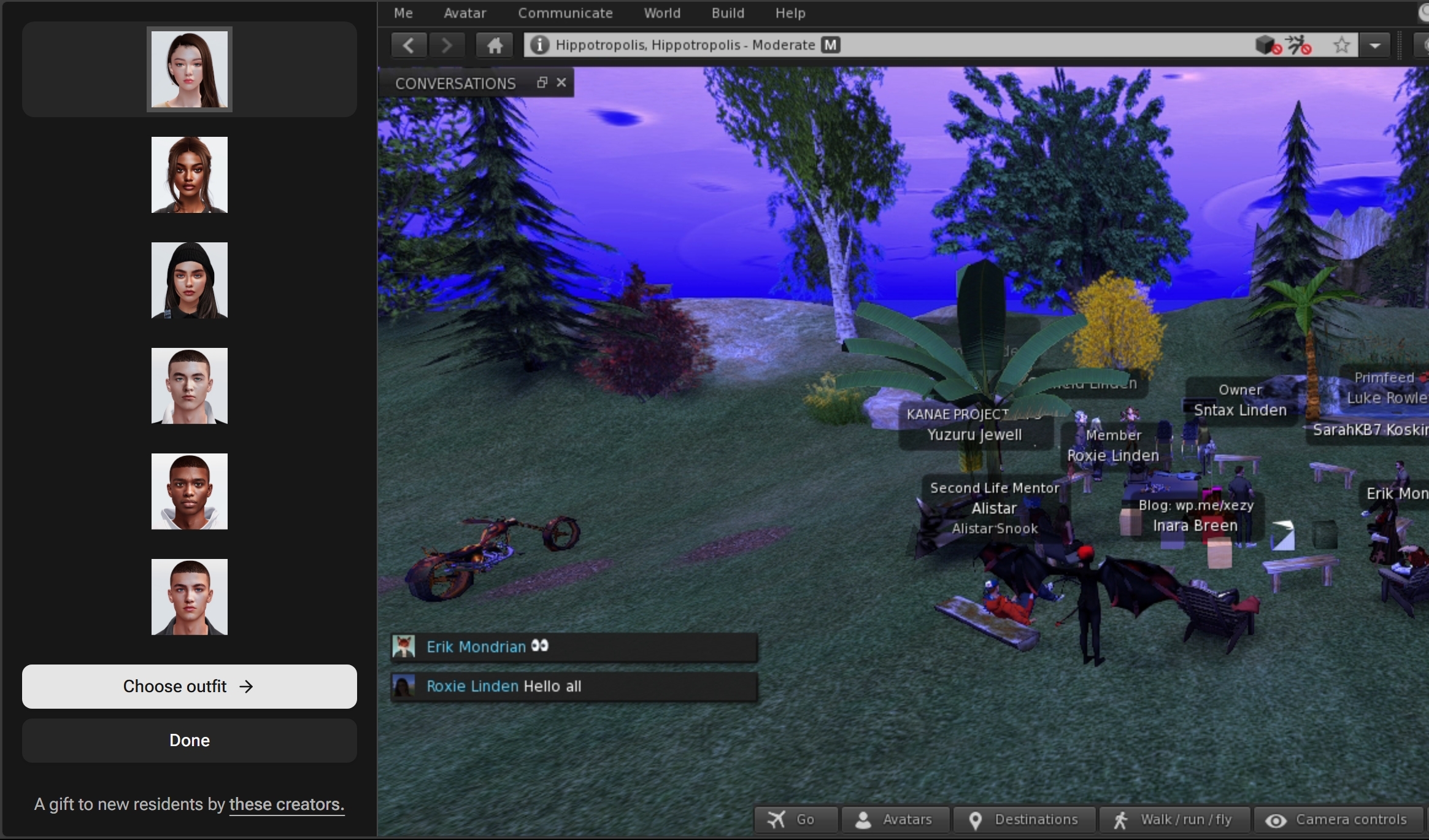
Avatar Picker

The Avatar Picker. Credit: Linden Lab
  • The Picker is actually a browser HTML element separate to the viewer, popping out and to the left of the viewer within a browser tab.
    • This is currently experimental, but is something the Lab would like to move towards.
    • The idea is is move away from floaters in the viewer, where appropriate, moving things to one side in the browser so as to leave the in-world view less cluttered.
  • The picker is associated with the new Avatar Welcome Pack also issued in April, and forms first part of presenting Project Zero with a new UI, built using HTML / React, and first discussed by Philip Rosedale when Project Zero was initially launched.

Go Menu and Toolbar Button

  • Previously referred to as the “Destination Picker”, the Go Menu has now been implemented, the name aligning with the Go button seen on the web account registration  / join pages.
  • Accessed by a new Toolbar button within Project Zero – also called Go – the “menu” is a scrollable  panel of potential destinations for (new) users.
  • Currently, the panel contains three destinations, rather than the 12 indicated in the April meeting. These have been selected on the basis of activity, rather than location; the activities being: meeting people, building, joining a role-playing game.
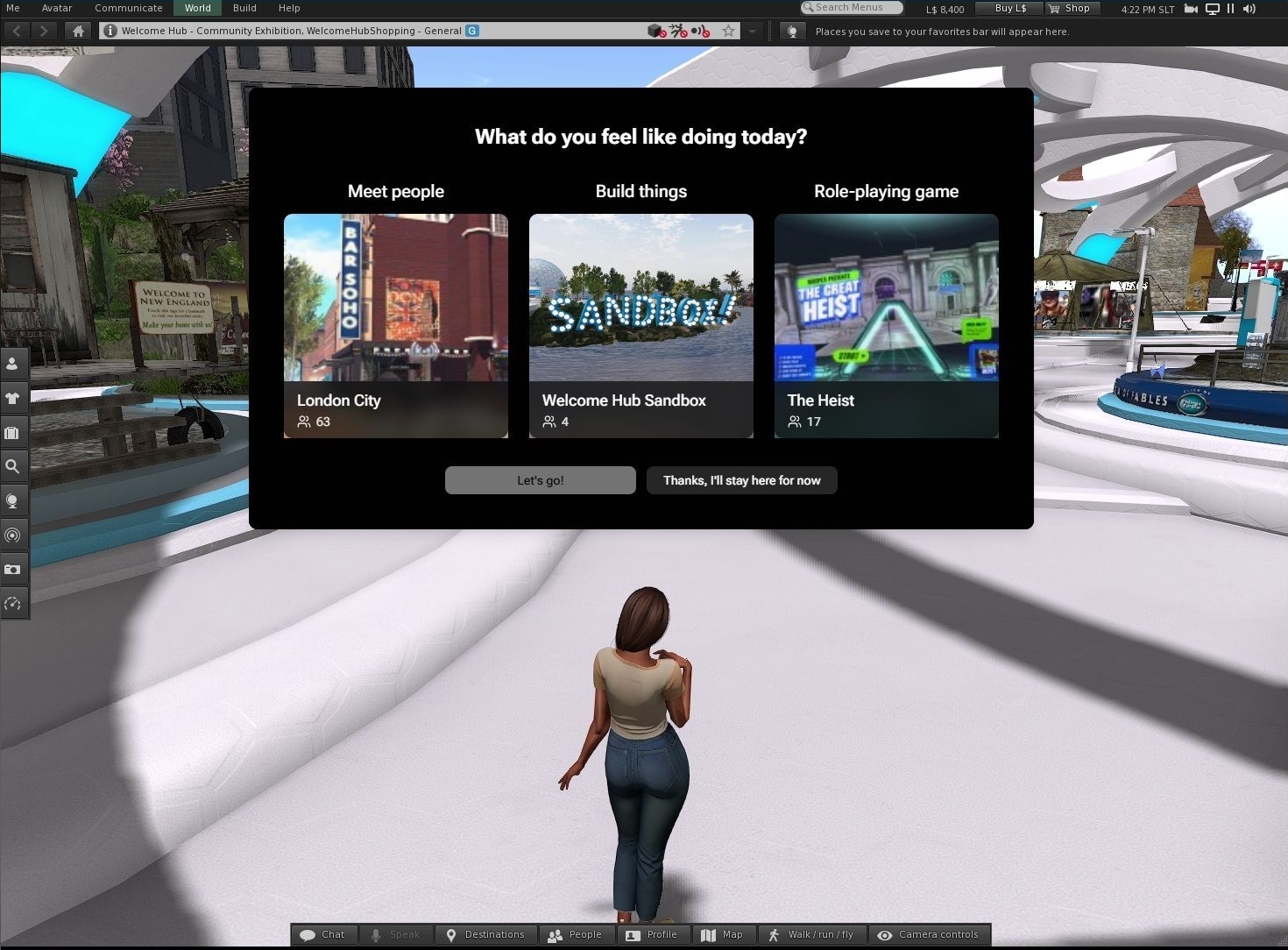
The Go Menu panel. Credit: Linden Lab
  • The Go Menu is automatically displayed when a new user first launches Project Zero, and is experimental at this point, and:
    • May well be expanded more towards the notional 12 places.
    • Is not intended as a replacement for the Destination Guide.
    • Is being monitored by LL to gather information of how well it is used and the potions people tend to use the most.
  • In addition, a new Toolbar button has been created.
    • This is called “Go” and has an airport-style image of an aircraft departing.
    • It is part of the default set of Toolbar buttons.
    • Allows a user to re-display the Go Menu panel.
  • Even with the limited choice on offer, the Lab has already noted that users coming into SL tend to pick on the option that has other avatars present, rather than being purely driven by activity. However, s noted in the meeting, it is still too early in testing to say this is definitively so (it might just be that as the first location in the panel, London City is just naturally clicked on, for example).

Toolbar Refresh

  • The general display of the toolbar buttons has been refreshed for Project Zero.
  • In particular, buttons are no longer displayed on the left side of the viewer window; everything defaults to the bottom of the window, with the number of buttons reduced to better-suit the initial needs of incoming new users.
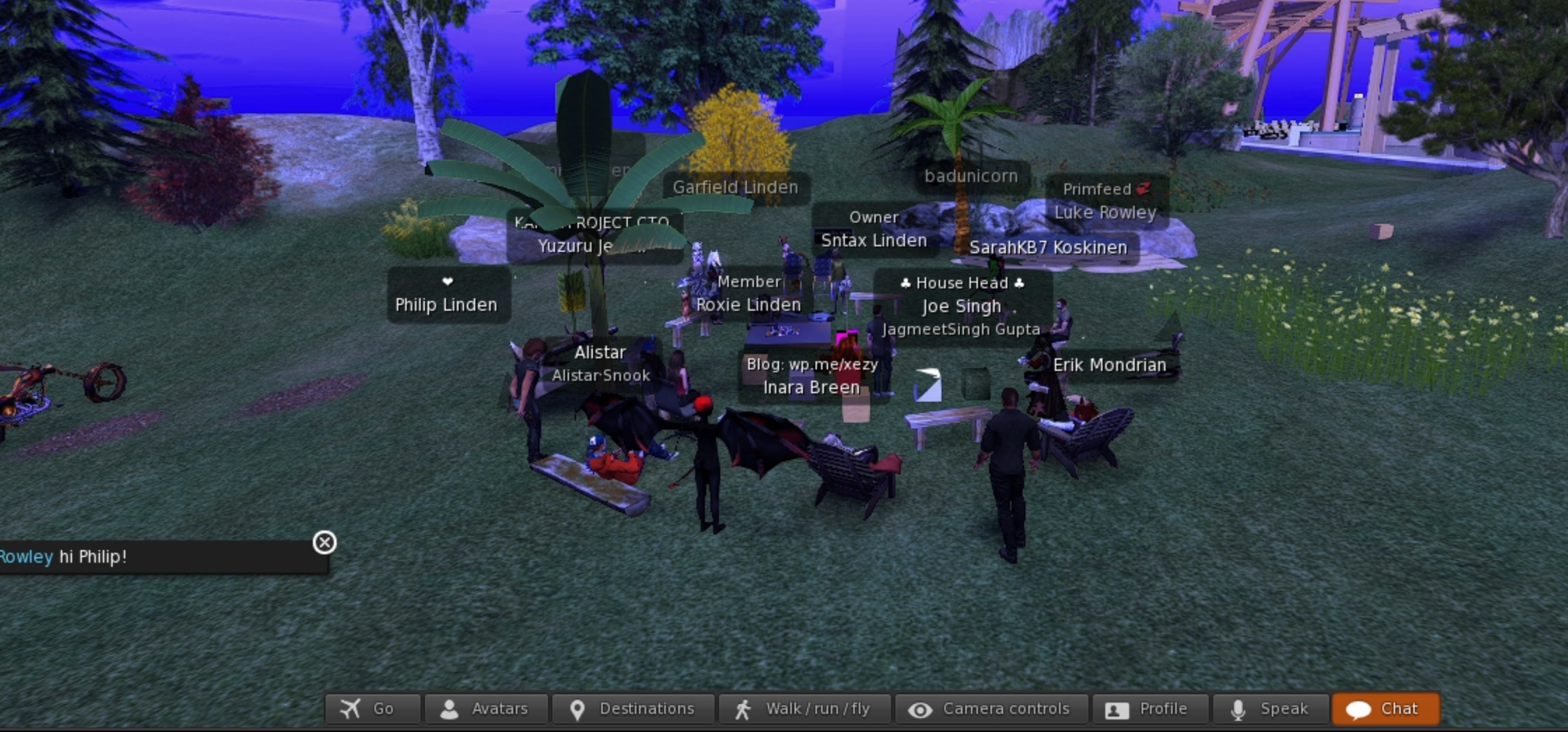
The new Project Zero Toolbar layout as seen by incoming new users – click for full size, if required. Credit: Linden Lab
  • By default, this Toolbar comprises:
    • Go button – described above.
    • Avatars – opens the avatar picker, also described above for changing an avatar / altering the style of dress.
    • Six unchanged buttons: Destinations, Walk/Run/Fly, Camera Controls, Profile, Speak, Chat.
  • During the meeting, the following default buttons were additionally suggested:
    • Chat Bar (per most viewers outside of the official viewer).
    • Inventory.
    • People / Friends + access to Groups.

General Discussion

  • It was noted that those attending the meeting had all been unable to access Project Zero to test the new features – it is hoped (no promises) that this might bee addressed.
  • Suggestions for alternative Go Menu destinations were offered:
    • Builders Brewery and Ivory Tower of Prims as places for those wishing to learn to build.
    • A broader selection of game destinations, rather than just MadPea.
    • Places like Dreamer’s Bay, where newcomers can receive assistance, have the opportunity for free housing, etc.
  • There was a general Discussion on how people make friends, and the various means of doing so, possibly in the hope of finding a route to making it easier for newcomers to do so, rather than them getting confused by multiple different ways.
  • The above led to a more esoteric discussion on Calling Cards; the Friends List (and how it’s not really that, it’s more a contacts / acquaintances list for many, which strayed into the realm of Firestorm Contact Sets); feedback on how people might go about making friends. These discussion appeared to be more for gleaning information than aiming towards anything planned for Project Zero.
  • The point was made that Second Life is potentially far less sociable nowadays than previously, and that while the onus seems to be on creators and content – which can help – the sense of wider community and of having places to go and things to do has been somewhat lost. In this, mention was made of fun activities such as skydiving, regions like the Greenies and other builds by Rezzable, etc.

Date of Next Meeting

A return to Umi in Second Life

Umi, May 2025 – click any image for full size

Update, July 2025: Umi appears to have closed. The SLurl here have therefore been removed.

It’s been a fair while since I’ve written about any of Paradox Ivory’s region designs; the last occasion was following a visit to Cravone City in 2021 (a place which itself appears to have expanded mightily since then). Paradox has also in the past been responsible for a location called Umi, which shared a region with her Tokyo Street Subway Entrance, locations I wrote about in 2019 and 2018 respectively.

Both of the latter vanished into the ether sometime after 2019, and to be honest, at that point I lost track of Paradox’s work. So I was pleasantly surprised when Cube Republic poked me about Umi’s return – this time on a much larger scale.

Umi, May 2025

Once again occupying a Full private region – this time leveraging the Land Capacity bonus – and with an adjoining Homestead (currently under construction, UMI is expanded well beyond its 2018/9 form, offering a lot to see and the promise of more to come, given Paradox is in the process of expanding it into the adjoining region.

Welcome to Umi, where serene rural rhythms blend with vibrant urban energy amid a captivating fusion of Japanese and Korean cultures. Here, each street corner tells a tale, every café beckons you to linger, and every encounter promises a journey to joy. Don’t forget to say hello to Umi’s beloved resident cats, who add their own special charm to this enchanting island experience. Welcome to a world where every purr and whisker brings a new adventure!

– From the Umi About Land description

The Landing Point for Umi sits at its southern end, where the setting meets the sea, the two separated by a stretch of rocky, shingle beach which may not avail itself overly well to sunbathers or swimmers, but is certainly appreciated by the local populace of seagulls.

Umi, May 2025

Taking the form of a ferry quay stretching a makeshift-looking pier (wooden planks and iron grating welding on to sealed oil cans for floatation) out into the bay, the Landing Point gives the impression that one has literally just stepped off the ferry on arriving (an if you listen, you will hear the ferry’s horn away in the distance and it (presumably) chugs off back to the mainland.

Once through the gates of the ferry terminus, visitors have a choice of routes: along the raised causeway road (presumably elevated to keep it clear of high tides!) and thence up into the town proper. For those preferring a wander along the not entirely attractive beach, it is possible to turn east or west and do so, either extremity of the shingle and rock waterfront having a stepped footpath leading up into town as well. Of the two, the walk to the west also offers the opportunity to visit the Seaside Café, which is doing its best to remain happy and sunny, despite the aging drabness of the beach!

Umi, May, 2025

Umi itself is neatly tiered, rising from the waterfront as set of linear elements. The first of these, bracketed at either end by the steps rising from the extremes of the beach, as well as being reached directly from the steps rising from the end of the causeway road, is a walled water channel, complete with narrow footpaths to either side and with little bridges periodically spanning it.

Behind this is a small residential district, complete with a playground and what looks like a nursery school. Another waterway (a storm drain?) separates this area from the uppermost part of the town, pair of contented Buddha-like stone cats guarding the central stairway leading up to it.

Umi, May 2025

This upper area mixes businesses with apartments and residences, footpaths and streets combining to form an engaging little maze to encourage visitors to explore. Within this area one will find the first warnings of on-going construction, but these are easy to avoid without risk of coming to injury. There’s also a traditional shrine awaiting discovery and further little park spaces.

A point of note here is that there are a number of private rental residences within Umi (four easily identifiable within the upper district, numbered as they are, with four more in the middle-level apartment blocks to the east side of the setting); so do be a little wary of trespassing people’s homes. There are also a number of small business premises available for rent in the setting as well.

Umi, May 2025

The overall attention to detail is one of the many things that make Umi so attractive. Paradox has worked hard to give the town a sense of being a living, breathing space. Houses are furnished, window boxes and planters are cultivated; the general clutter of life can be found everywhere; there is a feeling that much of the town has grown organically, rather than being neatly planned, birds sing in the trees and can be found making the most of garden spaces and the like.

Paradox has also made great use of sound surfaces as well: iron gratings cover drains and form the walkways on bridges. When you walk on them, they will ring with the sound of your heels passing over them. There are also plenty of places to sit and pass the time – such as the Café Umi.

And then there are the cats. As much residents here as anyone, they are to be found everywhere, all of them doing typical cat things: stalking, walking, looking cute, sleeping, making it clear whether your attention is wanted or not, and offering the occasional snippet of conversation.

Umi, May 2025

Even with all this said, I’ve still only scratched the surface of Umi’s treasures. To appreciate them in full, I recommend you hop over and pay a visit for yourself! My thanks, again, to Cube for the hat-tip.

Art and pondering humanity’s future in Second Life

SLEA 3: Manoji Yachvili – Lost the Last
I live in the countryside and I love nature and I think I could not live without the thousand shades of green that pass through the seasons, the sound of birds, the buzzing of bees, the bleating of sheep, the neighing of horses … and I see how the world is changing.
Nature will find a way to survive, it’s resilient, and like a thousand other species have, I’m convinced that we’re doomed to extinction, at least as structured as we are now.
So I wonder if there will be and what will be our future as human beings?

With these words, artist Manoji Yachvili (Onceagain) introduces us to a provocative essay-in-art exploring our relationship with our home world; questions of life within the broader solar system (and by extension, our galaxy as a whole); on the genuine threat of climate change, and questions of our survival as a race, and how we might recall Earth, should we survive the ecological destruction we are actively encouraging each and every day.

SLEA 3: Manoji Yachvili – Lost the Last

Entitled Lost the Last, the installation is particularly provocative for me, as it focuses in part on the questions of life on Mars and the potential for humanity to settle thereon. Or perhaps “dangerous” might be a better term; I’ve been both directly and indirectly involved in the questions related to the human exploration of Mars (up to and including working with Mars analogue environments and looking at questions of human factors), all of which could so easily cause me to superimpose my own commentary on certain things rather than focusing on the installation itself (such as dwelling on the bunkum idiocy of a certain CEO of a commercial space venture and his “plan” for “colonising” Mars).

It is possibly this wider focus on Mars, coupled with our on-going efforts to explore it and seek answers to basic questions as to what happened there to both turn it from a warm, wet planet, possibly harbouring basic life, and what happened to that life;, which caused Manoji to focus on it within this installation. As such, there is perhaps a temptation to critique it in light of the references to climate change on the basis that the latter is unlikely to cause Earth to drift into a Mars-like state of potential frozen stasis, but rather push us  increasingly towards the broiling hell we know as Venus.

SLEA 3: Manoji Yachvili – Lost the Last

However, I would venture to suggest such critiques are put aside, as the focus should be on the broader questions asked by the installation, and what any potential colonisation of Mars, coupled with the global failure on the parts of governments and corporations to really work to reverse – or at least slow – the critical overload with are placing on this planet in terms of climate impact and pollution, might mean for this planet.

The installation itself forms two halves. The first – which housed the installation’s Landing Point – presents a barren landscape, seemingly rusted with iron oxides. It carries a very Mars-like feel to it, but it is not Mars. It is a dead (or near-dead) Earth. This is shown by the remnants of a high-rise building to one side of the setting, an old highway information sign and evidence of even old ruins from humanity’s past. The Landing Point sits within a small structure – and I would suggest spending a minute or two examining the contents of this room prior to moving on; they have a lot to say for themselves.

SLEA 3: Manoji Yachvili – Lost the Last

A gallery lies a short walk from the Landing Point, the hazmat figure standing in front of it again suggesting this is in fact Earth, albeit Earth with a clearly noxious atmosphere. Within this gallery lies an exhibition of art carefully crafted to aid in illustrating the idea that we are the architects of Earth’s – and our own – doom. Mixed with the images are 3D pieces by various artists, selected by Manoji, they further underscore the themes of loss and memory.

There are some apparent anachronisms here: The space suited figure apparently cannot survive without their suit and helmet as they explore what is left of Earth, but horses and trees can. However, as we know from Mars, life – admittedly in its more basic forms – is remarkably hardy and able to survive in environments utterly hostile to us. As such, I would suggest the inclusion of horses and trees within some of the images is intended to be a metaphor for this fact: we can more easily relate to life persevering when Nature has turned Her back on us, rather than depictions of more basic life we might not recognise.

SLEA 3: Manoji Yachvili – Lost the Last

On encountering the far wall of this space (walk into it), visitors will be asked to accept a local Experience (if they haven’t in a previous visit). This will teleport them to the second part of the installation: a base on Mars.

Surrounded by a backdrop which put me in mind of the Columbia Hills (not that this is remotely relevant), the base serves as a place where memories of all we have lost are kept alive – at least in miniature: ideas of open homes where we were once free to breathe the air outdoors; places rich in grass where the creatures with which we once shared our home world could wander; a place where water flowed freely, without having to be canned and rationed. It serves as an illustration of what we stand to lose if we persist in making Earth hostile towards us, and all we stand to lose.

SLEA 3: Manoji Yachvili – Lost the Last

Evocative and with much to say, Lost the Last should be seen, explored and considered.

SLurl Details

2025 week #21: SL SUG meeting -SLua

Chaos and Calm – Chaos Theory, March 2025 – blog post

The following notes were taken from the Tuesday, May 20th, 2025 Simulator User Group (SUG) meeting. They form a summary of the items discussed, and are not intended to be a full transcript. The notes were taken from my chat log of the meeting. Pantera also recorded the meeting, and that recording is embedded at the end of this piece – my thanks to Pantera, as always, for providing it.

Meeting Overview

  • The Simulator User Group (also referred to by its older name of Server User Group) exists to provide an opportunity for discussion about simulator technology, bugs, and feature ideas.
  • These meetings are conducted (as a rule):
  • Meetings are open to anyone with a concern / interest in the above topics, and form one of a series of regular / semi-regular User Group meetings conducted by Linden Lab.
  • Dates and times of all current meetings can be found on the Second Life Public Calendar, and descriptions of meetings are defined on the SL wiki.

Simulator Deployments

  • There are no planned deployments to any channels this week, only restarts.

SL Viewer Updates

SLua Updates

I’m going to write up an implementation of better event handling in pure SLua so that people can get a feel for the API and make suggestions before we commit to actually implementing a specific implementation in the server.
Got sidetracked improving setlinkprimitiveparamsfast perf with many PRIM_LINK_TARGETs since I saw that bogging down the SLua alpha sims but I’m back on track now 🙂

– Harold Linden (SLua development contractor)

  • It was reiterated that the plan remains to move SLua to a more open beta on Agni (the Main grid), once further updates have been made by LL. (Such as the event handling and memory management mentioned). When this happens, it will initially be to a “handful of regions” prior to gaining broader deployment.
  • Harold Linden indicated that most of the current Canny Feature Requests for SLua will be implemented during the beta phase of the project – although some, such as “require” will take time to “do properly”, and so there may be stopgap solutions “similar to the ones people already use for LSL that uses local pre-processing.”
Not ideal but there’s a lot of yak shaving that needs to be done to get proper “require” working with new “library” type assets and don’t want to block the rest of SLua on it. 
  • In responding to a comment about an possible inter-script dependency system, he further noted:
There would be no inter-script dependencies per-se, this is more akin to pure modules that can just export types and functions etc with no shared state. More like a statically linked library that only gets evaluated when the script is compiled. It’s essentially just enabling something that people already tend to do with pre-processors, the only difference is the assets live with the rest of your stuff.
  • This sparked a debate on the use of libraries, plug-ins ,etc., a lot of which is “still TBD”, other with matters of object update handing, etc. This discussion ran through must of the remaining 40 minutes of the meeting. Please refer to the video for specifics (as I am not a coder, and far from qualified to interpret all of the discussion!).
  • One important additional point was raised by Harold Linden:
Oh right, I feel like I should mention, we’re trying to track down a couple potential memory corruption bugs in SLua that we’ve had trouble reproducing on our dev machines. We’re going to look at pushing a version of the server with debugging instrumentation (AddressSanitizer) to the SLua sims on beta grid. It might make things slightly slower, but it’s only temporary.

In Brief

“Missing Content on Login”

We had a repro recipe for “missing content on login” and I was able to kinda fix it. It was semi-reliable (would happen maybe 20% of the time) for one our viewer dev contractors, but I couldn’t reproduce it myself. It is “kinda” fixed in that I have eliminated some unnecessary resets during login that would help trigger the bug, with a subsequent savings of effort and bandwidth of object update data on arrival. However the root race condition that is being avoided… I didn’t actually figure that out. 
So… I would expect improvements (reduction of missing content on login) but I don’t think this fixed everything. In particular, I thought maybe it would help reduce the rate of missing attachment items on avatars, but upon more thought I realized this fix is not relevant to that problem. Anyway, heads up: this fix is expected to be in Fig Pudding [the next simulator update].

– Leviathan Linden

TP Failure and Log-in Issues

  • Reports suggest that that has been a “big increase” in TP failures and login failures over the last week (I can attest to the former; having had around a 40% TP failure rate on first attempts to get somewhere on several days). Viewer logs and times incidents occurred, submitted via Canny, would be helpful in debugging issues.
  • It was also noted that LL is engaged in making some network infrastructure changes, so again, a request was made for those “experiencing connectivity problems not of the usual sort or frequency” to file a Canny report would be useful. Times, places, names, and log files.
  • The game_control capability remains on-hold. Leviathan Linden is currently engaged in other work, and unfortunately, game_control is is “near the bottom of” the stack of work he has on-hold as a result.

† The header images included in these summaries are not intended to represent anything discussed at the meetings; they are simply here to avoid a repeated image of a rooftop of people every week. They are taken from my list of region visits, with a link to the post for those interested.

2025 SL viewer release summaries week #20

Logos representative only and should not be seen as an endorsement / preference / recommendation

Updates from the week through to Sunday, May 18th, 2025

This summary is generally published every Monday, and is a list of SL viewer / client releases (official and TPV) made during the previous week. When reading it, please note:

  • It is based on my Current Viewer Releases Page, a list of all Second Life viewers and clients that are in popular use (and of which I am aware), and which are recognised as adhering to the TPV Policy.
  • This page includes comprehensive links to download pages, blog notes, release notes, etc., as well as links to any / all reviews of specific viewers / clients made within this blog.
  • By its nature, this summary presented here will always be in arrears, please refer to the Current Viewer Release Page for more up-to-date information.
  • Outside of the Official viewer, and as a rule, alpha / beta / nightly or release candidate viewer builds are not included; although on occasions, exceptions might be made.

Official LL Viewers

  •  Default viewer: 2025.03 7.1.13.14343205944, issued April 9th and promoted April 15th – No Change.
  • Release Candidate: 2025.04 – 7.1.14.14911904105, May 13th 2025 – Updated.
    • Includes the following new features:
      • Chat Mentions (Early Support): Type @ then pick a name. To follow: audible alerts and highlight colour pickers.
      • My Outfits subfolders: now supports the use of subfolders.
    • Key updates:
      • Build Floater improvements: increase to scale boundaries; Physics Material Type now updates when selecting linked objects; Repeats per Meter value no longer incorrect for non-uniform sized objects
      • Hover height: the minimum/maximum is now +/- 3 meters.
      • Snapshot floater: L$ balances can be hidden independently of the rest of the UI.
      • Preference Search bar: general usability and readability improvements.
    • Refer to the release notes for full updates and fixes.
  • Second Life Project Lua Editor Alpha, version 7.1.12.14888088240, May 13th – Updated.

LL Viewer Resources

Third-party Viewers

V7-style

  • No updates.

V1-style

  • Cool VL Viewer Stable: 1.32.2.48, May 17, 2025 – release notes.

Mobile / Other Clients

  • No updates.

Additional TPV Resources

Related Links