
As NASA faces the threat of significant cuts in its science missions and research budgets, together with a potential overhaul of the US-led Artemis Project, China has further indicated its commitment to expanding its human presence in space, while the European Space Agency could see an increase in its budget (subject to end-of-year approval), amidst a call for Europe in general to increase its overall spending on space-based activities.
China has confirmed that it will be moving ahead with an expansion of its Tiangong space station with up to three new modules, potentially doubling its size. First hinted at in late 2022, the new modules are believed to comprise:
- An updated version of the Tianhe core module , being referred to as the expansion module, providing additional power systems, a new multi-port docking adaptor equipped to handle a range of vehicles, including the upcoming next generation crew vehicle.
- Two multi-function science modules, likely updated versions of the current Wentian, and Mengtian science modules.
The new modules are to include state-of-the-art engineering and maintenance capabilities, such as 3D printers capable for producing replacement parts used on the station (as had been introduced with the International Space Station), as well as allowing the total crew mission complement aboard the station to be expanded.

In confirming the expansion plans during a China state television interview, Wang Jue from China Aerospace Science and Technology Corporation (CASC) stated that the timeline for the expansion has yet to be confirmed, but in keeping with launches for the station to date, the modules will be flown aboard the Long March 5B booster, currently China’s most powerful launch vehicle and capable of pushing up to 25 tonnes of payload to low-Earth orbit (LEO).
Wang also confirmed that Long March 5B is itself undergoing “reliability and safety” updates – although these are not interrupting the current launch schedule. In particular, China is looking to make the re-entry of the rocket’s large first stage a more controlled affair. The country has been heavily critiqued for its Laissez-faire attitude of just allowing the first stage, which tends to fly higher than the first stages of comparable western rockets, to simply make an uncontrolled re-entry and break-up over the Pacific Ocean, rather than actually guiding it towards doing so.
Most recently, the Long March 5B has been used to launch the first batching of China’s Guowang (also called Xingwang and Hulianwang – the latter being the name of the satellite class) megaconstellation to compete with Starlink. It has taken over this role from the Long March 2 and 3 vehicles to accelerate the deployment of some 13,000 operational Hulianwang satellites of various classes. These will be placed into a range of orbits, as is the case with Starlink, allowing the system to join Starlink in further interfering with Earth-based astronomy on a global basis and adding to the amounts of pollutants dumped into the upper atmosphere annually as defunct satellites in the systems re-enter and burn-up.
The next space station related launch for Long March 5B, meanwhile, is due in 2026. This will be to deliver the free-flying Xuntian space telescope, a “Hubble class” orbital observatory. It will operate largely remotely from, but in a co-orbit with, Tiangong, the crews from which will perform routine maintenance on the telescope.

With a 2-metre diameter primary mirror offering a field of view some 300 times greater than the Hubble Space Telescope, Xuntian will be equipped with a 2.5 gigapixel imaging system and will be used to study areas including dark matter, dark energy, galaxy formation and evolution of the cosmos. China has stated the observatory will be offered for international science and research.
One major aspect of the Tiangong expansion will be the ability for the station to house larger crews, including tiakonauts from China’s partner nations. The country is due to shift its crewed spaceflight capabilities from its current Shenzhou, 3-person vehicles, to its modular, multi-function and semi-reusable Mengzhou (“Dream Vessel”) craft.

The latter, due to commence operations in 2027 or 2028, will be able to deliver up to 6 crew at a time to Tiangong (or 3 crew and a half-tonne of equipment). A further variant of the craft will form the vehicle for delivering crews of three to lunar orbit in the 2030s, who will then use the companion Lanyue (“embracing the moon”) lunar lander (launched separately) to descend to and return from the surface of the Moon, in order to achieve China’s intent to establish a permanent human presence on the Moon in the 2030s.
Rocket Lab Gains US DoD Support
Rocket Lab, the little company looking to out-SpaceX SpaceX, has gained a further boost in confidence.
Currently, the company is best known for its Electron semi-reusable launcher capable of putting 320 kg to LEO and 150 kg to Sun-synchronous orbit (SSO). However, Electron is just one element in a multi-part strategy that has enabled Rocket Lab to achieve considerable success. As well as the booster, the company has developed its own range of 3D printed rocket engines, develops satellite for customers, and has built a multi-purpose spacecraft “bus” called Proton, capable of delivering payloads to orbit or to other planets, as well as other tasks.
But one thing CEO Sir Peter Beck said the company would never do was move into the field of building “big” rockets – and he was so adamant in this, he promised to eat his hat if the company decided otherwise. And eat his hat he did, some four years ago, when Rocket Lab announced it was developing Neutron, a medium-lift launch vehicle (MLLV) capable of delivering up to 13 tonnes to low-Earth orbit.

As launch vehicle go, Neutron is unique. The entire first stage of the vehicle is a rocket unto itself – and fully reusable. Rather than comprise a first stage with one (or more) stages bolted on top of it and the payload on top of those, Neutron is designed to carry its “upper” stage and its payload inside itself. On reaching orbit, the nose of the vehicle opens up, allowing the “upper” stage (an expendable kick stage) with the payload attached, to be pushed clear, prior to igniting its motor.
The first launch of a Neutron vehicle is due later in 2025, and in keeping with the likes of SpaceX and Blue Origin, Rocket Lab will attempt to recover the first stage with an at-sea landing on specially adapted landing barge. But even before its first flight, Neutron has been given a double boost (no pun intended) by the US Department of Defence. The first of these is that Rocket Lab, with Neutron, has been cleared to bid for US National Security Space Launch (NSSL) contracts through to 2029. As SpaceX knows, this is a lucrative market, and Rocket Lab is the first public-traded launch company to be selected to possibly fly NSSL missions to orbit. The company has already commenced launch assurance reviews with the US military, and Beck has indicated that Rocket Lab could present bids for NSSL launches as soon as mid-2026.
In addition, the US Air Force (somewhat keen to regain some of the space high ground it has had to cede in the formation of the United States Space Force) has also selected Neutron as the test vehicle for the Rocket Experimentation for Global Agile Logistics (REGAL) initiative, intended to assess the use of rocket vehicles to rapidly deploy materiel from locations in the United States to “anywhere in the world” in what are referred to as “point-to-point” flights.
This idea was recently given a stir by the SpaceX CEO, stating that company’s Starship / Super Heavy combination would be “ideal”. While interest in the concept has remained within the USSF and USAF, the selection of Neutron for initial testing is a poke in the eye for SpaceX and one which makes a lot of sense. While Neutron cannot lift the upper end of Starship’s payload spectrum, it is entirely possible that in point-to-point operations, Starship would have its payload capacity somewhat limited. Further, Neutron is ready-made for landing on its own feet, Starship isn’t, and it doesn’t require a bloody great booster to get it (and any payload it has to carry off the ground at either end of the operation.
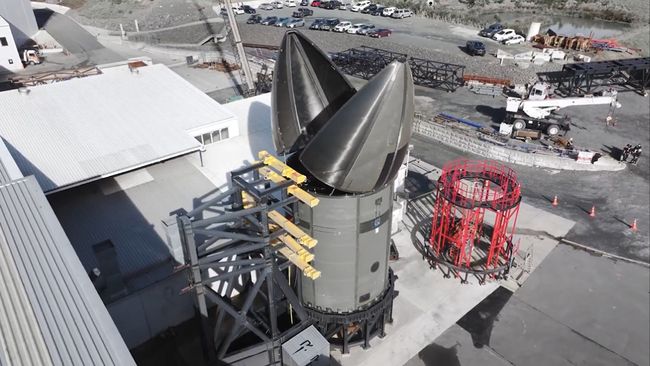
However, that said, the whole idea of REGAL is questionable. It’s not like you can simply lob a rocket on a ballistic flight, flip it over and land it anywhere you like. It requires quite substantial infrastructure at either end of the equation (assuming you’d like it to return to base after a flight, at least). A landing / launch platform is required; you need propellant storage and delivery / pumping capabilities; payload handing equipment, skilled personnel and facilities to undertake these and other operations. None of which can just be thrown up overnight.
As such, any idea of “point-to-point” capabilities is at best limited to complex facilities fully capable of handling the receipt and launch of the booster vehicle and payload. While this doesn’t entirely rule the idea out, it does restrict where and how such capabilities might be used; it’s hard to see such a system dropping into a FOB in a zone of conflict, or putting down right on top of a natural disaster to deliver aid – two of the promoted ideas behind REGAL. Given this, it will be interesting to see what develops as REGAL testing commences, potentially (again) in 2026.
Voyager 1: Thrusters Recovered
In another deep space piece of miracle working that would impress Montgomery Scott, NASA engineers have recovered a set of thrusters vital for communications with Earth, on their Voyager 1 spacecraft – twenty years after the system was considered defunct.
The Voyagers maintain communications with Earth via a large high-gain communications dish they carry on their “backs”. However, as they move through interstellar space, both Voyager 1 and Voyager 2 must carry out periodic “roll manoeuvres” to ensure these dishes remain aligned with Earth for communications to continue.
These manoeuvres are carried out using small sets of thrusters on each vehicle, under the guidance of a star tracker system. The latter calculates the position of Earth and the spacecraft’s required orientation thereto by means of observing a set of notable stars the system can “see”, and using their positions to calculate where Earth is and the degree of roll the vehicle must make to re-centre the communications dish.

In 2004, the heater units required to warm the “primary” thrusters on Voyager 1 started to show signs of failure, risking a possible thruster misfire which could swing the vehicle so far off-axis, its star tracker would no longer be able to identify the stars in needed to carry out its calculations. Because of this, operations were switched to the “back-up” thrusters.
By 2018, these “back-up” thrusters (now re-designated the “primary thrusters) were encountering issues as a result of the build-up of residual material in their chambers after each use. Steps were taken to reduce this issue by placing some of the remaining thrusters into “reserve”, the idea being to switch to the “reserve” thrusters if those remaining in operation become too unreliable for continued use.
This actually happened in September 2024 – however, it transpired that the “reserve” thrusters were already badly “clogged” with residual material. This might not have been a critical issue but for the fact that, starting in May 2025, the 70-metre diameter Deep Space Station 43 (DSS-43) radio communications dish located in Canberra, Australia, would be going off-line for a 10-month overhaul. A part of NASA’s Deep Space Communications Network (DSN), DSS-43 is the only Earth-based communications system available to NASA for communications with either of the Voyager craft.

The concern was that if Voyager 1 was allowed to continue to rely on its increasingly faulty thrusters, a misfire might occur whilst DSS-43 was offline, and the craft would be “lost” as a result of a communications breakdown. To avoid this, the decision was taken in March 2025 to try to recover the original thrusters system on the grounds that they would have 20 years less wear-and-tear and residue build-up, due to being inactive.
Even so, switching back to them would not be without risk; Voyager 1 would have to restore power to the thrusters disabled in 2004. However, with a dwindling ability to generate electrical power (since 1998, NASA has had to periodically shut-down instruments on each Voyager craft so they could maintain some degree of minimal operational and communications capability); as such there was real concern any power-up of the electrical systems on the 2004 thrusters could cause a damaging electrical surge – particularly given the previously-faulty heaters – or a thruster misfire, ending communications with Earth.
The attempt to do so was made in March 2025; it was carried out in stages designed to ensure if anything went wrong, Voyager 1 would still be capable of locating Earth again in the event of the latter occurring. With a 46-hour lag in two-way communications between Earth and Voyager 1, the attempt was made in late Match 2025 – and proved a success.
On March 20th, 2025, mission control at the Jet Propulsion Laboratory, Pasadena, California, received the information they’d hoped: Voyager 1 had successfully brought the 2004 thruster system back on-line. There was no power spike, no issue with the thrusters firing, and Voyager 1 confirmed it had completed the test manoeuvre.
Since then, the system has continued to be monitored, and with DSS-43 due to go down for its upgrade, control was swapped from the increasingly at-risk “back-up” thrusters back to the “primary” thrusters. This should hopefully allow Voyager 1 to maintain contact with Earth, even without it being able to receive commands of any complexity (there are narrow windows of opportunity in the DSS-43 overhaul during August and December 2025, where it could send short sequences of commands to the Voyager craft), and be ready to say “hello!” once more when full communications are resumed in 2026.


 Inara Pey: Living in a Modemworld