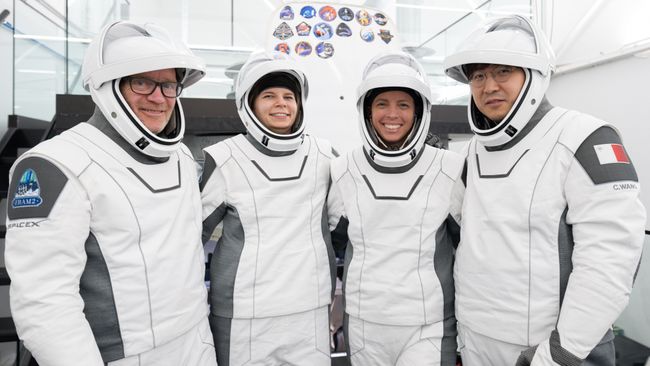
If all goes according to schedule, a SpaceX Falcon 9 / Crew Dragon combination is due to lift-off from Kennedy Space Centre’s LC-39A on March 31st, 2025, carrying four private citizens into space for a 4-5 day mission.
Aboard Crew Dragon Resilience will be Chinese-born, but Maltese citizen and crypto currency entrepreneur Chung Wang, who will be the mission’s commander and is a co-bankroller of the flight; Jannicke Mikkelsen, a Scottish-born Norwegian cinematographer and a pioneer of VR cinematography, 3D animation and augmented reality, who is the other co-bankroller for the flight; Eric Philips, a 62-year-old noted Australian polar explorer, who will be the first “fully” Australian national to fly in space, and Rabea Rogge, a German electrical engineer and robotic expert.
What is particularly notable about this flight is that it will be the first time any human space mission will be launched into a high-inclination (90º) polar orbit at an altitude of some 420-425 km (giving it a 93-minute orbital period). The aim of the flight is to carry out research on the Earth’s poles and their space environment, hence its name: Fram2. This celebrates the ship used by (among other Norwegian polar explorers), Roald Amundsen. In fact, in a further tie to polar exploration, mission was originally due to be flown aboard Crew Dragon Endurance, named for Ernest Shackleton’s vessel, until scheduling issues meant the mission has to switch to using Resilience.
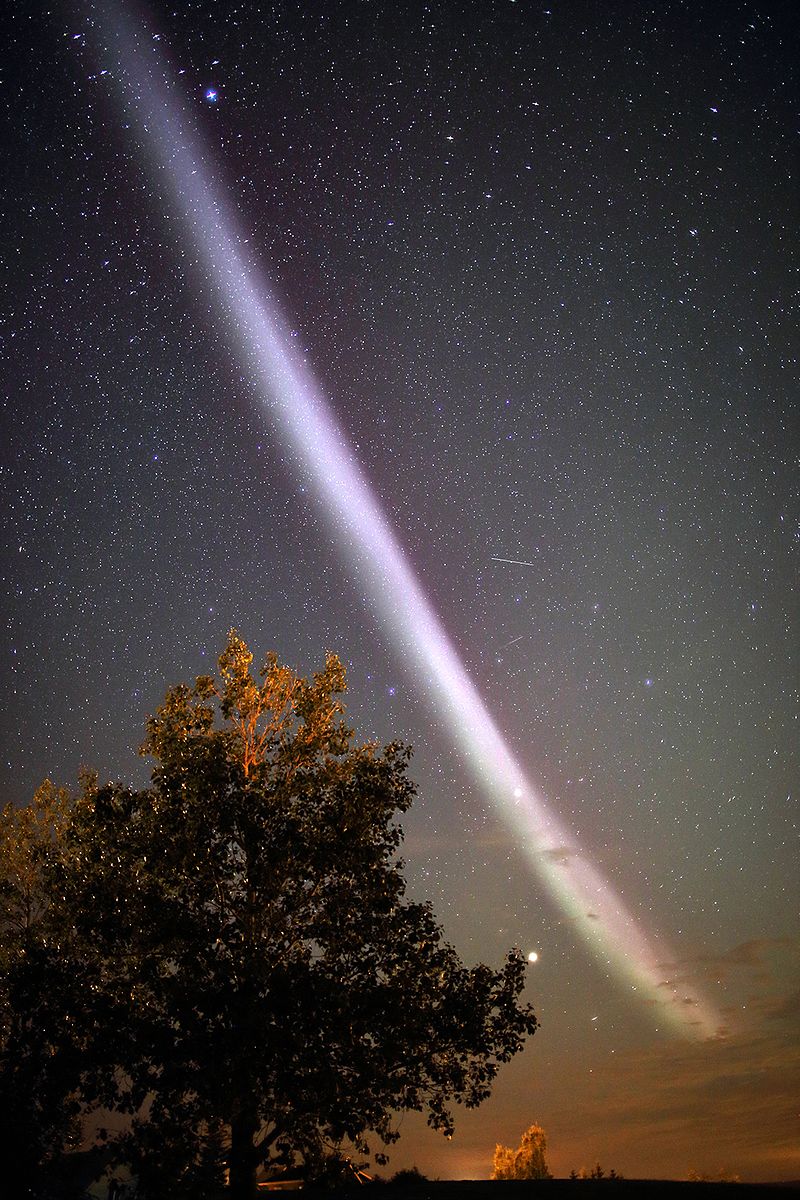
Given the time of year of the mission, flights over the North Pole and arctic will be carried out in daylight, allowing for direct observations of Arctic ice melt, whilst passage over Antarctica and the South Pole will be in darkness, during which times the crew hope to be able to more clearly study the phenomena known as STEVE.
According to data gathered by the European Space Agency (ESA), STEVEs are caused by a 25 km wide ribbon of hot plasma at an altitude of 450 km, with a temperature of 3,000 °C flowing at a speed of 6 km/s (compared to 10 m/s outside the ribbon). They appear as a very narrow arc extending for hundreds or thousands of kilometres, aligned east–west, and generally last for twenty minutes to an hour. STEVEs can appear in both southern and northern skies, and are a phenomenon with a quaintly curious history.
As an observable event, records on STEVEs go back at least as far at 1705 – but throughout that time, they have had always largely been dismissed as an off-shot of aurora because (until October 2024) one had never been observed in the absence of any aurora. However, this changed in 2016 thanks in part (and possibly inevitably) to social media.
It was in that year that a group of amateur aurora photographers in Alberta, Canada noticed the appearance of a nightly whilst observing aurora, and they started taking photographs of the events and posting them to Facebook, with one of them referring to the ribbon in his photos as “Steve”, in reference to the comic series (and film) Over the Hedge. The photographs rapidly went viral and sparked a lot of discussion as to what the ribbon might be.
In particular, the photos and discussions drew the attention of a couple of planetary physicists, one of whom connected the photos to the data gathered on the phenomenon by ESA, leading another – Robert Lysak – to come up with the backronym of STEVE, for Strong Thermal Emission Velocity Enhancement, which is the term now used to reference the ribbon scientifically. It is now hoped that that physical observations from orbit of STEVE events by the Fram2 crew will help further our understanding of the phenomenon.
In addition to this, the mission’s science programme includes the first attempt to grow mushrooms in space in an effort to further research into the ability to provide sustainable nutrition on space missions – something seen as key to missions to Mars.

While there have been successful efforts to grow foodstuffs on the International Space Station (ISS) such as red Russian kale, chilli peppers, dragoon lettuce, dwarf wheat, mustard, they have not been without their drawbacks. For one thing, even relatively small amounts of food cultivation require space and other resources quite out of keeping with the results: while a cubic metre of growing space can generate a small crop of food in just 30-35 days, the amount produced tends to only be enough to help supplement a single meal (or perhaps two) for 7-8 people.
Mushrooms – in this case oyster mushrooms – potentially offer a more viable means of dietary supplement. They grow at a rapid pace (doubling in size every day), do not require an enormous amount of space, they have a rich nutrient profile and – when grown under UV lighting (as these will), they can produce the daily dose of vitamin D required by astronauts. They can also grow in inedible plant waste, do not require intensive cultivation in order to grow.
For Fram2, the plan is for the crew to prepare an oyster substrate in orbit, and then study its growth and fruiting process and then monitor the rate of the developing mushrooms, record their growth characteristics in microgravity and monitor for any unusual contamination. The fungi will then be returned to Earth for further studies, including whether or not the mushrooms are still safely edible and can deliver on their nutritional promise.
With a battery of human science objectives set for the mission – including testing a portable MRI unit, carrying out x-rays of the human body, studies into blood and bone health, and glucose regulation in the body in micro-gravity – Fram2 is set to be one of the most science-intensive short-during human space flight missions yet undertaken.
ISAR Spectrum Maiden Flight Ends with a Ka-Boom
Europe’s commercial launch companies are not having a lot of success. In 2024, German company Rocket Factory Augsburg (RFA) hoped to be the first European commercial launcher to get a rocket to orbit from European soil (excluding Russia) with its RFA One vehicle. However, that hope ended in August 2024, when the first stage of the vehicle was lost after it exploded during a static fire engine test at the UK’s SaxaVord Spaceport (see: Commercial activities and a fly-by).

That loss in turn came on top of the 2023 failure of a (now defunct) Virgin Galactic airborne launch of the company’s LauncherOne from their carrier aircraft, Cosmic Girl, flying out of Spaceport Cornwall (aka Newquay Airport) – see: Space Sunday: Exoplanets and updates. Now, a further company has added to the list.
Thus, Germany’s Isar Aerospace had – with finger’s crossed – hoped to claim the crown by reaching orbit from the Andøya Spaceport in northern Norway, and albeit using a vehicle without any payload. The aim of the launch was intended to be a fully integrated test of the company’s two-stage Spectrum rocket and launch and flight systems to determine the vehicle’s readiness to commence payload carrying operations. Given this, the company did indicate actually reaching orbit would be a bonus.
Spectrum is designed to operate from multiple launch sites –notably Andøya, targeting Sun-synchronous (SSO) and polar orbits, and Guiana Space Centre (Spaceport Europe) for equatorial and medium inclination orbits. It is capable of lifting up to a metric tonne to low-Earth Orbit (LEO) and up to 700 kg to SSO. The first operational flight is expected to be out of the Guiana Space Centre, carrying seven small satellites, later in 2025.

The test flight – calling Going Full Spectrum – out of Andøya on March 30th, appeared to start off smoothly enough. The vehicle lifted-off cleanly at 10:30 UTC, the rocket and climbed away from the launch pad. But as the rocket commenced its programmed ascent roll at 18-seconds in the flight, attitude control was lost, the rocket pitching over onto its side.
At this point the webcast video froze, but the sound continued to play, and the rocket was heard exploding. Initial reports stated that the vehicle’s flight termination system (FTS) had been triggered. However, separate footage recorded from a cell phone and posted by Norwegian publication VG, showed the rocket falling horizontally to strike the waters close to the launch facilities and explode. Later video of the released to various organisations euphemistically referred to the vehicle’s fall and explosion as being in “a controlled manner”. That said, the flight did yield data.
Two more Spectrum rockets are currently being fabricated, but the company has yet to indicate whether either of these will be used for a further flight test or whether they will seek to go ahead with a payload launch.
China’s Planetary Exploration Roadmap
As I’ve noted in numerous past Space Sunday pieces, China is developing a multi-faceted robotic and human space exploration programme, with the latter focusing on Earth-orbital activities using the Tiangong space station (soon to be joined by a new crew-carrying space vehicle), then missions to the lunar South Polar Region commencing in the early 2030s, prior to progressing to human-to-Mars flights some time thereafter.
On the robotic front, China has already achieved a lot re: the Moon and Mars, and on March 26th, 2025, the country’s Deep Space Exploration Laboratory (DSEL), part of the China National Space Administration (CNSA), unveiled what appears to be a roadmap of upcoming missions, to the general public. In a slide offered during a presentation, DSEL highlighted a number of goals, commencing with the already in-development Tianwen-3 Mars sample return mission. In all, the slide disclosed the following mission ideas:
- ~2028 (launch): Tianwen-3 Mars Sample Return.
- ~2029 (launch) Tianwen-4 Jupiter / Callisto orbiter mission investigating the potential habitability of the latter.
- ~2030: Earth-based platform for simulating planetary environments and their habitability.
- ~2033 (launch): Venus atmospheric sample return mission (utilising aerodynamic space vehicle).
- ~2038 (launch): untended, automated Mars science outpost for long-term biology and environmental research (precursor to human missions).
- ~2039 (launch): Neptune / Triton mission to investigate habitability of outer planets and water worlds.

Also mentioned in the presentation was the Earth 2.0 Exoplanet Investigator – a TESS-like observatory for studying exoplanets, particularly those referred to a “exo-Earths” – planets of a size and location around their parent stars considered suitable for the potential development of life. Earth 2.0 (referred to as “ET” – geddit?) is currently due for a 2028 launch to operate at the Sun-Earth Lagrange point 2 (the same gravitationally-stable region of space on the far side of the Earth relative to the Sun in which the James Webb Space Telescope operates). Once there, it will attempt to continuously monitor 2 million stars within the Kepler mission star field in an attempt to locate more exoplanets.
To achieve this, ET will use a set of 6 28-cm aperture telescopes working in unison. Due to its location and optical capabilities, ET will be able to study large areas of our galaxy for extended periods, increasing its ability to both locate more planets and to do so across wider areas. In this respect, ET will not only try to detect “exo-Earths” but also characterise them – determine their size, atmospheric composition, potential for bearing liquid water, etc., working in collaboration with ground-based and other facilities. It further hoped that these studies will increase our understanding of the mechanisms at work in the formation of exoplanets, particularly given that the mechanisms observed without our own solar system do not necessarily seem to apply to all other planetary systems.

In addition, ET is to be equipped with a 35 cm microlensing telescope it will use in an attempt to locate “rogue” (aka “wandering”) planets. These are planetary bodies no longer tied to orbiting a particular star, but instead wander freely in interstellar space.
As such planets do not lend themselves to detection via the transit method – regularly passing between the observer and their parent star, causing the brightness of the latter to dip relative to the observer – ET will focus its 35-cm telescope on around 30 million stars within the galactic bulge in an attempt to detect gravitational lensing effects caused by the passage of rogue planets somewhere between the observatory and the “cloud” of background stars.
In all, ET is slated for a 4-year primary mission once launched and operational – although clearly, it could run for much longer than this. It is also the only high-volume, in-depth mission with a specific focus on worlds with potential habitability slated for launch in the near future; whilst NASA is developing the Habitable Worlds Observatory (HWO), this is still very much at the conceptual stage, and unlikely to be ready for launch within the next 15-20 years.

 Inara Pey: Living in a Modemworld