
On Tuesday, March, 18th, 2025, A SpaceX Crew Dragon – mission Crew-9 – made a safe splashdown off the Florida coast prior to being successfully brought aboard the waiting recovery vehicle. This brought to an end what has been perhaps the most mis-reported human space mission thus far.
This is because the vehicle which carried NASA astronauts Barry “Butch” Wilmore and Sunita “Suni” Williams into space back in June 2024 was the much-troubled Boeing CST-100 Starliner. Whilst the vehicle reached orbit successfully, it suffered further problems with it primary propulsion system – located on the vehicle’s expendable service module. As a result, and exercising an understandable over-abundance of caution, NASA opted to leave Wilmore and Williams on the ISS until an alternate means of bringing them home could be scheduled.
However, at no time did this ever mean Williams and Wilmore were “stranded” on the ISS: just because NASA did not want to bring the astronauts back to Earth in an emergency did not ever equate to the agency being unable to do so. This was proven in July 2024 when, following the disintegration of a Russian satellite led to a short-term threat of possible debris impact with the ISS. As a result the station’s crew were ordered by NASA and Roscosmos to “shelter in place” aboard their respective space vehicles – including Wilmore and Williams aboard the CST-100 – in case an emergency departure and return to Earth was required if the debris could showed signs of intersecting the ISS in orbit.
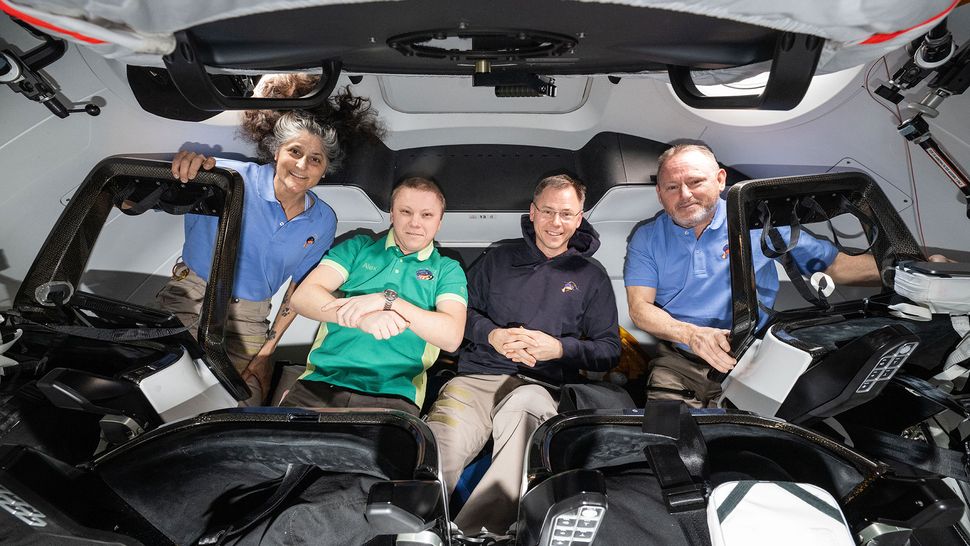
In fact, one of the reasons Starliner remained at the ISS even after the decision had been made to return Williams and Wilmore to Earth via other means was as much about providing them with a “lifeboat” return to Earth for as long as possible, as it was about carrying out further tests on the vehicle.
As it was, Starliner did eventually undock from the ISS in September 2024 ahead of the launch of the Crew 9 mission, with the crew capsule Calypso successfully landing on Earth at the end of a fully automated flight and despite two further system hiccups. Meanwhile, the Crew-9 mission also arrived at the ISS in September 2024 to become NASA Expedition 72, with Williams and Wilmore slotting into the two Expedition 72 crew slots vacated for them, in order to see out the mission’s 170-day rotation on the station.
The rotation came to an end on Tuesday, March 18th, 2025 when Crew 9 – Williams and Wilmore together with mission commander Nick Hague and cosmonaut Aleksandr Gorbunov undocked from the ISS at 0505 UTC, their places having been taken by the Crew 10 / Expedition 73 crew, who arrived at the ISS two days previously.
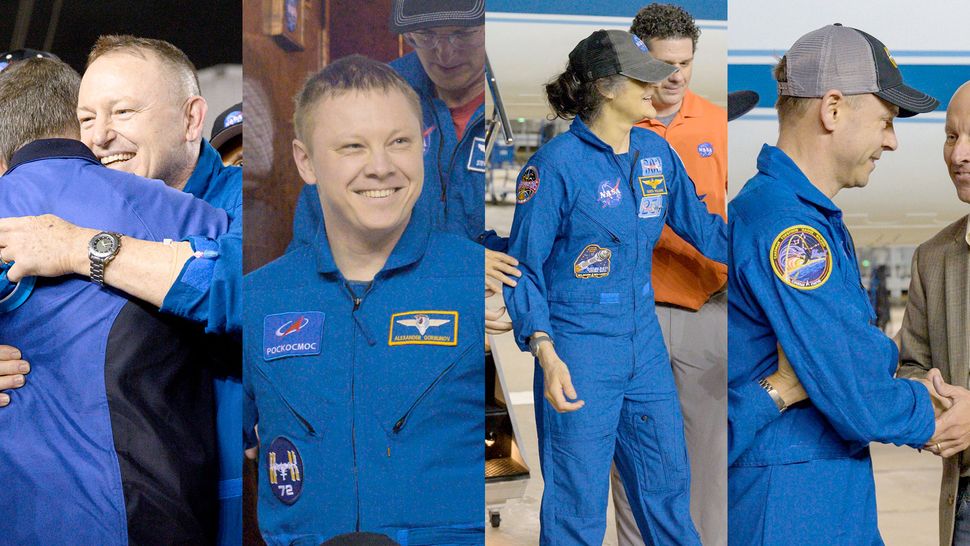
And while much has been made of Williams and Wilmore’s extended stay on the ISS, overall, the 286 days they spent on the station is not exactly record-breaking or that unusual. Among NASA’s astronauts, five others have spent longer periods of time on a single ISS crew rotation (even if their time was planned from the outset to be so), whilst four cosmonauts have spent in excess of 330 days each (437 in the case of Valeri Polyakov) on either the Soviet / Russian Mir station or the ISS. That said, Williams has now accumulated the second highest number of continuous days in space by a US astronaut – 608 days – slotting in behind Peggy Whitson who accumulated 675 days in space with NASA and a further 9 days as a private citizen astronaut on the Axiom Ax-2 mission.
What of Starliner?
Whilst Wilmore and Williams may not have been stranded in space, the Starliner programme does have issues, notably with the design of the four propulsion pods – dubbed “doghouses” because of their appearance – mounted on the Starliner’s service module, and which have yet to be fully resolved.

The pods, each of which mounts five “large” orbital manoeuvring and control (OMAC) thrusters as a “primary” means of propulsion and seven smaller reaction control system (RCS) thrusters used for very precise manoeuvring and control, have been something of a bane to Starliner for the last several years. During preparations for the second uncrewed flight of the CST-100 system (itself the result of an embarrassing cock-up in integrating the timing systems between the launch vehicle and the Starliner craft in the first orbital test flight), it was found that a large number of the values within the thrusters had jammed, delaying the launch by several months, only for a number of the thrusters to have issues during the flight.
During the first Crew Test Flight with Williams and Wilmore, no fewer than five of the RCS thrusters failed during initial docking attempts at the ISS, although four were brought back on-line and the docking completed. This failure, coupled with the discovery that the issue was related to overheating within the “doghouse” units which had not been picked up during the development and testing of the units, then led to something of an embarrassing public spat between Boeing, as the main vehicle contractor, and Aerojet Rocketdyne, makers of the propulsion units, prior to NASA banging some heads together.
Since then, work on rectifying the propulsion unit issues has continued in near-silence. However, the return of the two astronauts to Earth inevitably caused some of the spotlight to swing back towards Boeing and Starliner and if / when / whether it night fly again. There is little doubt that NASA does want Starliner to continue: having all of their eggs in the Crew Dragon / Falcon 9 basket is far from ideal despite that successes of those systems thus far. This was something noted by Steve Stich, NASA’s Commercial Crew Programme Manager, following the Crew 9 splashdown.
We really need to get Boeing into a crewed rotation. Butch and Suni’s return on Dragon, to me, shows how important it is to have two different crew transportation systems, the importance of Starliner and the redundancy that we’re building into human spaceflight for our low Earth orbit economy.
– Steve Stich, NASA Commercial Crew Programme Manager

While progress has been made on mitigating the overheating issue by means of changing the operating parameters of the thrusters software system so as to avoid the need for any excessive redesign of the “doghouse” systems, these changes will need to be tested at some point through an actual flight test – and the same is true of the more minor, but still required, alterations to the helium purge systems within the propulsion systems. This raises another issue: should such a test be carried out via a crewed or uncrewed mission.
The final decision on this lies with NASA, although in their rare comments on the work, Boeing has been somewhat bullish, pushing for the flight to be crewed. For its part, the space agency will not be drawn on what form any additional test flight should take – only that the vehicle used should be “mission ready”, with Boeing in a position to rapidly pivot from completion of a test flight to flying a full crew rotation afterwards.
Even if we were to fly the vehicle without a crew in the return, we want that to be crew-capable. So, we want it to have all the systems in place that that we could fly a crew with. What we’d like to do is that one flight and then get into a crew rotation flight. So, the next flight up would really test all the changes we’re making to the vehicle, and then the next fight beyond that, we really need to get Boeing into a crew rotation. So, that’s the strategy.
– Steve Stich, NASA Commercial Crew Programme Manager
As to when any such flight might take place remains an open-ended question. NASA continues to signal it would like at least the test flight to occur in 2025, but the overall mission schedule for the ISS this year – crew rotation flights, resupply missions (including the demonstration flight of the Dream Chaser resupply vehicle) – mean that docking opportunities for any Starliner test flight are not that numerous in the near-to-medium term.
Blue Ghost says “Night-night” with Stunning Images
In my previous Space Sunday update, I wrote about the private Blue Ghost lander by Firefly Aerospace, which successfully touched-down on the Moon on March 2nd, 2025, marking the company as the first to carry out a “fully successful” (e.g. without rolling or toppling over) commercial lunar landing.

Over the next lunar daylight period (14 terrestrial days), the vehicle carried out its assigned surface science work, with only the drill system – called LISTER (for Lunar Instrumentation for Subsurface Thermal Exploration with Rapidity rather than having any reference to a character from Red Dwarf) failing to operate as hoped, only reaching a depth of around 1 metre than the hoped-for 3 metres.
However, on Sunday, March 16th, the lander went quiet as the lunar night took hold, denying it the sunlight it needed to convert into electrical power and heat, and temperatures plummeted.

While there is a chance residual energy stored in the lander’s batteries might be sufficient to keep its essential electronics functioning, the Firefly team are not expecting to be able to re-establish contact when daylight returns on the vehicle in April.
Rather than simply bid farewell to their plucky little lander, however, on March 18th, Firefly Aerospace, via NASA – the mission being part of NASA’s Commercial Lunar Payload Services (CLPS) programme – released some images captured during the mission to highlight its success. Taken in high definition, they are regarded as some of the best ever taken from the surface of the Moon, and I’ve reproduced some of them here for your appreciation.

Discovering Biosigns on Other Worlds Just Go Easier. Sort-of
So far, we’ve discovered in excess of 4,000 planets orbiting stars beyond our own, and while many are unlikely to support life of any kind, much less life as we know it, there are equally many that just might. The trick is actually recognising the fact they do across the vast interstellar distances involved.
Thus far, the common technique used to try to determine whether or not an exoplanet might harbour life is to look for biosignatures – the by-products of life processes – when analysing the composition of its atmosphere. However, there are a number of problems with this approach, including the fact that many biological interactions can be similarly produced through purely abiotic means such as inorganic chemical reactions, and determining one from the other over interstellar distances in next to impossible.

To combat this, researchers from University of California, Riverside, have suggested that astronomers looking for potential signs of life examine the atmospheres of potentially habitable worlds for concentrations of methyl halides. These are gases combining a methyl group with a halogen atom – and they are only produced via organic means by anything from bacteria through to plants. Ergo, if they can be detected in the atmosphere of a planet, they would potentially point to some form of organic process at work on that world.
Clever, right? Well, yes, but there is a hitch. Even here on Earth, atmospheric concentrations of methyl halide are low and prone to being broken-up and “lost” within the general atmospheric “noise”, thus making them hard to detect – and this would likely be true for many potentially life-bearing worlds orbiting other stars. Fortunately, the researchers have an answered for that: look for methyl halides in the atmospheres of hycean worlds.
These are planets which have been shown to have hydrogen-rich atmospheres and are believed to have liquid water surfaces (“hycean” being a portmanteau of “hydrogen” and “ocean”). Generally, speaking, these worlds exist within the “Goldilocks zone” around their parent star: the region wherein all the “right” conditions come together to potentially give life the “kick start” it needs. Further, such are their general atmospheric composition and character, they could support far higher – and more detectable – concentrations of methyl halides.
In this, the researchers are supported by the fact that one biosignature appears to have been detected within the atmosphere of an exoplanet – dimethyl sulphide. This was reported as being discovered within the atmosphere of K2-18b, a hycean world, in 2023. And even while the overall number of hycean worlds thus far discovered is small, finding traces of methyl halides in the atmosphere of just one would be ground-breaking news.

Another potential area where the detection of methyl halides might work is in the study of the water vapours expelled from the likes of Europa and Enceladus in our own solar system. Both of these moons give off plumes of water vapour through geysers, which in the case of Enceladus, is sufficient to actually help renew the otherwise unstable E- ring around Saturn. Were methyl halides to be found within these vapours (assuming they could survive in the tumult), it could dramatically increase the potential for one of these moons to be harbouring microbial life in its waters.

 Inara Pey: Living in a Modemworld
I’m not sure you meant “second unscrewed flight of the CST-100”, but it seems appropriate somehow 🙂
LikeLike
Gah… bloody autocorrect. It *keeps* doing that, despite “uncrewed” being in the local dictionary. Normally I catch it, post-upload.
LikeLike