
One of the most expansive space programmes, both national and commercial, is that of China. I’ve covered multiple missions carried out by the Chinese national space programme both in terms of human spaceflight and the establishment of an orbital space station, and robotic missions to the Moon and Mars. I’ve also touched on the country’s growing commercial space sector, some of which seemingly “borrowing” heavily from the likes of SpaceX in terms of vehicle design and development – particularly with regards to reusable boosters.
At the top of the list for the latter is Jiangsu Deep Blue Aerospace Technology. Founded in 2016, the company has been recognised for developing a family of semi-reusable launch vehicles called Nebula – which bear a remarkable resemblance to the SpaceX Falcon 9.
The smaller Nebula-1 vehicle-capable of lifting payloads in the 2-8 tonnes range – has been undergoing increasingly ambitious launch and landing tests of the vehicle’s first stage over the last several years. The company had been planning to lunch the vehicle on its first orbital flight, including the booster returning to a landing, be the end of 2024. However, the loss of a Nebula-1 first stage during a high altitude launch and recovery flight in late September has now put this in doubt.
The Nebula-2 vehicle, meanwhile, not only resembles Falcon 9 with very similar landing legs and grid fins, but is also a very similar payload capability, including up to 20 tonnes to low-Earth orbit (LEO) in a full expendable mode (compared to Falcon 9’s 22 tonnes when fully expendable). It is due to make its orbital debut in late 2025.
Whether either vehicle can be considered a direct “rip off” of Falcon 9 is perhaps debatable: form follows function when it comes to flight dynamics; but it’s hard to imagine Deep Blue reaching their rocket design and propulsion choice without them taking a long, hard look at SpaceX.

This is perhaps even more true when looking at the latest announcement concerning the company’s other planned area of operations: sub-orbital tourist flight to the edge of space. On October 23rd, 2024, the company’s CEO, Huo Liang, announced these sub-orbital flights will start in 2027, and ticket reservations are now open.
The flights will, according to Huo, be akin to Blue Origin’s New Shepard flights: lift-off using a recoverable booster (in this case, the Nebula-1 first stage), carrying a capsule capable of sitting up to 6 people in two rows of back-to-back seats, prior to the booster separating and returning to a safe landing.
Once separated, the capsule will coast ballistically, passing through the Kármán line at 100km altitude, the passengers getting to enjoy around 5-minutes in weightlessness, prior to gravity making its presence felt once more as the capsule commences its fall back to Earth. Parachutes will be used to slow the descent until just above the ground, when four pairs of mid-mounted motors will be fired for a soft landing. It’s not clear if the capsule will include either a “crush ring” at its base designed to absorb the final impact with the ground (like the New Shepard capsules) or utilise some form of inflatable cushion, as with Boeing’s CST-100 capsules.
What is interesting is the capsule’s uncanny resemblance to the SpaceX Crew Dragon. The two are so similar in overall looks and dimensions, one might be forgiven for thinking they are the product of the same company. The only at-a-glance difference (outside of the paint scheme) being Crew Dragon had two viewports on one side of the vehicle, and the Deep Blue vehicle – which at the October 24th announcement bore the somewhat clumsy name of “Rocketaholic” in slides and literature – has six primary viewports, three on either side and aligned to give all six passengers a view out of the vehicle, and one more to either sides of the seating, for a total of eight.
Internally, the differences are likely to be more noticeable, including the back-to-back seating arrangement of the Deep Blue vehicle and the fact that whilst slightly smaller than Crew Dragon, it potentially has a larger internal volume available to passengers as it does not have any docking and hatch mechanisms in the nose area.

Whether or not operations do commence in 2027 remains to be seen; it is entirely unclear as to where development of the capsule stands or when practical testing will commence (if it hasn’t already).
Deep Blue is actually the second Chinese entity to “borrow” from SpaceX for space tourism flights. In 2021, CAS Space – a private venture spin-off of the Chinese Academy of Sciences (CAS) – announced they would start conducting fare-paying space tourism flights in 2024, after a (surprisingly) short 3-year flight development and test cycle of a capsule and booster system.
In this, CAS Space perhaps borrowed even more heavily from SpaceX. Not only do full-scale mock-ups of its capsule show it to be another to borrow heavily from Crew Dragon (and which shares pretty much the same dimensions as the Deep Blue capsule), the booster somewhat resembles Blue Origin’s New Shepard – but is designed to make a return to the launchpad, a-la the SpaceX Starship / Super Heavy – where it is to be grabbed by arms on the launch tower, rather than landing on the ground.

Since the initial announcement, CAS Space has (unsurprisingly) revised the date on which they plan to start fare-paying flights, moving it back to (currently) 2028, in order to allow sufficient time for vehicle development and testing. However, they have also indicated plans to operate it not from a spaceport, but from a dedicated “Aerospace theme park”, with one flight taking place roughly every 4 days. Flights on either Deep Blue or CAS are rumoured to be in the US $210,000 per person, and be interesting to see whether either will come to pass.
Space Evasion and Detection Avoidance
In my previous Space Sunday article I wrote a little about the increasing issue of space debris in orbit around Earth and the increasing need for satellites to manoeuvre away from chunks of dead satellites which beak-up in orbit, used rocket parts and so on. However, that’s not the only reason for some satellites requiring an ability to adjust their orbit. Another is to evade or avoid detection.
This is something particularly used by so-called “spy” satellites, like the various families operated over the decades by the US National Reconnaissance Office (NRO). Many of these include the ability to be “re-tasked” – have their orbital periods and inclinations changed – so as to be able to overfly targets of interest or to take longer to pass over a country in order to gather more detailed intelligence. However, the degree to which this is possible has always been somewhat constrained in terms of how much propellant these satellites might carry and how much they can use to achieve orbital adjustments without unduly shortening their anticipated operational life. But that might all be changing in the future, thanks to the US Space Force’s X-37B automated spaceplane.

Also known as the Orbital Test Vehicle (OTV), the X-37B is a highly-secretive vehicle programme capable of exceptionally long-duration missions in orbit. For example, OTV-6 launched on May 17th, 2020 and returned to Earth on November 12th, 2022, spending a little under 3 hours shy of 909 complete days in space. The USSF / Department of Defense is pretty quiet about the purpose of the two X-37B vehicles, other than stating they are for carrying out research into advanced technologies for space application and the fact that they do carry experiments related to NASA as a part of their payloads.
But in October 2024, the USSF was a little more forthcoming, revealing that the current X-37B flight, which launched in December 2023, has been carrying out a series of aerobraking tests in Earth’s atmosphere to examine the use of such capabilities to radically alter an orbital vehicles trajectory and inclination around Earth.
Aerobraking – using the frictional heat of the upper layers of an atmosphere as a means to both decelerate a space vehicle and / or to alter its orbit – is a process that is well understood on paper and has been used by both NASA and the European Space Agency. The former has used it on their of its Mars missions: Mars Global Surveyor (MGS), Mars Odyssey and Mars Reconnaissance Orbiter; whilst ESA has used aerobraking in conjunction with its ExoMars Trace Gas Orbiter mission to Mars and its Venus Express mission.
Data from all of these missions was used in the preparations for X-37B to make use of Earth-based aeorbraking to significantly alter its orbital period and orbital shape around the Earth. The attempt – carried out some time between October 10th and October 15th – was designed specifically to lower the overall perigee of the vehicle’s elliptical orbit and make its orbit more circular without the use of propellants, and bring the craft into a position where it can carry out the next phase of the mission.
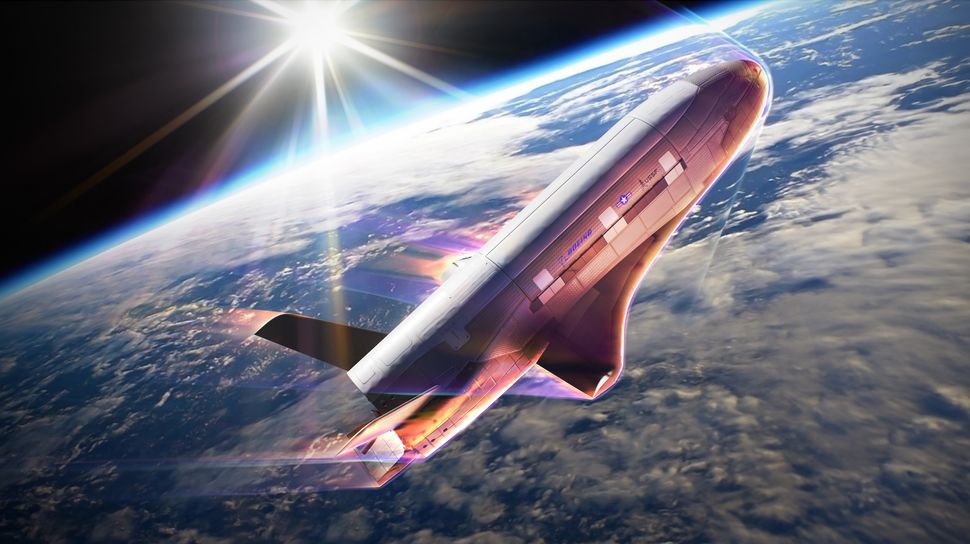
Whilst the manoeuvre was fairly basic, it is seen as a precursor to more complex manoeuvres by the vehicle on future missions as the USSF researches the use of aerobraking as a strategic tool which could be employed by future generations of MilSats as well as vehicles like the X-37B.
By carrying out an atmospheric dip of this nature, the X-37B demonstrates its ability to become a very effective operational, rather than experimental vehicle. Having such a craft that could in theory be deployed to orbit reasonably rapidly and equipped with a range of intelligence-gathering equipment would be exceptionally worrying to another military power.
Under normal circumstances, satellites are highly predictable; locate one, track it for a while, and you can predict when it is going to be below the horizon (and therefore unable to see / hear you) and when it is going to pop back up again. Thus, it is very easy to determine when you might be able to carry out an operation you’d rather others didn’t know about immediately – such as the large-scale movement of troops and materiel to a foreign border or the deployment of a fleet to open sea.
However, if you can never be sure exactly where those eyes are or whether then are looking at your forces, things get a lot more complicated, resulting in potential second-guessing, delay or even backing away from what might be seen as overly aggressive actions.
[The X-37B is] fascinating [because it] can do an orbit that looks like an egg and, when it’s close to the Earth, it’s close enough to the atmosphere to turn where it is. Which means our adversaries don’t know – and that happens on the far side of the Earth from our adversaries – where it’s going to come up next. And we know that that drives them nuts. And I’m really glad about that.
– Former USAF Secretary Heather Wilson
Of course, the flipside of this is the further militarisation of space and the risk of it becoming a future combat environment.

The aerobraking is not the only unique aspect of this mission. During their first 6 flights the two OTV vehicles operated in low Earth orbit. Prior to the mission launching, the USSF indicated that in part it would involve testing the effects of radiation on various materials and technologies whilst in an elliptical orbit sufficient for the vehicle to pass through the Van Allen radiation belts. However, it was not until February 2024 that amateur sleuths who track orbital craft were able to confirm the vehicle’s exact orbit: an inclination of 59.1 degrees to the equator, and ranging between 300 km and 38,500 km from the surface of the planet!
This discovery led to speculation as to how the vehicle would survive re-entry when coming home, as it would be entering Earth’s atmosphere at a speed closer to that of a vehicle returning from the Moon or Mars than from LEO, and thus experience much higher temperature regimes on a direct passage back into the atmosphere in order to land. Now, with these orbital adjustments carried out, the vehicle has no need to make such a high-speed re-entry, as it is once again operating at a significantly lower orbital velocity.
Quite when the vehicle will return, however, is unclear. Until now, each successive X-37B mission has been longer than the last – but there is no absolute requirement for this. Also the USSF has said on the matter than now it is established in it new LEO, the vehicle will commence the next phase of its mission.
A Second from Disaster
Whatever one’s view of the SpaceX Starship / Super Heavy launch system (and there are multiple reasons to doubt its actual viability as a genuine flight system / revenue earner), the capture of the Super Heavy booster at the landing facility during the recent Integrated Flight Test 5 (IFT 5) on October 13th was a remarkable achievement. However, audio accidentally released on October 25th reveals the flight of the booster almost ended in it striking the ground in close proximity to the launch tower and stand.
I gotta be really up-front about scary shit that happened …We had a misconfigured spin gas abort …and we were one second away from that tripping and telling the rocket to abort and try to crash into the ground next to the tower. We had a whole bunch of new aborts and commit criteria that we tried to double-check really well, but, I mean, I think our concern was well-placed, and one of these came very close to biting us.
– Unnamed SpaceX official

The audio was released inadvertently as a result of SpaceX CEO Elon Musk taking a call from his engineers about a post-flight engineering review whilst apparently more interested in a video game he was playing, and then subsequently releasing a clip of his game-play which included audio of the discussions.
What is striking about the audio is that it is made clear that the engineers had plenty of data indicating the flight was on the edge, and that some of the issues could have been addressed before the flight (fore example, they have evidence the vehicle could lose one or more of the triangular chines running vertically up the booster to protect essential external equipment during its descent – and that’s precisely what happened), and they knew there had been an insufficient amount of time given to a full pre-flight review ahead of IFT5.
We were scared about the fact that we had 100 aborts that were not super-trivial … which were routed in we didn’t do as good a review for pre-flight one lift-off.
– Another SpaceX official discussing the review of IFT5
The audio also includes a hint that the engineers are concerned about the next flight is turning into a struggle between trying to get it ready in a short a period of time as possible and actually having the time to properly address and mitigate the problems identified with IFT5.
Obviously, given the brevity of the recording, it is not clear was was said in the rest of the meeting, or what Musk’s overall response to the concerns raised might have been. However, later the same day he did take to Twitter / X.com to state IFT6 would be happening sooner rather than later.

 Inara Pey: Living in a Modemworld