Milk Wood, October 2024 – Click any image for full size
With November on the horizon and the start of National Novel Writing Month (aka NaNoWriMo – or NAN-oh-RY-moh) I received an invitation from long-time acquaintance in Second Life, Lizzie Gudkov, to pop over to Milk Wood, the home of Virtual Writers, as they gear-up for their new event for November each year, Moxie Madness.
Virtual Writers is an on-line community of writers, originally founded in 2007. The group is committed to showcasing both experienced and emerging writers in a range of interactive and immersive environments around the globe. Milk Wood provides a focal point for the group’s activities, offering an environment which writers can come together to share in the writing experience, socialise, have fun together and – if they wish – find a virtual home.
We offer a space for all writers at all stages, within a digital medium. This unique place allows the user to more fully develop their characters and settings, meet other likeminded individuals, share experiences, and learn and grow as writers.
We know the challenges writers face because we’ve each had similar roadblocks. Many of us have had expert help along the way and want to pay it forward. We learn from each other and share our expertise gladly. Whether you’re an experienced writer or just starting out, there’s a place for you at Virtual Writers.
– from virtualwriters.org
Milk Wood – The Stone Circle, October 2024
Occupying a Full private region leveraging the Land Capacity bonus, Milk Wood has been crafted by Harriet Gausman to provide a gorgeous setting in which to stir the creative juices whilst escaping the distractions of the physical world. It is a place Inspired by the BBC-commissioned radio drama Under Milk Wood, by Dylan Thomas, a play itself deeply interwoven with Dylan’s short life, and his passing away in 1953 whilst on a tour of the United States with the play (which he was still revising at the time, having roots reaching back into the early 1930s and the very start of his writing career whilst still in his late teens.
Within the region is a mix of public and private spaces – the latter being a range of rental cottages, beachfront cabin, houses and the like – stirred together without obvious boundaries in places, which can make exploration a little difficult for the casual visitor. So if you are visiting out of curiosity, then please bear this in mind as regards wandering into someone’s personal space.
Milk Wood, October 2024
That said, the blending of both public and private fits the region well, given its primary intent to bring writers together to allow them to share time and experiences, engage in a shared experience of writing and reading – and as noted, provide a home for those wishing to rent one.
The 500 word snatch is a popular way of breaking down a large writing project – such as a novel – into much small, easily-digested bites by scheduling a specific time each day to write 500 words. Nor does the snatch have to be related to a single work; the challenge can be used for many different writing forms, such as outlining ideas, drafting a blog post, writing poetry, producing a short story, and so on.
Poem-a-Day (PAD)
April, 08:00 daily
To coincide with National Poetry Month. Write a poem every day for the month of April.
Milk Wood – Forest Coffee Bar, October 2024
Moxie Madness
November (all 30 days)
The group’s new challenge in respect of NaNoWriMo: write a 50,000-word novel in 30 days. As a part of this Moxie (standing for Month of Xtra Inspiration & Effort) provide a wealth of support for those participating in NaNoWriMo with daily write-ins, resources, and a selection of workshops/seminars from successful authors.
Details of sessions, workshops and events associated with Moxie Madness are available via the Moxie Madness information boards (such as found at the Forest Coffee Bar).
A more relaxed version of the November novel writing event. Sessions are held in both April and July, with writing challenges with word-counts of between 5,000 and 25,000 for any type of writing project. The time can also be used to edit your Moxie manuscript from November, plan for coming Moxie Madness or delve into research.
I’ve attended Milk Wood poetry readings, daily dashes, and the intense annual NaNoWriMo event in November. Milk Wood provides a forum for interacting with other writers, both newbies and published professionals, and a place to promote books and literary events. It’s possible to join a writing circle and set your avatar to work at a computer while you type away on a real world project. There’s always someone to offer encouragement, sympathy or advice when you hit a snag or need a break
Poet and author Patricia Averbach (via virtualwriters.org)
Milk Wood – Camp Site, October 2024
It’s fair to say (having sat-in on a 500 Word Snatch – even if this blog post did run to more than that as I was writing it at the time!) events at Milk Wood are well-attended and the folk are friendly and easy-going. Therefore if you are a writer of fiction, non-fiction, poetry, or a blogger or diarist, and so on, and haven’t dropped into Milk Wood, I would genuinely recommend doing so.
In terms of exploration, the majority – but not all – of the rentals are located around the region’s coastline, with most of the public spaces – the Forest Coffee Bar, the Boho Bean Coffee Shack, the Fiesta Bar and Dance Floor, the Milk Wood Camp Site, and the Milk Wood Drive-In – located within the western half of the region, and reachable one to the next on foot without fear of colliding with someone’s home; only the Stone Circle, on the north side of the region is very close to any rentals. To ease getting around, there in an in-region teleport system, together with a local Experience to help with hopping around.
Milk Wood, October 2024
Whilst not primarily intended for the purposes of photography, the region is nevertheless beautifully designed and landscapes and offers a relaxing environment with some public spaces in which to sit and pass the time / think about what to write next in addition to the group’s various events.
Hailey’s Mystical Forest, September 2024 – blog post
The following notes were taken from the Tuesday, October 29th, 2024 Simulator User Group (SUG) meeting. They form a summary of the items discussed, and are not intended to be a full transcript, and were taken from the chat log and Pantera’s video of the meeting, which is embedded at the end – my thanks to her for providing it.
Meeting Overview
The Simulator User Group (also referred to by its older name of Server User Group) exists to provide an opportunity for discussion about simulator technology, bugs, and feature ideas.
Meetings are open to anyone with a concern / interest in the above topics, and form one of a series of regular / semi-regular User Group meetings conducted by Linden Lab.
Dates and times of all current meetings can be found on the Second Life Public Calendar, and descriptions of meetings are defined on the SL wiki.
Simulator Deployments
No deployments for this week, just rolling restarts across the grid.
Simulator Deployment Plans
The next simulator maintenance update will be Barbecue (or BBQ), which is currently awaiting further bug fixing. This should include:
Support for “alpha-gamma” which will allow an object owner to adjust some of the PBR alpha values that were impacting legacy things like hair.
A new warning on receiving direct IMs from Scripted Agents (“registered” bots): if a Scripted Agent “right clicks” you and sends you a message, it will trigger a warning about sharing personal information with bots within the chat window.
Following Barbecue should be Apple Cobbler, which should include:
llTransferOwnership which enables a prim give itself to a new user (subject to owner permissions already set).
An extended llGiveInventory to allow for a destination folder (system folders + RLV/a) to be specified as well (+ the use of a parameter list, so further options can be added in the future).
SL Viewer Updates
No changes at the start of the week:
Release viewer: version 7.1.10.10800445603, formerly the DeltaFPS RC (multiple performance fixes, etc), dated September 11, promoted September 17 – No change.
Aesthetics improvements: new Antialiasing setting – SMAA; Contrast Adaptive Sharpening; Khronos Neutral Tone Mapping (can be changed to ACES via the RenderTonemapType Debug setting).
Game Control
Leviathan Linden noted the latest news on this work:
GameControl is in develop branch, not sure when it will reach an official release or find its way into TPV. Meanwhile game controller hardware support has been temporarily disabled on Mac (although it didn’t work very well there anyway since most devices are not recognized by the OS) until we sort out some “duplicate keypress” issues.
In Brief
Please refer to the video below for the following:
Reports indicate the the most recent simulator deployment appears to have fixed most of the lost / ghosted attachment issues experienced during teleport / physical region crossings.
A general discussion on RLV and possible #RLV folder structure, and RLV extensions to folders. For those curious about RLV/a, given RLVa is currently to be incorporated into the official viewer, please refer to (among other sources):
Further discussion on llTransferOwnership and llGiveAvatarInventoryList. Part of the latter included the extent to which scripts should be able to use it to create new inventory items (e.g. such as preventing it from using the Current Outfit Folder, whilst removing the burden of everything going to the Inventory root folder.
Both the RLV and LSL commands above lead to a wider discussion on inventory, folder structures, how / where items should be placed when received via script, etc., filtering inventory, and so on.
There is no current work on HTTP/2 for CDN and asset fetching. This is described as something LL want to get to, but keeps getting stalled due to the focus being on other areas of work. Monty Linden also noted a move to HTTP/2 may not yield any significant loading improvement over HTTP/1.
† The header images included in these summaries are not intended to represent anything discussed at the meetings; they are simply here to avoid a repeated image of a rooftop of people every week. They are taken from my list of region visits, with a link to the post for those interested.
On Tuesday, October 29th, 2024, Linden Lab announced that the company’s founder, Philip Rosedale has been appointed to the full-time role of Chief Technology Officer (CTO), in a move that will undoubtedly cause excitement in some quarters.
As well as founding the company, Rosedale served as its CEO through until 2010, when he departed the company to work on various new ventures, including Coffee and Power and, most notable, the VR-centric virtual world / social spaces company, High Fidelity.
The latter actually became an investor in Linden Lab / Second Life in January 2022 in a deal which included the transfer of some staff from High Fidelity to Linden Lab, together distributed computing patents held by High Fidelity, which has transitioned by that time toy working on solutions focused on spatial audio that would allow people to work collaboratively whilst geographically separate. Also as a part of that deal, Rosedale took up the role as a special advisor to the Second Life management team and the Board at Linden Lab.
In this role he has spent the last 2+ years providing advice and support to the Lab’s Board under Executive Chairman Brad Oberwager and the executive team, and has been visible at a number of Lab-led town hall meetings and similar events as well as participating in various Lab Gab events.
In his new role as CTO, Rosedale “will guide technology and product strategy daily” alongside the executive management team, and he will also resume a seat on the company’s Board.
Over the last four years since the acquisition, Linden Lab has re-focused itself on improving and serving Second Life. We’ve divested ourselves of unnecessary projects, streamlined our operations, increased the quality of customer support, and grown our overall revenues and profitability. We’re now in a unique position to define the future of virtual worlds, and Philip is returning to help myself and the exec team achieve that goal.
– Brad Oberwager, Linden Lab Executive Chair, via the announcement
Philip Rosedale Round Table Event
The announcement also indicated the Lab will be holding a Community Round Table event on Friday, November 1st, 2024, at 10:00 SLT featuring Philip Rosedale. At the time of writing, the venue for the event was TBA – this post will be updated with details when available. However, questions are being sought from Second Life users, so if you have a question for Philip Rosedale, you can submit it via this form.
Logos representative only and should not be seen as an endorsement / preference / recommendation
Updates from the week through to Sunday, October 27th, 2024
This summary is generally published every Monday, and is a list of SL viewer / client releases (official and TPV) made during the previous week. When reading it, please note:
It is based on my Current Viewer Releases Page, a list of all Second Life viewers and clients that are in popular use (and of which I am aware), and which are recognised as adhering to the TPV Policy. This page includes comprehensive links to download pages, blog notes, release notes, etc., as well as links to any / all reviews of specific viewers / clients made within this blog.
By its nature, this summary presented here will always be in arrears, please refer to the Current Viewer Release Page for more up-to-date information.
Note that for purposes of length, TPV test viewers, preview / beta viewers / nightly builds are generally not recorded in these summaries.
Official LL Viewers
Release viewer: version 7.1.10.10800445603, formerly the DeltaFPS RC, dated September 11, promoted September 17 – NO CHANGE.
Release Candidate: ExtraFPS RC, version 7.1.11.11296522354, October 18 – NO CHANGE.
Ashemi, October 2024 – click any image for full size
Ashemi is a setting which, like the tide, ebbs and flows in and out of Second Life. The work of SL partners Ian Ventori (Jayshamime) and Ime Poplin (Jayshamime), and has been featured in this blog numerous times since 2016. This is because Jay and Ime (sometimes with help from friends) always put together settings which carry within them certain motifs and themes which can be found in previous designs, allowing each version of Ashemi to stand both in its own right whilst also sharing threads of ideas which flow through all of them like a familiar musical refrain.
The last time I visited an Ashemi build, it took the form of a repurposed oil or natural gas platform sitting out in blue waters somewhere, its derricks and drilling and recovery equipment all gone, replaced by the living spaces and businesses of a tiny community, thus making it an island of life in a broad sea. Something of this theme is continued in the 2024 build, but in a very different manner.
Ashemi, October 2024
The region sits as an island, a semi-industrialised place looking like part of a much larger conurbation, but which seems to have fallen on hard times. A single tall smokestack exhales a white plume into the sky as it surpasses the local buildings in its height as it does so. These other buildings rise as factory blocks, apartment buildings with places of business below, and a single, strange structure rising on four stout legs to become a luxury apartment overlooking its downtrodden neighbours and offering shelter to the autumnal trees growing beneath it.
There is little other greenery to be found within the walls formed by the island’s buildings, save for an attempt by someone to make a garden around their trailer home. Here, grass has been planted together with shrubs and rhubarb is being forced under glass. Whoever lives here values their privacy: the trailer home is surrounded by a tall chain link fence topped by razor wire. Outside of this, lanterns hang prettily, suggesting a welcome might yet be found in the trailer whilst adding their illumination to that of the neon signs and hoardings of the surrounding buildings. However, whom they might attract to their businesses is anyone’s guess; even the local swimming pool is looking a tad sad, whilst a once pristine fairground rides have most certainly aged beyond their prime, leaving only the local café as possibly deserving custom within its well-kept interior.
Ashemi, October 2024
Which is also not to stay nature has entirely given up here; trees grow along the southern shoreline, whilst to the southwest the land opens up into s park-like headland where Sakura blossom and other trees offer shade and places to sit might be found (as they can indeed be found elsewhere in the setting). It is from here that visitors can get a good view of the outlying elements of the setting and add to the mystery of its possible backstory.
Two block-like islands sit just off the region’s boundaries. They carry on them squat apartment blocks hunched over their ground-floor business, the lights within them and on their advertising hoards bright and warm, feed by the overhead powerlines following the grid patterns of streets where vehicles and people might be seen.
Ashemi, October 2024
Given their regular shapes, these islands appear entirely artificial – but were they built over the waters around them, or were they once both part of the same landmass, perhaps even joined to Ashemi’s near-deserted form, only to become regularly-shaped bastions of town life as sea levels rose and cut them asunder from one another, whilst also encroaching on their heartland to form it into the island of Ashemi?
A third blocky island rises from the sea on the other side of Ashemi in relation to its park-like headland. It is crowned by massive structures dwarfing anything else to be found, with huge clusters of cables draped in the deep canyons between them. Industrial-looking, dark and almost foreboding, it stands in stark contrast to anything else to be seen, adding a further twist to any story one might try to conjure for the setting’s history.
Ashemi, October 2024
That this is place potential somewhere in the near-future can perhaps most clearly be seen in the design of that third off-region island. However, another clue can be found in the fact that air cars and moving back and forth in the sky, together with what look like automated cargo carriers. The air cars look to be for travel between the town-like islands and between them and the more futuristic island with its towers and cable and dishes. In this, they almost completely ignore the little island of Ashemi and its various attractions, perhaps living it to be visited only by boat.
Rich in detail and with multiple places to sit, this iteration of Ashemi again offers many opportunities for the imagine to wonder about its origins and for the taking of photographs. My thanks to Jay for the personal invite to pay a visit.
A “boarding pass” for a sub-orbital flight aboard Deep Blue Aerospace’s “Rocketaholic” capsule and Nebula-1 booster. Credit: Deep Blue Aerospace
One of the most expansive space programmes, both national and commercial, is that of China. I’ve covered multiple missions carried out by the Chinese national space programme both in terms of human spaceflight and the establishment of an orbital space station, and robotic missions to the Moon and Mars. I’ve also touched on the country’s growing commercial space sector, some of which seemingly “borrowing” heavily from the likes of SpaceX in terms of vehicle design and development – particularly with regards to reusable boosters.
At the top of the list for the latter is Jiangsu Deep Blue Aerospace Technology. Founded in 2016, the company has been recognised for developing a family of semi-reusable launch vehicles called Nebula – which bear a remarkable resemblance to the SpaceX Falcon 9.
The smaller Nebula-1 vehicle-capable of lifting payloads in the 2-8 tonnes range – has been undergoing increasingly ambitious launch and landing tests of the vehicle’s first stage over the last several years. The company had been planning to lunch the vehicle on its first orbital flight, including the booster returning to a landing, be the end of 2024. However, the loss of a Nebula-1 first stage during a high altitude launch and recovery flight in late September has now put this in doubt.
The Nebula-2 vehicle, meanwhile, not only resembles Falcon 9 with very similar landing legs and grid fins, but is also a very similar payload capability, including up to 20 tonnes to low-Earth orbit (LEO) in a full expendable mode (compared to Falcon 9’s 22 tonnes when fully expendable). It is due to make its orbital debut in late 2025.
Whether either vehicle can be considered a direct “rip off” of Falcon 9 is perhaps debatable: form follows function when it comes to flight dynamics; but it’s hard to imagine Deep Blue reaching their rocket design and propulsion choice without them taking a long, hard look at SpaceX.
Deep Blue’s capsule and launch vehicle bear a remarkable similarity to the Crew Dragon and Falcon 9 operated by SpaceX. Credit: Deep Blue
This is perhaps even more true when looking at the latest announcement concerning the company’s other planned area of operations: sub-orbital tourist flight to the edge of space. On October 23rd, 2024, the company’s CEO, Huo Liang, announced these sub-orbital flights will start in 2027, and ticket reservations are now open.
The flights will, according to Huo, be akin to Blue Origin’s New Shepard flights: lift-off using a recoverable booster (in this case, the Nebula-1 first stage), carrying a capsule capable of sitting up to 6 people in two rows of back-to-back seats, prior to the booster separating and returning to a safe landing.
Once separated, the capsule will coast ballistically, passing through the Kármán line at 100km altitude, the passengers getting to enjoy around 5-minutes in weightlessness, prior to gravity making its presence felt once more as the capsule commences its fall back to Earth. Parachutes will be used to slow the descent until just above the ground, when four pairs of mid-mounted motors will be fired for a soft landing. It’s not clear if the capsule will include either a “crush ring” at its base designed to absorb the final impact with the ground (like the New Shepard capsules) or utilise some form of inflatable cushion, as with Boeing’s CST-100 capsules.
What is interesting is the capsule’s uncanny resemblance to the SpaceX Crew Dragon. The two are so similar in overall looks and dimensions, one might be forgiven for thinking they are the product of the same company. The only at-a-glance difference (outside of the paint scheme) being Crew Dragon had two viewports on one side of the vehicle, and the Deep Blue vehicle – which at the October 24th announcement bore the somewhat clumsy name of “Rocketaholic” in slides and literature – has six primary viewports, three on either side and aligned to give all six passengers a view out of the vehicle, and one more to either sides of the seating, for a total of eight.
Internally, the differences are likely to be more noticeable, including the back-to-back seating arrangement of the Deep Blue vehicle and the fact that whilst slightly smaller than Crew Dragon, it potentially has a larger internal volume available to passengers as it does not have any docking and hatch mechanisms in the nose area.
Renderings of Deep blue’s Rocketaholic capsule. Note that like Crew Dragon, the vehicle has an oval, rather than circular cross-section when seen from above. Credit: Deep Blue Aerospace
Whether or not operations do commence in 2027 remains to be seen; it is entirely unclear as to where development of the capsule stands or when practical testing will commence (if it hasn’t already).
Deep Blue is actually the second Chinese entity to “borrow” from SpaceX for space tourism flights. In 2021, CAS Space – a private venture spin-off of the Chinese Academy of Sciences (CAS) – announced they would start conducting fare-paying space tourism flights in 2024, after a (surprisingly) short 3-year flight development and test cycle of a capsule and booster system.
In this, CAS Space perhaps borrowed even more heavily from SpaceX. Not only do full-scale mock-ups of its capsule show it to be another to borrow heavily from Crew Dragon (and which shares pretty much the same dimensions as the Deep Blue capsule), the booster somewhat resembles Blue Origin’s New Shepard – but is designed to make a return to the launchpad, a-la the SpaceX Starship / Super Heavy – where it is to be grabbed by arms on the launch tower, rather than landing on the ground.
Two views of a full-scale mock-up of the proposed CAS Space sub-orbital space tourism capsule, which is approximately the same size as Deep Blue’s. Credit CAS Space (2022)
Since the initial announcement, CAS Space has (unsurprisingly) revised the date on which they plan to start fare-paying flights, moving it back to (currently) 2028, in order to allow sufficient time for vehicle development and testing. However, they have also indicated plans to operate it not from a spaceport, but from a dedicated “Aerospace theme park”, with one flight taking place roughly every 4 days. Flights on either Deep Blue or CAS are rumoured to be in the US $210,000 per person, and be interesting to see whether either will come to pass.
Space Evasion and Detection Avoidance
In my previous Space Sunday article I wrote a little about the increasing issue of space debris in orbit around Earth and the increasing need for satellites to manoeuvre away from chunks of dead satellites which beak-up in orbit, used rocket parts and so on. However, that’s not the only reason for some satellites requiring an ability to adjust their orbit. Another is to evade or avoid detection.
This is something particularly used by so-called “spy” satellites, like the various families operated over the decades by the US National Reconnaissance Office (NRO). Many of these include the ability to be “re-tasked” – have their orbital periods and inclinations changed – so as to be able to overfly targets of interest or to take longer to pass over a country in order to gather more detailed intelligence. However, the degree to which this is possible has always been somewhat constrained in terms of how much propellant these satellites might carry and how much they can use to achieve orbital adjustments without unduly shortening their anticipated operational life. But that might all be changing in the future, thanks to the US Space Force’s X-37B automated spaceplane.
X-37B 1 sits on the runway after landing at the Shuttle Landing Facility, Kennedy Space Centre, November 12th 2022, the 909th day of the OTV-6 (USA-299) mission. Note the USAF markings, as the vehicle lifted-off in 2020, prior to the official formation of the US Space Force. Credit: Staff Sgt. Adam Shanks, USAF/USSF
Also known as the Orbital Test Vehicle (OTV), the X-37B is a highly-secretive vehicle programme capable of exceptionally long-duration missions in orbit. For example, OTV-6 launched on May 17th, 2020 and returned to Earth on November 12th, 2022, spending a little under 3 hours shy of 909 complete days in space. The USSF / Department of Defense is pretty quiet about the purpose of the two X-37B vehicles, other than stating they are for carrying out research into advanced technologies for space application and the fact that they do carry experiments related to NASA as a part of their payloads.
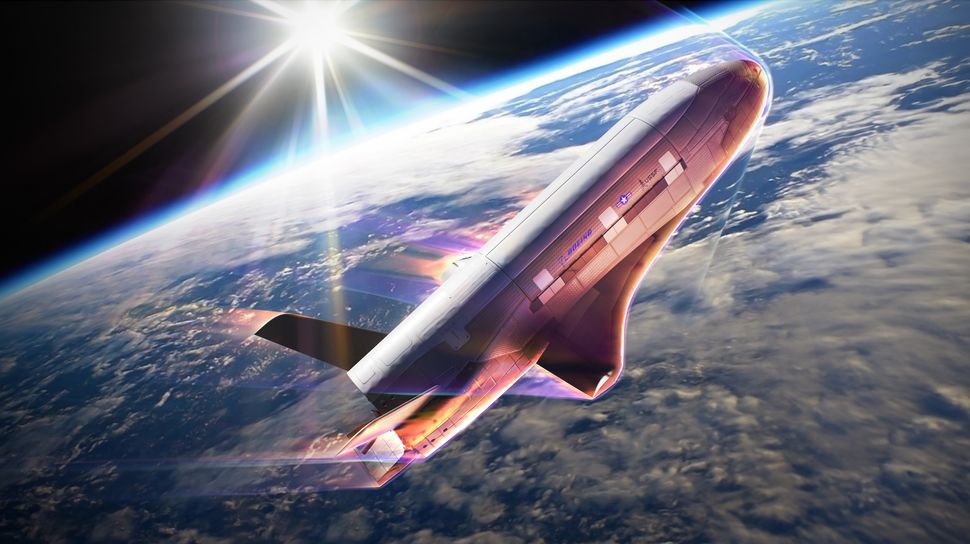
But in October 2024, the USSF was a little more forthcoming, revealing that the current X-37B flight, which launched in December 2023, has been carrying out a series of aerobraking tests in Earth’s atmosphere to examine the use of such capabilities to radically alter an orbital vehicles trajectory and inclination around Earth.
Aerobraking – using the frictional heat of the upper layers of an atmosphere as a means to both decelerate a space vehicle and / or to alter its orbit – is a process that is well understood on paper and has been used by both NASA and the European Space Agency. The former has used it on their of its Mars missions: Mars Global Surveyor (MGS), Mars Odyssey and Mars Reconnaissance Orbiter; whilst ESA has used aerobraking in conjunction with its ExoMars Trace Gas Orbiter mission to Mars and its Venus Express mission.
Data from all of these missions was used in the preparations for X-37B to make use of Earth-based aeorbraking to significantly alter its orbital period and orbital shape around the Earth. The attempt – carried out some time between October 10th and October 15th – was designed specifically to lower the overall perigee of the vehicle’s elliptical orbit and make its orbit more circular without the use of propellants, and bring the craft into a position where it can carry out the next phase of the mission.
An artist’s rendering of the U.S. Space Force’s robotic X-37B conducting an aerobraking, using the drag of Earth’s atmosphere, to alter its orbit. Credit: Boeing
Whilst the manoeuvre was fairly basic, it is seen as a precursor to more complex manoeuvres by the vehicle on future missions as the USSF researches the use of aerobraking as a strategic tool which could be employed by future generations of MilSats as well as vehicles like the X-37B.
By carrying out an atmospheric dip of this nature, the X-37B demonstrates its ability to become a very effective operational, rather than experimental vehicle. Having such a craft that could in theory be deployed to orbit reasonably rapidly and equipped with a range of intelligence-gathering equipment would be exceptionally worrying to another military power.
Under normal circumstances, satellites are highly predictable; locate one, track it for a while, and you can predict when it is going to be below the horizon (and therefore unable to see / hear you) and when it is going to pop back up again. Thus, it is very easy to determine when you might be able to carry out an operation you’d rather others didn’t know about immediately – such as the large-scale movement of troops and materiel to a foreign border or the deployment of a fleet to open sea.
However, if you can never be sure exactly where those eyes are or whether then are looking at your forces, things get a lot more complicated, resulting in potential second-guessing, delay or even backing away from what might be seen as overly aggressive actions.
[The X-37B is] fascinating [because it] can do an orbit that looks like an egg and, when it’s close to the Earth, it’s close enough to the atmosphere to turn where it is. Which means our adversaries don’t know – and that happens on the far side of the Earth from our adversaries – where it’s going to come up next. And we know that that drives them nuts. And I’m really glad about that.
– Former USAF Secretary Heather Wilson
Of course, the flipside of this is the further militarisation of space and the risk of it becoming a future combat environment.
A rare (and rotated) look at the X-37B’s payload bay, looking down over the rear of the vehicle. The payload bay (2.1 m long by 1.2 m wide) is shown with the doors open, but the vehicle’s solar arrays used to generate electrical power in their stowed position. Credit: Boeing
The aerobraking is not the only unique aspect of this mission. During their first 6 flights the two OTV vehicles operated in low Earth orbit. Prior to the mission launching, the USSF indicated that in part it would involve testing the effects of radiation on various materials and technologies whilst in an elliptical orbit sufficient for the vehicle to pass through the Van Allen radiation belts. However, it was not until February 2024 that amateur sleuths who track orbital craft were able to confirm the vehicle’s exact orbit: an inclination of 59.1 degrees to the equator, and ranging between 300 km and 38,500 km from the surface of the planet!
This discovery led to speculation as to how the vehicle would survive re-entry when coming home, as it would be entering Earth’s atmosphere at a speed closer to that of a vehicle returning from the Moon or Mars than from LEO, and thus experience much higher temperature regimes on a direct passage back into the atmosphere in order to land. Now, with these orbital adjustments carried out, the vehicle has no need to make such a high-speed re-entry, as it is once again operating at a significantly lower orbital velocity.
Quite when the vehicle will return, however, is unclear. Until now, each successive X-37B mission has been longer than the last – but there is no absolute requirement for this. Also the USSF has said on the matter than now it is established in it new LEO, the vehicle will commence the next phase of its mission.
A Second from Disaster
Whatever one’s view of the SpaceX Starship / Super Heavy launch system (and there are multiple reasons to doubt its actual viability as a genuine flight system / revenue earner), the capture of the Super Heavy booster at the landing facility during the recent Integrated Flight Test 5 (IFT 5) on October 13th was a remarkable achievement. However, audio accidentally released on October 25th reveals the flight of the booster almost ended in it striking the ground in close proximity to the launch tower and stand.
I gotta be really up-front about scary shit that happened …We had a misconfigured spin gas abort …and we were one second away from that tripping and telling the rocket to abort and try to crash into the ground next to the tower. We had a whole bunch of new aborts and commit criteria that we tried to double-check really well, but, I mean, I think our concern was well-placed, and one of these came very close to biting us.
– Unnamed SpaceX official
According to SpaceX engineers, the Super Heavy booster used for the October 2024 IFT5 came within once second of flight systems acting on an incorrect abort signal which would have seen the booster smashing into the ground close to the launch stand facilities. Credit: SpaceX
The audio was released inadvertently as a result of SpaceX CEO Elon Musk taking a call from his engineers about a post-flight engineering review whilst apparently more interested in a video game he was playing, and then subsequently releasing a clip of his game-play which included audio of the discussions.
What is striking about the audio is that it is made clear that the engineers had plenty of data indicating the flight was on the edge, and that some of the issues could have been addressed before the flight (fore example, they have evidence the vehicle could lose one or more of the triangular chines running vertically up the booster to protect essential external equipment during its descent – and that’s precisely what happened), and they knew there had been an insufficient amount of time given to a full pre-flight review ahead of IFT5.
We were scared about the fact that we had 100 aborts that were not super-trivial … which were routed in we didn’t do as good a review for pre-flight one lift-off.
– Another SpaceX official discussing the review of IFT5
The audio also includes a hint that the engineers are concerned about the next flight is turning into a struggle between trying to get it ready in a short a period of time as possible and actually having the time to properly address and mitigate the problems identified with IFT5.
Obviously, given the brevity of the recording, it is not clear was was said in the rest of the meeting, or what Musk’s overall response to the concerns raised might have been. However, later the same day he did take to Twitter / X.com to state IFT6 would be happening sooner rather than later.







 Inara Pey: Living in a Modemworld