Grauland / Primary Colors, September 2024 – click any image for full size
Cube Republic gave me a poke in the ribs recently to suggest I hop back over to Jim Garand’s Grauland to see what Jim has done since my last visit. As I’ve frequently noted, I enjoy visiting Jim’s work and writing about it, but the first time I popped over to visit this iteration, I was interrupted by a bout of “real life” and didn’t have time to see much. Fortunately, the past few days have enabled me to hop back, so here we are.
With Grauland / Primary Colors, Jim takes us into the American heartlands (at least going by one of the billboards) and an industrial setting of a chemical plant of some description. It appears to be producing vivid primary colours for who-know-what purpose (perhaps they are for painting prims shipped from the Prim Rig in the ANWR Channel 😀 ).
Grauland / Primary Colors, September 2024
Sitting alongside a busy road, the complex is impressive and speaks to a slick operation. The bulk raw materials arrive by rail to be dropped from their hopper cars as they sit on elevated track. From here, they’re bulldozed into piles so that articulated yellow loaders can scoop them up for transfer into more hoppers where they can be conveyed to huge tanks. Once in these, they appear to be dissolved into a a liquid mix, and so pass onwards through associated processing (including the burning-off of waste product) to eventually end up in tanker wagons as finished goods, ready to be hauled of along the very same rails they arrived on.
Part of the processing also seems to involve deliveries by road through the plant’s main gates, the materials stored in a small warehouse on that side of the grounds. Everything appears to be watched over from the vantage point of a control room sitting to one side of the main plant on four stout concrete legs. Although, looking at the screen savers on a couple of the PCs in the room, staff there would appear to at times have their minds on things other than monitoring systems!
Grauland / Primary Colors, September 2024
Throughout the tanks, risers, piping, silos and whatnot are ground-level and elevated walkways and catwalks offering visitors the opportunity to explore the complex in detail, whilst the surrounding hills make it clear the place is well inland and away from the sea. Exactly where it might be is left to the imagination; one of the billboards hints it might be along Route 66 and maybe in Missouri – why else the advert on the board? – But this is pure supposition on my part, although said ad did allow me to learn that “The Best Fudge Comes from Uranus” really is an advertising slogan for a tourist attraction on US Route 66 in Missouri.
This is a setting with a lot of subtle detail built-in; the screen savers on the computers suggests the desire to break with the cycle of mundane duty when at work; the condition of some of the towers and storage tanks give the impression of age while the colour-coding on some of the pipes gives a further sense of authenticity, as do thinks like the first aid equipment at the gate house. Some of the controls in the main building have some curious labelling – but such is the way of things when building a scene in Second Life, and certainly nothing to complain about.
Grauland / Primary Colors, September 2024
With the landing point (which includes the teleport up to Jim’s M1 Poses store) located in the north-west corner of the region, this is a setting that spreads itself out before you to the east and south as you arrive, begging to be explored (and I liked the way the north edge of the region has been raised to suggest spoil tips from the plant that have been in place so long, the local grass has claimed them even as they denote the edge of the walkable region and the start or the encompassing region surround).
Opportunities for photography abound through the setting, particularly for those who appreciate a more industrial background to their avatar studies. So with that said, I’ll leave you to hop along and see for yourselves.
Now open through until Sunday, September 22nd, 2024 (inclusive) in Second Life is the 2024 edition of the Spoonful of Sugar festival in support of Médecins Sans Frontières (MSF), the globe-spanning non-profit organisation delivering emergency and humanitarian aid to people affected by armed conflict, epidemics, natural disasters and similar.
Also known as Doctors Without Borders, MSF was originally founded in Paris, France in 1971 and is entirely self-governing; the support and treatment it provides is given on the basis of need, irrespective of race, religion, gender or political affiliation. It is often one of the first organisations to have feet on the ground wherever and whenever humanitarian aid and medical support is desperately needed, and since its founding, MSF has grown to a movement of 24 associations, bound together as MSF International, now based in Switzerland. Thousands of health professionals, logistical and administrative staff – most of whom are hired locally in respect of the care they give around the world – work on programmes in some 70 countries worldwide to provide medical and social care & support for a staggering 10+ million people annually.
Since its own establishment, the SOS event has raised more than US $100,000 for MSF’s global work, in keeping with its mission statement.
We believe the simplest form of compassion is to simply care for the life of another. And we believe medical care to be the most fundamentally basic means by which to do that.
– The Spoonful Of Sugar Festival Mission Statement
Spoonful of Sugar 2024 (September 7th-22nd)
This year, SOS is taking place across a total of six regions with the theme of En France!, with five of the six regions very much focused on MSF’s founding city of Paris. Four of these regions present the core shopping elements to the event, each one presented as scene featuring the kind of French townhouses and business façades found along places like the Champs-Élysées, surrounding a central area representative of I. M. Pei’s glass-and-metal Louvre Pyramid, located in the Palace’s Cour Napoléon.
With pairs of these regions sitting to either side, the two central regions are more open in their design. The first forms the main landing point and activities venue for SOS, and is dominated by the Eiffel Tower and the park below it, into which has also been placed a giant Ferris wheel, which I take as representing the 60-metre wheel at the Tuileries Gardens. This region – SOS Uber Global – is connected to two of the shopping regions by bridges, with a further bridge connecting it to the other central region in the group.
The latter is mindful of rural France, and is home to various spaces given over to breedables, landscaping and gardening – and most notably, a special 10th anniversary art display presented by Harmonic Sanctuary, founded and operated by Harlow Jones Blues (harlowjones) and Jess Blues (JessBlues).
Une Célébration Du Pays Basque, spoonful of Sugar 2024 (September 7th-22nd)
Une Célébration Du Pays Basque “takes you on a journey through the stunning landscapes and rich culture of the Basque region of France”. Centred on a watermill similar to those which might found in the region, and here offered and in homage to Jess’ father, who was born in such a building. The exhibition offers a rich and engaging collection of images in celebration of the French Basque region – the landscape, the people and the lifestyle, with an additional display of art located in the cave to one side of the gallery building.
Beyond this, the setting continues as a place to explore and spend time within, and I recommended taking time to pick up a note card from the information board at the gallery’s landing point. It contains a wealth of information that’s worth the time taken to read it – and remember that much of the art (produced by Jess and Harlow) is offered for sale exclusively at SOS, with a goodly portion of the cost going directly to the event.
Spoonful of Sugar 2024 (September 7th-22nd)
The best way to find out about all that’s going on at SOS 2024 and which stores are where within the region is via the official website, where you can find the schedule of entertainment, and the region list page with SLurls directly to all stores and points of interest. The base of the Eiffel Tower is the location for the event’s raffle, and also a place where Animesh mime artists can be found performing (this is Paris, after all!), with a select of low-cost items with 100% of all proceeds going to the event right next to them. I didn’t notice any hunt this year – but might have missed it in my travels.
As always, Spoonful of Sugar is an event well worth visiting. Even if you don’t find anything to buy in the shopping regions, the donation kiosks will welcome your Linden dollars, and you can be absolutely sure that your money is going to a very worthy cause.
A high-resolution image of the vestibule area within the nose of CST-100 Calypso showing some of the docking mechanism as the vehicle clear the International Space Station (ISS) on September 6th, 2024. Credit: NASA
Boeing’s Starliner capsule Calypso is back on Earth after what appears to have been an almost pitch-perfect automated return flight form the International Space Station (ISS).
The vehicle departed the ISS at 22:04 UTC on September 6th, after almost a day of preparations during which Starliner’s inner hatches were sealed as was the hatch on the ISS’s Harmony docking adaptor, prior to the “vestibule” at the forward end of Calypso, containing the vehicle’s half of the docking mechanism, being slowly depressurised. Some time prior to the undocking, and while awaiting the formal ATP – authority to proceed – the two control rooms at Johnson space Centre, Texas, one for the ISS the other for Starliner, did a final go / no-go poll, after which ISS Flight Director Chloe Mehring called the station.
Station Houston space-to-ground 2 for Starliner undock.
Go ahead, we’re with ya.
Hey, Suni both the Starliner and the ISS flight control teams have polled GO for undock at this time. Expected undock time is 22:04 [UTC].
Okay, copy. 22:04. Hey, y’know, just looking at the flight control roster, and like wow! It is the all-star team! You guys, it IS time to bring Calypso home. You have GOT this! We have your backs, and you’ve got this. Bring her back to Earth.
– Exchange between Flight Director Chloe Mehring and astronaut Suni Williams on the ISS prior to Starliner’s departure.
The Starliner Mission Operations Control Centre during the Starliner return to Earth operation, Friday, September 6th, 2024. Credit: NASA
ATP came at 22:02 UTC, and the 12 docking “hooks” on the ISS docking adaptor rotated to their “open” position, allowing springs on the Starliner’s docking mechanism to very gently push it away from the space station two minutes later. The use of such springs avoids the need for the vehicle to use its forward thrusters, potentially spraying ISS docking adaptor and hatch with toxic hydrazine exhaust gas.
Once the separation between station and vehicle had exceeded 5 metres, Starliner commenced a series of 12 short firings of the forward facing reaction control thrusters on the service module, pushing itself outside the 200-metre Keep Out Sphere (KOS), an imaginary zone around the ISS within which a spacecraft must be on what is called a “4-orbit safe free drift trajectory”, meaning that it can float freely in close proximity with the station for a period of 4 orbits (roughly 6 hours) without any risk of collision should its manoeuvring system fail.
These burns were more or less a “reversing manoeuvre” in a straight line. Once outside the KOS, Starliner was within the larger Approach Ellipsoid (AE), another imaginary area of space around the station within which spacecraft must be able to float freely for up to 24 hours without risk of impacting the space station. Once in the AE, Starliner continued to move away from the station whilst starting to raise its orbit until some 19 minutes after undocking, it was clear of the AE as well and moving on to an orbit that would carry it around the Earth several times and bring it to the required position for its de-orbit burn.
Starliner is pushed clear of the ISS by springs within the nose of Calypso, the vehicle’s capsule. Credit: NASA TV
Once clear of the AE, the ISS involvement in the flight concluded, leaving the NASA Starliner flight team to oversee the rest of the return, an operation of multiple parts.
In particular, the Calypso’s own Reaction Control System (RCS) thrusters were tested. Entirely separate from the problematic thruster systems on the service module, Calypso’s RCS allow the capsule to manoeuvre and maintain orientation once it has separated from the service module after the de-orbit burn, in order for it to successfully re-enter the denser atmosphere. These 12 thrusters are divided to two “strings” of 6, with only one “string” being used in flight operations, the other being there for redundancy purposes. One of the thrusters did fail to fire during the tests, but posed no threat to the flight.
A view from the ISS television camera as the departing Starliner fires its forward-facing thrusters as it moves away from the station. Credit: NASA TV
Similar redundancy exists within the service module RCS (hence why it has 28 thrusters in 4 banks of 7 apiece), and a test of 10 of the unused RCS thrusters on the service module during the same period saw them all operate without a hitch.
Then, immediately prior to the de-orbit burn was due to commence, a final weather check was carried out over the landing zone to confirm everything was above the required minimums for a Starliner landing. These checks include ensuring that winds be no greater than 12 knots, temperatures at ground level will be no lower the -9.4ºC, and the cloud base must not be lower that approx. 300 metres and allow for an all-round visibility of no less than 1.85 km (1 nautical mile). It must also be confirmed that there are no thunder or electrical storms within a 35.4 km radius centred on the landing zone which might interfere with data transmissions / reception. Should any of these criteria not be met, the de-orbit burn would be postponed until such time as all could be met.
Mission control graphics of the de-orbit OMACS de-orbit burn of the CST-100 Starliner, September 6th/7th. 2024. The four OMACS motors (white) can be seen firing along the vehicle’s line of flight, with reaction control thrusters (coloured) also firing to maintain the vehicle’s orientation and rotation. Credit: NASA TV
As it was, everything was well within tolerances at the landing zone, and at approximate 03:15 UTC, four OMACS – orbital manoeuvring and Attitude Control System– motors on the service module fired in a 59-second burn, with several RCS thrusters also firing to maintain the vehicles overall orientation and attitude, slowing the vehicle sufficiently for natural drag to start pulling it into the denser atmosphere.
Immediately following the de-orbit burn, Calypso separated from the service module and oriented itself so the primary heat shield was at the correct entry for atmospheric interface, whilst the service module dropped into an uncontrolled re-entry so it would burn-up in the atmosphere and any surviving debris full into the southern Pacific Ocean. Calypso reached its re-entry interface – the period when it passed into the upper reaches of the denser atmosphere and experienced maximum re-entry temperatures – some 15 minutes after jettisoning the service module, and as it approach California’s Baja Peninsula. After this, things happened rapidly.
An infra-red, low-light image of Calypso deploying her drogue parachutes during her atmospheric descent. The bight disk of light below the vehicle is the forward heat shield falling away. Credit: NASA
At 22km altitude, the forward heat shield at the top of the capsule was jettisoned, clearing the way for parachute deployment. This commenced almost immediately with the deployment of the vehicle’s two drogue parachutes, designed to help reduce its speed. These opened slowly over a 28-second period in order to reduce the stress on their canopies and the degree of sudden deceleration on the vehicle.
The drogues were in turn released at 10km altitude, allowing the three main parachutes to deploy and open over a 16-second period, again to reduce the strain on them and the vehicle. They then carried Calypso down towards landing. With a couple of hundred metres left in the descent, the primary heat shield was released, exposing the six airbags sitting between it and the base of the capsule, allowing them to rapidly inflate to cushion the actual landing.
At an altitude of around 10km, with the main parachute deployed and the capsule held upright, the main heat shield is dropped, freeing-up the six airbags under Calypso to inflate. Credit: NASA
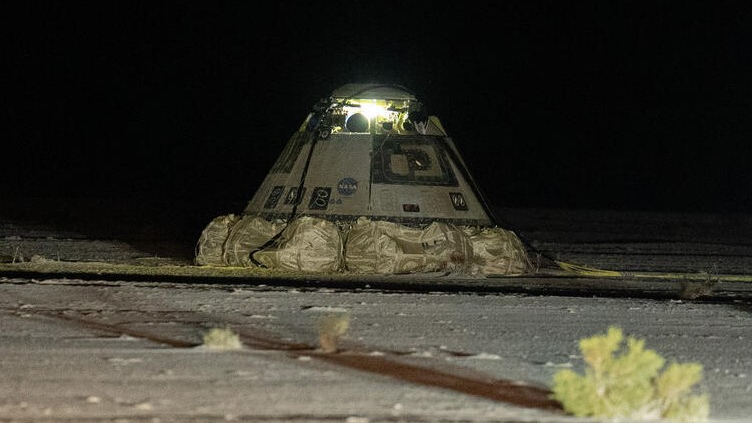
Touchdown came at 04:01 UTC on September 7th, and the recovery teams started their operations shortly after, moving in to the landing site from upwind of the vehicle to avoid risk of any harmful gases from the propulsion systems, etc. Safing of the vehicle and preparing it for transit away from the landing zone proceeded over the course of the next several hours.
With Calypso now on Earth, the focus will shift to trying to rectify the causes of the issues with the service module propulsion systems. As I’ve previously noted, this is made harder as engineers have no physical parts to eyeball; they will have to continue to work on data gathered through ground testing of identical units and data gathered during all the test-firings performed during the flight (including those carried out during the vehicle’s return to Earth).
Seconds before touchdown: with the airbag inflated, Calypso is a seconds from landing within the White Sands Space Harbour, New Mexico, Credit; NASA
Calypso, meanwhile, with two flights under her belt, will now return to Boeing for a thorough check-out, overhaul and refurbishment. Although when she or the unnamed Capsule S2 (which performed the seconded uncrewed flight test to the ISS in 2022) will fly again is unclear. Currently, S2 is scheduled to fly the first Starliner operational mission (Starliner-1) in August 2025; however, NASA is now hedging its bets: it has recently double-booked the SpaceX Crew Dragon Crew-11 mission (crew yet to be assigned) to fly in the same period if it becomes apparent Starliner-1 will not be ready to fly.
As previously noted, this means that astronauts Barry “Butch” Wilmore and Sunita “Suni” Williams will be remaining aboard the ISS until February / March 2025, when they will return to Earth on the SpaceX Crew Dragon Freedom. This is due to lift-off from Kennedy Space Centre on or around September 24th, carrying astronaut Nicklaus “Nick” Hague, and cosmonaut Aleksandr Gorbunov to the ISS, where they will complete a 5-day hand-over with the Crew 8 team. The latter are set to depart the ISS around October 1st.
A high-speed tracking image of Calypso passing through re-entry, the plasma around it glowing bright and leaving a heated trail behind the capsule. Credit: NASA
However, Crew 9 will not be the first the reach the station following Starliner’s departure. Soyuz TM-26 is to due to depart the Baikonur Cosmodrome on September 11th, carrying cosmonauts Aleksey Ovchinin and Ivan Vagner, and NASA astronaut Don Pettit.
They will dock with the ISS a few hours later, after a “fast” ascent and rendezvous, and raise the total crew on the ISS to 12. Then on September 24th (the day NASA is targeting for the launch of Crew 9 / Expedition 72), Soyuz TM-25 is set to depart the station and bring Oleg Kononenko, Nikolai Chub, and NASA astronaut Tracy Caldwell-Dyson back to Earth .
Calypso on the ground on September 6th / 7th, 2024. following her return to Earth at the end of her second flight into space (and first to the ISS). Credit: Boeing
Blue Origin Advances New Glenn Maiden Flight, But Without NASA’s EscaPADE
Blue Origin is progressing toward the maiden flight of its New Glenn semi-reusable medium-to-heavy lift launch vehicle – although there are doubts about whether the company will meet the mid-October launch window NASA originally set it.
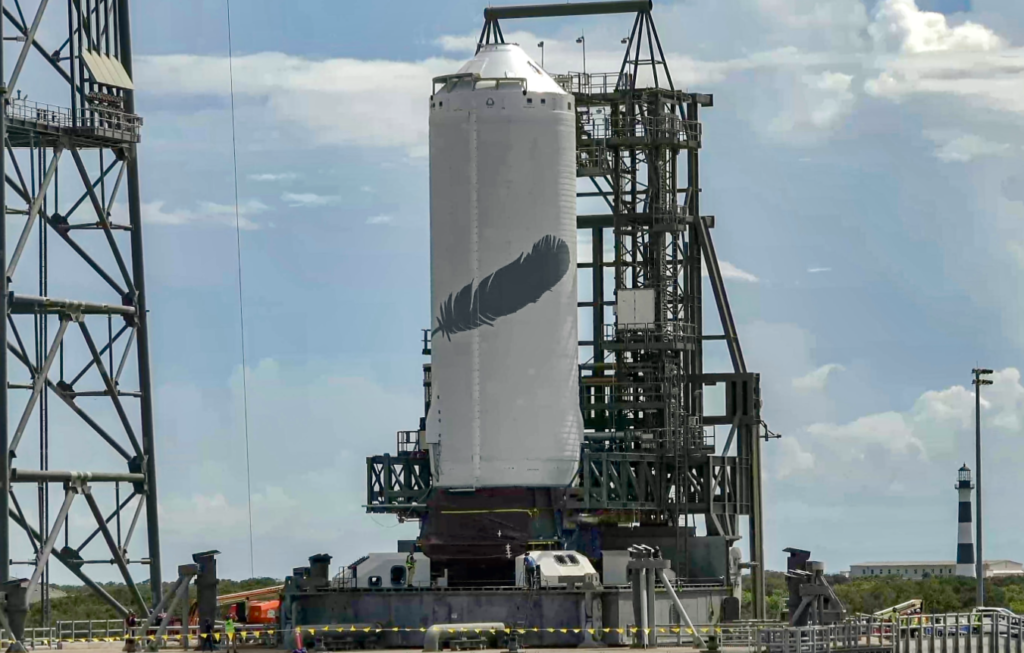
On September 3rd, the company deployed the new rocket’s 23m tall second stage to its launch facilities at Cape Canaveral Space force Station, Florida, where it will undergo a static fire test of its two Blue Origin BE-3U motors. However, this is just one of a number of milestones the company must meet in very short order if it is to make the mid-October launch window they state they still intend to meet.
The second stage of the first New Glenn rocket built for flight by Blue Origin, is moved to Launch Complex 36 at Cape Canaveral Space Force Station, Florida where it is due to undergo static fire tests. Credit: Blue Origin
This date was set by NASA when Blue Origin offered the flight as the launch vehicle for NASA’s EscaPADE Mars orbiter mission. A part of NASA’s Small Innovative Missions for Planetary Exploration (SIMPLEx) programme, whereby missions costs are to be reduced by launching them as secondary payloads alongside primary missions, thus reducing their launch costs.
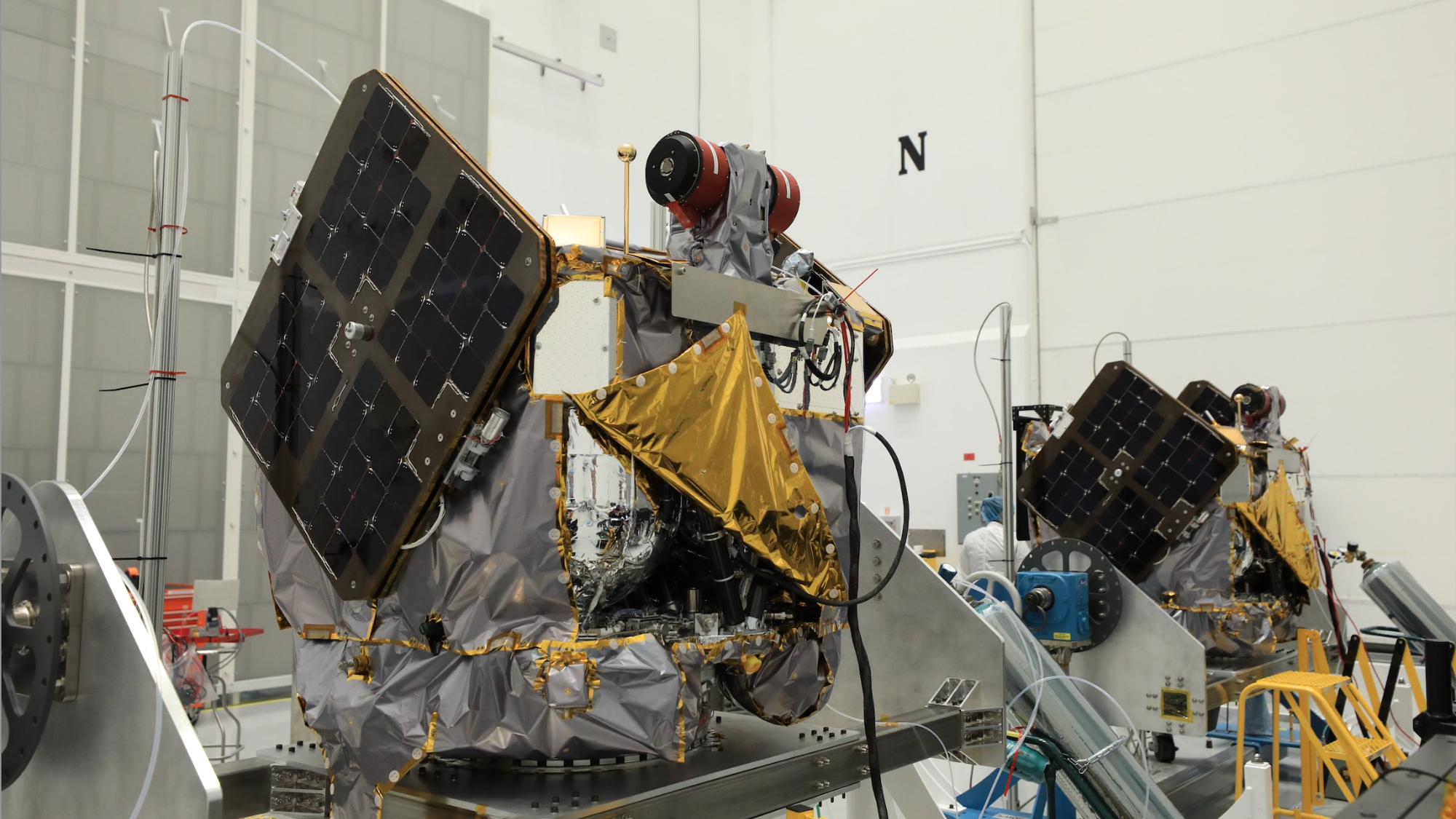
In this, EscaPADE – standing for Escape and Plasma Acceleration and Dynamics Explorers – a pair of identical satellites designed to study Mars’ atmosphere, were supposed to be launched with NASA’s Psyche mission, which originally was going to make a fly-by of Mars whilst heading for asteroid 16 Psyche, eliminating virtually all launch costs. However, Pysche’s launch was revised to a point where the Mars fly-by was no longer possible, and EscaPADE needed a new ride.
The New Glenn second stage raised to its vertical position on on the static fire test stand, Cape Canaveral Space Force Station, Florida. Credit: Blue OriginWhile Blue Origin offered the maiden flight of New Glenn at the bargain basement price of $20 million, it was still more that the original budget for the mission. With the launch facing a host of deadlines, including the second stage static fire test, and things like the integration and testing of the vehicle’s seven first stage BE-4 engines; stacking and integration of the vehicle’s two stages together with the payload and payload fairing; pad roll-out and countdown demonstration tests, NASA has been understandably concerned about Blue Origin’s ability to make the launch window for the last couple of months.
These concerns gained momentum because in order for EscaPADE to be ready for the launch, both satellites must be loaded within toxic hypergolic propellants. This is a costly, time-consuming exercise, and if New Glenn cannot make the October launch window, then NASA will have to go through an equally costly and delicate “de-tanking” exercise and purging of the propellant tanks of the satellites – and then go through the process again when the mission is ready for launch. So the decision was taken to avoid the additional costs and pull EscaPADE from the New Glenn launch. Instead, the agency is looking to launch the mission in spring 2025 – but still using a New Glenn vehicle.
Blue and Gold, the two identical EscaPADE satellites, built by Rocket Lab for NASA, seen in their “folded” configuration within an NASA clean room. Credit: NASA / Rocket Lab
This in itself has raised eyebrows; optimal launch windows to Mars occur around every 26 months, which spring 2025 does not meet. As such, it currently looks as if EscaPADE, a 990 kg all-up weight – will be the sole payload for the launcher, which will have to throw it into a heliocentric orbit around the Sun and out to Mars on an extended transfer flight.
In the meantime, and as noted, Blue Origin have stated they are still aiming to launch New Glenn on its maiden flight in October. With the removal of EscaPADE, they now intend to use the launch to place its Blue Ring “space tug” into orbit. This is a vehicle at the centre of a new operation for Blue Origin – providing on-orbit maintenance and movement of satellites. The company is also talking to the US government about using the flight to certify New Glenn as National Security Space Launch system.
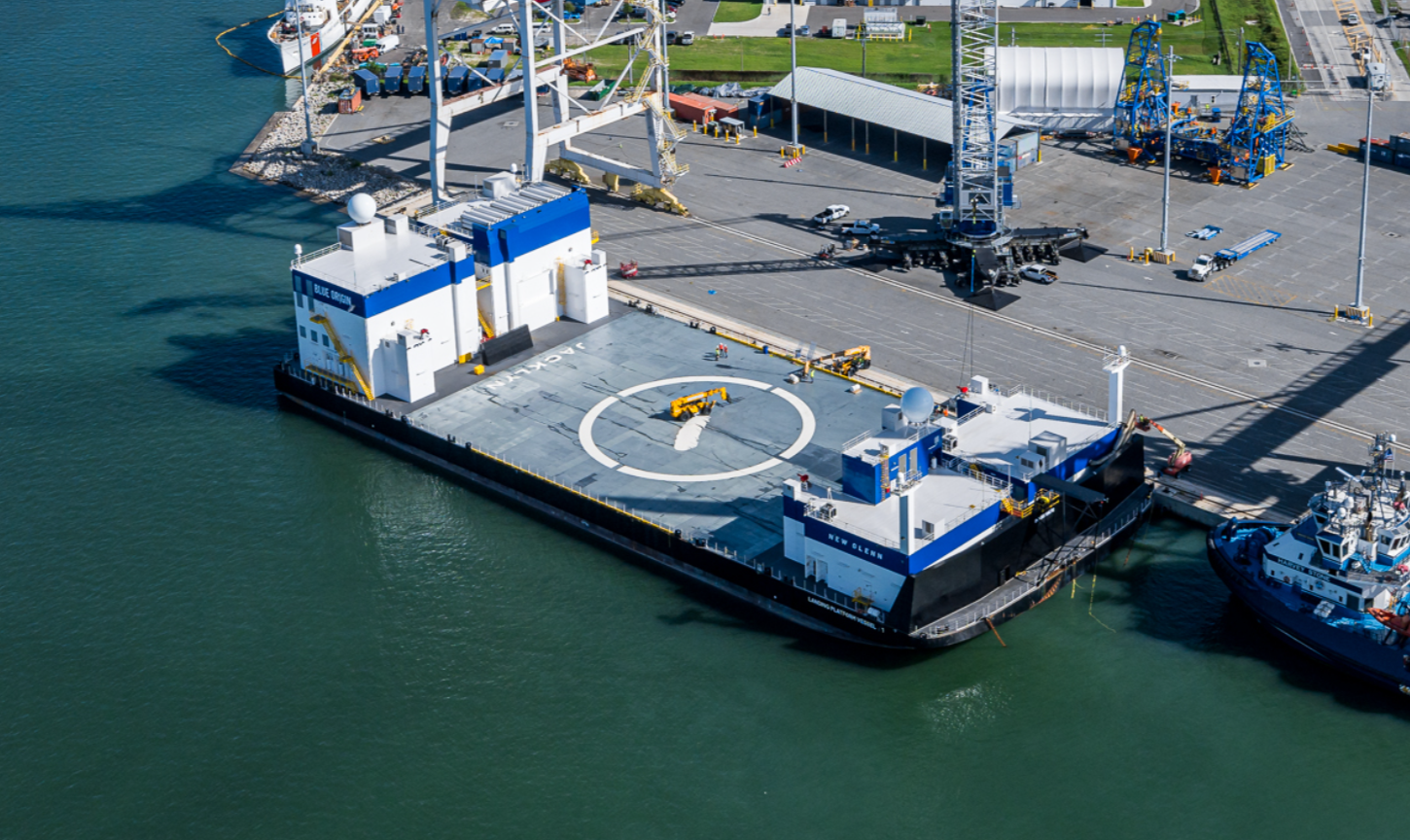
As a semi-reusable vehicle, the first stage of New Glenn is designed to be able to land after each use. To achieve this, it will use a sea-going landing barge akin to, but larger than, the SpaceX autonomous drone ship landing platforms. Officially called a landing platform vessel (LPV), the first of these barges arrived at Port Canaveral at the start of September 2024 in readiness for the maiden flight of New Glenn.
Built in Romania and outfitted and commissioned in France, LPV-1 Jacklyn, named for the mother of Blue Origin founder Jeff Bezos (who has also personally financed the company), the 115-metre long platform has already caused raised eyebrows as it has four large structures fore and aft of the 45m wide landing area. It’s not clear if these are integral to the barge (although the do seem to be) and what they might be for.
Blue Origin LPV-1 Jacklyn alongside at Port Canaveral, September 3rd, 2024
Certainly, putting such large structures on the barge is an interesting choice. Trying to successfully land a tall, thin tube containing the remnants of liquids that like to go kaboom when mixed and given the excuse, is not exactly a sinecure (just ask SpaceX). As such, hemming-in the landing zone with tall structures that could cause an even greater conflagration were a booster stage to topple into them whilst going the way of said kaboom seems to be somewhat tempting fate; I guess time will tell on that.
Loch Dhoire an Chláir, September 2024 – click any image for full size
Ireland (or Éire if you prefer) covers an area of just under 70,300 square kilometres; but while small (ranking 118th on the list of countries by total area), it is one of the most stunningly (and romantically) beautiful to visit, its comparatively small size allowing so much of it to be easily appreciated in a single visit.
One of the most beautiful parts of Ireland – for me, anyway – is Connemara, County Galway. Located on the west of Ireland and facing off against the Atlantic, Connemara has a magnificent coastline with multiple peninsulas, whilst just s short distance inland lay mountains such as the Twelve Bens / Pins (Na Beanna Beola) and the Maumturks / Maamturks (Sléibhte Mhám Toirc) together with the Pantry and Sheffrey ranges, all of which border the magnificent Connemara National Park, numerous rivers and lakes and lochs.
Loch Dhoire an Chláir, September 2024
Connemara is also famous for its strong roots in traditional Irish culture, the fascinating history of mining within its borders (tours of some of the mines are available) and which sought Connemara Green Marble, copper pyrite, and minerals and gemstones in general. It’s also the point of arrival for Alcock and Brown and the end of their 1919 historic non-stop trans-Atlantic flight – and a lot more besides.
However, it the the region’s lochs that were the focus of my most recent excursion within Second Life. This is because Jade Koltai recently overhauled her Homestead region of Overland Hills to present another setting inspired by a physical world location: Derryclare Lough, a freshwater lake within Connemara located near the southern end of the Twelve Bens, and from which she has borrowed its Irish name, Loch Dhoire an Chláir.
Loch Dhoire an Chláir, September 2024
Sitting at the mouth of the Inagh Valley and fed by water flowing to of the nearby Lough Inagh further up the valley, Derryclare Lough is so-named as it is close to the Derryclare mountain as it sits at the southern end of the Twelve Bens range. It is a lake perhaps most famous for its fishing, its conifer woods, its distinctive island reached via a stone causeway cutting through its shallows, and for being a favourite spot for photographers who have visited it from across the world.
The latter have, over the years, produced an plethora of beautiful images of the lake and its dramatic surroundings. Most of these feature the lake and its island under balmy summer skies, often at sunset. They are images that soften the area’s ruggedness into a more romantic idyl-like beauty. However, Jade eschews such a look for her design; offering something more in keeping with the weather that can sweep into Connemara from the nearby Atlantic, presenting a setting that is heavily overcast, the clouds lowering and spitting forth rain; the mountains and hills cast into the role of brooding hulks as they rise from the more distant landscape, their peaks silhouetted against the clouds and their shoulders wrapped in misty haze and their feet lost in shadow.
Loch Dhoire an Chláir, September 2024
It’s an excellent choice, giving the entire setting an air of mystery and intrigue which helps set it as a place very much inspired by rather than modelled on the actual loch. This allows Jade to present a setting that carries the essentials of Derryclare Lough – the waters of the lake, the island within it, the peaks of the Twelve Bens – whilst also potentially casting her net wider to capture more of the essence of Connemara as whole.
Thus, within the setting come much of the rugged beauty of the peat bogs and moors of the region, a hint of the loneliness of crofting – even something of Connemara’s Medieval history. This takes the form of ruins of a castle / fortified house (courtesy of Marcthur Goosson, whose work forms the backbone of my own island home in Second Norway), which perhaps offers a hint of Clifden Castle with it arched entrance and single tower.
Loch Dhoire an Chláir, September 2024
Jade’s use of region surrounds to create a sense of the mountains bordering the lough and to give added depth and life to the setting is simply superb; it’s easy to imagine you could just step off the region itself and strike out towards the rising peaks and perhaps find yourself on the Glencoaghan Horseshoe. Closer to home, the little crofter’s cottage located to one side of the setting perhaps also stands in place of the numerous small cottages that can be found along the shores of the lake and which can be used (with a suitable licence) as a base to go fishing on the waters of the lake and the rivers flowing into and from it.
Fishing on the lake is most often carried out from the “butts” – piers extending out from the shore -, and these are also represented within Jade’s build, as is the distinctive wooded island and the long stone causeway reaching out to it. The latter allows visitors walk out to the island and, should the need to escape the rain be felt, the tents set out on the island might provide it. Forming a little camp site, they are one of several places visitors can sit and pass the time to be found throughout the setting. Another such place sits to the south of the land, not too far from the ruins. A single wooden chair sits looking out over the the more distant land, a blanket draped over it and a lantern illuminating the ground in which it stands. To one side of the chair is a flat-topped boulder suggestive of a flat cairn topped by a cross and a vase of red roses. It’s a poignant little vignette, one suggestive of a place of memory and solace; one that adds yet more depth to the setting.
Loch Dhoire an Chláir, September 2024
However, the best way to appreciate the setting is obviously to visit it. When you do so, make sure you have local sounds enabled to capture more of the region’s ambience. I’d also advise sticking with the local environment to fully appreciate Loch Dhoire an Chláir as intended by Jade. All told, another beautiful and atmospheric setting – and one not to be missed.
The following notes were taken from my audio recording and chat log transcript of the Content Creation User Group (CCUG) meeting held on Thursday, September 5th, 2024.
The meeting was also livesteamed on You Tube by the Lab. The video is embedded at the end of this summary, my thanks to the Lab for providing it.
The CCUG meeting is for discussion of work related to content creation in Second Life, including current and upcoming LL projects, and encompasses requests or comments from the community, together with related viewer development work. This meeting is held on alternate Thursdays at Hippotropolis.
Meeting dates and times are recorded in the SL Public Calendar, and they re conducted in a mix of Voice and text chat.
The notes herein are a summary of topics discussed and are not intended to be a full transcript of the meeting.
Official Viewers Status
Release viewer: version 7.1.9.10515727195, formerly the Atlasaurus RC (object take options; improved MOAP URL handling) promoted August 26.
Performance boosts. Memory management has been optimized and users will experience a higher FPS across various systems. A comprehensive range of bug fixes are also provided. This includes better PBR material handling and resolving frequent crashes. See the release notes for more.
UI for scheduling region restarts now available via a new button located in the Region/Estate floater. (Note: there is currently an issue with scheduled region restarts working correctly and a fix is due to come in the next server release).
The performance setbacks between the original PBR viewer release (7.1.6) and the Graphics Featurettes viewer (7.1.8), and which particularly negatively hit the Firestorm PBR release were again covered (for additional content, see my August 30th TPVD meeting summary).
This has resulted in a “significant portion” of the viewer development work being focused on recovering performance and rectifying the underpinning bugs and issues – some of which are not specific to the PBR implementation itself. Some of this work has been surfaced in the DeltaFPS viewer, but more is to come.
The above work also folds into it various fixes for crashes and bugs and a number of Visual Aesthetics (as in how SL looks – see below).
This work will impact other areas of viewer work, so glTF projects like the PBR Terrain Painting and Transmission / IOR work are going to be pushed back somewhat, as is work on the viewer-side implementation of Laua scripting support. However, all of these work is still on the roadmap, just delayed.
[Video: 8:24-8:56] Cosmic Linden has been working on an improvement to avatar loading to assist with performance improvements, and this has been pushed to the DeltaFPS RC viewer, together with working on bug fixes.
[Video: 9:00-9:54] Runitai re-iterated that the Graphics Featurette viewer introduced the major performance hits (some of which are related to bounding box management and memory management, the the TPVD notes linked-to above), and DeltaFPS sees a good improvement in performance over Graphics Featurettes, and the viewer in development (“ExtraFPS“) that will follow DeltaFPS should see performance return to levels seen with the initial PBR release.
[Video: 45:46-46:36] Which is not to say there are not additional PBR-related performance problems – such as those tied to specific GPU such as the Nividia GT1030 2Gb. These are also the subject of fixes being implemented in either the DeltaFPS viewer or the upcoming ExtraFPS viewer that will follow it.
Linear alpha blending: in order for PBR lighting to render anywhere close to correctly, alpha blending has to be switched from SRGB to linear colour space. This can cause some older content using Blinn-Phong to look either more opaque or more transparent than in did pre-PBR.
The fix for this will likely be to add the ability for people to set and alpha/gamma ramp on an item, which can be modified per texture entry, adjusting how transparent the item is on a curve.
This should help with a range of issues – particularly those associated with pre-PBR hair, as has been noted by an number of users.
To help with this, the new alpha/gamma ramp value will still be adjustable even if the content is No Mod, so as to allow users to adjust legacy content affected by the issue, rather than having to wait for fixes from content creators.
This fix will hopefully follow in the ExtraFPS viewer after DeltaFPS, but in the meantime will be made available in a viewer build available through the Content Creation Discord group‡ for those wishing to test it once the initial work has been completed.
Runitai Linden also indicated that as an extension to this work, LL might be able to find a way to apply the adjustment automatically, rather than people having to manually set it, but also noted any automatic solution would be “hard”.
Auto-exposure: LL is looking to add controls for dynamic exposure (speed of transition, range, ability to turn off / on). These options will be made available via the Advanced Graphics floater, and maybe / someday via the the sky settings floaters.
[Video: 10:03 -10:50] Anti-aliasing: there has been negative feedback from those who used to run the viewer with Advanced Graphics Model (ALM) disabled and who are forced to have it enabled all the time as a part of the PBR rendering, don’t like the look of Fast Approximate Anti-Aliasing (FXAA) as used in the viewer, so LL are adding support for Subpixel Morphological Anti-Aliasing (SMAA).
In addition, Rye Cogtail from the Alchemy team did a pass on the FXAA code and found it was not working as well as it should be.
Updates to FXAA and the addition to SMAA will be appearing in the viewer to follow DeltaFPS.
Work is also being put into smoothing the problems created by switching from 8-bit colour precision to 16-bit float colour precision (which can be the cause of bugs wherein you go somewhere in SL and everything glitches to black or solid white). This work should surface through DeltaFPS.
[Video: 11:05-11:45] The Sun is unrealistically dim. LL are considering adding a specific Sun intensity multiplier to Sky settings.
As a temporary fix, and whilst not specifically addressing the sun issue, the overall brightness in a scene can be adjusted via very small tweaks to the HDR slider in the Personal Lighting floater.
[Video: 49:16-56:05] Tone mapping: Rye Cogtail from the Alchemy team has contributed the Khronos Neutral tone mapper for inclusion into the viewer.
This is not as dark as the current default in the viewer, and initially will use debugs to select which tone mapper is used (as the existing mapper will remain).
LL are looking to make this the default for tone mapping (subject to the outcome of testing), and the mapper is currently in the viewer Develop branch for TPV / viewer builders to take a look at.
When implemented the controls will likely be in the Advanced Graphics settings as a combo box and a slider. The control may also in the future be added to the sky settings.
In addition, there will be a new control – Tone Mapping Strength – to alter the linear alpha colour.
A key point to content creators on this is: you should not put the tone mapper in your textures (e.g. via the options available in PhotoShop when exporting textures) by bumping saturation, etc., and baking the tone mapper into the texture (as well and not baking things like reflections into textures).
WYSIWYG will still be possible providing creators select a tone mapper in SL that matches the mapper in their tool of choice or by using no post and working in linear + using the HDRI Preview option (Develop(er) > Render Tests) and use the same HDRI in SL as your content creation tool.
A new project intended to move Second Life away from reliance on the Vivox voice service and plug-in, and to using the WebRTC communications protocol (RTC=”real-time communication”). Roxie Linden is leading this work.
Key benefits:
WebRTC supports a wide range of real-time communications tools in common use (e.g. Google Meet), supporting audio, video and data communications, and is thus something of a “standard” approach.
Offers a good range of features: automatic echo cancellation, better noise cancellation and automatic gain control, much improved audio sampling rates for improved audio quality.
Opens the door to features and capabilities to voice services which could not be implemented whilst using Vivox.
Status
WebRTC is now fully supported in the official viewer.
The back-end deployment on the simulator servers is progressing (2 release candidate channels for simulator servers – BlueSteel and Ferrari – should now have WebRTC support), but this is not yet universal across the entire grid, and will take at least another 2 weeks to be grid-wide.
Throwing the switch from running Vivox on the back-end to running WebRTC only will be dependent upon third-party viewers implementing and releasing the viewer-side WebRTC library.
In the meantime, peer-to-peer and ad-hoc WebRTC can be tested on the WebRTC regions of WebRTC Voice 1, WebRTC Voice 2, WebRTC Voice 3 and WebRTC Voice 4. However, there is no bridging between WebRTC peer-to-peer / ad-hoc and Vivox.
In Brief
[Video 17:06-25:06] A discussion on Marvelous Designer (MD) cloth simulation within Second Life. This was done with Sansar, allowing clothing to be properly draped over an avatar body, and allowed for adjustments to be made prior to the finished results being baked-out (with automatic hidden surface removal).
Second Life utilises a different data modern to Sansar which introduces a range of complexities that would require significant re-working of how clothing / mesh data is management, a potential re-writing of the entire Bake Service and other factors, all of which make MD integration a challenge.
Further complexities are added by the fact that unlike Sansar, which utilised a single avatar body type, SL has a plethora of bodies, and so using the cloth simulation against different body types (whether by creators or users) gets considerably more complicated, as do the requirements for data handling / storage and the costs involved.
As such, whilst these issues are not necessarily complete barriers to integration, they do mean that there are significant considerations involved, as well as significant changes to SL that would have to be made. Thus, it is not currently on the roadmap or under current consideration.
Please refer to the video for further details.
[Video: 25:16-26:12] 2K texture support for Bakes on Mesh – while there was no precisely update available:
It is believed the majority of the work in enabling 2K Bakes on Mesh is now done in terms of getting an early prototype put together on one of the Lab’s own development grids.
However, there is currently no public availability for the capability, not is there any release schedule. The work remaining “on-going”.
[Video: 26:31-28:50] A brief discussion on creating content with both Blinn-Phong and PBR materials and some of the issues that can occur + some of the slight eccentricities (e.g. objects with both appearing to turn metallic when edited).
It was noted that as Blinn-Phong is still supported, creators can continue to use that in preference to PBR materials, although as time goes on the underpinning tools (like Blender) might move more and more into the glTF support arena and make it easier to produce glTF compliant content which can be used in SL.
[Video: 29:14-30:57] Transmission and IoR: these are being implemented against the glTF extensions approved by Khronos. This work is focused on implementing them against the prototype glTF implementation, then it they pass that, the focus will move to integration with SL and how they work with glTF materials assets and how to apply them to mesh and prim faces.
However, as noted above, this work is currently paused pending completion of the performance improvements work, and is unlikely to resume until after the viewer following Delta FPS has surfaced.
It was also noted that it will still be a while before LL are confident enough with both Transmission and IoR to allow either to be added to content be users, even on a test basis.
[Video: 40:22-41:48] The question was asked that, when SL gets glTF morph targets, if it would be possible to swap out vertex maps as well to change vertex weights so that it might be possible to deform clothing using the morph targets via script, then change the rigging, so an to allow one-size-fits-all clothing.
Runitai Linden noted that LL are aiming to hit all of the “musts” and “shoulds” in the glTF specification. For morph targets, this means effectively having three channels per mesh that can be modified with the morph slider, thus limiting what could be done.
[Video: 42:10-44:55] llSetAlpha / llSetColor, etc: LL is planning on making these functions implicitly access the PBR equivalents when a PBR material is present. However, this is hampered by the fact a good proportion of users are still on non-PBR viewers, so “there’s not good answer to which channel it should modify.” This means that currently, the easiest thing it to leave the functions “as is” until sufficient enough users are on viewer with PBR support.
This does not mean non-PBR content will no longer be a thing; just that creators should not have to make a non-PBR version of their content because there are people still using a non-PBR capable viewer.
The last few minutes of the meeting are spent discussing what additional elements of the glTF specification have yet to be worked on.
† The header images included in these summaries are not intended to represent anything discussed at the meetings; they are simply here to avoid a repeated image of a gathering of people every week. They are taken from my list of region visits, with a link to the post for those interested.
‡ Due to an express request from Linden Lab, I am unable to publish information on how to join the Content Creation Discord group. If you are a creator and are not a member, please contact Vir Linden via notecard or IM.
As regulars to these pages are probably aware, I covered the Combat User Group meetings from February 2024 through until late July, 2024, during which Rider Linden worked with members of SL’s widespread community of combat enthusiasts on an initial overhaul of Second Life’s combat system (SLCS). The aim was not to develop a new combat game or combat system, but to provide combat enthusiasts with a much improved box of tools (scripted capabilities) for better, more immersive combat experiences within Second Life.
Details of what many hope will be the first phase of the Combat 2.0 project can be found in my Combat User Group summaries. However, two spin-offs (so to speak) of this work have been the Combat Partnership, and the return of three much-loved combat regions (which were originally part of the Teen grid): Concord, Lexington and between them, No Mans Land, with the promise that the latter would undergo a facelift and act as a new nucleus to help encourage combat enthusiasts – both within Second Life and those who may have departed the platform – to give the new and updated capabilities a go.
An inaugural (and informal) meet-up within the regions was initially held on July 25th, mainly featuring those combat enthusiasts who had participated in the user group, the session being to mark a wrap on the first phase of work and to put the Combat User Group on hiatus for a time.
Combat 2.0: Concord (with personal EEP setting)
Now the facelift work on the three regions has been completed, and on September 5th, 2024, Linden Lab launched a new promotion for Combat 2.0 utilising a video produced by Vrutega, expressly aimed at encouraging people to come back into Second Life and give things a go. And going on preliminary responses, it has been well-received.
Concord and Lexington act as the base locations for two teams for those wishing to engaged in team-based combat, but the regions are also open to more general player versus player (PvP) or player versus environment (PvE) combat. They each have dedicated landing point:
No Mans Land is the epicentre for combat. It includes a network of WW1 style trenches, open land, for PvP and cover for PvE against the roaming armed aerial drones. For team-based combat, Red and Blue flags are also located in the region, ready to be attacked / defended. Nor do those wishing to join in have to equip themselves before joining in – those who are new to Combat in SL or are making a return out of curiosity, can obtain various free weapons, generously provided by creators with the Second Life combat community. These can be found within the hangers at Concord and Lexington, and some might be floating around elsewhere.
As well as the showcase regions at Concord et al, the updated Combat 2.0 capabilities are available to all combat regions holders in Second Life to leverage. As a very, very small thumbnail of the updates, the following are now available with Combat 2.0:
Damage events (llDamage) and healing (incl. objects having health).
Better control over what happens on death.
Spawn points.
A new and dedicated combat log – “Brigadier Linden” combat region owners can leverage in administrating combat in their regions.
region-wide settings available to combat region owners.
new LSL functions and events.
All of these are covered in much greater detail via the dedicated Combat 2.0 SL Wiki page, which also includes links to specific information on things like the Combat log and updated / new LSL functions.
Combat 2.0: No Man’s Land (with personal EEP setting)
Combat Partnership
With Combat 2.0 becoming available, Linden Lab has announced the Combat 2.0 Promotion Partnership Programme has been launched.
The intention behind the Promotion Partnership Programme this is to give those actively involved in combat activities in Second Life the “opportunity to help us spread the word across the grid about Combat 2.0 in Second Life”.
Participants will have their regions / communities included in a Combat section of the Destination Guide. There may be other benefits for participants as well.





 Inara Pey: Living in a Modemworld