Kingsand, June 2024 – click any image for full size
I recently received an invitation from .Tempest Rosca-Huntsman and her SL partner, John (Johannes Huntsman), to visit their latest project, completed under the banner of the Formal Knot group and in association with Kultivate Magazine and Art Hub.
Kingsand is a Homestead region designed by Tempest and adjoining the Kultivate Gallery region. It is offered as a location for relaxation and photography – and to mark its opening, it is also host to a photographic competition running through until June 30th, 2024 offering a combined prize pool of L$30,000 – of which more anon.
Kingsand, June 2024
Accessed via the southern side of the Kultivate Water Haven region, Kingsand presents an open, semi-rugged setting sharing the same region surround as the former, thus allowing it to be enclosed on three sides with high mountains which add depth to photographs taken within it.
The land comprising the region has been divided into three parts, each separated from the others by water channels. The land directly adjoining the Kultivate gallery spaces is fairly low-lying, carrying with in a hint of a wildling garden, ancient paths and steps providing routes between the more even elements of the land, walls and gates offering a further sense of sub-division among the trees and flowers. To the east, this land forms a long finger of a headland, far rockier in nature, bordered by relatively open waters to one side and that larger of the channels cutting into the land on the other. Cut through by a narrow gorge, this headland ends in a low-lying promontory topped by a giant windmill.
Kingsand, June 2024
Across the channel, the larger of two islands cam be reached via a stone bridge. Low-lying to the south and west, this island rises to a tall central peak with highlands reaching up to it from the eastern side. These slopes provide the means to reach the ruins of a cathedral or some similar structure sitting on a shoulder of rock thrusting outwards from the peak.
Apparently now the home of a library / story-telling space rich in flowers and blossoming vines and presided over by a dryad caved into a tree at its centre, the ruins might also be used as a means to reach the top of the mountain – although this does entail dropping down their flank and scrambling through the brambles at their base, and getting back again might be a challenge on foot, given there is no mean to climb back up into the ruins. Although that said, the bare peak is easily visible from the ruins, so such a climb isn’t really necessary unless you’re really wanting to take a photograph of yourself up there.
Kingsand, June 2024
To the west, the land sweeps around the mountain and along the second of the water channels to reach another bridge, this one offering the way to the smaller of the two islands. The most rugged element of the region, this island forms two rocky hills cut through by a natural canyon. The latter leads the way to a deck built out over semi-turbulent waters and offering one of multiple places to sit and pass the time spread throughout the setting.
The overall design is such that the region might be enjoyed by multiple visitors without them necessarily tripping over one another, and with sufficient space for photographers to rez-out props for photography again without necessarily interrupting others. Those who wish to do so should join the Formal Knot group; there is no charge and auto-return is set for 90 minutes. This should be more than enough time to compose props and photographs – but if you take advantage of this and complete your work within the time limit, do please consider taking back your items.
Kingsand, June 2024
Which brings me neatly to the June 2024 photo contest. Full details are in a notecard available from the region’s landing point – together with another card providing region information and rules – however, and in short:
Entries must comprise images taken within the Kingsand region, and entrants are limited to two such images apiece.
Entries must be submitted to the Kingsand Flickr group and bear the tag “Kingsand”.
Prizes will be awarded on the basis of L$10,000 each to two winners and L$5,000 each to two runners-up, for a total prize pool of L$30,000.
In addition, winners, runner’s up and a selection of commended entries to the competition will be exhibited at Kultivate Art Gallery at a date to be announced.
Kingsand, June 2024
Sitting under a fairly neutral environmental setting, Kingsand is perhaps best suited to being photographed using your own EEP settings – the landscape being such that its naturally lends itself to a range of day cycles and settings extremely well. It also seems to lack any ambient sound scape, which is a shame given its natural beauty. However, accepting the region is primarily designed for photography, this does not overly detract from its appeal.
In all a superb setting ideal for photography and avatar studies. My thanks to Tempest and John for the invitation to make a pre-opening visit.
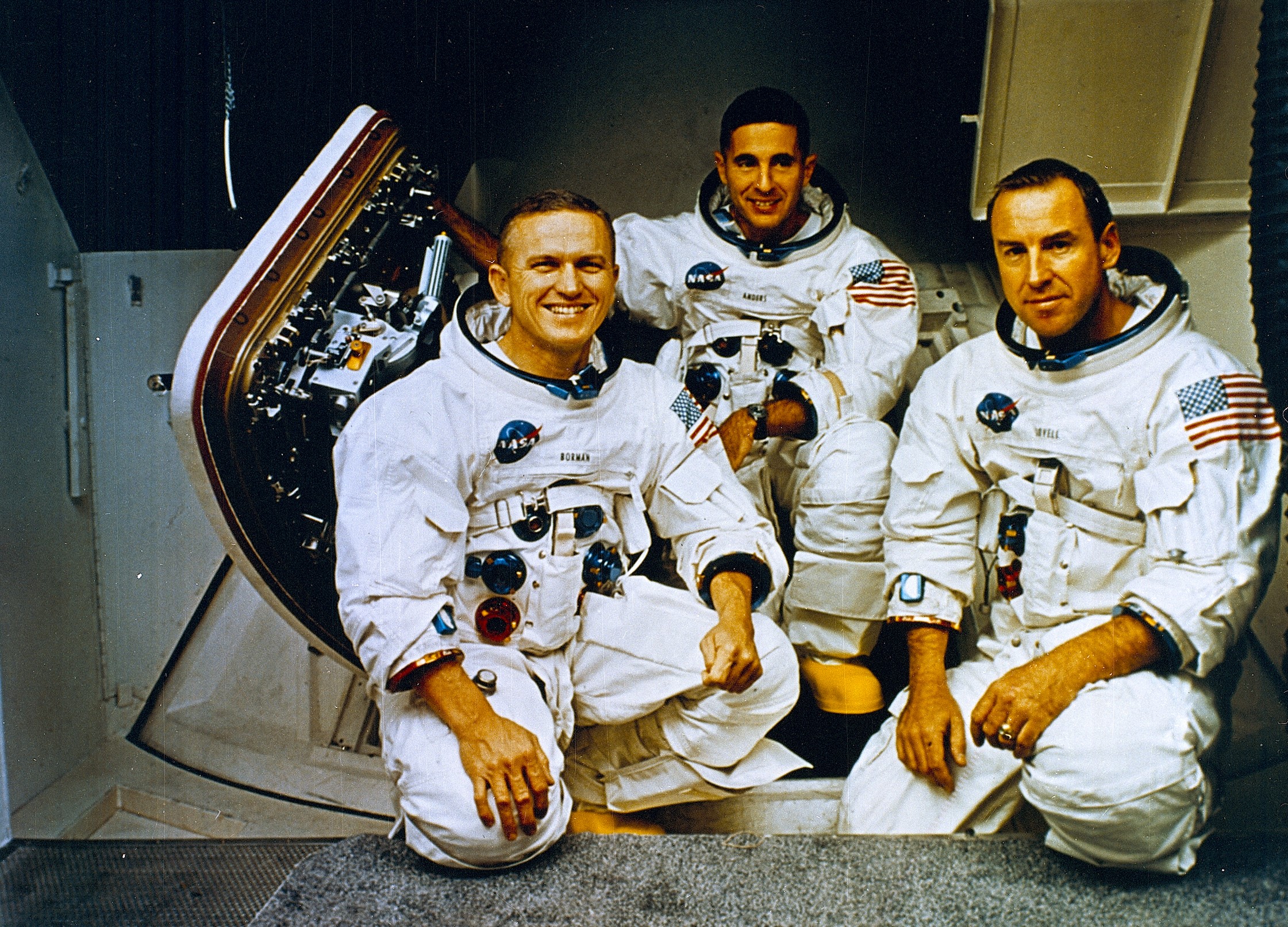
William “Bill” Anders (centre) flanked by his fellow Apollo 8 crew members Frank Borman (l) and Jim Lovell, pictured prior to the launch of their mission on December 21st, 1968. Credit: NASA
Another of the first cadre of humans to visit the Moon and its vicinity was lost to us on June 7th, with the death of William Alison “Bill” Anders at the age of 90.
Born in 1933 in the (then) British Crown Colony of Hong Kong, Anders was the son of a US naval officer on deployment to Hong Kong and China, the family becoming embroiled in the Sino-Japanese War when it broke out in 1937. This forced Anders’ mother to flee Nanjing with her son and survive by wits alone to get them both back to the United States, where they were reunited with Anders’ father, who had been wounded and subsequently rescued by British forces after the Japanese dive-bombed his patrol vessel out from underneath him.
Initially opting to follow his father into the Navy, Anders studied at the US Naval Academy at Annapolis, gaining a degree in electrical engineering. However, enamoured with flying, on graduation he opted to take a commission into the US Air Force and became a fighter pilot. After a series of non-combat operational tours, he sought to become a test pilot – which required he have an MSc. Initially studying aeronautical engineering, he switched to nuclear engineering, gaining his MSc in 1962. However, at that time NASA was recruiting its third astronaut intake and applied and was accepted.
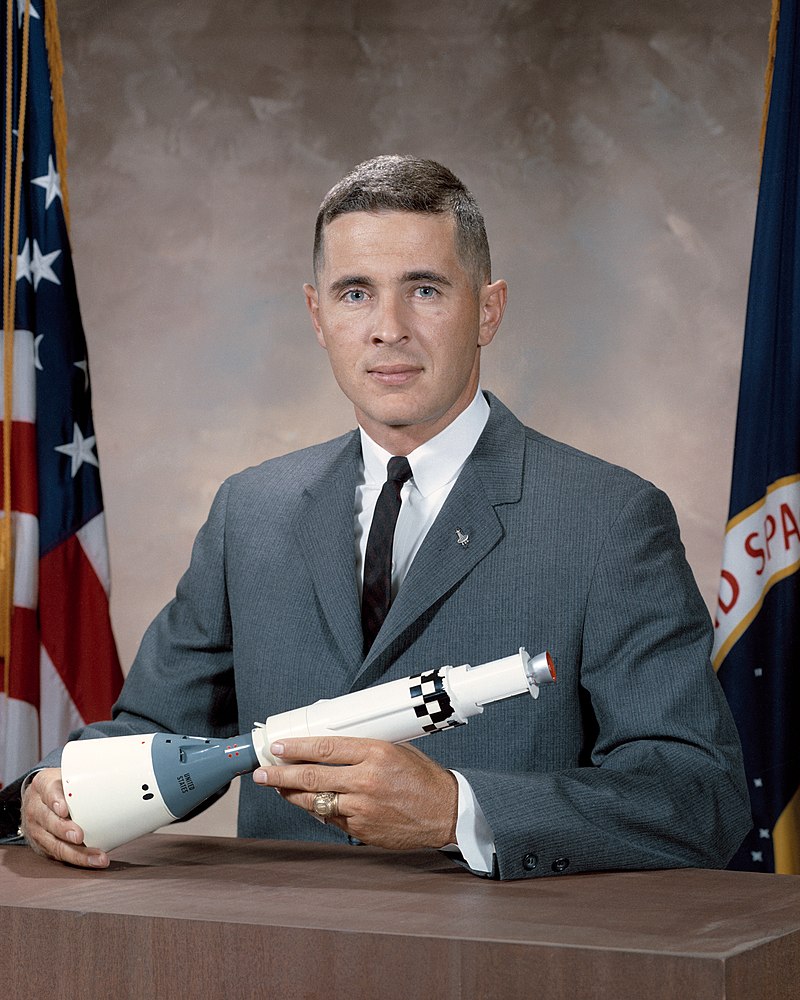
“Bill” Anders in an official NASA portrait photograph from 1964, when he responsible for developing astronaut procedures for dosimetry, radiation effects and environmental controls. Credit: NASA
In late 1966, Anders was assigned to the crew of Apollo 9, alongside Frank Borman and Michael Collins. Together, they would carry out the second Earth-orbiting, crewed check-out of the Apollo Lunar Module (LM), following-on from the Apollo 8 mission crewed by James McDivitt, David Scott and Russell “Rusty” Schweickart. However, by mid-1968, and with both flights due before the end of that year, the LM was not fit for supporting astronauts in space. Fearing the Russians were about to fly a crew around the Moon, NASA decided to switch gear: Apollo 8 would become a cislunar mission, flying with just the Apollo Command and Service Modules (CSM), and Apollo 9 would then complete 1 Earth-orbit crewed test of the LM.
Only McDivitt and his crew didn’t want to go around the Moon, feeling their expertise was better suited to the LM test flight. So instead, the crews were swapped – Borman and Anders, now joined by James “Jim” Lovell, Michael Collins having suffered a back injury requiring surgery – became the Moon-orbiting Apollo 8 crew, and McDivitt’s mission was re-designated Apollo 9, to fly in early 1969.
Thus, on December 21st, 1968, Apollo 8 lifted-off for the Moon, racking up a number of firsts along the way: the first crewed flight of the Saturn V rocket, the first crewed spacecraft to leave Earth’s gravitational sphere of influence; the first crewed spaceflight to reach the Moon; the first crew to broadcast to Earth from lunar orbit – and most famously of all – the first humans to ever witness Earthrise, with Anders capturing what is now regarded as “the most influential environmental photograph ever taken”.
The picture was captured on Christmas Eve 1968, as Anders was using a 70mm Hasselblad camera loaded with a black-and-white film cartridge to image the lunar surface when he happened to look up through the Command Module’s window and see Earth starting to come into view over the Moon’s limb. Calling to Lovell for a colour film cartridge, he quickly re-loaded his camera with it and then took the iconic shot we all now know as Earthrise.
In doing so, he was actually the second human to photograph the Earth rising over the Moon’s limb; the honour of being the first actually goes to Frank Borman – only his camera was also only loaded with black-and-white film. Thus Anders is the first human to capture the sight in the colour image which has come to represent the beauty, loneliness and fragility of the world we call.
The iconic Earthrise image, as captured by Bill Anders on December 24th, 1968. On the left, the enhanced, post-processed version turned through 90-degrees. On the right, the original as it appeared to Anders from within Apollo 8, dur to his orientation in the vehicle. Credit: NASA
If you can imagine yourself in a darkened room with only one clearly visible object, a small blue-green sphere about the size of a Christmas-tree ornament, then you can begin to grasp what the Earth looks like from space. I think that all of us subconsciously think that the Earth is flat … Let me assure you that, rather than a massive giant, it should be thought of as the fragile Christmas-tree ball which we should handle with considerable care.
– Bill Anders describing how he felt when seeing the Earth appearing from behind the limb of the Moon
Bill Anders would only make that one flight in space. In May 1969 he was appointed to the influential position of executive secretary of the National Aeronautics and Space Council (NASC), where he did significant work in developing US space policy. In 1973 he was appointed to one of the five leadership slots of the US Atomic Energy Commission (AEC), transferring to chair the Nuclear Regulatory Commission (NRC) when that was formed in 1975.In mid-1976 he was appointed (at his request) as the US Ambassador to Norway, prior to moving to the private sector and the start of a highly successful career in business in 1977, finally retiring in 1994.
Passionate about flying, Anders, together with his wife Valerie and two of his sons – Alan and Greg – founded the Heritage Flight Museum in 1996, regularly flying the museum’s pistoned-engined aircraft and air shows around the United States. He also owned and operated a T34 Mentor training aircraft, and on June 7th, 2024, he took to the air in this aircraft to fly circuits over Puget Sound, Washington State, where he lived. During this flight it appears – via eye witness video – he attempted a low-altitude loop in a channel between two islands, but the aircraft failed to pull up in time, slamming into the water and breaking up, likely killing Anders instantly. The accident is now under investigation by the US National Transportation Safety Board (NTSB).
Anders is survived by his wife of 67 years, Valerie, and their six children.
Starliner Launches; Issues Persist
Boeing’s much-troubled CST-100 Starliner finally lifted-off on its first crewed test flight at 14:52 UTC on Wednesday, June 5th, finally sending astronauts Barry “Butch” Wilmore and Sunita “Suni” Williams on their way to the International Space Station (ISS) in a flight intended to help clear the Starliner capsule for use in ferrying up to four crew at a time to the ISS, and in an emergency (and depending on available seating), returning up to 7 to Earth.
June 5th, 2024: Boeing’s Starliner spacecraft climbs into the sky atop a United Launch Alliance Atlas V-N22 from Cape Canaveral Space Force Station in Florida at the start of the Crew Flight Test. Credit: Joe Raedle via Getty Images
As I’ve reported in past Space Sundays, the Crew Flight Test of the vehicle has been plagued by problems – many with Starliner itself, but also extending to launch systems on the ground and systems within its launch vehicle, the Atlas-Centaur V-N22. However, the launch on June 5th was flawless, and marked both the first time in history that humans have flown atop the veritable Atlas V, which is more usually employed for cargo carrying launches, and the first time since Apollo 7 in 1967 that a crewed vehicle has lifted-off from facilities at Cape Canaveral Space Force station (then called the Cape Kennedy Air Force Station).
Fifteen minutes after launch the Starliner separated from the Centaur upper stage, entering a sub-orbital trajectory around the Earth, allowing for a preliminary vehicle check-out and a rapid return to Earth in the event of issues. With the crew and ground personnel satisfied all was well, Wilmore and Williams used the vehicle’s propulsion system to increase its altitude and velocity, enabling it to enter orbit 31 minutes after lift-off.
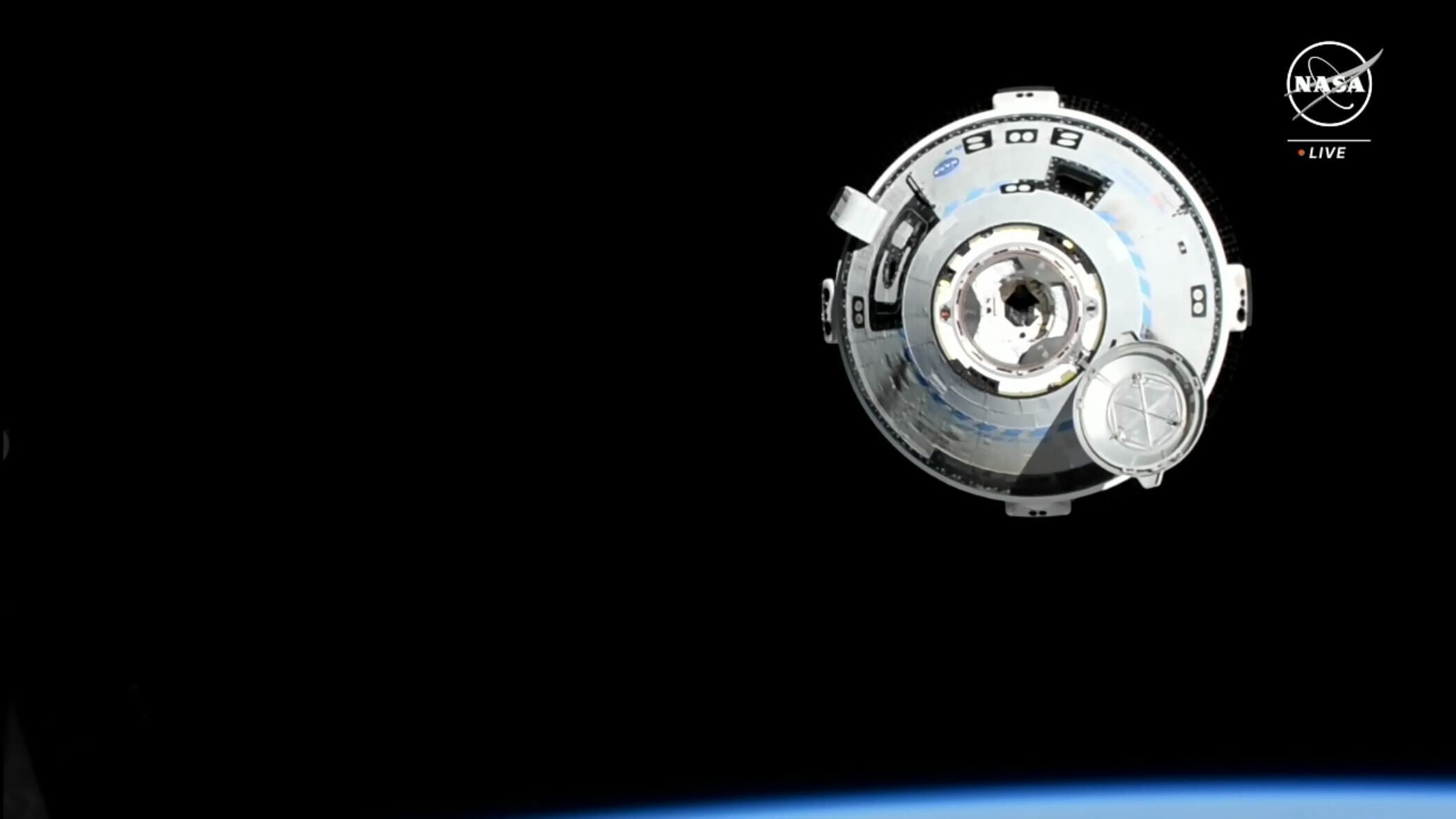
Starliner Calypso sits just off the ISS prior to docking on June 6th, 2024. Credit: NASA
The rest of June 5th saw the crew carry out a series of tests with the vehicle as it climbed towards the ISS, putting it through various manoeuvres and testing communications and other systems. During this time further helium leaks were detected in the vehicle’s thruster system – a known leak having been the cause of one of the delays to the mission’s launch – and 6 of the vehicle’s 28 thrusters were shut down. This did not impact vehicle performance, but the fact that four further helium leaks were detected on top of the known leak indicates there may be a systematic issue within the design of the propulsion system.
Further issues occurred during the vehicle’s approach to the ISS on June 6th, when five of the reaction control system (RCS) thrusters were automatically deactivated, forcing the actual docking to be delayed, Starliner held in a station-keeping position by Wilmore and Williams some 200 metres from the station whilst a team on the ground recovered four of the recalcitrant thrusters, enabling the vehicle to dock with the Harmony module on the station. Hatches between vehicle and station being opened 2 hours after docking, to allow for further post-flight checks on the dock seal within the vehicle and for Williams and Wilmore to change out of their pressure suits.
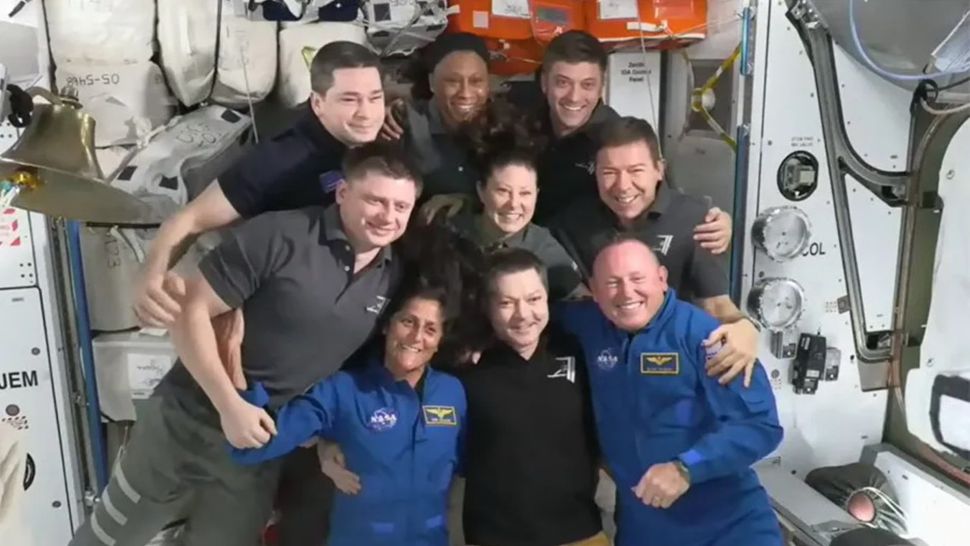
“Suni” Williams and “Butch” Wilmore (in blue NASA jumpsuits) celebrate their arrival aboard the ISS with the crew of Expedition 71. Credit: NASA
The vehicle will remain docked at the ISS for several more days prior to departure with Wilmore and Williams for a return to Earth and a soft landing in New Mexico on June 14th.
June brings with it Cica Ghost’s installation for the the month, located on her Homestead region of Mysterious Isle, and this time it is a little different from recent installations from Cica.
Entitled Under the Stars, it comes with a quote from John Green’s debut novel (2005), Looking for Alaska, which – as with the majority of the quotes Cica uses – frames the theme of the installation, without necessarily reflecting the source it is taken from (in this case, Looking for Alaska being a coming of age story):
At some point we all look up and realize we are lost in a maze.
– John Green
Cica Ghost: Under the Stars, June 2024
Instead, the quote literally describes the core of the setting – a maze carved into the ground and sitting under s starry sky. The landing point sits at the start of the maze and to one side of the region, the way forward marked by high walls of terrain and the path quickly splitting. Which arm you take is entirely up to you – but what I would suggest is that you resist the temptation to cam upwards and look at what might be sitting above and instead allow the maze to unfold before you.
This actually makes describing the setting a little hard, as it really is best taken as a voyage of discovery. However, within the maze is a series of open spaces, some of which are home to giant creatures of fantasy; but these are not monsters; rather they are more like oversized cuddly toys, some of which bring to mind memories of Dr. Seuss. All are sleeping, the stars overhead looking like lights spread across a green sky of grass, presenting the feeling we are somehow underground whilst at the same time suggesting the creatures are all lost in happy dreams. Those spaces with a creature contain one of Cica’s marvellous drawings.
Cica Ghost: Under the Stars, June 2024
Also scattered through the maze are ladders leading up to the ground above. These can be climbed to reveal what lay overhead. Again, I don’t want to spoil things by saying too much here.
With a number of places to sit, creatures to photograph (and purchase!), Under the Stars is another genuine delight from Cica and fully deserving of a visit.
My audio recording and chat log transcript of the Content Creation User Group (CCUG) meeting held on Thursday, June 6th, 2024.
My audio recording + the video recording by Pantera (embedded at the end of this summary) of the Third-Party Developer meeting (TPVD) held on Friday, June 7th, 2024. My thank to Pantera as always for providing it.
Meetings Purpose
The CCUG meeting is for discussion of work related to content creation in Second Life, including current and upcoming LL projects, and encompasses requests or comments from the community, together with related viewer development work. This meeting is held on alternate Thursdays at Hippotropolis.
The TPV Developer meeting provides an opportunity for discussion about the development of, and features for, the Second Life viewer, and for Linden Lab viewer developers and third-party viewer (TPV) / open-source code contributors to discuss general viewer development. This meeting is held once a month on a Friday, at 13:00 SLT at the Hippotropolis Theatre.
For both meetings: dates and times are recorded in the SL Public Calendar, and they re conducted in a mix of Voice and text chat.
The notes herein are a summary of topics discussed and are not intended to be a full transcript of the meeting.
The latest Graphics Featurettes RC viewer is seen as the last RC update prior to this viewer being promoted, hopefully in week #24 if it passes QA. This will see the official release of Viewer-side setting of PBR materials for terrain; 2K texture upload support; glTF / PBR mirrors.
A request has been made to fix an alpha asset mode issue prior to release. This is seen as unlikely, unless QA reject the viewer going to release status.
It is anticipated the WebRTC viewer will move from project viewer status to RC viewer status with its next update.
The initial RC viewer will support both Vivox Voice and WebRTC, depending on how voice is handled on the back-end for any given region.
However, there may be issues when trying to use Voice across different regions / in groups where use of WebRTC and Vivox is mixed.
A planned Maintenance RC viewer (Maint A) is currently pending the resolution of a number of fixes, hence why Maint B and C are currently in the pipeline.
Graphics / glTF
General Notes on glTF / PBR (CCUG Meeting)
Cosmic Linden is working on custom repeats for PBR terrain, allowing for higher texel densities to help reduce the “stretching” of textures of elevation changes) and better support 2K textures. This work is *not* part of the PBR Terrain updates in the Graphics Featurettes viewer, but will be part of a follow-on set of glTF updates currently contain within a development viewer branch on Github.
This branch also includes a improvement specifically for Mac performance related to actions such as editing, moving UI elements around, etc.
It has been noted that the current implementation for reading & writing glTF data has some limitations in terms of SL, so there is some internal work to re-write it to better fit the SL systems / services. Part of this work means Geenz is re-writing some of the work on glTF transmission to better fit the SL asset loader.
This work will also assist the development work going into the glTF scene import project.
Development of the ability to import glTF scenes (objects, materials, animations, etc.), directly from Blender to Second Life. This includes a node hierarchy which will allow some degree of editing / modification of scene elements once imported. There will also be the ability to export scenes back to Blender for more extensive update by the creator. Both of these latter points (editing / export) will be subject to the SL permissions system.
Scenes are liable to use the MSFT glTF extension for Level of Detail (LOD), as this allows LODs to be set per node within a scene, providing more intuitive / consistent LOD switching management (based on screen coverage).
There will be constraints placed on scene imports (e.g. will not be able to have a scene which exceeds the capacity of a region; scenes will not be able to span more than one region (so as to avoid issues with physics, etc.); and so on).
Status:
Rapid prototyping of the ability to upload and preview glTF scenes is progressing. This can be tested via prototype viewer made available through the Content Creator Discord channel (apologies, but due to a request from Linden Lab I cannot provide details on how to join this channel, outside of contact Vir Linden) and on the glTF development / test regions on Aditi.
The functionality currently remains that of being able to preview a scene – there is no actual simulator-side representation of the scene (e.g. it is viewer-side only, so only visible in the viewer used for the preview). Obviously, this will change as the work progresses.
For those wishing to test the capability, note that there is an known issue with large file uploads for glTF scenes failing. This is being investigated by Pepper Linden.
The work is now within the general development branch of the graphics / glTF work.
Limits (avatar limits, land impact, number of vertices, faces, etc), will be defined in detail as the project develops, with any defined as a “must” within the glTF specification being a hard line, those defined as a “should” being considered as the baseline.
[Video: 20:50-21:55] Transitioning to glTF scene support (when it ready for more widespread availability) will be in a manner akin to the introduction of mesh support back in 2011/12: those running viewers that have not updated to the code supporting glTF scene rendering will not see any scenes they enter, but will instead see “something akin to a little chiclet of a sculpt”.
† The header images included in these summaries are not intended to represent anything discussed at the meetings; they are simply here to avoid a repeated image of a gathering of people every week. They are taken from my list of region visits, with a link to the post for those interested.
Located within the north-west corner of a Full private region which has been sub-divided into a series rental parcels, and which leverages the Land Capacity bonus, Simurg occupies a little under 4096 sq metres and is held by Lintu (KorppiLintu). It is offered as public space for visitors and photography, redressing it to suit the season and / or to offer different themes. The iteration I visited at the start of June 2024 carried the sub-title Ancient City, and contained a mix of ancient history wrapped with a touch of fantasy mythology.
Given its small size, the setting is seemingly easy to take in at a single glance, open to the water on two sides and the other two screened from the rest of the region intruding through the considered use of a main structure and two scenic backdrops. However, a simple glance can be deceptive; there is a lot more here than at first appears to be the case.
Simurg, June 2024
Perhaps the easiest way to think of the setting is as an ancient and once massive building – perhaps a temple; a place long since overcome by the passage of time. The landing point sits on the north side of the parcel, backed by great arches of a tall, ruined wall and looking across what was once a flagstone floor, now broken and open to flooding by the surrounding waters.
A good portion of this floor survives, pointing south-east towards stairs leading up to an antechamber apparently overlooking the rooftops of a large town or city suggestive of some where in Italy or southern Europe. Also pointing towards the antechamber is a high wall mixed with rock formations which seems to form the western boundary of the setting – although looking through its lower arches will reveal this is not the case.
Simurg, June 2024
Upon this wall, and looking down over the flagstones and water, is a line of statues which carry a Grecian styling about them. Further statues are set just above the waters at the base of this arched wall, although one of these is more Elven in look, thus providing one of the more fantasy elements to the setting. This is increased by the presence of stone-rendered sea beasts in the waters either side of the main flagstone floor. These in turn may have been called forth by the strange mer-like figures trumpeting the arrival of a figure upon a chariot and carrying a trident as he appears to have risen out of the sea behind the landing point.
All of this statutory add to the idea that this is a place steeped in history and legend (that charioted figure, for example, might well appear to be raiding up out of the sea, but he appears to in fact be Achilles, rather than any deity of the deep rising from the sea). However, little touches are add to the mix which bring together so much – as with the elven figures mentioned above, together with one of the statues within the antechamber also mentioned earlier. Rather than being something from ancient times, it is in fact a reproduction of a statue on the Honour Grave of Johannes Benk (1844-1914), located within the Vienna Central Cemetery, thus giving a further little twist to the setting’s narrative.
Simurg, June 2024
This great, semi-flooded hall is only a part of the setting. Sitting atop the high wall running on the west side, and above the statues thereon, sits a large table of rock forming a north-pointing promontory. Here, within a garden-like setting is evidence that however ancient the ruins below and around it might be, this is a place still very much in use. To one end stands the remnants of a modern brick-built structure with the bric-a-brac of modern life in and around it, presenting cosy place to sit and pass the time. facing it from the far end of the promontory is wrought iron gazebo with table and chairs under its open top, offering another place to sit, whilst between them, the garden is split by water tumbling from above and then down a gaping hole it has tunnelled through the rock so it might fall onwards to join the waters below.
A glance down through the hole created by the waterfall reveals a little campsite tucked out-of-sight from the main ruins and sitting on a rocky outcrop. But how is it, and this elevated garden to be reached? There is no means by which to climb the ruins / rocks to reach it, and the waters surrounding and campsite on its outcrop appear too deep to wade through. The answer is to follow the trail skirting the waters flood a part of the ground level area and running north, away from the steps up to the antechamber.
Simurg, June 2024
Lit by electric or gas street lamps, this path leads the way to a teleport portal sitting within a door-like ring of stones. Obey the instruction of Click to Teleport, and you’ll be carried up to the garden. A second teleport tucked behind the brick ruins will then carry you down to the foot of the waterfalls. From here it is possible to take stepping stones back through an arch to the main part of the setting, or – despite the depth of the water between shore and campsite – walk to the little campsite without getting dunked, courtesy of an invisiprim.
Making excellent use of the available parcel space and vertical elevation, this iteration of Simurg has a welcoming mystical air to it. For me, this was increased by the parcel’s name: “Simurg” is one of the alternate spellings for the benevolent bird of Persian mythology, the simurgh. This is perhaps more happenstance than intentional – as noted, the parcel’s design seems to change over time (at least going by Lintu’s profile picks), rather than intentional – but it’s still a nice convergence between name and theme.
Simurg, June 2024
Certainly, the atmosphere within the setting is enhanced by the local environment settings (which I admittedly tweaked very slightly for the purposes of the images here), and brings together a mix of influences in a pleasing cocktail of sights and opportunities for photography. It might perhaps benefit for a slightly more immersive soundscape, but this is a very minor niggle and in no way detracts for the overall beauty and appeal of Simurg.
The following notes cover the key points from the Web User Group (WUG) meeting, held on Wednesday June 5th, 2024. They form a summary of the items discussed and is not intended to be a full transcript. A video of the meeting, recorded by Pantera Północy, is embedded at the end of this summary – my thanks as always to Pantera for recording it and making it available.
Meeting Overview
The Web User Group exists to provide an opportunity for discussion on Second Life web properties and their related functionalities / features. This includes, but is not limited to: the Marketplace, pages surfaced through the secondlife.com dashboard; the available portals (land, support, etc), the forums.
As a rule, these meetings are conducted:
On the first Wednesday of the month and 14:00 SLT.
Meetings are open to anyone with a concern / interest in the above topics, and form one of a series of regular / semi-regular User Group meetings conducted by Linden Lab.
Dates and times of all current meetings can be found on the Second Life Public Calendar, and descriptions of meetings are defined on the SL wiki.
Following requests for an increased frequency of Web User Group meetings, the web team has been looking to move the standing meeting to a different day / time each month.
Specifically, the day being considered is Tuesday, and the time moved from 13:00 SLT to 12:00 noon SLT.
Insufficient numbers were present at this meeting (just 7 people, three of whom were Lab employees and one (that would be me) afk throughout the meeting!). Ergo, this idea will be raised at the July meeting.
“Good progress” has been made on a new responsive layout for the marketplace intended to improve MP displaying on a mobile phone or if you are looking at the marketplace in the viewer at smaller breakpoints.
The Marketplace team has just completed a “research spike” looking at Search issues and believe they have some good solutions for some of the problems user have reported, and will be looking to make updates to Search based on the results of this work.
Some live experiments have been carried out on Search filters in response to concerns raised at past WUG meetings.
Specifically, the experiments focused on how filter changes might impact sales of non limited quantity items.
After looking at the data on marketplace for a weekend the team didn’t see much meaningful change in terms of sales or traffic for non limited quantity items.
The team is still looking into ways to better promote the viability of original creators and their creations on marketplace. One idea is to have some form of carousel of “most popular creators” (similar to the “customers are buying now” carousel on the MP home page), listing the most popular creators in terms of sales over a given period (e.g. the past 24 hours).
Sntax Linden is open to suggestions via the Marketplace Board at Feedback Portal on how LL might accomplish this.
Additional ideas for carousels on the Marketplace home page being mulled by the Lab include: “hot and new creators”; “popular items” and “hot & new items”, the idea being to help alleviate the need to use Search and result filters to find new release, new items, etc.
One of the things I would like to accomplish is better promoting creators. Being able to discover a product on the marketplace is great, but I would love more tools for creators to organically promote themselves or for shoppers to be able to find stores/creators.
– Sntax Linden
Another area of discussion at the Lab is how a “for you” capability might be implemented down the road, correlating the sales of the most popular items selling on the MP globally with a user’s own shopping history, with it being noted that personalised relevancy is something the team would like to “tackle across the platform”.
There was a general discussion on Search and how it is used to find good, creators, etc. This touched on idea around a system-generated tag cloud based on new / popular / “hot” items; better system-managed filters, etc.
Providing a New MP category geared towards specifically for new users that would enable to them to locate items that would be interested in (e.g. Senra clothing and accessories, easy-to-unpack and use items), with an emphasis on ease-of-use (e.g. does not require in-world unpacking, the need to read a notecard or wade through lots of options, etc.
The above touched on the core limitations of Senra – that even for new users, it requires a level of understanding of SL to make proper use of it post web-customisation during on-boarding, including:
What inventory is, how the system Library works.
How to copy items from the Library to inventory.
The difference between clothing layers and attachments, understanding the basic iconography they use.
As such broadening the knowledge base for Senra, providing information on it beyond the web-based onboarding was discussed.
Towards the end of the meeting was a general discussion on how parcels and land might be better searched in general (e.g. allowing those with multiple parcels to group them together as a “place” entry (not to be confused with Place Pages) which can be searched, and which displays information on all the parcels.
As these were general discussion point, rather than ideas for implementation, please refer to be video below for further information.






 Inara Pey: Living in a Modemworld