Grauland, January 2024 – click any image for full size
It was off to Grauland for me for my first of 2024 trips to Jim Garand’s always photogenic region, which also serves at the home for his M1 Poses store (tucked neatly out of the way in the sky). The last time I visited, the region was home to a setting featuring ancient stone ruins awaiting exploration, set with a somewhat tropical environment; it’s a theme which-sort of continues with the iterated I visited in January – albeit featuring ruins of a very different kind.
For this setting Grauland presents an almost flat island; whether temperate, tropical or sub-tropical is hard to say at first glance, although there are clues to suggest the former is likely the case, rather than the latter two, and on which stand the remnants of what may have been a sizeable industrial operation.
Grauland, January 2024
Quite what that endeavour might have been is open to to imaginative interpretation; to one side of the island, old pumpjacks stand in a field of wild grass, the “nodding donkey” head of one still rising and falling as the little group comes close to resembling a drove of their four-legged namesakes grazing quietly. They suggest that oil might have been a focus of efforts here; however, two of the surviving structures suggest something else to have been the mainstay of work here.
To the west of the island, and partially build on blocky concrete stilts over the water, stands a massive elevator / silo building with eight massive silos forming two column- like rows supporting the high roof built over the great hall between them – a hall now oddly home to a grove of trees which reach from main doors to the iron stairways climbing the far wall to provide access to the upper levels of the building as they stand out over the watery shallows. An outer wall of these levels, complete with their glassless windows staring across the island and out to sea, proclaims the building to belong to Black Stripe Grain, Inc., although it is a little hard to imagine the eight massive silos being home to mere grain – so might the building’s labelling by a cunning disguise? As I said, this is a place open to imaginative interpretation!
Grauland, January 2024
A short distance from this huge elevator with its silos stands a hopper for loading bulk goods onto railcars. Again, its looks suggest it was used for something other than grain, but such has been the passage of time here, who can really tell? And it is clear that a fair amount of time has passed here.
The rail line that once proceeded out from the hopper and – one assumes – over a low-lying trellis across the waters to – well, somewhere – now lies rusting and broken. With rails no longer carried over the water but instead sloping down into it, the line is blocked by derailed boxcars and a rusting carriage which might once have carried a workforce to and from this place.
Grauland, January 2024
Contrasting the sense of human desertion present across most the island, the east side of the complex remains relatively intact, with concrete wharves still in good working order and offering berths to a large boat – perhaps a trawler pressed into other duties – which appears to be in good working order, and a smaller cabin cruiser to which time has been less kind.
But again, while the wharves remain relatively pristine compared to the rest of the island thus far described, the same cannot be said of the warehouse / factory built alongside them. With one side either collapsed or ripped open, it is in a sorry state, now apparently the haunt of graffiti artists visiting the island, whilst the intact section its upper floor reveal it to have once been a literal body shop or sorts, the sad remains of its produce scattered on decaying pallets, sitting in aging crates or hanging from rusting irons.
Grauland, January 2024
Elsewhere there is yet more evidence of past use and hints that further buildings once stood here whilst the workers at least enjoyed some amenities. For example a single, lonely bus sits out on the dirt, its paintwork slowly fading in the sunlight or being slowly corroded by rust. It’s presence suggests it once spared workers the drudgery of walking too and from the rail carriage(s) which may have once brought them here.
But civilisation has not entirely deserted this place. As noted above, the old factory has obviously has the attention of street artists, whilst between the towering “granary” and the factory sits a concrete-side tank. although it might be surrounded by iron railings which may have once suggested it to be a place of potential harm and has machinery alongside it which dips the snout of a pipe into it, the waters within it are clear and blue enough to encourage whoever visits to turn it into an outdoor swimming pool, regardless of its former use. Several places to sit have also been established around the island, further suggesting it receives frequent visitors, something backed-up by the RHIB drawn on up one shore, a picnic basket and blanket close by.
Grauland, January 2024
Desolate yet remaining strong hints of life, carrying a sense of mystery among its deserted buildings, this iteration of Grauland has much to say about itself whilst at the same time holding back enough of its history to set the imagination wandering as much as feet might wander through its structures and open spaces.
The following notes were taken from the Tuesday, January 23rd, 2024 Simulator User Group (SUG) meeting. They form a summary of the items discussed, and are not intended to be a full transcript. A video of the meeting is embedded at the end of this summary, my thanks as always to Pantera for recording the meeting and providing it.
Meeting Overview
The Simulator User Group (also referred to by its older name of Server User Group) exists to provide an opportunity for discussion about simulator technology, bugs, and feature ideas.
They are open to anyone with a concern / interest in the above topics, and form one of a series of regular / semi-regular User Group meetings conducted by Linden Lab.
Dates and times of all current meetings can be found on the Second Life Public Calendar, and descriptions of meetings are defined on the SL wiki.
Simulator Deployments
No SLS Main channel deployment on Tuesday, January 23rd, 2024; the simhosts were all just restarted.
The week #3 attempt to deploy the Fall Colours RC simulator had to be rolled back after it was discovered Debian had accidentally included a bug with the version of the OS used to package the simulator release. It is hoped this will be corrected in order for the simulator update to be deployed on January 24th.
Assuming Fall Colours is successfully deployed, week #5 (commencing Monday, January 29th, 2024) should see it promoted to the Main SLS channel and the Gingerbread RC release reach at least some of the RC channels.
Those wishing to test these functions can do so on Aditi (the Beta Grid) on regions including Mauve, Jigglypuff.
Viewer Updates
No changes at the start of the week, leaving the list of official viewers as:
Release viewer: version 7.1.2.7215179142, formerly the glTF PBR Materials Maintenance RC, issued December 15, promoted January 8, 2024 – numerous bug fixes and improvements – No Change.
glTF PBR Materials Maintenance-2 RC viewer, version 7.1.3.7467259489, issued January 12, 2024.
Maintenance-W RC viewer, version 7.1.3.7453541295, January 9, 2024 – bug and crash fixes.
Maintenance X RC, version 7.1.1.7088410646, December 7 – usability improvements.
Maintenance Y RC, version 6.6.17.6935642049, issued November 21 – My Outfits folder improvements; ability to remove entries from landmark history.
Project viewers:
Puppetry project viewer, version 6.6.12.579958, May 11.
Jira End-of-Road – Reminder
Linden Lab is ending its use of Atlassian Jira for the filing of bug reports and feature request, and is instead moving to Github / Canny. For specifics, please refer to the following:
The new means of filing bug reports / feature requests is via the Canny feedback portal.
Combat Committee User Group
Rider Linden has received the green light to establish this meeting to discuss combat simulation in Second Life, and ways / means to improve what is currently available.
The venue / time / frequency of meetings will be announced at the next SUG meeting.
Game Control Update
A reminder that the game_control event for using game controllers has been removed from the Gingerbread maintenance RC to become its own branch / channel (currently on Aditi (the Beta grid), where it can be found on the regions LeviathanLove and LeviathanLost.
In Brief
In is hoped that work on improving vehicle interactions with parcel ban lines (e.g. stopping them hitting ban lines and getting stuck by having them bounce back) will hopefully be implemented later in 2024. Several Lindens are interested in poking at this.
The above led to an extended conversation on security systems in general – notably those which are intentionally aggressive / used to override ban line limitations (e.g. by preventing overflight of parcels on the Mainland well above the upper limit of ban lines). This conversation touched on:
The tension between people’s right to privacy vs. the natural expectations that when flying over a contiguous world, a freedom of passage should be allowed.
Requests that some form of minimum delay (e.g. 15 secs) be enforced on security systems to prevent unnecessary 0 sec ejection / teleporting those who are innocently passing by a protected parcel.
Providing some means for information on orbs / ban lines / private(/restricted) parcel being passed to the viewer (e.g. to be display on the Mini-Map for the former, and / or UI icon to be displayed when passing over restricted / private parcels with an active security.
Please refer to the video below for more on this.
† The header images included in these summaries are not intended to represent anything discussed at the meetings; they are simply here to avoid a repeated image of a rooftop of people every week. They are taken from my list of region visits, with a link to the post for those interested.
NovaOwl Community Centre & Gallery, January 2024: Susann DeCuir
Open through until late February 2024 within the ground-level main gallery at NovaOwl Community Centre & Gallery operated by ULi Jansma, Ceakay Ballyhoo & Owl Dragonash, is a small but engaging exhibition of images by fellow blogger and Second Life traveller, Susann DeCuir.
Entitled Nature and Animal Impressions from Second Life, this is a modest display of pieces with – as the name suggests – a focus on animals (particularly our feathered friends!) and landscapes. Taken at various locations around Second Life, they images serve to both illustrate Susann’s enthusiasm for the many faces of this digital realm and her richly engaging style of photography.
NovaOwl Community Centre & Gallery, January 2024: Susann DeCuir
It also, if I might say so, provides insight into Susann’s humour and philosophy on life. The former might be found in the captions provided for some of the works, with Attention, this morning… carrying a hint of a Jets and Sharks confrontation to the point where you can almost hear Bernstein’s music in the background, and Owls Tribunal with its quintet of owls sitting atop fence posts like judges at the bench considering Issues Of Import.
The latter – Susann’s outline on life, might be most clearly glimpsed within Don’t Cry Because It’s Over, Smile Because It Happened; a valid philosophy for looking on life, loss and love.
NovaOwl Community Centre & Gallery, January 2024: Susann DeCuir
What I particularly appreciate about Susann’s work is her approach and style. Not only does she have an eye for capturing a scene and an theme or idea, she has a deft approach to processing her images, as she notes herself.
I only use one program for the Second Life photos, the free version of Fotojet. I use it to put the motif in the right light by using some minor effects. Apart from that, everything is shown in its original form as created by the sim designer. I pay particular attention to the fact that I use the region’s own EEP.
– Susann DeCuir
This results in images which are both personal in the message they may carry whilst also giving a richness of depth to her impressions of the places she has visited without betraying the creator’s original intent. All of which makes this a genuinely treat of an exhibition; my only regret with it is that there are not more pieces on display to enjoy!
NovaOwl Community Centre & Gallery, January 2024: Susann DeCuir
Logos representative only and should not be seen as an endorsement / preference / recommendation
Updates from the week through to Sunday, January 21st, 2024
This summary is generally published every Monday, and is a list of SL viewer / client releases (official and TPV) made during the previous week. When reading it, please note:
It is based on my Current Viewer Releases Page, a list of all Second Life viewers and clients that are in popular use (and of which I am aware), and which are recognised as adhering to the TPV Policy. This page includes comprehensive links to download pages, blog notes, release notes, etc., as well as links to any / all reviews of specific viewers / clients made within this blog.
By its nature, this summary presented here will always be in arrears, please refer to the Current Viewer Release Page for more up-to-date information.
Note that for purposes of length, TPV test viewers, preview / beta viewers / nightly builds are generally not recorded in these summaries.
Official LL Viewers
Release viewer: version 7.1.2.7215179142, formerly the glTF PBR Materials Maintenance RC, issued December 15, promoted January 8th, 2024 – numerous bug fixes and improvements – NEW.
Timeless Seasons, January 2024 – click any image for full size
Occupying a Full private region leveraging the available Land Capacity bonus, Timeless Seasons is a location designed by videographer Suzie Anderton as a place where visitors can – to quote the Destination Guide entry:
Experience the magic … and revel in wonders as you descend its hills. Gather loved ones for a journey through this kingdom uncovering cuddle spots, event venues, portals to the unknown, and a cavern system. Welcome to a realm where seasons unfold timeless experiences for you and your family.
All of which is a heady promise to fulfil, but the region does so quite admirably.
Timeless Seasons, January 2024
Presenting something of a south-to-north orientation, the region features tall uplands to the former which both step and flow down to northern lowlands, where a channel of water almost cuts the landscape in two, coming close to leaving an oval lake sitting within an island of its own.
This is a place which, whilst there are signs of human habitation, appears to be largely given over to the unspoiled beauty of nature. However, this is perhaps a little deceptive; the zip lines descending across the landscape from the highlands and the kayaks and boats down on the waters of the channel and lake reveal opportunities for fun and laughter which might break into the sense of serenity as they offer the more active visitor the chance for a little good-natured excitement.
Timeless Seasons, January 2024
Exploring the setting can be done either on foot or on horseback – there are several places throughout where a horse can be obtained, whilst those with their own wearable horses can always use those, if so minded. Those who really fancy a challenge can also grab a bicycle and use their pedal extremities as motive power – but to be honest, riding down the slopes from the north side of the island is not something I’d relish – and least, not without a parachute just in case!
The landing point is set mid-way down the southern highlands. Here, on a broad outthrust of rock extending away from the southern cliffs prior to itself falling away to the lands below, sits an impressive lodge. It presents itself as a place into which people can retreat for a game, time in a hot tub, an romantic meal or simply to rest in the bar lounge. Before it, and short walks from the landing point are the first of the bicycle and horse rezzers, whilst one of the region’s zip lines awaits the daring, as it drops away from a deck extending out over the sheer rock face fronting the lodge.
Timeless Seasons, January 2024
However, before being too quick to depart the lodge and start exploring, a wander around to the gardens behind the lodge is recommended, as it is within them that one of the setting’s little secrets is tucked away; a gated grotto with a mix of the magical and the romantic within, over which can also be found an outdoor space for entertainment and dancing.
Exactly how the latter is reached (save by teleporting) is a little unclear; there is a grassy path extending east which rolls upwards just beyond the wooden gazebo. However, it does not seem to connect with the dance area directly, but instead provides access to two further routes of exploration, both pointing westwards.
Timeless Seasons, January 2024
The first forms a rocky step directly behind and above the lodge’s garden, its southern side formed by vertical cliff walls from which water drops into a pool (and a subterranean channel, given the pool doesn’t overflow?) towards their western end, where the path become a broad grass slope tumbling gently down to the northern lowlands to offer a path along the banks of the water channel which cuts into the region.
The second path runs almost the entire width of the setting, sitting atop the high cliffs as it passes a further point where horses or bicycles might be obtained, before also turning north to follow a rocky / hilly shoulder of land as it descends down towards the lowlands to reach the little silver of land connecting the southern aspect of the region the ring of land surrounding the lake.
Timeless Seasons, January 2024
The land around the lake offers its own treats and places to explore, from the aforementioned boats and kayaks to little hideaways, a cosy beach, the opportunity to try one’s hand at slip boarding – and even conversing with the local centaurs! Places to sit and explore abound throughout, and those who wander the banks of the channel bordering the lake might spot another of the region’s secrets: the dark maw of a cavern mouth awaiting the adventurous (or curious!), one with perhaps a little touch of Smaug lying within.
Caught in an eternal spring afternoon, Timeless Seasons makes for a rewarding – and obviously photogenic – visit. With hewn rock signposts to help guide folk around it, lots of choice of both exploration and means of exploration or for just chilling and / or cuddling, the region is deserving of the time spent within it, and finished in a subtle soundscape.
A mini league of nations in space: the Expedition 70 (back) and Axiom 3 (front) crews. From left to right: Michael Lopez-Alegria (AX-3); Satoshi Furukawa (JAXA/Ex 70); Loral O’Hara (NASA/Ex 70); Walter Villadei (AX-3); Konstantin Borisov (Roscosmos/Ex 70; Andreas Mogensen (ESA / EX 70, with microphone); Oleg Kononenko (Roscosmos / Ex 70 – in orange); Alper Gezeravcı (AX-3); Jasmin Moghbeli (NASA / Ex 70); Marcus Wandt (Ax-3) and Nikolai Chub (Roscosmos / EX 70). Credit: NASA TV
The first all-European crewed space mission is currently underway at the International Space Station (ISS) – albeit through the auspices of two US-based companies and NASA.
The Axiom AX-3 mission lifted-off from Launch complex 39A at Kennedy Space Centre, Florida at 21:49 UTC on January 18th, carrying a crew of four aboard the Crew Dragon Freedom. As its name suggests, the mission is the third crewed flight to the ISS undertaken on a private basis by Axiom Space, utilising the launch capabilities of the SpaceX Falcon 9 booster and Crew Dragon capsule.
Delayed by 24 hours to allow for additional pre-flight checks, the launch was perfect, carrying mission commander and former NASA astronaut Michael López-Alegría, representing Spain, his nation of birth (he holds dual Spanish and American citizenry), vehicle pilot Walter Villadei of the Italian Air Force, making his first fully orbital flight into space, having previously flown as a member of Italy’s sub-orbital flight with Virgin Galactic, and mission specialists Marcus Wandt, a reservist in the European Astronaut Corps, and Turk Alper Gezeravcı who becomes his country’s first astronaut.
The Falcon 9 booster carrying Crew Dragon Freedom and AX-3 crew, rises from Launch Complex 39A at Kennedy Space Centre, January 18th, 2024. The tall structure to the right of the Falcon launch pad is the new launch support tower for the SpaceX Starship / Super Heavy combination. Credit: Future / Josh Dinner
Following launch, the Falcon 9’s first stage made a successful landing at Cape Canaveral Space Force Base south of Kennedy Space Centre, whilst the dragon went on to a successful orbital insertion and separation from the booster’s upper stage, to start a 36-hour gentle rendezvous with the ISS, the Crew Dragon gently raising its orbital altitude to match that of the ISS before closing to dock with the station.
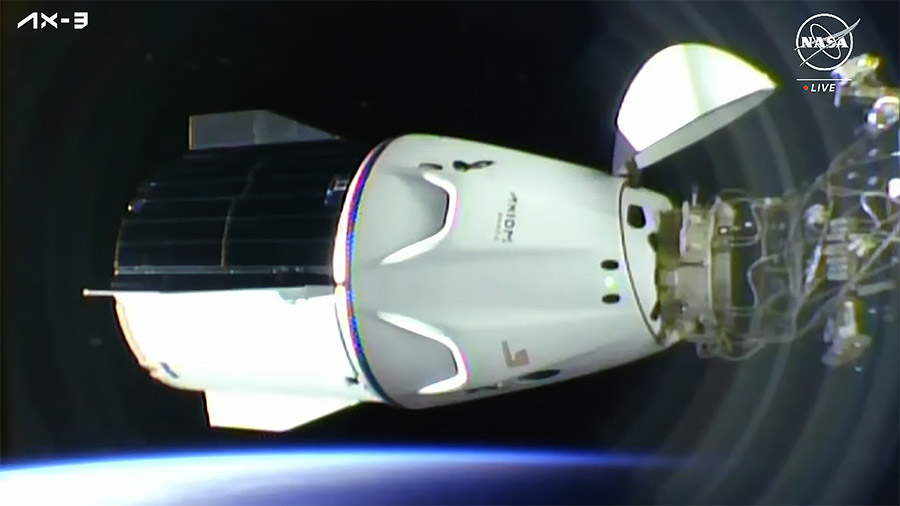
The latter took place at 10:42 UTC on Saturday, January 20th, 2024, when Freedom latched on to the forward docking port on the station’s Harmony module and pulled into for a hard dock. 90 minutes later, with post-flight checks completed and the AX-3 crew able to change from their pressure suits to less restrictive flight wear, the hatches between station and capsule were opened, and López-Alegría led his crew out to be greeted 7 members of ISS Expedition 70.
Freedom, complete with Axiom Space logo, contacts the docking mechanism at the forward port of the ISS Harmony module, prior to being pulled into a hard dock, January 20th, 2024. Credit: NASA TV
The mission – which is due to last some 14 days at the station – marks the sixth orbital flight for López-Alegría. He first flew in 1995 on the second mission of the US microgravity laboratory, a research module carried within the payload bay of the space shuttle prior to the development of the ISS. He subsequently flew on STS-92 and STS-113 whilst the ISS was being constructed, prior to serving as ISS mission commander for the Expedition 14 rotation in 2006-2007. He also served as the head of NASA’s ISS Crew Operations office (1995-2000) and is also a former NASA aquanaut, serving on the first NASA Extreme Environment Mission Operations (NEEMO) crew aboard the Aquarius underwater laboratory, in October 2001. Having joined Axiom in 2017, he first flew aboard Crew Dragon in the AX-1 mission in April 2022.
The remaining three AX-3 crew are all orbital rookies making their first stay in space. However, their presence on the ISS means that the station now has its largest ever international crew, with two US citizens, three Russians, a Dane, and a Japanese astronaut making up the ISS expedition crew.
We’ve got so many nationalities represented on board, and this is really symbolic of what we’re trying to do to open it up not only to other nations, also to individuals to researchers to continue the great work that’s been going on onboard the ISS for the last two decades plus.
– Michael López-Alegría
While aboard, Ax-3 crewmembers will live and work alongside the station’s current residents, performing experiments and research started with the first two Axiom missions, with a focus on human spaceflight and habitability in microgravity environments, a goal very much in keeping with international research on the station and of particular interest to Axiom Space, which plans to operate its own orbital facilities, initially docked their own modules with the ISS prior to separating them to become a dedicated orbital facility when the ISS is decommissioned in 2030.
In addition, the AX-3 crew will conduct research into AI and human health – the mission includes an experiment from Turkey called Vokalkord, which uses AI algorithms to diagnose several dozen diseases by analysing a cough or someone’s speech -; experiments with high-strength alloys, with implications for in-space construction and assemblies as well as other biology and physics-related work.
China’s SpaceX? Sort-of, But Not Exactly
The Zhuque-3 VTVL-1 test article during it’s first lift-off / landing test at the Jiuquan spaceport, China, January 19th, 2024. Credit: Landspace
A glance at the image above might initially suggest it is one from the history books: an early flight test of the Falcon 9 reusable first stage out of SpaceX’s flight test centre at McGregor, Texas. However, the landscape isn’t entirely in keeping with that of McLennan and Coryell counties, Texas, whilst a closer look at the booster might reveal something of the truth, thanks to the large red flag painted thereon.
The craft is in fact the Zhuque-3 vertical take-off, vertical landing unit 1 (VTVL-1), a test article developed by Chinese private sector launch start-up Landspace. It is intended to pave the way for a semi-reusable launch vehicle called Zhuque-3 (“Vermillion bird-3”), which is intended to have the same overall launch capabilities as Falcon 9 (up to some 21 tonnes to low-Earth orbit (LEO) when flown fully expendable, and between 12.5 and 18.4 tonnes when the first stage is to be re-used). However, to call it an outright “Falcon 9 clone”, or a “copy” of SpaceX’s work would not be strictly accurate.
Whilst there is much about Falcon 9 which likely influenced the Zhuque-3 design, the fact is that its looks are as much about the old axiom, form follows function, as much as any “copying” of SpaceX; the overall design and appearance of the booster and its landing legs are simply the result of their form being the most logical to meet the requirements of their functionality (hence why, in aircraft design, for example, vehicles designed for a specific task by different nations can often end up appearing quite similar, even if not direct copies).
Similarly, and while SpaceX fans have pointed to Landspace also “copying “SpaceX in the use of stainless steel for the rocket and the use of methlox – liquid methane/liquid oxygen – engines (all of which are used by SpaceX in their Starship / Super Heavy combination), the fact is that the Chinese commercial space sector has been dabbling in methlox propellants since around 2015, pre-dated Starship development, whilst the use of stainless steel in the Zhuque-3 rocket is perhaps more the result of Landspace already having experience in fabricating rocket cores out of it via their operational Zheque-2 launch vehicle than any attempt to copy someone else’s work. While also is not to say that SpaceX haven’t cut a path that other companies around the world can follow.
The first (expendable) launch of Zhuque-3 is expected in 2025, and will mark a further expansion of China’s commercial space sector, in which Landspace is just one of a number of companies developing or operating launch systems and developing semi-reusable launchers. Just how much competition there is already in the market is perhaps illustrated by the fact that some news agencies reported on the Zhuque-3 test flight by using video footage of the second test carried out by China’s iSpace company of their Hyperbola-2 VTVL test vehicle, which took place in December 2023!
Such is the broad and rapid pace of reusable booter development in China’s commercial space sector, footage similar to this video showing the first VTVL test of the iSpace Hyperbola-2 booster VTVL test article (and which I covered at the time), was mistakenly used by some news outlets to report on the January 19th Zhuque-3 VTVL test. Video credit: iSpace via SciNews
Overall, the Chinese commercial market is as richly diverse as the developing commercial space sector in the US, and with China enjoying good trade relations with a number of Asian countries looking to develop space-based capabilities, there is good potentially for interest in using these vehicles to gain something of an international footprint.
Three Mini Mission Updates
Peregrine Mission One
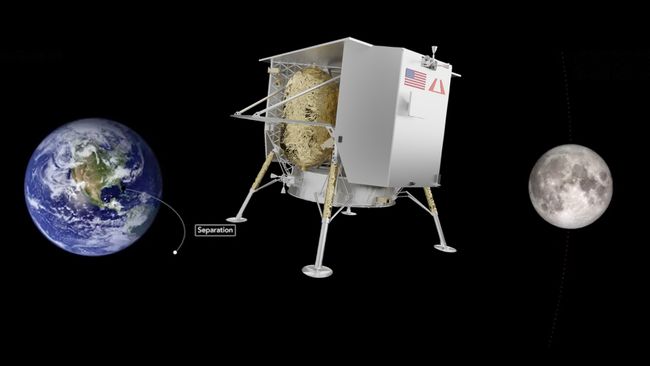
Astrobotic’s Peregrine Mission One (aka Peregrine or Peregrine One), is now officially over. As I’ve previously reported, the NASA-funded private mission to put a lander on the surface of the Moon under the agency’s Commercial Lunar Payload Services (CLPS) programme, got off to a flying start with a January 8th, 2024 ride to TLI (trans-lunar injection) aboard the maiden flight of United Launch Alliance’s Vulcan Centaur rocket. However, some time after the separation of the lander from the rocket’s Centaur upper stage, a propellant leak occurred which resulted in the lander entering an uncontrolled tumble, shifting it away from its rendezvous with the Moon and starving it of the propellants needed to make a landing even if it could get there.
The Peregrine Lander, now lost. Credit: ULA
On January 14th, the lander crossed the orbital path of the Moon, and shortly after that, gravity took over and started pulling it back towards Earth. As a result, on January 18th, 2024, the craft re-entered the atmosphere over the South Pacific, where it proceeded to burn-up. However, analysis of data returned by the craft as it headed back to Earth revealed a possible cause of the propellant system failure, as related by Astrobotic CEO John Thornton during a press briefing on January 18th:
The valve separating the helium and oxidiser in the lander’s propulsion system did not re-seal properly. This allowed a rush of helium to enter the oxidiser tank, raising the pressure to the point where the tank ruptured.
This knowledge actually helped in securing the lander’s final demise: by characterising the nature and direction of the leak, together with the rate of loss of remaining gases, flight engineers were able to put the lander into a more controlled entry into the atmosphere, pushing itself farther over the South Pacific to avoid the risk of any components surviving re-entry from falling over land masses.
Despite the loss, Astrobotic remain upbeat about their next lunar mission – again supported by NASA – which will hopefully see the company’s Griffin lander deliver NASA’s VIPER rover to the Moon in 2024.
Japan’s “Sniper” Achieves Lunar Landing But Not Without Issues
Meanwhile, Japan became the 5th country to successfully land a spacecraft on the Moon when their Smart Lander for Investigating Moon (SLIM) touched-down near Shoji Crater close the Moon’s equator at 15:20 UTC on January 19th, 2024 (00:20 on January 20th, Tokyo time).
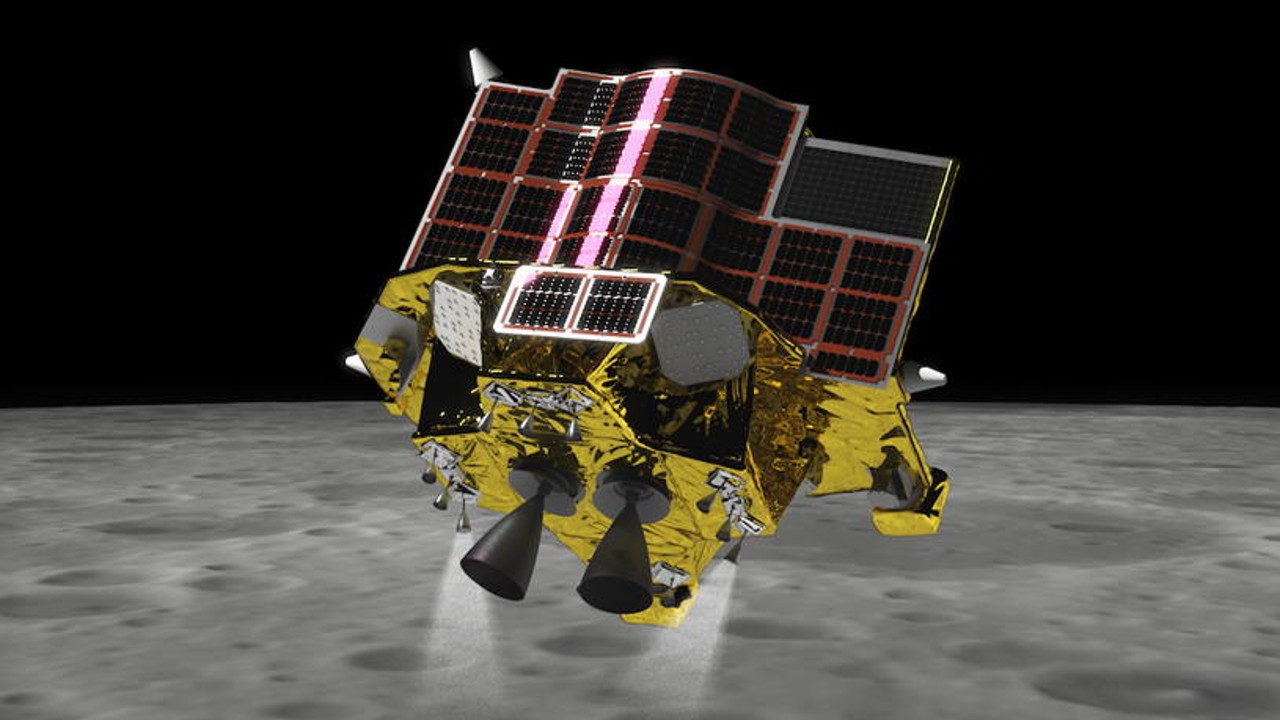
Launched in September 2023 alongside Japan’s X-Ray Imaging and Spectroscopy Mission (XRISM), SLIM – nicknamed “Moon Sniper” – took a leisurely trip to the Moon, spiralling slowly away from Earth to enter lunar orbit on Christmas Day 2023, orbiting the Moon at an altitude of just under 600 km. The orbit was then eased down to around 50 km, and than further reduced to a point just 20 km above the lunar surface, where the descent proper began, curving the lander in towards its target zone. At 5 km above the Moon, the descent became vertical, with livestream telemetry showing everything to be spot-on.
An artist’s impression of Japan’s SLIM lander descending towards the surface of the Moon. Credit: JAXA
At 50 metres above the surface, the vehicle translated in flight, moving horizontally to position itself directly over a pre-planned landing point, before descending to a successful soft-landing. It was this final manoeuvre which formed one of the key goals for the mission. Usually, landing zones for robot vehicles are planned well in advance and encompass elliptical areas around 10 km wide and a couple of dozen in length. However, SLIM carried modified facial recognition software which allowing it to monitor its descent and adjust its position autonomously by matching surface features scanned by its cameras with high-resolution images of the landing site stored in its navigation system. At 50 metres, the craft was able to confirm its desired landing point – an area just 100 metres across by contrast to normal landing zones and then manoeuvre itself to a landing with it.
But while the landing was successful, it became clear something was wrong; there was no sign that the battery system powering the craft was receiving energy from the lander’s solar array. After investigating the issue for a number of hours, engineers at the Japan Aerospace Exploration Agency (JAXA) concluded that while SLIM had landed within the desired zone, for some reason its wasn’t correctly oriented for its solar array to receive sunlight, leaving it trapped on battery power, which would expire within hours.
Prior to completely exhausting the battery, attempts were made to put the lander in a dormant mode, the hope being that as the Moon moves in its orbit over the next few days, sunlight will fall onto the lander’s solar array, and power will start to be generated, allowing to to wake itself up and start surface operations.
A Model of the tiny LEV-2 lunar rover, called SORA-Q, in its spherical form. The 250 gram rover is equipped with camera systems (the yellow/tan elements visible inside it), and can change shape by opening its two halves to form a more cylindrical shape. It was designed to operate independently of the SLIM lander for around 2 hours after landing, but at the time of writing, it is not clear what data, if any had been received from it. Credit: JAXA / Doshisha University / Sony
While both of the mini-rovers – LEV-1 and LEV-2 are thought to have successfully reached the surface of the Moon, at the time of writing, their status is unknown.
Even if the lander cannot recover itself with the aid of sunlight, SLIM is a very successful mission: demonstrating the means to make landings on other bodies with near pinpoint accuracy will be of vital importance in unfolding efforts to explore and develop the Moon and to further explore Mars both robotically and (eventually) with human missions.
Ingenuity Suffers Communications Glitch
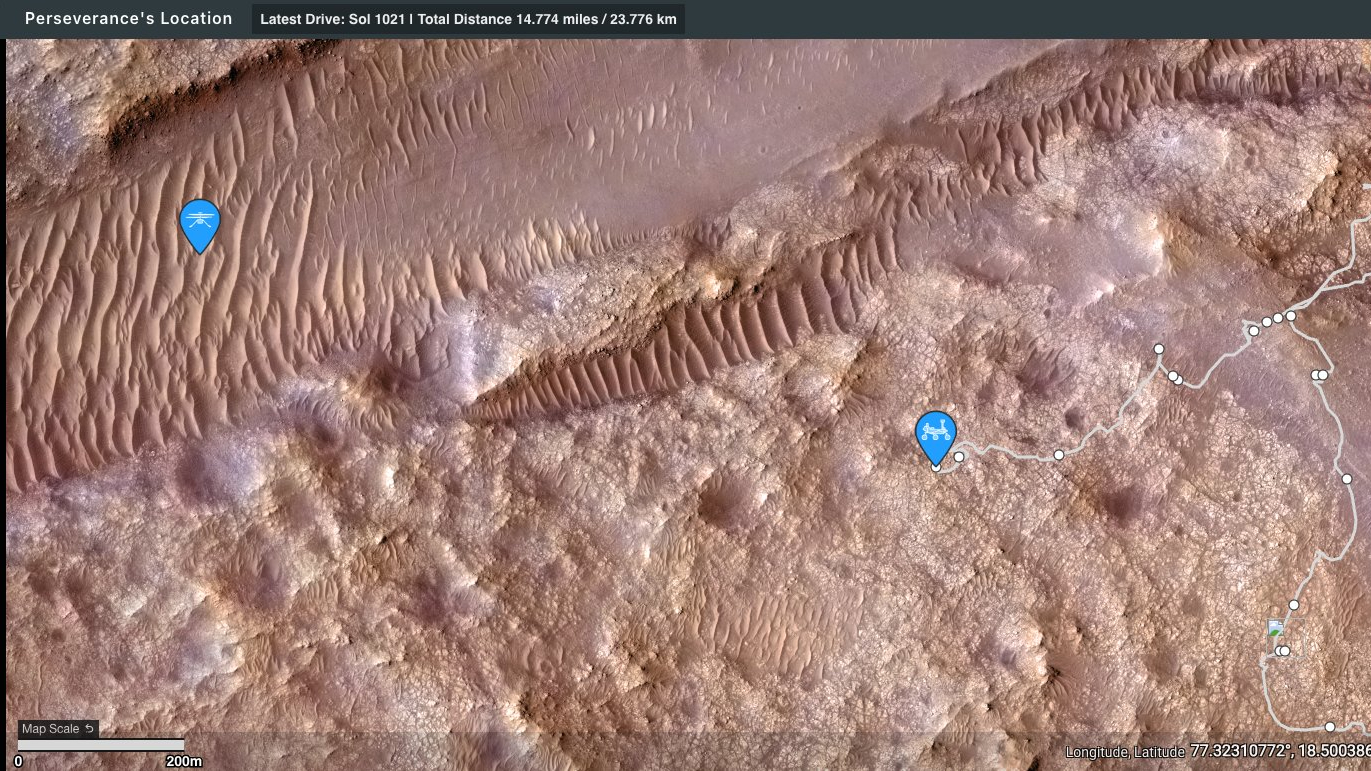
NASA’s Mars Helicopter Ingenuity completed its 72nd flight on January 18th, 2024, but not without incident. Lifting-off from sand dunes some 800-900 metres from the Mars 2020 rover Perseverance, the helicopter was engaged in a brief “pop-up” test flight intended to see it climb vertically to 12 metres altitude, hover, and then descend back to a landing.
Telemetry received via the rover indicated that the first elements of the flight were successful – but all contact was lost during the descent phase. For a time it was unclear if the use was a communications drop-out, or something more drastic, and with Perseverance out of direct line-of-sight with the helicopter, determining which was initially difficult.
In recent flights Ingenuity has been ranging ahead of the rover, acting as an airborne scout for possible driving routes. At the end of its 71st flight, the helicopter suffered a slight issue, causing a premature landing somewhat further than planned from the rover; as a result this flight was to confirm all flight systems and software were operating nominally, prior to resuming normal operations and allowing the helicopter to come back closer to the rover.
Following the loss of signal, telemetry was reviewed to see if it revealed any indication of a serious issue and possible vehicle loss. None was found, so engineers determined it was likely a comms problem and ordered Perseverance to change its communications parameters and lengthen the time periods it listens for Ingenuity’s transmissions.
The relative positions of Ingenuity and Perseverance, January 19th, 2024. Credit: NASA/JPL
As a result, in the early hours of January 21st (UTC), communications were once again established, allowing more data on the final phase of the flight to be relayed to Earth for study. Currently, Ingenuity remains grounded, and mission planners are considering ordering Perseverance to drive a point where it can see Ingenuity to allow for a visual inspection of the helicopter.









 Inara Pey: Living in a Modemworld