
With the ending of a year comes the start of another and with it an opportunity to take a look at some of what I consider to be the notable space events of 2024.
Space Missions
India
2024 is scheduled to get off the pad with the January 1st launch of the India Space Research Organisation’s (ISRO) X-ray Polarimeter Satellite (XPoSat), another ambitious mission designed to further demonstrate India’s ability to stand alongside the likes of the United States, China an the European Space Agency at the forefront of space science.

XPoSat’s 5-year primary mission lifespan of 5 years is to study cosmic ray polarisation by observing the 50 brightest known sources in the universe, including pulsars, black hole X-ray binaries, active galactic nuclei, neutron stars and non-thermal supernova remnants using its two primary instruments. Studying how radiation is polarised gives away the nature of its source, including the strength and distribution of its magnetic fields and the nature of other radiation around it.
January 7th should see India’s Aditya-L1 solar observatory, launched in September 2023, enter its operational halo orbit at the L1 Lagrange Point, located between the Earth and Sun at some 1.5 million kilometres from Earth. Once in place, it will spend an initial 5 years carrying out continuous observations of the solar atmosphere and study solar magnetic storms as they develop, together with their impact on the environment around the Earth.
In February, the most expensive Earth observation satellite should launch. The NASA-ISRO Synthetic Aperture Radar (NISAR) is intended to observe and understand natural processes on Earth, and will be able to observe both of the planet’s hemispheres over a period of at least 3 years. Intended to measure some of the planet’s most complex natural processes, including ecosystem disturbances, ice-sheet collapse, and natural hazards such as earthquakes, tsunamis, volcanoes and landslides, NISAR data will be made globally available within days of it being gathered – or in near-real time should it detect any natural disaster, so that agencies and organisations responsible for disaster relief might use the information in their planning and operations.
Also scheduled for the first quarter of 2024 is the first uncrewed test flight of India’s Gaganyaan space vehicle. Designed to carry crews of two or three into orbit, the capsule and its service / propulsion module, will be capable of spending up to 7 days at a time in orbit, and is the formative part of an ambitious programme to establish a national space station in orbit and send crews to the lunar surface.

Depending upon its outcome, the fully automated, 2-day Gaganyaan-1 mission could be followed before the end of the year by two further test flights, at least one (if not both) will include Vyommitra (from Sanskrit: vyoma, “space” and mitra, “friend”), a complex robot in the form of a female human upper body.
Initially intended to assess the effects of g-forces and weightlessness on humans flying in Gaganyaan, Vyommitra could in fact play an active role in crewed flights as well in place of a third person. It is not only programmed to speak Hindi and English, recognise various humans and respond to them, it can perform multiple mission-related tasks, including environment control and life support systems functions, handle switch panel operations, and give environmental air pressure change warnings.
Once the 3 uncrewed flights have been completed, the first crewed flight of Gaganyaan is set to occur in 2025, and if successful will mark India as only the fourth nation in the world to independently fly crews to orbit after Russia, the United States and China.
Finally (for this article that is – India has a number of other missions planned for 2024), at the end of the year, ISRO should launch their Venus Orbiter Mission, unofficially known as Shukrayaan (from the Sanskrit for Venus, “Shukra”, and yāna, craft”/ “vehicle”). Intended to study the atmosphere and surface of Venus, the mission will include an “aerobot” balloon it will release into the Venusian atmosphere.
United States – NASA
NASA obviously has a lot going on all the time, so the following really is an abbreviated “highlights” list.
In February, the remarkable Juno vehicle will complete the second of 2 extremely close approaches (both to 1,500 km) to Jupiter’s innermost Galilean moon, Io. These very close flybys (the first having occurred on December 30th, 2023) allow the probe to observe the most volcanically active place in the solar system in extraordinary detail, with the February flyby also allowing the spacecraft to reduce its orbital period around Jupiter and its moons to just 33 days.
Another mission to Jupiter will commence in 2024, with the October launch of NASA’s Europa Clipper at the start of a 5.5 year cruise out from Earth to Jupiter, with assistance from Mars and Earth (in that order) to get there. Once in orbit about Jupiter in 2030, the mission will commence a 4-year primary study of the icy moon of Europa to help scientists better characterise the moon, including the potential for it have an extensive liquid water ocean under its icy crust.

In terms of NASA’s human spaceflight operations and ambitions, 2024 should see three landmark flights:
- April 2024 should see the first test flight of Dream Chaser Cargo to the International Space Station (ISS). An automated space plane which is launched via rocket (generally the ULA Vulcan Centaur) but lands like a conventional aircraft, Dream Chaser is intended to deliver up to 5.5 tonnes of cargo (pressurised and unpressurised) to the ISS, although for this first flight, the Dream chaser Tenacity will be limited to 3.5 tonnes. The flight will be the first of at least six the Dream Chaser system will make in support of ISS operations through until 2030, carrying both supplies to, and equipment and experiments from, the space station.
- April 2024 should also see the long-overdue Crewed Flight Test (CFT) of Boeing’s CST-100 Starliner to the ISS. The eight-day mission is due to see test pilots Butch Wilmore and Suni Williams fly the reusable capsule to a rendezvous and docking with the space station. If successful, the mission will clear the way for operational flights of the Starliner vehicles carrying around 4 people at a time to the ISS from 2025 onwards.
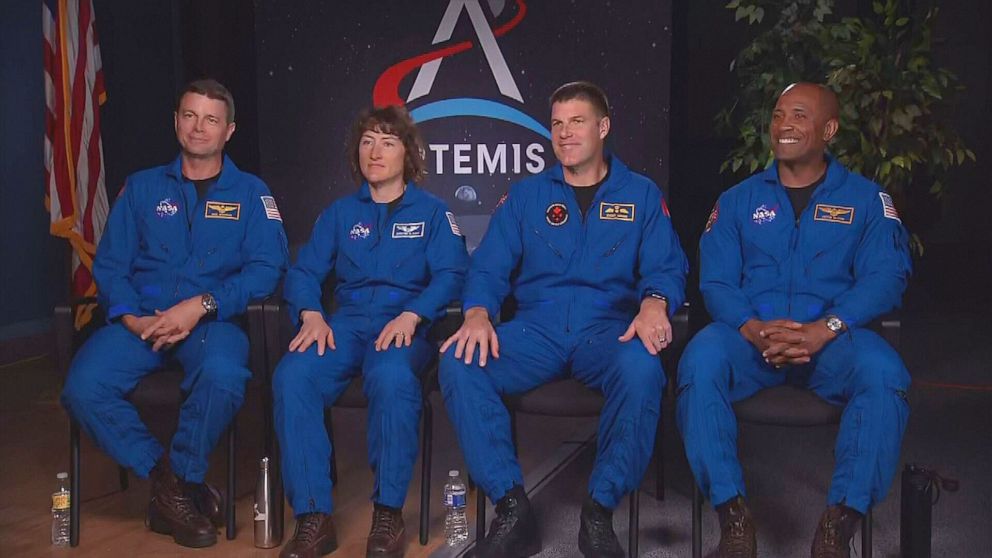
- Artemis-2 . Targeting an end-of-year launch, this mission – officially referred to Artemis Exploration Mission 2 (EM-2) will return humans to the vicinity of the Moon for the first time since 1972 and Apollo 17. Utilising the third Orion Multi-Purpose Crew Vehicle (MPCV), Orion CM-003, the 10-day mission will see the four-person crew of Americans Reid Wiseman, Victor Glover, Christina Koch and Canadian Jeremy Hansen launched on a flight that will loop them around the Moon, with Glover and Koch respectively becoming the first person of colour and first woman to fly in space beyond low Earth orbit. The focus of the mission is to carry out multiple tests of the vehicle in preparation for the commencement of missions to return humans to the surface of the Moon with Artemis 3, officially targeting at end of 2025 launch date, but more realistically slated to fly no earlier than early-to-mid 2026.
The US, with the largest share of the commercial spaceflight market will also see numerous private venture missions – some in support of NASA’s lunar exploration ambitions – take place. For me, the most notable commercial flights taking place in 2024 are:
- January 8th, 2024: the maiden flight of the Vulcan Centaur rocket. The new workhorse launch vehicle for United Launch Alliance (ULA), this first flight will hopefully see the much-delayed launcher send the Peregrine Lander to the Moon. Also a private development (by Astrobiotic Technologies) the Peregrine Mission One has been funded under NASA’s Commercial Lunar Payload services (CLPS) programme to deliver science and technology payloads to the Moon. If successful, the launch should be the first of 7 Vulcan Centaur launches for the year on behalf of NASA, the US military and commercial customers.
- August 2024: the maiden flight of Blue Origin’s heavy lift launcher, New Glenn. With a first stage designed to be reused up to 10 times, New Glenn is intended to be Blue Origin’s entry into commercial and government-funded space launch operations, capable of delivering large payloads to a range of orbits around Earth and sending them into deep space. For its first flight, New Glenn will be responsible for sending NASA’s EscaPADE (Escape and Plasma Acceleration and Dynamics Explorers) orbiters to Mars.
- Starship IFT-3: the third attempt by SpaceX to achieve a semi-orbit around Earth with their controversial-come-questionable Starship / Super Heavy launches combination. The exact date for the attempt is unknown given the on-going investigation into the failure of the second integrated flight test and the further loss of both vehicles.
- Polaris Dawn: the first in a trio of privately-funded crewed orbital missions utilising the tried and trusted SpaceX Crew Dragon. Spearheaded by billionaire Jared Isaacman (who funded and flew the Inspiration4 flight in September 2021), the mission will feature Isaacman and three others – form USAF fighter pilot Scott “Kidd” Poteet and SpaceX employees Sarah Gillis and Anna Menon – none of whom are professional astronauts. As will as carrying out a range of experiments and raising money for St. Jude’s Children’s Research Hospital in Memphis, Tennessee, the mission will attempt to set to records: become the highest Earth-orbiting crewed spaceflight to date (1,400 km above the Earth) and perform the first ever commercial spacewalks, utilising EVA suits designed and developed by SpaceX.
European Space Agency
The European Space Agency hopes to finally launch its Ariane 6 booster on its maiden flight around the middle of the year. Another launcher development programme that has had its share of issues, Ariane 6 is intended to replace the already retired Ariane 5 as ESA’s workhorse medium-to-heavy lift carrier, capable of achieving all of the common Earth orbits with payloads of up to 21.6 tonnes (LEO) and able to lob up to 8.6 tonnes into a lunar transfer orbit (LTO). The maiden flight will see the vehicle hopefully deliver an international mix of government and private missions to LEO in a rideshare arrangement, and will be followed by a French space agency / defence agency mission before the end of the year.

Later in 2024, ESA will utilise a SpaceX Falcon 9 booster to send its Hera spacecraft to rendezvous with the binary asteroids Didymos and Dimorphos, which it is scheduled to do in December 2026, 26 months after launch. Once there, Hera’s primary focus of study will Dimorphos, the target of NASA’s DART Impactor mission, which slammed into it in September 2022 in an attempt to assess the theory of kinetic impact as a means to deflect an asteroid on a collision course with Earth. As well as examining the physical aftermath of DART’s impact on Dimorphos, Hera will attempt to characterise both asteroids in detail, land two cubesats – Milani and Juventas on Dimorphos before itself attempting a landing on Didymos at the end of its mission.
2024 will also see the launch of the joint ESA-JAXA (Japan Aerospace Exploration Agency) EarthCARE (Cloud, Aerosol and Radiation Explorer) mission, designed to investigate the role that clouds and aerosols play in reflecting incident solar radiation back into space and trapping the infrared radiation emitted from Earth’s surface to better understand the evolution of Earth’s temperature.
Japan
Japan hopes to join the “league of lunar nations” on January 19th, 2024, when its Smart Lander for Investigating Moon (SLIM) should touchdown near a small lunar impact crater called Shioli located within the much larger Cyrillus crater on the near side of the Moon. Launched alongside the nation’s X-Ray Imaging and Spectroscopy Mission (XRISM) in September 2023, SLIM achieved orbit around the Moon on Christmas Day 2023, and will attempt its landing using software based on facial recognition code. This will (in theory) enable it to identify craters and other features during its descent towards the landing zone and adjust its course accordingly, so that it makes a precise landing.
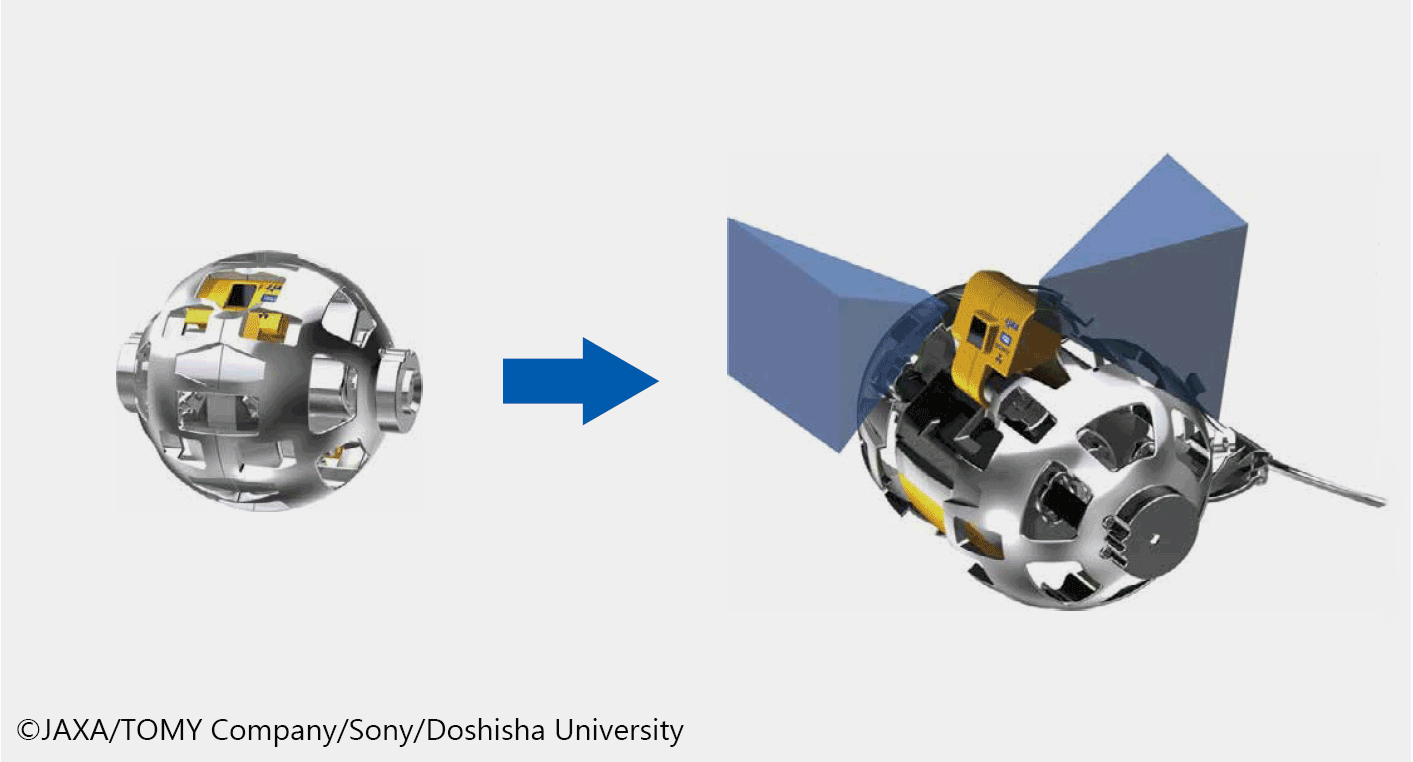
Once on the surface, the lander will operate both on its own and deploy two micro-rovers, Lunar Excursion Vehicle 1 (LEV-1), a “hopper”-style vehicle capable of communicating with Earth independently of the lander, and Lunar Excursion Vehicle 2 (LEV-2) or Sora-Q, a unique little 250 gram rover which can physically change its shape.
Note: in the run-up to Christmas 2023, multiple media outlets reported that Japan would be launching its Martian Moons eXploration (MMX) mission to study both Deimos and Phobos (respectively the outer and inner moons of Mars) and collect samples of the later for return to Earth for analysis. However, the launch of this mission has in fact been postponed until 2026.
China
The Chinese will continue their space activities across multiple fronts throughout 2024, including further activity within their small, but growing commercial space sector as well and their government-backed activities with their emphasis near-Earth human spaceflight, lunar exploration, astronomy and robotic missions.

In particular 2024 will see the launch of Chang’e 6, the sixth of the nation’s robotic lunar explorers, and the most complex mission they’ve undertaken to date.
The 8.2-tonne mass, 4-segment vehicle comprising a propulsion module, an Earth-return capsule, a lander and an ascent vehicle, is due to be launched in May 2024 from Wenchang Satellite Launch Centreon Hainan Island.
On arrival in lunar orbit, the lander / ascent vehicle will attempt a soft-landing on the lunar far side on the edge of the Apollo Basin within the South Pole-Aitkin (SPA) impact basin, itself the target of future human missions to the Moon.
Once there, the lander will recover some 2 kg of surface material and rock from up to 2 metres below the surface. These samples will be stored within the ascent vehicle, which will deliver them back to lunar orbit and the waiting Earth-return module, which will then bring them back to Earth for analysis. If successful, the mission will result in the first lunar samples from the far side of the Moon being returned to Earth.
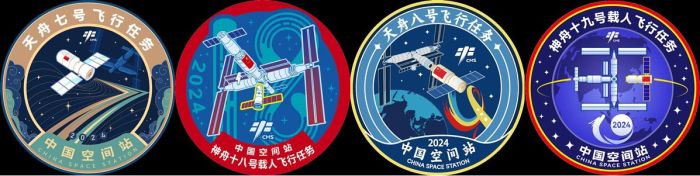
Operations will also continue on the Tiangong space station throughout the year. In all, four missions will be launched to the station, with two crews also making the return to Earth. These missions comprise:
- Tianzhou 7, an automated resupply vehicle will deliver up to 7.4 tonnes of supplies and equipment to the space station early in 2024, in readiness for the first crew rotation for the year. Currently, the vehicle is at Wenchang Satellite Launch Centre undergoing integration and testing with its Long March launch vehicle, but a target launch date has yet to be announced / confirmed.
- In May, Shenzhou 18 is set to deliver the next three-person crew to the space station at the start of a 6-7 month rotation. They will briefly share the facilities with the crew of Shenzhou 17 during a week-long handover period, before the latter return to Earth.
- Later in the year, and in a repeat of the above, Tianzhou 8 will deliver further supplies and equipment to Tiangong, and in November the 3-person crew of Shenzhou 19 will arrive at the station to take over from the Shenzhou 18 crew, who will return to Earth following a hand-over.
Again, at the time of writing no details on the crews for either Shenzhou mission have been released by the Chinese military.
And There’s Still More
The above clearly doesn’t cover all of the various comings and goings at the ISS in terms of crew rotations and resupply missions (outside of Dream Chaser) – many of which make up a good portion of Russian space activities for 2024; or all the various government and commercial satellite launches, or operations planned for all the other deep space missions currently underway. But, were I to try to list everything this article would turn into a cure for insomnia! So I’ll simply turn to the final topic for consideration here.
Astronomy
Well, there will inevitably be a lot going on here as well, both in terms of astronomical events and the finding from our various observatories and the multiple institutions around the world delving into the data and images those observatories are providing. So, this being the case, I’m instead going to simply leave you with a calendar of astronomical events taking place throughout the year – note all times given are in UTC, and my thanks to the folk at In the Sky for making it possible for this calendar to be included here.

 Inara Pey: Living in a Modemworld
This is the perfect time, I guess, to thank you for this column in your blog. Without your Space Sundays, what would I know about space exploration? Nothing. It’s not inside an average housewife’s scope to care about these things. Thanks to you I know at least a little bit, what country has what project going, what kinda vehicles are circulating what planets and how far humanity as a whole had ventured out into space.
I grew up knowing exactly space is dark, and vast, cold and … boring. Thanks for proving me wrong.
LikeLike
Thank you, Orca. I’d always had a passing interest in spaceflight (I’m both a sci-fi reader / watcher + got into astronomy by way of my father, who was also very into space exploration). Being able to witness various launches – notably the space shuttle – first hand, probably also helped! Anyway, hope to keep you informed of things through the coming year in the missions and event mentioned above, and by looking at other activities / events as well!
LikeLike