
Just a week after the passing of Apollo astronaut Ken Mattingly (see: Space Sunday: Remembering Ken Mattingly), came the news that another pioneering hero of spaceflight, Frank Borman, had passed away at the age of 95.
Born in Gary, Indiana on March 14, 1928 as the only child of Edwin Otto and Marjorie Borman, Frank Frederick Borman II considered Tucson, Arizona to be his home town after his family moved there whilst he was very young in order to ease the numerous sinus and mastoid problems he suffered in the colder, damper environment of Indiana.
By the age of 15 and in the mid-1940s, he was playing football for the high school team and, thanks to local flight instructor Bobbie Kroll, who took a shine to his enthusiasm for aviation, he has his student’s flying certificate and was a member of a local flying club. His aim was to levering his football playing into a scholarship so he might attend an out-of-state university offering a good course in aeronautical engineering.
Unfortunately, this did not work out and with graduation approaching and his family unable to afford to send him to a suitable university, he determined he’s have to enlist in the Army and later use his right to a college tuition under the GI Bill. However, a family friend persuaded local congressman Richard F. Harless to add Borman’s name to a list of nominees he was going to put forward for a slot at the US Military Academy, West Point.

Despite having little chance of being offered the slot – his was the fourth and last name on the list, after all – Borman took the entrance exam, and passed. Shortly afterwards, hostilities in the Pacific ended, and astoundingly, those on the list ahead of him opted to forego military service, gifting the slot to him.
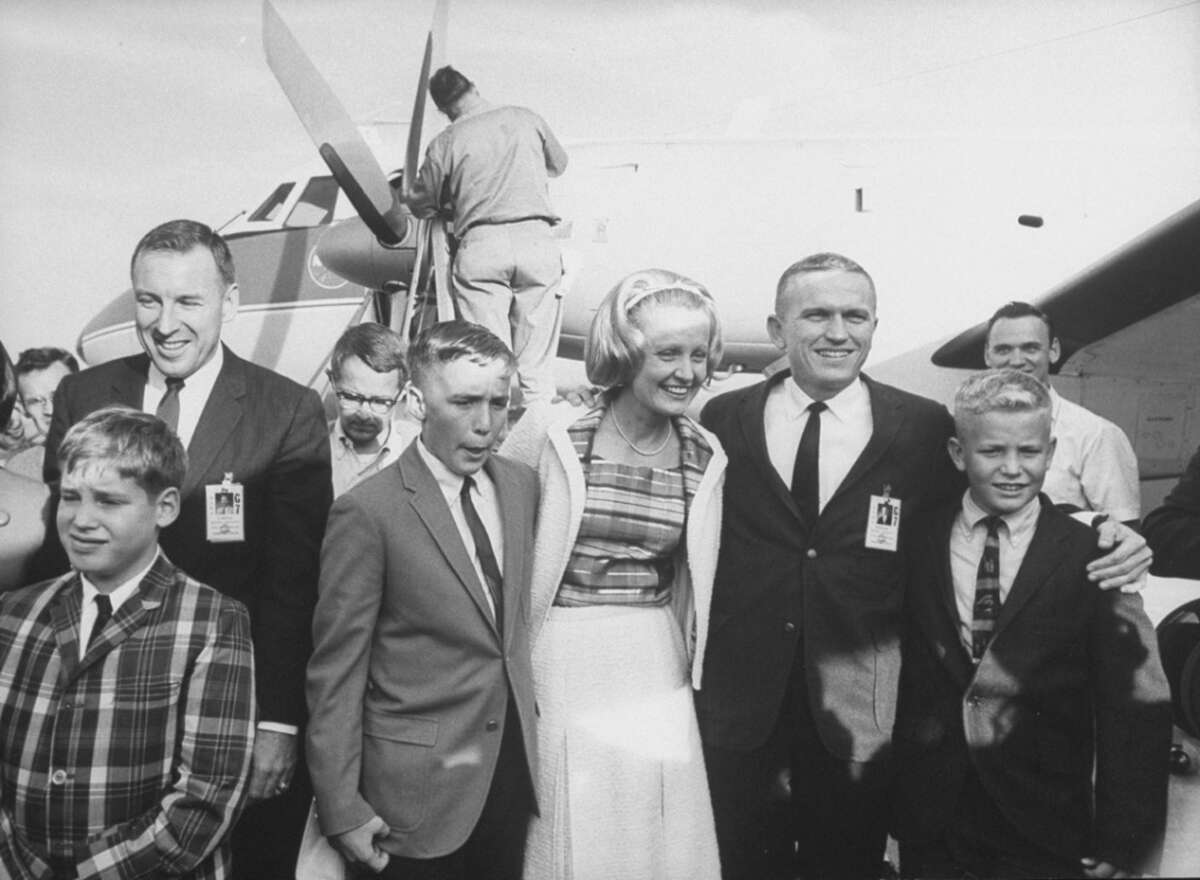
Graduating West Point in June 1950, Borman returned home to Tucson on leave prior to commencing his formal basic training. Whilst there, he arranged to meet Susan Bugbee, whom he had dated in high school. She had recently graduated from the University of Pennsylvania with a degree in dental hygiene. Rekindling their relationship, they were married on July 20th, 1950.
Achieving his goal of training as a fighter pilot, Borman attended combat flight school throughout most of 1951, based at Nellis Air Force Base, Nevada. Whilst there, Susan gave birth to their first son, Frederick Pearce Borman, in October of that year. Two months later, Borman found his flying career potentially shattered after he suffered a perforated eardrum whilst on a dive bombing training flight and doctors grounded him indefinitely as a result.
It took him a year to convince his seniors his ear had healed without any danger of further ruptures, and he was capable of flying. During that time, he was assigned to ground duties at Clark Air Base in Philippines, where Susan gave birth to their second son, Edwin Sloan.
By 1960 and with a Masters degree under his belt – which he obtained in just a year rather than the usual 3 – Borman had been back in the pilot’s seat for eight years, clocking up some impressive experience, all of which resulted in his selection for training USAF Experimental Flight Test School. Graduating from it April 1961, he was immediately selected as one of five Air Force students to attend the first class at the Aerospace Research Pilot School. However, NASA also announced they were seeking nine candidates for their second astronaut intake, so Borman, along with fellow student James McDivitt and instructor Thomas Stafford obtained permission to apply, and all three were formally accepted as a members of the “Next Nine” (Group 2) NASA astronaut candidates in April 1962.
At NASA, Borman became known for his focus and tenacity – and for have something of an ego. He was initially selected to fly with Mercury veteran Virgil “Gus” Grissom on the first long-duration flight of Gemini. However, their pairing as the back-up crew for Gemini 3, the first Gemini Project crewed mission, led to tensions such that when astronaut chief Donald “Deke” Slayton wanted to promote both men to the prime crew slots on the mission after original mission commander Alan Shepard was diagnosed with Ménière’s disease, Grissom stated he would only fly the mission if Borman were replaced as his pilot.
Complying with the request, Slayton replaced Borman with John Young. This scored two goals: it ended the friction between Grissom and Borman and it allowed him to appoint Borman as commander of the long-duration Gemini flight – now designated Gemini 7 – with Jim Lovell as his pilot, the two getting on well together. Plans changed just two months ahead of Gemini 7’s December 1965 launch, when Gemini 6 was cancelled while the crew of Walter Schirra and Thomas Stafford were actually in their capsule preparing for launch.
The reason for this was Gemini 6 has been due to perform rendezvous and docking tests with a uncrewed Agena Target Vehicle launch just ahead of it. However, the Agena had exploded shortly after launch, leaving Gemini 6 without a docking target. However, rather than drop the mission entirely, mission planners decided Gemini 6 – re-designated as Gemini 6A – could launch a few days after Gemini 7, with Schirra and Stafford using it as their rendezvous and docking target.
Borman agreed to this change, but drew the line at any idea of the two craft physically docking; he and Lovell didn’t have the time they’d need to learn the required procedures, even if their vehicle were to be the passive element of any docking. He also mixed the idea that Lovell and Stafford should perform and joint EVA and swap vehicles, pointing out this would require Lovell to wear a Gemini EVA suit for several days, something for which it was not designed. Conceding these points, mission planners settled on the basic rendezvous idea, and Gemini 7 lifted off on December 4th, 1965, with Gemini 6A following on December 15th – three days later than planned.

During the intervening period, Borman and Lovell completed all the major aspects of their mission – which were related to matter of crew hygiene, nutrition, fitness, diet, etc., during a lunar mission – and were keen to see Gemini 6A arrive. This it did some 13 hours after launch, with Schirra initially bringing the craft alongside Gemini 7 at a distance of 40 metres before spend the next 4.5 hours performing a series of rendezvous manoeuvres, at times coming as close as 30 cm (1 ft) to Gemini 7 as he practiced docking manoeuvres and assessed flight control precision. After this, he moved Gemini 6A some 16 km away to allow both crews to get some rest without any worry their vehicles might collide.
After just over 24 hours in orbit, Gemini 6A fired its retro-rockets and re-entered the atmosphere, splashing down in the North Atlantic to be recovered by the USS Wasp. Meanwhile Borman and Lovell continued in orbit, becoming concerned as their craft started experiencing a mounting series of niggling issues and malfunctions as it started to reach the limits of its operational endurance. Despite this, both men remained in good spirits, even joking with their recovery crew – their December 18th splashdown was close enough to that of Gemini 6A that the USS Wasp was also assigned to their recovery – that they’d been together so long, the Wasp’s Captain might as well marry them!
Following the April 1 fire which claimed the lives of Grissom, Edward White and Roger Chaffee on January 27, 1967, Borman was the lone astronaut assigned to the panel charged with investigating the cause of the fire and recommending corrective measures. He played a central role in this work, one which would bring him directly into conflict with personnel at North American Aviation, the company responsible for manufacturing the Apollo Command Module, and at times also with NASA senior management. However, it was also a role that resulted in a much safer command module vehicle.
After this, he was assigned to Apollo 9, which was to be the second on-orbit flight to test the lunar module, the first being Apollo 8, scheduled for late 1968. However, when the lunar module designated for the Apollo 8 mission arrived at what was now Kennedy Space Centre in June 1968, engineers proclaimed it unsuitable for flight and requiring several hundred corrective actions, all of which push the Apollo 8 mission back almost into Apollo 9.
To avoid this, George Low, Deputy Administrator for the Manned Spacecraft Centre, suggested that Apollo 9 should be used for the lunar module test flight, and Apollo8 switched to perform a round-trip flight to the Moon, thus beating the Russian, whom the CIA claimed planning to fly an unmanned vehicle around the Moon at the end of the year. As McDivitt and his crew, who had trained extensively for the lunar module testing, wanted to say with that flight, they were swapped with Borman’s Apollo 9 crew, who were assigned to the lunar round trip – with just over four months in which to train for it.

Despite the time constraints, Borman, Lovell and William Anders trained hard for the mission, and at 12:51:00 UTC on December 21st, 1968, Apollo 8 lifted-off to start of a mission marked by a number of notable events, being:
- The first crewed flight of the Saturn V launch system
- The first crewed mission to ever leave low Earth orbit.
- The first crewed mission to enter lunar orbit.
- One of the first recorded instances of an astronaut – Borman – suffering space adaptation syndrome (SAS).
In addition the crew were the first humans to:
- Enter the gravitational sphere of influence of a celestial body other than Earth.
- Ever be entirely cut off from Earth as their vehicle passed around the Moon.
- Witness “earthrise” – the Earth rising over the limb of the Moon, something almost impossible to see from the surface of the Moon where the Earth is either above or below the horizon.
SAS is a condition now known to affect up to 50% of all astronauts during their first day in space. Humans are dependent on two systems to manage movement: their visual system and their vestibular system, which relies on gravity. Given the lack of the latter in space, both systems can send conflicting information to the brain on whether or not a person is in motion, resulting in nausea and possible vomiting until the brain can learn to suppress the signals from the vestibular system which claim the body is not in motion when the eyes and brain know it is. Because both Gemini and Mercury were so small, they didn’t afford crews the freedom of movement presented inside the Apollo craft and so the condition hadn’t really been identified during the early Apollo flights, and given that he did adjust and recover after several hours, Borman’s episode was put down to a bout of the 24-hour ‘flu.
The “earthrise” phenomenon was first witnessed as Apollo 8 came around from behind the Moon at the end of its fourth orbit. All three men were busy with various observations, with Anders taking black and white photos of the lunar surface when he happened to look up. Causing him to gasp in surprise.
Oh my God, look at that picture over there! There’s the Earth coming up. Wow, is that pretty! … You got a colour film, Jim? Hand me a roll of colour, quick, would you?
– William Anders, Apollo 8, on witnessing “Earthrise” for the first time
Taking the colour film cassette from Lovell, Ander loaded it into his camera and took the picture destined to become famous the world over, and later selected by Life magazine as one of its hundred photos of the 20th century: Earthrise.

As they rounded the Moon for the ninth time, the astronauts began their second television transmission to Earth, one with a special Christmas message the crew had prepared with the knowledge of mission control, as the transmission drew to a close, they each took turns reading verses from the Book of Genesis describing the creation of the Earth; given what they had witnessed with “earthrise” the passages seemed particularly fitting.
Apollo 8 started its return to Earth on Christmas Day, 1968. After a successful trans-Earth injection burn and a short television broadcast home, the crew discovered the first of two presents to them from “Deke” Slayton and the astronaut office at Houston. The first came in the form of a real Christmas dinner with all the trimmings, all specially packed; the second was three miniatures bottle of Brandy, which Borman ordered should remain unopened until after splashdown to avoid any alcohol-induced impairments. All three men ended up saving their bottle for years after the mission.
Splashdown took place on December 27th 1968, a total success, doing much to pave the wave for Apollo 11. For Lovell, it was to be the first of two flights to the Moon. For Anders and Borman, it was both their first and last; Anders departed NASA in May 1969 to become the executive secretary of the National Aeronautics and Space Council (NASC) at the request of President Nixon, whilst Borman had already decided to retire from both NASA and the Air Force after the mission, planning to pursue a career with Eastern Airlines.
This he did, but only after he undertook a worldwide and ultimately unsuccessful mission on behalf of President Nixon to try and rally international support for the release of US prisoners held by North Vietnam. Joining Eastern shortly after completing this tour, Borman rose from a VP position (which involved him actively participating in the recovery of survivors after the crash of Eastern Airline Flight 401 in the Florida everglades) to CEO and also chairman of the board by 1976. His hard-line approach as CEO initially saw the company return to profit for the first time in almost two decades, but it was a pyrrhic victory. With the deregulation of the airlines in 1978 leading to increasing low-cost competition, the need to reduce labour costs and update the airline’s aging, inefficient fleet, it was not long before Eastern was spiralling back into deep debt, and Borman’s attitude won him few friends amongst the board or the employees. He resigned in 1986, when the company was sold.
After this, he worked for a number of companies and market sectors prior to retiring in 1998 to run a Montana cattle ranch he and Susan purchased. Here he split his time between managing the ranch’s cattle business, indulging in his passion for building model aircraft, restoring a rare World War 2 combat aircraft and – most of all – caring for Susan, who had been diagnosed with Alzheimer’s disease and passed away in 2001.
Throughout his retirement, Borman maintained close ties with Lovell and Anders, often sharing the stage with them at events celebrating Apollo 8 and the Apollo programme. He also did much to try to encourage young people to enter the fields of science and technology. He passed away at the age of 95 on November 7th, 2023, at the Billings Clinic, Montana, after suffering a stroke. His is survived by both of his sons.

 Inara Pey: Living in a Modemworld