Logos representative only and should not be seen as an endorsement / preference / recommendation
Updates from the week through to Sunday, November 12th, 2023
This summary is generally published every Monday, and is a list of SL viewer / client releases (official and TPV) made during the previous week. When reading it, please note:
It is based on my Current Viewer Releases Page, a list of all Second Life viewers and clients that are in popular use (and of which I am aware), and which are recognised as adhering to the TPV Policy. This page includes comprehensive links to download pages, blog notes, release notes, etc., as well as links to any / all reviews of specific viewers / clients made within this blog.
By its nature, this summary presented here will always be in arrears, please refer to the Current Viewer Release Page for more up-to-date information.
Note that for purposes of length, TPV test viewers, preview / beta viewers / nightly builds are generally not recorded in these summaries.
Official LL Viewers
Release viewer version 6.6.16.6566955269, formerly the Github Actions (GHA) RC viewer, version , issued October 20, promoted October 25 – No Change.
Release channel cohorts:
glTF / PBR Materials viewer updated to version 7.0.1.6750600769, November 11.
Maintenance-W RC viewer updated to version 6.6.17.6709258523, November 9.
Fank Borman during Suiting-up for the Apollo 8 mission, December 1968. Visible but blurred in the background is his crewmate, Jim Lovell. Credit: NASA (via You Tube)
Just a week after the passing of Apollo astronaut Ken Mattingly (see: Space Sunday: Remembering Ken Mattingly), came the news that another pioneering hero of spaceflight, Frank Borman, had passed away at the age of 95.
Born in Gary, Indiana on March 14, 1928 as the only child of Edwin Otto and Marjorie Borman, Frank Frederick Borman II considered Tucson, Arizona to be his home town after his family moved there whilst he was very young in order to ease the numerous sinus and mastoid problems he suffered in the colder, damper environment of Indiana.
By the age of 15 and in the mid-1940s, he was playing football for the high school team and, thanks to local flight instructor Bobbie Kroll, who took a shine to his enthusiasm for aviation, he has his student’s flying certificate and was a member of a local flying club. His aim was to levering his football playing into a scholarship so he might attend an out-of-state university offering a good course in aeronautical engineering.
Unfortunately, this did not work out and with graduation approaching and his family unable to afford to send him to a suitable university, he determined he’s have to enlist in the Army and later use his right to a college tuition under the GI Bill. However, a family friend persuaded local congressman Richard F. Harless to add Borman’s name to a list of nominees he was going to put forward for a slot at the US Military Academy, West Point.
Borman’s official 1950 West Point yearbook photo. Via Wikipedia
Despite having little chance of being offered the slot – his was the fourth and last name on the list, after all – Borman took the entrance exam, and passed. Shortly afterwards, hostilities in the Pacific ended, and astoundingly, those on the list ahead of him opted to forego military service, gifting the slot to him.
Graduating West Point in June 1950, Borman returned home to Tucson on leave prior to commencing his formal basic training. Whilst there, he arranged to meet Susan Bugbee, whom he had dated in high school. She had recently graduated from the University of Pennsylvania with a degree in dental hygiene. Rekindling their relationship, they were married on July 20th, 1950.
Achieving his goal of training as a fighter pilot, Borman attended combat flight school throughout most of 1951, based at Nellis Air Force Base, Nevada. Whilst there, Susan gave birth to their first son, Frederick Pearce Borman, in October of that year. Two months later, Borman found his flying career potentially shattered after he suffered a perforated eardrum whilst on a dive bombing training flight and doctors grounded him indefinitely as a result.
It took him a year to convince his seniors his ear had healed without any danger of further ruptures, and he was capable of flying. During that time, he was assigned to ground duties at Clark Air Base in Philippines, where Susan gave birth to their second son, Edwin Sloan.
By 1960 and with a Masters degree under his belt – which he obtained in just a year rather than the usual 3 – Borman had been back in the pilot’s seat for eight years, clocking up some impressive experience, all of which resulted in his selection for training USAF Experimental Flight Test School. Graduating from it April 1961, he was immediately selected as one of five Air Force students to attend the first class at the Aerospace Research Pilot School. However, NASA also announced they were seeking nine candidates for their second astronaut intake, so Borman, along with fellow student James McDivitt and instructor Thomas Stafford obtained permission to apply, and all three were formally accepted as a members of the “Next Nine” (Group 2) NASA astronaut candidates in April 1962.
At NASA, Borman became known for his focus and tenacity – and for have something of an ego. He was initially selected to fly with Mercury veteran Virgil “Gus” Grissom on the first long-duration flight of Gemini. However, their pairing as the back-up crew for Gemini 3, the first Gemini Project crewed mission, led to tensions such that when astronaut chief Donald “Deke” Slayton wanted to promote both men to the prime crew slots on the mission after original mission commander Alan Shepard was diagnosed with Ménière’s disease, Grissom stated he would only fly the mission if Borman were replaced as his pilot.
Complying with the request, Slayton replaced Borman with John Young. This scored two goals: it ended the friction between Grissom and Borman and it allowed him to appoint Borman as commander of the long-duration Gemini flight – now designated Gemini 7 – with Jim Lovell as his pilot, the two getting on well together. Plans changed just two months ahead of Gemini 7’s December 1965 launch, when Gemini 6 was cancelled while the crew of Walter Schirra and Thomas Stafford were actually in their capsule preparing for launch.
The reason for this was Gemini 6 has been due to perform rendezvous and docking tests with a uncrewed Agena Target Vehicle launch just ahead of it. However, the Agena had exploded shortly after launch, leaving Gemini 6 without a docking target. However, rather than drop the mission entirely, mission planners decided Gemini 6 – re-designated as Gemini 6A – could launch a few days after Gemini 7, with Schirra and Stafford using it as their rendezvous and docking target.
Borman agreed to this change, but drew the line at any idea of the two craft physically docking; he and Lovell didn’t have the time they’d need to learn the required procedures, even if their vehicle were to be the passive element of any docking. He also mixed the idea that Lovell and Stafford should perform and joint EVA and swap vehicles, pointing out this would require Lovell to wear a Gemini EVA suit for several days, something for which it was not designed. Conceding these points, mission planners settled on the basic rendezvous idea, and Gemini 7 lifted off on December 4th, 1965, with Gemini 6A following on December 15th – three days later than planned.
Gemini 7 with Borman and Lovell aboard, as seen from Gemini 6A, shortly after their initial rendezvous, December 15/16, 1965, when the two craft are approximately 10 metres apart. Credit: NASA
During the intervening period, Borman and Lovell completed all the major aspects of their mission – which were related to matter of crew hygiene, nutrition, fitness, diet, etc., during a lunar mission – and were keen to see Gemini 6A arrive. This it did some 13 hours after launch, with Schirra initially bringing the craft alongside Gemini 7 at a distance of 40 metres before spend the next 4.5 hours performing a series of rendezvous manoeuvres, at times coming as close as 30 cm (1 ft) to Gemini 7 as he practiced docking manoeuvres and assessed flight control precision. After this, he moved Gemini 6A some 16 km away to allow both crews to get some rest without any worry their vehicles might collide.
After just over 24 hours in orbit, Gemini 6A fired its retro-rockets and re-entered the atmosphere, splashing down in the North Atlantic to be recovered by the USS Wasp. Meanwhile Borman and Lovell continued in orbit, becoming concerned as their craft started experiencing a mounting series of niggling issues and malfunctions as it started to reach the limits of its operational endurance. Despite this, both men remained in good spirits, even joking with their recovery crew – their December 18th splashdown was close enough to that of Gemini 6A that the USS Wasp was also assigned to their recovery – that they’d been together so long, the Wasp’s Captain might as well marry them!
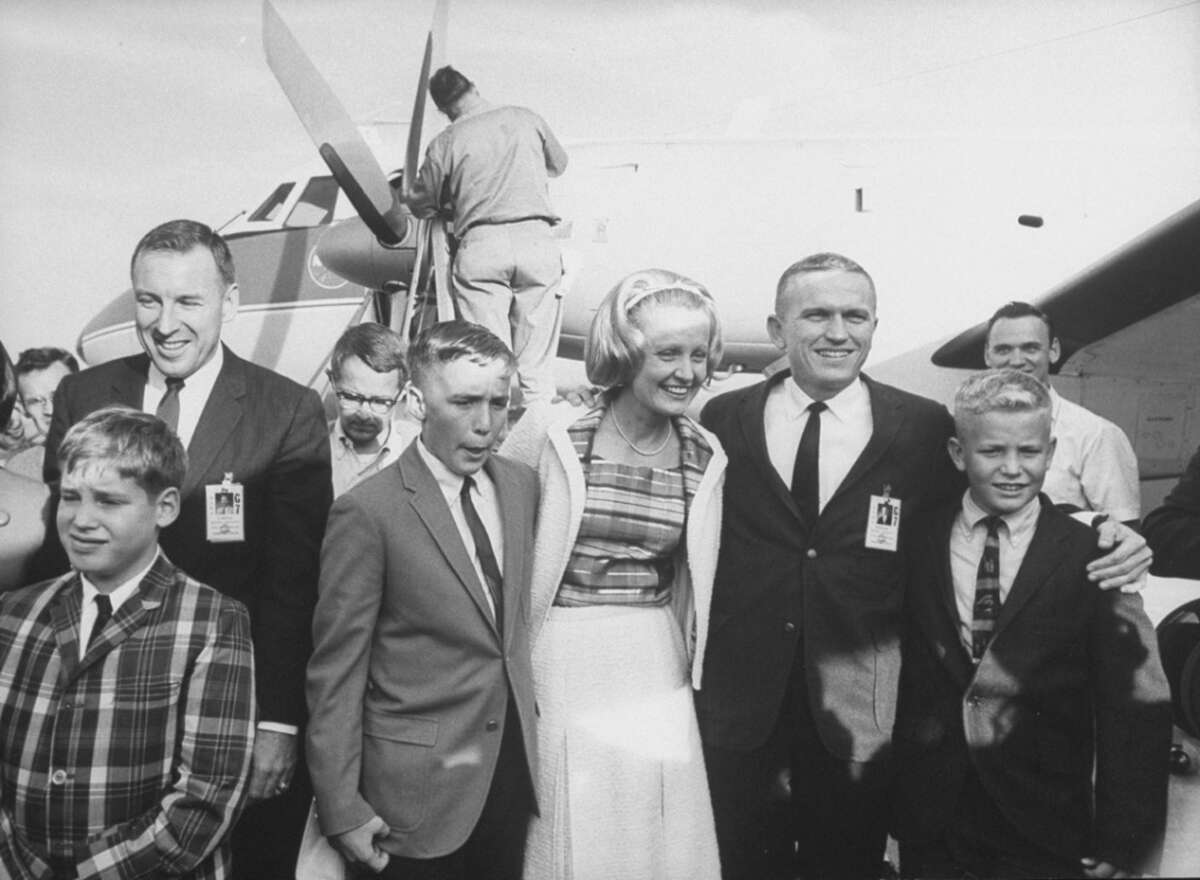
James Lovell (left, with son Jay) and Frank Borman (right, with wife Susan and sons Frederick and Edwin), following the successful flight of Gemini 7



 Inara Pey: Living in a Modemworld