
It is perhaps the unsung hero of space launch capabilities. Whilst the media focuses on its darling Falcon 9 – a vehicle which, to be sure, is innovative, successful and highly flexible -, or reflects on Russia’s veritable (if sometimes troublesome) Soyuz family, Europe’s Ariane 5 has quietly gone about the business of lifting payloads to various orbits and a deep space missions for 28 years, barely coming to prominence in the news, unless in exceptional circumstances. Such as on the occasion of its final flight, as has been the case this past week. This is a shame, because the Ariane 5 project has been remarkably successful.
First flown in 1996 as the latest iteration of the Ariane family, the rocket’s history goes back to the 1970s, when an Anglo-French-German project was established to develop a new commercial launch vehicle for Western Europe. Christened “Ariane” – the French spelling of the mythological character Ariadne – the project became largely French-driven but within the auspices of the European Space Agency (ESA). The latter charged Airbus Defence and Space with the development of all Ariane vehicles and all related testing facilities, whilst CNES, the French national space agency, spun-up a commercial operation called Arianespace – in which they retain around a 32.5% stake – to handle production, operations, marketing and launches of the Ariane family, the latter being made out of Europe’s Spaceport, aka the Guiana Space Centre at Kourou in French Guiana.
Arianespace was the world’s first commercial launch provider, initially offering customer launches atop the evolving family of Ariane vehicles, commencing with Ariane 1 in 1979. Then, from 2003 through 2019, then partnership with Russia to provide medium-lift launch capabilities utilising the Soyuz-ST payload carrier under the Arianespace Soyuz programme, becoming the only facility to operate Soyuz vehicles outside of Russia (until the latter’s invasion of Ukraine brought the partnership to an end). In 2012, Arianespace further supplement its range of capabilities by adding the Italian-led Vega small payloads vehicle to their launch vehicle catalogue.
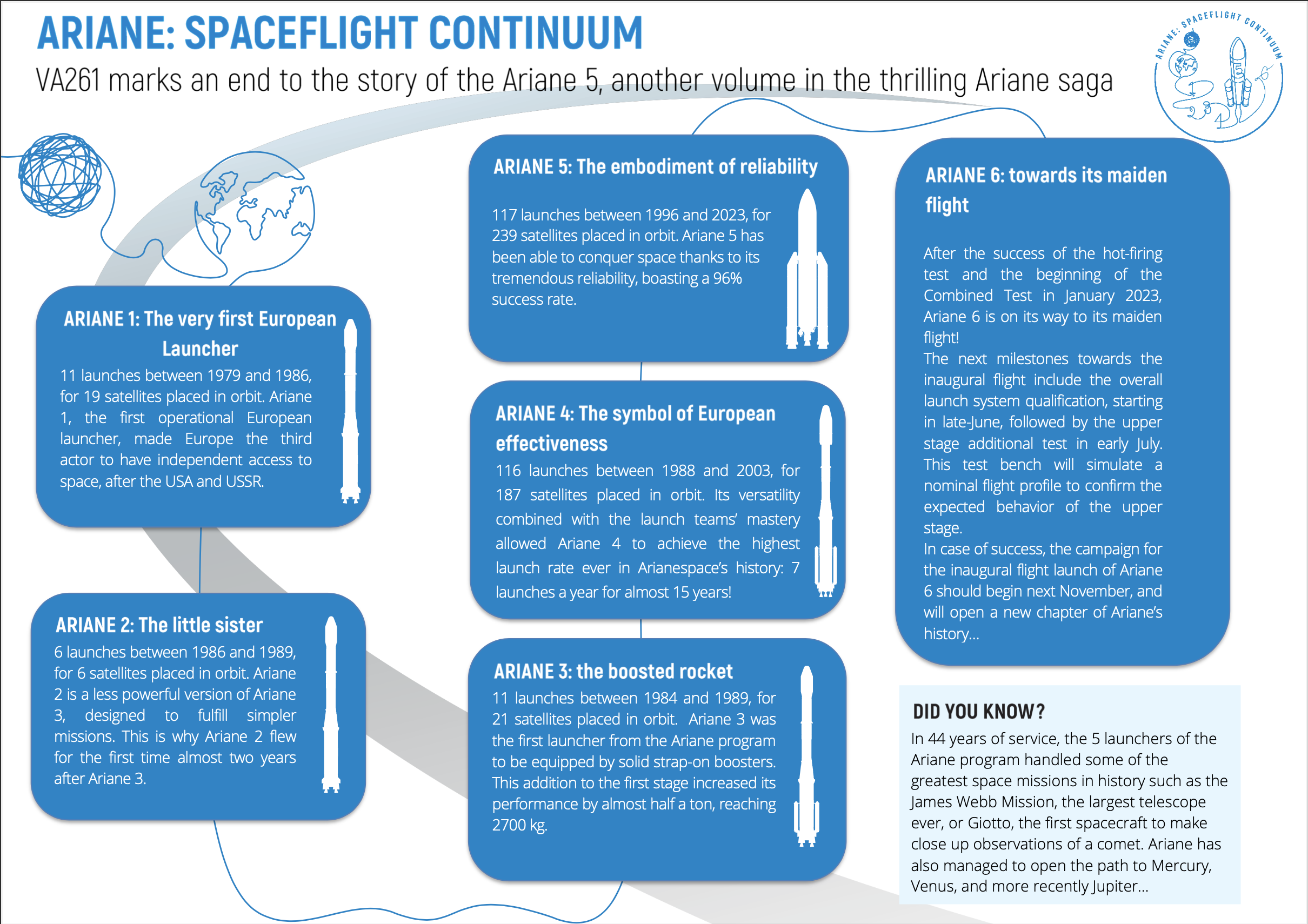
Ariane 5 was first launched in June 1996 in what was called the G(eneric) variant, capable of lifting 16 tonnes to low Earth orbit (LEO) or up to 6.95 tonnes to geosynchronous transfer orbit (GTO). Over the coming years, it iterated through four evolutions – G+, GS, ECA, and ES – each bringing about a range of performance and other improvements which raised the vehicle’s maximum lift capabilities to 21 tonnes of payload to LEO and 10.86 tonnes to GTO whilst also allowing Arianespace to lower launch fees to customers. In addition – and while it was never used in such a capacity – Ariane 5 is the only member of the Ariane family to be designed for crewed launches, in part being designed to carry the Hermes space plane to orbit (of which more below).
In all, Ariane 5 flew a total of 117 launches from 1996 onwards, suffering three partial and two complete failures to deliver payloads as intended, with an maximum launch cadence of 7 per year. Notable among these launches are:
December 10th, 1999: the X-ray Multi-Mirror Mission (XMM-Newton). Itself an oft-overlooked mission when compared to NASA’s Great Observatories programme, XMM-Newton was one of the four “cornerstone” missions of the Horizon 2000 chapter of ESA’s science missions.
Named for English physicist and astronomer Sir Isaac Newton, the spacecraft comprises 3 X-ray telescopes feeding a range of science instruments and imaging systems. Its primary mission is the study of interstellar X-ray sources in both narrow- and broad-range spectroscopy, and performing the first simultaneous imaging of objects in both X-ray and optical (visible + ultraviolet) wavelengths. The programme was initially funded for two years, but its most recent mission extension will see it funded through until the end of 2026 – with the potential (vehicle conditions allowing) – for it to be extended up to the launch of its “replacement” mission, the Advanced Telescope for High Energy Astrophysics (ATHENA), due to commence operations in 2035/6. As of May 2018, XMM had generated more than 5,600 research papers.
March 2nd 2004: Rosetta. Another Horizon 2000 “cornerstone” mission, Rosetta spent 10 years using the inner solar system to allow it to rendezvous with the nucleus of comet 67P/Churyumov–Gerasimenko – the first space vehicle to enter orbit around a comet following its arrival on August 6th, 2014.
For two years, the vehicle revealed an enormous amount about the comet, although it was perhaps overshadowed in the public consciousness by the adventures of the little Philae lander Rosetta dispatched to the surface of the comet, and which captured hearts and minds with its struggles.

May 14th, 2009: Herschel Space Observatory and Planck Observatory. These two ground-breaking missions were delivered to the Erath-Sun Lagrange L2 position (yes, the one also used by the James Webb Space Telescope – JWST -, and the one the Euclid mission will utilise where it arrives in an extended halo orbit around it in August 2023). Whilst separate missions, both spacecraft were launched on the same Ariane 5 booster and each utilised a service module built to a common design.
Initially planned for a 15-month primary mission, Planck – named for German physicist Max Planck – ran for just under 4.5 years, concluding in 2013 after on-board supplies of liquid helium were exhausted, and the primary instruments could longer be cooled to their required operating temperatures. As fuel remained for the craft’s manoeuvring thrusters, Planck was ordered to move away from the L2 position and into a heliocentric orbit, where its systems were decommissioned and the vehicle shut down.
The Herschel Space Observatory, meanwhile, operated for just over 4 years, and was the largest infrared telescope ever launched until the James Webb Space Telescope. It was yet another “cornerstone” mission for Horizon 2000, and was named for Sir William Herschel, the discoverer of the infrared spectrum. Its primary objectives comprised investigating clues for the formation of galaxies in the early universe, the nature of molecular chemistry across the universe, the interaction of star formation with the interstellar medium and, closer to home, the chemical composition of atmospheres and surfaces of planets, moons and comets within our solar system. In this regard, the observatory amassed more the 25,000 hours of science data used by 600 different science programmes.
October 20th, 2018: BepiColumbo. Undertaken by ESA and the Japan Aerospace Exploration Agency (JAXA), BepiColumbo is the overall mission title given to two vehicles and their transfer bus, all launched as a “stack” via Ariane 5, in a mission to carry out a comprehensive study Mercury, the innermost planet of the solar system. It is named after Italian scientist and mathematician Giuseppe “Bepi” Colombo.
Despite its orbit being relative close to Earth (when compared to the outer planets of the solar system that is), Mercury’s is one of the most technically complex to reach. “Bepi” Columbo calculated a vehicle could use a solar orbit and multiple fly-bys of the inner planets to reach Mercury in an energy-efficient manner – and it is this style of approach the mission is using to reach its destination. It has already completed five gravity assist manoeuvres (1 around Earth in 2020, two around Venus in 2020 and 2021 and 2 around Mercury in 2021 and 2022). A further fiver fly-bys of Mercury will occur in 2024/25 to bring the mission to its primary science orbit around the planet at the end of 2025.

At that time the vehicles will separate, the transfer bus, called the Mercury Transfer Module being discarded to allow the 1.1 tonne ESA-built Mercury Planetary Orbited (MPO) to commence what is expected to be at least one terrestrial year of operations studying the planet. During the initial phase of this mission, MPO will in turn deploy the Japanese-built Mio vehicle into its own orbit around Mercury, where it is also expected to operate for at least a terrestrial year.
December 25th, 2021: James Webb Space Telescope. Covered multiple times in this column, JWST might be regarded as something of an indirect nephew to ESA’s XMM Newton, but with the ability to “see” further and deeper into the solar system.
April 14th, 2023: JUICE – the JUpiter ICy moons Explorer. As covered in these pages, JUICE is widely regarded as one of the most important space missions yet undertaken and intended to study Jupiter’s moons of Europa, Ganymede and Callisto (and a possible fly-by of the asteroid 223 Rosa whilst en route). This mission formed the penultimate mission for Ariane 5.
I’ll have further updates on BepiColumbo, JWST and JUICE as the missions evolve.
In addition, Ariane 5 was responsible for launching all five Automated Transfer Vehicle (ATV) resupply missions to the International Space Station. With the largest capacity of any unscrewed resupply vehicle travelling to the ISS (up to 7.6 tonnes), the ATV was used between 2008 and 2015, each vehicle being disposed of through atmospheric re-entry burn-up at the end of its flight. In 2012, a modified version of the ATV was offered to and accepted by NASA to be the Service Module for the Orion Multi-Purpose Crew Vehicle.
Ariane 5’s final launch took place on July 5th, 2023, lifting-off from Europe’s Spaceport at 22:00 UTC, to send two communications satellites on their way to GTO. Heinrich-Hertz is a German-built experimental communications satellite for public sector communications, while Syracuse 4B is a French military communications relay satellites. Both the deployments – 3 minutes apart – and the launch itself were flawless.
Ariane 5 has perfectly finished its work. It’s really now a legendary launcher. It leaves behind an incredible legacy of technical prowess and reliability.
– Stéphane Israël, Arianespace CEO
The rocket is due to be replaced by Ariane 6. Offered in two primary variants the 62 (with 2 solid boosters) and 64 (with 4 solid boosters), Ariane 6 is designed to offer increased payload capabilities compared to Ariane 5 over a wide range of mission types, orbital and deep-space, but at up to half the cost of an Ariane 5 vehicle production and launch cost, allowing it to compete more directly with SpaceX and other medium / heavy lift launch commercial launch vehicles, Improved launch processing and flow means Ariane 6 should be able to achieve up to 11 launches per year. However, the vehicle’s development and testing has run into problems, with the initial launch being pushed back several times, with ESA stating the maiden flight will still take place in late 2023, although observers believe this will slip to 2024.
Hermes – The Little Spaceplane That Almost Was
A key element in the planning for Ariane 5 was the proposed Hermes crewed vehicle. Proposed in the pre-ESA era of the European Space Research Organisation (ESRO) of the 1970s, Hermes was seen as a means to provide Europe with its own crewed launched capability to counter undue reliance on NASA for such a capability.
In the earliest phase of the concept, two basic configurations for Hermes were considered: a “traditional” capsule design and lifting body design capable of an unpowered glide back to a landing following re-entry. Debates on which should be adopted through until 1983, when CNES – the agency particularly pushing for greater European autonomy in crewed launches – selected the winged vehicle as the most flexible, and more cost-effective due o is ability to be re-used.

Initial designs for the spaceplane envisioned it as a 20-tonne delta-winged vehicle without a tail surface, this being replaced by wingtip surfaces for directional stability during atmospheric flight. Capable of supporting 6 astronauts and carrying up to 4.5 tonnes of cargo, the vehicle was initially intended to operate on its own for periods of up to 90 days in orbit. In this configuration, Hermes would have a pressurised cabin forward, a small unpressurised payload bay midships with a manipulator arm for deploying payloads in orbit, with support systems in the rear. However, in this configuration, Hermes would be too heavy for Ariane 4 – which was also unrated for human launches – to lift, and the decision was taken to fold a Hermes launch capability into the Ariane 5 design.
Then in January 1986, the shuttle Challenger was lost, and the decision was taken to equip Hermes with some kind of high-altitude crew egress system. This involved fitting the vehicle with ejection seats. However, the overall complexity of such a system and its associated mass meant the the crew count was reduced to a maximum of three to reduce mass, and the payload mass was reduced by 1.5 tonnes. To further simplify the design, it was also decided to remove the unpressurised cargo bay (and manipulator arm) and replace it with a pressurised unit directly connected to the crew cabin. This would allow the vehicle to be used as an orbital laboratory with the lab capable of being outfitted for different missions.

By 1988, the design had further evolved to a 2-stage vehicle: a 19-m long delta-winged pressurised glider, capable of atmospheric re-entry, supported by a disposable cone-shaped Resource Module. Attached to the rear of the vehicle, this would act as a mating system for connecting Hermes to Ariane 5 and provide it with power and life-support while in orbit. It was believed that separating these elements from the core vehicle would simplify the overall design and reduce mass and thermal heating issues being encountered in computer modelling of the design.
Also by this time, plans were in-hand for a large-scale US space station to be called Freedom, and ESA had proposed supporting it by providing three individual units under the programme name Columbus: a pressurised module attached directly to the station; a semi-pressurised laboratory operating within its own orbit – the Columbus Man-Tended Free Flyer – and an unpressurised experiments platform in polar orbit, with Hermes supporting all three.
In this role, the space plane would require an airlock to allow for docking with the pressurised Columbus modules for crew members to egress and service the polar platform – and it would be easier to include the mass and complexity of this airlock in the Resource Module, so Hermes would not have to deal with that mass when re-entering the atmosphere.
Under this programme, Hermes would be developed over an 8-year period, with the first uncrewed launch targeting 1998. However, the remaining technical complexities in the design pushed this back to late 2002, with further slippage likely. Then in the early 1990s, ESA joins the US and Russia at the core of International Space Station project, and Europe cut back the Columbus project to just the pressurised module attached to the station, both the Free Flyer and polar platform being cancelled. As a result of both of these factors, the Hermes project was cancelled in 1992.
However, whilst Hermes is no longer an active project, some of the concepts it embraced are due to fly in 2024, when ESA is due to launch Space Rider (Space Reusable Integrated Demonstrator for Europe Return) for the first time. This is a small-scale, uncrewed lifting body design supported by a separate Resource Module, intended to both deliver up to 620 kg of payload to orbit on a reusable / routine basis, and act as a technology demonstrator for lifting body designs to be used in orbital and sub-orbital flights.

 Inara Pey: Living in a Modemworld