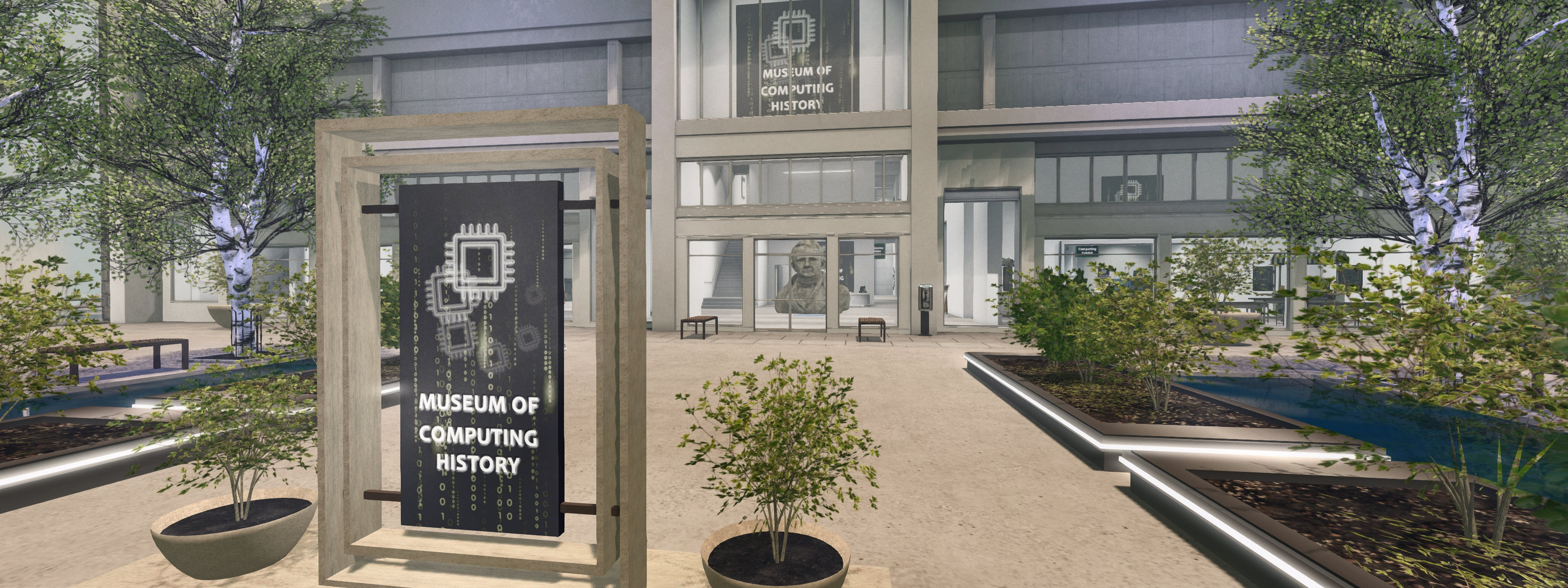
As a part of my on-going (and occasional) visits to museums in Second Life, I recently had the opportunity to drop in on the quite excellent Museum of Computing History, managed and curated by Brian Aviator, with the assistance of Timothy McGregor and Kevin Jackman.
Tucked neatly under Brian’s Blackslough Field Regional Airport and overlooking the inland seas and waterways of Sansara, this is one of two museums Brain operates / curates in Second Life, the other being the LGBTQ History Museum and Cultural Centre (also due to appear in these pages later this month, and which is – at the time of writing – featured as an Editor’s Pick in the Destination Guide in recognition of Pride Month).
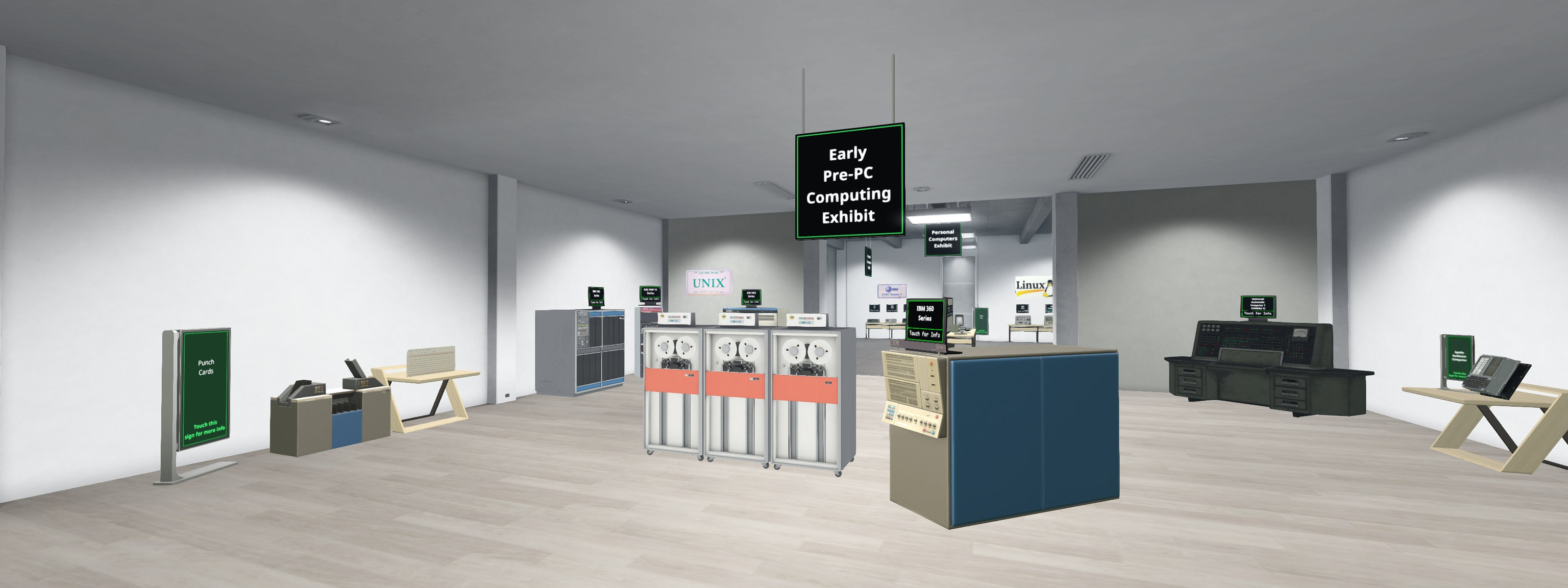
Extending over two floors, and with an ample, well-tended forecourt / terrace public space before it, the museum offers an impressively comprehensive dive in to the history of computing, from the abacus to the blade server and the rise of AI, featuring not just the technology and technological innovations, but many of the the individuals who have contributed to the development of computers, computational engineering and computer science down through the centuries and decades.
From the entrance foyer, dominated by a bust of Charles Babbage, the lower level of the museum comprises the Admiral Grace Hopper auditorium and four exhibition halls in which may be home to static exhibitions, and others have their displays rotated over time as new exhibits are developed (as is the case on the museum’s upper floor). At the time of my visit, the exhibits in these lower halls comprised:
-
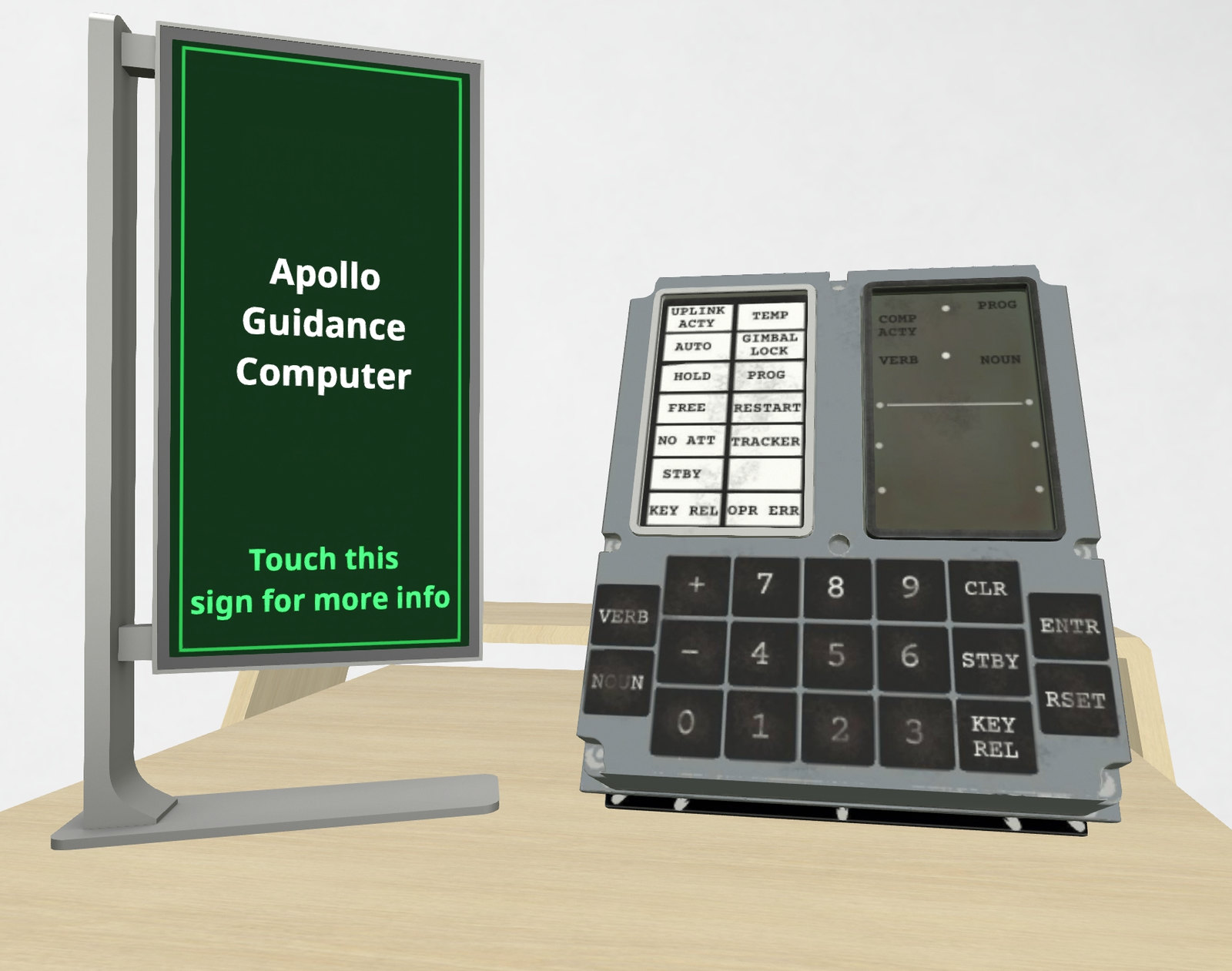
Museum of Computing History, June 2023. Made famous during the Apollo 11 landing mission, July 20th, 1969 Early Pre-PC Computing, which includes one of the earliest computational machines known to Man (the abacus), alongside models of Babbage’s Difference Engine; the electro-mechanical devices which played major roles in the European theatre of World War II – the German Enigma code setting machine and the Polish-British code breaking Bombe; the machines from the early decades of the modern computer era: punch-card and tape-driven monsters, and even a look at one of the first computers to be used extensively “off-world”: the Apollo Guidance Computer (thanks to Hollywood and numerous dramatizations of the Apollo 11 lunar landing, perhaps now more widely known as the “1202 alarm computer”).
- The Personal Computers Exhibit, which is liable to raise fond smiles for some, including as it does models of Commodore, Sinclair, Apple, Tandy, IBM and other machines as well as their associated operating systems upon which many enthusiasts cut their computing teeth. I personally found myself smiling at the presence of the BBC Model B and (for reasons that are both convoluted and irrelevant to address here, but include personal travels, Sir Arthur C. Clarke and film director Peter Hyams) the Kaypro II).
- An Interactive Fiction Exhibit, with its reminder that there was a lot of brain-engaging fun to be had with computers long before the arrival of graphical games and shooting the bejesus out of others. This is also supported by a video presentation called Get Lamp: the Text Adventure Documentary, available through the Admiral Grace Hopper auditorium.
- A look inside what might now be regarded as an “old school” data centre with huge boxlike machines (rather than huge boxlike racks of machines), and the odd super computer.
These hall all feature models of the various systems, boards, boxes and computers which in turn represent the work of multiple creators from across Second Life – such as (but most certainly not exclusively) Crash Lunar and (appropriately, given the museum’s subject matter) Ozzy Wozniak, both of whom provide a range of free models of computers, handhelds and consoles for those interested. Additional models have also been provided by Brain himself, imported (I believe I’m correct in saying) from 3D models developed by the Universidad de Castilla-La Mancha, Spain – for whom Brian gives acknowledgement. All are presented with display boards which, when touched, will provide a notecard of contextual information (and it should be noted that even the posters on the walls in some of the halls can also be touched for information of their own).

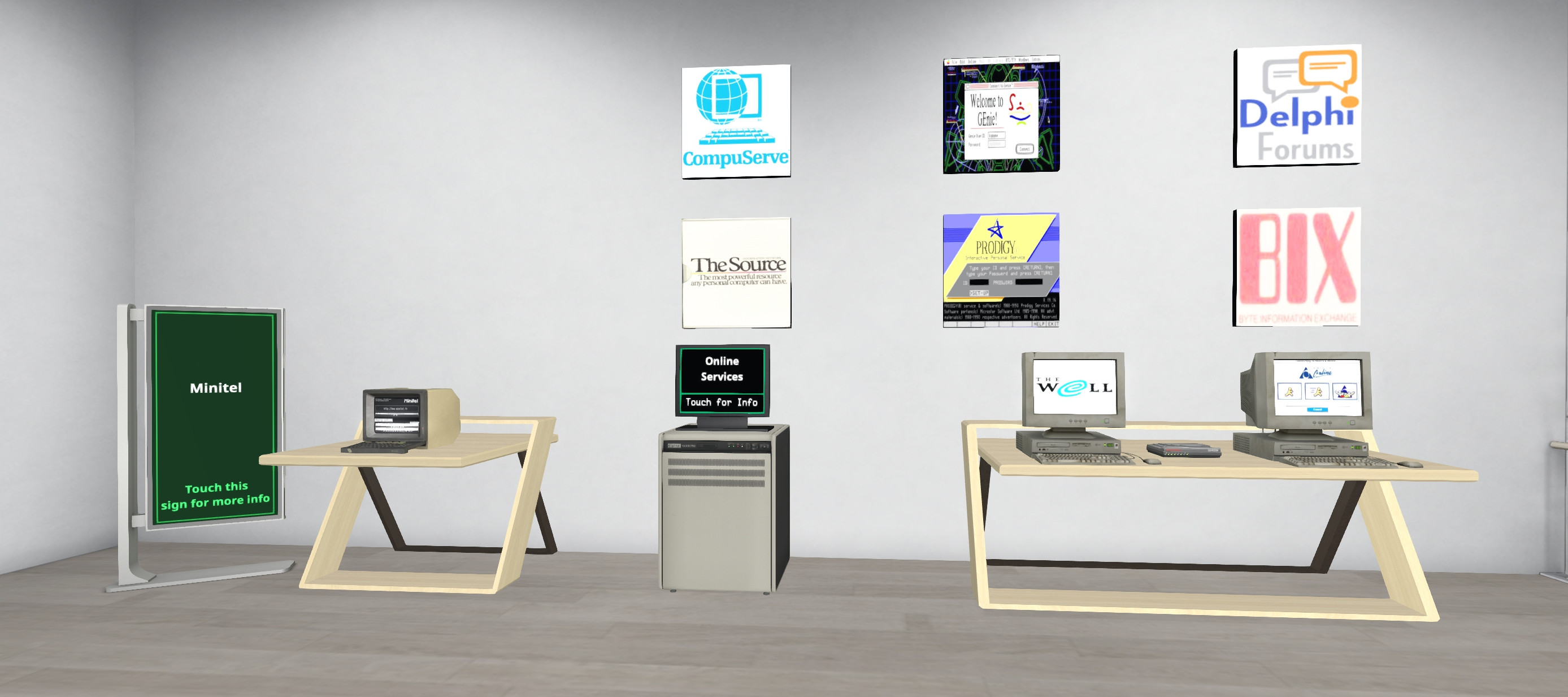
The upper floor if the museum comprises five exhibition halls, all following the same approach as the lower floor, with each focusing on a specific exhibit related to computing. At the time of my visit, these comprised: the relationship between computers and telecommunications and the rise of networking; video games and console systems; the development of artificial intelligence; the noble / ignoble art / act of hacking (which of these terms largely dependant on the who, what, where, when and how of the said hacking) , and biographies of some of the leading personalities and individuals who have played a role in the evolution of computers, mathematics, computer sciences, communications, and related subjects.
Comprising images of the individuals concerned which can be touched for a notecard-based biography, the latter covers people who – at least in name – are likely be known to many: Augusta Ada King, Countess of Lovelace, Alan Turing, Steve Jobs, William Gates III, Steve Wozniak, Sir Tim Berners-Lee and Linus Torvalds, for example – and one Philip Rosedale; those who might be familiar (if not really known, such as Blaise Pascal; Seymour Cray; Vinton “Vint” Cerf (who has actually been in Second Life) and Robert Kahn; to those who really should have much wider recognition than they do, but whose achievements have perhaps been overshadowed by others – such as the aforementioned Grace Hopper, together with Margaret Hamilton and Dorothy Vaughan, who at times get pushed aside in the male-dominated history of computing, and Douglas Engelbart, whose work at times gets subsumed by the near-mythic achievements of Steve Jobs.

The latter’s work (with that of his team at the Stanford Research Institute – now SRI International) is the subject of a second video presentation within the museum, highlighting what would become retrospectively called The Mother of All Demos. The was a live event held in 1968, in which Engelbart interactively demonstrates his team’s oN-Line System (NLS), which is very much the precursor of just about everything we take for granted with computers today: the graphical interface with its cursor (or “bug” as they called it) and mouse; the ability to work collaboratively and share files dynamically; the use of hypertext and hypermedia – even teleconferencing. The video offered at the museum summarises Engelbart’s presentation, but for those interested, the entire demonstration – which lasted over 90 mins – is also available on You Tube.
I admit I did find myself a little conflicted over the use of notecards throughout the museum; not because it is a difficult format to understand, but rather because there are instances where the information is liable to change (such as with the biographies of some of those featured within the upper floor exhibitions, or on the subject of AI), which might lead to some information becoming out-of-date. As such, I wondered if offering a mix of web links as notecards, depending on the subject matter, might not be easier from a maintenance standpoint.
SLurl Details
- Museum of Computing History (Blackslough, rated Moderate)


 Inara Pey: Living in a Modemworld