Rotating crews to / from a space station is so routine here in the west that the comings and going of crews at the International Space Station (ISS) rarely gain much of a mention unless something extraordinary happens, or they happen to be entirely privately-funded, as with the Axiom Space Ax-2 mission (of which more below).
Not so for the Chinese, however, who are still adjusting to life with an orbital outpost that is meant to remain under permanent occupation and also provide a stepping stone towards the Moon. What’s more, they are gradually become more public about things as they continue to rake up successes.
Following the completion of “construction” of the major elements of the Tiangong space station with the docking of the second science module in November 2022, the Shenzhou 15 crew, comprising taikonauts Fei Junlong, Deng Qingming and Zhang Lu have been at work commissioning the module and carrying out further work in preparing the station for full-time operations, building on the work of the Shenzhou 14 crew, as well as performing a full science programme.

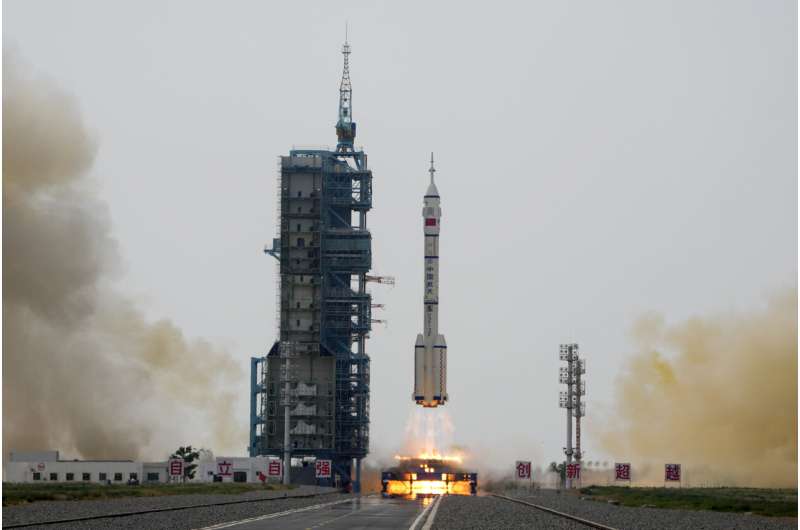
On May 30th, they were joined by the crew of Shenzhou 16, who performed a “fast burn” flight to rendezvous and dock with Tiangong just seven hours after their launch from the Jiuquan Satellite Launch Centre in the Gobi Desert. This crew has garnered a lot of attention both nationally and internationally, as it includes China’s first non-military tiakonaut to fly in space: professor Gui Haichao, an aerospace researcher who has studied and taught in China and Canada.
The entire launch was covered live on Chinese national television, as was the rendezvous and docking, summarised for new broadcasts and viewing in the west in videos like the one below.
Gui is joined on the mission by commander Major General Jing Haipeng of the People’s Liberation Army Air Force (PLAAF), and rookie taikonaut Colonel Zhu Yangzhu of the People’s Liberation Army. Scheduled for a duration of 180 days, the mission will see Jing become China’s most experienced taikonaut, with four missions under his belt and clocking up over 225 days (cumulative) in orbit.
Following docking, the Shenzhou 16 crew remained with the three men of Shenzhou 15 Through until the weekend, when the Shenzhou 15 crew departed the space station late on Saturday, June 3rd (Beijing time), to commence a 9-hour return to Earth, where they touched down at the Dongfeng landing site within North China’s Inner Mongolia autonomous region at 06:33 on Sunday, June 4th (Beijing time – (22:33 UTC on June 3rd).
The landing was also covered in detail by the Chinese media, and as with the Russian approach to crew returning from long duration orbital flights, the three men were not allowed to spend time standing or moving under their own power; instead they were helped out of their craft and into waiting chairs, where they were interviewed by a China Central Television (CCTV) crew in a live broadcast. This focused on Senior Colonel Deng Qingming, quite possibly one of the longest-serving astronauts-in-waiting in the world prior to lifting-off on this mission, having been in the PLA taikonaut corps for 26 years! He is actually the last of China’s “first generation” intake of astronauts to fly into space, and his perseverance has made him an icon on the PLA space corps.
In between Shenzhou 16 lifting-off for Tiangong and Shenzhoou 15 returning, the crew of Axiom AX-2 also wrapped up their stay at the International Space Station and returned to Earth.
As the name indicates, this was that second Axiom Space crewed mission to the ISS, carried out as part of the company’s progress towards running its own space station, and delivered a crew of four astronauts to the ISS for a period of eight days. Aboard were former astronaut Peggy Whiston as mission commander, John Shoffner, an aviator and entrepreneur, Ali AlQarni, a captain in the Royal Saudi Air Force and Rayyanah Barnawi, and Saudi biomedial researcher and the first Saudi woman to fly in space.

The mission lifted-off from Kennedy Space Centre atop a Falcon 9 rocket on May 21st, 2023, and the Crew Dragon Freedom docked with the Harmony module of the ISS a day later. During their time on the station, the crew performed public outreach activities along with scientific research, including studies into the effects of microgravity on stem cells and other biological experiments which had been agreed with the Saudi Space Commission as part of the deal to fly the two Saudi nationals on the mission.
For Whitson, it was a fourth opportunity to fly in space and add to an already impressive record: in her first mission, she spent an extended mission on the ISS, in her second she became the first woman to command the ISS (and later became the first women to complete two tours on the ISS as mission commander), she has completed the most EVAs (spacewalks) thus far for a woman, having spent a total of 60 hours and 21 minutes outside of the ISS performing various tasks; she has spent a total of 675 days in space during her career and remains the oldest woman to orbit the Earth. She was also the first woman to become NASA’s Chief Astronaut, the most senior position in the NASA Astronaut Corps.
For the rest of the crew, it was the opportunity to experience space for the first time, and for Axiom Space, a further opportunity to study managing orbital operations and research endeavours of the kind they hope to both manage and host on their own space station. The latter is due to start life as modules attached to the ISS (and referred to as the Axiom Orbital Segment) in the late 2020s, before becoming an independent orbital facility when the ISS is decommissioned at the start of the 2030s.
On May 30th, 2023, the crew re-boarded Freedom and departed the ISS, splashing down successfully in the Gulf of Mexico off the coast of Panama City, Florida in the early hours of May 31st, local time, where it was recovered by the SpaceX recovery ship Megan.
Spaceport Company Performs At-Sea Launches
Landing returning crewed spacecraft on the world’s seas – as with the AX-2 mission – has long been a thing for the United States. However, it has also been the dream of some to use the oceans as a means of launching vehicles into orbit – perhaps most famously (thanks to it being referenced in the Apple TV series For All Mankind), the simply gargantuan Sea Dragon. Planned in the 1960s but never built, this behemoth was designed to lift 550 tonnes of cargo to orbit – and to start its journey by floating in open waters off the US coast.
Obviously, Sea Dragon never came to be, but in 1999, a multi-national corporation – Sea Launch – commenced payload launches from the deck of a modified oil rig – the Odyssey, operating in the Pacific Ocean close to the equator – using a specialised version of the Russian Zenit-3SL. The company carried out a total of 36 such launches from 1999 through 2014, when Russia’s first military incursion into Ukraine (which ultimately brought an end to the company), suffering only four failures.

Now a US company – the appropriately-named The Spaceport Company – has hosted four sounding rocket launches with the support of Evolution Space, from a platform in the Gulf of Mexico. The launches were the latest step of a proof-of-concept study the company is carrying out into the feasibility of conducting payload-to-orbit flights from mobile platforms operating off the US coast.
In particular, the company stated the operation – performed on May 22nd – was intended to exercise the procedures -including getting approvals from the Federal Aviation Administration and U.S. Coast Guard, clearing airspace and waters to allow for a safe launch – before any actual rocket launch from the platform.
The company plans to plans to use the platforms – called liftboats – which can sail / be towed to a designated location before temporarily anchoring itself to the sea bed by means of four legs which can be extended down into the water to a depth of up to 50 metres, and also left the platform clear of the water. A second platform then acts as the launch control centre, freeing launches from the need of any land-based infrastructure, outside of a docking and servicing facility with the means to accept launch vehicles and move them onto the launch platform safely.
These platforms will be capable of being deployed almost anywhere of the US coast, although the company particularly hopes to leverage the increasing demand for launches out of both the Cape Canaveral Space Force Station and Kennedy Space Centre. presenting companies operating smaller rocket systems with a viable off-shore alternative.
Both The Spaceport company and Evolution Space (who providing the rocket systems for the May 22nd launches) kept quiet about the event itself, only releasing a post-launch briefing on the launches 24 hours after they had taken place. Further test flights on the platform are expected over the course of the nest two years, and the company is targeting 2025 for its first full-scale, fully commercial payload launch.
Starliner “On Course” for … Another Launch Delay
Getting a new human-rated spacecraft up and running from scratch isn’t easy. It can also be embarrassing – as NASA and Boeing are discovering with the latter’s CST-100 Starliner (and no, SpaceX didn’t do it “from scratch”, they used an existing unscrewed vehicle as a baseline in Cargo Dragon – which is not to demean their work, just to point out comparing Starliner development with that of Crew Dragon is a case of apples and pears).
On May 27th, both the agency and Boeing stated preparations for the oft-delayed first crewed flight of the vehicle – intended, like Crew Dragon, to ferry personnel to / from the International Space Station – was on course for a late July launch. This despite a statement issued just 24 hours earlier by NASA’s own Aerospace Safety Advisory Panel raising concerns about specific aspects of the work still to be done and specific elements of the Starliner vehicle. In fact, the joint statement from NASA / Boeing didn’t even mention the ASAP’s concerns.
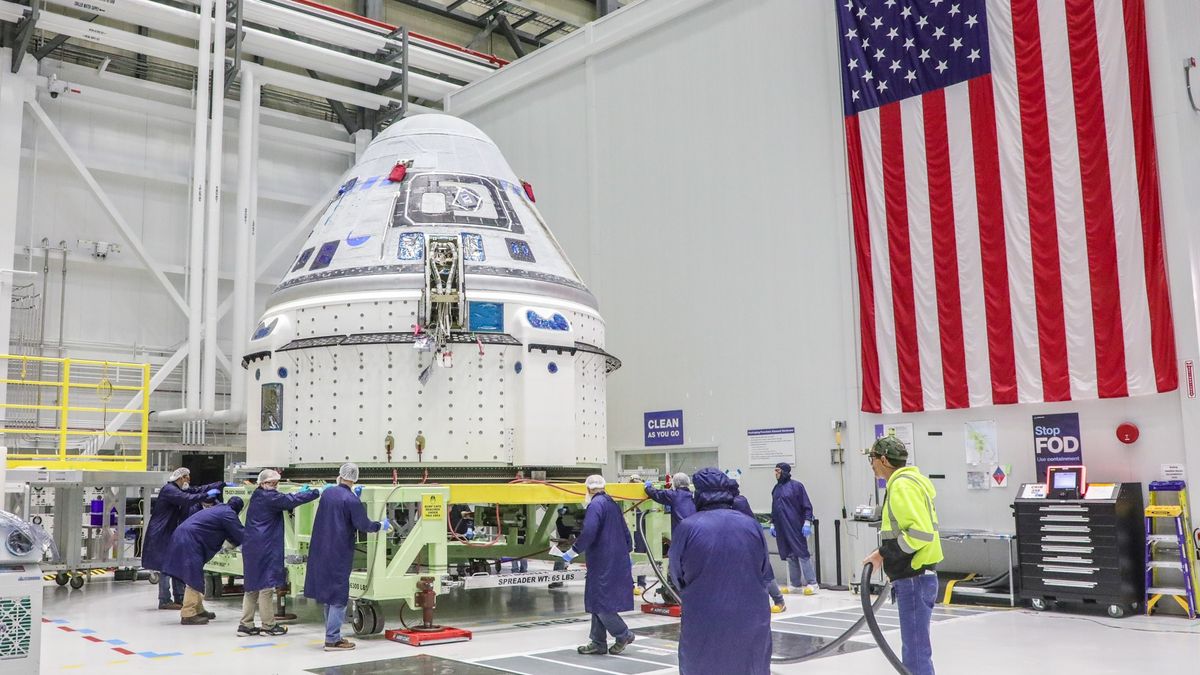
This has turned out to be embarrassing because less than a week after their robust can-do statement, NASA and Boeing abruptly called a halt to launch preparations citing two “newly discovered” issues. This affect elements of the vehicle’s parachute system – which was one of the area of concern specifically raised by the ASAP in their May 26th statement. As a result, the launch is now “indefinitely delayed whilst the situation is reviewed, and neither NASA nor Boeing would comment on whether the planned 6-day flight to the ISS with a crew of 2 – NASA astronauts Butch Wilmore and Suni Williams – and a necessary precursor to CST being approved for “operational” crewed flights, will go ahead before the end of the year.
Virgin Galactic Flies, Virgin Orbit Dies
During the brief hiatus of this column, Virgin Galactic completed a required sub-orbital flight test of its sub-orbital space plane VSS Unity, the first since the vehicle was grounded for an extensive overhaul and systems update almost two years ago.
Carried aloft from Spaceport America in New Mexico at 16:15 UTC on May 25th, 2023 by the carrier aircraft MSS Eve, the vehicle was released at altitude roughly an hour and ten minutes later, performing a nominal burn of it rocket engine to climb to a height of 87.2 km, just above the 80-km altitude recognised by US government agencies as “the edge of space”, but below the 100 km Kármán line, then successfully returning to Earth and landing back at Spaceport America.
The flight – Unity 25 – carried four of the company’s employees seated behind flight commander Mike Masucci and pilot with CJ Sturckow. Jamila Gilbert, Christopher Huie, Luke Mays and Beth Moses (making her second sub-orbital hop in the vehicle) were there in the role of “passengers” in order to confirm the vehicle’s readiness to commence fare-paying flights, which are now expected to commence later in June.
The first commercial flight will be Galactic-01, a dedicated research flight for the Italian Air Force. It will be followed “at regular intervals” by flights carrying up to 6 passenger at a time.
At the opposite end of the scale, Virgin Orbit announced on May 23rd, that it is to cease to exist and its assets sold off to successful bidders, with a large proportion of said assets to go – subject to the court’s approval to just three bidders and a purchaser:
- Rocket Lab: The US-based New Zealand private launch company is seeking to purchase the Virgin Orbit production facility and machinery / equipment in Long Beach, California, a few blocks from their existing facilities. They have offered US $16.1 million for the facilities, and plan to use them development of the reusable Newton rocket.
- Vast, the “artificial gravity space station” construction start-up I recently covered in these pages has offered US $2.7 million for Virgin Orbit’s lease on a test site in Mojave, California, along with machinery, equipment and inventory there.
- Stratolaunch has had its US $17 million “stalking horse” bid for Virgin Orbit’s Boeing 747 and related equipment I noted in my previous Space Sunday update, accepted. They have not disclosed their intentions for Cosmic Girl.
- Inliper Acquisition LLC, a liquidation company has successful negotiated for the sale of another of Virgin Orbit’s facilities at Long Beach, for the sum of US $650,000.

 Inara Pey: Living in a Modemworld