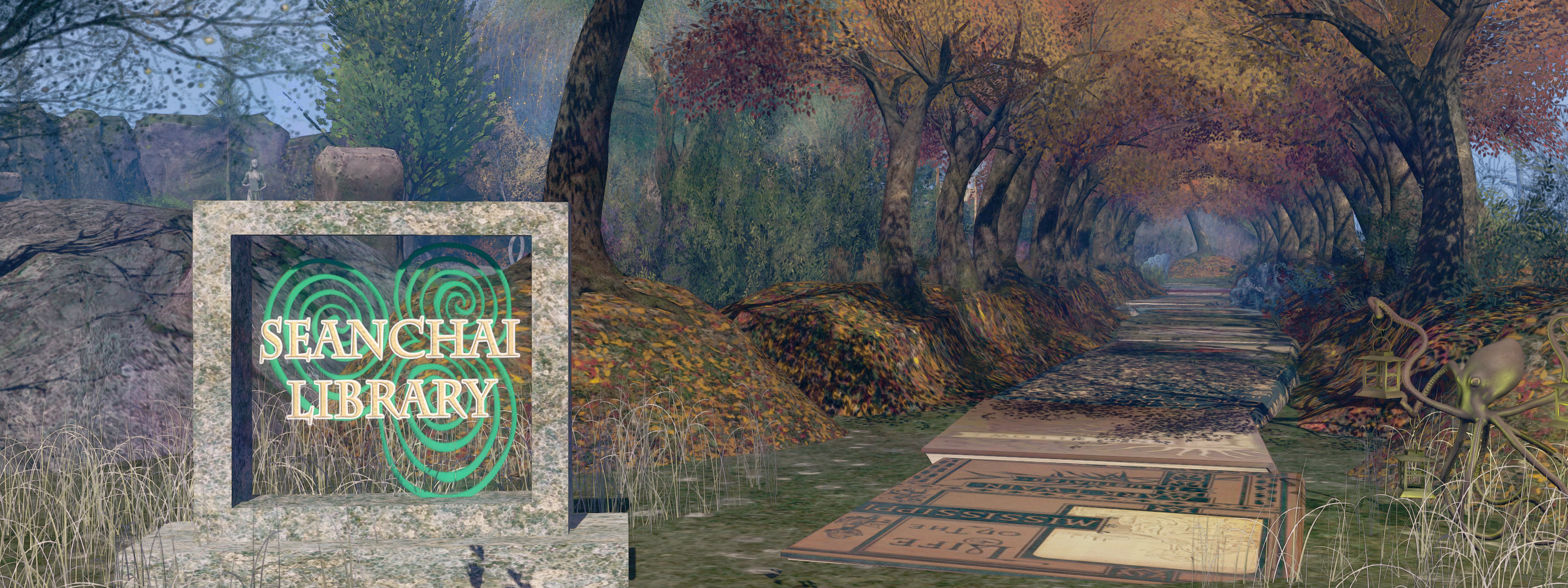
It’s time to highlight another week of storytelling in Voice by the staff and volunteers at the Seanchai Library – and this week previews the launch of a very special event.
As always, all times SLT, and events are held at the Library’s home in Nowhereville, unless otherwise indicated. Note that the schedule below may be subject to change during the week, please refer to the Seanchai Library website for the latest information through the week.
Monday, January 16th, 19:00: Fear Hound
In the slums of a city, a vagrant young man is drafted by a member of the city’s psi squad in a search for a trapped psychic radiating her fear to people for miles around.
With Gyro Muggins.
Tuesday, December 17th, 19:00: Cold Clay
It’s autumn in Shady Hollow, and residents are looking forward to harvest feasts. But then a rabbit discovers a grisly crop: the bones of a moose.
Soon, the owner of Joe’s Mug is dragged out of the coffeeshop and questioned by the police about the night his wife walked out of his life–and Shady Hollow–forever. It seems like an open-and-shut case, but dogged reporter Vera Vixen doesn’t believe gentle Joe is a killer. She’ll do anything to prove his innocence. . .even if it means digging into secrets her neighbours would rather leave buried.
Faerie Maven-Pralou reads the second book in the Shady Hollow series by Juneau Black, in which some long-buried secrets come to light, throwing suspicion on a beloved local denizen.
Nitroglobus Roof Gallery, January 2023: JuleJules Farigoule – The Farigoule Collection
Opening on Monday, January 16th, 2023 in the Annex at Nitroglobus Roof Gallery, curated by Dido Haas, is The Farigoule Collection, a series of images and settings by Jules Farigoule which – as always for Nitroglobus – offers a fascinating take on the art and expressionism of the artist involved.
The easiest way to introduce the collection is to use Dido’s own words:
A while ago when meeting with Jules in his loft, which is really a superb tastefully made place, I asked him if he was willing to exhibit his awesome art collection at Nitroglobus. At first he hesitated and told me he was neither an artist nor was this a ‘collection’, just images which he likes to have around him; a very subjective and personal selection. .. a set of images, gathered from meetings, friendships and by chance, from the serendipity of Jules’s long Second Life.
Dido Haas
Nitroglobus Roof Gallery, January 2023: JuleJules Farigoule – The Farigoule Collection
Now, on the surface, this may not sound so unusual – serendipity often plays a role in art, be in painting, drawing or photography, and in Second Life, photographs tend to focus on our personal moods or on the friends we make, the people we encounter and the sights we come across in our explorations. So what makes this collection so special?
Simply because, while it may not have any intentional theme or narrative thread, it is nevertheless something of a story about Jules – who hails from France – and his self-expression both in the physical world and within Second Life.
Some of the latter is expressed through the two settings occupying the floorspace of the Annex, and which offer a glimpse into Jules’ loft home in-world. Their simplicity of form and minimalism, coupled with the placing of the art on their walls and the sculptures, speak to a mind and eye driven by thoughts of beauty and balance, and something of a reverence for the female body – as well as the simple joy of taking photos.
Nitroglobus Roof Gallery, January 2023: JuleJules Farigoule – The Farigoule Collection
More broadly – and intimately – the exhibition as a whole offers insight into the dual nature of Jules’ time in Second Life, where both a male and a female avatar – Gaia Republic – are used (with Jules now being the primary and Gaia – although older – the “Alt”). The images from Second Life – outside of those Jules has on display within the “loft” sets which originate with other artists (including Dido herself) – come from both the persona of Jules and that of Gaia, and examining the differences in style, tone and subject between the two.
Most of the images by Jules, meanwhile present fair more structured results in which the more technical aspects of each – style, focus, presentation, cropping and production. Thus, there is perhaps a femininity reflective of Gaia that naturally comes to the fore within Mes copines, whilst Jules’ piece might be seen as leaning towards a more “masculine” expressionism.
Nitroglobus Roof Gallery, January 2023: JuleJules Farigoule – The Farigoule Collection
It’s subjective to be sure, and also subjective, given the technical skills required to produce Mes copines are as great as those seen within, say, ExMachina 04. More importantly, the contrasts speak to a person as ease within the skins of both Jules and Gaia, and makes for a delight layer of observation when viewing these pieces.
Mixed with the Second Life images are several which appear to have been brought into SL from the physical world, and these again offer insight into Jules’ outlook as an artist and the richness of his imagination.
Yet another engaging exhibition from Nitroglobus – and full kudos to Dido for persuading Jules to display his work, and to Jules for doing so.
Nitroglobus Roof Gallery, January 2023: JuleJules Farigoule – The Farigoule Collection
Logos representative only and should not be seen as an endorsement / preference / recommendation
Updates from the week through to Sunday, January 15th, 2023
This summary is generally published every Monday, and is a list of SL viewer / client releases (official and TPV) made during the previous week. When reading it, please note:
It is based on my Current Viewer Releases Page, a list of all Second Life viewers and clients that are in popular use (and of which I am aware), and which are recognised as adhering to the TPV Policy. This page includes comprehensive links to download pages, blog notes, release notes, etc., as well as links to any / all reviews of specific viewers / clients made within this blog.
By its nature, this summary presented here will always be in arrears, please refer to the Current Viewer Release Page for more up-to-date information.
Note that for purposes of length, TPV test viewers, preview / beta viewers / nightly builds are generally not recorded in these summaries.
Official LL Viewers
Release viewer: Maintenance P (Preferences, Position and Paste) RC viewer version 6.6.8.576863 Monday, December 12.
Release channel cohorts:
No updates.
Project viewers:
glTF / PBR Materials project viewer updated to version 7.0.0.577486 on January 11, 2023.
Newly discovered Earth-size planet TOI 700 e orbits within the habitable zone of its star in this illustration. Its Earth-size sibling, TOI 700 d, can be seen in the distance. Credit: NASA/JPL-Caltech/Robert Hurt
Since its launch in April 2018, TESS, the Transiting Exoplanet Survey Satellite, has located 5,969 candidate exoplanets within the immediate (cosmically speaking) neighbourhood of our solar system. Of these, 268 have been confirmed as actual planets – although 1,720 have been dismissed as false positives.
Three of the positives were located orbiting a red dwarf star called TOI 700, some 100 light-years away and within the constellation Dorado, one of which sits within the star’s habitable zone where liquid water might exist on the surface.
And now a fourth has been added to the tally, with the confirmed discovery of TOI 700-e, another planet within the star’s habitable zone. Like TOI 700-d, the other planet within the star’s habitable zone, it is roughly Earth-sized – around 95% the size of Earth, marking it as slightly smaller than TOI 700-d, which is 1.1 times the side of Earth.
This is one of only a few systems with multiple, small, habitable-zone planets that we know of. That makes the TOI 700 system an exciting prospect for additional follow-up. Planet e is about 10% smaller than planet d, so the system also shows how additional TESS observations help us find smaller and smaller worlds.
– Emily Gilbert, NASA’s Jet Propulsion Laboratory
TOI 700-d was actually the first Earth-sized planet TESS located within the habitable zone of s star, and wobbles in its orbit, and those of the other two planets TOI 700-b and TOI 700-c, led Gilbert and her team to task TESS with a re-visit to the system in the belief another planet might be hidden within it, hence the discovery of TOI 700-e.
All of the planets are likely tidally locked to their star – always keeping the same side facing it as they make their orbits. This makes the chances of them supporting life complicated, as one side is always exposed to the heat of the star, and the other to the freezing cold of space. Between them, along the terminator, they may have more temperate regions, but assuming the planets have an atmosphere, the temperate regions could be ravaged by storms where warm and cold fronts continuous meet. All four planets have short orbital periods – 10 days for the innermost planet 700-b to just over 37 days for the newly-discovered 700-e. Planets b, d, and e are likely rocky, while planet c is likely more similar to Neptune.
The term habitable zone also deserves some expansion, as it actually covers two overlapping zones around a star, the optimistic habitable zone (OHZ) and the conservative habitable zone (CHZ). The former is a region around a star where water may have existed at some point in the planet’s history; the CHZ is a more tightly-constrained region where scientists hypothesize liquid surface water might have existed for most of a planet’s history and it may have developed a more Earth-like atmosphere. TOI 700-e is in the optimistic habitable zone for its star.
That said, determining the habitability of solid rocky planets within the OHZ / CHZ of a star is impossible at our stage of exoplanet science. Simply put, they are fat too small to be seen well enough to make firm conclusions. All scientists can say is that a planet might be potentially habitable and then explain their detailed findings. In the case of TOI 700-e, the science team notes:
With a radius of 0.953 Earth radii, TOI-700-e is likely a rocky planet with a probability of 87%, [and a] timescale for tidal locking of to be on order a few million years. Given the age of the system, it is likely that the planet is in a locked-in synchronous or pseudo-synchronous rotation.
– Emily Gilbert, NASA’s Jet Propulsion Laboratory
One interesting aspect of the TOI 700 system is that while the star in an M-type red dwarf, a spectral type known for violent, powerful flares which could play havoc with the atmosphere and environment of the planets orbiting it. However, TOI 700 is older and more quiescent than its siblings and so perhaps less violent towards its children. Given this, and the fact it is a multi-planet system with two Earth-sized planets sitting within it OHZ, it forms a counterpoint to TRAPPIST-1, a younger, more aggressive M-class star with seven Earth-sized planets orbiting them, four of them within its own OHZ. Studies of both systems offers the potential for extended comparative study, potentially helping scientists better understanding of exoplanet systems form and M-type stars (the most numerous type of star in the galaxy), and how the planets within them retain (or lose) their atmospheres.
The discovery of TOI 700-e is a further demonstration on how the search for exoplanets is progressing. Prior to the launch of the long-running Kepler Space Telescope, only a handful of exoplanets had been discovered, and the number is now over 5,000, with discoveries in recent years revealing more and more Earth-sized worlds and multi-planet systems.
While the number of confirmed planets is small, TESS is adding to that total, and out ability to understand such worlds is gaining a boost thanks the James Webb Space Telescope (JWST). The instruments on the telescope are designed to study exoplanet atmospheres and use spectroscopy to determine their compositions. In fact, this work has already started with the planet Bocaprins (WASP 39b), a “hot Jupiter” planet 700 light years way, with JWST confirming its atmosphere contains sodium, potassium, carbon dioxide, carbon monoxide, water vapour and most significantly, sulphur dioxide.
The James Webb Space Telescope could both assist in the discovery of exoplanets and in analysing their atmospheres. Credit: NASA
The last is important both because it is the first time scientists have found this molecule anywhere outside of our Solar System, confirming photochemical reactions can take place in the atmospheres of exoplanets, and confirms JWST can detect such photochemical reactions within planetary atmospheres over vast distances – .something which could be an important factor in determining what interactions might be taking place in the atmospheres of many exoplanets.
As such, exoplanet science is maturing rapidly.
Soyuz MS-22 Update
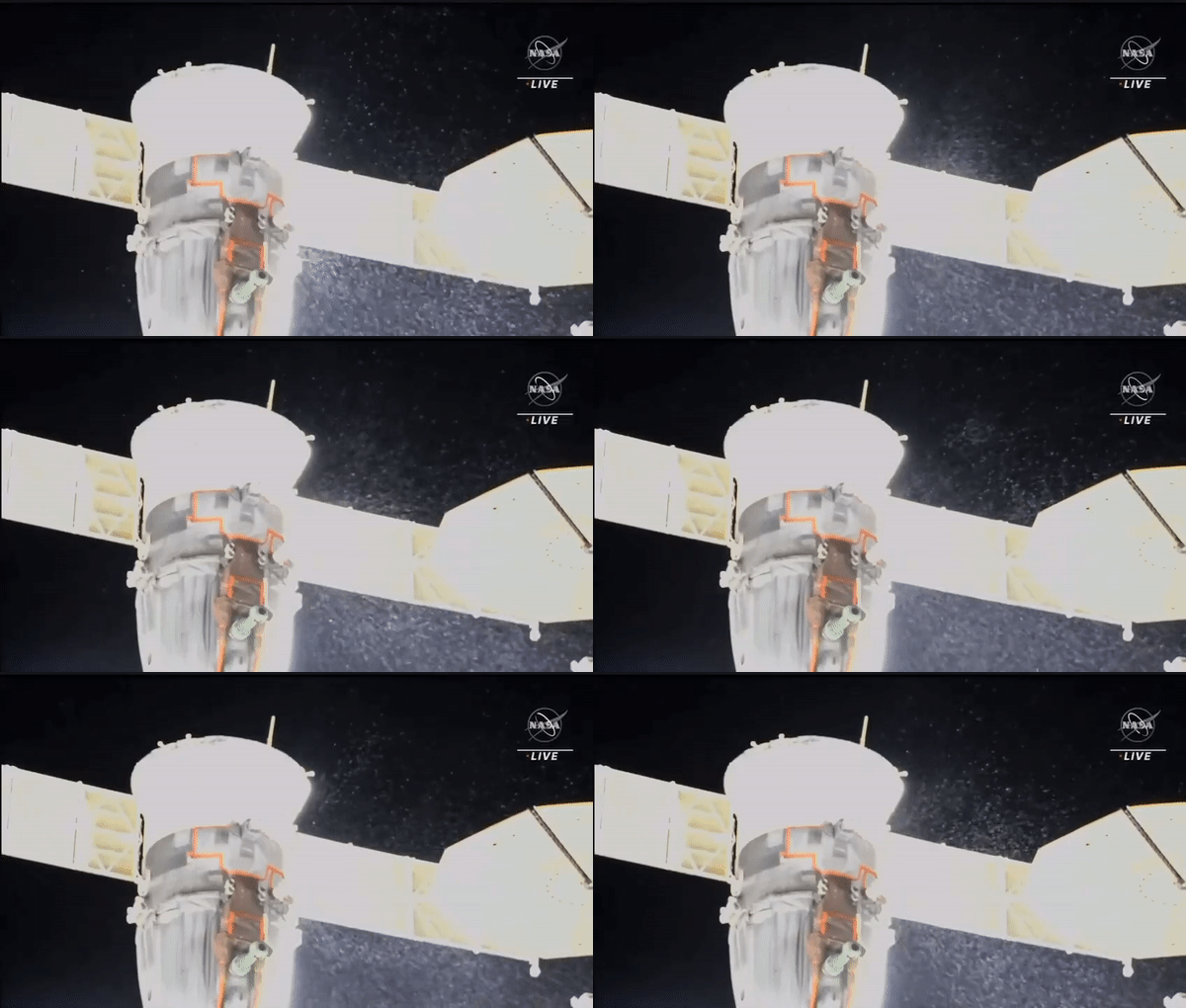
Russia has confirmed it will launch Soyuz MS-23 to the International Space Station in an uncrewed mode to replace the Soyuz MS-22 vehicle which suffered a major coolant leak in December 2022, following what is theorised a piece of dust striking the external radiator at a speed of 7 km/s.
Following the accident, a number of western experts suggested the Soyuz vehicle would be incapable of maintaining a safe temperature in the crew cabin during a return to Earth. After a month-long review of the situation, including examining options for a space-based repair, the Russian space agency Roscosmos has reached the same conclusion.
Video of the Soyuz MS-22 coolant leak, December 14th 2022. Credit: NASA
Soyuz MS-23 will therefore launch on or around February 20th in an automated configuration to provide the means for cosmonauts Sergey Prokopyev and Dmitri Petelin and NASA astronaut Franco Rubio to return to Earth at a later date – exactly when that will be is unclear; as a result of needing to use MS-23 as a replacement vehicle, crew rotations on the Russian side of things will be disrupted, and so Roscomos expects the MS-22 crew to extend their stay on the station by “several months”.
However, the February launch for MS-23 still means that should an emergency evacuation of the station be required in the next month, the crew of MS-22 would be without a ride home. To cover this, it has been suggested at least one MS-22 crew member (likely Rubio) could return on Crew Dragon 5 with the four astronauts it flew to the ISS in October 2022, and remaining MS-22use that vehicle -the thinking at Roscosmos being that with a smaller crew, the damaged cooling system on the Soyuz wouldn’t be so strained and could maintain “safe” temperatures within the vehicle.
Once MS-23 has docked at the station, MS-22 will be prepared for an automated return to Earth, where the investigation into the coolant loss will continue.
Repairs to the damaged vehicle were ruled out due to the difficulties involved in any spacewalk to do so – not the least of which was the risk of ammonia contaminating the spacesuits used and then being brought back into the ISS in high enough concentrations that it might pose a serious health risk if inhaled by any of the crew.
Akiniwa: Haiku Quan – Just who do you think you are?
Now open at Akiniwa, a region within the Akipelago estate of arts regions founded and operated by Akiko Kinoshi (A Kiko), is an engaging exhibition of art by Haiku (Haiku Quan), one of Aki’s partners in organising and hosting art and music events within Akipelago, and who is herself both a photographer-artist and patron of the arts in Second Life.
In this latter regard, and as well as the work she carries out with Aki and Violet Boa at Akipelago, Haiku founded the Free Museum on 2021, giving away copies of works by some of SL’s most gifted artists (with their approval). In 2022 she sponsored the first annual Lyrics Prize and awarded over L$100,000 in prizes to the residents who wrote the best original lyrics to a dozen popular songs.
Akiniwa: Haiku Quan – Just who do you think you are?
Now at Akipelago, Haiku launches a new phase of her work in supports art in Second Life, a new complex of three gallery buildings of a unique neo-industrial design by Blue Tsuki, all of which are to be curated by Haiku and are ranged on three sides of an open air events area. One of these units will eventually be home to additional works from the Free Museum, and the other will host rotating exhibitions by other Second Life artists. The fourth side of the venue is occupied by Nessuno Myoo’s As Mammoths In the Middle Of Butterflies, an installation I reviewed in April 2022.
As for the first unit, this is home to Haiku’s exhibition With Just who do you think you are? This is a collection of no fewer than 300 avatar portraits captured by Haiku. Many of the subjects are themselves artists and musicians using Second Life as their medium of expression, with one or two SLebrities mixes among them (see if you can spot Simon Linden for one…).
Akiniwa: Haiku Quan – Just who do you think you are?
However, rather than being offered as individual pieces, Haiku has opted to place up to 16 portraits in a single frame and then use a scripted timer to rotate through them, showing etc i turn for a period long enough for us to appreciate each one. This results in an exhibit in which the pieces are almost constantly in a state of flux (or change), presenting visitors with the choice of observing the changes a picture frame at a time until all the portraits it contains, or to wander around the gallery floor, each circuit revealing different portraits, giving the sense of walking through a space much larger than the hall.
In terms of the portraits themselves, they are almost all head-and-shoulder shots, the subject looking directly at the camera and with a minimum of post-processing. Thus they present an honest view of each avatar, unburdened by the play of digital tools – and in doing so, perhaps allow us a glimpse one their eyes to the person who lies, so to speak, within them.
Akiniwa: Haiku Quan – Just who do you think you are?
Engaging and rich in content, Just who do you think you are? offers a noel manner in which to present avatar portraits – and I look forward to returning to Akiniwa and witnessing the development of Haiku’s new endeavour as the galleries all become occupied.
Sunday, January 15th will see the 2023 edition of Hippiestock take place in Second Life. A day-long music event, Hippiestock was established in 2011 by Hippie Bowman as a way to for him connect directly with friends he’d made through the Second Life forums. and this year it is sponsored by sponsored by Corsica South Coasters and Commune Utopia.
Whilst intended as a “one-off”, such was the response to that first event in 2011, the Hippie agreed to consider making it an annual event -and 12 years later Hippie and his friends once again present an opportunity to come together with fun and music and to embrace the “hippie philosophy”, once described by Hippie himself as:
[A belief] in peace as the way to resolve differences among peoples, ideologies and religions. The way to peace is through love and tolerance. Loving means accepting others as they are, giving them freedom to express themselves and not judging them based on appearances. This is the core of the hippie philosophy.
– Hippie Bowman, January 2011
Hippestock, January 2023
The event kicks-off at 09:00 SLT on Sunday January 15th, with the music line-up as follows:
09:00 SLT – Hippie Bowman
10:00 SLT – Dimvan Ludwig
11:00 SLT – Alsund
12:00 noon – Cranston Yordstorm
13:00 SLT – The Vinnie Show
14:00 SLT – Joe Paravane
15:00 SLT – Lluis Indigo
16:00 SLT- Jed Luckless (2-hour set with particle show by Moondance Parx)
As well as enjoying the music in an outdoor setting designed to recapture the sense of Woodstock, attendees also have the opportunity to explore the Hippiestock region, there the beach, a camp site between it and the region’s river, a barn recalling Woodstock, a rendition of England’s Stonehenge and multiple places to sit and relax might be found and enjoyed. This setting will remain open to the public to enjoy through until the end of Wednesday, January 18th, 2023 – so even if you don’t make the event on the 15th, there will still be time afterwards to drop in and explore.
 It’s autumn in Shady Hollow, and residents are looking forward to harvest feasts. But then a rabbit discovers a grisly crop: the bones of a moose.







 Inara Pey: Living in a Modemworld