An oriental Collins Land in Second Life

Collins Land, Collins Land; Inara Pey, June 2017, on Flickr Collins Land – click any image for full size

I was stunned to realise that it has been almost four years since I last visited Collins Land, the home of Cerys Collins (Cerys Celestalis). In fact, it has been so long that in the intervening time, Cerys has moved from at Homestead to a Full region. The current build has been in progress since May 2017, with Cerys noting it is now “95% complete”.  Having learned of the Japanese-themed redesign by way of my favourite region hunters, Shakespeare and Max, Caitlyn and I had to leap over and have an explore.

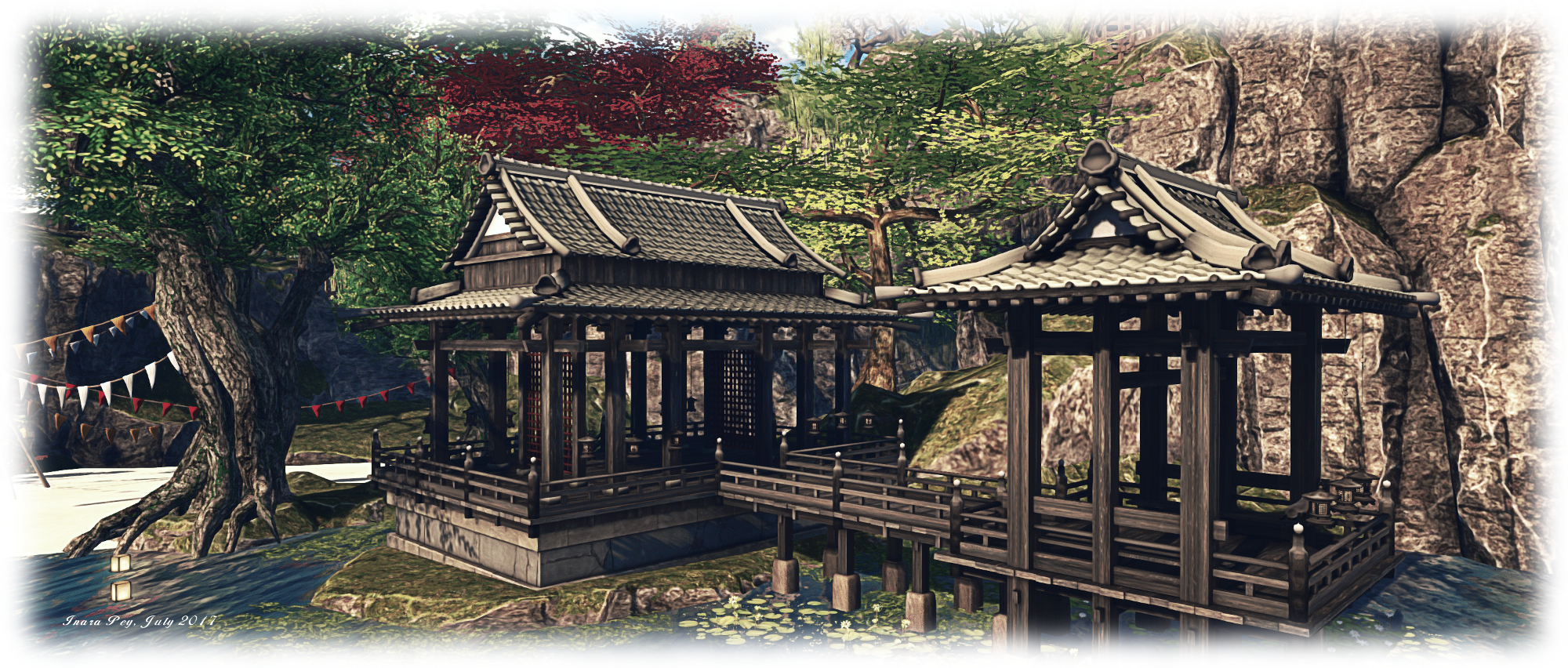
Following the region landmark will deliver you to a shaded spot south and west of the region’s centre, and the grounds of a large traditional Japanese house, built over the cooling influence of a large pond. The latter is an indication that water plays a subtle but important role within the region – keep an eye out for how Cerys makes use of it throughout. The house is situated to one side of tiered gardens and grounds, all of which tend to form a good starting point for explorations.

Collins Land, Collins Land; Inara Pey, June 2017, on Flickr Collins Land

Wooden paths wind and fork their way through the grounds, offering a number of points of entry into the house as well as leading to other points of interest. Follow these board walks with care: just when you think you’ve found them all, the likelihood is you’ll find another leading you to a little scene, a part of the whole whilst also feeling entirely secluded. One route, for example, leads way to a little shaded summer-house to the south overlooking a beach; another route offers access to another little group of buildings in the south-west corner of the island, where a Koi house sits over another pool of water.

Close to the landing point lay stone steps climbing up into the region’s highlands. These are, like a number of the major paths around and through the region, marked by a torii gate. The steps wind their way up to a high plateau, where sits a Buddhist shrine protected by a moat and walls. Along the way, you’ll pass through bamboo groves and past a Machiya house. As well as offering a break from the climb, the gardens of the house offer a view west and north, emphasising the verdant nature of the region.

Collins Land, Collins Land; Inara Pey, June 2017, on Flickr Collins Land

The shrine isn’t the highest point on the island, however. That honour goes to the pagoda in whose shadow it might sometimes sit. This pagoda can be reached by scrambling over the rocks, but there is a fabulous climb via wooden walkways which winds its way up the side of the cliffs, after also starting from the gardens of the landing point. This route – its start denoted by another of the torii gates – should not be missed, and offers more views out over the surrounding mountains.

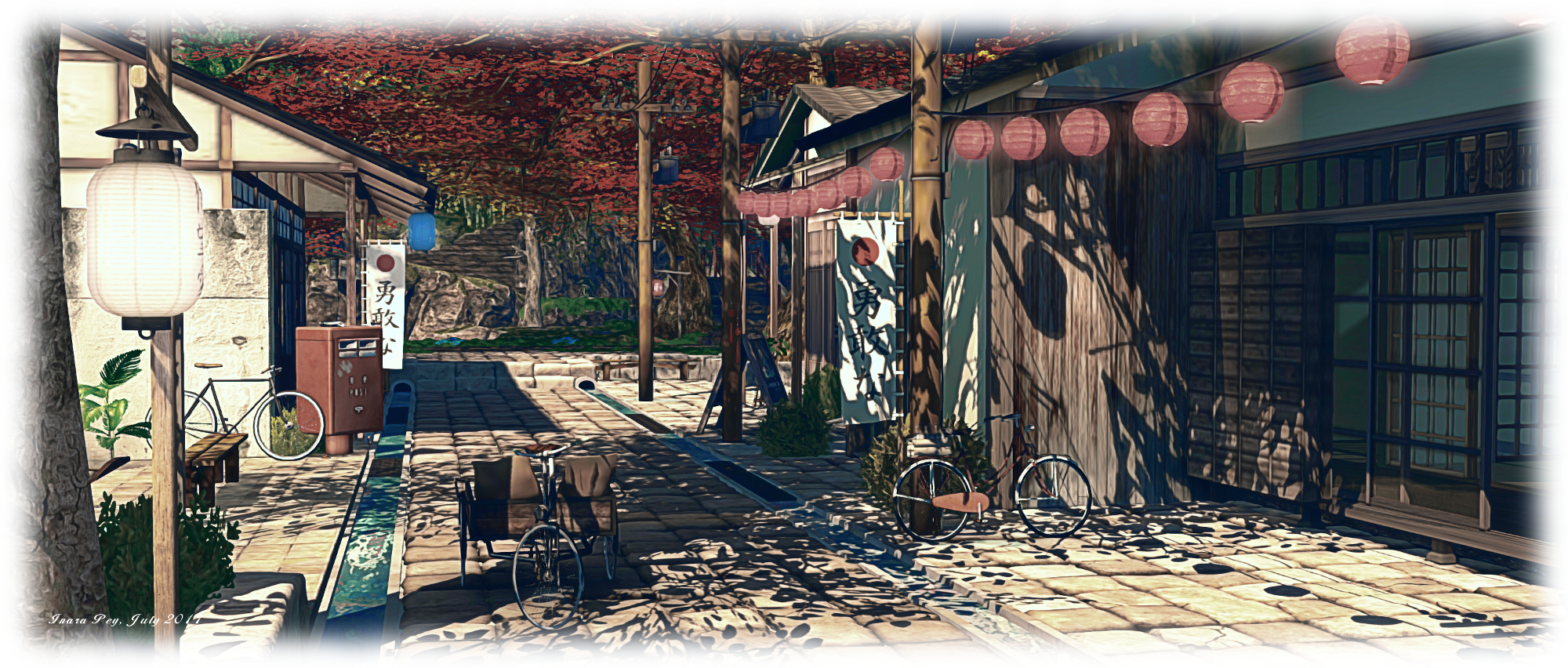
On the north side of the region, sitting under the massif, is a small village, reach by following yet another wooden footpath running northwards from the main house near the landing point and along the west side of the region – watch for the pleasing little detours off of this again along the way. This path gently climbs down the rocky shoulder of the island to reach the village by way of a bridge separating another inland pool from the waters surrounding the region. Built over cobbles and stones, the village appears to be devoted to farming and fishing, and visitors are welcome to try their hand at Greedy, Greedy if they so wish.
Collins Land, Collins Land; Inara Pey, June 2017, on Flickr Collins Land

The lowlands of the northern village are matched by the beach to the south, once again reached by steps leading down from the gardens and house at the landing point. Follow the stepping-stones here and you’ll uncover one of the region’s secrets. As noted, there are others awaiting discovery, as is a hidden place – although I’m not 100% certain that is intended to be open to the public.

I really cannot over-emphasize the beauty of this iteration of Collins Land. The colours are rich and vibrant, the landscaping beautifully and painstakingly done, the beauty spots numerous, the hidden places intimate, the use of space exquisite – as is the way the paths and climbs naturally follow the contours of the land. Keep an eye out for the little touches of humour to be found dotted about in the ground in the water. This humour offers a nod to the fact the work is still ongoing: a group of artisans working (and resting!) as they ready the final bits…

All told, an absolutely gem of a region – as is always the case with Cery’s designs. Click the image below and scroll around the landing point in 360o. If you’re a Flickr user and take shots of the region, please consider sharing them with the Collins Land Flickr group.

SLurl Details

SL project updates 27/3: TPV Developer meeting and JIRA

Stony Hill Vineyard, Stony Hill; Inara Pey, June 2017, on Flickr Stony Hill Vineyardblog post

Friday, July 7th saw a truncated TPV Developer meeting take place in lieu of the planned meeting for Friday, June 30th. As always, the video of the meeting is embedded at the end of this report, and my thanks to North for recording and providing it. Timestamps in the text below refer to that video, and will run the video from that point in a separate browser tab.

SL Viewers

[3:30] The Alex Ivy 64-bit release candidate viewer (version 5.1.0.507006 at the time of writing) is due to be updated in week #28 (commencing Monday, July 10th). The viewer is liable to receive further updates prior to any promotion to release status, as the Lab further refines the Windows SL Launcher.

As previously noted in these pages, the launcher is designed to detect which version of the viewer a Windows system can run. If it detects the system can run the 64-bit version of the viewer, it downloads and installs that, if not, it defaults to downloading the 32-bit version. An upcoming update to the viewer will include a debug setting to override this and force one or other version to be downloaded and installed (obviously, this will not work trying to run the 64-bit viewer on 32-bit Windows, but will allow the 32 viewer to be run on 64-bit Windows).

Crash rates for the viewer are elevated, but the Lab suspects this is down to the number of 32-bit versions being run.

[5:35] This leaves the current viewer pipelines as:

  • Current Release version 5.0.6.326593, released on May 26th, promoted June 20th – formerly the AssetHTTP RC viewer – overview
  • Release channel cohorts:
  • Project viewers:
  • Obsolete platform viewer version 3.7.28.300847 dated May 8th, 2015 – provided for users on Windows XP and OS X versions below 10.7.

The 360 snapshot viewer should be updated with some fixes “soon”.

Server Updates

[6:05] The simulator version using the new Linux operating system update, currently deployed to the Magnum RC channel (server version 17#17.06.29.327400) should be promoted to the Main (SLS) channel on Tuesday, July 11th.

[12:07] This simulator version also includes the fix for DJ boards (see BUG-10073). Some people may need to update their board scripts.

JIRA Temporarily Closed to Comments

The Second Life JIRA has been temporarily closed to comments, because: idiots. Or to allow the Lab to explain it:

Recently, our bug reporting system (Jira) was hit with some spam reports and inappropriate comments, including offensive language and attempts at impersonating Lindens. The Jira system can email bug reporters when new comments are added to their reports, and so unfortunately the inappropriate comments also ended up in some Residents’ inboxes.

We have cleaned up these messages, and continue to investigate ways to prevent this kind of spam in the future. We appreciate your understanding as we work to manage an open forum and mitigate incidents like this.

In the short-term, we have disabled some commenting features to prevent this from recurring. This means that you will not be able to comment on Jiras created by other Residents. We apologize for this inconvenience as we look into long-term solutions to help prevent this type of event from occurring.

Other Items

  • The next Firestorm release is liable to be in September
  • [8:51] The Lab is looking at turning off the remaining UDP messaging for asset delivery on the servers in February 2018, although this is TBC. This means that viewers not running the latest HTTP updates will not be able to receive any asset data.
  • [17:41] The next scheduled TPV Developer meeting is Friday, July 28th


Sansar: new Creator Profile video as preview invites ramp-up

(courtesy of Linden Lab)

On Thursday, July 6th, Linden Lab released a further Sansar preview video focusing on the work of a content creator – Ria, which I’ve embedded at the end of this article

Given we’re now not that far away from the doors to Sansar opening to a wider audience in the “creator beta” (or whatever the Lab finally calls it), the video can be seen as a further ratcheting of things  – alongside recent media articles – ready for the opening. At the same time, the past week has seen a further batch of invited into the Creator Preview find their way to those who have applied to access Sansar.

Further invites to join Sansar have been issued in the last week by the Lab

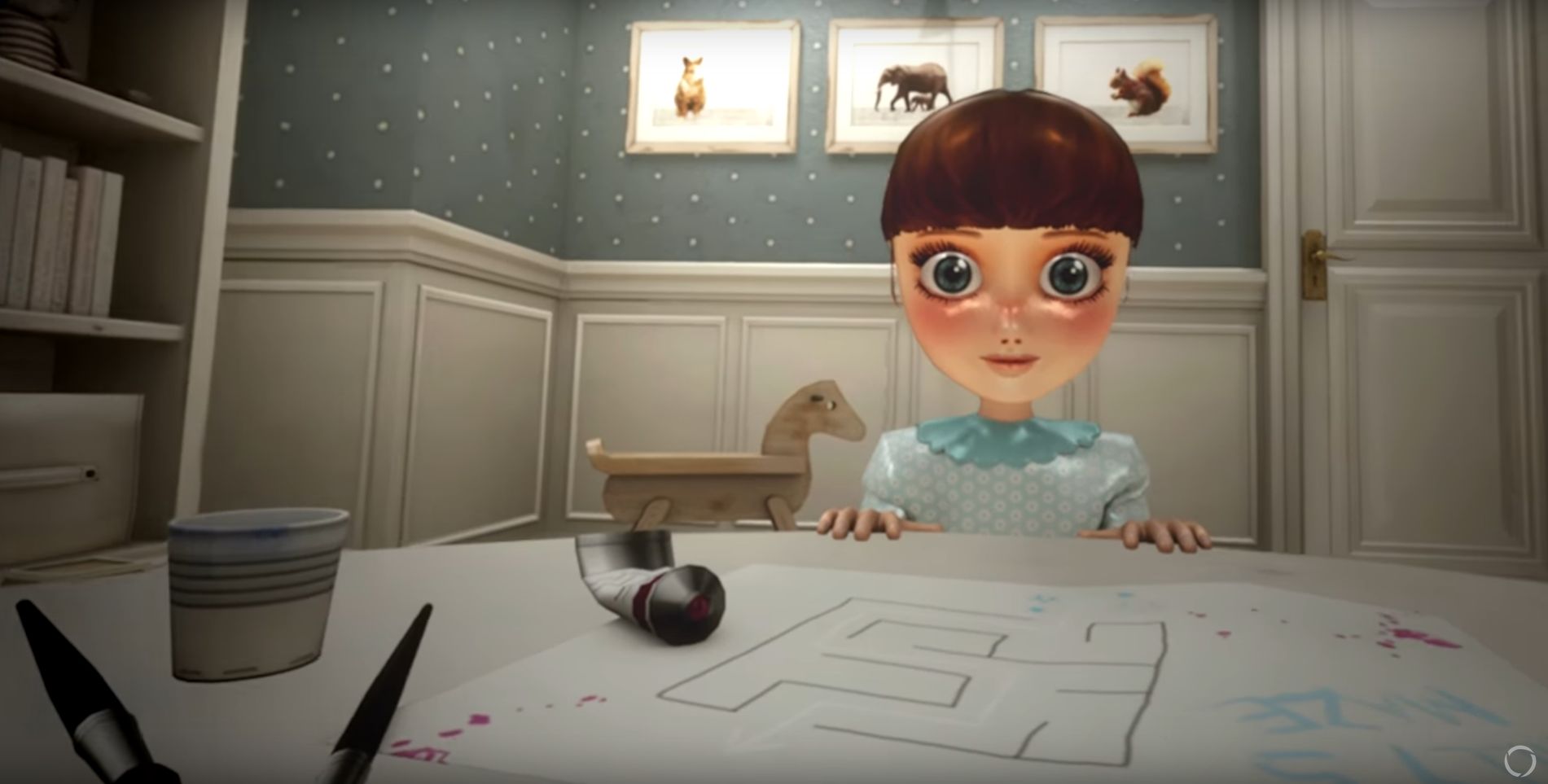
At 99 seconds in length, the video is an engaging enough piece, Ria’s experience from both within and without, which takes the form of an immersive story involving a little girl and her toys, utilising three locations linked by teleports. Kudos to Drax for presenting a means of suggesting the potential of VR immersion by overlaying images from within the game with shots of Ria looking around her creation while using a HMD. It may not be as immersive as “the real thing”, but it’s a lot better that intercut views of heads with HMDs strapped to them bobbing and weaving in front of computer screens we’ve seen in the past.

Those looking for details on Sansar are going to be disappointed however – this is a promotional video after all. That said, there are some interesting shots of the edit environment and what appears to be the fully realised run-time space. Again, given it is a promo video, reading too much into what “is” or “isn’t” said would be a mistake.

Some have found a couple of statements in the video objectionable. The first is the idea that “there is nothing even remotely like Sansar out there” – and I admit to finding it questionable myself.While it may not be as deeply immersive as a “true” VR experience, the fact remains that SL offers pretty much everything Sansar promises, and has done for a good while now. And just because it doesn’t support headsets doesn’t change that. And in terms of VR, there is High Fidelity to consider as well…

The second is that Sansar will achieve “broad appeal” when launched. This has been pooh-poohed on the basis that VR itself has yet to achieve a significant market share. However, “broad appeal” needn’t necessarily mean “mass market” – and the two seem to be getting conflated.

Inside Ria’s Sansar Experience

I personally don’t think VR (and by extension Sansar) will be “mass market”. However, as I’ve oft said, there are markets were VR could have a significant role, and Sansar could be ideally positioned to leverage them. Design, architecture, training, simulation, education, healthcare, for example; plus, as friend and content creator Dassni pointed out to me in a lengthy conversation, it might even appeal to indie game / game modding enthusiasts.  Taken together, these could facilitate the kind of “broad appeal” for Sansar to generate a comfortable level of revenue for the Lab – in time.

How much time? Well, therein lies the rub. Sansar itself is going to need a lot more development work once the gates open to a wider audience, and even among the markets already looking at VR, the preference might be to wait until headsets have improved in capability and looks and come down in price – something which could be around 2-3 years away.

SL project updates week 27/2: Content Creation UG

The Content Creation User Group meeting, at the Hippotropolis Camp Fire Circle (stock)

The following notes are taken from the Content Creation User Group meeting, held on  Thursday, July 6th, 2017 at 13:00 SLT at the the Hippotropolis Camp Fire Circle. The meeting is chaired by Vir Linden, and agenda notes, etc, are usually available on the Content Creation User Group wiki page.

Audio extracts are provided where relevant. Note that this article is organised (as far as possible) by topic, and does not necessarily reflect the chronological order in which items were discussed. Medhue was a little late to the meeting, and so missed the first 15 minutes. However, his video is embedded at the end of this article, and time steps to it, where applicable, are provided and will open the video at that point in a separate browser tab for ease of reference.

New Starter Avatars

The Lab issued new starter avatars on Wednesday, July 5th. Six out of the eight classic avatars utilised Bento extensions for rideable horses or wings. See my write-up on them for more.

Animated Objects

General Update

Work is continuing on trying to get linksets to work correctly. This is focused on ensuring there is sufficient back-end code to correctly handle multiple animated requests from different elements within an animated object.

Some general questions related to animated mesh were asked at various points in the meeting, these are addressed below.

  • Will animated objects use the Bento skeleton – yes.
  • [5:07] Will animated mesh allow the return of mesh UUID flipping (removed due to the ability being badly abused) – very unlikely.
  • [6:12] Where will animations for animated objects be stored? Within the object (or elements of the object) itself, and called via the object’s own scripts – as per scripted attachments on avatars are handled.
  • [7:15] Will animated objects use an AO? Not in the sense of an avatar AO, as animated objects will not make use of the basic system animations / locomotion graph. There was some debate over the effectiveness of using the AO system, although it was pointed out it could make it easier when having pets following you, running when you run, etc. One suggestion was that pathfinding might be adopted to act as a pseudo-AO.
  • [29:02] There is still no data on an animated objects project viewer will be available.

Attaching Avatars and Animated Objects To One Another

There is obviously considerable interest in enabling avatars and animated objects attach one to another. For example,  being able to walk up to a free roaming horse and then mount it and ride it, or having a pet running around on the ground you could “pick up” and have it sit on your shoulder, move between your shoulders, look around, lie around your neck, etc.

Achieving this raises numerous issues – how should two skeletal objects attach one to another, how are the independent animation sets handled, how are they kept in sync, how the hierarchy is managed (which is the parent, which is the child, etc.

Some options have been suggested for allowing avatars to attach to animated objects – such by having a specific “sit bone” which could be targeted and then used as an anchor point to help maintain some semblance of synchronisation between the animated object and the avatar’s own animations. Feature request BUG-100864 offers a similar suggestion, utilising a scripted approach. Vir has suggested that this feature request perhaps be used as the basis for further discussion, and welcomes JIRAs on alternative approaches.

“First Pass” at Animated Objects

[09:59] Vir reminded people that the current work is only a first pass at animated objects, designed to provide basic, usable functionality. Providing more NPC-like capabilities: animated objects with locomotion graphs and using the system animations; attaching animated objects to avatars / avatars to animated objects; giving animated objects the notion of an inventory and wearables, etc., are all seen as potential follow-up projects building on the initial capability, rather than attempting to do everything at once.

Caching  / Pre-loading Animations

Sounds and animations can suffer a noticeable delay on a first-time play if they have the be fetched directly at the time they’re needed. For sounds, this can be avoided by using LSL to pre-cache them (e.g. using llPreloadSound) so they are ready for the viewer to play when needed, but there is no similar capability for animations.

A feature request (BUG-7854) was put forward at the end to December 2015, but has not moved beyond Triage. Vir’s view is that pre-loading animations in a manner similar to sounds makes sense, should be relatively straight-forward and could help with syncing animations in general. However, whether or not it might / could be done within the animated objects project is TBD.

Other Items

Sample Code and Code Libraries

[11:39-27:45] Medhue Simoni opens a discussion on code availability – noting that Pathfinding had suites of example code which appear to have vanished, suggesting that the Lab could do more to provide more complex examples of how new capabilities could be used and then made available to everyone could help leverage such capabilities more effectively.

From this came ideas of open-sourcing more of the Lab’s own code for experiences (like Linden Realms), the potential for abuse this could present (people developing cheats for games), the complexities (or otherwise) of LSL coding, the fact that often when the Lab develops something, they’re not aware of exactly what directions creators will take it, and so masses of example code might be of limited value, etc., – although code demonstrating how to do specific things would undoubtedly be of benefit.

Vir points out that the Lab’s resources are finite for coding, and an alternative might be for a more recognised open-source repository to store, reference and obtain documented code and examples might be in order – there are already libraries and resources on the SL wiki, but these aren’t necessarily easy to navigate. There is also the LSL wiki – although this may be in need of update, as well as resources on a number of forums.

[25:47] Within this conversation, the question was asked if the 64Kb limit on scripts could be raised, and the short answer – as Vir doesn’t deal directly with the scripting side of things is – unknown.

[29:56-end] This conversation then spins out into the technical limitations of Second Life (CPU core usage, etc.) when compared to other platforms as seen by one creator. some of the broader comments in voice and text seem predicated on misunderstandings (e.g. the Lab is investing in newer hardware where possible, but are hamstrung by a need to ensure back compatibility with existing content, which sometimes limits just what can be done; the idea that the new starter avatars are No Mod  – they’d fully mod, etc), and which also touches on the basic need for education on content creation (e.g. responsible text sizing and use), before spinning out into general concerns on overall security for content in SL.

“Bento equipped” starter avatars for Second Life

The new Rhiannon avatar from the Lab standing and with optional Bento horse

First hinted at during Patch and Dee’s Meet the Lindens session at SL14B, the new set of Second Life avatars from Linden Lab appeared on Wednesday, July 5th, and were announced via an official blog post.

There are eight avatars in the new range, referred to as the “Renaissance” set – a term more akin to the capabilities provided with the avatars than the actual historical period, perhaps. They are paired into four sets of male and female avatars which might be described as: angel, demon, warrior and (as the Lab calls them) “mystic heroes”.

Three of the pairs – angel, demon and warrior – are “Bento equipped”, meaning they make use of the Bento skeleton for their wings (angels / demons) or horse (warriors). Note this does not mean the avatars themselves are Bento; they are system avatars, but are supplied with fitted mesh clothing and mesh accessories.

The new avatars are best accessed via Me (/Avatar > Choose an Avatar)

To make use of any of the new avatars, display the Choose an Avatar picker, scroll to the one you wish to try, and click on it. Your avatar will wear the outfit, which is also transferred to your Clothing system folder under the avatar’s name, one of:

  • Anna or Marcus for the angels
  • Elleria or Sauin for the demons,
  • Kara or Feng for the “mystic heroes”
  • Rhiannon  or Thomas for the horse riders.

There can be some short-lived oddities when wearing the Bento equipped avatars using Replace Current Outfit. For example, as the riding animation for Rhiannon and Thomas is an attachment, depending on how things load, it can briefly look as if you are standing “in” the horse, rather than sitting in the saddle.

Also, as the horses use the wing bones for their forelegs, swapping to a winged avatar after using one of the horse-related avatars at any time in a session, can lead to your wings appearing in front of you  at thigh level to you and those around you. Walking forward should fix this in all views (if not, right clicking on your avatar and using the Reset Skeleton option may be required – if other still see your wings oddly placed, advise them to do the same with your avatar).

The Kara “Mystic Hero (and non-Bento equipped) avatar (l)  and the Elleria avatar with Bento wings

You can obviously mix’n’match the avatar elements should you wish. For example, want to have the (nominally) “non-Bento” Kara avatar to ride a horse? Just copy the horse mesh and riding AO from Rhiannon’s folder to Kara’s folder. Detach Kara’s default AO and then attach the riding AO and horse.   and attach.

Be aware that a little care is required if you wish to use a horse with one of the winged avatars. As the horse forelegs use the wing bones, you will need to remove the wings before attaching a horse (and vice-versa), or a conflict will occur. Note, as well, that you can rez the two horses in-world as static objects, should you wish. They have an LI of 26 (male horse) and 31 (Female horse).

As system avatars with editable shapes, you can obviously apply skin, tattoo and clothing layers to them if you wish and change their shape (the fitted mesh clothing should all follow shape changes within reason).  All of which makes each of them a nice little package if you’re looking for something different for an alt or something.

The new avatars on the SL sign-up page

That said, these avatars aren’t designed for the established user per se – although their low render cost is obviously a boon to those on lower-end systems. Really, these are more geared to new starters in SL, and as such, they have all taken their place on the sign-up page avatar carousel. In terms of their render costs, seven of the eight sit between 12K and 18K in their default look, and the most expensive in terms of rendering – Kara –  is 30,059, which is still more than reasonable.

In terms of general looks, these avatars compare very well with updated Classic avatars released in 2015 and the last set of mesh avatars released by the Lab. However, a little more in the way of ethnic diversity might be nice (Asian, for example?).

My alt avatar using the new Elleria demoness avatar, sans wings (so as to avoid conflicts with the horse), the Rhiannon avatar AO, and the Bento horse from the Thomas avatar – note my avatar is also wearing my preferred system skin for her, applied to the Elleria shape

Overall, a decent set, which increases the range of starter avatars and which are pretty cost-effective. I certainly like the Elleria avatar enough to now use it as the default look (again, sans wings for now) for my alt avie. As she is simply a CTA (Crash Test Avie) when fiddling with viewers, and a stand-in for me when I’m busy in-world elsewhere and cannot always attend a meeting, I’ve never really invested in outfits for her. So I think she appreciates the occasion change of look like this 🙂 .

One Tree Hill in Second Life

One Tree Hill

Karma Avedon sent me an invitation to visit her full region installation, One Tree Hill which is – although still in part a work-in-progress – now open for visitors. “[It’s] my first ever work for the LEA and I am very excited both to have had my idea accepted and to have managed to actually bring it to fruition,” she told me prior to Caitlyn and I paying a visit.

The installation is a virtual reflection of U2’s seminal album The Joshua Tree, which celebrated the 30th anniversary of its release in March 2017. The album grew from a mix of influences – social, political, spiritual, and cultural. It was released in a period of history which we see echoed somewhat today, with economics dominating the politics of the UK (U2’s home) and America; global small-scale conflicts; the changing face of traditional industries – notably coal mining; etc.

One Tree Hill: With Or Without You

All of this, including the influences behind many of the songs contained within the album are reflected within One Tree Hill. Some of these references are obvious, others are more subtle or layered. Also to be found are reflections on the band’s contrasting views between “real America”  and “mythological America”, and reminders that the UK and the USA have much in common.

A journey begins  Where the Streets Have No Name, a flat desert-like environment cut by broad, nameless roads, stretching away to the horizon, a great mesa rising to one side. Much of this contains images of the American mythos: great flat desert plains, broad, ruler-straight roads arrowing to the horizon, billboards (which carry some of the more overt political references for both the 1980s and today), and a reminder of the former importance of coal in building both the UK and USA.

One Tree Hill

Where one travels through this landscape is a matter of choice. Follow the single south pointing road, and you’ll pass a row of bonnet-buried Cadillacs – a reference to Cadillac Ranch, and emblematic of the American mythos. Close by, on the other side of the road visitors can reflect on being With Or Without You; the internal struggle of the song (to be a husband at home or a rock star on tour) powerfully represented by the statue of a couple caught in the tension of a tango – and a dance orb allows visitors to engage in a dance as well.

Staying on the lowland area, where Joshua trees via with umbrella thorns to offer some greenery, and travelling south, one will eventually come to a large gallery space (still under construction) and references to Bono’s time in South America. The latter represents both Bullet the Blue Sky and Mothers of the Disappeared in a rain-soaked corner. The latter of these also perhaps contains modern-day references: the three distressed mothers all being clad in burqa-like garments, whilst the boards set on the chain link fence appear to be in reference to more recent conflicts.

One Tree Hill: Red Hill Mining Town

Atop the mesa and reached via an ascending set of wooden platforms, sits a literal representation of Red Hill Mining Town literally sits, offering another layered interpretation of the period. The song itself was written around the unfolding political upheavals impacting Britain’s coaling communities in the mid-1980s, and in particular the 1984 Miner’s Strike; however, the town is very clearly American in setting.  Thus, a parallel is drawn between the decline in the importance of domestic coal witnessed in both the United States and the UK – for largely the same economic reasons – during the 1980s. A further layer is perhaps added as well, in that the embodying Red Hill Mining Town as a run-down American township might be seen as a metaphor for the band’s own conflicted views of the “real” (declining traditional industries), and “mythological” (land of golden opportunities) United States.

Within this town are further references to both The Joshua Tree with I Still Haven’t Found What I’m Looking For, featured appropriately enough within a church; and to U2’s own history in the form of the STS Studios, where many of the group’s songs (including some from The Joshua Tree, but notably the likes of Rattle and Hum) originated / were recorded. Standing over all of this, and reach by another set of wooden steps, is One Tree Hill, written in reflection of a 1984 visit to Maungakiekie, a volcanic peak in New Zealand, and one of the most spiritually significant to Māori people. As with it’s namesake, Karma’s One Tree Hill is a place of reflection and peace.

One Tree Hill: Mothers of the Disappeared


One Tree Hill is a fascinating, layered installation, one which should be explored carefully, allowing for reflections on U2’s album and music and the imagery presented within the build. Do be sure to have ambient sounds active when visiting and – if you’re a U2 fan, try the music stream as well. I’ve also not referenced all the tracks on the album – others are to be found, but I’ll leave you to find them (hint: look indoors for at least one), as that’ll leave you some mystery as well 🙂 .

SLurl Details