 Update, February 19th, 2014: dio was discontinued by Linden Lab on February 19th, 2014. Links to the dio website, etc have therefore been removed from this article.
Linden Lab has officially launched dio, the latest in its new product line, in a beta release on Tuesday 29th January.
dio has been subject to much speculation since the original website was accidentally left accessible to enquiring noses back in May 2012. More recently, the site has been extensively updated, giving some clues as to what it is about.
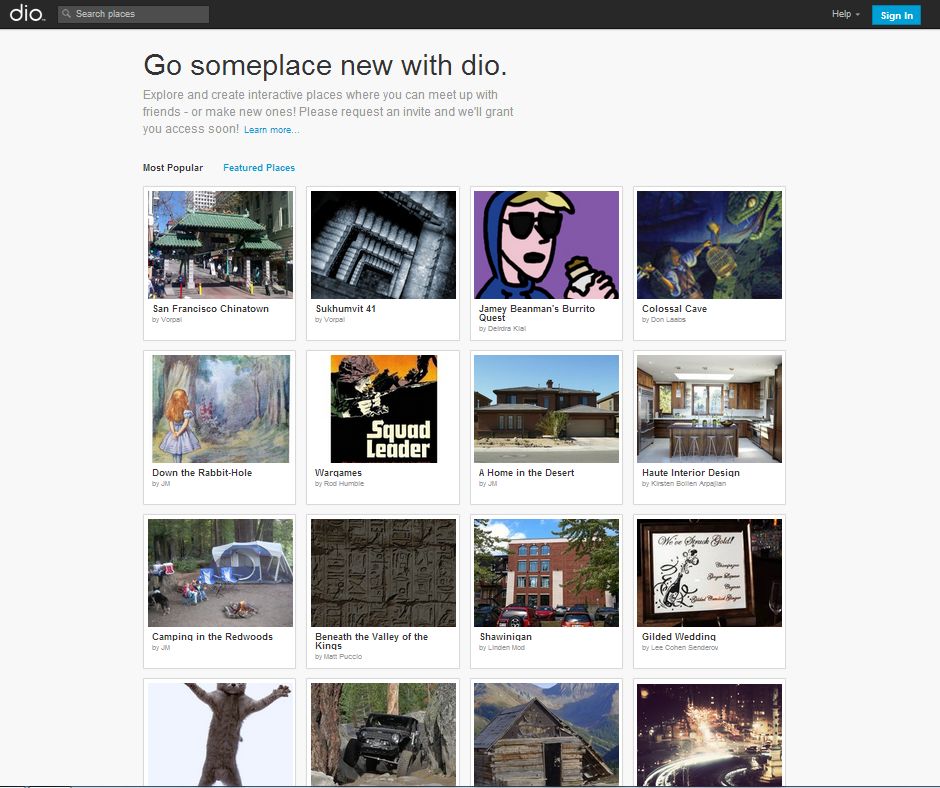
The press release announcing the launch reads in part:
In dio, you create places by adding text, photos, videos, and interactive objects into interconnected ‘rooms’ that give spatial context to the content you share. You can keep your places private, share them with friends and family, or allow everyone to explore and enjoy them. Live and persistent chat allows you to socialize with other users as you discover and explore dio places together and see what those who came before you had to say. In the future, dio users will be able to monetize the dio places they create, enabling them to profit from their own creativity.
The Learn More link on the site provides more information on the site, and there is an introuctory vdieo to accompany the launch.
Within dio, users can create places – such as their own homes – or recreate events in their lives, such as their wedding, or make picture-based games, and so on, and then select how to share them. All of these aspects cane be combined, as dio Producer Bo Barfield explained in an interview with Forbes Magazine to mark the launch:
You can combine these game-like experiences in places where they traditionally wouldn’t be. As an example, a hotel that’s trying to find a new way to advertise and make money can recreate their hotel in dio, and then make a short and easy game that takes a few minutes. Say Clare Danes lost her beloved emerald earrings. Find it somewhere in the hotel, and you get a free bottle of champagne with your stay. It’s using gamification in a richer way. It’s not just about getting badges or achievements: It gets customers imagining themselves in your hotel or whatever it is you’re trying to market.
Questions as to how dio will be monetised, both for the Lab and for users, are also answered – to a point – within the Forbes article, where Barfield states:
We want to implement revenue sharing with the content creators of dio to give people an incentive to create interesting spaces. We’re going to give them a cut of the advertising revenue that they bring.
We’ve seen that work exceptionally well in Second Life, where users can monetize their own creation…. If I create a dio place that’s very compelling and is getting lots of traffic, then I’ll be able to monetize that as a share with Linden Lab.
So it would appear to be that dio is perhaps the Lab’s most ambitious product to date, aiming at a very broad cross-section of users, from individuals through to businesses.
Interestingly, the dio Terms of Service still make reference to the use of Linden Dollars. Given the website is still beta, this may be down to the fact that the ToS is still boilerplated from the Second Life ToS – a point I’ve previously made. While I’m still somewhat drawn to this being the case, it is nevertheless interesting to speculate where and how Linden Dollars might be linked to dio, and what form any cross-pollination between dio and Second Life (were there to be any) might take.
Also accompanying the launch is a set of video tutorials on You Tube.
The response from Frobes’ contributor Carol Pinchefsky is broadly positive towards the platform. Those wishing to sign-up can do so (it’s free), either by using their Facebook account or using their e-mail address.
I’ll be looking at dio in-depth in an upcoming article.

 Inara Pey: Living in a Modemworld