Second Life Oculus Rift viewer 4.1.0.317313: update and JIRA

The Second Life Oculus Rift project viewer has been updated to support the Oculus CV-1 - but not without issues
The Second Life Oculus Rift project viewer has been updated to support the Oculus CV-1 – but not without issues

Update: July 8th: Linden Lab has suspended viewer support for the Oculus Rift. This article has been updated accordingly, notably with strikethroughs on links which are no longer valid.t.

On July 2nd, I posted about the release of the latest Oculus Rift project viewer, version 4.1.0.317313. As I’m actually Riftless, I could do little more than take a surface poke at the viewer and leave it to others to have a more detailed look – and they have done so, and found things to be less than favourable.

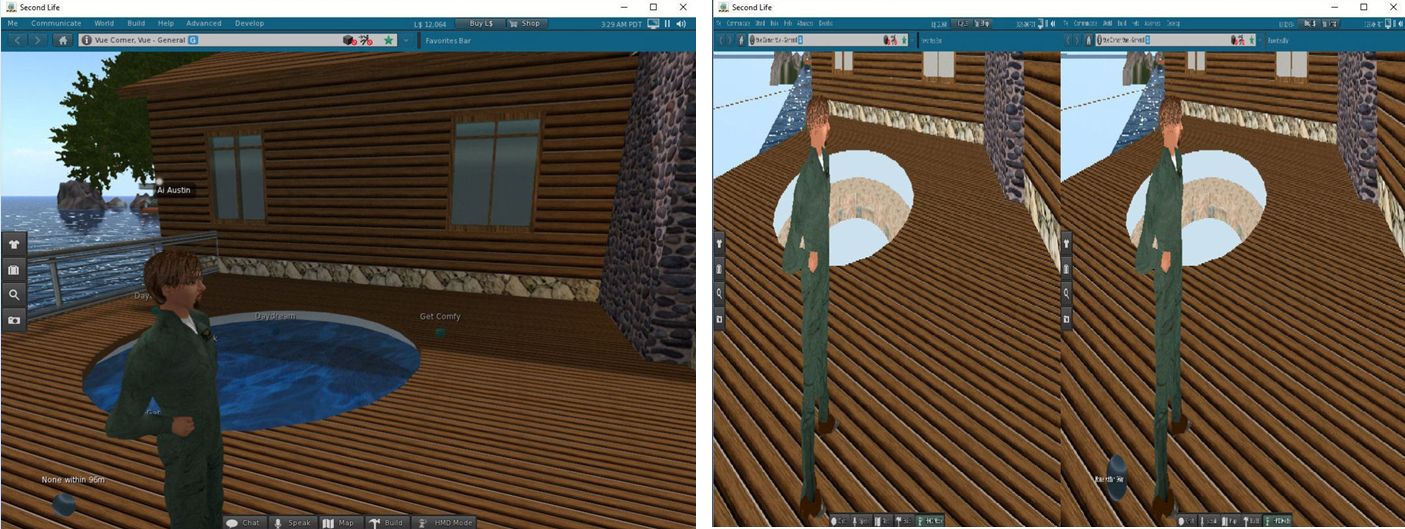
Ai Austin / Austin Tate is perhaps best placed in terms of overall feedback having gone through using an Oculus Rift HMD with the new viewer in several scenarios, all of which he has documented in his own blog, some of his initial finding having been reported in the comments following my original article. The problems he’s encountered include:

  • In all cases and with all graphics settings tried, the HMD view is over bright and washed out pastel in colour. He also notes the Pixel Luminance Overdrive setting, which had been present in earlier versions of the Rift project viewer is now absent
  • A failure to show any objects, wither in-world or attached to an avatar, with full or partial transparency when in HMD Mode (so, avatar hair, for example will not render). AI found that disabling Atmospheric Shaders in the viewer resolved this – but is not entirely a desirable solution
  • The image resolution in the HMD is low and jagged, and altering the viewer’s graphics settings apparently has no impact
  • Numerous UI-related issues in HMD mode, including: UI elements in fixed positions which cannot be changed via viewer settings; object and avatar labels and interaction icons fail to show; mouse pointer fails to display
  • Additional visual and display issues.
AI Austin illustrates one of the visual issues with the new Oculus Rift projects viewer: one the left, a scene rendered in the viewer when not in HMD mode; on the right, when rendered in HMD - note the washed-out Linden water in particular
Ai Austin illustrates one of the visual issues with the new Oculus Rift projects viewer: one the left, a scene rendered in the viewer when not in HMD mode; on the right, when rendered in HMD – note the missing transparencies in thew avatar’s hair, giving the impression of hair loss and the “missing” hot tub water. Credit: Ai Austin / Austin Tate

His experience mirrors that of other Rift users, including TTech (who also commented on this blog), and a number of users who have tried this 4.1.0 release of the viewer and have commented on the Oculus Rift forum thread ( see feedback commencing with this message onwards).

Commenting on the viewer at the Simulator User Group meeting on Tuesday, July 5th, Oz Linden said:

At this point, I don’t have any real comment.  It’s a Project Viewer, and one explicitly labelled Experimental at that… the point is for people to try it and let us know what they find out.

To help let the Lab know what people find out in using the viewer, I’d like to point to a bug report – BUG-20130 – raised by Rai Fargis.

While I am flattered that staff at the Lab do read this blog, if you are experimenting / trying the new Oculus Rift project viewer and experience specific issues, please add them to bug report rather than documenting them in the comments following this article (general feedback here is welcome, obviously). Doing so, and including with information on your system set-up, relevant log files, etc., guarantees your feedback is seen and recorded by the Lab, encouraging them to investigate issues.

When reporting problems, one thing to keep in mind is that this version has leapt forward several iterations in terms of the Oculus SDK; therefore comparisons with earlier versions of the viewer may not be helpful (outside of possibly pointing to removed options which proved useful in dealing with specific issues in the past). Rather, specifics of issues encountered with this version will offer a better means for the Lab to start / continue investigations.

At the moment, viewers operating in HMD mode have no means to tell the simulator they are doing so. Therefore, the Lab doesn’t have a means of accurately determining the numbers of people using Rift HMDs – and metric which could be useful in the future; as such, it is something which may change with a future update to the viewer.

With thanks to Ai Austin, TTech, Rai Fargis, and Jeanette Doobie

Second Life Oculus Rift viewer 4.1.0.317313

The Second Life Oculus Rift project viewer has been updated to support the Oculus CV-1

Update: July 8th: Linden Lab has suspended viewer support for the Oculus Rift. This article has been updated accordingly, notably with strikethroughs on links which are no longer valid.

Update July 5th: Rai Fargis has raised a JIRA – BUG-20130 – where specific issues with this viewer can be recorded for the direct attention of l,inden Lab. Many thanks to Rai for doing so, and to Ai Austin for poking me with the JIRA number. please also refer to my follow-up article on his project viewer

Update July 3rd: Those with Oculus HMDs are reporting significant issues with this update to the viewer via Twitter, the SL forums and YouTube, with some of the problems also being added as comments to the end of this article. Any specific, reproducible issues (allowing for the apparent quantity of problems being encountered) should be reported to the Lab via the LL JIRA, if possible. 

On Friday, July 1st, 2016, Linden Lab released the much-anticipated update to the Oculus Rift project viewer.

Version 4.1.0.317313 of the viewer is a Windows only build, for a very specific reason, as all VR followers should be aware, and as explained in the headline comments in the release notes:

The SDK from Oculus Rift does not support anything but Windows, so the other platforms are not supported for use with an Oculus Rift.

This update means the project viewer should now support both the Oculus DK 2.0 and the new consumer version of the headset, the CV-1. Note, however, that it is not intended to support the HTC Vive as well (see below).

In addition, the update brings the viewer up-to-date with all viewer releases through to the Lab’s current release code base, and so includes the plethora of updates over the last two years, up to and including Avatar Complexity and graphics presets.

As with the previous version of the viewer, the Oculus Rift setting panel can be accessed via Preferences > Move & View. There is also an Advanced HMD menu option in the viewer’s Advanced menu, but I’ve no idea what this does (I don’t have an Oculus Rift of my own), and a toolbar button is available for those wishing to toggle in / out of the viewer’s “Rift mode”,  which can also be done by pressing CTRL-SHIFT-D (note that using either of these options will generate an on-screen error message if a Rift headset is not connected to your PC).

Oculus Rift Set-up floater

The release notes for the viewer contain a set of tips designed to help optimise the viewer’s performance (unchanged from the previous release of the viewer), as well as listing the core key controls:

  • Enter HMD mode – CTRL + SHIFT + D
  • Align to look – Q
  • Center Mouse Pointer – Z
  • Action key – X
  • Camera Mode – M (Press multiple times to cycle through 3rd Person, HMD Mouse look, and 1st Person modes)
  • Hide UI – CTRL+SHIFT+U

Performance

As has been repeatedly indicated by the Lab (e.g. the June 2016 Meet the Lindens chat with Ebbe Altberg), the nature of Second Life, where much of the in-world content (including avatars) has not been optimised for delivery at very high frame rates, the viewer is unlikely to deliver optimal Oculus Rift performance (e.g. 75 fps at all times for the DK-2 and 90 fps for the CV-1).  It should, however, offer a “comfortable” level of performance sufficient enough for people to enjoy the immersive experience presented by the headset reasonably well.

Future Intent and Vive Support

Going forward, the Lab plans to progress Oculus support through project and RC status and integrate it into the release viewer. There are no plans to offer a specific “Oculus Rift flavour” version of the viewer that will be maintained alongside a “non-Oculus Rift” version.

Speaking at the TPV Developer meeting on Friday July 1st, Oz Linden indicated that providing support for the HTC Vive in Second Life is something the Lab “would like to be able to do”, but it is not something on the horizon at present. If and / or when the Lab might offer Vive support in SL, and how far that support might go (e.g. will it include support for using the Vive’s room sensors with SL) is an open question at this point is time.

Related Links

In the Press: a voyage of discovery in Second Life

Second Life has again been getting some fair press coverage, both directly and directly, of late. I’ve already written about the platform either being the focus of, or looked at as part of, two interesting articles published in Motherboard. Also during the week, Second Life was written about on this side of the Atlantic, as first reported by Ciaran Laval.

On April 28th the on-line edition of France’s Le Monde carried an article focused on Second Life, written by  Morgane Tual.  Bearing the delightfully French title Absurde, créatif et débauché : dix ans après, « Second Life » est toujours bien vivant (Absurd, creative and debauched: ten years later, “Second Life” is still alive), it weaves a wonderful introduction to the platform which cannot fail to have those of us immersed in this digital world smiling and / or nodding in agreement.

Morgane Taul: an engaging article on Second Life
Morgane Tual: an engaging article on Second Life

This is very much a hands-on, through-the-eyes look at Second Life, good and bad, written with an unabashed honesty and wonderment. Opening with a description of her initial time in Second Life and a (first?) encounter with another resident, Ms. Tual quickly informs her readers where she is and why she is there – and hints that what she has to say might come as a surprise for who might have heard of the platform at some point:

Like me, some haggard and clumsy beginners landed on this strange beach to discover what remains of this game that occupied the headlines there about ten years. I expected to find, a decade later, a deserted world, ageing technology and a few cobwebs in the corners. It was exactly the opposite.

From this set-up we are lead on what is very much a personal voyage of discovery through Second Life. In it we encounter the realities of the platform – good and bad in equal measure,  each presented to us as they are encountered.

So it is we share in her wonder as she hops from place-to-place; her confusion (and that of others newcomers) in finding herself unceremoniously dumped at an infohub; the embarrassment that can occur simply as a result of clicking the wrong button, or in awkwardly accepting the help of another. We share in her delight in her discoveries of the music scene and in finding a place were she makes a new friend, Patti, a fellow French woman. From here we join her on a whirlwind tour of Second Life which take her to Hogwarts and thence via Star Wars, 221B Baker Street and a nightclub, to the Petit Trianon, Tatiana Dokuchic’s wonderful build in the Duché de Coeur, and a conversation with Tatiana herself.

Petit Trianon by Tatiana Dokuchic, featured in Absurde, créatif et débauché : dix ans après, « Second Life » est toujours bien vivant
Petit Trianon by Tatiana Dokuchic, featured in the Le Monde article by Morgane Tual

Interspersed with this are the assorted facts and figures from the Lab – the 900,000 monthly log-ins, the broad demographic, the economics of the platform, and so on, together with the usual potted history of the platform, all of which paints one of the clearest pictures of Second Life I’ve had the good fortune to read; one with a personal narrative free from the need to fall back on cliché or dogged by mocking observation.

Such is the narrative, we’re drawn directly into Ms. Tual’s experiences, all of which are related without judgement, but often with a real sense of joy and / or wonder. Of course, the sex is also there, but so too is the discovery that contrary to belief, Second life isn’t necessarily “all about the sex”, a point of view Ms. Tual fully embraces.

The breadth of possible engagement in Second Life is touched upon in other ways as well. Through the conversation with Tatiana, readers are introduced to the richness of opportunity for creativity in Second life. Art and entertainment are referred to – the latter supported by the inclusion of some hand-picked videos.

We also witness the tales of others, such as the guy who initially mocked the activities of SL users, regarding them as “losers”, only to himself become engrossed in the platform and all it offers. We are also – movingly – introduced to the way in which Second life bridges the physical / digital divide, very genuinely bringing people together when entire continents might otherwise separate them.

With videos and in-world images, personal tales, a frank narrative, Absurde, créatif et débauché : dix ans après, « Second Life » est toujours bien vivant is one of the most engaging pieces on second Life it has been my pleasure to read. Recommended.

HTC Vive and Microsoft HoloLens available for pre-order

The HTC Vive and Microsoft HoloLens: available to pre-order (sort-of in the case of the HoloLens)
The HTC Vive and Microsoft HoloLens: available to pre-order (sort-of in the case of the HoloLens) – credits; Vive via HTC, HoloLens via Microsoft

Monday, February 29th 2016 saw HTC / Valve open the doors for pre-ordering of the consumer version of the Vive VR headset, while Microsoft started accepting pre-orders for the Development Edition of the AR / mixed reality HoloLens system.

The first batches of each system are expected to start shipping around the same time as Oculus VR commences the first shipments of the Rift headset, which was made available for pre-order in January: the Rift is expected to start shipping on March 28th, world-wide, with the Vive starting on April 5th, also world-wide (although the latest update on the UK order page now states shipping will be in May 2016, possibly as a result of initial order received). The HoloLens will commence shipping on March 30th – but only to developers in the USA and Canada.

HTC initially announced the US consumer price for the Vive  – US $799 excluding sales and shipping –  on Sunday February 21st. This is some US $200 more than the Oculus Rift, but the prices does includes two wireless hand controllers; Rift buyers will have to purchase similar controllers separately, either from a third-party or through Oculus VR when their Touch system launches some time in Q2 2016. While no prices have been confirmed for the latter, many are taking Palmer Luckey’s comments that bundling Touch with the Rift would have “significantly” raised the price of the latter to mean that Touch is liable to cost between US $100 and US $200 – markedly closing the gap between the two systems.

The Vive pre-order kit comprises the headset unit, two wireless hand controllers, two room sensors and a pair of ear buds (the headset includes a jack socket for those wishing to use their own headsets / ear buds
The Vive pre-order kit comprises the headset unit, two wireless hand controllers, two room sensors and a pair of ear buds – although the headset includes a jack socket for those wishing to use their own headsets / ear buds (credit: HTC)

On February 28th, 2016, HTC further announced the Vive’s international pre-order pricing. This see the Vive pitched at £689 (around US $960) in the UK and €899 (US $977) in Europe, both inclusive of VAT but exclusive of shipping costs (£57.60 for UK customers). Customers in Canada can expect to pay CAD $1149 + tax and shipping.

The Vive package includes the headset, which has a similar technical specification to the Oculus Rift (but with a 9:5 aspect ratio rather than 16:9, the former being said to result in a more natural and convincing “feel” to images on the headset’s screens), the two wireless controllers,  a pair of Vive base station sensors, a Vive Link Box, and a pair of Vive ear buds. For a “limited period” pre-order units will additionally ship with two free VR games: Job Simulator: The 2050 Archives and Fantastic Contraption and will also include Google’s Tilt Brush VR painting system.

As an added sweetener for developers, and as reported by Tech News World, Unity Technologies has announced their game platform will have native support for the HTC Vive and Steam VR, while Valve have introduced an advanced rendering plug-in developed for Unity. There is also a Vive Developer’s portal, which includes support for Unreal Engine.

The computer hardware specifications for the Vive also pretty much resemble those of for the Oculus Rift, and like Oculus VR, Steam are offering an application that potential purchasers can download to test whether their PC is “VR ready”, while HTC offer a page of recommended PC hardware suppliers who can provide “Vive optimised systems” to US customers.

The Vive Pre consumer edition now available for pre-order
The Vive Pre consumer edition now available for pre-order (credit: HTC)

As I reported in January, the headset includes two interesting additions. The first is the front mounted “pass through” camera, which allows the user to see an overlay of the room around them projected into their virtual view. This fades in if they approach a physical object (e.g. a wall or desk, etc.), or can be manually triggered via the hand controllers, and allows for collision avoidance when using the headset with the room sensors to move around within a VR environment. The second is “Mura correction” (“mura” being a Japanese term meaning “unevenness” or “lack of uniformity”), which removes the inconsistent brightness levels between one pixel and the next on earlier Vive headsets, presenting a far more uniform and cleaner image.

Further information can be obtained from the HTC Vive pre-order website and via Valve’s Steam website.

Continue reading “HTC Vive and Microsoft HoloLens available for pre-order”

HTC: Vive pre-orders open Feb 29; company split denied

The HTC Vive Pre (image: HTC)

Following the end of the 2016 Consumer Electronics Show (CES) earlier in January, HTC announced that their Vive VR system will be available for pre-order from February 29th, with shipping to commence in April.

The Vive demonstrated at CES was the “2nd generation” Vive Pre, which boasted significant improvements over the first development unit in terms of headset sized, general ergonomics, fit, comfort and capabilities. In particular the unit boasts a front-mounted pass through camera, (which HTC has sometimes referred to as the “chaperone system”), and a correction tool to present a clearer view of the VR environment on the headset screens.

The Vive Pre features a central, front mounted pass through camera system (image: HTC)

The pass through camera allows the user to see an overlay of the room around them projected into their virtual view. This fades in if they approach a physical object (e.g. a wall or desk, etc.), or can be manually triggered via the hand controllers. While some have critiqued it as “breaking” the VR experience, others have seen it as a useful means for a Vive user to re-orient themselves within their physical space.

Mura correction” (“mura” being a Japanese term meaning “unevenness” or “lack of uniformity”) removes the inconsistent brightness levels between one pixel and the next on earlier Vive headsets, giving rise to what HTC called a “linen like quality” to VR scenes. The result is a far more uniform and cleaner image, as shown in the exaggerated image below, courtesy of Road to VR.

"Mura correction" improves the VR image seen on the Vive's headset lenses, as illutrated by this exaggerated representation, courtesy of Road to VR - click to enlarge
“Mura correction” improves the VR image seen on the Vive’s headset lenses, as illustrated by this exaggerated representation, courtesy of Road to VR – click to enlarge

The pre-order price for the Vive has yet to be confirmed, but it is anticipated it will be somewhat more that the Oculus Rift. Even allowing for the  fact the price will include hand controllers and room sensors, this leaves HTC with a potentially awkward situation.

While the US $599 (+ tax and shipping) for the Rift took many by surprise, the take-up among early adopters has been positive; so much so that orders are now being backdated to July 2016. That’s good for Oculus VR – but it also means HTC could find the market for early adopters considerably smaller given so many have pre-ordered the Rift; and if the Vive does come in at a significantly higher price, they could find those who have held by from placing an order with Oculus VR to see what HTC do offer, swinging back towards it in favour of the Vive. Nor do the problems necessarily end there.

As I recently noted, tethered VR systems could face an uphill battle in trying to reach a more general market among the populace at large when compared to the cheaper, more accessible opportunities available through mobile VR.

Nvidia plan a "GeForce GTX VR Ready" logo for computer systems capable of meeting tethered VR requirements, and will be offering Nvidia has set out specific minimum requirements that must be met in order for consumer PCs to be able to cope with virtual reality graphics
Nvidia will offer a “GeForce GTX VR Ready” label for consumer PCs capable of meeting tethered VR requirements, and is working on a new range of GPUs specifically to meet the needs of VR (image: Nvidia)

While the latter may limited in capability and scope in comparison to tethered rigs, they are far more affordable and accessible, dampening any interest people have in paying for the tethered rig and the necessary hardware on which to run it. Particularly given that Nvidia estimate less than 1% of computers in household use will be capable of running tethered VR systems. Thus, HTC could find themselves right out in the cold if the Vive is significantly more expensive that the Rift among the wider public who might have a system capable of supporting VR headsets and are willing to give it a go as units hit retail outlets.

HTC was also the subject of intense, if brief, speculation on Sunday, January 18th and Monday, January 19th 2016. It started when the Chinese language Commercial Times, Taiwan’s largest financial newspaper ran a story claiming HTC’s Chairwoman, Cher Wang, was considering spinning-off the fledgling VR business into a separate company.

HTC Chairwoman Cher Wang: enthusiastic about VR, but not planning to split it into a separate entity.

The report was picked-up through other news outlets, and gained widespread reporting in the VR media, and saw HTC’s share price rise by 5.23%. However, on Monday, January 19th, the company issued a statement to investors, labelling the media claims as incorrect, and stating the company has no plans to split the VR business into a separate entity.

At what price VR?

Oculus CR-1 with microphone, Oculus Remote and Xbox wireless controller
Oculus CR-1 package (image: Oculus VR)

On Wednesday, January 6th, and as I reported, Oculus VR announced the price of the first generation Oculus Rift VR headset as being US $599 (€699 in Europe and £499 in the UK) + shipping at applicable taxes, with the unit available for pre-order.

The price has caused some consternation around the globe, even though Palmer Luckey had, since September 2015, been indicating the headset would be more than the assumed price of US $350, as my colleague Ben Lang over at The Road to VR quoted Luckey saying at the time.

As it is, the Oculus Rift is apparently heavily subsidised by Facebook; had it not been so, then the price might have been north of the US $1,000 mark . Further, and like it or not, the HTC / Valve Vive is likely to have a price point somewhat more than the Rift – although it will include hand controllers and room sensors, which the Rift does not. In addition, the latest version of the Vive sports a “chaperone system”: a front-mounted camera which allows the user to overlay their VR environment with images of the room around them, making for easier physical movement when using the headset.

Elsewhere, there has been speculation about the possible price of Sony’s PlayStation VR (PSVR), particularly after Forbes reported Amazon Canada had it listed at CAN $1,125 (roughly US $800). The listing price was later removed, with Sony stating it was an error and that the final price of the PSVR has yet to be determined – but it has left people wondering.

And while the Oculus Rift price may seem steep, it might be worth pointing out that the Vuzix iWear, an OSVR-based headset initially aimed at the immersive film experience, but capable of supporting VR games and applications, is currently available for pre-order at US $499, and comes with a specification somewhat below that of the Rift.

Sony PSVR - Amazon Canada quoted a price of US $800, quickly countered by Sony - but some speculate it might be accurate
Sony PSVR – Amazon Canada quoted a price of US $800, quickly countered by Sony – but some speculate it might be accurate or at least close to the truth (image: Sony Computer Entertainment)

So does this mean the US $599 price tag for the Oculus Rift is justified? Given that the first pre-order batch apparently sold-out within minutes, one might be tempted to say “yes”. However, the initial rush could be deceptive; while there are undoubtedly a lot of early adopters out there willing to pay a premium for the hardware, they aren’t likely to be in the majority.

And here is where consumer-focused VR could end-up being hoist by its own petard, and in a number of ways, some of which are pointed to by Chris Kohler, writing at Wired.

The first is that VR as a term is already being badly abused.Much is made of 360-degree video (already a thing through Google Cardboard systems), but it really isn’t VR as many would accept it.

The second is there is already a rising tide of headsets offering “VR experiences”. Most of these are (again) Cardboard-based and utilised a mobile ‘phone. The problem here is that inevitably, the quality of the experience isn’t all it could be. What’s more, it often hooks back into the idea that VR is pretty much stuff like 360-degree video.

Samsung's Gear VR sits at the top of the mobile VR pyramid, and could be said to be indicative of where Oculus VR would like to go: a self-contained, lightweight system which doesn't necessarily tether the user to their computer
Samsung’s Gear VR sits at the top of the mobile VR pyramid, and could be said to be indicative of where Oculus VR would like to go: a self-contained, lightweight system which doesn’t necessarily tether the user to their computer (image: Samsung)

The issue here is that despite these factors, these low-end headsets and units such as Samsung’s Gear VR, are presenting VR as something that’s easily affordable (given most people are liable to have a suitable ‘phone to use with them). The experience may not be terribly clever when compared to the Rift or the Vive – but it is there, and it is coupled with a possible perception that VR is about 360 film / sports experiences.

Thus, unless the Rift and the Vive et al can convince the greater populace they offer a truly unique, high-end, head-and shoulders-above-the-rest type of VR experience that instantly compels people to shell out the readies for them, there is a risk that they could be seen a “just another headset”, and passed by in favour of the cheaper albeit less capable headsets, at least until the price point is seen to come down – and that could put something of a pin in the side of the VR bubble, if only in the short-term.