Versu: making NPCs human

versu-5Amidst all the focus on Second Life and the emerging press coverage on its tenth anniversary – with Gamastura being the latest, providing a very short, punchy and positive piece based on the All Things D article which I examined here over the weekend – it is easy to miss the fact that another of LL’s products, Versu, has also gained a little media attention.

Versu, the Lab’s interactive storytelling application for the iPad, launched back in February with little fuss or flag-waving.  Since then, there’s been little news. It doesn’t appear as if the library of titles available for it has grown to any degree, and there has been little in the way of any word from the Lab as to the future of the product. Versu hasn’t been updated since March 2013, the promised Android version has yet to surface, and there has been no news on the Lab’s broader plans to allow users to write and publish their own stories.

However, in June, UK magazine New Scientist published a piece on Versu, AI gets socially savvy, written by Douglas Heaven. The article was born out of Richard Evans, one of Versu’s co-creators, presenting a paper entitled Versu: A Simulationist Interactive Drama, at the Games and Media Event held in May 2013 at the Imperial College London. Heaven’s piece also appeared in New Scientist Online under the title AI makes social game characters all too human.

One of the current Versu titles

It’s a fascinating read. Not only does it give a greater insight into the power and versatility of Versu – something which is potentially easy to dismiss when first encountering the product on paper -, it also suggests ways in which applications such as Versu could be used to assist with or study a range of real-world social and other situations.

FLIRTY, shy or gossipy… these aren’t the typical traits of a bit of computer code. But a simulation system that gives computer-controlled agents a sense of social propriety could change that, leading to more realistic interactions between humans and characters in games.

So opens Heaven’s piece, before going on to give some background on Evans himself, who is not only one of the two minds behind Versu, but also worked on The Sims 3, before going on to set-up LittleTextPeople with Emily Short, which the Lab acquired in January 2013, and from which Versu was born. Interestingly, one of the motivations to generate such a rich depth to Versu’s non-player characters was the frustration Evans had with the behaviour of characters in The Sims 3 where, Heaven notes, computer-controlled characters would suddenly behave inexplicably, shattering the illusion of realism – such as visiting a neighbour’s house and having a bath…

To avoid this, Versu characters are not scripted, per se, as the New Scientist piece notes:
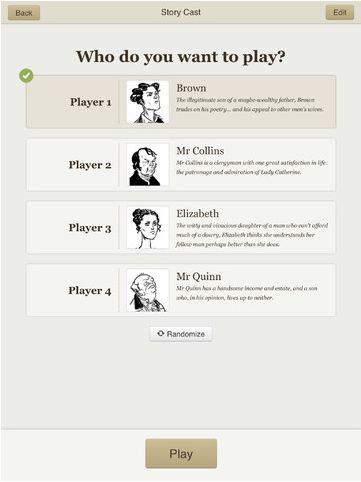
Versu character screen (click to enlarge): you chose the characte you wish to play, the rest will react to you based on a range of social rules, their own goals, and your actions in the story (image courtesy of Linden Research / Apple Computers)
Versu character screen: you chose the character you wish to play, the rest will react to you based on a range of social rules, their own goals, and your own actions in the story (image courtesy of Linden Research / Apple Computers)

Each of its computer-controlled characters is governed by a deep model of social propriety. They react to rudeness, disapprove of bad manners, and they know a violated social norm when they see one. They gossip, show off and flirt. To make such behaviour possible, Evans streamlined the code that defines characters’ beliefs and desires. This allows them to weigh the consequences of many possible actions before deciding how to behave…

The behaviour of the agents [characters] is not scripted. Instead, they each have a unique set of goals and desires that govern their behaviour. No two play-throughs are likely to be the same.

This approach allows the Versu characters to “play out their own soap opera independently”, which can have some very surprising repercussions, as Evans noted in his presentation. In it, he relates that when testing Versu, he was surprised to find he was being snubbed by one of the characters. It wasn’t until he examined the game’s logs that he found out why. Earlier in the game, he had been rude to another character, who had gone on to tell others of his unpleasantness, with the result that Evans found himself snubbed later in the game.

Because Versu uses social rules to govern the actions and reactions of non-player characters, it is seen as a particularly powerful tool for modelling human interactions, which is in turn bringing it to the attention of academics as well as gamers.

Evans also sees a wider potential for the technology developed for Versu, suggesting that it could be used in a wide variety of activities – such as helping soldiers learn to interact with  civilians in a war zone, or young people to deal with bullies.

Of all the new products launched to date by the Lab, Versu is the one which has piqued my curiosity the most – and it is also the one I’ve found to be the most frustrating, given it is restricted to the iPad and lack of any further news on it coming out of the Lab. Evans’ paper and this New Scientist article therefore both provide welcome insight into the app, and on its potential for the future – assuming the Lab shares in those aims and remains committed to developing and enhancing Versu.

Related Links

Linden Lab launches Versu

LL logoOn Thursday 14th February, when most of us had our attention on One Billion Rising in Second Life, Linden Lab launched Versu on the iPad.

The much-anticipated storytelling app is being made free-of-charge and is bundled with a tutorial, a “scene” and a “full length” story, with other titles to be offered at $4.99 each and offered “periodically”.

The press release announcing the lauch reads in part:

A product of Linden Lab’s acquisition of LittleTextPeople earlier this year, Versu provides unique narrative experiences in which the reader is an integral part of character-driven interactive stories. In Versu, you take on a character with distinct preferences, concerns, and desires, as you explore and change a story through your decisions and interactions with other characters. The characters you encounter are endowed with sophisticated artificial intelligence and have their own unique personalities, motivations, and emotional reactions as you interact with them. The decisions you make and how you treat other characters define your character in the story and influence the narrative, giving each title the potential for many unique experiences to explore. In the future, the tool set used to build these immersive stories will be made available to users, enabling readers to insert their own characters and scenes into the narratives they explore.

The Versu website provides more information on the titles released with the app:

An Introduction to Society: a piece approximately 5 minutes in length and designed as a tutorial / introduction to Versu with a lighthearted theme, covering the basics of interacting with the app – understanding objectives and achievements, playing settings and directing a chosen character. The story involves Lucy, a schoolgirl receiving instruction from her grandmother about how to behave herself in polite society. There are several possible outcomes to the story, as well as a little background on characters who may appear again in future titles.

The Unwelcome Proposal: in this scene, adapted from Pride and Prejudice and which runs some 5 – 10 minutes as a further introducion to Versu, Elizabeth’s cousin Mr Collins is full of reasons why they should be married. She disagrees, but can she convince him her refusal is sincere? Users can play as either Elizabeth or Mr Collins, exploring routes through Austen’s story and drawing heavily on her original text.

The first Versu title, offered at $4.99

The House on the Cliff: a full-length original story running to some 30-45 minutes by Emily Short. An accident to a carriage and mail-coach strand a group of strangers in a desolate stretch of coastland. The only source of shelter is an ancient, rambling estate, where neither servants nor master appear to be at home. Users can pick character from a wide selection and play through the story, forming alliances or finding enemies among the other travelers. Tasks within the story include working to recover from the crash, uncovering the secrets of the estate, and the option to pursue aims unique to the chosen character.

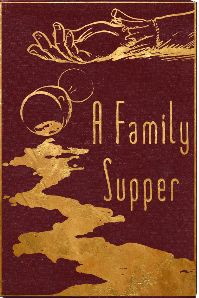
A Family Supper: offered at $4.99, this is a full length story of around 30-45 minutes. The Quinn family is hosting a small house party, but an unconventional guest threatens their peace with sonnets, vegetarianism, and a gift for finding everyone’s sore points. When secrets start coming to light and a corpse appears, it’s up to you to bring about justice – if justice is what you want. Players can choose between one of two characters, Lucy, who is staying with her hosts, or another character who is present only for supper — at the Quinns’ estate. As the evening progresses and things begin to go wrong, help to discover what has really happened, and decide how it should best be resolved — if you don’t provoke your hosts to throw you out of the house first, that is!

Of these stories A Family Supper is perhaps somewhat familiar, given the story outline was referred to briefly when the Versu wesbite was open to public viewing at the start of 2013, so presumably, the other character which can be adopted by users is that of “Miss. Bates”. Similarly, The House on the Cliff would appear to be the ghost story hinted at as well. Where there is a very clear difference between the accidental exposure if the website and the launch of the product, is that the “leak” of the website indicated that Versu would be browser-based, rather than a dedicated app.

While Versu is initially only available for the iPad, a version for Android is promised soon. Going on the launch of Creatorverse, any wait for this to happen shouldn’t be that long – although it is uncertain whether the Android product will be aimed solely at tablets or accessible on devices with smaller screens.

A video released with the launch, explains more about the app and the stories, with insights from creators Emily Short and Richard Evans, as well as an unusually gravel voiced Rod Humble.

An interesting aspect with Versu – and in keeping with the idea of “shared creative spaces” – is that while the initial offerings are authored by the team from LittleTextPeople, users will in the future have the option of writing and published their own Versu stories, as noted on the Versu website:

As a content creator, you’ll be able to create your own characters, improvise new dialogue and gestures for them, and even build entirely new stories and games for others to enjoy.

How this will work, and what options may be included in order for budding authors to monetise their stories is unclear – so eyes need to be kept on the Linden Research and Versu websites to catch upcoming announcements as / when the self-authoring capabilities are launched. However, this does go some way to explaining the references to “user-generated” content found in the Versu Terms of Service during the time when the website was accidentally revealed to the public in January.

Of all the new products the Lab initially announced, Versu is the one that has grabbed my attention the most, although I admit I was surprised by dio, launched at the end of January. The press release, Versu website and launch video have again piqued my interest even if, as a non-Apple user, I’ll have to be patient before I can get my little paws on a version (assuming that the Android version will be playable on small-screen devices as well). Certainly, of all the products launched to date, Versu would seem to have the most solid means of building a reliable (if possibly not overly large) revenue stream from the off, through the periodical release of engaging titles, should the app build up a reasonable following.

Related Links

Versu: Regency England with murder, ghosts and romance

Update January 3rd, 2012: following posts on the Versu FAQ from myself and Ciaran Laval, the FAQ has been removed from the Versu website.  The Dio Help page still remains available for that product – at least for the present!
ALL logofter my brief look at the Versu and Dio websites on New Year’s Eve, I poked a little deeper into the Versu site, taking time to paw over the FAQ, which sheds a little more light on things than I’d initially realised.

As has already been indicated by Rod Humble, Versu is an interactive storytelling medium which relies on strong character interaction, with the plot and character behaviours driven by the actions and reactions of the player through their character.

The Versu website placeholder from Linden Research, December 2012

Versu will initially be browser-based only, although there are expectations at the Lab that a tablet version will be available in the future. Access will apparently be – initially, at least – via Facebook, with the FAQ stating that there is a “limited number” of development accounts available for those wishing to access the game without going via Facebook. The game is largely text-based, again has already been indicated, but will include images of the other non-player characters in the immediate vicinity of the player’s character.

Versu's stories will initially be set in Regency England (1811-1820)
Versu’s stories will initially be set in Regency England (1811-1820)

The initial story appears to be a murder mystery, and features a choice of principal characters – “Lucy” or “Miss Bates”. The FAQ indicates that two additional stories are in development, “A ghost story and a romance story in the same time period (Regency England [1811-1820]) are already partially drafted and will be presented at launch.” It goes on to say that, “In the future, we will also include episodes from other settings — anything from spy thrillers to comedy to noir detective stories. Anything that involves strong character interaction is a good fit for the Versu engine.”

Progress through the story is up to the player. For example, a player can select from a list of available scenes, then chose to interact or not. How they interact with the other non-player characters will shape how those characters react to the player in the future (so flinging a bread roll at Mr. Quinn may not endear you to him). If a player chooses not to interact, the story will still progress, making for interesting variations in gameplay – particularly on the “what if” department (“What if I’d left dinner before X, and gone to Y?”; “what if I’d selected A instead of B?” and so on).

Interestingly, some progress through the story is down to what amounts to random chance. To quote the FAQ again, “Whether a character spills something by accident, or selects one conversation gambit or another, might be the result of randomization.”

Progress through gameplay is also marked by the player’s character completing assigned tasks, which doubtless help guide the player through the story to one of several potential conclusions. Progress through tasks can be reviewed via an “Achievements” page.

Games will be entirely self-contained, such that while there are several potential ways to reach the denouement to a story, and the story itself has a number of different endings depending on choices made and actions taken, the cast list will remain the same for each. Thus, any characters previously “killed off” will be brought “back to life” at the start of the next game.

There are also some limitations with the game:

  • The initial release will be single-player only; multiplayer capabilities (such as playing together in different roles or working with other players to resolve a story) are planned for the future
  • There will be no option to save gameplay with the initial release.

Also, players will not initially be able to generate their own characters. However, the FAQ indicates that this is again planned for the future and will include the ability for players to, “Define your own character, complete with appearance and expressions, personal preferences and unique dialogue options”.

An interesting note with Versu is that the Terms of Service refers to user-generated content (section 4.4). This may simply be because the ToS has been largely boilerplated from Second Life, and thus may not be indicative of how the ToS will appear one it has been fully edited. However, the linked DMCA page is similarly “Versu’d”, so it does raise a question as to what user-generated content might be applicable, particularly if Versu is to fit under the Lab’s umbrella of “Makers of Shared Creative Spaces”.

Is section 4.4 of the ToS simply a reference to a player’s ability to generate their own character and character image, or is it something more?  Again, could the FAQ reference that, “Anything that involves strong character interaction is a good fit for the Versu engine”, mean that the engine might be opened to third-party developers for future stories?

The Facebook access is also interesting, as mirrors what appears to be Dio’s preferred access mechanism (at least initially). As such, it would seem that both Versu and Dio are an attempt by LL to tap-into the large, potentially ready-made Facebook audience. Currently, there is no real indication as to how either will be leveraged from the point of view of generating revenue, although a few thoughts have sprung to mind on that subject.

All told, the website give more information on Versu than I’d initially given it credit, as does the “Help” option on Dio provides a little more information there. Hopefully, and depending on access, I’ll have more information on both in the near future.

Linden Lab’s Dio and Versu websites appear

Update, February 19th, 2014: dio and Versu were discontinued by Linden Lab on February 19th, 2014. Links to their websites, etc have therefore been removed from this article.

Update January 1st, 2013: I finally took a proper look through the Versu FAQ and have provided further information in a new report.
LL logoLinden Lab have slipped out the initial cuts of the Dio and Versu websites. Currently, there is nothing on the corporate website relating to the latest items in the new product line-up from the Lab, although Dio caused a stir early in 2012 when a nascent website bearing the name was accidentally made public.

Neither of the new websites give much away – Versu in particular is rather bland, but both point to the new products potentially approaching a point where they’ll be launched in the near future.

The Versu website placeholder from Linden Research, December 2012

Versu will be the first product to emerge from the Lab directly as a result of their acquisition of LitleText People, also early in 2012, and has previously been described by Rod Humble in a Techcrunch article as, “Procedural interactive storytelling. Basically you set the motives and the behaviors of the individual characters and the plot gets generated as you go, and each time it’s different.”

Techcrunch themselves interpret this as meaning, “The idea here is to tap into collaborative storytelling, something that’s been gaining in popularity in online spheres, as evidenced by the traction social writing startup Wattpad has seen. But with Versu, Linden Lab adds a gaming element to interactive storytelling that essentially allows players to create their own characters which then write themselves. It seems like a smart way to capitalize on the observer tendency that’s turned Second Life players into story watchers.”

The new website, as shown above, currently gives little away, however, this is liable to change as the release / beta / however LL opt to launch, draws closer.

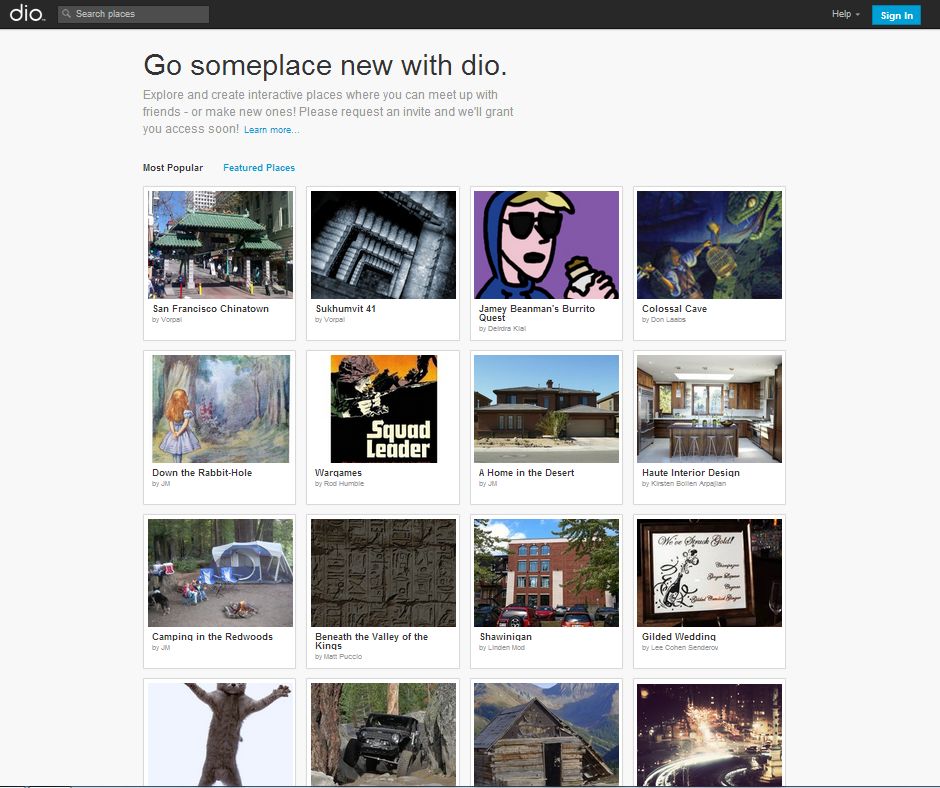
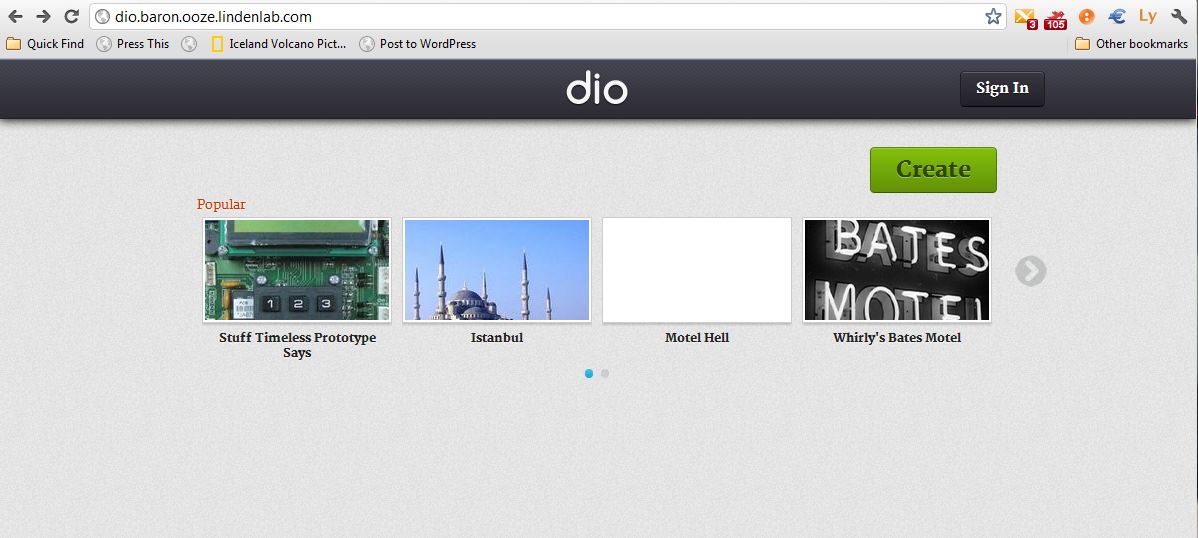
The new Dio website, by contrast, has more in the way of content. This is unsurprising, as it appears that Dio is actually the next product on the runway to follow-on from the launches of Patterns and Creatorverse. However, whether the content is genuine or simply placeholders for testing purposes is unclear, at least to me, as I’m not a Facebook user – and Facebook is required to log-in to the site (if log-ins are indeed open).

Again, in talking to Techcrunch in November, Humble described Dio as, “A web experience called Dio that’s really hard to explain, which I like. It’s sort of like Second Life without the graphics, or Facebook but trying to be more of a creative space.” He goes on, “So it’s a web experience and you create your space, but within the spaces, everyone has their own avatar and avatars carry inventory. The way you navigate from space to space is via doors, and you can make things like a MUSH [multi-user shared hack] or hobby space very easily.”

The new Dio website homepage (click to enlarge)

As noted above, logging-in to the Dio website requires a Facebook account, and even the “request an invite” button leads to the Facebook log-in page. Whether the latter is intentional or not is currently unclear; however, limiting log-in to Facebook may limit Dio’s appeal to SL users, but would obviously open it out to the entire Facebook community, potentially raising its visibility.

Clicking on any of the options on the home page is possible, but again, little is given away as to what they do, or to provide more insight into the site than Humble’s description to Techcrunch.

One of the options ("albums"?) within the Dio website
One of the options (“albums”?) within the Dio website

Some of these options allow you to drill down further, but overall, it is currently hard to see how things link together and how “avatars” and “carrying inventory” fit within the scheme of things. Options then range from games through what appear to be tour guides, to business portfolios, to collaborative projects, discussion groups and personal photo albums, making Dio something of a melting pot of ideas and potential uses.

For those interested / curious about the directions LL is taking vis-a-vis new products, then these two websites are potentially to the two to watch as 2013 unfolds, even if right now, they raise more questions than they answer.

Related Links

Webspace with avatars and inventory – Humble talks dio and Versu

Update, February 19th, 2014: Creatorvers and dio were discontinued by Linden Lab on February 19th, 2014. Links to their websites, etc.,  have therefore been removed from this article.

Details of a kind are starting to slip out about LL’s new product stream. We’re now already very familiar with Patterns and Creatorverse, the latter of which reached the Android platform at the start of the week, coming to it via the Kindle range of tablets.

Creatorverse: iPad, Kindle and Android so far

An article in Techcrunch provides some more insight into the remaining two products of which we’re already aware, Dio and Versu.

The article starts off with a positive comment on Second Life itself:

Linden Lab, the company that created Second Life and grew that online community into one of the most colorful, varied online social networks in the world, is doing some very different things for the first time in many, many years.

Admittedly, this quickly slides into the murkier waters regarding declining user numbers, observing rather interestingly that “passive viewing becoming the dominant interaction method”, before bringing up that beloved subject of many a journo reporting on SL, that of its “sordid past”.

I’m not entirely sure what is meant by “passive viewing”, but I suspect that relates to many of the more populous venues in SL being clubs (of every sort) whereby avatars are dancing but most of the conversation is going on in IM, giving the illusion that everyone is sitting in silence watching avatars gyrate twist and turn individually or in groups, or twirl gracefully around the dance floor like pairs of professional ballroom dancers. While the image is true, I’m not entirely sure how representative of SL it is as a whole.

But I digress.

In the article, Rod Humble confirms the upcoming order of the remaining two initial product releases from the Lab, with Dio coming up next, followed by Versu.

“The next project is a web experience called Dio that’s really hard to explain, which I like. It’s sort of like Second Life without the graphics, or Facebook but trying to be more of a creative space,” Humble is quoted as saying in the Techcrunch article. He goes on, “So it’s a web experience and you create your space, but within the spaces, everyone has their own avatar and avatars carry inventory. The way you navigate from space to space is via doors, and you can make things like a MUSH [multi-user shared hack] or hobby space very easily.”

Dio: “webspace with avatars” (image from an early version of the Dio website, and not necessarily representative of how the finished product will appear)

Continue reading “Webspace with avatars and inventory – Humble talks dio and Versu”

Slightly Mad Avians: Humble talks Creatorverse, Versu and Dio

Update, February 19th, 2014: Creatorverse, Versu and dio were discontinued by Linden Lab on February 19th, 2014. Links to their websites, etc, have therefore been removed from this article.

Looking through the pingbacks on my blog comments, I was curious to see one show up on the 23rd October 2012 linking to an article I wrote back at the start of the year. Curious at to why someone would be linking to an old article, I went to have a look.

Turns out the article linking to me is from Kotaku, a games-related blog run by Gawker News – and the article itself is an interview with Rod Humble. (which came to me via Kotaku’s Australian site) Needless to say, I was more than a tad surprised to have someone interviewing our own Rodvik linking to my blog (oh, be still, beating ego!), so I decided to have a read through.

The piece itself is obviously about the Lab’s new and upcoming products, and it gives some interesting insights into the thinking behind them.

“Just about everybody I know who isn’t in the games business or programming business comes to me with a game idea or a website, and the truth of the matter is, quite often, they can’t make it.”

the article quotes Humble as saying. He then goes on:

“There’s this big barrier. They look at something like C++ [programming] code and, frankly, it looks like a big equation. It just looks like gibberish.

“The more we can make tools that are just fun to use—all of a sudden you are making something you wanted—you can focus on the creativity than mastering this arcane set of symbols. We can hopefully bring more people into that fold of ‘hey, you made something!'”

Thus is the broad thinking behind Patterns, Creatorverse and the still-to-be-seen Dio and Versu, which are apparently going to be appearing something in the next month – if not before the end of this one, depending on how you read quotes from elsewhere.

Creatorverse itself comes in for some attention in the piece – Humble describes it as being his five-year-old daughter’s favourite game at the moment, and it is referred to as coming out “later this year”. Whether that is a result of the interviewer misunderstanding Humble (the interview was via ‘phone), or whether it is because the release date may have shifted while the wheels at Apple (or elsewhere) turn slowly, isn’t clear.

What is clear, however, is the novel way Creatorverse is pitched in the interview:

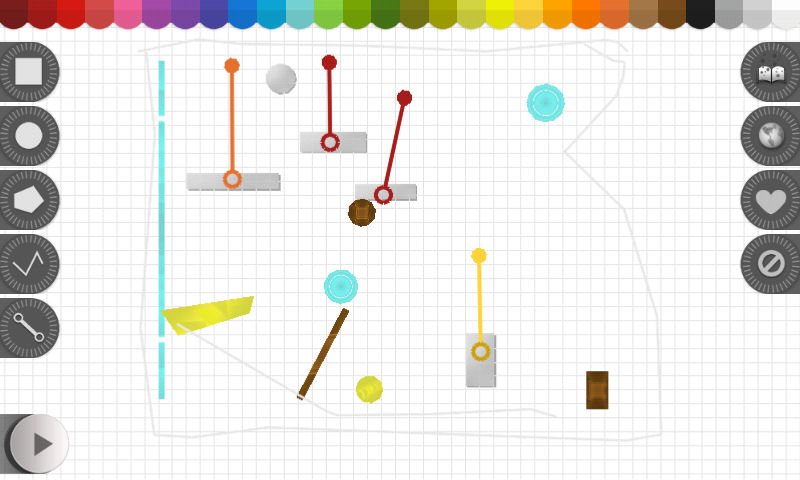
In the near future, his company will put out a program for iPad called Creatorverse, which will let people use shapes and physics to create basic 3D systems and, yes, games, then share them for anyone else to download and play. Think of making a game that lets you fling shapes into other shapes—your own “Slightly Mad Avians”, he offers as an example, if you get what he means.

Creatorverse

While Slightly Mad Avians could stand as a title in its own right (along with Perturbed Pigeons, a name Darien Caldwell suggested to me the other evening in an entirely unrelated conversation…), it’s nevertheless a curious hook on which to hang a description of Creatorverse – but an interesting one in terms of mental images….!

What is of greater potential interest, however, is the comments about the upcoming Dio and Versu.

Dio is described as: “A website that lets people create rooms out of their personal images and videos, connects them to other people’s rooms and lets people share the space.”

While it has previously been described as “A room creator, in which players can do everything from construct a choose-your-own adventure to develop an interactive wedding album,” and Linden Lab managed to accidentally give people something of a quick peek at an early iteration of a website connected to Dio back at the start of the year, the comment in the Kotaku piece implies that the website appears to be the product, rather than in support of it. It’ll be interesting to see how people react to this.

Versu, meanwhile, gains a little more flesh on the bones given in an interview with Giant Bomb, with Humble describing it as, “A platform that lets you make real interactive drama” by giving you “the ability to create characters within a story and then, thanks to the AI, see that “those characters will have emergent properties as you play through the story.” He goes on to admit that this is pretty ambitious and admits to an element of “Tilting at windmills” in order to bring it to a wide audience.

The article goes on to talk in more detail about Patterns, which many of us – and many more in the gaming community – are enjoying even in its nascent (or as Humble puts it, “not even pre-baked”) form. It also talks about Humble himself and his arrival at Linden Lab, which leads to a good mention of Second Life:

It makes perfect sense that Humble would wind up at Linden Lab, the company best known for the virtual world Second Life. It’s as successful a canvas for the communal creation of a virtual world as there’s been. It’s been a viable digital canvas for about a decade now has been populated by users who make their own buildings and vehicles, who design contraptions, contort physics, stage elaborate events, form societies, and pioneer the art of inhabiting elaborate second skins that express inner or otherwise impossible creativity and desires.

It’s a positive read, and well worth taking a few minutes out to read through.

Related Links