The Drax Files Radio Hour interviews: Emily Short

radio-hourEpisode #23 of  The Drax Files Radio Hour was posted on Friday June 13th. With the “live” podcasts currently on hiatus until August 2014, this is the second of a series of more in-depth interviews with people from across the metaverse and beyond.

As usual, and as well as being available on the show’s website and on Stitcher, episode #23 is also on YouTube, and embedded at the end of this article.

The featured interview with this show is with none other than interactive fiction writer, narrative design consultant, co-founder of Little Text People, co-developer of Inform 7, the interactive fiction system, co-developer of Versu – I could go on and on, such is my admiration for her – Emily Short!

Given the above, you might be able to guess that this is an interview I’ve been looking forward to, and while time wasn’t the best, I tried to assist Drax in getting ready for it (although even then, some of the planning went out the window as we were overtaken by events!), so my thanks to Drax for the shout-out at the start of the show,

Emily Short on the IF panel, PAX East, 2010

The interview, which commences at the 3:44 mark, is extremely wide-ranging, covering topics such as the creation of Little Text People, the time Emily and her LTP colleague, Richard Evans spent at Linden Lab, the nurturing of Versu, Emily’s own background and how she came to be interested in interactive fiction (IF) via the work of games design pioneer Scott Adams (not to be confused with the creator of Dilbert!) and moving forward from there.

Since the announcement that Versu – albeit is a slightly different Versu to the one initially marketed by the Lab – would be able to continue under its own banner, there have been musings as to the deal struck between Linden Lab and the Versu team. Had the IP been fully released by the Lab? Had an agreement on revenue sharing been achieved? Were there other strings attached?

Obviously, such questions may not be the easiest to answer; commercial arrangements between companies tend to be saddled with NDAs and the like, and the Versu / Linden Lab arrangement is certainly one of those. As such Emily has to be circumspect when answering such questions. However, she does indicate that there may potential for some of the titles from the “app version” of Versu to reappear, such as the Office Politics titles by Deirdra Kiai. Whether these will be direct ports or will see anything added to them, should it come to pass, remains to be seen.
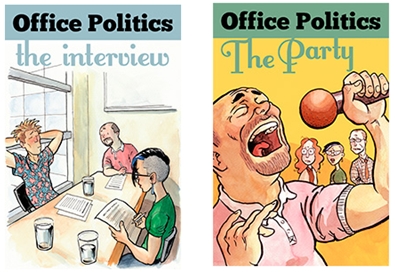
The Office Politics titles, by Deirdra Kiai, were written for the original Versu app, and might appear with the new Versu in the future
The Office Politics titles, by Deirdra Kiai, were written for the original Versu app, and which might appear with the new Versu in the future

It’s important to note that the Versu we see with Blood & Laurels is somewhat different from the Versu which first appeared under the Lab’s banner. As Emily notes, the “first” Versu was more an app into which IF games could be plugged. Versu as we see it now is geared more towards developing self-contained titles – as Blood & Laurels is, and just as Bramble House will be. Packaging titles in this way offers the ability to build much more involved games – as has been noted, Blood & Laurels has some 240,000 words of interactive content, only 7% of which is liable to be encountered in a single play.

Author and Linden Jake Forbes (via Amazon)

With the original Versu, much was made of the potential for people to create their own IF games for use on the platform. Whether this is still the case is unclear. The system itself would apparently need more work to support this, and the agreement with the Lab may limit what can be achieved in this area. Currently, story development remains confined to the Versu team and select other authors such as Bramble House’s Jake T. Forbes (himself a Linden as well as an author in his own right) and, possibly as noted, Deirdra Kiai.

An interesting aspect of Versu’s modularity is that it needn’t necessarily be limited to a text-based front-end. but could be embedded into something else or skinned by an alternative front-end. This means it could, for example, potentially be used in other game types or in business training or in education. These latter areas were somewhat upon in May 2013, when Versu co-creator Richard Evans presented his paper Versu: A Simulationist Interactive Drama, at the Games and Media Event at the Imperial College London, which prompted Douglas Heaven to write AI makes social game characters all too human for New Scientist Online, and which I wrote about at the time.

Whether this flexibility with the Versu components means it might see use in support of better AI-driven NPCs within Second Life, as many have speculated in the past, remains to be seen. This is another area Emily is not in a position to comment upon – which shouldn’t necessarily be taken to mean something is being worked on.

Another interesting aspect with Versu is the potential for it to be used in a multi-player format. While there are no plans for it to be used in this way at present, Emily offers some intriguing speculation on the matter:

The Versu engine is capable, under the hood, of doing multi-player as well as AI characters. And something that we talked about a long time ago, in the early days of the project … you would be able to play in the multi-player, and you would actually be able to add new content to the story. So if you got to the point where you were playing with somebody and you wanted to say something that wasn’t already coded into that scenario, you would actually be able to, right at that moment, write a new piece of content…

It’ll be interesting to see if this does come to pass down the road, as the team hopefully develop the resources they need to enhance and develop Versu, and as opportunities of perhaps working with third parties arises.

There is so much more to this interview than can be covered here. Where AI may go in the future; cautionary notes on how governments or private organisations might employ AI technologies alongside the huge amounts of data (social and otherwise) we’re allowing to be accrued on ourselves; caveats about tests used to determine whether or not the conditions of the Turing Test really have been met; have been met; even dreams of holodeck-style IF are explored!

All of which makes this a fascinating conversation, one well worth taking the time to sit down and listen to, whether or not you’re directly interest in interactive fiction (and you likely will be by the end of it!).

congrats to Drax on his Best Machinima award at the New Media Film Festival

The Drax Files Radio Hour interviews: defining the real and the virtual

radio-hourEpisode #22 of  The Drax Files Radio Hour was posted on Friday June 6th. With the “live” podcasts currently on hiatus until August 2014, this is the first of a series of more in-depth interviews with people from across Second Life and beyond.

As usual, and as well as being available on the show’s website and on Stitcher, episode #22 is also on YouTube, and embedded at the end of this article.

This first interview show primarily focuses on Tom Boellstorff (Tom Bukowski in SL), a professor of anthropology at the University of California, Irvine, who has studied such subjects as the anthropology of sexuality, the anthropology of globalisation, the anthropology of HIV/AIDS, and linguistic anthropology, publishing numerous books and papers along the way.

Tom has been involved with and in Second Life for over a decade, being one of the early pioneers on the platform, at a time (2004) when there were perhaps 2,000 active SL accounts and concurrency was measured in the hundreds. He has authored and co-authored two notable titles on the subject of virtual worlds in that time, namely Coming of Age in Second Life: An Anthropologist Explores the Virtually Human, (Princeton University Press, 2008), and Ethnography and Virtual Worlds: A Handbook of Method (Princeton University Press, 2012, co-authored with Bonnie Nardi, Celia Pearce & T. L. Taylor).

Tom’s name may also been familiar to some for his involvement in the story of Fran Swenson (Fran Seranade in SL), a Parkinson’s Disease sufferer, whom I wrote about in 2013, and who was also featured in The Drax Files: World Makers segment #13, in November 2013.

Tom Boellstorff (image: Univ. of California)

This is a wide-ranging interview, commencing at 05:06 into the recording,  which encompasses, but is not limited to, such diverse but inter-related topics as how we define – or perhaps should define – virtual worlds; the differences (and similarities) between virtual worlds and other digital spaces; the challenges of defining what is meant be “real” and what is meant by “virtual”; and a discussion on communities of intent and their role within Second Life – and SL’s role with them. Along the way there are some thought-provoking challenges to how we perhaps think about SL and how we may actually contribute, to a degree, to the broader misconceptions surrounding SL simply through the language we use when referring to it.

In terms of providing a definition of virtual worlds and virtual environments, Tom offers up the idea that they can be defined as any place or activity which allows you to “go AFK” (away from keyboard) – that is, you can stop interacting with others involved in the same space / place / activity and then return, and whatever was going on prior to your stepping away continues (and perhaps, in some cases, evolves) during your absence, and is still there where you return.

This is something of a mind-boggling concept and definition, particularly when Tom goes on to suggest that the very first virtual environment came about not in the digital era, but in the earliest days of the telephone, when two people were engaged in a conversation, and one momentarily put the telephone handset down to do something, then rejoined the conversation without actually hanging-up. As such, it’s liable to have some frowning at the idea.

However, when taken alongside his comments about place (or the sense of place), one can see where he is coming from. With place entered into the equation (actually, one of the foundations of the discussion), then it is easier to understand his contention, and to agree with his view that standalone games, as immersive to the individual as they may well be,  are not really virtual spaces in the sense that Second Life, or even a Skype call, can be considered virtual spaces. Second life continues after we log-off, the same way that life at either end of Skype call continues after the call ends; stop playing a standalone game, and that’s it, there is nothing else until you start playing it again.

Such definitions of virtual worlds might sound very academic: interesting for a thesis or a book, but with little other meaning. However, as Tom goes on to explain, this is actually not the case:

I actually think it’s very important because it is amazing how much confusion there is out there about all of these technologies. There’s a lot of misunderstanding and confusion, and so … I spend a lot of time doing definitions, and i think it is just as important as the interesting, sexy stories about the cool things people are doing, because if we don’t have a basic understanding of what we’re looking at, it really makes it hard to figure out why its important.

Continue reading “The Drax Files Radio Hour interviews: defining the real and the virtual”

The Drax Files Radio Hour 21: the image of Second Life

radio-hourI missed reviewing The Drax Files Radio Hour #20 as real life has been keeping me rather busy of late. Hopefully, the transcript of the Creating the VR Metaverse panel at SVVR will go some way to making up for things (and even that was late in getting into print, courtesy of RL!).

Episode #21, the last of the “live” podcast for this series, continues in spirit with the last, the two major interviews – with Voidpointer and Catalyst Linden – having been recorded at the SVVR conference. As usual, and as well as being available on the show’s website and on Stitcher, episode #21 is also on YouTube, and it is to that recording (embedded at the end of this article) any timestamps given in the text refer.

The early part of the show re-visits SVVR and Leap Motion, who are in the process of adding on-screen rigged hands which move in accordance to the user’s hand movements / gestures, and have also creating a prototype cradle which allows the Leap unit to be attached to a Rift headset, allowing it to track hand movements, with the rigged hands appearing on the Rift’s screens.

The recent Designing Worlds show on the new user experience and user retention  – on which Jo appeared – is discussed. Time hasn’t allowed me to watch the show as yet, but it is on my “to-do” list. I confess that I’m always leery of suggestions from users on what “needs” to be done or “should” be done with the whole new user experience. Yes, the Lab hasn’t done particularly well over the last 11 years  – to a point – but that doesn’t actually mean that we, as users necessarily have any clearer idea of what needs to be done / should be done, simply because all too often our own views tend to be somewhat biased to some degree, or we simply fail to take into consideration was has actually been tried in the past and trot out ideas which have been shown to make very little difference in the scheme of things.

Which is not to say that ideas shouldn’t be discussed, but rather a broader forum should perhaps be established, where more in the manner of two-way discussions between Lab and users can take place, ideas more fully synthesised and options looked at.

The new mesh avatars also get a mention, and some of the problems of supplying mesh avatars to new users are highlighted. Leaving aside the valid problems mentioned in the show, What surprised me most about these avatars was that they appeared to have been released prematurely or at least without thorough testing. For example, they were promoted as using fitted mesh, yet the base shape was released as No  Modify, thus nullifying the ability to customise them using the sliders without swapping the shape (something new users are hardly likely to know how to do).

To his credit, Ebbe Altberg took it on the chin when I Tweeted him about this, indicating that it and a number of other issues would be fixed. But really, so basic a mistake shouldn’t have occurred in the first place.

ebbe-avatars

This episode features two interviews with Linden staffers. The first is with Voidpointer Linden, who is well-known to attendees of the Server Beta meetings, which he attends from time-to-time. He has worked on a number of SL projects, including pathfinding, and more recently, the Oculus Rift. The interview commences at the 24:10 mark. Catalyst Linden, the senior director of development at the Lab is interviewed at 37:27 into the recording.

Voidpointer Linden in human form (stock)

Both Voidpointer and Catalyst point to themselves as being “gamers”, and both indicate that on first encountering Second Life as gamers, they simply didn’t get it – although they do now.

A major part of them getting it is clearly to do with the fact that they have joined the Lab, and so SL has become their paid job. However, there is also the fact that as former gamers, they are perhaps both well-placed to understand why and how SL’s appeal needs to be broadened in order to attract more users to it.

During his chat, Voidpointer’s comments on the Lab needing to appeal to as broad a span of potential users as possible, even going so far as to acknowledge that the company needs to address those who, like Pamela from segment #8 of The Drax Files Radio Hour, simply do not see virtual worlds or VR as something they need to embrace, because it has no relevance to them.

Attracting a broader audience is also a theme in Catalyst Linden’s comments, and he goes some way further towards demonstrating why the perception that Linden staffers “don’t get” Second Life really is in error. Even as someone who has only been at the Lab for around 12-15 months, it’s clearly evident that Catalyst does get Second Life and its potential appeal as well as any user who has given serious thought on this subject.

Continue reading “The Drax Files Radio Hour 21: the image of Second Life”

The Drax Files Radio Hour 19: sending you back to the future

radio-hourEpisode 19 of the The Drax Files Radio Hour is largely devoted to the recent transhumanist-focused Back to the Future of the Metaverse.

As well as being available on the show’s website and on Stitcher, the show is also on YouTube, and it is to that recording (embedded at the end of this article) any timestamps given in the text refer.

The show starts with a brief discussion on ways to help journos better present Second Life, with Jo having uploaded images of her 1920s Berlin Project to Wikimedia and as a part of a Wikipedia page on the project.

Leo Sun, writing for Motley Fool, picked-up on one of Jo images, together with one from the Lab, which was used in an article reflecting upon on the Facebook / Oculus VR vision of a billion-user “MMO”, thus suggesting putting out information and (particularly) good quality images that are readily available for re-use, copyright-wise, may be a way of raising SL’s visibility.

Drax also promotes the forthcoming metaverse panel which will take place at the first Silicon Valley VR (SVVR) Conference and Expo, and which he will be moderating. The panel will feature Ebbe Altberg (Linden Lab), Philip Rosedale (High Fidelity), Stefano Corazza (Mixamo), Tony Parisi (Vizi), and will take place on Tuesday May 20th, who will be considering topics such as:

  • One global metaverse or many?
  • Identity and privacy
  • Virtual World Governance: democracies, the greek god model, or benevolent dictators
  • Intellectual property and legal jurisdictions
  • Avatar portability and standards
Creating the VR metaverse panel
(l to r): Ebbe Altberg, Philip Rosedale, Stefano Corazza and Tony Parisi. Ready to answer questions on “Creating the VR Metaverse”

If you have a question you’d like to put to one, some or all of the panel, please leave it in the comments section at the end of this announcement.

The main thrust of the show however, is a look at the aforementioned Back to the Future of the Metaverse event, which took place on Thursday, May 15th, albeit it not without technical issues. An event organised by the Skefi’a online science/fiction magazine, led by Giulio Prisco (SL: giulioprisco), it was billed as a discussion of “the VR renaissance outlined in Back to the future in the Metaverse”, an essay by Mr. Prisco, published by Skefi’a on April 22nd.

On hand at the event were a number of speakers. Unfortunately, issues with SL meant things did not go as planned, and activities had to be hastily decamped to Google Hangouts, where only a subset of the participants were able to be involved in activities. Two of these were Philip Rosedale of SL and High Fidelity fame and Stephen Larson,  CEO of MetaCell and a co-founder and the project coordinator for the OpenWorm open science project, both of whom feature in this podcast.

A full video of the event is available on YouTube, with Philip Rosedale initially speaking between the 0:07:00 mark and the 0:09:50 mark, prior to the move to Google Hangouts, with his presentation resuming at the 0:21:55 mark following the move. The Radio show’s coverage of his presentation starts at the 8:20 mark in the podcast, and begins at the point where things have been picked-up in Google Hangouts.

For those who have been following High Fidelity and recent blog posts Mr. Rosedale has made, together with his presentations at events like the SVVR meet-up in March, and his VWBPE keynote, there is little of additional note in what he has to say in the roughly 12 minutes in which he speaks or in the Q&A session which follows. As well as re-treading some of the work High Fidelity are doing, and their approach to a distributed computing approach to virtual environments, he again re-states his belief in technology  – and the removal of the keyboard and mouse – as being the single key required to unlock the doors to the mass adoption of virtual environments.

How High Fidelity will work - click for full size (courtesy of High Fidelity)
How High Fidelity will work – click for full size (courtesy of High Fidelity)

Continue reading “The Drax Files Radio Hour 19: sending you back to the future”

The Drax Files Radio Hour 18: more from Santa Cruz and a CEO’s son

radio-hourEpisode 18 of The Drax Files Radio Hour features the third part of Draxtor’s chats with Linden staffers. Alongside of this is an interview with one with Aleks Altberg (son of LL CEO Ebbe) and another with Karl Krantz, organiser of the Silicon Valley Virtual Reality Conference taking place on May 19th-20th.

As well as being available on the show’s website and on Stitcher, the show is also on YouTube, and it is to that recording (embedded at the end of this article) any timestamps given in the text refer.

Brendan Iribe’s “fireside chat” with TechCrunch co-editor Matthew Panzarino at the recent TechCrunch Disrupt New York event (May 5th-7th), pops-up in the early part of the show. During the chat (which I muse upon here), Iribe outlines a potential future for VR is a (very loosely defined, in terms of purpose and use) MMO / metaverse of virtual environments. This is not a vision that he sees coming about in the next year or two – Iribe couches his frame of reference around a decade hence, at a time when he sees VR / VWs having wider acceptance and the technology itself has had time to further mature (particularly some of the associated hardware) and become more broadly accepted in daily life.

Brendan Iribe, Oculus VR CEO, talks to Matthew Panzarino at Techcrunch Disrupt NY (image via Techcrunch)

Surprise is expressed in the show that SL seems to be “unknown” or “ignored” by Iribe and others. I don’t think this is a valid assumption. Cory Ondrejka not only works at Facebook, but he was involved in the Oculus VR acquisition and he’s hardly blind to Second Life, having co-founded it.

Rather I’d suggest the reason SL isn’t mentioned comes down to something that appears to be missed in the discussion: the fact that Iribe is talking in terms of something a decade hence, and possibly something likely not built entirely by any single organisation, although FB is obviously well-placed to help build things. Perhaps more to the point, FB could position itself to provide core elements of the backbone – such as transaction services, identity services, and so on, thus becoming a gatekeeper to this new environment, much as Philip Rosedale wants to position High Fidelity in his vision of things.

As such, by the time the brave new digital world painted in Iribe’s broad brushstrokes actually arrives, it will likely be something that is so beyond comparison with SL that the latter is not seen as having relevance in discussions. In this, it’s not so much down to Iribe and others to point to SL and say, “look, this is the idea!” It is for SL to find wider relevance in the scheme of things.

The interview with Aleks Altberg commences at 16:18 into the show. A lot has been documented by Ebbe himself about Alek’s involvement in SL (perhaps first in this very blog in a comment he left just after starting at LL, then later during his VWBPE address), so it’s good to hear from him first-hand about his experiences with the platform and his thoughts about it.

Aleks Altberg, courtsey of 425 motorsport
Aleks Altberg, courtesy of 425 motorsport

Aleks reveals it was his father who indirectly go him interested in SL after he found his Dad using it. From here, his tale is probably familiar to many SL users – passing the time flying around, exploring, meeting people and only gradually unlocking the deeper secrets of SL – object creation, building, and so on, over time, which in turn led him into scripting and thus into SL commerce.

In discussing getting more people engaged in SL, Aleks offers-up an interesting “five-step” plan, which includes basic control orientation and some initial content building. It’s not a bad approach – but in some respects, it has been tried, albeit it not in quite the way he suggests, and hasn’t always worked.

He’s also less-than-convinced that trying to help people connect to things in SL which (might) interest them will work. He actually has a point – not everyone who comes to SL really knows what they’re looking for. Equally, there is no guarantee that anything which may have enticed someone into SL becomes the reason for them to remain engaged in SL.

However, I’d still suggest that many who come to SL do so because they have heard of something or seen something which has piqued their interest, and so attempting to find the means to connect them to that interest / point of curiosity (and others similarly engaged), then letting them discover everything else over time, is potentially more beneficial than appearing to say, “here’s all that SL can do – now go forth and do it!”, and shouldn’t be completely dismissed.

Karl Krantz, founder of the SVVR Meet-up (image courtesy of Road to VR)

Karl Krantz is interviewed at 26:12, where he discusses the SVVR conference and expo, which he admits to being an attempt to get the more affordable aspects of VR “away” from the gaming environment and open them out to more widespread interest / opportunities. The conference will take place at the Computer History Museum, Mountain View, California on May 19th / 20th.

Those in a position to attend can get $100 off the price of admission (reducing it to as little as $250) by using the code “drax2014″ (or indeed, “nwn2014″ if you are an NWN reader) when registering. They can then get to hear the likes of Palmer Luckey (Oculus VR), Philip Rosedale, Ebbe Altberg, David Holtz (Leap Motion), Ben Lang (Road to VR) and others.

Krantz is also no stranger to SL, and offers some interesting commentary on the platform – including the need for the Terms of Service to be redressed (which is being worked upon internally by the Lab). He’s also very positive towards LL being able to position themselves to capitalise on any VR wave which may emerge, although his comments on the ToS and on issues of performance caveat this particular view somewhat.

More particularly, he suggests Linden Lab might be better served in moving away from being solely a platform provider and focusing on providing the core services – the transaction system and Linden Dollars, the identity management service, the marketplace, etc. and then opening the rest of the platform out for development and operation by others and folding-in OpenSim. Again, this is pretty similar to the High Fidelity approach, and it could have some merit to it; the problem being how the Lab pivots away from its current operating / revenue model to this kind of approach without actually hurting itself financially in the process or causing mass disruption to SL as it is operated today.

Enkidu Linden is an Engineer Manager for Platforms at the Lab, and Drax had the opportunity of interviewing him during the Santa Cruz meet-up, as we hear starting at the 34:38 mark. Aside from his work with the transactional elements of the platform, Enkidu reveals an interesting approach to how we relate to our avatars and express ourselves through our avatars.

Where many of us seek to build our avatar as  – for want of a better term – a singular focal point of our identity in terms of looks, appearance, etc., and through while we can express ourselves, Enkidu comes from the opposite end of the spectrum, using many different avatar forms to express facets of his personality and interests. He’s certainly not alone in doing this; I have a couple of friends who routinely shift their avatar form as a means of self-expression. Even so, it’s and interesting reflection of the diverse ways in which we can define a means of identity and connection with others.

In terms of Lindens and their time in-world, Enkidu points-out that staff at the Lab, being geographically diverse in their locations (east and west coast, north and south), do spend time in-world attending various meetings in non-public regions and also spend time elsewhere (presumably using their Alts prior to Ebbe lifting the ban on staff using their “official” accounts for in-world roaming). In this, he notes, “Our job is to make sure the people in Second Life can have the experiences they want to have. If we never have those experiences ourselves, how can we understand what they are?”

This is a wide-ranging discussion which tackles, or at least touches upon, a fair few areas. Those who have ever wanted to understand more about Linden Dollar transactions, the LindeX and exchange rates (and how the latter in particular keep the SL economy stable) would do well to listen to Enkidu’s description – in totally none-technical terms – of how things flow together and the wheels turn.

As a former government employee, Enkidu offers some observations on our relationship with government and our relationship with the Lab, some of which indirectly echoed Ebbe’s own Forum-made observation of the Dunning-Kruger effect which can shape some reactions to the Lab’s stewardship of SL. it’s an observations which is, at least sometimes and in certain ways, hard to dispute.

All told, another fascinating discussion with a Lab staffer, albeit one somewhat different to those in the last two shows.

Not much to say in summary this time around, other than the interviews are once again excellent.

The Drax Files Radio Hour: a Linden-eye view

radio-hourThe 17th edition of The Drax Files Radio Hour more-or-less carries on where episode 16 left off, with more interviews and comments from Linden Lab staffers, gathered when Drax dropped-in on a group of them as they camped-out in Santa Cruz one Friday afternoon.

Prior to this, there’s another Leap Motion giveaway, and mention of forthcoming updates to OnLive’s provisioning of SL Go. there’s also usual chin-wagging about HMDs, and details of an offer for those who can attend it to get $100 off registration for the Silicon Valley Virtual Reality Conference and Expo, which takes place at the Computer History Museum, Mountain View, California on May 19th / 20th. Simply use the code “drax2014” (or indeed, “nwn2014” if you are an NWN reader) when registering, and get to hear the likes of Palmer Luckey (Oculus VR), Philip Rosedale, Ebbe Altberg, David Holtz (Leap Motion), Ben Lang (Road to VR) and others.

As well as being on the blog post and Stitcher, the show can also be found on YouTube, and I’m using that recording in the timestamps below. The recording itself is towards the end of this piece.

For those who want to cut to the quick, the core interviews commence at 20:25 into the podcast. This is an absolute “must listen” portion, although the sound quality isn’t brilliant in places, for which Drax apologies up-front (one of the pains of recording in an outdoor, windy environment). Nevertheless, sound issues shouldn’t necessarily be an issue for skipping over this part of the show, in which the likes of Baker Linden, and Hoz Linden from the development side of things (Hoz is a development team manager), and members of the finance team discuss the complexity and intricacy involved in running and maintaining an environment as complex as Second Life.

Baker Linden is well-known among those familiar with the dev side of Second Life and who attend the Simulator User Group and the Server Beta User Group, both for the work he carries out. His current major project being Group Ban lists, providing the means by which troublemakers can be banned from re-joining groups with open enrollment (think estate bans, and you’ll get the picture). He’s a popular figure among users, and known for his mischievous sense of humour. A server-side trouble-shooter, he’s also undertaken major fixes for large group loading issues.

Both Baker and Hoz note that as SL is community driven, it’s important to give those managing communities the tools with which they can manage things more efficiently. The group ban and  group load work are considered major elements in this, with the former being voluntarily picked-up by Baker in 2013 after reading JIRA VWR-29337.

Goup bans: the option to ban people from a group is available from the Members tab (l), and allws individual or multiple bans to be applied. Those banned are listed in Banned Agents tab (r), which include a button to unban names and a button to pre-actively add names to the ban list using the people picker
Group bans: provides the option to ban troublemakers from a group. It involves some significant changes to the server-side of SL, as well as updates to the viewer itself. Key among the latter is an additional sub-tab (currently called “Banned Agents”) in the Members tab of the Group floater. This displays a list of those banned from a group, and provides a means of applying individual bans (which can also be applied via other means) or multiple bans, and to unban a person.

The discussion covers some of the difficulties the Lab faces with maintaining Second Life (server and viewer – with Drax drawing an analogy through plumbing: when something major goes wrong with the plumbing in a house, it’s not exactly feasible to rip it all out and start over, so the plumber has to work through how things work, where things go and what needs to be done to fix things with minimal disruption (or additional breakage to the house) – which is pretty much how LL’s devs have to work.

This is in some ways illustrated by the comments made about fixing group chat [26:29]. There is currently a project that Simon Linden is working on to better optimise elements of group chat, which has been getting some regularly testing on the Aditi (Beta) grid by both the Lab and users. The code for this looks likely to be fully deployed to the back-end  chat servers in week 19 (commencing Monday May 5th). It won’t resolve all of the issues associated with group chat, but it should see some overall improvements.

Both Baker and Hoz note that any significant overhaul of the chat system would require significant investments in time, manpower and money – and that even then, while they may end up fixing an obvious problem, the nature of the SL services are so intertwined, that it is not always possible to simply remove a block of code or a service and simply replace it with something else without running the risk of doing far more harm than good. It is this complexity, coupled to both a cost / benefit analysis of what can be achieved in a given time frame over what might be achieved, and an analysis of the potential for content breakage (itself no small concern), which generally tends to result in the Lab opting not to work on issues which users may see as being something which is an “obvious” fix, rather than any capricious refusal to do so.

Hoz passes some thoughts on perceptions about Linden staff engagement in SL, noting that he doesn’t spend much time in-world, he is nevertheless passionate about the creative processes in SL and how they’re leveraged by users. He also notes that, realistically, given the number of hours available to them, many Lab staff are focused on running the company and the grid rather than spending a lot of time in-world. Baker admits to being a Second Life user prior to joining the Lab, and quite possibly a rowdy one at that, which goes a long way to explaining his very evident enthusiasm for the platform.

The second part of this interview [31:09] sees Hoz take the opportunity to again re-iterate that while the Lab may not do everything users want, or may not appear in-world a lot of the time doesn’t mean they lack passion for, or interest in, the platform or its users. This discussion moves on through subjects such as the JIRA (and the misconceptions that surround it), and as such, is one of the richest pieces of information anyone who wants to understand what really goes on at the Lab, rather than making assumptions, should take eight minutes of their time to listen to what Hoz has to say.

From here, the conversation switches to Bacon and Saeros Linden [46:40] , both of whom work in the finance team. Bacon has the job of testing the entire transaction management / payment system by going out and purchasing SL goods, purchasing land, making tier payments, buying Linden Dollars, etc., while Saeros works on the code for this side of the platform.

Bacon Linden tests all aspects of the transaction system, whether it’s buying goods in-world or via the Marketplace, buying land, paying tier, purchasing L$, making premium membership payments, paying in L$ or via PayPal or credit card, and so on (image courtesy of Draxtor Despres)

Again, the fascinating elements of this conversation are the extent of the testing involved, which encompasses interactions with the third-party companies responsible for processing the likes of credit card payments on the Lab’s behalf, as well as all the internal mechanisms use by the Lab for user / user transactions. Again, for those with an interest in how the various aspects of SL actually work, this is another discussion where much is revealed, particularly LL’s dependence upon external service providers which may not always be understood  – or readily acknowledged at times. As Bacon points out, the Lab isn’t only subject to these services where handling certain payments are concerned, they really are also subject to any issues these services may suffer as well.

The range of the discussion here is as fascinating as that with Baker and Hoz, demonstrating again that the folk managing and running the platform actually do have a greater appreciation of the platform and how it is used than we might actually credit – although that doesn’t necessarily mean that do get everything right, as the frank discussion on recent issues relating to transaction history page updates, and the step being taken to correct matters, reveals.

The show rounds-out with Da5id Abbot discussing Fantasy Faire 2014 [55:33] – which, if you haven’t visited already, please make sure you do!

Another great show, and the interviews here are simply superb and more than worth taking the time to listen to. It’s very easy to build-up preconceptions and make assumptions about the Lab and its relationship to both Second Life and its users, particularly when we distance ourselves from the Lab as much as they have in the past appeared to distance themselves from us.

As such, and as I’ve already mentioned a couple of times, the interviews presented here should help redress the balance somewhat. For my part, and while I make a point of attending as many in-world meetings with Lab staffers as I can (up to five a week), the conversations were still an eye-opener for me in several respects, and I really cannot recommend both this segment and episode #16 of The Drax Files Radio Hour enough.