The Drax Files Radio Hour: taking flight with an aeronautical legend

radio-hourI’ve not covered recent Drax Files Radio hour shows, primarily due to time constraints. However, show #49 features a special guest whose work has brought fun to a lot of people’s lives in SL (including my own), Steve “Cubey Terra” Cavers. Given his work has had such an influence in various aspects of my SL life, I couldn’t pass-up writing about this show.

The interview kicks-off after the usual preamble,  at the 21:35 minute mark. Cubey Terra may be a name unfamiliar to those who have come to SL in recent years, particularly as he decided to take a break from the platform for a couple of years. But to many in the SL aviation community and who have been around for a while, his name is instantly familiar, and often linked to the nickname “the grandfather of SL aviation”, a term he’s personally uncomfortable with, for reasons which are explored as his conversation with Drax unfolds.

As well as being active in SL from the earliest days (that is, from just after it opens its doors to the public in June 2013), Cubey also spent time working for the Lab as a part-time support volunteer. As such, he is ideally placed to discuss Second Life from several perspectives: content creation, the very early days of the platform and the users it attracted, and that of providing user-focused support and assistance back when the platform was just starting to grow.
Cubey Terra
Cubey Terra

However, before all of that is reached, the conversation kicks-off with an interesting exchange on the subject of alt accounts and our level of comfort with them, but from the perspective of using them ourselves, and the reactions from friends and those around on on discovering we have alt accounts.

What is interesting here is the somewhat divergent views Cubey and Drax, as individuals who don’t use their avatars as characters, but rather fully invest their personality into their avatar, have about their alt accounts. On the one hand, Drax finds it constraining, and consciously feels more of a puppeteer with his alts, while Cubey perhaps find his alts somewhat more liberating when used. These reactions aren’t uncommon; I’ve particularly identified more with Drax’s perspective in the past, although my view has perhaps started to lean towards Cubey’s more recently and in certain situations.

While he worked for the Lab “only” for a year, Cubey provides some fascinating insights into what it is like to be involved in user support back when Second Life was a lot smaller than it is today, and matters could more easily be handled in more of an on-going, hands-on and proactive manner:

Right from the beginning of Second Life, Linden Lab decided that it would be a good idea to have staff in-world, standing around in welcome areas or going around from sim to sim, making sure that things are running correctly, problem-solving, putting out fires – literally, because people would rez fires and worse. And so it was more a personalised experience than what you get now … so that’s basically what I would do.

As a personalised experience, it was, inevitably, something that couldn’t easily scale given the sudden and missive influx of users Second Life gained during the 2005-2007 period. This is something Cubey notes in the interview, explaining how the influx resulted in the support staff logging-in to the support service outside of their assigned hours in order to to try to ensure problems could be dealt with. Such was the situation, that even as early as 2005, those working in support were openly voicing opinions that the approach simply wouldn’t scale to meet the constantly rising demands for assistance – something which helps put the pivoting of support and assistance towards other means and channels into better perspective.

This part of the conversation also touches on broader aspects of governance and on the needs for some structure and rules, and Cubey offers-up so sage observations on matters of finding a a balance between creative freedom and a balance, open social environment.

One of the reasons Cubey may be averse to his title of "the father of SL aviation" is that he took his inspiration from those at the Kazenojin aviation group and Andrew Linden
One of the reasons Cubey may be averse to his title of “the father of SL aviation” is that he took his inspiration from those at the Kazenojin aviation group and Andrew Linden

Around half-way through the interview, matters turn more to Cubey’s involvement in the Second Life aviation community. In particular, Cubey touches upon how he got started in aviation via the Kazenojin aviation group, and Andrew Linden’s first aeroplane script. It is because his work was pre-dated by Kazenojin and Andrew Linden that he feels uncomfortable with titles such as “grandfather” of SL aviation.

Even so, for many of us who came into SL around 2006/7, his name is pretty synonymous with flying and aeronautical matters in Second Life. To use myself as an example; long before I started flying aeroplanes in SL, I was deeply into SL skydiving as a direct result of discovering the Terra range of parachutes, which in turn led my to joining a skydiving club  / group in SL (and I still use the TerraSport III Pro ‘chute in-world to this day). And when I did start flying in earnest, it was the Terra Stingray I turned to to get started (and I still fly that today as well!).

The Cubey Terra Stingray was one of my first real forays into flying in SL - a great aircraft (which also doubles as a speed boat and submarine!)
The Cubey Terra Stingray was one of my first real forays into flying in SL – a great aircraft (which also doubles as a speed boat and submarine!)

The end of the interview turns its attention to what draw Cubey back to SL after his break, and start creating once more. The answer is given pretty much in one word: mesh. Through it, Cubey now has the opportunity to learn new content creation techniques and develop the kinds of aircraft he’s always wanted to create, but has been unable to do so due to previous constraints within the platform.

All told, another fascinating interview (and one deserving of a full hour, frankly), providing a lot of insight into times past in SL, and not a few thoughts on times present and times yet to be.

Cubey marked his return to SL with the release of the Terra Xplorer "hover disk"
Cubey marked his return to SL with the release of the Terra Xplorer “hover disk”, a fun way to travel around

The Drax Files Radio Hour: land of the Lindens

radio-hourTime has meant I’ve not had time to mull over the last few Radio Hour podcasts, which is a shame as there have been some gems. If you’ve not already done so, do try to catch show #41 for a brilliant interview with Justin Esparza the man behind one of the great legends of SL – Salazar Jack. Then there’s show #44 with Jaimy Hancroft, one of the great talents behind Dwarfins and the creator of the magnificent Hope’s Horizon at the 2014 Fantasy Faire.

However in the latest podcast, show #46, Drax ventures out on his own to visit the Lindens on their home turf, dropping in on the Battery Street offices for an informative visit, offering a lot to listen to and absorb.

The Lab's Battery Street staff (image: Ebbe Altberg, via Twitter)
The Lab’s Battery Street staff (image: Ebbe Altberg, via Twitter)

The first big interview, kicking off at the 18:08 mark into the show, is with Monty Linden, who provides a clear-cut explanation for the Content Delivery Network (CDN) and also talks about his HTTP project work. Such is the level of information in this conversation, rather than condensing into a couple of paragraphs here, I’ve included it in a separate article, as it really does help frame both the CDN work and the HTTP work in non-technical terms.

That said, Drax also leads Monty into a discussion about net neutrality starting at the 24:50 minute mark in the interview (and continues through until the 30:13 mark), which is also something worth listening to in detail (and which I’ve deliberately excluded from the article on Monty’s CDN / HTTP discussion).

Down in the basement – looking down on the Lab’s engineering team at Battery Street (image via The Drax Files Radio Hour)

Elsewhere in the show, Drax gets to try out the DK2 with Second Life (36:27), with Ebbe revealing that a popular destination when demonstrating the Oculus and SL to journalists is Mont Saint Michel, which for those who have not visited it, is a glorious Second Life reproduction of the “real thing“. Ebbe also makes mention of one of the problems that preclude SL from being an “ideal” companion for the Oculus – the render engine isn’t up to consistently manage the 90 frames-per-second already utilised by the Oculus Crescent Bay prototype in order to eliminate issues of image judder when the wearer turns their head.

In discussing the Oculus Rift, Ebbe indicates that the Lab is working to make the abstraction layer for input devices as open as possible on their next generation platform, so that new devices can be added as easily as possible. He also reveals the new platform already works with game pad devices and the Leap Motion.

The discussion of the Oculus and Leap Motion is particularly interesting as it opens the door on the myriad of challenges encountered in user interface design. For example, with gesture devices, not only do you need to define the gestures required to move an avatar and interact with in-world objects, etc., you need to consider what’s required in order for the user to interact with the UI itself – to press buttons, make menu selections, and so on. These complexities of user interface design get even deeper when you consider that not only do they have to work across multiple client platforms, they have to work across multiple combination of client platform, input and other devices (screens, headsets, etc.).

Mont Saint Michel; Inara Pey, June 2013, on FlickrMont Saint Michel – a location the Lab uses to demonstrate the Oculus Rift and Second Life to journalists

Mention here is also made of High Fidelity. While the two are entirely separate companies, there is an intimation from Ebbe that High Fidelity may be one of the “technology partners” the Lab is talking to with regards to facial recognition capabilities in the next gen platform. Given that the Lab did provide some seed money towards High Fidelity’s first round of funding, this would make some sense.

As Drax tours the Lab’s office with Ebbe (35:13), some interesting snippets of what is going on are provided – such as the work that’s already going on with the “next generation Marketplace”. This is further touched-upon in a conversation (43:59) with Brooke Linden from the SL Commerce Team. She not only discusses aspects of the the Marketplace such as trying to address performance issues, improve search and so on, she also confirms that the Commerce Team is working closely with those working on the next generation platform to ensure that lessons learned in operating the SL Marketplace are carried forward in support of that project.

A potentially interesting snippet about the SL Marketplace from the conversation is that it handles a larger volume of sales than most on-line e-commerce sites. As Brooke points out, given that it does deal with micro-transactions, it is somewhat easier for the Marketplace to generate volume sales; however, this still makes it a challenge when trying to manage things.

Kona, Shaman and (looking like he's fresh from the set of Star Trek sans insignia!) Caleb Linden
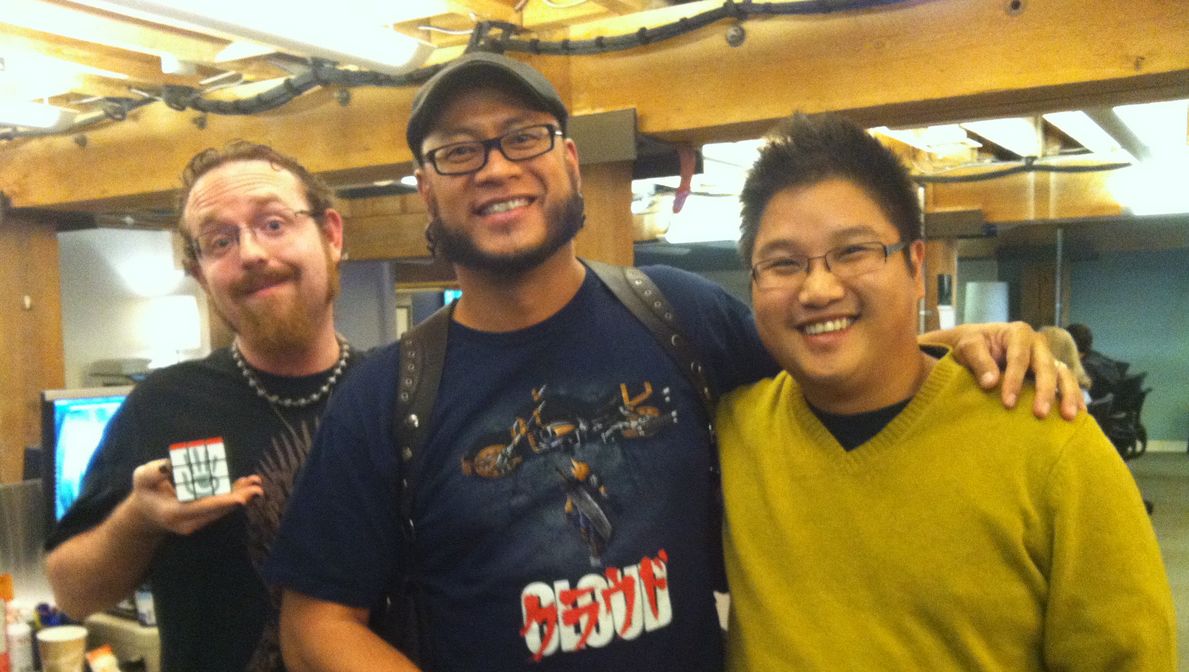
Left-to-right: Shaman and Kona Linden from the QA  team and (looking like he’s fresh from the set of Star Trek sans insignia!) Caleb Linden. Shaman (one of the friendliest and welcoming members of the Linden team I’ve met in-world) and Kona discuss with Drax the idea of making Lab’s internal merchandise, such as the Rubik’s cube Shaman is holding, available to users, as well as matters of community (both within the Lab and in SL). Caleb co-leads the Server Beta User Group meeting on Thursdays (image via The Drax Files Radio Hour)

One interview that didn’t make it to the podcast features Jeff “Bagman Linden” Peterson, the Lab’s VP of engineering, who is heading-up the next generation platform work (Don “Danger Linden” Labs having the lead on Second Life). Apparently, a little too much was revealed about the new platform considering the growing commercial interest in virtual world spaces, so the Lab has requested that  Unfortunately, dues to the fact the Lab is keeping a tight lid on the new platform for the time being, the interview has been shelved for (hopefully) a later date.

All told, a really interesting podcast, one that shouldn’t be missed.

The Drax Files Radio Hour: healing and memories

Episode #37 of the Drax Files Radio Hour arrived on Friday September 19th. I’m little out-of-step with things, having missed segment #36, so my apologies on that and the late arrival of this article.

The two major topics of interview with this episode are remembering Joe Miller (Joe Linden) and on SL as a tool for counselling and support, as seen by Dr. Tammy Fletcher.

Joe Miller (Joe Linden) remembered in the show (Image: Sportvision.com)

Jeska Dzwigalski remembers Joe Miller early on in the show (the 02:56 mark). Mr. Miller, who passed away in July 2014,  served as the Lab’s Vice President of Platform and Technology Development from May 2006 through until December 2010, and as such, oversaw many of the key technical developments within Second Life.  Jeska is well placed to recall him, as she worked with him through his time at Linden Lab, where he was highly respected by colleagues and by SL users.

A lot of Jeska’s comments are reflected in the short piece I wrote on Mr. Miller, but her time working with him obviously gives her recollections a very first-hand and personal feel, and her comments on the arrival of voice – which was added to SL pretty much as a result of Joe Miller’s involvement at the Lab – help shine a light on how the Lab believed it could add a whole new level of immersiveness to the platform.  She also touches upon his genuine passion for the platform, and his direct influence on her as a mentor, thus providing a warm insight to one of the great heroes of Second Life.

Prior to going to the interview with Dr. Fletcher, the show touches on a number of areas, including the plight of young LGBT people, who are forced from home by their parents. This is something Vilvi Rae actually covered through a Second Life machinima film called Sun Dog, focusing on the estimate that around a quarter of all homeless young people in Western countries identify as LGBT, who cite conflict at home as the main reason for leaving and taking to the streets. The film was second runner-up in the University of Western Australia’s / Screen My Shorts’s Project Homeless challenge, being one of three films made in Second Life on the subject of Homeless which topped-out the machinima section of that challenge.

During the VR commercial break ;-), the discussion sort-of edges towards the idea that VR and AR may merge.  I’ve given up waving my arms at Drax and chanting, “castAR, castAR” as an early example of technology already well down this road, so instead, I’ll cut to my own commercial break 🙂 – the last few minutes show the AR / VR combination element.

We get to the chat with Dr. Tammy Fletcher (known as Avalon Birke in SL) starting at 27:48 with an introduction by Drax. A therapist providing individual and couples counselling, Dr. Fletcher is a long-time believer in the role virtual environments can play in mental healthcare and support.

In some respects, this interview travels further through a door opened during the episode #35 interview with Jacquelyn Ford Morie, which also touched upon the use of VWs in therapy work, specifically mentioning the ICT’s work with VR and virtual environments (and which will be the focus of one of my promised further articles on the ICT), the use of the SimSensei, which I wrote about in August, and also Jacki’s work with Dr. Valerie Rice of the US Army in using mindfullness-based techniques within VWs to assist US service personnel and veterans deal with PTSD.

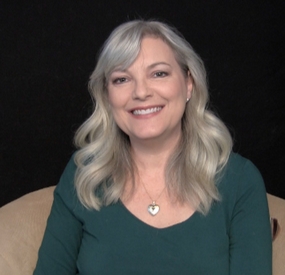
Dr. Tammy Fletcher
Dr. Tammy Fletcher (via fletchertherapy.com)

Which is not to imply that this conversation is simply a re-run of topics already covered. Far from it; the discussion is very broad-ranging and offers considerable food for thought, looking as it does at the complexities, benefits and potential problems of providing or seeking counselling and support through a virtual medium such as Second Life.

For example, how can you, as an SL resident for example, be sure that the person offering to provide counselling is actually qualified to do so, when you have nought but an avatar name to (initially) go on? How can you be totally assured of confidentiality of information – either as a person seeking support or as a therapist wishing to provide support. All of this and more enters the discussion, and Dr. Fletcher’s own experiences as both a Second Life resident and as a professional counsellor provides added depth to what is already a thought-provoking subject.

A frequent theme within the interview is countering the oft-held view (generally from outside the platform) that SL is somewhat itself a pathology. This is done very clearly and directly on a number of occasions, such as drawing parallels between it and other, similar activities which present the same degree of involvement but which are regarded as “acceptable”, and by underlining the fact that by offering many and varied avenues for release and self-expression, SL is potentially an ideal environment for what might be referred to as self-therapy. Of course, as SL users, we may all feel we’re well-versed and understand how beneficial SL can be; nevertheless, Dr. Fletcher’s comments are well worth listening to, as they provide a perfect frame by which many of these negative views on SL can be positively countered.

That said, and in terms of the core issue of providing therapy and support within such an open virtual medium like SL, all is not necessarily sunshine and roses. There are a fair few thorny issues involved, which Dr. Fletcher both acknowledges and offers additional food for thought. Identity and veracity are two such thorns: how can you really know that a person hanging out a shingle to offer professional counselling is qualified to do so? How can those providing counselling and support actually determine the genuineness of those seeking their support? more importantly, how they can fulfil their legal obligation of attempting to intervene should threats of self-harm be raised by a patient.

This is perhaps where the mask of anonymity works against the platform, and not necessarily just within the healthcare community. Some groups have striven to address this through their own means; Dr. Fletcher makes mention of one group in the healthcare community, while the SL Bar Association have also established their own verification service to help those seeking legal advice via SL. But should the Lab be more directly involved? That’s a tough question to answer; certainly making the Lab the gatekeeper of activities over which they have no direct control (and may not be best placed to manage) may not be as straightforward as it sounds.

Similarly, there is often only so far a therapist / counsellor can go when issues of threatened self-harm are raised on the part of a patient; how can the proper authorities be informed when all you have is an avatar name? Where or how should the Lab be involved, can they be involved in an effective manner?

Issues like these can have an impact on the overall degree and effectiveness of providing support and therapy through a virtual medium, and Dr. Fletcher superbly sets out many of the boundaries faced by the virtual counsellor as well as pointing to the rich benefits that can be obtained through such immersive environments like SL, with its many and varied communities and subcultures, opportunities for positive release and for what might – as mentioned above – be referred to as self-therapy.

With reference to communities and subcultures, her commentary on both the furry and child avatar communities within SL are a definite must listen, and directly challenge the misguided preconceptions sometimes held by those outside such communities, and on the way each of them are sometimes quite wrongly viewed as being a pathology.

In fact, so much is touched upon within the interview – including a look ahead to the potential of the Lab’s next generation platform – that it’s impossible to encapsulate it all in written words. If you haven’t already listened to this segment of the Drax Files Radio Hour, then it is one that I’d really encourage you to find time to sit down and run through, whether or not the subject of psychology is of interest to you. It will leave you with a lot to consider and contemplate.

The Drax Files Radio Hour: Jacquelyn Ford Morie – finally!

radio-hourEpisode #35 of  The Drax Files Radio Hour was posted on Friday September 5th, bringing with it a return to the “live” podcasts with Jo Yardley.

This is the episode which (finally!) brings us the interview with Jacquelyn Ford Morie, which I’ve been waiting for since I first heard that Drax had interviewed her back in July. Our very own Vick Forcella also puts in an appearance as well, making some pertinent observations about the Lab’s next generation virtual world platform, which you can also read on his blog.

As well as the main interview, there is the usual round-up of VR news. In this, the Samsung Gear VR and the beta of a new VR portal site are perhaps the most interesting elements.

The Jackie Ford Morie interview comes in at the 20:20 mark. For those unfamiliar with her name or work, she is an artist, scientist and educator working in the areas of immersive worlds, She obtained her Masters in Computer Science from University of Florida in 1988, prior to helping in the development of the Computer Graphic Design and Computer Animation programs at the Ringling College of Art and Design games and social networks. From here she progressed on to the Visual System Lab (VSL), a part of the Institute for Simulation and Training  at the University of Central Florida in Orlando, FL. While there, she worked on Virtual Reality projects for the State of Florida and the Army Research Labs.

Jacquelyn Ford Morie
Jacquelyn Ford Morie (image via DSKNECTD)

She has also worked for Walt Disney Feature Animation (WDFA), where she was responsible for developing a comprehensive year-long apprenticeship for incoming computer graphic animators, an approach she replicated for VIFX, Blue Sky Studios and Rhythm and Hues Studios. However, it was while at WDFA that she was invited to take part in a 1996 National Research Council workshop entitled Modeling and Simulation: Linking Entertainment and Defense. This led directly to the founding of the Institute for Creative Technologies (ICT) at the University of Southern California. Until 2013 she was a Senior Research Scientist at the ICT, involved in a range of VR projects, many of which are described in the interview. Around mid-2013 she departed the ICT to set-up All These Worlds, LLC to take her work related to virtual worlds and avatars which was initiated during her time at ICT, to a broader audience.

For anyone remotely interested in the field, Jackie is precisely the person to listen to. Not only is her own experience with the technology fascinating to discover, her sheer knowledge of how the technology developed and the potential applications, from highly specialised through to the entertainment industry to consumer-focused uses through the 1990s is absolutely fascinating. And if you’re reading this, Jackie – yes please, do go ahead and write that book on the history of VR!

At several points in the discussion, the issue of presence is touched upon. With the re-emergence of VR in the modern era, this has become a slightly divisive subject, as there is really two side to it: that of the physical / spatial immersion, wherein we having the physical feeling of being within an environment as represented through VR; and the emotional / social aspect of immersion – which is something that the likes of SL is particularly good at enabling.

It’s fair to say that many currently engaging with VR perhaps place greater emphasis on the form, physical / spatial immersion, than on the latter – hence why some don’t see worlds like SL as particularly relevant to VR. However, as Jackie points out, physical  / spatial immersion is less than half the story. No matter how involved the environment, or how “real” it seems, a part of our minds is always aware that it is a virtual environment, and that we’re still rooted in reality outside of the environment. However, bring the emotional / social sense of immersion, and then VR really becomes all-encompassing. Indeed, it is this aspect of emotional engagement, of bringing the mind to a point where it is so convinced that what it is witnessing is real, which has caused some to cogitate on whether VR could, if handled incorrectly, literally become a killer app.

Jacki’s own involvement in VR has been directed toward the more psychological elements of immersion, something which perhaps started with her involvement in the “presence questionnaires” used by researcher throughout the 1990s and right up to today to measure both a person’s predisposition to become immersed in something and their actual sense of immersion in a virtual experience, through to seeking ways and means to enhance the psychological sense of immersion up to and including the use of scents.

Sargeant Star - one of the ICT's virtual humans used to present the US military to the public
Sargeant Star – one of the ICT’s virtual humans used to present the US military to the public

At the ICT, her work has very definitely been focused on the more psychological aspects of immersion, including the use of a wide range of other technologies to heighten a person’s sense of psychological immersion, some of which has been a natural extension of her early work in the fied.

Alongside of this, she has been involved in the development of virtual humans – in which the ICT is a work leader. I’ve covered some of the ICT’s work in this area through my look st SimSensei and MultiSense (which Jacki references in the interview) as a means of providing support for those suffering mental health issues.

The ICT’s work, whilst bent towards military applications, actually represents a unique fusion of technology research, the entertainment industry and military applications, and it is something I’ll be looking at some more in the near future, as I have two further articles on their work waiting in the wings to be polished-off.

One of these is a look at the ICT’s use of VR in helping veterans and personnel deal with post-traumatic stress disorder (PTSD). This is also something Jacki has been involved in, through her collaboration with Colonel Valerie Rice into the use of Mindfulness-based Stress Reduction (MBSR), which has also been a focus of her new company, All These Worlds.

It was because of the developmental work on virtual humans that Jackie became involved in virtual worlds like Second Life, which she first used in combination with the virtual human toolkit developed by the ICT to create more advanced and reactive / responsive automated avatars (aka bots), which could be potentially used in a range of scenarios and training opportunities.

ANSIBLE: one aspect of a NASA funded look into how virtual environments can provide psychological support for astronauts on deep space missions

More recently, All These Worlds have been involved with NASA, looking at the ways in which VR, immersive environments and even virtual humans could be used to benefit astronaut crews engaged in deep space missions (such as one to Mars, which would likely have a 3  to 3.5 year duration, much of which would be outside of synchronous two-way communications with Earth due to time delays in transmissions). I touched upon some of this work, that of the ANSIBLE project also back in June 2014 as a part of a high-level look at VR’s role in space exploration. With a more involved project likely to be kicking-off in the near future, it’s something I plan to return to and look at in more depth later in the year.

Rounding-off the interview is a look to the future and where VR may well be leading us, and some of Jacki’s views are again though provoking, as is some of the work on which she’s been engaged – but I’ll leave it to you to listen to the programme and discover. This really is an interview not to be missed.


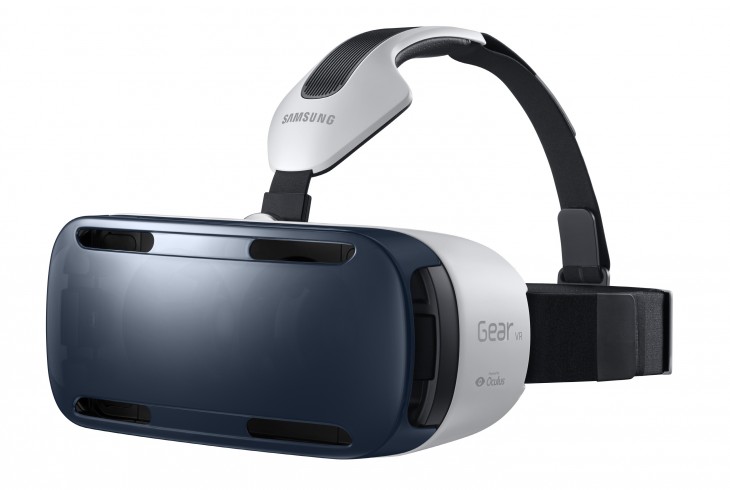
The Samsung Gear VR (image via TNW blog)

The Samsung Gear VR is particularly interesting because it seeks to take an important step beyond what could limit the mainstream take-up of VR when looking purely at something like the Oculus Rift – portability. Frankly, many people aren’t going to want to be tethered to their PC or a high-powered laptop in order to enjoy their VR; they’re going to want to have the freedom to enjoy VR where they like, when they like. The Gear VR is a clear step in the right direction where this is concerned. It’s also, for a device using mobile technology (the Galaxy Note 4), a lot smarter looking than the “mobile VR solutions” we’ve seen to date.

Of course, the Gear VR is far from perfect – it does require a Galaxy Note 4 to power it, so even with the headset rumoured to be costing around $199 (or £150 / $245 through one third-party reseller), it is likely the yet-to-be-confirmed price / monthly contract fees for the Note 4 will to see the overall cost of a Gear VR set-up pushed pretty high, again possibly limiting its appeal to that of the real VR enthusiasts.

Nevertheless, it’ll be interesting to see where this goes – and how it feeds back into the Oculus Rift down the road. Samsung are expects in mobile / portable technology and computer hardware design, so what might come out of a synergy between them and Oculus VR down the road could yet be surprising and revolutionary.

The second element to the news – the beta testing of a new content portal for the Gear VR market under the Oculus banner. Providing access to games and films, and which is itself provided as a VR experience, the portal pointer to the potential future for Oculus VR, not so much as a hardware maker but as a technology innovator and (more specifically) a content provider. And when it comes down to it, content is where the big money in VR actually resides.

Content is why I personally feel that rather than bringing about a resurgence of interest in virtual worlds, as some seem to believe will be the case, VR will result in virtual worlds remaining a niche usage, simply because the richness of available VR content results in the mainstream continuing to see VWs as superfluous to their needs, even while they embrace VR for a wide range of pursuits and activities – such as by watching things like movies and live events such as sports via VR, which itself was so recently given a  preliminary road-test by the UK’s BBC in a world’s first that seems to have gone largely unnoticed by the VR fraternity.


The Drax Files Radio Hour: lunch and Second Life

radio-hourEpisode #28 of  The Drax Files Radio Hour was posted on Friday July 18th. After a measure of disappointment on my part that the promised interview with Jacquelyn Ford Morie didn’t appear – for fully understandable reasons – this segment makes up for it with a chat with long-term Second Life business man Lislo Mensing, or as he’s known in the physical world, Stefan Weiss.

Stefan is the driving force behind a recreation of the heart of Munich in Second Life. He’s also the owner of Teledollar, a Linden Dollar Authorised Reseller, and he has some interesting first-hand experiences of trying to marry-up the virtual and physical worlds.

This is perhaps the most informal interview Drax has conducted to date in the radio show, taking place as it does over lunch in the physical Munich, where he met Stefan while enjoying his summer vacation in Germany. As such, this is both the first in a trio of such informal “lunch with a lifer” interviews and is also something of an introduction to Bavarian cuisine!

Virtual Munich, which dates from 2007, is a recreation of the centre of Munich. It features many of the landmarks from its physical namesake, including several of the city’s churches and the old city gates. All of these, while prim builds, have been constructed using around 6,000 photos taken of the actual city of Munich, allowing as much as possible of the original’s essence to be recaptured within the virtual constraints of two regions in SL. Streets and plazas are faithfully recreated, and even a portion of the underground (subway) transit system has been reproduced (tickets L$69), which connects the heart of the city to the surrounding rural regions.

In developing the build, Stefan saw the potential for a symbiotic way of promoting the virtual in the physical and vice-versa. Approaching the Munich civic authorities, he put forward the idea that virtual Munich could be used as a means of promoting the physical Munich, offering people who might be considering a visit to the city the means to immersively learn about it and explore it prior to actually visiting. There was initially a positive response to the idea, and even talk of including the virtual version of Munich in documentation about the city’s 850th anniversary.

Unfortunately, all this came to nought when, in late 2007, German media outlets (and others around the world) followed the UK’s Sky News in running exposés on sexual ageplay rings within Second Life. Understandably, support for the project from both Munich’s civic authorities and from businesses rapidly declined in the wake of the reports; so much so that Stefan was refused permission to take photos of the non-public areas of some of the historic buildings which he had hoped to be able to share with people by recreating them in-world.

A view across the munich skyline in Second Life
A view across the Munich skyline in Second Life

While there has always been much speculation as to the impact these and other such exposés had on the wider view the public and businesses had on Second Life, Stefan’s frank description of the situation he personally faced really adds perspective to one of the factors that undoubtedly led to SL fall from grace in the media’s eyes, and which may have had a far greater impact on the media’s perception of the platform than its inability to live up to the hype created around it.

Stefan Weiss as caught at a Munich SL user’s meet-u (image by Xphile Boucher, via The Drax Files Radio Hour website)

Beyond this, the conversation touches on the relevance of virtual worlds, with Stefan pointing out that really, not much has changed over the years where the broader attitude towards VWs is concerned. This, he points out, is largely due to what I’m going to henceforth call the Pamela Effect henceforth (particularly after the re-run of Drax’s interview with her in segment #27 of the Drax Files Radio Hour): most of those in the “mainstream” market simply don’t see VWs as being in any way relevant to their physical and digital lives and activities, and so don’t see why they should bother giving VWs a go.

Not only is this attitude perhaps common among the vast majority of Internet users, but it obviously also encompasses businesses as well,  who have far more accessible means at their disposal for marketing the products and services and of reaching an audience. It is relevance – far more than issues of getting the keyboard and mouse “out of the way” – which is likely going to be the major issue for anyone trying to drive a virtual world even further into the mainstream consciousness – at least for a the foreseeable future.

I’ve mentioned three reasons why I think this is the case in a previous article (although these are the only reasons for my feeling this way).  Stefan points to a couple more; things which are regularly discussed, at least among those of us already engaged in VWs: scalability (in terms of having an environment which can actually support compelling, mass audience / mass participation activities), and accessibility. In this latter respect, Tony Parisi is more than likely correct in his view that unless a virtual world embraces the ease of access presented by the web, it’s going to have trouble making its presence felt.

Relevance is also something that came to mind when the Oculus Rift received its obligatory mention in the interview. While much has been made of the potential of VR bringing about a renaissance in interest in virtual worlds, very little has really been said about the potential for VR to do exactly the reverse, and leave virtual worlds still locked into a narrow niche within the mainstream market.

Simply put, if VR brings about the kind of situation which is discussed in the show, allowing hundreds and thousands of people world-wide to sit down and witness a World Cup final as if they were there, or a Wimbledon championship or take a ride into space or stand on the surface of Mars or explore the wreck of the Titanic or do a hundred other things that might not be otherwise possible for them, and share the experience with others –  then why should they even bother with farting around with a virtual world?

Towards the end of the piece, things get a little confusing as other virtual environments, such as Twinity and Google Lively are touched upon amidst some lunchtime chuckles. There’s also a brief overview of the Teledollar operation before times catches up with Stefan and Drax, and things are cut short by the needs of the physical world and work.

This is very much a curate’s egg of a conversation; there is a lot discussed and mentioned which offers food for thought. The over-the-lunch-table nature of the conversation lends a curious tilt to things, helping to add flavour to the proceedings, and giving it an oddly intimate feel for the listener, as if we’re sitting on a table close by and overhearing their discussion as they eat; and what interesting listening it makes!

The Drax Files Radio Hour: Tony Parisi and the web as the home of VR

radio-hourEpisode #26 of  The Drax Files Radio Hour was posted on Friday July 4th. Marking the 5th interview segment while the “regular” podcasts are on hiatus for the summer. It features none other than the remarkable Tony Parisi.

As usual, and as well as being available on the show’s website and on Stitcher, episode #26 is also on YouTube, and that version is also embedded at the end of this article.

For those not familiar with the name, Tony Parisi is the co-creator of the VRML and X3D ISO standards for networked 3D graphics, and a 3D technology innovator. He’s a career CTO / software architect and entrepreneur, has and is serving on a number working groups, and may also be familiar to some as one of the SVVR Creating the VR Metaverse panel in April 2014.

Tony Parisi (via SVVR)
Tony Parisi (via SVVR.com)

In June he published a blog post entitled Virtually Anywhere, which serves as the launching point for the interview. In that post, he makes the case for the metaverse being the 3D web, pointing to the work of Vladimir Vukićević and Josh Carpenter (who was also on the SVVR Creating the VR Metaverse panel) of Mozilla in bringing native support for the Oculus Rift and other VR devices to Firefox; work which is also being  being paralleled by Brandon Jones at Google for Chrome and also within Internet Explorer. This is something he sees as undoubtedly beneficial, commenting:

We’re now seeing attempts to develop Virtual reality for the Oculus Rift using web technology. There are a couple of browser extensions you can get for Firefox and Chrome that will talk to the Oculus headset, you can write some JavaScript code for WebGL to render in stereo. And so people are starting to experiment with that, which is a really good thing, because I believe that open technology is the way we’re going to build the virtual reality metaverse.

He admits that the post is something of a manifesto to get VR onto the web, rather than seeing it recycled through walled gardens utilising proprietary applications which must be downloaded and installed in order to be used. It’s a manifesto worth reading, and certainly one to give pause for thought. A 3D web has long been talked about – often in terms of the technology which will supplant the web as we know it (e.g. as SL was once glowingly described) – actually seeing the web itself evolve to leverage virtual and augmented reality makes far more sense, being a more logical evolutionary step.

Vladimir Vukićević and Josh Carpenter - working on
Vladimir Vukićević and Josh Carpenter – working on browser support for Oculus Rift and other VR devices – see their joint presentation (images: Wikipedia and Mozilla, respectively)

Through his development of VRML and X3D, Tony is no stranger to the potential of VR or, for that matter, virtual worlds. In discussing VRML, he points to Blaxxun Interactive (originally “Black Sun Interactive”, a name taken from virtual night club featured in Neal Stephenson’s Snowcrash), credited with the development of one of the first 3D community platforms designed for the Internet back in 1995.

While VRML didn’t catch on in the manner hoped, being an idea somewhat ahead of its time given the state of play with hardware, data transmissions speeds on the Internet, etc., it did give rise to X3D. This, together with improvements in home computing capabilities and better Internet connectivity, saw Tony and his colleagues poking at virtual world environments.

The famous Business Week magazine cover

“We were sitting in a garage doing it together,” he recounts, “And then Second Life got on the cover of Business Week in 2007. Everyone probably remembers the famous Anshe Chung avatar on the cover; and that’s when the boom starter and hype started around Second Life, around ’07.

“And by that summer, literally two months, three months later, I had a lot of investment money from large venture capitalists to do the same thing in a web browser, lighter weight, a little more mainstream targeted. Second Life was thought to be for the geeks, the shut-ins, all these pejoratives you can imagine, disregarding the creative impulse and all the wonderful stuff that was built. And so a lot of folks, including management in my start-up, for example, felt that there could be a middle-of-the-bell-curve mainstream virtual world experience targeted at about everybody that would work just great.”

The product was originally called Flux, and while it didn’t quite go as planned, as Tony wryly notes, it did morph into Vivaty, which carried on through until 2010, and Vivaty Studio is still around today.

Continue reading “The Drax Files Radio Hour: Tony Parisi and the web as the home of VR”