Lumiya 2.5.0: advanced rendering

Update August 29th: There have been two additional updates with Lumiya since this review was published. Versions 2.5.2 and 2.5.3 both offer the same additional functionality as reviewed here, but include further fixes for devices using Adreno GPUs.

lumiya-logoAlina has released versions 2.5.0 / 2.5.1 of Lumiya. The two versions, released on August 26th and August 27th respectively, comprises the same updates features-wise, but the 2.5.1 release includes an additional fix to correct a crash issue users encountered with devices using Adreno GPUs (such as the HTC One).

The focus for this release has been on rendering capabilities, with the 2.5.0 release notes summarising the updates as:

  • An advanced rendering mode for better visual quality
  • Limited windlight support (sky, clouds, stars, time of the day)
  • Drag-to-select pointer for easy selection of small objects in 3D mode
  • Ability to purchase objects
  • Fixed an issue with terrain not being rendered when 3D view is opened too early.

Advanced Rendering and Windlight

The number of rendering options already included in Lumiya is impressive. Advanced Rendering brings with it the ability to render in-world light and other visual effects, windlight support for clouds, night-time stars, setting the time-of-day in the world view, and anti-aliasing.

Advanced Rendering options. note that Advanced Rednering must be enabled via a separate option in the Settings menu in order to access the options
Advanced Rendering options: note that the capability must be enabled via a separate option in the Settings menu in order to access these options

The additional capabilities are added to the 3D View section of Lumiya’s Settings menu (device Menu button > Settings), although they are on by default. While they do offer some enticing options, they do make Lumiya very much more device dependent than perhaps has been the case with the client in the past.

For example, I found that with the Advanced Rendering options active, my Galaxy S2 struggled mightily to render an in-world scene, even with high quality textures disabled, max avatars dialled back to 1 and draw distance down to a minimal 48 metres. More particularly, it got very hot in my hand; something I’ve not encountered previously. Once rendered, the scene also lacked clouds (although I’d chosen a region with a cloudscape overhead on purpose), but stars were visible when switching the time to night. Because of this, I’ve not included images from my phone, but rather demo images Alina captured on a tablet device with more oomph than my S2 can manage, as they give a fairer indication of what can be seen when using the right hardware.

Lumiya has clouds - if your Android device has the power
Lumiya has clouds – if your Android device has the power

That my S2 struggled isn’t surprising. There’s an awful lot of work for a small hand-held device to manage, even with just some of the bells and whistles turned on. Just as it is unrealistic to expect older computer hardware with limited graphics performance, memory, etc., to be able to handle all the latest shiny in Second Life, it’s also unfair to expect devices which necessarily have limited capacity to present everyone with the same level of detail with all the options ticked.

Starry, starry night / Paint your palette the Lumiya way ...
Starry, starry night / Paint your palette the Lumiya way …

Drag-to-Select

Another major new addition to Lumiya in this release is Drag to Select. This comprises a small hand icon in the top left of the world view, with the label Drag to Select. Following the instruction allows you to drag the icon (which changes to an arrow) and point to objects in-world, enabling you to interact with them more easily. Releasing the icon when pointing at an object will bring up the initial interaction menu, allowing you to touch, sit, etc., depending on the object.

Use Drag to Select to interact with in-world objects which may be too small to otherwise use long touch on

This is especially useful when using a small screen, where the finger can easily cover multiple items, resulting in some frustration when trying to long touch something for its menu. Do note, however that as the option removes your avatar from the in-world view, you can’t use it to touch your own attachments; nor does it appear to work on other avatars’ attachments.

Making Purchases

You can now shop ’til you drop with Lumiya. Simply find a vendor or object set for sale, long-touch it, and the pop-up menu includes a Buy Object item. Tap this for a final confirmation before buying.

You can now purchase things with lumiya
You can now purchase things with Lumiya (account balance blanked on purpose)

Feedback

Another interesting update, albeit it one which may well tax some devices, prompting users to disable some of the options. Seeing windlight start to arrive in Lumiya is good, and helps the client to become more of a mobile alternative to a full-blown viewer for those on the move requiring their SL fix. Similarly, having the ability to make in-world purchases adds to Lumiya’s attractiveness. I also like the new Drag to select function, although its addition is starting to make the in-world view on small screens rather crowded. Even so, I’d rather have it than not.

I understand that in-world building is on the cards for a future release of Lumiya; now that will be interesting. I presume it’ll be a capability best suited to tablet devices rather than small-screened handhelds, but that’s no reason for seeing it excluded. It just means I’ll have to go buy myself a tablet! :D.

Related Links

Lumiya 2.4.7: bake, float, layer and find your place

lumiya-logoLumiya, the mobile client for Android devices saw two rapid-fire updates on June 11th. First came version 2.4.6, offering a lot of new and improved functionality, which was followed by 2.4.7 with a round of bug fixes which demonstrated again that no matter how hard you try to stomp on the little sods before a release, some of them will still be there to blow raspberries at you after a release…

Given the rapid-fire nature of the updates, I’ll be reviewing them all under the banner of the 2.4.7 release.

The Fixes

The under-the-hood fixes to Lumiya with this release comprise:

  • Minor inconsistencies with avatar shape rendering correctly
  • Fixed terrain rendering in regions with default terrain textures
  • Fixed a crash on clearing cache while connected
  • Updates for server-side baking compatibility.

Multi-wear / Multi-attach

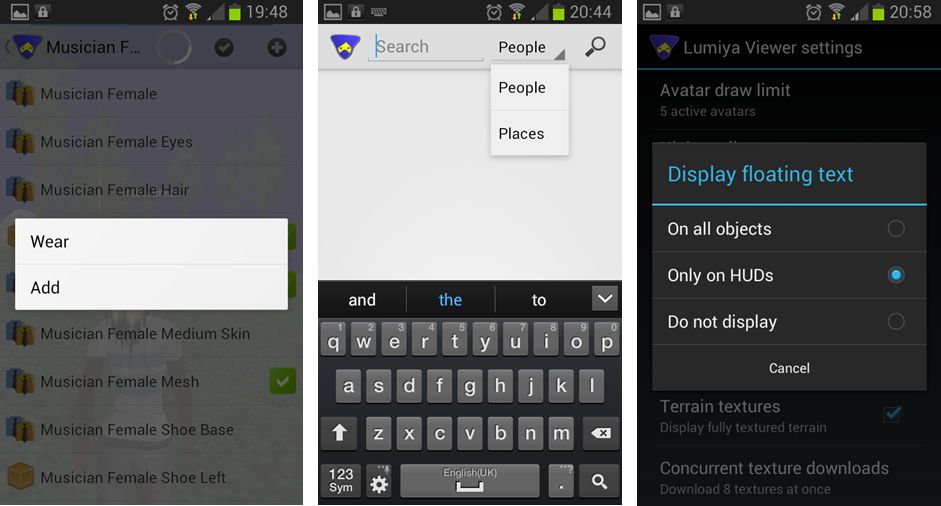
Lumiya now supports multi-wear for clothing at attachments.This is enabled via an ADD option appearing in the pop-up menu when selecting items from inventory or outfits to be worn / attached.

Currently, the order in which items on the same clothing layer are displayed is a little random (so if you wear shirt layer item 1 first and then shirt layer item 2, the second item might appear to be worn over the first, but the next time you add them in the same order, the second might appear to be worn under the first). There is also no ability to re-order items once worn, as is possible with a viewer.

At the moment, system clothing in Lumiya all utilises the same icon in inventory & outfits (a shirt icon), regardless of the layer on which it is worn. Alina does plan to improve this in time, however her attention is on other functionality right now.

aaa
Lumiya 2.4.7: (L) – The new ADD option for multi-wear, allowing additional clothing items to be worn on an occupied layer / attachments to be worn on an occupied point, a-la most viewers, and accessible from both inventory and outfits; (c) – the new Places search option, which can be selected from within Search; (r) – the three options available from within Lumiya’s settings for displaying hover text in-world

Search Places

Lumiya’s Search option has been expanded to incorporate places and well as people. You can toggle between the two on entering search (e.g. by selecting it from the menu displayed when tapping the Menu button on your device) by tapping on the displayed option (People is the default) and selecting the required option from the drop-down.

Emotes and Hover Text

Lumiya now supports emotes in chat (e.g. /me smiles) and will also now display hover text above objects. By default, this is only on for hover text associated with worn HUDs. This is to prevent smaller screens being over-run with lots of on-screen hover text (because you’re roaming through a breedables store, for example). However, it can be enabled for in-world objects (or disabled altogether) by tapping the Menu button on your device and then going to Settings and scrolling down to 3D View and tapping Display floating text. This will display a pop-up menu with three options: On all objects, Only on HUDs, and Do not display – tap the radio button for the desired option.

Feedback

All told, another nice little package of updates to Lumiya which again further increase its capabilities and which enhance it as a worthwhile alternative to a full-blown viewer for those who need to access SL while on the go and away from their computers.  All of the additional functions are nice-to-haves, and the server-side baking / appearance updates ensure that Lumiya remains SSB/A-ready, once the latter starts to go live across the grid. There is something of a delay in changing / updating outfits as a result of SSB/A, so if you do try Lumiya for the first time, please bear this in mind and remember the app is doing an incredible amount of work in order to bring you both a mobile client and a functional in-world, real-time view of the world.

Kudos to Alina once again!

Related Links

Lumiya 2.4.5: nips and tucks

lumiya-logoSaturday May 25th saw the arrival of Lumiya 2.4.5. Something of a maintenance release, rather than one which offers heaps of new features, the update should help improve the overall experience for users who make use of Lumiya to access Second Life while on the go. Which is not to say there aren’t any visible updates to the app – there are; however, these are more aimed at also enhancing existing functionality, rather than adding new bells and whistles.

This update also sees Lumiya made available via Android Pit as well as Google Play, allowing it to be purchased via PayPal.

Profile Pictures, Picks and Notes

2-4-5-3Perhaps the most visible change with the 2.4.5 update has been made to the profile display, which now includes the ability to display people’s profile pictures within Lumiya, together with pictures included in their Picks, and which also allows you to add notes of your own to their profile.

Accessing your own (or a friend’s) profile will now display their profile picture on the left of an updated profile display, with their on-line and payment status information displayed to the right of it, together with their SL age. The selected individual’s About information is now displayed directly under their profile picture in a manner which mirrors the legacy “in-viewer” profile floaters which are common to v1-based viewers and popular with some V3-based TPVs.

Tapping the Picks tab will display a list of available Picks for the selected user, any of which can be accessed by tabbing on them, and will display their associated pictures after any descriptive or other text. Use the Back button on your device to move back and forth between Picks or to exit a profile display altogether, as per usual.

The Note functionality is also accessed by tapping a tab at the top of the profile display, and works exactly the same way as the notes option in viewer profiles – the notes you add are only visible to yourself.

Inventory Search

Lumiya 2.4.5 adds the ability to search your inventory for an item or items matching a given keyword. The search option is accessed by opening your inventory and then tapping the button with the magnifying glass icon (again in keeping with V3-based viewers). This will open a search field at the top of the display as well as displaying the device keypad to input a search term.

Lumiya 2.4.5: Search inventory (l): select a storage device (c) and deactivate a group tag (r)

Deactivate Current Group and External Storage Device Support

With Lumiya 2.4.5 you can deactivate your current group tag, and also define which storage medium you wish to use for the Lumiya database.

The latter – selecting a storage device for storing your Lumiya database – is controlled through Lumiya’s Settings options (accessed through the Menu button on your device). It can be found under the Cache section of settings, towards the bottom of the list of options (“Database location”). Tap to display a list of available alternative (e.g. “Internal storage” and “SD card”) and then tap the desired option.

Deactivating a group tag is a simple matter of displaying your list of groups, then long-touching the name of the active group and tapping the displayed option to Deactivate. This will uncheck the Group name in your list, and will result in your avatar’s tag only showing your display name and / or user name in other people’s views. You can of course activate any group tag simply by long-touching it and then tapping the displayed Activate option once more.

Under the Hood

The under-the-hood changes to Lumiya are designed to improve your experience when running Lumiya and comprise:

  • Auto reconnect after connection loss.
  • Improved handling of large inventories.
  • Runtime texture compression to reduce memory usage.
  • Online/offline notifications in chat windows.
  • Option to deactivate active group.

Feedback

This update to Lumiya is again somewhat “low-key” compared to some of the previous releases, but this doesn’t make it any less valuable. Alina is focusing on refining the client and the options it currently offers, rather than looking to add a lot of additional bells and whistles at this point it time. As such, this update is very evolutionary rather than revolutionary – and there is nothing whatsoever wrong with that, and is a very worthwhile download if you don’t have Lumiya set to auto-update.

Related Links

Lumiya: now you rez it, then you take it

lumiya-logoLumiya, the SL / OpenSim viewer for Android has seen two further updates since my last review. Version 2.4.3, released on February 16th, primarily saw the addition of flexiprim support in the 3D view, and the option to teleport to an avatar as well as some nips, tucks and tweaks.

Version 2.4.4, release on March 7th added object rezzing options and inventory-taking option to Lumiya as well as the ability to create landmarks. Taken together, both updates significantly add to Lumiya’s capabilities, and as I had a little free time, I took version 2.4.4 for a spin to try all the updates out.

Teleport to an Avatar

Teleporting to an avatar using Lumiya is a simple matter of selecting them from your Friends list, the Nearby list using a long touch and then selecting Teleport To from the pop-up menu. You’ll be asked to confirm the action – note that Yes is on the RIGHT of the confirmation dialogue; clicking it will teleport you to the avatar (or any landing point near them, if one is set at their current location).

Creating a Landmark

To create a landmark at any time, display your inventory, then click on the Landmark icon displayed in the bottom right of the inventory window (portrait display) or top right (landscape display). If the icon isn’t displayed in the latter view, tap the Menu button on your device and select Create Landmark from the displayed menu.

Use the Menu button on your device when displaying the inventory window to display a list of options of the Create Lanmark icon isn't already displayed
Use the Menu button on your device when displaying the inventory window to display a list of options of the Create Landmark icon isn’t already displayed

Note that you can access inventory either from the Lumiya Suitcase icon when in text view or in the 3D world view. If the icon isn’t visible in the latter, tap the menu bar on your device to display a list of options – inventory access should be at or near the top.

Tap the Menu button on your device to display all available menu options when in 3D world view

Rezzing Objects and Unpacking

Rezzing an object in-world in Lumiya is a simple matter of locating the object in your inventory and then long-touching it to display a pop-up menu. Tap Rez on the menu then confirm you wish to rez the object in-world in response to the dialogue displayed.

Objext rezzing from inventory & copying / moving the contents of an object back to inventory
Object rezzing from inventory & copying / moving the contents of an object back to inventory

Assuming you have object entry / rezzing rights for the parcel you are on, the object will be rezzed in-world. To display the contents, long-touch it (note that you may have to adjust your camera position to select the object, particularly if it is rezzed on another touchable object), and select the Open option from the displayed menu. An inventory-like window is opened to display the contents of the object, which can be copied / moved to your inventory by tapping the Copy button at the top right of the contents window.

Other Bits and Feedback

Lumiya supports flexiprim motions in the 3D world view as of version 2.4.3

Versions 2.4.3 and 2.4.4 see improved handling of large meshes, improved notification settings and assorted bug fixes.

The flexiprim support in the 3D world view works well, although rendering things like flexihair when in motion may result in slight oddities; for example, when walking, my hair tended to all but vanish at times, but would quickly come back once I stopped, and Lumiya reproduces SL’s signature “hair flair”  – long hair flairing out behind your avatar like a comet’s tail – very well :).

Overall, these have been two somewhat “low-key” updates for Lumiya compared to recent passes (mesh support et al). However, I know that 2.4.3 marked another milestone for Alina, as she’s been working on getting flexiprims to work for the last several months – so it’s good to see she’s succeeded.

The ability to rez / open objects adds another fundamental capability to Lumiya, as does the ability to create landmarks. All-in-all, another good set of updates which once again increase Lumiya’s attractiveness as a very capable means of accessing Second Life and OpenSim while on the move.

My only real issue with the viewer is that if Alina keeps developing Lumiya, I’m going to have to go out and buy a Tablet just so I can really enjoy using it! :D.

Related Links

Lumiya: mesh, rlv and more

lumiya-logoLumiya has gone through a series of updates recently, cycling rapidly through versions 2.4.0 and 2.4.1 (the latter to fix an OpenSim teleport issue) on January 31st, and arriving at 2.4.2 on February 4th to fix some issues with mesh clothing uncovered by yours truly.

These releases see Lumiya introduces key features users have been waiting for, and start paving the way for future SL support. Taken together, the core updates comprise:

  • Support for mesh objects and clothing
  • Support for RLV
  • Support for server-side baking

Mesh Support

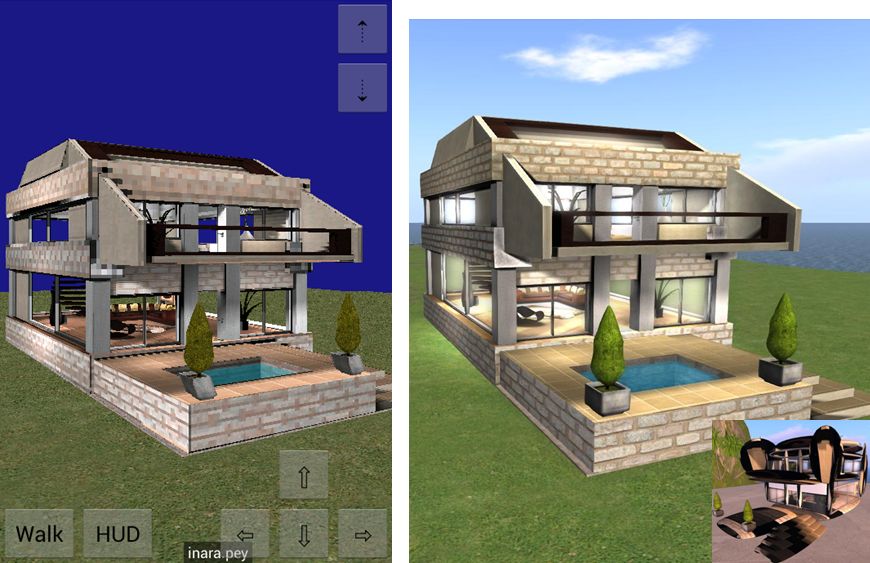
Mesh support works well with in-world objects, as the following image demonstrates.

A partial mesh house rendered in Lumiya (l) and a mesh enabled viewer (r). The inset images shows the hows as rendered in a non-mesh viewer

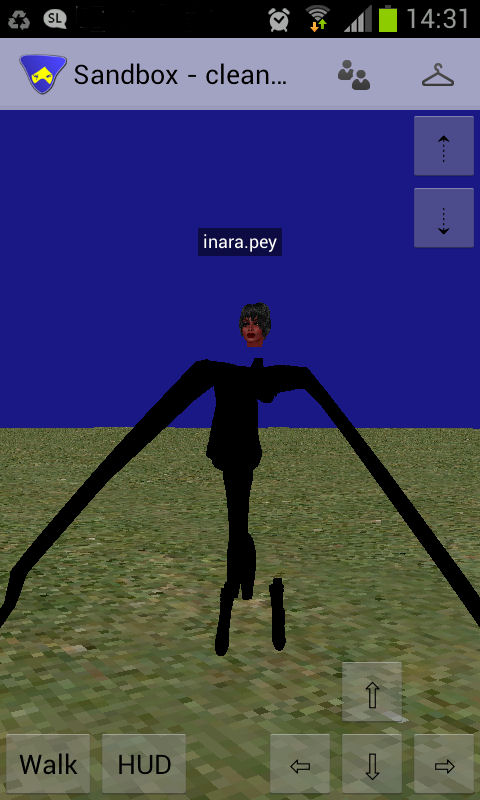
Mesh clothing was a little more problematic with the initial 2.4.0 / 2.4.1 release, for both rigged and non-rigged mesh clothing. While some would render correctly, other items would not, exhibiting issues with arms and / or legs, and even rendering as  being worn back-to-front.

Mesh rendering in Lumiya 2.4.0 / 2.4.1. sometimes things went a little ka-ka...
Mesh rendering in Lumiya 2.4.0 / 2.4.1. sometimes things went a little ka-ka…

The issue appeared to be with how the SL software treats both rigged and unrigged mesh. I’m not a technical expert (as most know), but was able to carry out a series of tests which gave Alina Lyvette, Lumiya’s developer, a start on carrying out her own investigations which resulted in her fixing the issue – hence version 2.4.2 appearing.

With the latest release, it appears the majority of problems have been solved, although there have been some reports of mesh attachments such as hair still failing to render correctly.

Certainly from my perspective, and while I admittedly have what is a far less than extensive mesh clothing wardrobe, the issues which all gave me problems while using the 2.4.0 and the 2.4.1 releases of Lumiya all now appear to be resolved, and my mesh clothing now all renders correctly for me, and I’ve had no problems with the likes of mesh footwear so far.

One side effect of this is that the mesh support has slightly impacted the positioning of avatar attachments with Lumiya. Alina has had suspicions that there might be a problem with attachments and the avatar skeleton which may affect Lumiya, and now the issue has been confirmed, it’s on her list of things to update.

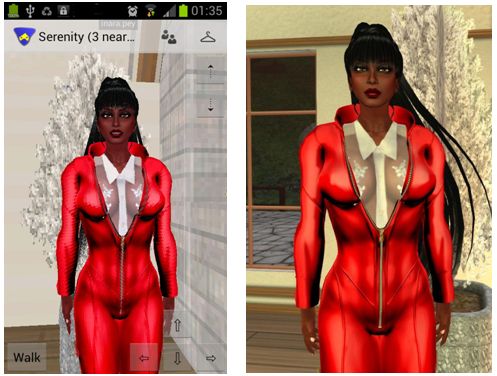
The magic of mesh in Lumia: a rigged mesh catsuit in Lumiya (l) and a regular viewer (r)

A new setting is also provided within Lumiya for users to define the quality of mesh rendering on their device  – useful if using an older, less capable GPU. The options can be found under 3D View on the Settings menu (device menu key > Settings), and comprise five settings: High Quality, Medium Quality, Low Quality, Lowest Quality and Disabled.

RLV Support

Lumiya, from version 2.4.0 onward, provides RLV / RLVa support. As with a traditional viewer, RLV must be explicitly enabled by the user via the Settings menu (device menu > Settings > Tap RLV enabled to check and turn on). Also, as with a traditional viewer, a restart is required once RLV has been enabled the first time.

Once enabled, behaviours are as seen with an RLV-enabled viewer: locked items are non-detachable; restricted options are removed from menu options; movement restrictions enforced etc.

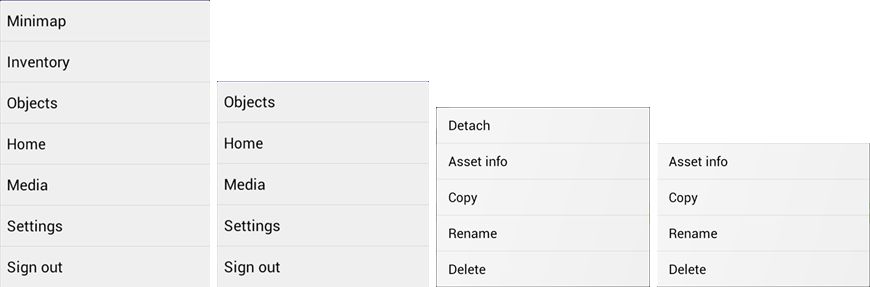
RLV in Lumiya: in the left two images, the 3D world view Settings menu showing how active RLV restrictions remove options (Inventory, Minimap) from that menu. On the right, two images showing the removal of the Detach option from the object menu for an RLV "locked" item
RLV in Lumiya: in the left two images, the 3D world view Settings menu showing how active RLV restrictions remove options (Inventory, Minimap) from that menu. On the right, two images showing the removal of the Detach option from the object menu for an item “locked” via RLV

RLV Support Notes

  • As Lumiya does not currently support particle rendering in the 3D view, chain links, etc., will not be rendered
  • Similarly, because Lumiya does not currently support windlight, any windlight controls / restrictions related to RLV will no be applied to the in-world view
  • There is currently no #RLV shared folder support
  • Disabling RLV in Lumiya will turn the functionality off without a need to re-log (all restrictions on detachment, menu options, etc., will be lifted).

Server-side Baking

Lumiya now provides support for Server-side baking (SSB, also referred to as avatar baking), and so is ready from when the new service is deployed to the main grid.

While there is a test area for SSB on Aditi (the Beta grid), I have encountered issues with logging-in to that grid using Lumiiya, and so have been unable to test and obtain images for this review.

Other Updates

Additionally. versions 2.4.0 through 2.4.2 add the following to Lumiya:

  • Avatar direction indicator added to Mini-map (a small arrow is displayed over your avatar, indicating the direction it is facing)
  • Animation requests are no longer auto-accepted
  • Fixed display of outfit folders in inventory
  • Fixed duplicate messages in chat
  • Fixed inventory appearing empty after teleport
  • Fixed broken teleports on OpenSim grids.

Feedback

Another series of updates which see Lumiya move even closer to matching viewer-based capabilities, making it even more a genuine alternative for those on mobile / tablet devices who wish to access Second Life / OpenSim while on the move. Both mesh rendering and RLV support are liable to be popular additions, and the server-side baking should stand it in good stead for upcoming changes to Second Life.

For those using an Android device, there simply isn’t a better means of access your virtual world.

Related Links

Lumiya 2.3.3: bringing texture to your world

lumiya-logoDecember 5th sees a further update to Lumiya, with the release of version 2.3.3.

Over the course of the last year Lumiya has developed from a basic text client into a app which rivals the viewer in terms of its capabilities – 3D rendering, avatar rendering, inventory access and management, outfits, touch, pay, OpenSim support. What’s more, all this has been ahieved in less than a year; it’s an incredible testament to Alina Lyvette’s abilities and determination to develop a functional, credible mobile client for virtual worlds like Second Life.

With version 2.3.3, Alina again raises the bar with a host of new features, as well a a number of fixes and updates:

  • Texture updates, including textured terrain in 3D view and option high-quality textures
  • Flying controls in 3D view
  • HUD support
  • “Clear cache” option in settings
  • Chat messages and user keys can be copied to clipboard
  • Option to restart sim for land owners
  • Configurable LED blinking for notifications
  • NEON-optimized code for texture decompression

Textures

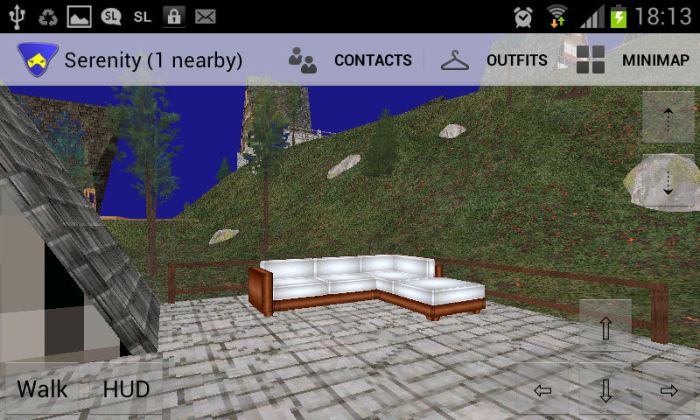
The first big update with Lumiya 2.3.3 is textures and texture handling. First and foremost, Lumiya will now render ground textures in the 3D view, something which immediately increases the attractiveness of outdoor scenes when rendered.

We haz teh grass! Lumiya now displays terrain textures

Lumiya also includes a number of configurable texture options available through the 3D View section of Settings (tap the menu button on your device, then tap Settings). These are:

  • High Quality Textures: toggles the high quality option on and off – this can put a device’s GPU under considerable stress and lead to extended rezzing times
  • Texture Memory Limit: set the maximum limit your device can use for textures from a set of four defaults: 32MB, 64MB, 128MB and 256MB. Note that Android can limit GPU memory use to 128MB, so using the 256MB may cause problems on some devices, including locked the application completely
  • Concurrent Texture Downloads: set how many textures can be downloaded concurrently (2, 4, 8, or 16)
  • Terrain textures: toggle the terrain texture rendering on / off.

Flying Controls

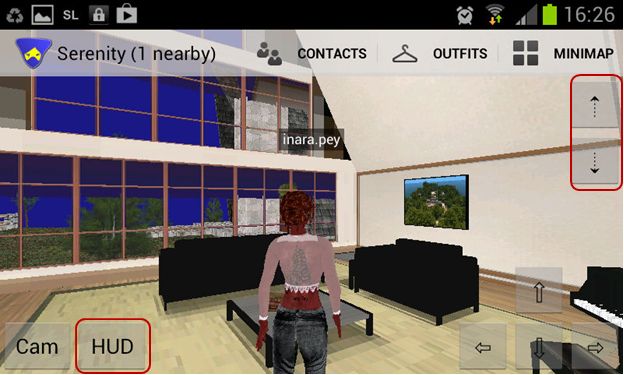
Lumiya 2.3.3 sees three new buttons appear on the 3D world view, two of which (in the top right corner of the screen) allow you to fly, as with a full viewer. Tap the UP arrow key to start flying / fly up, and the DOWN arrow to descent / land. Fly forwards / backwards using the movement keys in the lower right corner of the screen.

The new Fly buttons (top right) and HUD access button

When you start flying, a STOP FLYING button is displayed. One being tapped, it does precisely what it says: stops you flying – complete with the traditional falling animation as well!

Continue reading “Lumiya 2.3.3: bringing texture to your world”