In April, I followed the Lab’s lead in reporting on a new Massive Open Online Course (MOOC) designed to help Spanish-speaking educators in the use of Second Life as a starting point in their interaction with emerging and innovative environments that can be used for education.
Professor Max Ugaz, UMSP
Since that time, and as the Lab again reports, the course has been improved and updated, and a new session is set to start on Monday September 29th. The course has been developed by the Universidad de San Martín de Porres (USMP), located in Santa Anita, Lima, Perú, under by the university’s Project DirectorofVirtual Worlds, Professor MaxUgaz. The course will comprise three week-long modules with a total of 17 lessons and an average workload of around 5 or 6 hours per week.Details on the course, together with a registration form for interested parties, are available the university’s website, which includes an introductory video for the course (in Spanish). The course will take place at one of the USMP’s teaching areas in Second Life, commencing on Monday September 29th, as noted. As my own Spanish is poor to non-existent, I’ve taken the liberty or reproducing the Spanish portion of the Lab’s blog post below:
l Proyecto en Mundos Virtuales de la Universidad de San Martín de Porres de Perú, inicia este 29 de setiembre la segunda edición del curso en la modalidad MOOC (Curso Masivo Abierto En línea) titulado “Introducción a Second Life para Educadores 2da. Ed.”. El curso es gratuito y está diseñado para capacitar a educadores y público en general de habla hispana en el uso del mundo virtual Second Life, a fin de ofrecer conocimiento que permita desempeñarse en este entorno y aprovechar su potencial, especialmente en el ámbito educativo.
Si tú o alguien que tú conoces pueden beneficiarse de un curso como éste, pueden acceder al vídeo de introducción y registrarse en la página web. Inicio: 29 de Set.
Además se puede visitar la sede del curso dentro del mundo virtual desde nuestra Guía de Destinos.
In May of 2014, Landon Linden, aka Landon McDowell, the Lab’s VP of Operations and Platform Engineering, wrote a blog post on the reasons why a series of issues combined to make Second Life especially uncomfortable for many.
At the time, and as many bloggers and commentators – myself included – noted, the post came as a refreshing breath of fresh air after so long without meat-and-veg communications from the Lab in terms of what is going on with the platform and why things can go wrong.
Now Landon is back explaining how the Lab’s Ops team responds to issues within their services, the communications tools they use – and why the tools are so effective.
An Inside Look at How The Ops Team Collaborates is once again an interesting and informative piece, delving into not only the technical aspects of how the Lab respond to problems within their services, but which also encompasses the very human aspects of the dealing with issues – handling emotions when tensions are high, opening the window for those not directly involved in matter to keep an eye on what is happening so that they can also make better informed decisions on their own actions, and more.
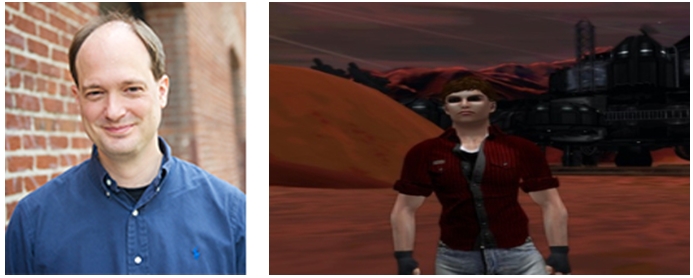
Landon McDowell, the Lab’s VP of Operations and Platform Engineering and his alter-ego, Landon Linden
The core of the Lab’s approach to incident communications is the use of text chat (specifically IRC) rather than any reliance on crash team meetings, the telephone and so on. Those who deal with the Lab on a technical level won’t be surprised at the use of IRC – it is a fairly strong channel of communication for the Lab in a number of areas; but what makes this post particularly interesting is the manner in which the use of IRC is presented and used: as a central incident and problem management tool for active issues; as a means of ensuring people can quickly get up-to-speed with both what has happened in a situation, and what has been determined / done in trying to deal with it; as a means of providing post-mortem information; and as a tool for helping train new hires.
These benefits start with what is seen as the sheer speed of communication chat allows, as Landon notes:
The speed of text communication is much faster. The average adult can read about twice as fast as they can listen. This effect is amplified with chat comms being multiplexed, meaning multiple speakers can talk intelligibly at the same time. With practice, a participant can even quickly understand multiple conversations interleaved in the same channel. The power of this cannot be overstated.
In a room or on a conference call, there can only be one speaker at a time. During an outage when tensions are high this kind of order can be difficult to maintain. People naturally want to blurt out what they are seeing. There are methods of dealing with this, such as leader-designating speakers or “conch shell” type protocols. In practice though, what often prevails is what one of my vendors calls the “Mountain View Protocol,” where the loudest speaker is the one who’s heard.
In text, responders are able to hop out of a conversation, focus on some investigation or action, hop back in, and quickly catch up due to the presence of scroll back. In verbal comms, responders check-out to do some work and lose track of the conversation resulting in a lot of repeating.
He also notes that not everyone is involved in a situation right from the start. Issues get escalated as they evolve, additional support may be called-in, or the net widened in the search for underlying causes, requiring additional teams to be involved, or the impact of an incident spreads. Chat and the idea of “reading scrollback” as the Lab calls it, allows people to come on-stream for a given situation and fully au fait with what has occurred and what is happening in a manner not always possible through voice communications and briefings, and without breaking the ongoing flow of communications and thinking on the issue.
The multiplexing capabilities of chat also mean that individuals can disengage from the main conversation, have private exchanges which, while pertinent to the issue, might otherwise derail the core conversation or even be silenced in something like a teleconference – and those engaged in such exchanges can still keep abreast of the central conversations.
For an environment like the Lab, where operations and personnel are distributed (data centres and offices located in different states / on different coasts, not everyone working from an office environment, etc.), chat has proven a powerful tool, although one that may take time getting to grips with, as Landon notes about his first exposure, saying:
I … just sat there staring at the screen wondering what the hell had just happened, wondering what the hell I had gotten myself into. I thought I was a seasoned pro, but I had never ever seen an incident response go that smoothly or quickly. Panic started to set in. I was out of my league.
However, the benefits in using it far outweigh any need for a degree of gear shifting required by ops staff in learning to use the approach. As Landon states in closing his comments, “when it works it is a wondrous thing to behold, a ballet in a war zone, beautiful, terrifying, and glorious.”
This is another great insight into what happens inside the Lab, and as such, the post makes very worthwhile reading, whether or not you have a background in Ops support.
During the Server Beta meeting on Thursday August 21st, it was confirmed that the first region to be rated a Skill Gaming region had arrived on the main grid. The region – called “Crunchy”, isn’t actually open for gaming; it’s a test area currently being poked at by Gecko Linden.
In addressing the arrival of the region, Simon Linden pointed to the Skill Gaming Approved Participants wiki page, and I noticed that the first set of Skill Gaming operators and the first batch of games have now been listed.
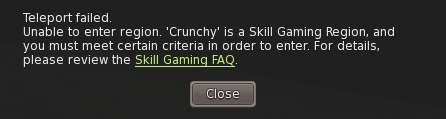
A warning is displayed if you attempt to TP to s Skill Gaming region you are not permitted to access
The test region is already set-up to exclude access to avatars which don’t meet the access requirements, which can be found in the Skill Gaming FAQ and on the Approved Participants wiki page. The access restrictions appear to work, as I was unable to reach the test region with my Crash Test Alt, but could enter it without a hitch with my primary avatar account.
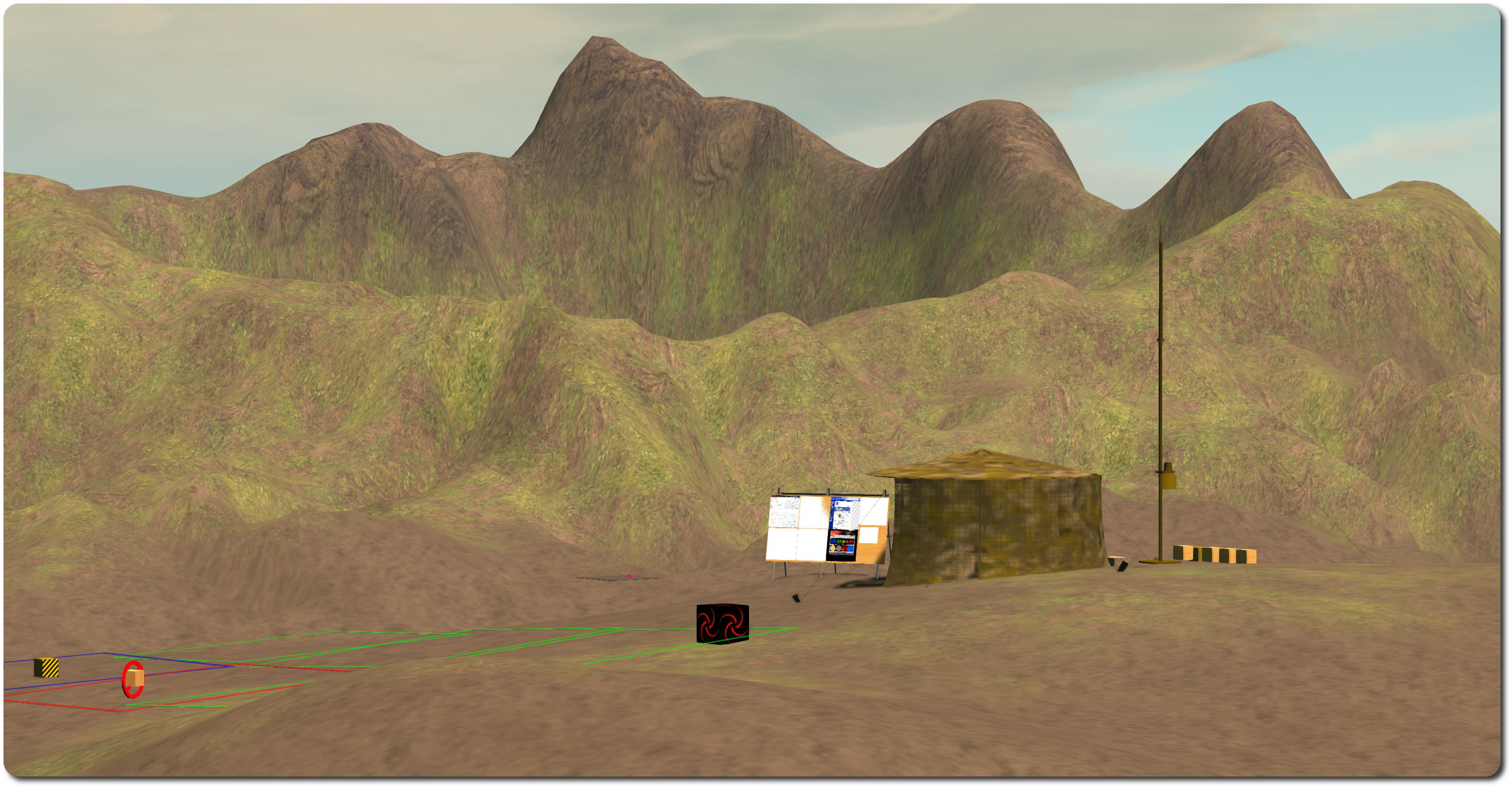
There are some other tests going on in the region which are likely to be readily to performance testing, etc; robots fly and shoot, MOAP boards are displayed (and Gecko Linden seems to be a bit of a space science fan, like me).
Crunchy: the Lab’s FOB for Skill Gaming regions, and “Base Camp Gecko”
Some 45 games (a fair few of them variations on Solitaire) were added to the Approved Participants wiki page on Thursday August 21st, split among a number of operators. In addition, some 30 Skill Gaming regions were listed as approved as Skill Gaming regions, although they have yet to actually be converted to the new region type.
With the revised September 1st deadline looming for the introduction of the updated Skill Gaming policy, these additions are the first sign that people are actually applying to become operators / creators, and it will be interesting to see how many more appear over the course of the next week. As it is, there still seems to be a lot that is still up-in-the-air with regards to the Policy and its associated FAQ – the latter of which hasn’t been updated since August 7th.
One area still to be cleared-up is that of quarterly fees, which may well be delaying some from applying to become licensed operators / creators. The lack of any clear indication of the fees was raised as a matter of concern at the August 2nd presentation Agenda Faromet gave on both Skill Gaming and the July Terms of Service update (transcript and notes to both available here).
In many respects, it is hard to understand why the Lab hasn’t announced quarterly fees. According to the FAQ, they are in respect of are in respect of “processing and compliance-related costs associated with maintaining this program”. Taking this as the case, then it’s not unreasonable to assume the Lab has an idea of the compliance related costs and other fees they are themselves facing in order to allow skill gaming on their platform, and so should have some idea of what the quarterly fees are likely to be.
This is not to suggest the Lab are attempting anything untoward in not revealing the fees; a was pointed out during the SLBA presentation, the likely reason the fees haven’t been announced is because the Lab have (or hadn’t at the start of August) got that far in their thinking. Even so, it is potentially causing people to hold off applying.
What also doesn’t help the Lab here is that Skill Gaming regions already have a higher tier associated with them ($345 + VAT where applicable) “due to the greater degree of ongoing administrative work associated with administering our rules concerning Skill Gaming in these regions”. So applicants are faced with that, the application fee, the cost of converting their existing regions – and then still have a possibly large question mark hanging over their potential total operating costs.
It doesn’t inspire confidence.
There are other aspects of the process that would seem to need clarification or risk confusion. As Ciaran Laval pointed out on August 13th, it has been suggested (not by the Lab, admittedly), that SL-focused stock exchanges are possibly exempt from the updated policy, but at least one is going through the application process (SL CapEx, again as indicated by Ciaran); ergo, further clarification on the status of exchanges would perhaps be welcome.
There is also the requirement (section 9 of the FAQ), that applicants engage a US-based and licence attorney to help with the legal aspects of their application (e.g. provisioning their RLO). However, this hardly seem correct when it comes to applicant from outside the USA, as a US attorney is unlikely to know the gaming laws applicable to another country (or can even give a legal opinion on the laws of another country). So where does that leave applicants from outside of the USA? Again, further clarification might well be welcomed.
In his article, Ciaran notes the fact that the Lab are willing to push back on the date from which the new policy comes into effect is good – and I agree (although like him, I’d also like to se some indication on whether they are also willing to push back the date from whence the nebulous quarterly fees kick-in).
But that said, the fact that more than a month after the updated policy was first announced people are still waiting for clarification on some matters relating to its introduction, does suggest the Lab has perhaps put the cart before the horse (and I admit, I’m tempted to put “again” at the end of that sentence).
Obviously, those wishing to create and / or operate games of skill have little choice but to comply with the new policy. Even so, it would perhaps be nice if the Lab didn’t continue to give the impression that the best way for people to decide whether they want to be or not is down to a roll of the dice, the current batch of applicants listed on the wiki page notwithstanding.
Update: just after pushing this out (slightly prematurely, thank you, Mona, for pointing out the error), Gwenners poked me on Twitter and reminded me of the 2006 experiments with reflections and supplied some links to shots from those heady days: http://goo.gl/vOs0MKhttp://goo.gl/xoVmo8 and http://goo.gl/IPJ0Bw.
The ability to have honest-to-goodness mirror surfaces in Second Life which could reflect the world – and avatars – around them has often been asked for over the years, but has tended to be avoided by the Lab as it’s been seen as potentially resource-intensive and not the easiest thing to achieve. As a result people have in the past played around with various means to try to create in-world mirrors.
Zonja Capalini posted an article on using linden water as an avatar mirror as far back as 2009
Zonja Capalini, for example, was perhaps one of the first to blog about using Linden water as a mirror (or at least the first I came across, thanks to Chestnut Rau and Whiskey Monday), and she certainly came up with some interesting results, as shown on the right, and which I tried-out for myself back in 2012.
However, achieving results in this way is also time-consuming and not always practical; you either have to purpose-build a set, or try shoving a jack under a region and hope you can persuade it to tip over on its side…
But there is hope on the horizon that perhaps we may yet see mirrors in SL (and OpenSim).
While it is still very early days, Zi Ree of the Firestorm team has been poking at things to see what might be achieved, and has had some interesting results using some additional viewer code and a suitable texture.
This has allowed Zi to define a basic way of generating real-time reflections, including those of avatars, on the surface of a prim. The work is still in its early days, and Zi points to the fact that she’s not a rendering pipe expert, so there may be under-the-hood issues which may not have come to light as yet. However, she as produced a number of videos demonstrating the work to date (see the same below), and has raised a JIRA (STORM-2055) which documents the work so far, and self-compilers can use the patch provided in the JIRA if they want to try things for themselves.
Currently, the code only works when the viewer is running in non-deferred rendering (i.e. with the Advanced Lighting Model turned off). This does tend to make the in-world view a little flat, particularly if you’re used to seeing lighting and shadows.
However, having tried a version of the SL viewer with the code applied to it, I can say that it is very easy to create a mirror – all you need is a prim and a texture, make a few tweaks to some debug settings, and a possible relog. The results are quite impressive, as I hope the picture below demonstrates (click to enlarge, if required).
I see you looking at me …
Performance-wise, my PC and GPU didn’t seem to take too much of a hit – no doubt helped by the fact the mirror effect only works in non-deferred mode at present. Quite what things would be like if this were to be tried with ALM active and shadows and lighting enabled and afters moving around in real time could be a very different story.
As the effect is purely viewer-side, it does run up against the Lab’s “shared experience” policy; not only do you need a viewer with the code to create mirror surfaces, you need a viewer with the code to see the results. People using viewers without the code will just see a transparent prim face (or if the mirror texture is applied to the entire prim, nothing at all while it is 100% transparent).
This means that in order for mirrors of this nature to become the norm in Second Life, then the idea, as offered through this approach, is going to have to be adopted by the Lab. Obviously, to be absolutely ideal, it would also be better if it worked with Advance Lighting Model active as well. Zi additionally notes that some server-side updates are also required in order for a simulator to be able to save things like the reflectiveness of a given mirror surface, etc.
It’s all done with mirrors, y’know … (click to enlarge, if required)
Whether this work could herald the arrival of fully reflective surfaces in-world remains to be seen. It’s not clear how much interest in the idea has been shown by the Lab, but hopefully with the JIRA filed, they’ll take a look at things. There’s little doubt that if such a capability could be made to happen, and without a massive performance or system hit, then it could prove popular with users and add further depth to the platform.
On Wednesday July 9th, Linden Lab announced forthcoming changes to their Skill Gaming policy, which were due to come into force as from Friday August 1st, 2014. They would bring with them stricter control enforced over the operation of games of skill in Second Life, and see the introduction of a new region type – The Skill Gaming Region – which will only be accessible to those Second Life users who are of sufficient age and are located in a jurisdiction that Linden Lab permits for this kind of online gaming activity.
However, on Tuesday July 29th, 2014, the Lab issued a blog post stating that the new Skill Gaming policy will not now take effect until Monday September 1st, 2014, pointing to the number of applications received as being the reason for the delay.
The update on the introduction of the revisions to Skill Gaming in Second Life reads in full:
As we recently blogged, we have a new policy for Skill Gaming in Second Life. In short, skill games that offer Linden Dollar payouts will be allowed in Second Life, but each game, its creator, its operator, and the region on which it’s operated must be approved by Linden Lab.
Today, we are changing the date that the changes described in our previous blog post go into effect. Instead of starting on August 1, the updated Skill Gaming Policy will go into effect on September 1, 2014. The original blog post and the FAQs will also be updated to reflect this new deadline.
Since our original announcement, we’ve received many applications from Second Life users who want to become approved skill game creators and operators. By moving the date back, we’ll be able to process a larger number of applications and also offer creators more time to make necessary changes to their games.
If you would like to apply to become an approved skill games creator and/or operator, you can do so through Echosign.
Infrastructure support for the new Skill Gaming regions has already been deployed to the main grid as a part of the server deployments of weeks 28 and 29.
There is no doubting that Second Life is an excellent platform for teaching and learning. That’s been demonstrated time and again, with many and varied educational and distance learning programmes being run through the platform, and with many schools, colleges, universities and other organisations making use of Second Life for a wealth of education and learning activities over the years.
Sweet Success is a programme developed by the Australian Digital Futures Institute (ADFI) and the International Centre of Applied Climate Sciences (ICACS) at USQ. It uses machinima created in Second Life to encourage Queensland’s sugarcane farmers to consider sustainable farming practices (including their own environmental impact on the land), and to stimulate discussion about how to incorporate an understanding of climate risk into their decision-making.
Sweet Success sought to better inform sugar cane farmers on climate and environmental impact using digital techniques, including machinima filmed in Second Life
The videos are set in an environment typical of that found in Queensland’s cane growing region, and feature a number of individuals typical of the character and disposition of Queensland cane farmers. Lasting some 3-5 minutes, the films serve as both a focal point for discussion and as a means to introduce the farmers to the climate information, interactive models, etc., which might be used to better inform their farming decisions.
The initial programme involved around 20 sugar cane farmers who were able to watch the films, study the material and discuss the issues and ideas raised. While there was some initial scepticism, the farmers admitted the videos were a positive means of passing on information on things they may not have thought about.
Dr. Helen Farley, one of the researchers involved in Sweet Success, and her SL alter-ego
Dr. Kate Farley, one of the Digital Futures faculty members involved in the project, and herself a long-term advocate for the use of virtual worlds for learning and teaching in higher education, describes the decision to use Second Life as being primarily a matter of finance and convenience: Second Life allowed the films to be put together at a far lower cost and much quicker than would have been the case with live action location shooting.
Matt Kealley, senior manager of environment and natural resources for the Canegrowers industry group sees the approach as potentially offering the means to deliver a lot of information on farming, climate, weather and so on to his members. He also believes that once the novelty of being presented with a film shot in a virtual environment had worn off, his members found the information presented to be “compelling” in content and value.
In fact, such has been the success of the pilot programme, the project has now been expanded to include some 400 Queensland sugarcane growers.
Dr. Kate Reardon-Smith of the ACSC
While the cost-effective nature of using Second Life as a film medium might have been the primary consideration in using it for the Sweet Success films, Dr. Farley, together with fellow researcher, Dr. Kate Reardon-Smith, believes that the approach has other benefits as well.
Leading a series of presentations on the work, both Dr. Farley and Dr. Reardon-Smith point to the use of Second Life as being ideal for addressing matters of climate risk assessment, sustainable farming methods and so on for a wide variety of farming locations and systems, simply through the use culturally appropriate clothing, language and design. In addition, the digital nature of the finished product makes it easy to package with the supporting material for dissemination anywhere in the world.
Nor is Sweet Success the only activity undertaken by USQ to use Second Life as a means of educating farmers. In 2010, ICACS, under its old title of the Australian Centre for Sustainable Catchments (ACSC), joined with the Asia-Pacific Network to use Second Life avatars as a means to present real world climate-based scenarios to farmers in the Andhra Pradesh region of India. The aim of the project was to challenge farmers about on-farm decisions that involve seasonal climate risk. As a distance learning project, it was delivered to Internet kiosks within the region where farmers could then discuss and debate the issues raised.
The ACSC-APN project in the Andhra Pradesh region of India also used Second Life as a means to engage farmers on the subject of seasonal climate risk and farming decisions
All told, both of these projects present a unique and fascinating extension of the use of Second Life as an educational medium and for distance learning.




 Inara Pey: Living in a Modemworld