Sheldon’s The Tyger in Second Life

The Tyger poster

I have a genuine love of poetry; be it Wordsworth, Shakespeare’s sonnets, Poe’s laments, T.S. Eliot’s journeys in verse, or evocative pieces from the likes of Masefield (Sea Fever) or  William Blake’s The Tyger.

Both of the latter are perhaps populist pieces; there are few, if any, lovers of poetry who cannot quote at least their opening lines. However, both contain a wealth of imagery and a depth of reflection on life – something often missed when reading either, such is the strength of the overlying imagery within them.

Of the two, Blake’s the Tyger is perhaps the more structurally and visually impressive, mixing as it does  trochaic tetrameter and  iambic tetrameter, alliteration and focused imagery, whilst also containing a deeper questioning which reaches beyond its own form, notably in reference to its “sister” (and potentially less well-known) piece The Lamb.

The Tyger is also the subject of a new poetic experience by the master of visual poetry in Second Life, Sheldon Bergman (SheldonBR).

I’ve covered Sheldon’s work in this pages, both in its own right, and with regards to his collaborations with Angelika Corrall, both as artists at and curators of, the former DaphneArts Gallery in Second Life. As such, I was delighted to receive a personal invitation from Sheldon to visit The Tyger, and took the first opportunity I could to immerse myself within it.

Now, when I say poetic experience with regards to Sheldon’s work, I mean just that; The Tyger is powered by a Second Life Experience, and it is essential you accept it on arrival at the installation if you are to proceed further, and then ensure your viewer is set as instructed in the pop-up (with the caveat that you only perhaps need to set Advanced Light Model (Preferences → Graphics) if you are running a non-PBR capable viewer and don’t run ALM as standard). Once you are set, click the Continue option on the HUD pop-up to deliver you to the installation proper.

The Tyger, Sheldon Bergman, April 2025

A quick point of none here is that your screen will go into a “letterbox” display format, courtesy of the HUD – and it is essential you should leave it in place. A second note here is that I’m not going to go into a deeply analytical piece on Blake’s works, by they The TygerThe Lamb, or the volumes from which they are drawn (Songs of Innocence and Songs of Experience), nor am I going to dwell overlong on Blake’s use of The Tyger as an exploration and questioning of 18th/19th century Christian religious paradigms. While these all fold into Sheldon’s The Tyger, they have all been written about extensively elsewhere.

Rather, what I will do here is offer thoughts on what appears to be a much broader canvas on which Sheldon paints, using The Tyger and its religious reflections as his foundation; a canvas which – to me at least – appears to offer thoughts not so much on our relationship with God, but our place within, and relationship as a whole with, the cosmos around us.

The installation initially begins within a twilight setting, at one end of a path formed by the waters of a stream rushing outwards from high waterfalls. The watery path is lit at intervals by pairs of candles, one to each bank. As well as lighting the way, they perhaps suggest the opening line of the poem and the flashes of colour one might see of a tiger passing through the shadows of the jungle. However, of more practical tone-setting (to my way of thinking, at least), is the initial quote offered by the HUD on arrival:

The clearest way into the Universe is through a forest wilderness.

– John Muir, environmentalist and philosopher

The Tyger, Sheldon Bergman, April 2025

This offers an intrinsic link between Sheldon’s use of the poem and its ability to question Christian tenets and paradigms with his broader theme as intuited above. One which grows as we follow the watery path as it travels through the gorge its has cut (symbolic, perhaps of the path we cut through life?) before the water turns to the left and enters a broad pool, and the visitor is left facing the open maw of a tunnel.

This opening, into which the flicking eyes of the candles lead us, is prefaced with a quote oft attributed to  Joseph Campbell (although so far as I’m aware is not something he wrote):

The cave you fear to enter holds the treasure you seek

It’s a statement that potentially takes us in several directions: caves can be thought of of dangerous and the home of predators; thus we remain rooted somewhat in the poem: whilst not a cave dweller itself, the tiger is perhaps the apex predator among land animals today. Further, caves can represent a journey into darkness and the unknown – just as life itself is a daily journey into the unknown; just as we have no idea what awaits at the end of our walk through the tunnel, we cannot comprehend what awaits at the end of our journey through life. Might it be the “treasure” of the kingdom of heaven as Christianity and its ilk would have us believe? Or might it be a quiet return to the nothingness of the Cosmos which, ultimately, birthed us?

Within Sheldon’s tunnel we have the opportunity to reflect both on Christian thinking – and the joining of Blake’s The Tyger with The Lamb  – complete with the opening lines of the latter (look for the side tunnel after passing the seaward opening in the tunnel walls). This is itself a layers element within the installation, encouraging us to consider Christian tenets (the Lamb of God, the Christian flock, etc.), whilst also underscoring Blake’s reflections on God’s apparently capricious nature as the creator of both the defenceless lamb and the deadly tiger:

When the stars threw down their spears,
And water’d heaven with their tears,
Did he smile his work to see?
Did he who made the Lamb make thee?
The Tyger, Sheldon Bergman, April 2025

It is also here – or at least, a little further down the tunnel – that the installation opens more fully onto questions of our place in the universe, starting with a further quote. This one from one of the great thinkers of the 20th century (and one of my heroes), Carl Sagan. It is a image he used a number of times in his writings, but it appears here in what is perhaps its most widely-quoted form:

The cosmos is within us. We are made of star-stuff. We are a way for the universe to know itself.

Carl Sagan, Cosmos: A Personal Voyage: The Shores of the Cosmic Ocean (1980)

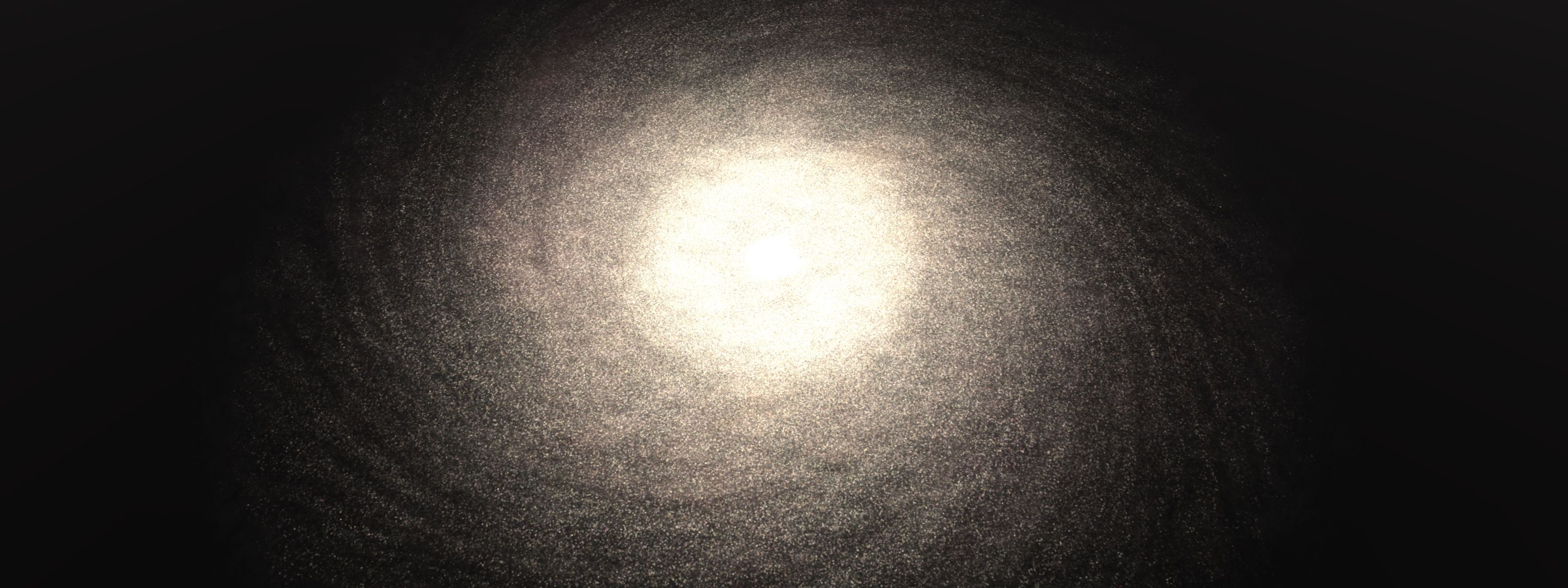
It is a quote that leads us, figuratively and literally, to a god’s-eye view of a spinning galaxy, a further marvellous metaphor and visual prompt for all that we might ascribe to Sheldon’s installation. It is also the perfect means to embody our unity with the universe, because to proceed, we must step through it.

The Tyger, Sheldon Bergman, April 2025

To do so is to enter the core of The Tyger, a space filled with the most incredible symbolism, questioning and statements for those willing to listen. From a vocal rendition of Blake’s poem, through the use of the Lacrimosa from Zbignew Preisner’s Requiem for My Friend (1998) to the lifting of the veil of blackness and revelation of Sheldon’s floating Tyger and its potential for layered interpretation, it is utterly breath-taking.

To itemise in words the richness and depth of all that’s offered here – from the poem, through the particular selection of Preisner’s Lacrimosa (hint: the piece has perhaps most memorably used to overlay the birth of the universe at the start if The Tree of Life, and we are perhaps particularly focused on the cosmos within this space) as well as its role within Zbignew’s Requiem (and indeed, the Catholic Requiem mass as a whole) to the presence of the floating Tyger and all that surrounds it – would be to defeat the purpose of the installation’s purpose.

Instead, I urge you to go and witness it; immerse yourself in The Tyger, its imagery, the richness of the poem itself and of Sheldon’s installation, and allow it to speak to you directly. It is magnificent.

The Tyger, Sheldon Bergman, April 2025

SLurl Details

Alone: an immersive literary experience in Second Life

Alone, May 2024 – click any image for full size

It has been a fair time since Sheldon Bergman (SheldonBR) has presented an immersive experience within Second Life; so when he contacted me personally to tell me he has a new installation available for people to visit, I was immediately intrigued, and as soon as time allowed, I followed his invitation and hopped over to Alone.

Often working in collaboration with Angelika Corral – with whom he once co-ran the always engaging DaphneArts gallery and arts centre – Sheldon earned a rightful reputation for developing immersive art installations leveraging the (then new) capabilities of SL Experiences. In particular, these installations sought to bring the work of poets and artists from the physical world to life within the virtual, with a noted focus on the life and works of Edgar Allan Poe (as covered in these pages, for example, by A dream within a dream: celebrating Poe in Second Life (2017) and Annabel Lee in Second Life (2019)).

Alone, May 2024

With Alone, Sheldon continues within this theme, presenting installation with a personal dedication to Angelika, featuring what is Poe’s most revealing – and potentially his best – verse. It may not be as well known as the likes of The Raven or Annabel Lee – in fact it wasn’t even published until well after his death in 1849, finally appearing in print in 1875, having been held within the possessions of a family in Baltimore – but what it does say does much to help our understanding of Poe’s nature and what lay behind his writing.

Exactly when the poem was written is unclear; the original manuscript was both untitled and undated. However, the year is widely taken as being 1829 – no doubt the result of the poem’s first publication being accompanied by a facsimile of the original manuscript and on which the editor of the magazine had taken upon himself to add the date “March 17, 1829”. As this does sit as the middle year of the three in which Poe’s poetry was at its most focused terms of annual output (the other two being 1827 and 1831), it’s potentially not unreasonable to pin it to that year.

Alone, May 2024

But whether it was 1829 or 1827 or 1831, the poem would have been written when Poe was in his early 20s; as such it shows a remarkable sense of self-awareness and personal perception. At its heart, Alone focus on themes of loneliness, isolation and – most particularly – of being different and apart from others. It marks how Poe had always known he had a substantially different outlook to those around him, one that has existed from a childhood in which he saw himself unable to see things as other children saw them, perhaps because of the tempestuous nature of his first two years on Earth, marked as they were by abandonment by his father, the death of his mother and his being taken into a strict foster care – as the poem directly references:

And all I lov’d—I lov’d alone—
Then—in my childhood—in the dawn
Of a most stormy life—was drawn

Alone, May 2024

This autobiographical element flows throughout the poem, right up to its open-ended final line in which the dash seems to state, that just as he past and present life had been, so to will be the future; whatever might pass as normalcy for those around him will forever be a foreign land to him, whilst his world will forever be beyond their understanding.

In this, Alone perhaps does more to shine a light on Poe’s short and tortured life than any amount of analysis of his work or examination of his death , both of which are too often the focus of any such analysis. Hence why, perhaps, Sheldon’s installation includes references to some of Poe’s famous works, both visually and through quotes: The Fall of the House of Usher (1839); The Black Cat (1843); The Raven (1845); A Dream Within A Dream and Annabel Lee (both 1849); doing so underlines the foundational element of understanding Poe’s view of himself any thus all of his writing.

Alone, May 2024

To appreciate Alone in its fullness, visitors should accept the local Experience after arriving at the landing point by clicking on the displayed poster. This will allow a HUD to be temporarily attached to the viewer – it will detach on leaving the region, but must be left in place through a visit – which will initially offer instructions on how to correctly view the installation. In short these are: use the local Shared Environment; make sure local sounds are enabled and you have Advanced Lighting Model (ALM) enabled via Preferences → Graphics. Once these points have been followed, clicking on the HUD text will deliver visitors to the installation proper.

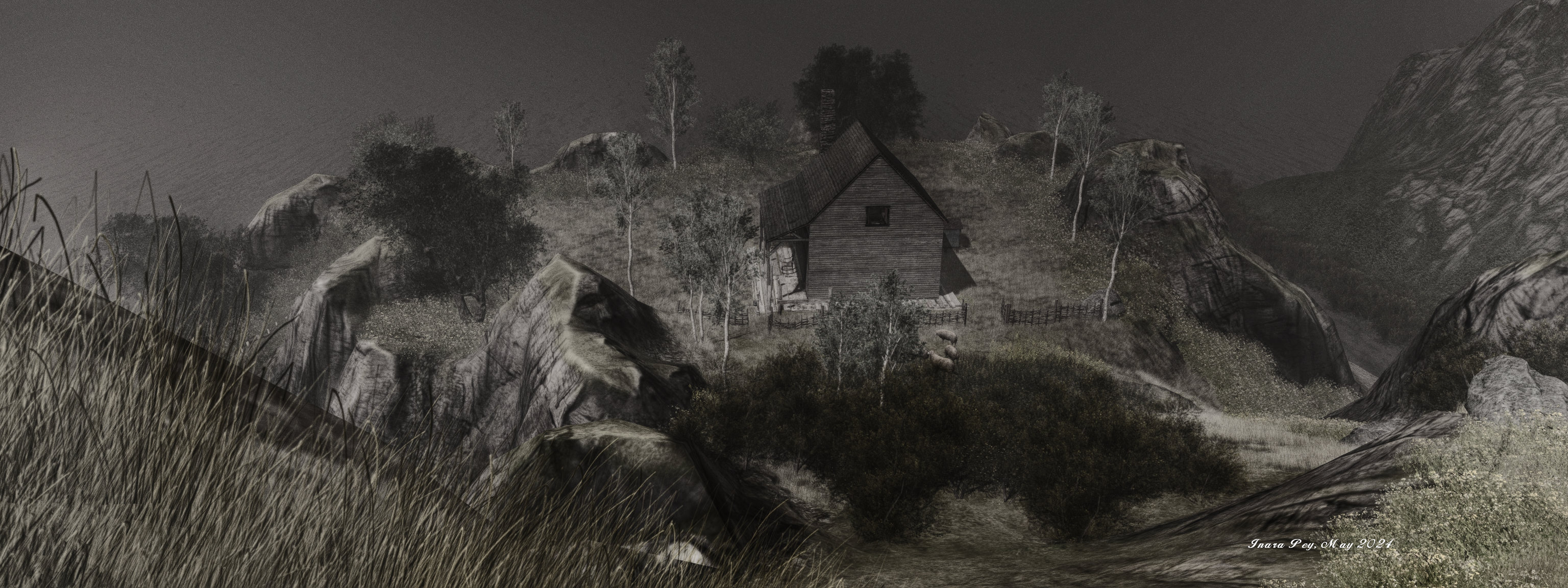
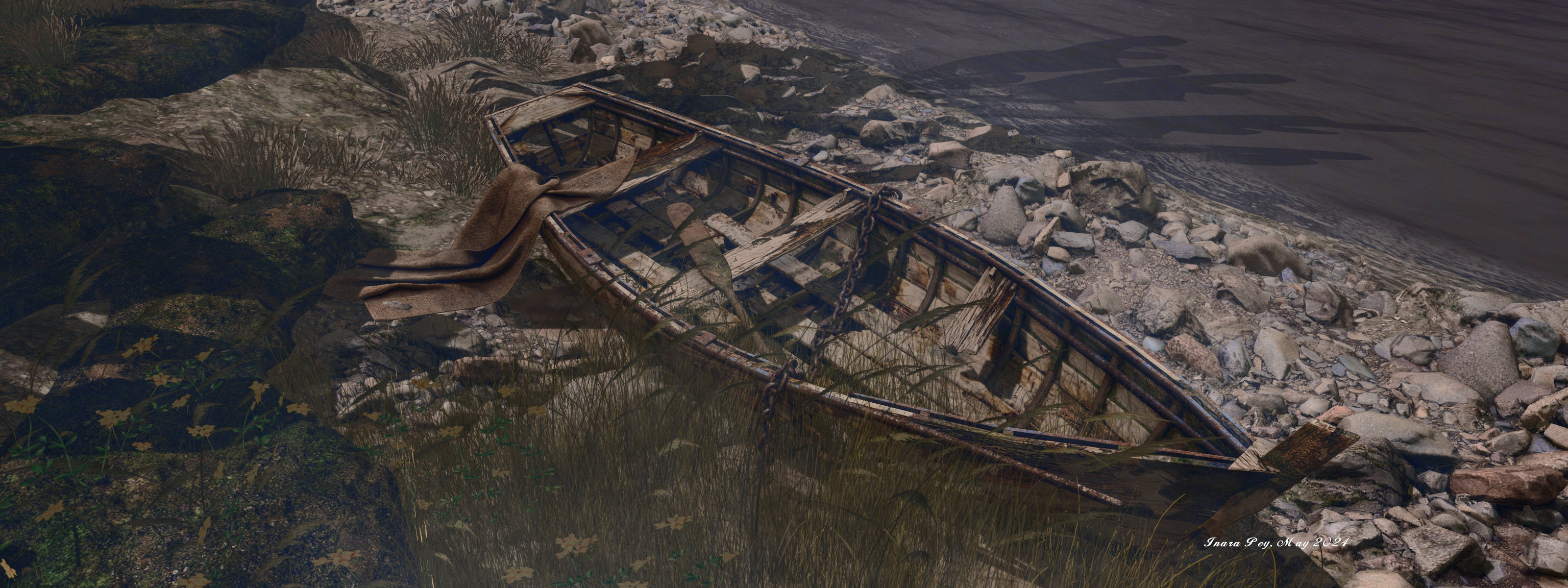
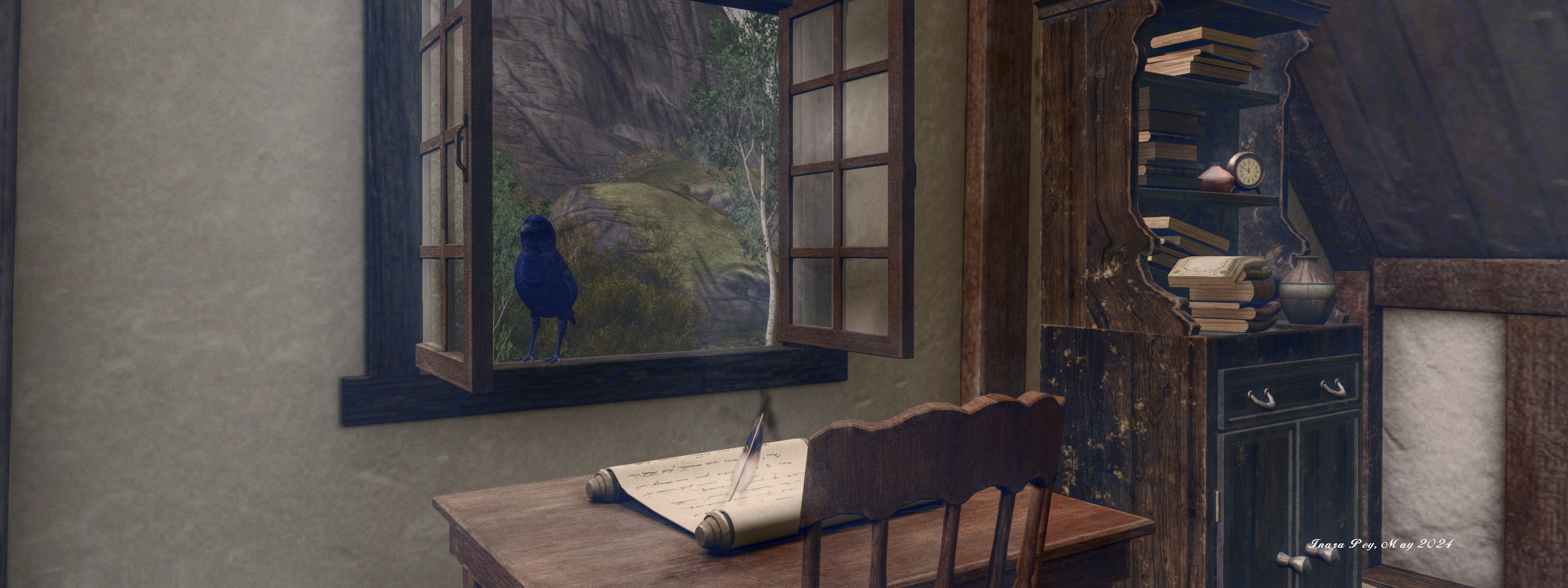
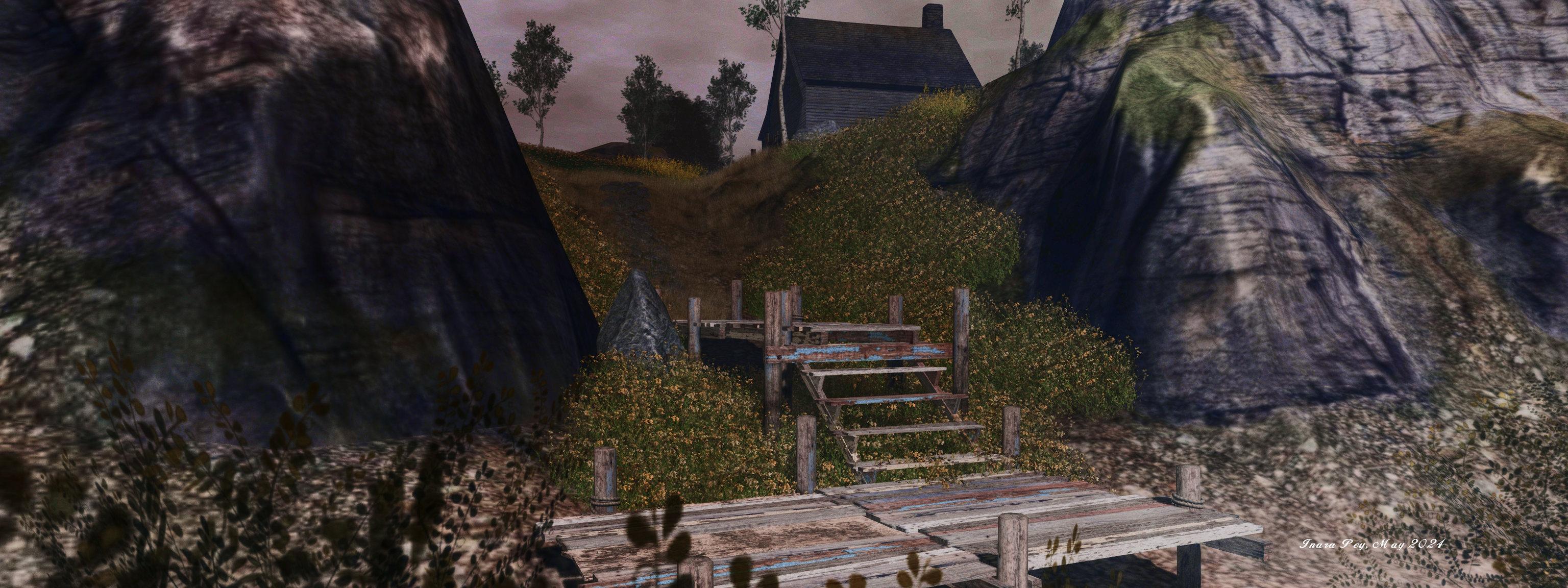
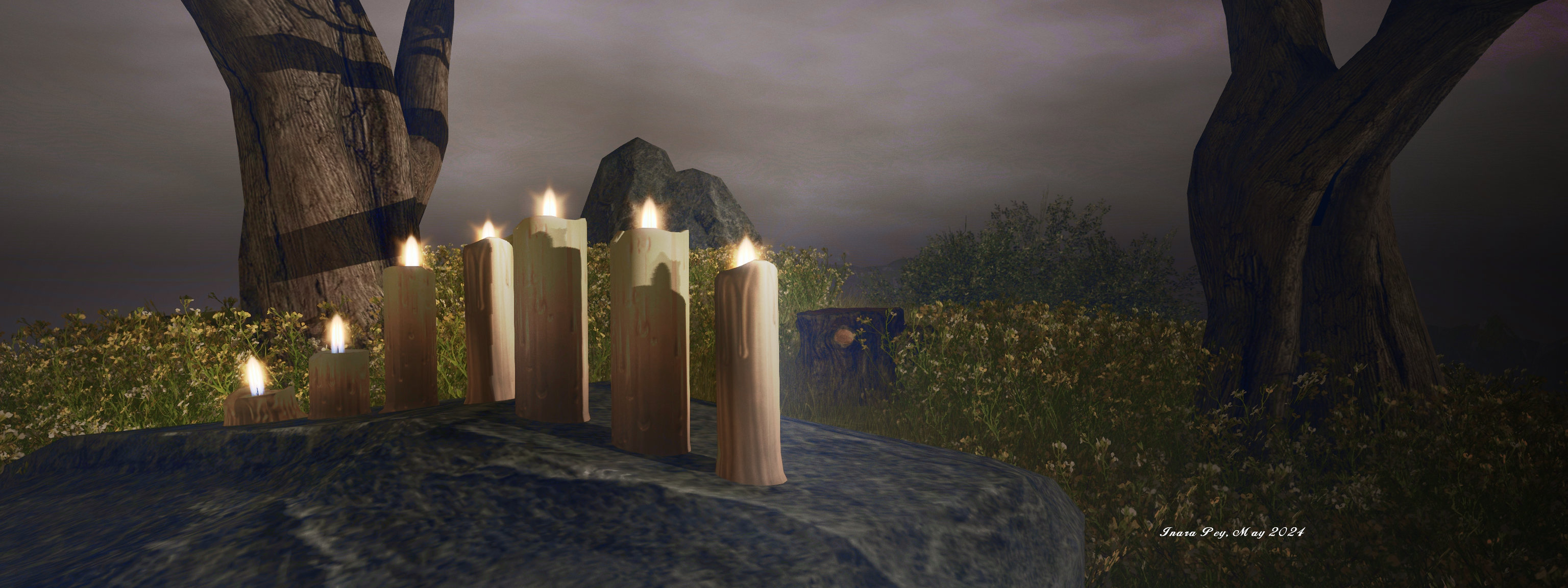
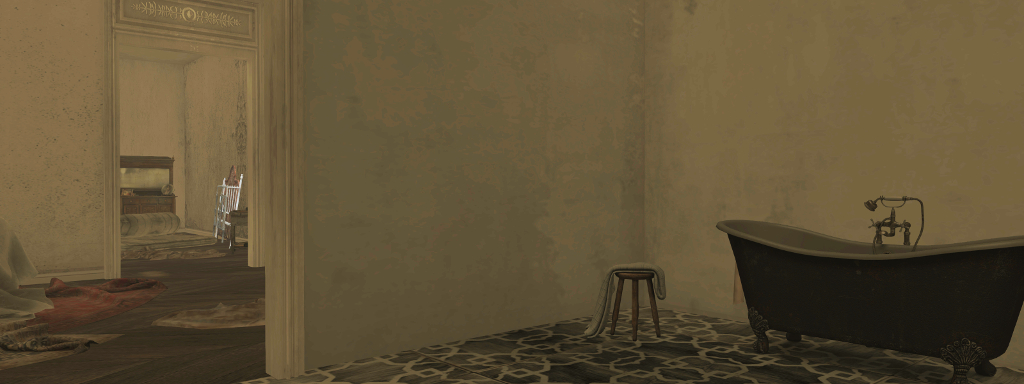
From here, it is a case of walking through the landscape from the landing point, up to the cabin sitting on the shoulder of a hill and then through it (upstairs and down), before exiting through the back door and following the path down to the waters and pier at the back of the cabin. In doing so, visitors will trigger visual elements at various points (such as the candles lighting to guide you up the hill) and text elements within the HUD, whilst also encountering reflections of the poems and stories the text references. Some of the latter might be obvious (such as the rave at the open bedroom window) others perhaps less so (e.g. the image on the wall of the cabin; the cabin and the wilderness in which it stands, etc.).

Alone, May 2024

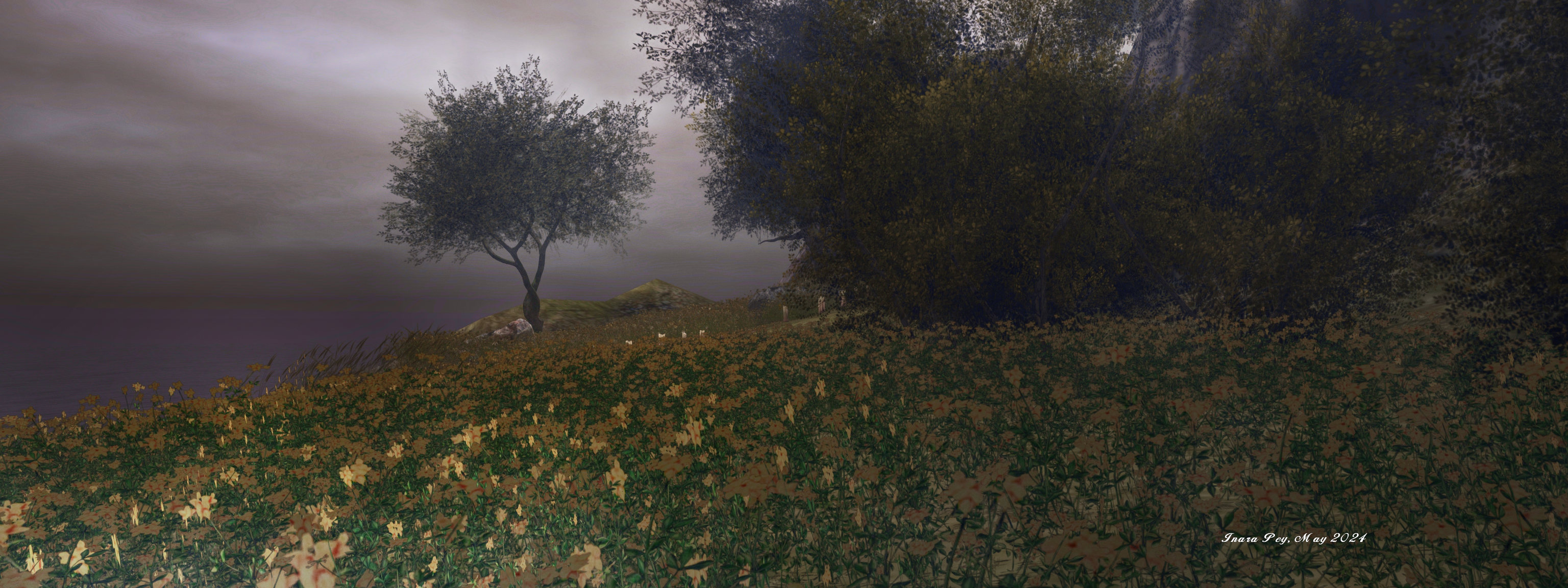
The final element of the installation requires climbing the ridge rising from the east side of the cabin (where the sheep are grazing) to run first south and away from the cabin and then back to the west as it rises to reach the top of a hill overlooking the landing point far below. Crowned by a trio of windswept trees standing as bent-backed guardians, the hilltop is home to a low, alter-like stone within candles and a tree stump seat. It’s a place I have little doubt the poet would have approved for the recital of his poem (triggered as visitors reach the trees), its isolation and position apart from the rest well suited to the poem’s themes. Further, in coming at the end of the experience, it offers another underlining of the poem as a means to better understand Poe and his work.

Alone might not be the easiest of installation to grasp, but for those with a love of poetry and the work of Edgar Allan Poe – and who indeed who might feel separated and apart from the rest of life for whatever reason – it is an engaging and potentially evocative one.

SLurl Details

  • Alone (Canary Islands, rated Moderate)

Annabel Lee in Second Life

DaphneArts: Annabel Lee

Angelika Corral and SheldonBR, curators of DaphneArts, have something of an affinity with the work of Edgar Allen Poe. In 2017 they hosted an exhibition of art marking 208th anniversary of his birth, and they have also produced works of their own focused on Poe, notably Dream Within A Dream, based on Poe’s poem A Dream Within A Dream, and a static installation modelled on Fall of the House of Usher.

Dream Within A Dream formed the leaping-off point for a series of immersive installations they have produced (and which has most recently encompassed the works of John Donne – see No man is an island). Now, and with an official public opening on September 2nd, 2019, they have returned once more to Poe, with a new immersive installation Annabel Lee, based on Poe’s poem of the same name.

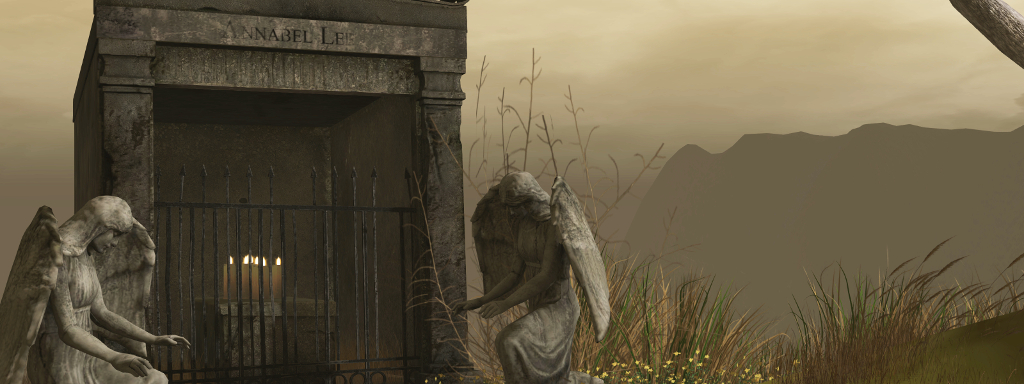
Annabel Lee was the last poem Poe composed; it explores the themes of death, love and the hereafter – all common these for Poe – wrapped within a “ballad” about the death of a beautiful woman. Within it, the narrator recounts his love for the woman – Annabel Lee – which began many years ago in a “kingdom by the sea”. He believes their love was so intense, the angels themselves became envious to the extent they caused her death. Nevertheless, he believes that the love they shared was so deep, neither angels nor the grave can constrain it, and that their souls remain entwined. And so it is, each night he dreams of her, as he lies beside her tomb.

DaphneArts: Annabel Lee

Like so many of Poe’s poems, Annabel Lee is complex as much as it is dark. There is something of an autobiographical element to it, another facet oft present in Poe’s work. He himself fell in love with his cousin, Virginia Clemm, and in the words of the poem – “she was a child” – being just thirteen when Poe married her, and she died just two years prior to the poem being written. Thus there is an element that in writing about the loss of “Annabel Lee”, Poe is perhaps drawing on personal experience.

In keeping with these immersive environments designed by Sheldon and Angelika, a visit commences in a sky box, where visitors are given an interactive HUD as a temporary attachment, and which should be accepted (it will be automatically be attached, and should detach on leaving – if not, just click the Stop button, when displayed). The skybox also includes instructions on setting your viewer’s environment (if you are using Firestorm, then the local windlight should apply via that viewer’s parcel windlight support). Once the viewer is set in accordance with the recommendations, visitors are free to take the teleport board to the ground level and the installation itself.

DaphneArts: Annabel Lee

The ground level presents the poem through what Sheldon and Angelika call “Magical Realism” – the use of sounds, visuals and the spoken word (in this case, Angelika reading the poem) – to evoke a sense that the visitor is immersed within its unfolding story. It’s a technique that might also be described as “immersive literary allegory”: a visual setting that both directly frames the telling of the poem’s story (the “kingdom by the sea”) and the passing of Annabel Lee (shown through the presence of her tomb), whilst also offering cues to the deep story of love and loss.

This latter aspect is shown through the use of elements such as the candles (a clear symbol associated with death) and the path they mark (representing the path we follow through life to its eventual end, which is in turn symbolised by the tomb), and by the house. The latter (perhaps best explored after hearing the poem throughout), shows signs of past habitation with rooms and furniture slowly mouldering. However, these are themselves more broadly representative of the memories of love and life shared but which have come to an end; the memories we fight to hold on to after the passing of a loved one, but which inevitably age and fade with the passing of time.

DaphneArts: Annabel Lee

So it is that this is a deeply atmospheric and evocative setting; one that should be experienced rather than described. It sets Annabel Lee, the poem, almost as fairytale without in any way destroying or distorting the emotional span of the original.

SLurl Detail

No Man Is An Island in Second Life

DaphneArts: No Man Is An Island

No man is an island is the opening line from a poem by English poet and cleric John Donne which perhaps is more often referenced via quotations of its final lines,  And therefore never send to know for whom the bell tolls; It tolls for thee.

However, this poem actually originated as a passage  of greater length and written in prose as Meditation 17, from Donne’s Devotions Upon Emergent Occasions. Originally written in late 1623 (and published the following year), Devotions was written whilst Donne was recovering from a but unknown illness (possibly relapsing fever or typhus), and forms a reflection of death, rebirth and the Elizabethan concept of sickness as a visit from God, reflecting sinfulness, with each of the 23 devotions within it a meditation on a single day of Donne’s illness.

DaphneArts: No Man Is An Island

I mention this because No Man Is An Island is also the title of the latest immersive installation by Angelika Corral and Sheldon Bergman, artist curators of DaphneArts, with the installation itself marking the reopening of the gallery at a new location in Second Life.

Taking its lead from Devotions, the installation offers the opportunity to reflect on Donne’s words as they came to be written in the poem, using a visual setting, music and the spoken word. Full instructions are provided at the landing point – and if you are using the Firestorm viewer, then you should automatically receive the required windlight environment setting. You should also accept the HUD that is offered on arrival. This will attach itself to your world view to present you with a “letterboxed” style view of your surrounding. If, by chance, you’re not using Firestorm and / or the HUD doesn’t attach (or you accidentally reject its request to attach), instructions and an option to obtain the HUD can be found on the wall of the arrival area.

DaphneArts: No Man Is An Island

The main setting for the installation and the poem’s recital is very atmospheric – and made more so by the music (played as local sounds, not via any audio stream). Across a windswept stretch of sand stands the silhouette of a lighthouse drawn against the heavy sky, a hut below it lit from within.  A candle-lit bridge, with more candles scattered over sand and rocks despite the rain, beckon you forward to hut and lighthouse.

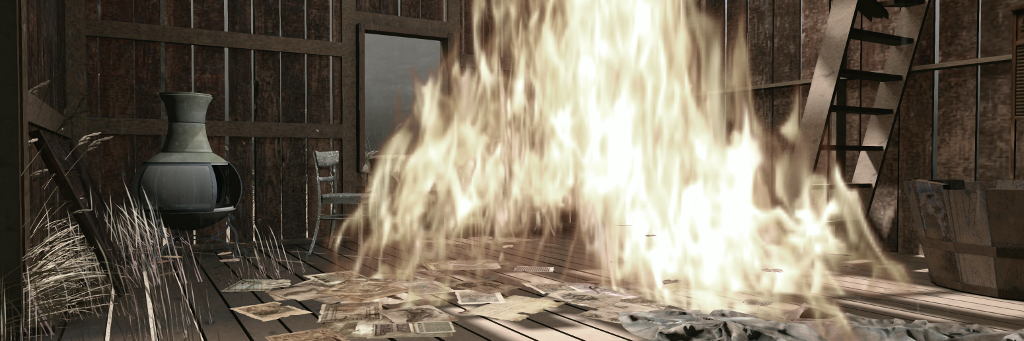
As you approach the hut, the light from within is revealed as a fire, burning brightly in the single room and consuming pages of manuscripts together with a shroud-like blanket. More candles  light the way up the lighthouse and its single door. Inside lies the opportunity to listen to a recital of the poem, and contemplate the sculptures that sit within the lighthouse walls.

DaphneArts: No Man Is An Island

Perhaps disarmingly simple in appearance, No Man Is An Island is actually nuanced and layered in presentation. Within Meditation 17, Donne is considering the nature of death (his own), and its impact (on him, if it is fact claiming another and not him), noting:

No man is an Iland, intire of it selfe; every man is a peece of the Continent, a part of the maine; if a Clod bee washed away by the Sea, Europe is the lesse …. any mans death diminishes me, because I am involved in Mankinde;  

Thus, within the hut with have the fire and the burning of manuscripts, many of the pages painstakingly written and illustrated by hand. They represent the idea that a loss does not just impact the one or the few, but lessens the whole; in their burning, the pages are not just lost to whomever set them ablaze, but are lost also to all who might otherwise have read them. Similarly, the blanket with its edge caught within the flames might be taken as a death shroud, symbolising, Donne’s view that any mans death diminishes me, because I am involved in Mankinde

DaphneArts: No Man Is An Island

In addition, the presence of the lighthouse offers reference to life and death, presenting a balance of views that reflects Donne’s thoughts. On the one hand, it was once perhaps the loneliest job on Earth, undertaken in isolation, would his passing of a lighthouse keeper really be missed by the world? But on the other, the role by its very nature was to protect the lives of those at sea, steering them away from the risk of death through the loss of the vessel beneath them – so yes, the loss of a lighthouse man could be sorely missed by the rest of us.

Other references are more obvious – the island-like setting, the rain (the curtained veil of death) – even our place in the cosmos (or what Donne might have regarded as God) is brought into focus, both visually and through the eternal questions repeatedly asked at the landing point.

SLurl Detail

A sense of Confinement in Second Life

DaphneArts: Confinement

Confinement is a complex installation located at DaphneArts, featuring a concept and art by Mi (Kissmi), with the physical space and overall presentation of the elements making up the installation by DaphneArts curators Angelika Corral and Sheldon Bergman (SheldonBR).

Mi says of the piece:

Confinement is our lot – from the beginning, in the womb, and even before, as soon as the idea of our conception germinates in the minds of our parents, enclosing us.

In other words, how we might grow as individuals is subject to a series of constraints which encompass us from the moment of conception through until death. Mi sees these constraints as falling into four main categories: geographical, mental, physical and social, and the visitor is invited to consider each of these both visually and aurally.

DaphneArts: Confinement

To fully achieve this, it is necessary to ensure your are correctly set-up to experience Confinement. This means ensuring you have Advanced Lighting Model enabled within your viewer (Preferences > Graphics > check the Advanced Lighting Model check box), you accept the local Windlight setting on arrival (automatic if you are using Firestorm; if you are using any other viewer, the preferred Windlight is Phototools – No Light by William Weaver. Should you not have this available with your viewer, try opting for Midnight or a similarly dark setting). Most importantly, you must accept the local HUD when offered and allow this to attach – without it, you will miss the greater part of the installation. Once attached, the HUD will display introductory text, which can be clicked away once read and the instructions followed. You are then ready to proceed.

This involves walking along a walkway constructed of massive cubes, while walls of these great cubes dominate the view left and right, separated from the walkway by deep chasms.  As one progresses, each of the four categories of confinement are revealed in turn, starting with Geographical. Images by Mi are illuminated, and the HUD presents visitors with the opportunity to hear a reading in French by Mi intended to encompass the symbolism of the confinement – and to read the words, presented in both French and English (note that due to the limitations of SL, the words may lag behind the reading; this is unavoidable).

DaphneArts: Confinement

For Geographical, the reading is taken from the lyrics to né quelque part (“born somewhere”), first recorded by Maxime Le Forestier in 1987; for Mental Confinement, we are presented with Un grand sommeil noir (A big black sheep), by the 19th Century poet Paul-Marie Verlaine; for Physical Confinement and Social Confinement, Mi presents two poems by Jacques Prévert: First Day and Familiale, respectively.

Each of these reading is accompanied by a series of images by Mi, also designed to be representative of the confinement they represent. Like the readings (including né quelque part, when the lyrics are separated from the music), these are stark pieces; abstract in nature, are designed not so much to illustrate, but to encourage, along with the spoken words, our deeper contemplation on the nature of each type of confinement we live within: those born – no pun intended – by the place and time of our birth; the confinement we face in terms of mental development – both our own capability and the opportunities society gives to us;  and the constraints we have to face within both life itself and in society’s expectations of the roles we will ultimately play.

DaphneArts: Confinement

Beyond the fourth confinement, the way leads down to a lower level, stairs lit by the naked flames of candles cupped in stone hands as the darkness closes around. In descending these steps, it is easy to feel as if one is descending into a sepulchre; or that the descent marks the passing from life to death. In echo of this, the hands towards the bottom of the stairs become more grasping in nature, as if trying to reach out from the walls and grasp the life from those passing.

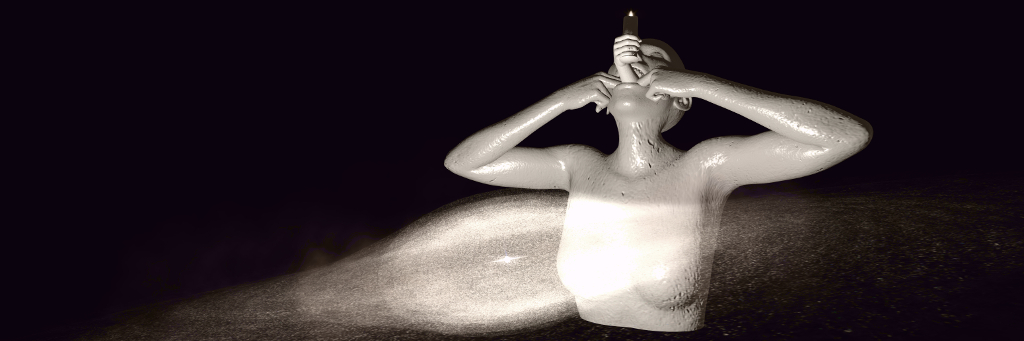
Finally, the path leads by candlelight to a last figure:  a woman caught between death (the hand at her throat) and life (the candle emerging from her midriff). And thus the circle is closed; our ultimate confinement lies within the unknown: we emerge from it in birth, and descend back into it in death.

One since June 2018, Confinement is a layered installation deserving of time and consideration when visiting.

SLurl Detail