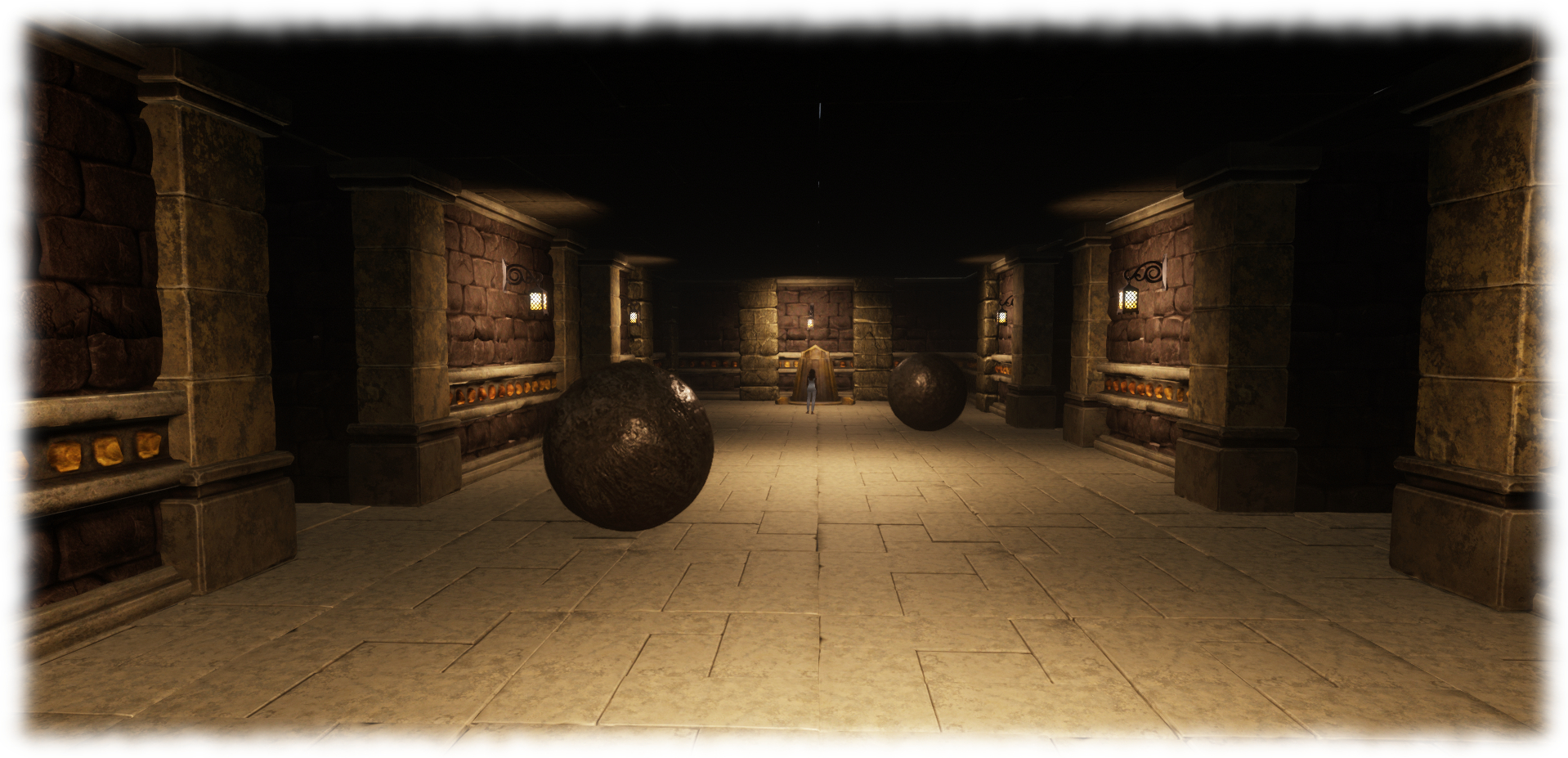
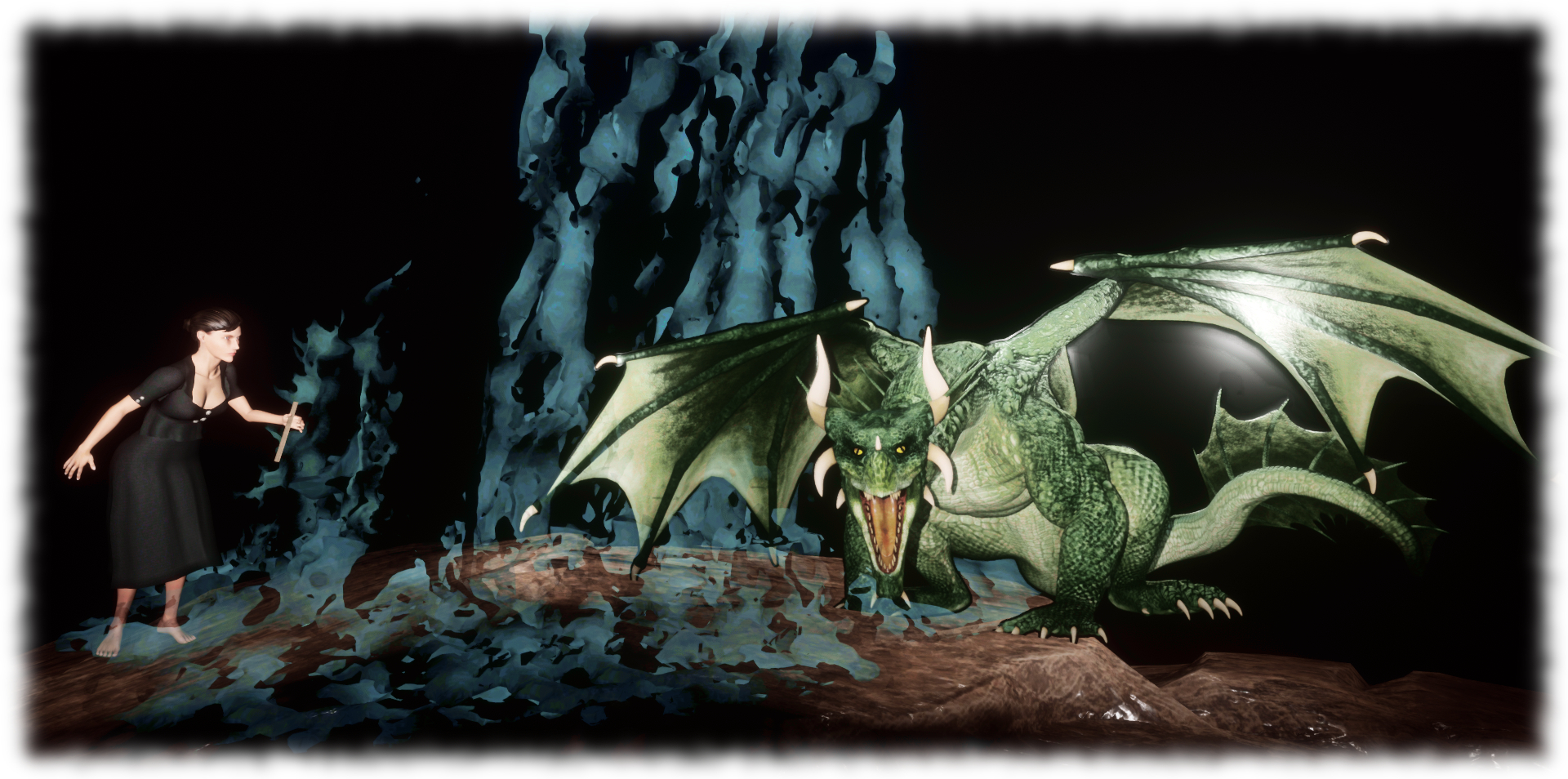
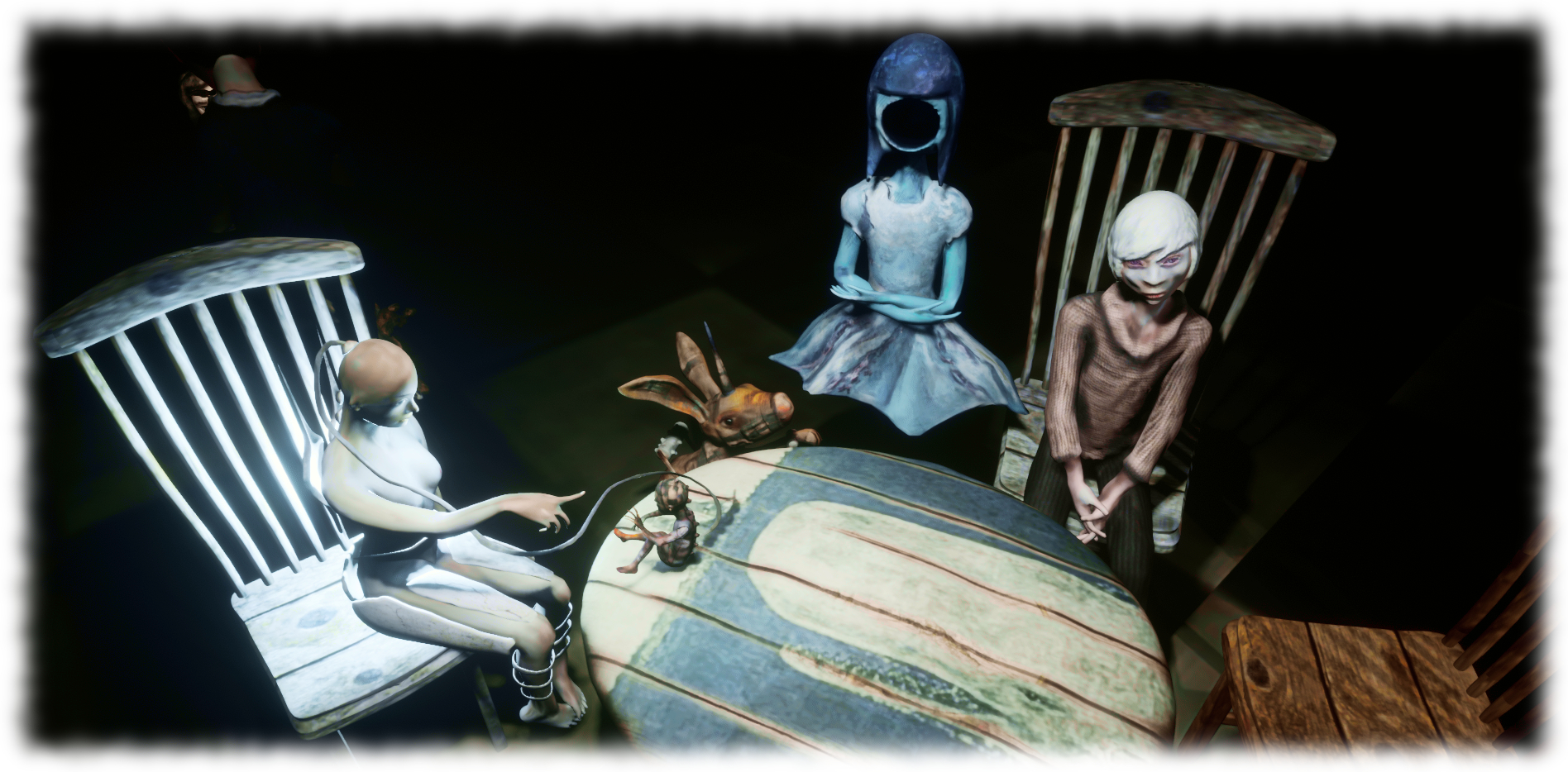
Sansar gets spooky in Spinnervale

Sansar: Spinnervale

What happens when you’re invited to dinner with friends, only to arrive at their little place in the country as the Sun is setting and the Moon rising and find music playing, the front door open, but no-one home? All you have is a hurriedly written plea for help:

Please help!!

Bob went to the wood this morning saying he’d be back in a few minutes, but he never returned. I’m worried!!

I’ve gone to look for him. Please come help me. Follow the river until you see the rock bridge and cross the river into the woods. I’m going to look at the cave and also lover’s leap. I don’t think he would have gone to Bat Hollow.

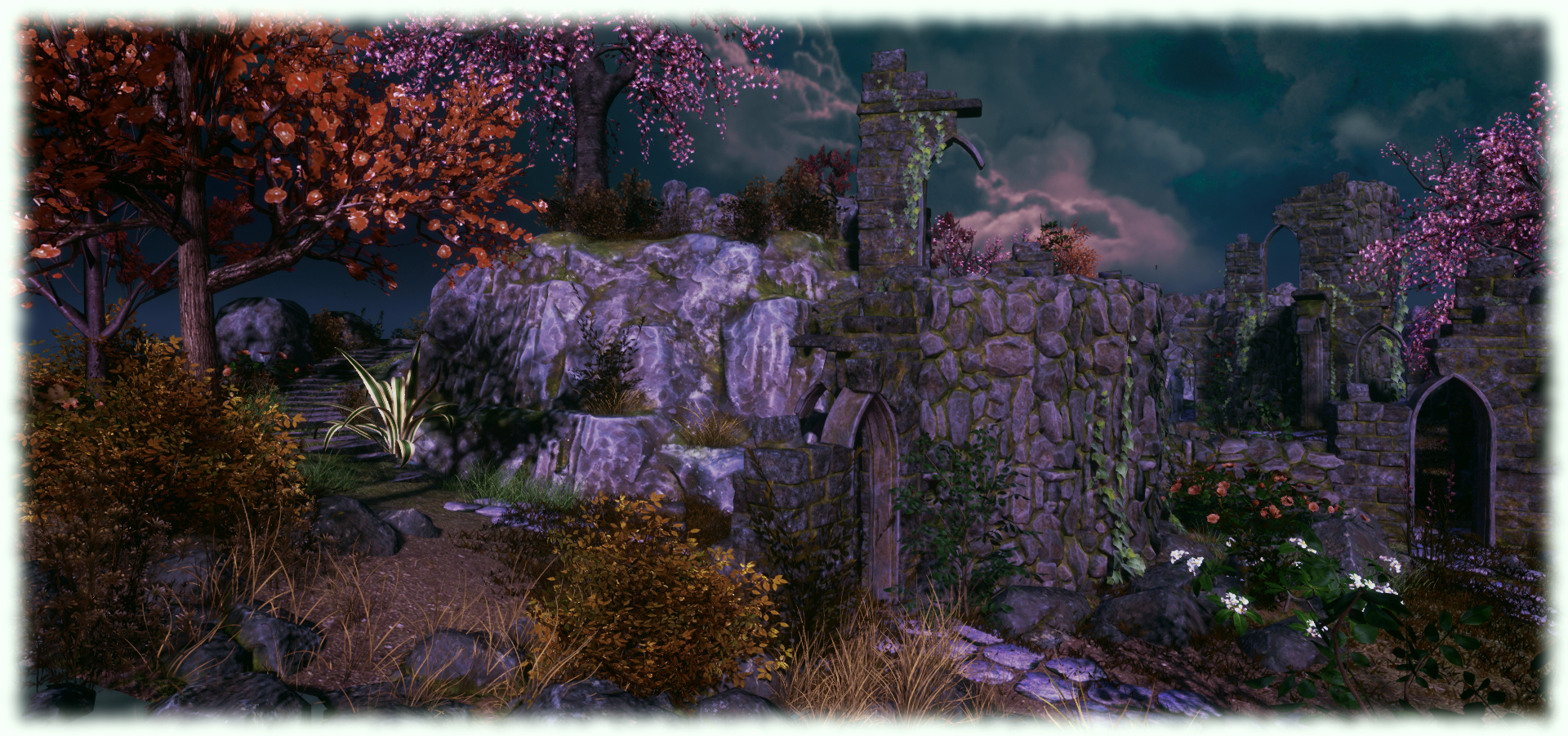
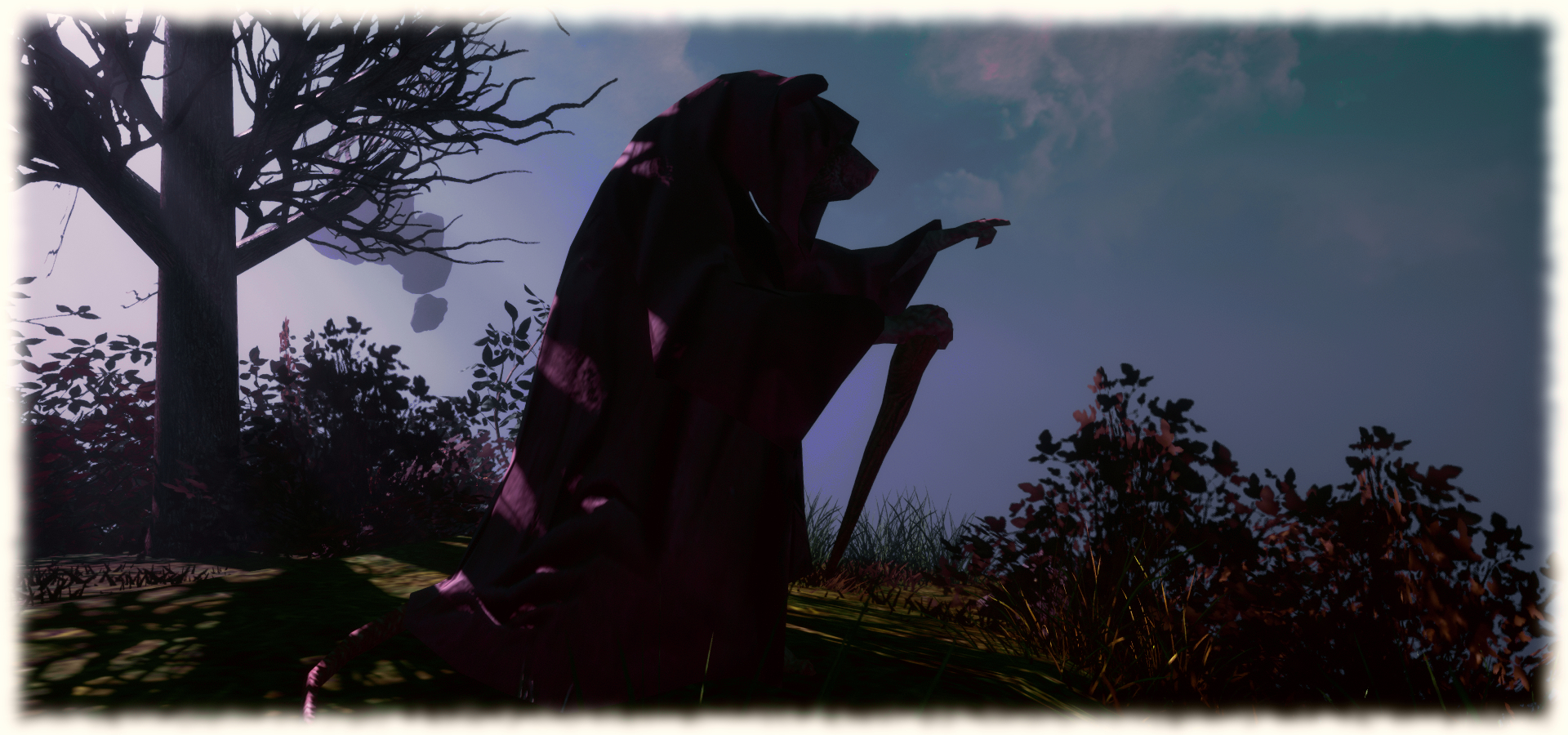
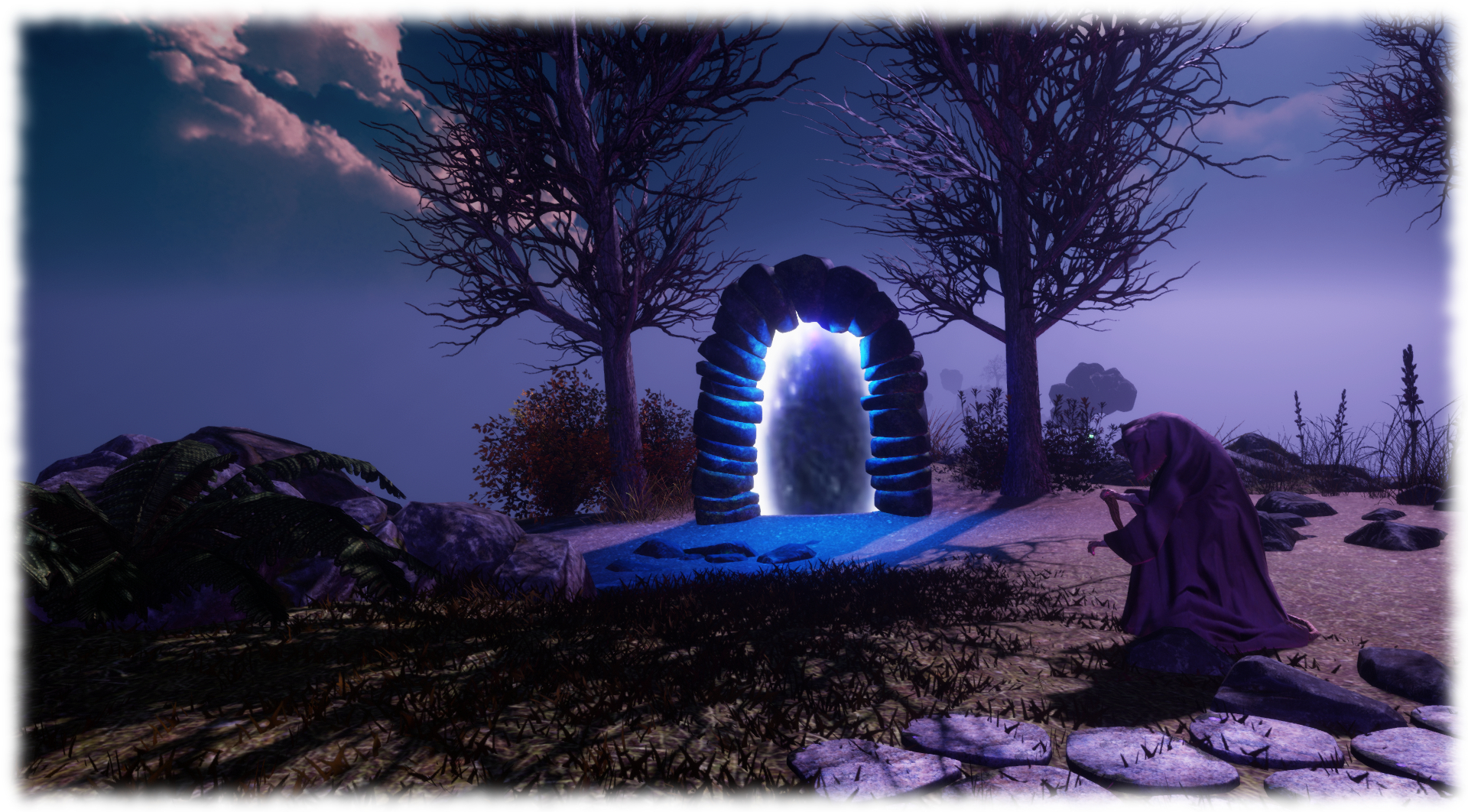
You’d hopefully set out to to provide the requested assistance. And thus you’d be drawn into the realm of Spinnervale, the seasonal experience designed by Debi Baskerville.
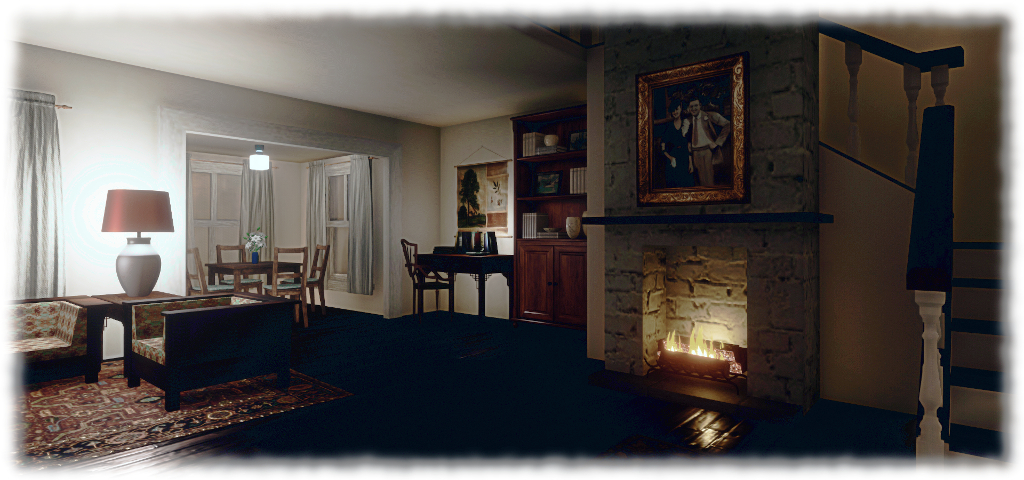
Sansar: Spinnervale – where are your hosts?

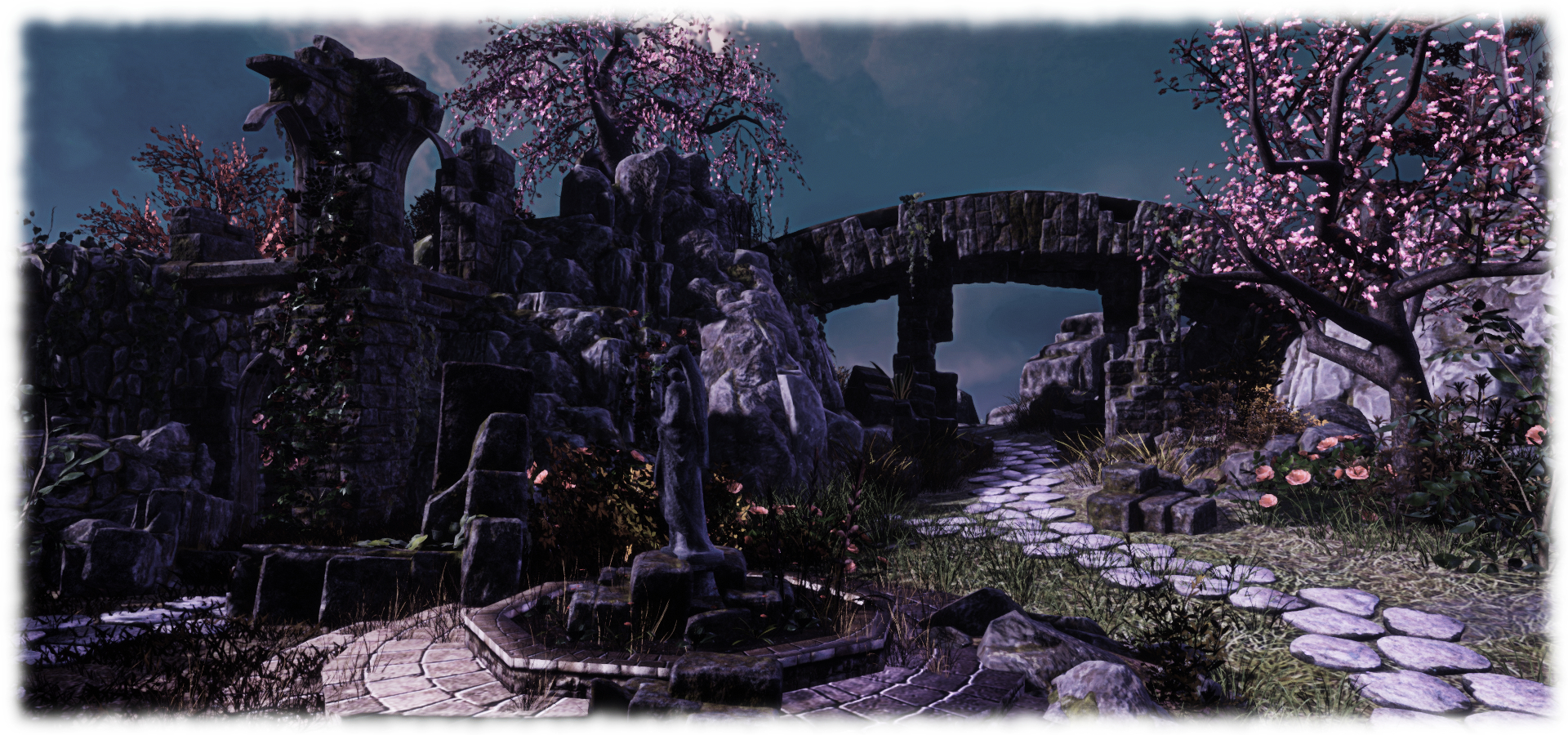
The river you’re asked to follow is located behind the house, a short walk away. “Rock bridge” is perhaps a little bit of a misnomer, as what you’ll actually be looking for is a set of stepping stones fording the water a little way upstream from the house.

On the far bank, the path turns sharply right, running under the shadow of a low cliff and up a shallow rise to where a sign points the way to either Lover’s Leap or to the Great Cavern. The way to Lover’s Leap is marked by steps cut into the rock, offering an easy route up to the plateau above. Before you take either route, however, walk down the far side of the slope and take a torch from the waiting basket (“get light” in chat). The best thing to do from here on is to swap to first-person view, as the light cast by the torch will accurately follow your camera and moves (what appears to be a function error within Sansar prevents it from doing so when in third-person view).
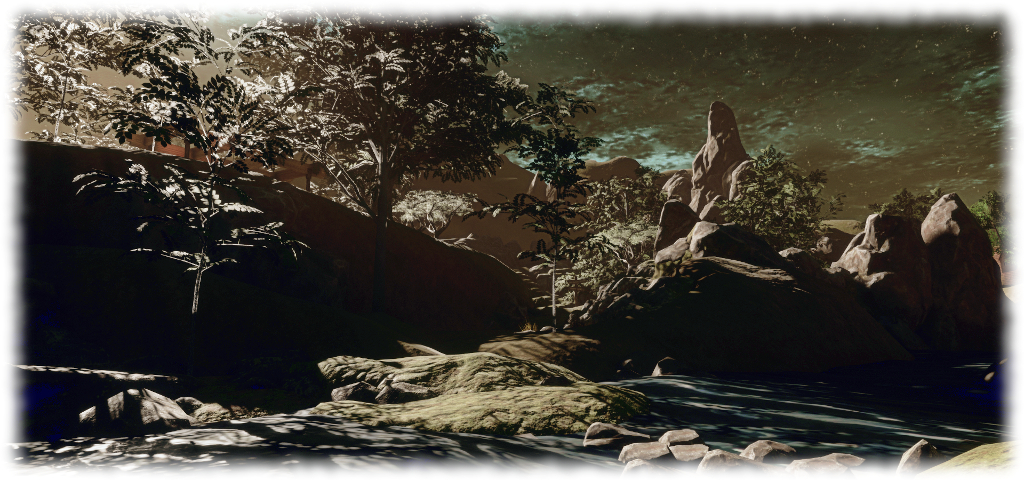
Sansar: Spinnervale – the river crossing

Here the route passes a pergola with benches beneath, strung by the nets and folds of spiders’ webs – a portent, perhaps? Facing the gazebo is a rocky formation weathered to form a set of natural step climbing upwards, inviting you to follow. They lead the way up to a wooden bridge crossing a narrow gorge – the infamous lover’s leap. Beyond this, the route winds up into the trees and shadows, where webs once again become prominent – and larger shadows move within the darkness!

The path to the Great Cavern offer move of a clue that you might find those you’re seeking – the steady beat of slightly ominous music. As you approach the entrance to the cavern, another noise will grow: a strange sucking, hissing sound, coinciding with the appearance of more webs. And inside the cavern you …

Sansar: Spinnervale – Bat Hollow

Well, you’ll have to pay a visit yourself and find out. However, particularly sensitive arachnophobes may want to think twice, both in the cavern and in the hills above Lover’s Leap!

Spinnervale is an entertaining experience given the time of year, and Debi has come up with a handy way of allowing for object interaction (remembering Spinnervale was opened before the Discovery Release made more direct object interaction possible in Desktop mode). It’s a nicely atmospheric build and makes for a fun explore.

Experience URL

Catching a little Zen in Sansar

Sansar: Zen Garden

The Zen Garden in Sansar is one of the experience produced by the Lab’s Sansar Studios team, and has been one of the more frequented locations, visitor-wise. One of the reasons for this has possibly been because the Zen Garden has opportunities for interaction with things within the scene – particularly for those using VR headsets and controllers.

A visit begins on the upper level of a large artificial structure floating in the sky. The top of this  – split into two levels – comprises a rectangular (non-accessible) building, a swimming pool, a games area and, on the lower level, an observation ring surrounding the sunken zen garden of the scene’s title. Steps connect the two main outdoor levels and provide access up to the building, where a set  of stairs zig-zag their way up the side, almost like a fire escape, providing access to and from the roof.

Sansar: Zen Garden

The games on the greensward in front of the building are playable by those with VR headsets, although those in Desktop mode might try their feet at kicking around one of the large beach balls. However, it may not be these or the immediate surroundings which hold the new arrival’s attention; this structure is far from alone in the sky. It is orbited by a number of rocky islands, some near, some seemingly far. These are home to a variety of building, from blocky buildings similar to the towers and buildings resembling mosques or orthodox churches, topped by minarets and spires. Others are simply the home of trees and little else. Around and between all of them, smaller rocks tumble or rotate along their own orbits.

The sky is also occupied by two vehicles – sky taxis, if you will. One buzzes like an industrious bee from rocky island to rocky island, apparently carrying passengers back and forth. Alas, it doesn’t come to the central structure, so there is no real opportunity to go island hopping. The second vehicle follows a more leisurely path, gently flying around the main structure, carefully descending to hover near the swimming pool once per circuit, giving people an opportunity to climb aboard and take a ride. This is surprisingly smooth – if a little disconcerting as the vehicle turns beneath you and you remain solid as a rock, staring in the same direction unless you opt to move. It’s also a little one-dimensional: a single circuit on the taxi is enough to suffice.

Sansar: Zen Garden

The Zen Garden is designed to be reached in two ways: via one of the two staircases which curve down through the rock into which the garden has been built, or via an open-topped elevator located to one side of the structure surrounding the garden. Those adept at teleporting could attempt a “jump” down to the floor area of the “foyer” cavern just to the front of the garden, if they are so minded – but a walk down the stairs is just as easy.

The garden, sitting in a circular well open to the sky, is a simple, elegant affair. Surrounded by a curtain of bamboo, it is open to the sky above while descending in three tiers from the cavern it faces. The lowest of these is water-filled, the two above it covered in raked sand. Floating above the innermost tier is a series of disks, with lotus leaves floating around them, which seem to form a path leading up to a mysterious red door sitting slightly ajar upon a rock.

Sansar: Zen Garden

The door beckons invitingly. Is it a portal to another place? I’m sure many have attempted to climb or teleport up the floating disks to reach it (or simply teleported directly up onto its rock). But sadly, the promise is an empty one. No gateway to another scene awaits; perhaps in the future, this may change.

Another promise which will hopefully be fulfilled within this scene (as well as elsewhere in Sansar) is the ability to sit down. Zen Garden offers a lot of seating – out in the sun, in rocky corners or in the shade of the building or at the bar – but sadly, the ability to sit isn’t something that has as yet been granted to avatars – although it will be coming.

Bumping into Papp, Tina and Gin (that’s me in the white) at Sansar’s Zen Garden

Zen Garden is perhaps one of the easier places to start with when first joining Sansar. There is enough to see and (potentially) do to keep the novice moderately occupied and  gain familiarity with their preferred mode of using Sansar, by it VR or Desktop.

Experience URL

Seven Wonders in Sansar

Sansar: Seven Wonders

I’ve often commented on Sansar’s potential for historical recreation, and there are  number of fledging experiences cultivating this idea: Sansar Studio’s Egyptian Tomb and Ortli Villa, for example or the builds by IDIA Lab’s Mencius Watts. Another example, which approaches things from an  imaginative angle, is Seven Wonders, which I visited just before the Creator Beta was launched.

Designed by Ancient (of SL’s Mole fame), Seven Wonders presents the novel idea of a theme park in which have been gathered together the Seven Wonders of the Ancient World. From the spawn point –  a little rocky amphitheatre caught under a bright, sunny sky – a brick paved path points the way through an ivy-lined tunnel. Walking through this brings visitors to a coastal walk raised above  golden sands. A broad wooden pier runs out over the sand – but this is not what catches the eye. Standing off-shore is the gigantic figure of the Colossus of Rhodes.

Sansar: Seven Wonders

As the path reaches the pier, so to does it branch, one arm rising inland, the other forming a gentle incline over a more rocky part of the coast, skirting the unmistakable stepped foot of the Great Pyramid of Giza. At the top of this coastal rise, the path splits again. To one side, the arch of a great bridge spans a small inlet to where the Lighthouse of Alexandria stands on a broad rocky promontory. The bridge itself offers excellent views of the lighthouse, the Colossus and the rising peak of the Great Pyramid.

Beyond the bridge, the path dips through another rocky tunnel before rising and turning inland, passing the lighthouse to lead the way first to the Mausoleum at Halicarnassus then to the Hanging Gardens of Babylon, again by way of the Great Pyramid. The latter sits in a desert-like setting, complete with a small Sphinx and a number of obelisks gathered around it, with palm trees offering shade. It is from this sandy setting that paths may also be found to the remaining two Wonders: the Temple of Artemis and the Statue of Zeus at Olympia.

Sansar: Seven Wonders

Set under a bright summer’s sky, Seven Wonders presents each of the Seven Ancient Wonders of the World in its own mini-setting.  The walks around and through the park are pleasant and offer a very fair feeling of being in a theme park, with bench seating, balloons, rubbish bins – and even detritus of human passage where the bins have been ignored. However, this is a static experience – at least for those in Desktop mode. This may lead to a temptation to dismiss it as something that could just as easily be built within Second Life (space permitting). It’s also true the structures aren’t all accessible.

Nevertheless, the experience does stand as a demonstration of what might be achieved as Sansar’s capabilities grow and people become more adept at using it and presenting models and information within their scenes and experiences. It’s not that hard to imagine visiting somewhere like this immersively in the future and gaining a virtual tour of each of these ancient monuments, complete with audio tour and visual aids, and the chance to witness what some of them may have looked like from within.

Sansar: Seven Wonders

In the meantime, Seven Wonders offers an interesting diversion and the chance to spend a pleasant time wandering under the virtual Sun.

Experience URL

Sansar: a voyage to the Moon and back

LOOT Interactive NASA Apollo Museum

Given my interest in space exploration, it really shouldn’t come as any surprise that my second Exploring Sansar article focuses on the LOOT Interactive NASA Apollo Museum, based on the Apollo Saturn Centre at the Kennedy Space Centre. However, there is another reason for my doing so: as the Sansar Creator Beta opened, it was – and remains as of the time of writing this piece – one of the most comprehensive demonstrations of Sansar’s potential for creating standalone, easily accessible educational / historical interactive virtual spaces.

As the name states, this experience is a celebration of America’s triumph in sending men to the Moon and returning them safely to the Earth at what was the dawn of the space age. As politically motivated as it may have been, Apollo was – despite the tragedies and near-disasters which marked it – a huge triumph of humankind’s determination and technical prowess.

LOOT Interactive NASA Apollo Museum

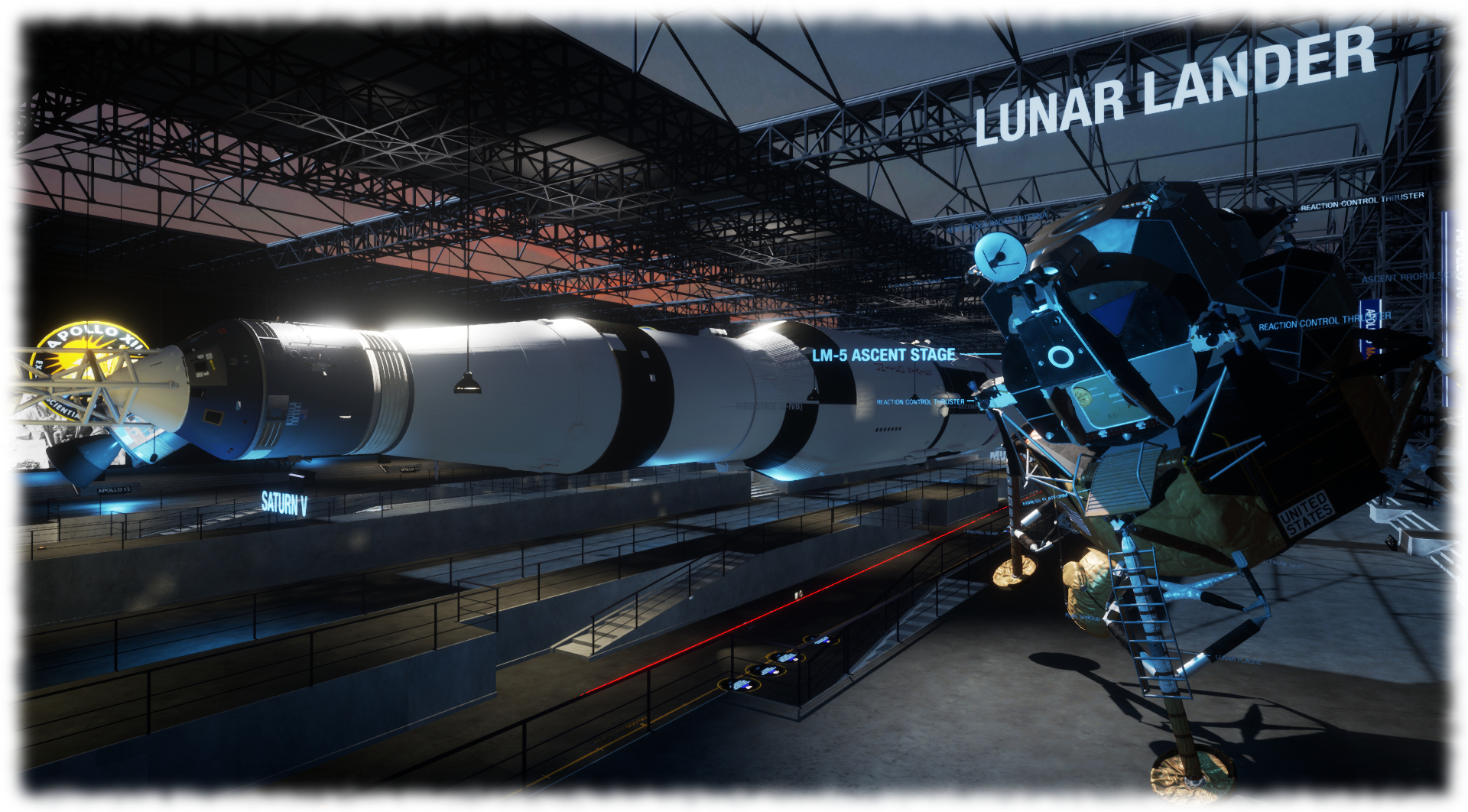
Unsurprisingly, given this *is* a museum, the setting is that of a mammoth hanger-like structure dominated by the huge form of an Apollo Saturn V rocket lain upon its side. Visitors arrive in a presentation area at the “base” of the rocket where, facing the five F1 engine bells of the  S-IC first stage of the booster, is a huge video screen, used to present a film on the entire Apollo programme, from birth, through development and the horror of Apollo 1, through to the triumph of Apollo 11, and thence onwards through the remaining six missions to the Moon, together with the recovery of the near-loss of Apollo 13.

Flanking the Saturn V are two raised galleries featuring the Apollo missions with photos, mission logos and information boards. These start with the tragic loss of Apollo 1 and astronauts Grissom, White and Chaffee and run down either side of the rocket, progressing through the preparatory missions leading up to the first manned lunar landing, and thence on through Apollo 17.

LOOT Interactive NASA Apollo Museum

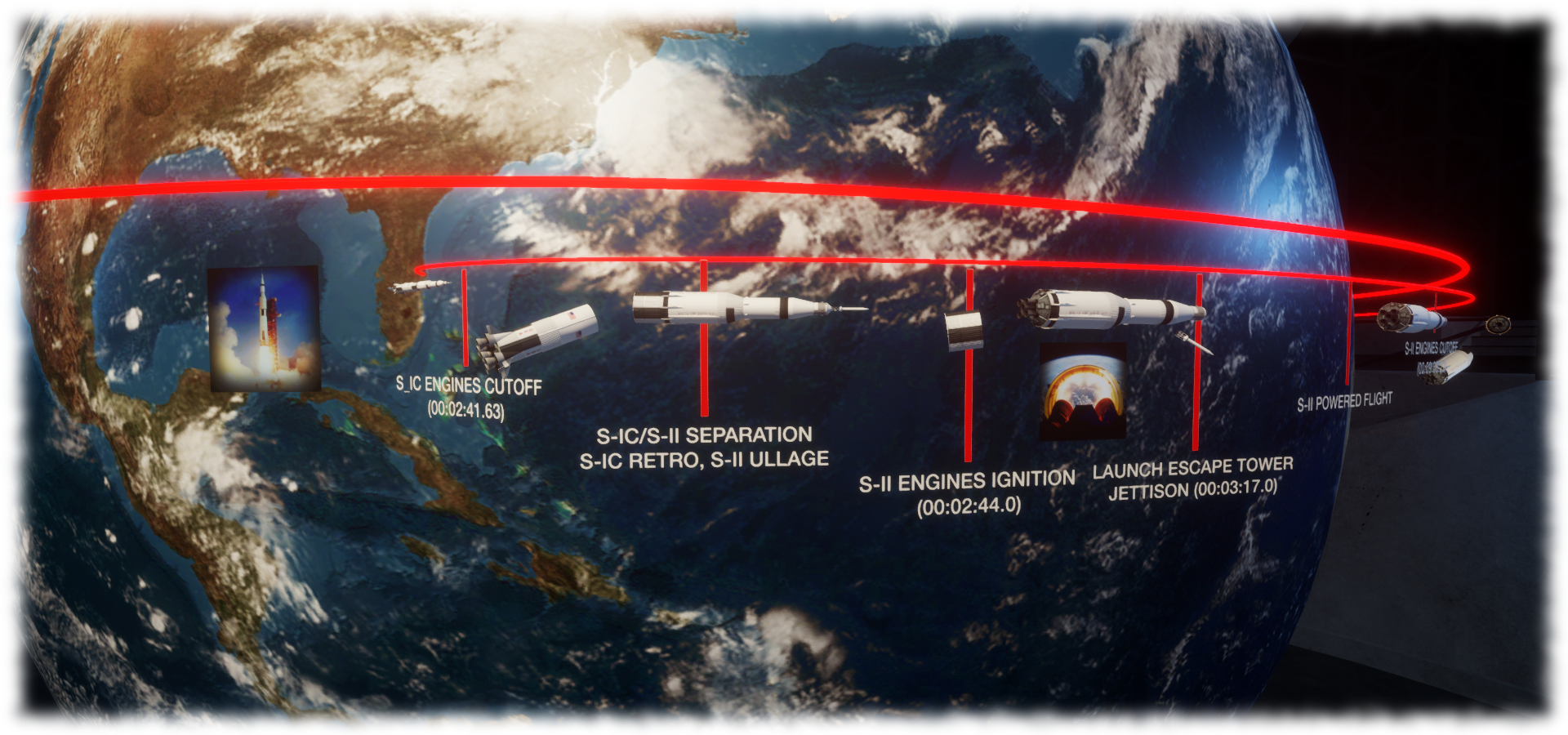
Sitting either side of the nose of the Saturn V are the LEM and the CSM. These and the rocket are neatly labelled, and the Service Module is shown with a cutaway in roughly the area where the liquid oxygen tanks exploded on Apollo 13, crippling it and leading to the rescue flight around the Moon. In the well between these display areas, starting with a model of the Earth, are a pair of time lines for the Apollo 11 mission. The first covers the journey from the Earth to the Moon, with principal events indicated along the way by scale models and annotations / information panels. The other similarly documents Apollo 11’s return to Earth.

Also, on the floor of these time lines are a series of interactive circles. Stepping on these will play audio clips of conversations between Mission Control and Apollo 11, and commentary from NASA on the mission status. There are other audio elements to be discovered as you explore the museum: an extract from Kennedy’s famous speech at Rice University in September 1962, when he uttered those immortal word, “We choose to go to the Moon.” There’s also audio at the Saturn V display.

LOOT Interactive NASA Apollo Museum

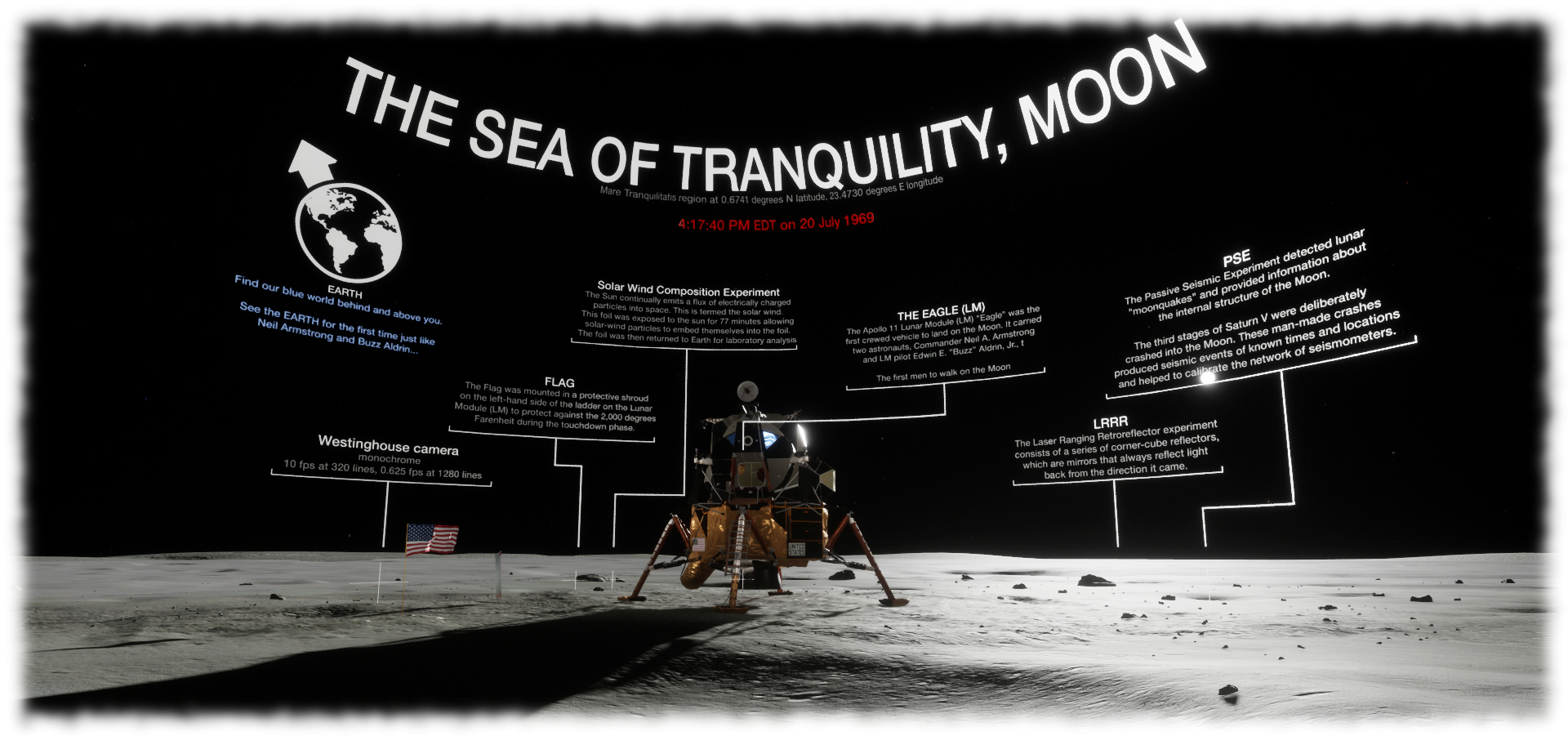
Beneath a model of the Moon which shows the landing areas of the six Apollo missions to reach its surface, sits a teleport disk. Simply step on it to be carried 384,400 km (240,250 mi) to Mare Tranquillitatis – the Sea of Tranquillity – and to where the Apollo LEM Eagle as it sits on the Moon. Pan / look up from here while you’re exploring, and you’ll get to see one of the most heart-catching sights a human can witness: looking back across the blackness of space to the beautiful, fragile marble of Earth.

Sansar’s current status does tend to limit what can be done interactively on the platform, and this in turn limits some of the effectiveness of experiences like this. For example, it would be nice of have a finer level of control over audio; right now, it is possible to end up with different audio elements confusingly overlapping one another (I have to admit I also found the clump-clump of shoes on solid floor is also a little off-putting when walking on the Moon). It would also be nice to have more interactive elements as well; as it is, the hanging information area above the Sea of Tranquillity setting is informative, but alignment with the appropriate elements can be difficult if you move.

LOOT Interactive NASA Apollo Museum

Nevertheless, the NASA Apollo Museum is an engaging, informative and immersive experience, offering a promise of just where Sansar might lead us as features and capabilities are added.

Experience URLs

Sansar: Secrets of the World Whale

Secrets of the World Whale; Inara Pey, August 2017, on Flickr Sansar: Secrets of the World Whale – click any image for full size

I’ve mentioned Secrets of the World Whale several times in my Sansar posts of late, so it seemed to be a good place to launch into my Exploring Sansar series.

Designed by Teager, of Breeder’s Choice and Teagle fame in Second Life, this is one of the more enchanting early Sansar experiences.  It is also one of the winners in the Lab’s Creator Challenge, winning Best Sound Design – although in my opinion, it could have just as easily been awarded Best Narrative and / or Best Visual Design.

Secrets of the World Whale; Inara Pey, August 2017, on Flickr Sansar: Secrets of the World Whale

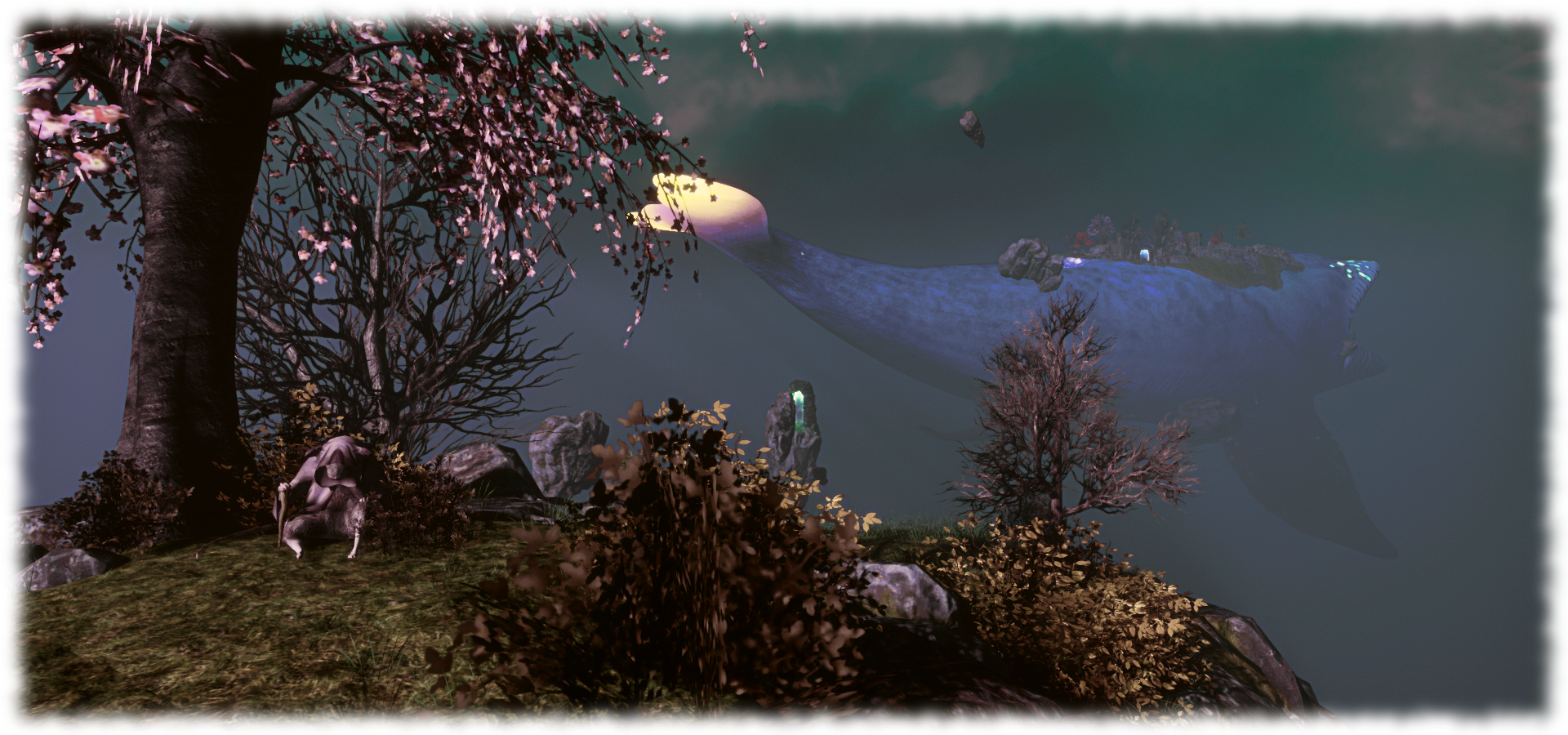
A visit begins on a floating island hanging in a clouded sky, the Sun illuminating the scene as it shines from beyond a very near-looking full Moon. Other islands of rock float in the sky and, beyond them, a great blue-coloured humpback whale swims through the sky.  Beneath a tree close to where we stand sits an old rat, wrapped in a cloak and holding a walking stick in one paw.

“Look yonder! The World Whale passes!” he whispers hoarsely at our approach. “A creature as ancient as time itself, it wanders the sky, swallowing civilisations whole, leaving chaos in its wake.  It is said that buried deep in the beast’s belly is an untold treasure, lost to man some thousand years. Perhaps, if we act quickly, we might discover it before the whale is lost to us again!”

Secrets of the World Whale; Inara Pey, August 2017, on Flickr Sansar: Secrets of the World Whale

Just beyond him, a tumble of rocks offer a way down to the island’s lower level as the rat tells us of the whale’s passing, and music drifts through the air. We encounter him again as he stands near the edge of the island, as he points outwards. “There! On that island!” he rat whispers once more, “An ancient doorway! But how to reach it?”

How indeed. There is a gulf of empty air between the island on which we stand and the smaller one on which the glowing portal stands. But, there are other islands as well. Perhaps, by using the personal teleport capability (CTRL+mouse + left click) we can jump one to the next with teleport hops. Take care as you do so, as the wind will howl around you, and a misplaced step could see you fall into the abyss – and back to the start of the experience.

Secrets of the World Whale; Inara Pey, August 2017, on Flickr Sansar: Secrets of the World Whale

Stepping through the glimmering portal will carry you to the whale, where your companion rat is again waiting to guide you onwards to where a garden and ruins awaits. Paths run around and over the gardens, but it is one in particular you need to seek: the one that leads down inside the whale itself. Once you find it, you’ll find yourself in a cavern-like world, where great stalagmites rise and stalactites descend, and a rough road leads you onwards. It many take a second or two to realise the formations are teeth and the road is the whale’s tongue.  Two portals await you – one leads back to the garden above, and the other – well, you’ll have to visit the world whale in its mysterious flight and find out for yourself.

Secrets of the World Whale is an engaging experience, combining strong visuals with a rich ambient sound scape and music, with a narrative track to follow. There are a couple of small hiccups, potentially down to Sansar’s state of play – stay too close to the rat for too long while he’s speaking, for example, and his words can end up in an overlapping series of loops – just keep walking to the edge of the audio fall-off to avoid it. However, none of this detracts from the central attraction of the experience.

Experience URL

Sansar: visiting some Creator Challenge winners

Sansar: Secrets of the World Whale – Teager

Prior to the public Creator Beta opening, Linden Lab issued a challenge to those creators who were a part of the Creator Preview and who helped to move Sansar to a point where the Lab felt they could open the platform to a wider audience.

On offer in the competition, which closed on July 24th, were a series of cash prizes to be awarded to creators who, “create an experience with Sansar that takes the tools currently available and pushes them to their limits”, offered across a range of categories: Best Overall; Best Gaming Experience; Best Media Experience; Best use of Physics; Best use of Scripting; Best Visual Design; Best Sound Design;  and Best Narrative Design.

On Wednesday, August 16th, Linden Lab announced the winners of the challenge, together with honourable mentions, and I was pleased to see that some of the places I’ve personally enjoyed the most whilst exploring Sansar from a user’s perspective are among those listed, together with some I’ve been planning to write about.

Sansar: Garden of Dreams – Kayle Matzerath

The Best Overall award has been given to Kayle Matzerath’s Garden of Dreams. This is a recreation of the region with the same name in Second Life, and it also gained the Best Gaming Experience award. As one might expect from Kayle, this is an experience rich in vibrant colour, and offers much to explore and discover.

The primary gaming mechanism can be found in the Dungeon of Dis Pear. Given the current status of Sansar’s development, it is somewhat rudimentary when compared to what can be achieved in Second Life, but can be played with or without a VR headset. Reached via one of the teleport platform at the experience landing point, the game comprises of making your way through three levels of challenges to claim a “prize”. None of them are particularly difficult, although the second level may take a minute or two to work out, as even an initial wrong step or two can see you teleported back to the start point even before you appear to have made progress. However, they do demonstrate some of the basic capabilities available in Sansar to good effect (e.g. automatic teleport back to a level’s starting point on being “killed”,  a capability familiar to many SL experience users).

Sansar: Garden of Dreams: the Dungeon of Dis Pear – Kayle Matzereth

Other games can also be found near the dance gazebo, but these do require the use of a VR headset and controller, limiting their use somewhat.  Garden of Dreams is a pleasant experience, full of Kayle’s motifs SL users will find familiar and sits alongside his recreation of the Village of Breeze as two places I like to visit and just wander.

The award for the Best Sound Design went to another of the experiences I love – Teager’s Secrets of the World Whale. This a beautifully put together environment, complete with the plaintive cries of the whale. It’s also one I also mentioned in my Sansar tips and picks article as worthy of a visit as it also introduces various capabilities in Sansar, including the need to use the personal teleporting option. It remains a featured destination in the Atlas, and will be a place I’ll be returning to soon in my upcoming Exploring Sansar travelogue series – as well Maxwell Graf’s LagNMoor (again a name which may be familiar to long-standing explorers of Second Life, having once been a region Max held alongside of his Rustica), which took the prize for Best Media Experience.

Sansar: Through the Waterfall – Jasmine

Jasmine’s Through the Waterfall: Enter Another World claimed the prize for the Best Narrative Experience. This is something of an adventure narrative, opening with the line Without dreams, we can never become more than that which we already are… and an invitation to jump down from the desk on which we sit and seek the keys which will take us through the story, a scene – or chapter – at a time, starting with the aftermath of a tragic car crash. It’s not an entirely happy tale, but the use of media, music and sounds to craft a story makes this a worthwhile visit.

With seven prize winners and a further 12 honourable mentions, the competition list makes for a set of interesting visits, some of which people may well find easier to get into than others (Ria and Draxtor’s 114 Harvest remains a place – the only place I’ve yet tried, in fact –  which persistently outlasts my patience in terms of load time and has me going elsewhere); but all are well worth a visit in some measure, demonstrating both what can be done in Sansar and – in all fairness – how much further along the road the platform needs to travel. In this latter regard, it’ll be interesting to see how they compare to experiences that are being offered in a few months time, as things continue to develop.

Sansar: An Evening at the Ballet – Bryn Oh, featuring some familiar friends and winner of the Best Visual Design award

To visit any of the experiences mentioned here or in the competition blog post, click on the experience names in the text, or in the image captions.