Oculus VR confirm: consumer headset to ship Q1 2016

On Wednesday, May 6th, Oculus VR confirmed the consumer version of their headset will commencing shipping in the first quarter of 2016, with pre-ordering due to start later in 2015.

  The news broke via a press release from Oculus VR, and Tweets from Oculus VR, Palmer Luckey, and the company’s Vice President of Product  Nate Mitchell (shown on the right).

The announcement ends months of speculation on when the consumer version of the headset might be available, with many originally predicting it would be ready for Christmas 2014 and then Christmas 2015. Despite such speculation, Oculus VR has always carefully avoided mentioning any approximate idea release dates. As I reported in these pages, even as recently as November 2014, Oculus VR Brendan Iribe was playing down any idea of any (then) near-term release of the headset:

We want to get it right. We really do. We’ve gone out there and we’ve set this bar and said, “we are going to get it right, and we’re not going to ship until we get it right” … We’re getting very close … We want it to be a beautiful product; there’s no reason it can’t be a beautiful product … so we still have a way to go, and we’re still working on a number of things, but we’re getting much closer. We like to say it’s months, not necessarily years, away [but] it’s many months, not a few months.
Click for full size

That something might be afoot by way of announcements was initially hinted at in a May 5th Tweet in which Palmer Luckey commented I love it when a plan comes together!

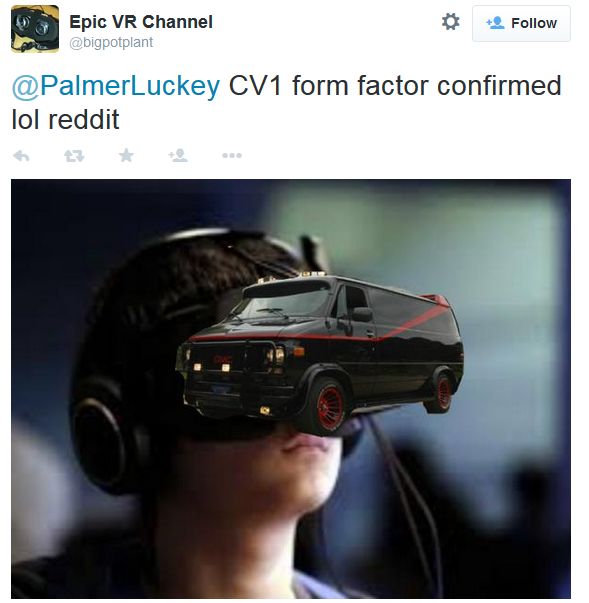
This brought an inevitable run of replies, many seeing it as a hint about the Oculus CV1 (as the consumer version of the headset has sometimes been referred to), including the humorous response seen on the right regarding the headset’s form factor.

Details of the headset are rather scant in the announcement and the images a little on the dark side (I’ve lightened the contrast on them below), with the release merely stating:

The Oculus Rift builds on the presence, immersion, and comfort of the Crescent Bay prototype with an improved tracking system that supports both seated and standing experiences, as well as a highly refined industrial design, and updated ergonomics for a more natural fit.

No details on pricing or quite when in 2015 people will be able to start pre-ordering the headset, and there are certainly no details on the technical aspects of the headset. However, one potentially interesting aspect of the announcement has already sparked some speculation, as it refers to the upcoming release as, “a fully-integrated hardware/software tech stack designed specifically for virtual reality”. This has prompted Techcrunch to comment:

There’s no mention of a third-party computer necessary to power the Rift, which previous Oculus developer kits required. That means the Rift might ship with a game console-esque device to handle computing for the headset. An all-in-one box could make virtual reality much more accessible to consumers, especially those who don’t own a high-grade gaming PC.

A front view of the Oculus consumer version (courtesy of Oculus VR)

In terms of specification, the announcement was equally enigmatic, stating, “we’ll be revealing the details around hardware, software, input, and many of our unannounced made-for-VR games and experiences coming to the Rift”, with the last part of this statement leading Techcrunch to also speculate whether Oculus VR might also announce a line of in-house developed games to go with the launch.

Given the backgrounds of many of those involved in the company, such an idea might not be wild speculation. As it is, it is already known that Oculus VR is helping to develop immersive movie experiences. Furthermore, in February 2015 it was confirmed that Facebook is developing VR apps, with Chief Product Officer Chris Cox saying that experiences as varied as flying a fighter jet to sitting in a Mongolian yurt would serve as inspiration, and describing the technology as “sending a fuller picture … You’ll do it, Beyoncé will do it”. Ergo, Oculus VR-branded games are not beyond the realm of possibly.

What the announcement does more-or-less mean is that unless something unexpected happens, the Oculus Rift will definitely be available after HTC / Valve have started shipping their own Vive headset, which looks set to hit the market around the same time as Samsung’s  (Oculus-enabled) Gear VR2, towards the end of 2015.
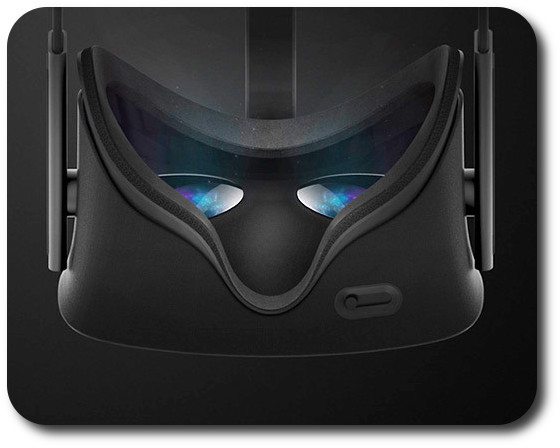
A view from under the Oculus consumer version (courtesy of Oculus VR)

While there has been a lot of hype about the possible demand for what is effectively a first generation headset from Oculus VR, there have also been some notes of caution sounded in some quarters. As gamesindustry.biz notes, Ben Schachter, a Macquarie Research analyst wrote to Facebook investors, stating:

While there is not yet any info on pricing or available units, we expect relatively small number of units and think that the initial device will be supply constrained. We think that the early versions of the device will be more about showing what is possible from gaming and other entertainment genres, and build demand for later versions of the device.

Mr. Schachter isn’t alone. While price may no longer be a limiting factor in obtaining a headset, Jacki Morie, herself a VR pioneer (and whose work has been featured in this blog a number of times) recently warned that care should be taken in how the potential for VR is promoted, in particular pointing to things like an Oculus VR sponsored art contest as a means to send out completely the wrong message about VR to a wider mass market audience and potentially damaging the technology’s credibility as a useful tool.

I actually doubt the wheels will seriously come off the cart with VR this time around, bad marketing campaigns and the like notwithstanding, although Jacki clearly has a point about getting the right message out there in the first place. However, I do tend to think that Mr. Schachter’s comment about the build-up of demand is well put. VR will profoundly alter many ways of doing things for all of us in time; but the the speculation and hype that will not follow Oculus VR’s announcement aside, it’s still going to be a few years or so before we see VR as being as ubiquitous a piece of technology in our daily lives as we do the mobile ‘phone today.

Lights! Camera! Headset! – Oculus VR opens movie studio

Image: Oculus VR / Story Studio

Oculus VR came, in a manner of speaking, a full circle with this Year’s Sundance Film Festival, which is currently taking place in Park City, Utah, and ends on February 1st, 2015.

In 2012, journalist Nonny de la Peña showed (what was then) her latest journey in what she calls “immersive journalism”, Hunger in Los Angeles. The film utilised a head-mounted display unit developed by a 19-year-old student. So convinced was that student of the potential for VR, he started putting together ideas for a commercial, low-cost headset. A kickstarter campaign followed  and … yes, you’ve guessed it, I’m talking about Palmer Luckey.

This year, Oculus VR are back at Sundance, in the form of their new in-house film studio, Story Studio, which is showcasing the first of five animated short films the company plans to make under the Story Studio banner over the course of the next year.

Located in San Francisco, Story Studio numbers around dozen film industry veterans from the likes of Pixar and Industrial Light & Magic under the leadership of Saschka Unseld, formally of Pixar. The company started to come together around a year ago, although as Josh Constine notes over at Techcrunch, the idea for the studio was already on the Oculus VR roadmap from the earliest days. Indeed, the very potential for VR in films as indicated by Oculus VR in their plans, many have been one of the added attractions for Zuckerberg in acquiring the company.

Certainly, Oculus VR’s CEO, Brendan Iribe is in no doubt that Facebook has been crucial in accelerating the film plans, noting to Constine, “this is another example where as a smaller, independent start-up it would have been hard to spin up an effort like this.”

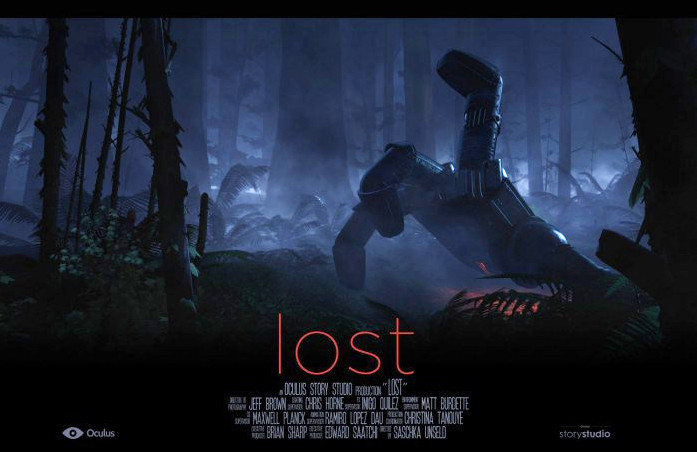
Lost, showcased at the 2015 Sundance Film Festival, is the first in a series of films from Oculus VR's new in-house film studio: Story Studio
Lost, showcased at the 2015 Sundance Film Festival, is the first in a series of films from Oculus VR’s new in-house film studio: Story Studio (image: Oculus VR / Story Studio)

Lost, the title of Story Studio’s short, runs at between 4 and 10 minutes, the length being determined by the level of engagement in the film and what the decide to explore within it. As such, it is said to be a powerful demonstration of the added depth that VR can bring to a film. It is being shown in the Festival’s New Frontier programme, which this years see no fewer than 11 of the 14 submissions attempt to utilise VR.

Not all of them succeed, as Casey Newton and Bryan Bishop, writing in The Verge note. Some mange to do exactly the reverse, and demonstrate the inherent weaknesses in VR if not used correctly, and the need to learn entirely new approach to filming, interaction and editing in order to properly create and maintain the desired level of immersion needed to make the use VR worthwhile.

It is because VR as a medium is so difficult a concept to grasp and successfully integrate into film-making that drove Oculus VR to create and develop Story Studio, as Iribe notes in a conversation with The Road to VR’s Ben Lang.

“When we started to show people [the Oculus Rift] in Hollywood, their question was ‘how do we get started?’… We said ‘you pick up these gaming tools like Unity or Unreal and you start making something’ but that’s not natural for [cinema creatives],” Iribe said. “Right now the focus is to support and inspire the community—share with them everything we’re doing, opening it all up. Over the next two months, we’re hoping to educate the community on how we did this and how we got started. We still have a ways to go before people are making longer film experiences.”

Saschka Unseld (image coutesy of skwigly.com)

Unseld picks-up on this line while talking to Techcrunch’s Constine alongside of Iribe.

“Everyone who starts a project in VR encounters the same things in the beginning,” he states. “They try to figure out ‘How do I make these things I know from film work in VR? How do I do a cut in VR?’ The resounding answer is that porting film concepts straight to VR just doesn’t work.”

Thus, Story Studio will be a studio in both senses of the word. Not only will it be a engine for producing a series of short animated stories over the courses of the next year, it will also be something of a “open-source” VR cinematography “school” presenting and sharing insights into the use of VR in films, offering examples of how the technology works or doesn’t work within the framework of a film, and so on.

This is actually a clever move, as it allows Story Studio to both offer a roadmap on how other studios might involve themselves in VR and present them with the kind of finished product which can be seen to work, both technically and with audiences, thus giving them something they can understand, replicate and even enhance as the technology matures.

Of course, all this will also be helped by actually having the technology – the headset itself – actually available to use by more than a few thousand people world-wide. And even here Story Studio may offer a small clue as to when the consumer version of the Oculus Rift might appear.

According to Reuters, via Fortune On-line, Lost is the first of five animated shorts Story Studio plan to produce over the next year. Furthermore, The Guardian suggests that all five will be released “in the run-up” to the release of the commercial version of the headset – which Iribe refers to as “Oculus Rift CV1”, while Iribe himself, when talking to Ben Lang, says all five films will be available for the CV1 product.So perhaps one way of counting down the time to the release of the commercial headset is to count off the Story Studio films as they appear…

Related Links

Oculus VR: of debuts and acquisitions

The Oculus Crescent Bay prototype showing the Samsung Gear-type head harness with motion tracking sensors on the back and the integrated headphones

As is to be expected, Oculus VR are attending the International Consumer Electronics Show 2015, which is once again being held in Las Vegas, Nevada, through until January 9th, 2015, where the latest headset prototype  – Crescent Bay  – is undergoing its “public debut”, and the company’s CEO, Brendan Iribe took time out to discuss the prototype and more with Techcrunch’s Darrell Etherington.

“Crescent Bay is a huge leap from Oculus Rift DK2,” Iribe informs Etherington at the start of their 6-minute discussion. “And it increases all the different parts, whether it’s resolution, precision, the positional tracking, the latency, the optics themselves, everything really takes a big jump, and it really finally delivers what we’ve been talking about for a long time, this pursuit of presence. It finally delivers on that presence that we feel is good enough for consumers.”

So, does that mean he’s revising his comment at November’s Web summit conference about the consumer version of the headset being “many months” away?

Oculus is again a major presence at the International CES in Las Vegas

Well, probably not. While no outright statement on time frames is given, it’s fair to say the the company is still putting a consumer release as some way down the road.

For one thing, the next immediate target is getting an audio SDK to developers to allow them to get to grips with the capabilities of Crescent Bay’s 3D immersive audio system. However, it’s liable to be another “few months” before that happens. For another, while the company feel they are now “close” to having a headset that is, technology-wise, to being consumer-ready, Iribe also notes the audio is at a “minimum” the company requires of a consumer product, and also that no decision on what they’ll actually be shipping as a consumer product as yet been made: it might be “just” the headset, or it might be the headset and an input system / device.

When speaking to Peter Rubin at the Web Summit in Dublin in November (linked to above), Iribe made it clear that input had become a “big focus” for the company, which they were “R&Ding”. He restates part of this to Etherington, which suggests they may still be leaning towards headset + input system / device, although he also noted that the company is not yet ready to discuss matters of input in public.

In terms of a suitable software library being available in time for any launch so – another consideration in determining when to launch the consumer product – Iribe indicates the company is “very happy” with the progress that is being made, suggesting this is less of a concern as they gradually move towards a consumer release.

Continue reading “Oculus VR: of debuts and acquisitions”

CtrlAltStudio provides Oculus SDK 0.4.4 support and Mac build

CAS-logoOn December 4th, Oculus VR released the latest software version for the Oculus Rift, version 0.4.4. A beta release, it includes an number of bug fixes and improvements, while retaining  experimental support for Linux.

As a result of this update, Strachan Ofarrel (aka Dave Rowe in the physical world) released an updated version of the Alpha version of his CtrlAltStudio viewer on Friday, December 12th. Version 1.2.2.41224 Alpha 5 brings with it not only support for the SDK update but also, courtesy of Mac viewer developer Cinder Roxley, a Mac build as well.

As usual with the Alpha version of the viewer, this release is installed into its own directory / folder, and so can be installed alongside the current release version of the CtrlAltStudio Viewer. A clean install is not required if you have been running previous alpha versions.

Core updates in this release comprise:

  • Updated to Rift SDK 0.4.4. This fixes the overdone vignette (fading to black) around the Rift barrel image’ edges edges.
  • Updated position of notification messages and script dialogue boxes so that they’re visible and usable in Riftlook.
  • Modified Start+Back key behaviour on Xbox controller if Rift display is configured: if you’re not in Riftlook then you enter Riftlook the same as before; however if you’re already in Riftlook then it zeros sensors the same as Ctrl+Spacebar (instead of exiting Riftlook). To exit Riftlook with the Xbox controller, press the yellow ‘Y’ button.
  • Updates for Mac OSX build.

Hints and Tips

Also, don’t forget that each set of release notes for the Alpha version of the viewer includes a set of hints and tips for getting the best results when using the viewer with the Rift.  These include tips from Strachan and also discoveries made by other users, and are being added to over time. They include, but are not limited to:

  • If you have good frame rates, including while turning, set your Rift display to 75Hz: Control Panel > Display > Screen Resolution > Advanced Settings > Monitor
  • If you’re experiencing judder while turning then try to try disabling one or more of the “Dynamic prediction” … “Pixel overdrive” Oculus Rift options, consider configuring your Rift display to 60Hz, and possibly try enabling triple buffering in your display driver
  • Setting your Rift to be your primary monitor may also reduce judder [Estelle Pienaar]
  • If you have a stereoscopic 3D system, you may need to disable stereoscopic 3D display in order to stop the Rift’s display rate being reduced from 75Hz to 60Hz. [Estelle Pienaar]
  • If you have an Nvidia graphics card, adding an entry for the viewer in the Nvidia Control Panel 3D Settings and setting the preferred refresh rate to unlimited may let your Rift run at 75Hz without needing to make it your primary monitor [Phoenix]
  • If using Windows 7 and you’re experiencing juddering, try turning off Windows 7’s Aero. [Phoenix]
With floating text you may want to adjust the distance the floating text fades at so that distant text is not so annoying in Riftlook - one of the tips from Strachan
With floating text you may want to adjust the distance the floating text fades at so that distant text is not so annoying in Riftlook – one of the tips from Strachan

 Related Links

Iribe: consumer Oculus Rift “many months” away

The Oculus Crescent Bay prototype showing the Samsung Gear-type head harness with motion tracking sensors on the back and the integrated headphones
The Oculus Crescent Bay prototype showing the Samsung Gear-type head harness with motion tracking sensors on the back and the integrated headphones (image via Oculus VR)

Brendan Iribe, CEO of Oculus VR was at the Web Summit event in Dublin Ireland at the start of November, where he sat down for a conversation with Wired’s Peter Rubin to discuss the latest state of play about the Oculus Rift, VR in general – and to deliver a small warning to others also involved in the headset market. He also indicated that the consumer version of Oculus Rift isn’t necessarily as close to reaching the market as some might think.

In terms of the Oculus Rift, he was upbeat about the latest prototype version, Crescent Bay, which appeared in September and which is said to be a “massive leap” forward in comparison to the Oculus DK2 hardware that shipped to developers in June and July.

Crescent Bay incorporates 360-degree positional head tracking through the inclusion of sensors on the back of the redesigned and improved head harness, higher resolution, wider field of view, a lighter body, and integrated audio (via Realspace 3D). Iribe said of the new prototype, “Crescent Bay is where it all begins: that quality level.”

Oculus Rift CEO Brendan Iribe (left), speaking at the 2014 Web Summit in Dublin, Ireland, November 4th
Oculus Rift CEO Brendan Iribe (left), in conversation with Peter Rubin from Wird Magazine at the 2014 Web Summit in Dublin, Ireland, November 4th (image via VentureBeat)

However, he also cautioned against people getting too excited over thought that the Rift is just around the corner. “What can I say on that?” he replied to Peter Rubin’s enquiry as to when a consumer version might appear. He went on:

We want to get it right. We really do. We’ve gone out there and we’ve set this bar and said, “we are going to get it right, and we’re not going to ship until we get it right” … We’re getting very close … We want it to be a beautiful product; there’s no reason it can’t be a beautiful product … so we still have a way to go, and we’re still working on a number of things, but we’re getting much closer. We like to say it’s months, not necessarily years, away [but] it’s many months, not a few months.

He then continued, “Crescent Bay, I’ll go on the record as saying that hardware-wise for the headset, it’s arguably almost there for the consumer product, and now there’s a few other parts. So we are finalising the specifications for that consumer version, and the headset is largely finalised.”

Michael Bormann of Engadget tires-out the Crescent Bay Oculus Rift prototype

One of the issues remaining in the way of a launch doesn’t lie with the headset – it is squarely down to the suitability of input devices. Iribe notes that keyboard, game pads and even gesture devices aren’t ideal; there needs to be some form of visual element (e.g. seeing your hands), and there needs to be a tactile element as well. People need to be able to touch, feel, and sense a button reacting to being pressed.He went on to say:

We’re trying to focus now on is, what is that VR input? Where does VR input begin? We don’t know the final Holy Grail of VR input; we have kind-of any idea of VR vision being a pair of sunglasses, which we’d like to get to [but] VR input, we’re still R&Ding, we’re still looking at. But that’s definitely a big focus for us.

The implication of his comments, and those that follow an observation made somewhat in jest by Rubin suggest that Oculus VR may be looking to develop their own input device, or perhaps work in close partnership with another company in the development of an “Oculus ready” (my term, not Iribe’s) device. Certianly, having grown from employing just 50 people prior to Facebook acquiring them, to almost 250 personnel today, it is not inconceivable that Oculus VR may be poking at ideas for its own inpute device.

What is the best VR imput tool... and are Oculus VR lloking to produce their own?
What is the best VR imput tool… and are Oculus VR lloking to produce their own?

The subject of VR’s “killer application” also comes up in the conversation, and Iribe states he feels it is too early to really say, although he acknowledges it will initially have a big rooting in games and entertainment – hardly surprising, given the Rift’s pedigree. “There’ll be a market of a lot of really fun entertainment experiences in VR where you’ll feel like you’re in the game or in the movie, and it’s going to be awesome,” he said.

But in terms of going mainstream, he very much sees VR’s future hinging on communications:

For me, the real media where this is going to really transform the world long-term, is when we can have face-to-face communications…. Most people travel, and we get on airplanes and cars to go have face-to-face communications… If you could, in the future throw on a pair of sunglasses, and we can have that same conversation with people around the world, all feeling like you’re in the same place, face-to-face, looking at each other, looking at each other’s eyes, looking in each other’s mouths; we may look like funny little avatars, we may look a little more human… that’s really transformative.

Could VR be as transformative in how we communicate and access information as the mobile 'phone has been?
Could VR be as transformative in how we communicate and access information as the mobile ‘phone has been?

Were this to happen, and VR offer the same ease of use and access to communications and information as the smartphone, Iribe is convinced it could have as deep an impact on the way we communicate as the mobile ‘phone itself. “To have virtual reality where you can have these face-to-face communications, that’s going to appeal to billions of people,” he said.

However, he also had a warning for other companies also trying to bring VR headsets to the market – there have already been at least two Oculus clones making waves (the ANTVR being one), with Sony also working on its Morpheus headset for the PS4. And that warning is: don’t launch until you’ve solved the problem of motion sickness. In giving the warning, Iribe seemed to be particularly focused on Sony.

We’re really looking forward to this as an industry, and looking forward to it being an industry that takes off… We’re really looking forward to more people jumping into the VR space, and we’re doing our best to be very open, supporting others. At the same time we’re a little worried about some of the bigger companies putting out product that isn’t quite ready. That elephant in the room is disorientation and motion sickness. That’s something I view as, two or three years from now, will really be behind us… We feel pretty confident that our consumer product will have solved that; and we’re really encouraging other companies, especially big companies, “don’t put out a product until you have solved that!”

Iribe's warning to Sony, "Don't launch until you've solved the problems of motion sickness"
Iribe’s warning to Sony, “Don’t launch until you’ve solved the problems of motion sickness” (image via Sony)

To this end, Oculus VR’s openness on matter has been such that they’ve invited senior representatives from Sony to come and learn from the lessons the company gained from users’ experiences with the DK1 and the DK2 and to see the Crescent Bay prototype ahead of its launch, offering them the advice that they should “make sure your product is as good or close!”

Elsewhere in the interview, Iribe gives some fascinating insight into a number of topics, including his role as CEO of Oculus VR, the impact of being acquired by Facebook, the company’s relationship with the VR community, the worries those within the company had (rightly so as it turned out) over the potential backlash they’d face if they accepted Facebook’s offer, and more. All of which makes for a fascinating 19-and-a-half minutes viewing.

CtrlAltStudio provides Oculus SDK 0.4.3 support

CAS-logoOn October 24th, Oculus VR released the latest software version for their SDK. Among the many updates came support for Unity Free developers (Unity versions 4.5.5 and up), and experimental support for Linux.

As a result of the release, Strachan Ofarrel (aka Dave Rowe in the physical world), has updated the Windows Alpha version of his CtrlAltStudio. The new release, version 1.2.2.41214 Alpha 4, issued on november 2nd, 2014, provides SDK 0.4.3,  a number of additional Rift display options and some more general updates:

  • Rift display options:
    • Dynamic prediction: adjust prediction based on latency feedback
    • Timewarp: re-project scene during distortion rendering
    • Timewarp waits: wait until the last moment to do timewarp
    • V Sync: wait for and swap buffers at monitor vertical sync
    • Low persistence: display low persistence images
    • Pixel overdrive: over-drive brightness transitions to reduce artefacts
  • Updated GPU table now includes NIVIDIA GTX 970 and 980 GPUs
  • A fix for Riftlook mouse hover target and context menu locations for in-world objects
  • A fix for Rift positioning in third person orbit camera view.
The new Rift display options can be found in Preferneces > Graphics, and are enabled by default. No restart is required on disabling / enabling any of them
The new Rift display options can be found in Preferences > Graphics, and are enabled by default. No restart is required on disabling / enabling any of them

All of the Rift display options are enabled by default in the viewer, and no restart is required when disabling / enabling them, allowing for rapid-fire experimentation. In addition, and in relation to them, Strachan provides the following advice in the release notes and blog post accompanying the release:

The “Timewarp waits” option shouldn’t really be made visible to the user, but in my testing I found that it seemed to help to be able to turn it off if rendering at significantly less than the frame rate the DK2 is set at. The variability of the frame-to-frame timing in Second Life may well be why.

The optimum settings depend on what frame rate you’re achieving and your personal preferences and sensitivities to different display behaviour: if you’re achieving the ideal of 75Hz including while turning your head then the default of all options enabled is best; otherwise you will probably want to try disabling one or more, consider configuring your Rift display to 60Hz, and possibly try enabling triple buffering in your display driver.

As with the previous ALpha releases with DK2 support, this version will install into its own directory, allowing it to be used alongside the release version (although it will obviously over-write Alpha 1 or ALpha 2, if installed). Also note that with this release:

  • There is still no support for the Rift’s with direct mode
  • The Advanced Lighting Model option in Preferences > Graphics needs to be enabled
  • The Oculus 0.4.3 runtime is required.

Related Links