Space Sunday: the mathematician of NASA

Tribute to Katherine Johnson. Credit: Breen, San Diego Union-Tribune

So often, when we think of the early years of US space flight, we think of steely-eyed, square-jawed test pilots supported in their missions by male, bespectacled and white-shirted scientists and flight controllers, their breast pockets lined with pens of various colours, all with similar haircuts and staring earnestly at computer screens, headsets allowing them to talk in clipped, precise terms with one another in acronym-laden sentences.

While both were very much the public persona for NASA, even becoming something of a cliché in television and film, they were only in fact the tip of the iceberg of the multitude of talents that formed NASA and made its missions possible. In particular, the image of the “nerds” of mission control has tended to very much overshadow the role played by many women in getting America both into orbit and to the Moon.

One of the foremost of these women was Creola Katherine Coleman, better known as Katherine Johnson, who sadly passed away on February 24th, 2020 at the age of 101. As a mathematician who spent 35 years working for NASA and its precursor, her calculations of orbital mechanics were critical to the success of the first US flights into space during the Mercury programme, and her work also encompassed the Apollo programme and the space shuttle.

Katherine Johnson, circa 1960. Credit NASA

Katherine Johnson was born on August 26, 1918, in White Sulphur Springs, West Virginia, the youngest of four children born to Joylette Coleman, a teacher, and her husband Joshua Coleman, a lumberman, farmer, and handyman. She showed a natural ability with mathematics from an early age. However, as her home county of Greenbrier did not offer public schooling for African-American students past the eighth grade (13-14 years of age), her parents enrolled her, at the age of 10, at the high school on the campus of West Virginia State College.

Following her graduation at 14, she attended West Virginia State, where she took every course in mathematics offered by the college and studied under chemist and mathematician Angie Turner King, and William Schieffelin Claytor, the third African-American to receive a Ph.D. in mathematics In fact, Claytor was so impressed with Johnson, he added new courses just for Katherine. Graduating summa cum laude in 1937 at the age of 18 and with degrees in mathematics and French, Johnson took on a teaching job at a black public school in Marion, Virginia.

She returned to studying mathematics after marrying her first husband, James Goble in 1939, becoming the first African-American woman to attend graduate school at West Virginia University.

Johnson’s association with aerospace commenced in 1953 when she joined the National Advisory Committee for Aeronautics (NACA), joining the Guidance and Navigation Department at the Langley Memorial Aeronautical Laboratory, Virginia. Here, she initially worked in a team of women supervised by mathematician Dorothy Vaughan, carrying out a range of mathematical analyses of aircraft flight dynamics, wind handling and more. She was then reassigned to the Guidance and Control Division of Langley’s Flight Research Division.

At first she [Johnson] worked in a pool of women performing maths calculations. Katherine has referred to the women in the pool as virtual “computers who wore skirts”. Their main job was to read the data from the black boxes of planes and carry out other precise mathematical tasks. Then one day, Katherine (and a colleague) were temporarily assigned to help the all-male flight research team. Katherine’s knowledge of analytic geometry helped make quick allies of male bosses and colleagues to the extent that, “they forgot to return me to the pool”. While the racial and gender barriers were always there, Katherine says she ignored them. Katherine was assertive, asking to be included in editorial meetings (where no women had gone before). She simply told people she had done the work and that she belonged.

– Oral history archive at by the US National Visionary Leadership Project

Katherine G. Johnson Computational Research Facility, Langley Research Centre, Virginia, inaugurated in 2019 and named in honour of Katherine Johnson. Credit: NASA

With the formation of NASA, Johnson worked as an aerospace technologist, moving to the agency’s Spacecraft Controls Branch, a department in which she continued to work through until her retirement from the agency in 1986. Her first major project was calculating the launch window and flight trajectory for Freedom 7, the sub-orbital flight that made Alan Shepard the first American in space on May 5th, 1961. In particular, her trajectory calculations – manually produced – ensured the recovery teams were on hand when Shepherd splashed down. In addition, to her calculation for flights, Johnson plotted backup navigation charts for the astronauts in case of electronic failures aboard their craft.

Such was her reputation and prowess, Johnson was key to ensuring NASA could transition from human computers to electronic computers. In this role, when John Glenn was preparing to make NASA’s first orbital flight around the Earth, he refused to fly unless and until Johnson had personally verified all of the electronic flight calculations for the mission. Despite the greater complexity in orbital flight calculations, Johnson did so by comparing the electronically-produced calculations  with her own manual calculations that she produced over the course of a day and a half – a feat that passed almost unnoticed in the pages of history.

In this respect, Johnson – although living in a state where segregation on the basis of colour was still very real (despite NASA’s somewhat more relaxed view of things) – would later state that she found sexism in the workplace the bigger problem (Glenn, for example, called for her to review the data relating to his flight simply as “the girl”).

We needed to be assertive as women in those days – assertive and aggressive – and the degree to which we had to be that way depended on where you were. I had to be. In the early days of NASA women were not allowed to put their names on the reports – no woman in my division had had her name on a report. I was working with Ted Skopinski and he wanted to leave and go to Houston … but Henry Pearson, our supervisor – he was not a fan of women – kept pushing him to finish the report we were working on. Finally, Ted told him, “Katherine should finish the report, she’s done most of the work anyway.” So Ted left Pearson with no choice; I finished the report and my name went on it, and that was the first time a woman in our division had her name on something.

– Katherine Johnson quoted in Black Women Scientists in the United States, 1999.

President Barack Obama awards the Presidential Medal of Freedom to Katherine Johnson in 2015. Credit: UPI

As NASA shifted gears to achieve President Kennedy’s goal of “landing a man on the Moon and returning him safely to the Earth”, Johnson threw herself into the task of making sure it could happen. She would arrive at the office early in the morning, work through until late in the afternoon, then go home to look after her three daughters – born to her late first husband, and living with her and her second husband, James Johnson – then returning to NASA after the children were in bed, maintaining a schedule of 14- to 16-hour days.

These hours enabled her to carry out a critical role in calculating Apollo 11’s flight to the Moon and back and – most crucially of all – she calculated the exact time that the lunar module ascent stage needed to lift-off from the lunar surface in order to successfully rendezvous with the Command and Service Module, a feat she would come to regard as her proudest accomplishment.

During this time, she also embarked on co-authoring a series of papers specifically for the Apollo programme (as part of some 26 science and mathematics papers she wrote while at the agency). These were intended to guide mission teams and astronauts alike through scenarios in which various computer systems on the spacecraft might fail. One of these papers, produced in 1967 with Al Hamer, detailed alternative methods of celestial navigation in the event of a failure with Apollo’s on-board navigation systems, and was pulled into use in the Apollo13 rescue in April 1970.

Everybody [in the Apollo programme] was concerned about them getting there. We were concerned about them getting back.

– Katherine Johnson, 2010, discussing her co-authored approach to one-star navigation,
tested by Jim Lovell during Apollo 8 (1968), and which formed a part of the Apollo 13 recovery efforts (1970)

Following Apollo, Johnson moved to the space shuttle programme, again playing a key role in preparations for the 1981 first flight of the original space-capable orbiter vehicle, Columbia, and worked on orbital requirements for the Earth Resources Technology Satellite (ERTS) project, which would later be renamed Landsat. Additionally, in leading up to her retirement in 1986, she turned her mind to plans for missions to Mars.

Following her official retirement, Johnson spent her later years encouraging students to enter the fields of science, technology, engineering, and mathematics (STEM), talking about her work at NASA and remaining a strong advocate of human space flight. In 2015, she was awarded the Presidential Medal of Freedom by President Barack Obama, while in 2016 her work, and that of her fellow African-American women at NASA was charted in the 2016 biographical movie Hidden Figures. In that same year NASA dedicated a purpose-built unit, the Katherine G. Johnson Computational Research Facility at the Langley Research Centre, in her honour. A second facility, also in Virginia, was renamed in her honour in 2019. The is responsible for developing and verifying software crucial to NASA missions. Both are fitting tributes to one of NASA’s pathfinders.

Katherine Johnson at 97. Credit: unknown

I found what I was looking for at Langley. This was what a research mathematician did. I went to work every day for 33 years happy. Never did I get up and say, “I don’t want to go to work.”

– Katherine Johnson, commenting on her time at NASA

Katherine Johnson died at a retirement home in Newport News on February 24, 2020, at age 101, she is survived by her three daughters, six grandchildren and 11 great-grandchildren. Her legacy is one that has carried humans into space and to the Moon, and paved the way for modern human space flight.
Space Sunday: the man who first walked in space

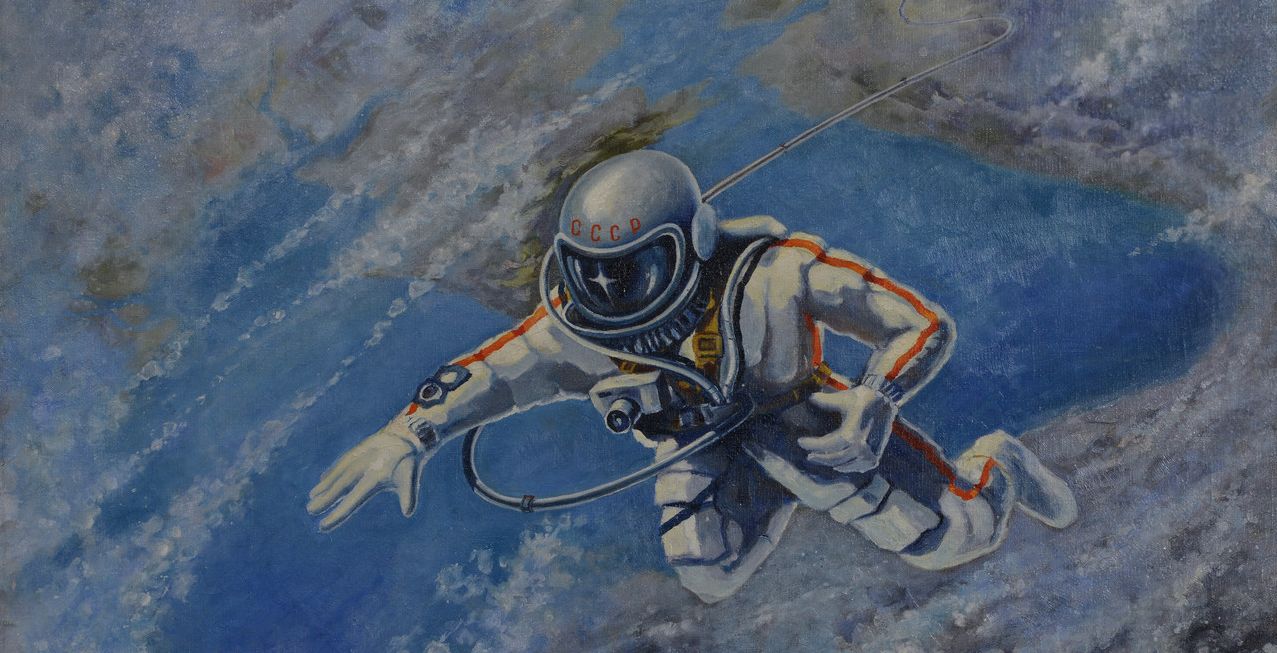
Alexei Leonov’s self portrait of his (and the world’s) first space walk, 1965.

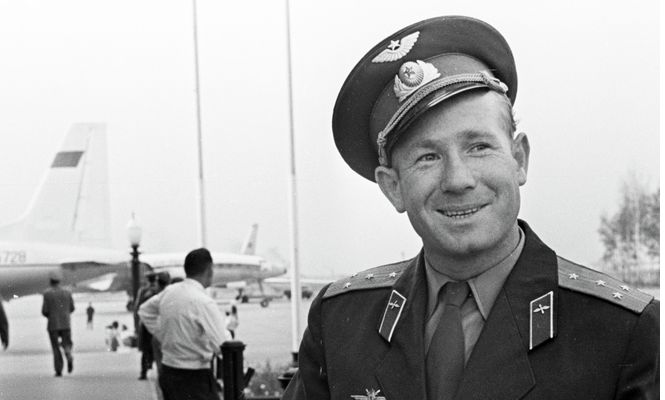
On Friday, October 11th came the news that Alexei Arkhipovich Leonov, the first man to complete a space walk, and later the commander of the Russian side of the historic Apollo-Soyuz mission, had sadly passed away at the age of 85.

Leonov was born on May 30th, 1934, in the remote Siberian village of Listvyanka, Siberia, to which his father’s family had been exiled as a result of his grandfather’s involvement in the 1905 Russian Revolution. In 1936, his railway worker / miner father was falsely accused of “improper” political views during Stalin’s purges, and was imprisoned for several years, leaving Alexei’s mother to raise her children on her own.

Leonov was known as a quick leaner with a keen sense of fun and light-heartedness, as this 1960s shot – taken before his first space flight – with his cap jauntily cocked to one side shows. Credit: RIA Novosti

Creative from an early age, Alexei developed a talent for painting and drawing, going so far as being able to sell some of his pieces for extra money. However, he was determined to be a military aviator, and when his reunited family relocated to Kaliningrad in 1948, he was able to pursue more technical studies that enabled him to be accepted into flight training in the 1950s. Posted to the the Chuguev military pilots’ academy, he graduated in 1957 as both a qualified fighter pilot and parachute training instructor, and served three tours of duty in both roles, gaining 278 hours flight time in front-line fighters and completing 115 parachute jumps while training others.

His skills as a parachutist saw him accepted into the new cosmonaut training programme in 1960 – it had been decided that for early flights, rather than landing in their capsule, cosmonauts would be jettisoned from their Vostok craft using an ejector seat similar to jet fighters, allowing them to complete the last part of their return to Earth via parachute.

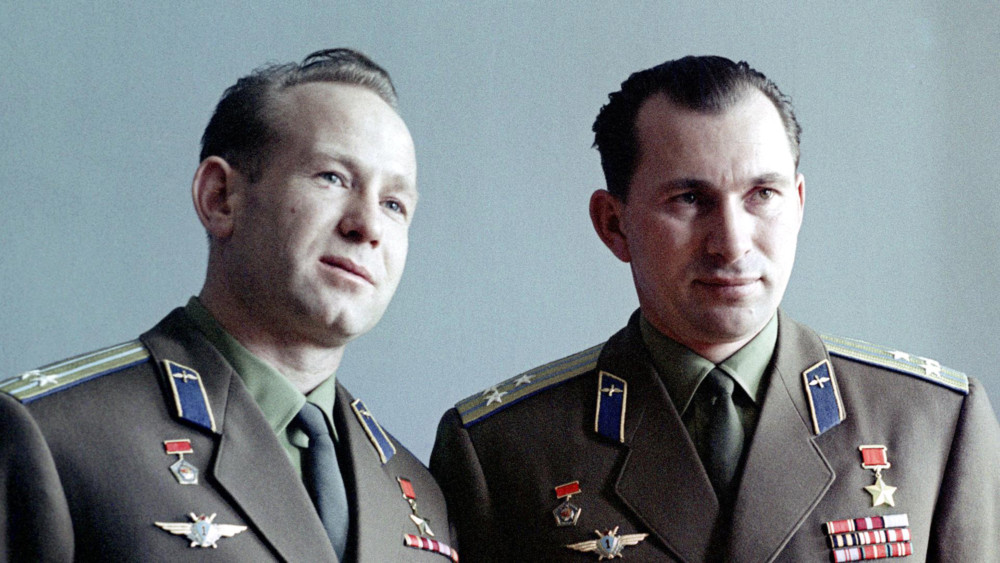
Alexei Leonov (back row, left), with some of his cosmonaut comrades, including Yuri Gagarin (first man in space), 2nd from the left, front row; Valentina Tereshkova (first woman in space), Gherman Titov (second cosmonaut in space, next to Leonov) and Pavel Belyayev (mission commander, Voskhod 2), right side, front row. This images was taken some time between April 1965 and March 1968 Credit: RIA Novosti archive

As a part of the original intake of 20 cosmonaut recruits, Leonov trained alongside Yuri Gagarin, the first human to fly in space and orbit the Earth, and Gherman Titov, the second Cosmonaut and third human in space. Like them, he was initially selected for Vostok flights, serving as back-up pilot to the 1963 Vostok 5 mission. However, before he could be rotated to a “prime” Vostok seat, he was one of five cosmonauts selected to fly the more ambitious Voskhod missions.

Voskhod was really a Vostok system but with the ejection seat and mechanism removed to make way for up to three crew seats, and with additional retro rockets attached to the descent stage to cushion the crew on landing instead of them being ejected. It was really an “interim” designed to bridge Vostok and the much more capable Soyuz (which wouldn’t fly until 1967), allowing Russia to match the America Gemini system in launching more than one man at a time. In particular, Leonov was selected with Pavel Belyayev (as mission commander) to fly the Voskhod 2 mission in which he would undertake the world’s first space walk.

This one-day mission was launched on March 18th, 1965 with the call-sign Almaz (“Diamond”). The design of the Vostok / Voskhod vehicle meant that the cabin could not be depressurised in order for a cosmonaut to egress the vehicle. Instead, a complicated airlock had to be fitted to the vehicle’s exterior. This comprised a metal mount surrounding the crew hatch, and to which was fitted an inflatable tube with a further hatch built on to it.

Alexei Leonov and avel Belyayev (r), pictured after their historic Voskhod 2 mission. Credit: unknown

Once in orbit, Belyayev helped Leonov add a backpack to his basic spacesuit that would supply him with 45 minutes of oxygen for breathing and cooling, pumped to him through an umbilical cord / pipe, and which included a second pipe and adjustable valve designed to vent small amounts of oxygen into space to carry away heat, moisture, and exhaled carbon dioxide. The airlock mechanism was then inflated and pressurised using air from the Voskhod’s supplies, extending it some 3 metres (9 ft) outward from the vehicle. After checking the integrity of the airlock tube, Belyayev opened the inward hinged crew hatch so Leonov could pull himself into the tube and the hatch re-secured behind him. Controls both inside the tube and the Voskhod allowed the airlock to be depressurised, allowing Leonov to open the inward-hinged “top” hatch.

Before exiting the tube, Leonov attached a video camera to a boom he then connected to the airlock rim, allowing live television pictures of his egress from the Voskhod to be captured and relayed to Earth. The sight of him exiting the vehicle reportedly caused consternation among some his family who didn’t understand the purpose of his mission!

When my four-year-old daughter, Vika, saw me take my first steps in space, I later learned, she hid her face in her hands and cried. “What is he doing? What is he doing?” she wailed. “Please tell Daddy to get back inside!”

My elderly father, too, was upset. Not understanding that the purpose of my mission was to show that man could survive in open space, he expressed his distress to journalists who had gathered at my parents’ home. “Why is he acting like a juvenile delinquent?” he shouted in frustration. “Everyone else can complete their mission properly, inside the spacecraft. What is he doing clambering about outside? Somebody must tell him to get back inside immediately. He must be punished for this!”

– Alexei Leonov, Two Sides of the Moon, written with U.S. Apollo astronaut David Scott.

Once clear of the airlock, Leonov encountered some difficulties. Not actually designed for the vacuum of space, his suit inflated and became semi-rigid, limiting his range of movements. He found he couldn’t reach a stills camera mounted on the front of his suit and intended to allow him to take photographs while outside the vehicle, for example. But worst was to come.

In training, Leonov had rehearsed sliding back into the airlock feet first, enabling him to easily swing the outer hatch back up into place to be secured and allow the interior of the tube to be re-pressurised so that Belyayev could then open the Voskhod’s hatch and guide him back into the spacecraft. However, he now realised he had a real problem.

With some reluctance I acknowledged that it was time to re-enter the spacecraft. Our orbit would soon take us away from the sun and into darkness. It was then I realized how deformed my stiff spacesuit had become, owing to the lack of atmospheric pressure [outside of it]. My feet had pulled away from my boots and my fingers from the gloves attached to my sleeves, making it impossible to re-enter the airlock feet first.

– Alexei Leonov, Two Sides of the Moon, written with U.S. Apollo astronaut David Scott,
describing his spacesuit issues

His only option was to enter the tube head-first and then work out how to turn himself around to close the hatch – except his suit had inflated such that it was too big to fit through the outer hatch ring. His only option was to use the oxygen relief valve to gently release pressure from the suit and deflate it. The problem? if he let out too much oxygen, he’d risk hypoxia and suffocation and if he let it out too quickly, he risked decompression sickness (or “the bends” as sea divers call it).

The first public indication that Leonov was in trouble came when the live video feed and radio broadcast were both cut and Russian state broadcasters switched to playing  Mozart’s Requiem in D Minor on repeat. Meanwhile, he cautiously went about releasing the pressure in his suit until he could wriggle his way into the airlock tube and, in a feat of contortion, turned himself around so he could secure the outer hatch. This effort proved almost too much for the suit’s primitive cooling system, and by the time Belyayev opened the Voskhod’s hatch and helped Leonov back into the capsule, he was in grave danger of passing out from heatstroke. However, their problems were far from over.

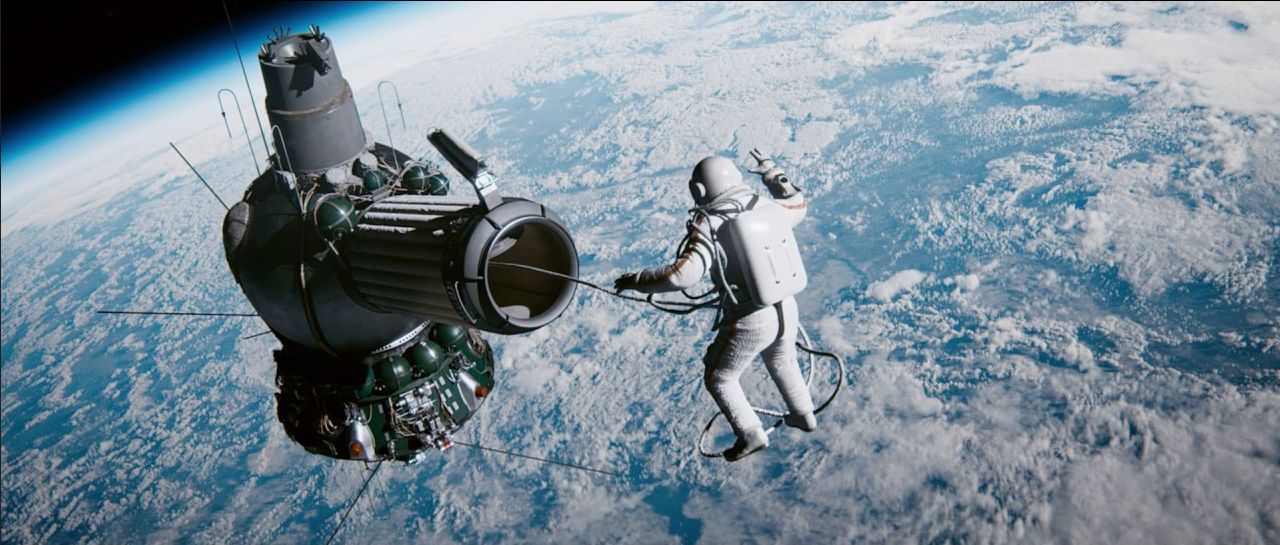
How it might have looked: a still from the 2017 Russian film Spacewalk, recreating Leonov’s historic 1965 space walk

Re-entry for the Voskhod was a three stage affair: eject the airlock, jettison the equipment module, then fire the retro-rockets on the descent module to drop the vehicle back into the denser part of Earth’s atmosphere. All of this was meant to be largely automated, but the guidance system failed due to an electrical fault taking out a number of systems, leaving Belyayev and an exhausted Leonov scrambling to handle things manually, literally clambering over one another to perform their assigned duties. As a result, the re-entry motors were fired 46 second late, enough to mean they would overshoot their planned landing site by over 380 km (241 mi).

However, this proved to be the least of their worries. No sooner had the rockets fired than the Voskhod went into a 10G spin, pinning the two men into their seats and rupturing blood vessels in their eyes. Through the observation port on his side of the vehicle, Leonov saw that the equipment module hadn’t fully separated from the descent module and lay connected to it via a communications cable. When the retro rockets fired to slow the decent capsule, the equipment module had shot past, causing the cable to snap taut and start the two modules tumbling around one another.

Continue reading “Space Sunday: the man who first walked in space”

Space Sunday: a legend, TESS and a rocket flight

“Flight”: Christopher C. Kraft Jr. (February 1924 – July 2019), the man who created NASA’s mission control and the role of the flight director. Credit: NASA

During the celebrations marking the 50th anniversary of the Apollo 11 mission in July, came a note of sadness: the passing of Chris Kraft.

This is a name that may not be familiar to some, but Christopher C. Kraft, Jr., was one of the most influential figures of NASA’s pioneering early years of America’s human space flight, who joined the agency from its forebear, the National Advisory Committee for Aeronautics (NACA).

Born in Virginia in February 1924, to Bavarian immigrants, Kraft began his studies at Virginia Polytechnic Institute and State University (Virginia Tech) studying aeronautical engineering. During this time he applied to join the US Navy, but was rejected due to an injury to his right hand that occurred during childhood. He graduated in December 1944 with a Bachelor of Science degree.

On graduation, he applied to both the Chance Vought aircraft company and NACA. On arrival at the former on his first day of work, he was told that he could not be hired without his birth certificate, which he had not brought with him. Annoyed, he returned home and accepted the offer from NACA instead.

At NACA he was assigned to the flight research division, working under Robert Gilruth, who was to become his mentor. Most of Kraft’s work was theoretical – although it did lead him to be the original discoverer of wingtip vortices causing the majority of turbulence behind an aircraft. While he enjoyed it, he also found it taxing to the point of considering leaving, when the NACA was subsumed by NASA.

Kraft (l) and mentor Robert Gilruth (r) celebrate the first orbital rendezvous between two crewed vehicles, Gemini 6 and 7, December 1965. Astronaut L. Gordon Cooper Jr stands behind them, centre, with arms folded. Credit: NASA

Gilruth then invited Kraft to join a new project he was heading – the Space Task Group – charged with putting a man in orbit. As a result, Kraft became one of the original thirty-five engineers to be assigned to Project Mercury. In his new role, he was assigned to the flight operations division at NASA, charged with determining how the Mercury missions would be managed and operated from the ground. He was reporting in to Chuck Matthews, who essentially passed off the division’s requirements to Kraft in a throwaway comment:

Chris, you come up with a basic mission plan. You know, the bottom-line stuff on how we fly a man from a launch pad into space and back again. It would be good if you kept him alive.

Kraft realised that just like test pilots, whom he had supported through the X-1 flight programmes, astronauts would need a system of communications and support back on Earth during critical phases of the mission. He also knew they would also require a ground-based tracking system and instrumentation for the telemetry of data from the spacecraft. Through this, he came up with the idea of a single control centre to monitor and operate missions in real-time; a concept never before tried.

I saw a team of highly skilled engineers, each one an expert on a different piece of the Mercury capsule. We’d have a flow of accurate telemetry data so the experts could monitor their systems, see and even predict problems, and pass along instructions to the astronaut.

– Chris Kraft, Flight: My Life in Mission Control, 2001

Within this structure, Kraft particularly identified the need for a single individual who would have overall control and coordination over the flight centre engineers, and make the real-time decisions about the conduct of the mission. He called that role the Flight Director, and nominated himself as the man for the role.

The first iteration of the mission control concept was the Mercury Control Centre at Cape Canaveral. During this time, Kraft continued to define and refine the role of the flight director, gaining the singular title Flight as a mark of respect, although his own stubbornness that could make him something of a controversial figure in the eyes of management – but not enough to prevent him being awarded the NASA Outstanding Leadership Medal on the recommendation of the NASA Administrator, and awarded by President John F. Kennedy.

During Mercury, Kraft selected and trained three engineers to become the first generation of flight directors with him:  Glynn Lunney, John Hodge and man who also grew into a legend as he followed Kraft, Gene Kranz. As the more intensive Gemini missions took place, Kraft took on a new role: head of mission operations, but remained  entirely hands-on with the flight director programme, continuing to select and train other flight directors and continuing a flight director in his own right.

Kraft, lower right, with his hand-picked team of original NASA flight directors, Gene Krantz (bottom left), Glynn Lunney, (top left) and John Hodge (top right). Credit: NASA

Mid-way through the Gemini programme, Kraft was asked to oversee the design and implementation of the brand-new mission control centre that would form a part of the new Manned Spacecraft Centre, near Houston, Texas (now the Johnson Space Centre), which would become the nerve centre for all of NASA’s human spaceflight operations.

Kraft, Lunney and Kranz worked directly on the requirements for the new mission control centre, located at Building 30 at the new space centre, liaising with contractors and determining the design of the two primary Mission Operations Control Rooms (each referred to as MOCR, or “moe-ker”).

By the mid-1960s, Kraft was made Director of Flight Operations, and closely involved in planning the Apollo programme. He joined with Gilruth, now the head of the Manned Spacecraft Centre and possibly the most powerful man in NASA next to the agency’s administrator, George Low, the manager of the Apollo Spacecraft Programme Office and Donald Kent “Deke” Slayton, the head of the Astronaut Office, to take on an entirely unofficial, but essential role:

The four of us … had become an unofficial committee that got together often in Bob’s [Gilruth’s] office to discuss problems, plans and off-the-wall ideas. Not much happened in Gemini or Apollo that didn’t either originate with us or with our input.

– Chris Kraft, Flight: My Life in Mission Control, 2001

Kraft at the flight director’s console during Gemini IV, June 1965, despite having been promoted to Director of Flight Operations. Credit: NASA

In 1969, Kraft officially became Gilruth’s deputy in running the Manned Spacecraft Centre, and succeeded him as overall facility director in January 1972. He remained in that role past his due retirement in 1980, remaining firmly embedded in the space shuttle programme. However, his stubborn and outspoken nature in matters relating to that programme brought him into conflict with NASA Administrator James M. Beggs and others, and he suddenly announced his belated retirement at the end of 1982.

Kraft indirectly returned to the shuttle programme in 1994, when he was appointed chairman of an independent review committee with the remit to investigate ways in which NASA could make that programme more cost effective. His report, published in February 1995, recommended NASA’s should outsource shuttle operations to a single private contractor.

Christopher J. Kraft Jr., February 1924-July 2019 in his official NASA portrait, 1979. Credit: NASA

More contentiously, it was sharply critical of the post-Challenger accident safety regime at NASA, claiming it was “duplicative and expensive”, while claiming the shuttle had become “a mature and reliable system”.

NASA’s own Aerospace Safety Advisory Panel responded that, “the assumption that the Space Shuttle systems are now ‘mature’ smacks of a complacency which may lead to serious mishaps.” Nonetheless, responsibility for shuttle operations was turned over to United Space Alliance.

In 2003, the investigation into the Columbia accident, directly cited the recommendations made by Kraft’s committee as potentially contributing to that accident, by encouraging NASA to view the shuttle as an operational, rather than experimental vehicle and distracting attention from continuing engineering anomalies. In typical form, Kraft  defended his report, insisting the space shuttle was “the safest space vehicle ever built”.

Kraft received numerous awards throughout his career, and in on April 4th, 2011, he was guest of honour at a ceremony at Johnson Space Centre’s Building 30 Mission Control Centre when it was renamed the Christopher C. Kraft, Jr., Mission Control Centre, in recognition of the facility’s 50 years managing US human space flight, and Kraft’s unique place in both NASA’s and the building’s histories.

Christopher Kraft passed away on July 22nd, 2019 at the age of 95 and leaving his wife of 69 years, Betty Anne, and son and daughter Gordon and Kristi-Anne, and their families.

Continue reading “Space Sunday: a legend, TESS and a rocket flight”

Space Sunday: the Moonwalker and the artist

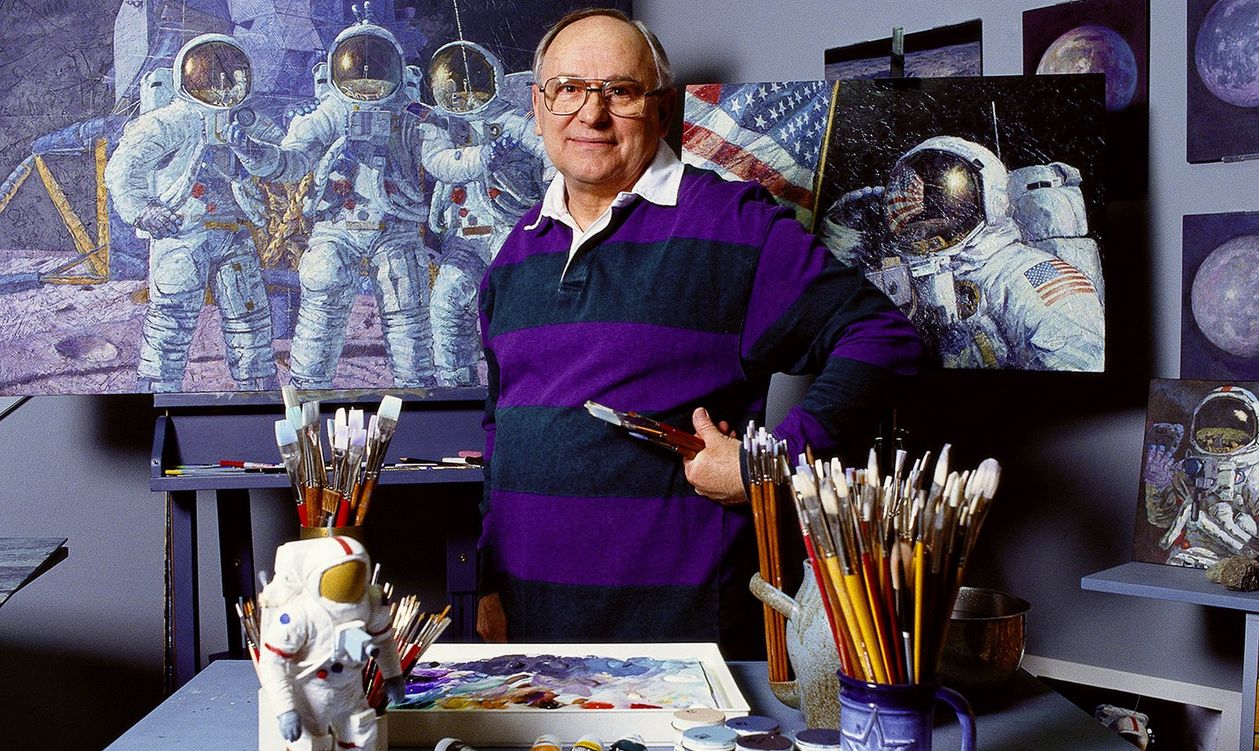
Astronaut and painter, Alan Bean in his Studio in Texas. Credit: unknown

The pool of men who flew to the Moon, and those who walked on its surface, as a part of NASA’s Apollo programme is sadly shrinking. And on Saturday May 26th, 2018, it became even smaller with the news that Alan Bean, the fourth man to set foot on the Moon had passed away.

His passing was unexpected. Although 86 years of age, he was in good health and was travelling with his family when he suddenly fell ill while in Indiana two weeks ago. He was taken to the Houston Methodist Hospital in Houston, Texas, to receive treatment, but passed away whilst at the hospital.

Born on March 15th, 1932 in Wheeler County, Texas, Alan LaVern Bean received a Bachelor of Science degree in Aeronautical Engineering from the University of Texas, Austin in 1955. While at the UT Austin, he accepted a commission as a U.S. Navy Ensign  in the university’s Naval Reserve Officers Training Corps and attended flight training.

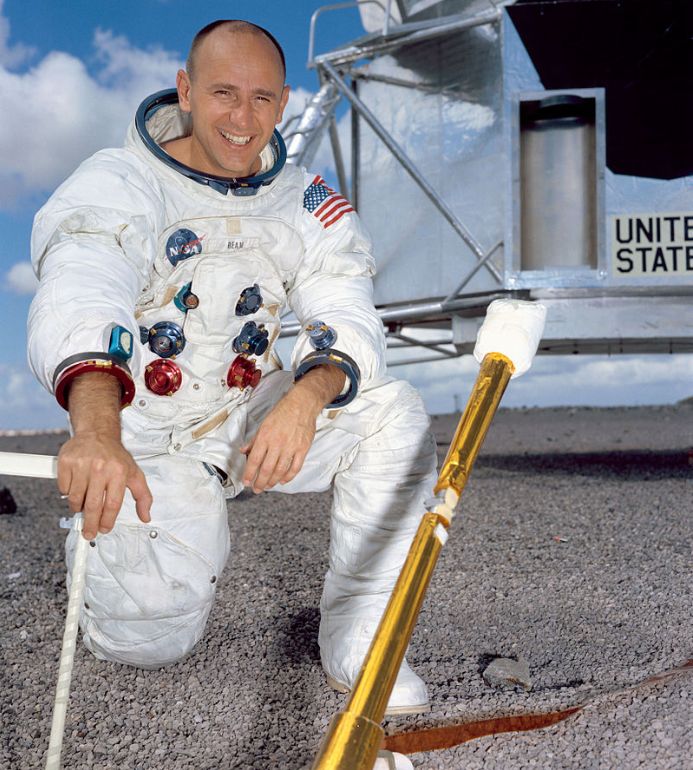
Alan Bean in 1969 in a NASA publicity photograph ahead of the Apollo 12 mission. Credit: NASA

Qualifying as a pilot in 1956, he served four years  based in Florida flying attack aircraft. He was then posted to the U.S. Naval Test Pilot School (USNTPS) at Patuxent River, Maryland, where his instructor was the irrepressible Charles “Pete” Conrad. The two stuck up an enduring friendship which was to eventually take them to the Moon.

As a naval test pilot, Bean flew numerous aircraft prior to transferring back to fighter operations in 1962, again serving in Florida for a year. In 1963, he was accepted into NASA as a part of the Group 3 astronaut intake.

He had originally applied as a part of the Group 2 intake in 1962 alongside Conrad, but failed to make the cut. Coincidentally, Conrad’s Group 2 application  – which was successful – was also his second attempt to join NASA. He’d actually been part of the Group 1 intake, but  – always rebellious – he walked away for being subject to what he felt were demeaning and unnecessary medical and psychological tests.

Bean’s flight career at NASA was initially choppy: he was selected as a back-up astronaut with the Gemini programme but did not secure a flight seat. He then initially failed to gain an Apollo primary or back-up flight assignment. Instead he was assigned to the Apollo Applications Programme testing systems and facilities to be used in both lunar missions and training for flights to the Moon. In this capacity he was the first astronaut to use the original Weightless Environment Training Facility (WETF). This is a gigantic pool in which astronauts may perform tasks wearing suits designed to provide neutral buoyancy, simulating the microgravity they will experience during space flight. He became a champion for the use of the facility in astronaut training, which was used through until the 1980s, when is was superseded by the larger Neutral Buoyancy Laboratory (NBL) used in space station training.

On October 5th, 1967, Apollo 9 back-up Lunar Excursion Module (LEM) pilot Clifton Williams was tragically killed in an air accident. As a result, “Pete” Conrad, the back-up crew commander specifically requested Bean be promoted to the position of his LEM pilot. This placed the two of them, together with Command Module (CM) pilot Richard F. Gordon Jr on course to fly as the prime crew for Apollo 12, the second mission intended to land on the Moon.

Bean and Conrad approached their lunar mission with huge enthusiasm and commitment. In contrast to some of their comrades, who at times found the intense geological training the Apollo astronauts went through a little tiresome, they became extremely engaged in the training – which resulted in them gathering what Harrison Schmitt – the only true geologist to walk on the Moon thus far – later called, “a fantastic suite of lunar samples, a scientific gift that keeps on giving today.”

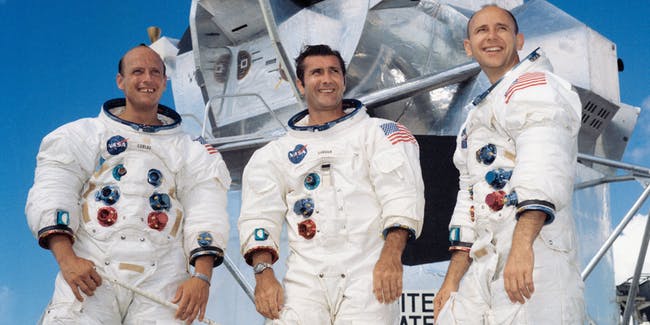
The Apollo 12 crew (l to r): Charles “Pete” Conrad, Commander; Richard F. Gordon Jr , Command Module pilot; and Alan Bean, Lunar Excursion Module pilot. Credit: NASA

In particular, Bean and Conrad became deeply involved in one of the primary aspects of their mission – a visit to the Surveyor 3 space craft.

The Surveyor programme was a series of seven robotic landers NASA sent to the Moon between June 1966 and January 1968, primarily to demonstrate the feasibility of soft landings on the Moon in advance of Apollo. Scientists were particularly keen that Conrad and Bean land close enough the probe so they could collect elements from it for analysis on Earth to see what exposure to the radiative environment around the Moon had treated them.

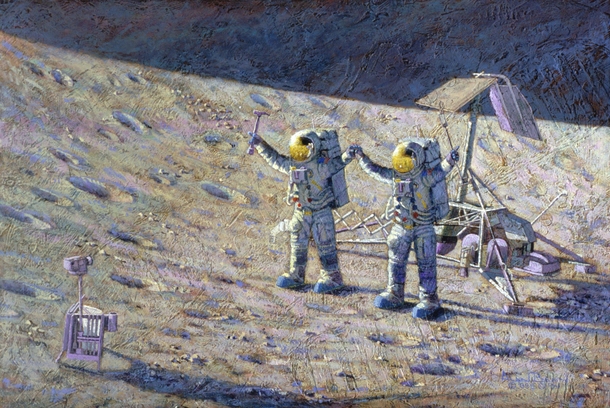
However, Bean had his own plans for the trip to the Surveyor vehicle: with Conrad, he conspired to smuggle self-timer for his Hasselblad camera in their equipment. The pair planned to secretly set-up the camera and use the timer to capture a photograph the pair of them standing side-by-side on the Moon – and confuse the mission control team as to how they had managed the feat! Unfortunately, Bean couldn’t locate the timer in their equipment tote bag until it was too late for the picture to be taken. Instead, he later immortalised the scene in his painting The Fabulous Photo We Never Took.

“The Fabulous Photo We Never Took” by Alan Bean. Courtesy of alanbean.com

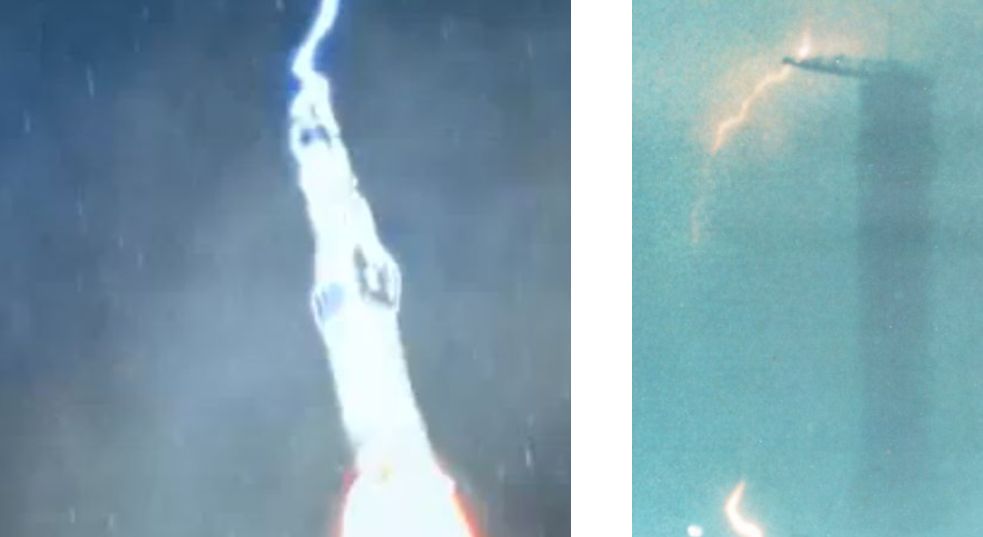
Apollo 12 launched on schedule from Kennedy Space Centre on November 14th, 1969, during a rainstorm. Thirty-six-and-a-half seconds after lift-off, the vehicle triggered a lightning discharge through itself and down to the Earth through the Saturn’s ionized plume. Protective circuits on the Service Module falsely detected electrical overloads and took all three fuel cells off-line, along with much of the Command/Service Module (CSM) instrumentation.

A second strike then occurred 15.5 seconds later, resulting in further power supply problems, illuminating nearly every warning light on the control panel as it caused a massive instrumentation malfunction. In particular, the “8-ball” attitude indicator was knocked out and the telemetry feed to Mission Control became garbled. However, the vehicle continued to fly correctly, the lightning not having disrupted the Saturn V’s own instrumentation unit.

Left: Apollo 12 is struck by lightning, the discharge passing down the vehicle into its exhaust plume. Right: the launch complex tower is also struck by lightning after the departure of the Saturn V rocket. Credit; NASA

Continue reading “Space Sunday: the Moonwalker and the artist”

Space Sunday: Stephen Hawking

Stephen Hawking, circa 1970

He was the galaxy’s most unlikely celebrity; a man almost every human with a passing interest in space, news or current affairs had likely heard of, even if they didn’t understand his work. For 55 years he “beat the odds”, so to speak, in living with a terminal illness, a rare form of early onset of motor neurone disease (also known as amyotrophic lateral sclerosis (ALS), or Lou Gehrig‘s disease).

Most of all, he forever altered or perception of the cosmos around us. He was able to take the obscure, fringe-like science of cosmology and make it possible the most compelling of space sciences through his insights into gravity, space and time which easily match those of Einstein.

I’m of course speaking about Professor Stephen Hawking, CH CBE FRS FRSA, who passed away on March 14th, 2018 (coincidentally anniversary of the birth of Albert Einstein).

Born on January 8th 1942 (coincidentally, the anniversary of the death of Galileo Galilei) in Oxford, England, Stephen Hawking had a modest  – oft described as “frugal” – upbringing. School for the young Stephen was not initially filled with academic prowess – he would later blame the “progressive methods” used at his first school in London, for his failure to learn to read while he attended it.

Things improved after a move to St. Albans, Hertfordshire, where he took his eleven plus examination a year early while attending the independent  St Albans School. His parents hoped he would be able to attend the well-regarded Westminster School, London from the age of 13. However, illness prevented him from taking the entrance examination which would have earned him a scholarship to the school, and without it, his parents could not afford the fees.

Instead, Hawking remained at St Albans, spending his time among a close group of friends, gaining an interest in making model aeroplanes, boats, and also fireworks. Most notably at this time, Hawking entered the influence of Dikran Tahta, his mathematics teacher.

Tahta encouraged Hawking’s interest in mathematics and physics, and urged him to pursue one or the other at University. Hawking’s father, however, wanted his son to follow his footsteps and attend his old Alma Mater, University College, Oxford to study medicine. Unwilling to disappoint his father in his choice of college, but heeding Tahta’s urgings, Hawking enrolled at the college, selecting physics as his subject, mathematics not being a part of the college’s curriculum at the time. He would later declare that Tahta was one of greatest influences on his life, alongside Dennis Sciama and Roger Penrose.

Three major influences on Hawking life: mathematics teacher Dikran Tahta (l), cosmologist Dennis William Sciama (c) and Professor Sir Roger Penrose (r), with whom Hawking collaborated on several of his early papers

Hawking started his university education in 1959 at the age of 17. For his first year-and-a-half he was “bored”, and found his studies “ridiculously easy”. His physics tutor, Robert Berman, would later comment, “It was only necessary for him to know that something could be done, and he could do it without looking to see how other people did it.”

During his second year, Hawking became more outgoing – and as a result, more interested in non-academic pursuits. In particular, he joined the college boat club as a coxswain, quickly becoming popular and fiercely competitive, gaining a reputation as a “daredevil”, often picking risky courses for his crew – sometimes leading to the boat being damaged in his thirst for victory.

The result of this was that his studies suffered, and he admitted that by the time his final examinations came around, he was woefully ill-prepared to take them. As a result, he opted only to answer the theoretical physics questions on his paper, knowing he had insufficient knowledge to answer the factual questions. He gambled doing so would  be enough to get him the first-class honours degree he needed if he were to attend Cambridge University for  his post-graduate studies in cosmology.

Hawking (r) coxing an eight at the University College Boat Club at the University College, Oxford, circa 1960

The gamble almost paid off: his results put him on the borderline between first- and second-class honours, requiring he complete an oral exam. As it turned out, his examiners realised they were facing someone far brighter than they on hearing him, and the first-class honours was duly awarded.

Hawking began his graduate work at Trinity Hall, Cambridge, in October 1962 and once again found things difficult. He had hoped to study under Sir Fred Hoyle, but instead found Dennis William Sciama, one of the founders of modern cosmology, was his supervisor. It was at this time that Hawking was diagnosed with motor neurone disease, and given just two years to live.

Understandably, this caused him to almost give up on his studies – only his relationship with his sisters friend, Jane Wilde, whom he met not long before his diagnosis, held interest. The two  became engaged in October 1964 and married in July 1965, Hawking commenting that Jane “gave him something to live for”. However, Sciama was not done with Hawking; throughout this period, he gradually persuaded Hawking to resume his studies.

Hawking met Jane Wilde, his first wife, shortly before he was diagnosed with motor neurone disease. They married in 1965, and together had three children – Lucy, Robert and Tim. They divorced in 1995.

Continue reading “Space Sunday: Stephen Hawking”

Space Sunday: in memory of John Young

John Young: Gemini (l), Apollo, shuttle and in 2002, two years prior to his retirement from NASA after 42 years with the agency (r). Credit: NASA / Getty Images

On Saturday, January 6th, 2018, NASA announced the passing of astronaut John Watts Young. The US space agency’s longest-serving astronaut during his career, Young passed away on January 5th at the age of 87. He flew in space six times across three different space programmes: Gemini, Apollo and the space shuttle.

Young was born in San Francisco, California, on September 24th, 1930, and earned a Bachelor of Science degree with highest honours in Aeronautical Engineering from the Georgia Institute of Technology in 1952. He served in the US Navy from 1952 through 1962, serving as a seaborne officer prior to entering flight training , qualifying as a jet fighter pilot in 1953. After flying front-line fighters for 5 years, he joined the US Navy Air Test Centre in 1959, evaluating fighter aircraft and weapons systems.

In 1962, Young joined NASA and was part of Astronaut Group 2 alongside Neil Armstrong first man on the Moon, Charles “Pete” Conrad, commander of the first crewed Skylab mission,  Frank Borman, commander of the first Apollo flight to the Moon (Apollo 8), James “Jim” Lovell, commander of Apollo 13, Thomas Stafford, commander of the US part of the Apollo-Soyuz Test Project (ASTP) mission, and Edward “Ed” White, who was to be killed in the Apollo 1 pad fire. He was the first of that group to fly in space as a part of the Gemini programme, the second of America’s manned spaceflight programmes, and the precursor to Apollo and the lunar effort.

John Young (r) with Gemini 3 commander Virgil “Gus” Grissom, standing in front of the Gemini simulator. Credit: NASA

He first flight into space was aboard Gemini 3 on March 23rd, 1965, sitting alongside Virgil “Gus” Grissom, the mission commander. The primary goal of the mission was to put the Gemini capsule through its paces during a 3-orbit flight – America’s seventh crewed spaceflight (or ninth, if you count two X-15 flights). It was also the final mission  controlled from Cape Kennedy Air Force Station in Florida (Cape Canaveral Air Force Station today), before mission control functions were shifted to the newly opened Manned Spacecraft Centre, known today as the Johnson Space Centre.

The mission was noted for the “contraband” corned beef sandwich Young smuggled onto the flight in his spacesuit. Grissom knew nothing of the sandwich until Young produced it, and both men took a couple of bites each before Young stowed it again to avoid crumbs getting into the capsule’s electronics. Post-mission, Grissom commented, “After the flight our superiors at NASA let us know in no uncertain terms that non-man-rated corned beef sandwiches were out for future space missions. But John’s deadpan offer of this strictly non-regulation goodie remains one of the highlights of our flight for me.”

The sandwich incident seemed to leave Young sidelined; rather than being pencilled for a command slot, he was relegated to the role of back-up. However, with the Apollo programme starting to ramp-up, Ed White was rotated over to the Apollo 1 crew, and this opened a slot in the Gemini programme for Young to take the command of Gemini 10 in 1966. The 8th manned Gemini flight and with Michael Collins flying alongside Young, Gemini 10 was the first to perform a rendezvous with two Agena target vehicles.

The spacecraft launched on July 18th, 1966, 100 minutes after its dedicated Agena target vehicle. After a successful rendezous and docking, they re-ignited the Agena’s motor, the first time this had been done, and used it to raise their orbit from an average altitude of 265 km (145 nautical mile) to a 294 by 763 km (159-by-412-nautical-mile) orbit, ready for a rendezvous with the Agena target vehicle intended to be used by Gemini 8, which was unable to complete its mission. Collins then completed the first of two EVAs after the crew had rested, and then Gemini 10 detached from its own Agena to make a successful docking with the passive Gemini 8 target vehicle – the first such docking without any assistance in handling the target vehicle from Earth. After a further rest period, Collins performed a second spacewalk. With a double doubling, two EVAs and 10 science experiments, Gemini 10 was one of the most comprehensive space missions completed up to that time, with the capsule splashing down on July 21st, 1966.

John Young and Michael Collins, the crew of Gemini 10, 1966. Credit: NASA

For the Apollo programme, Young was initially assigned to back-up crews. However, following the Apollo 1 fire which killed Grissom, White and Roger Chaffee, the flight roster was reshuffled, and Young was placed on the Apollo 10 crew as Command Module Pilot. This mission, which also included Thomas Stafford and Commander and Eugene Cernan as the Lunar Module Pilot, was the final Apollo mission prior to the missions to the surface of the Moon, and was the second – after Apollo 8 –  to actually fly to the Moon.

Launched on May 18th, 1969, the only Apollo Saturn V mission to lift-off from Launch Complex 39B, and only one of two Apollo missions to feature crews who had all previously flown in space (the other being Apollo 11). Reaching the Moon on May 21st, 2969, the Apollo 10 crew became – and remain – the humans  who have travelled the farthest from their homes. This is because the Moon is in an elliptical orbit around the Earth, which varies by some 43,000 km (23,000 nmi) between perigree (the point closest to the Earth) and apogee (the point farthest from the Earth), and Apollo 10 was the only Apollo mission to take place as the Moon was approaching apogee, meaning the crew were some 408,950 km (220,820 nmi) from their homes and families in Houston.

On reaching the Moon, Young was left aboard the Command and Service Module (CSM), code-named Charlie Brown, while Stafford  and Cernan took the Lunar Excursion Module (LEM) Snoopy to some 14.4 km (8 nmi) of the lunar surface, allowing them to overfly and survey the Apollo 11 landing area in the Sea of Tranquillity. To avoid the risk of Stafford and Cernan actually landing on the Moon, the LEM had been short-fuelled, forcing them to fire the descent unit motor to start an ascent back up to orbit. However, this initially did not go smoothly.

Due to a small series of input errors by Stafford and Cernan, Snoopy’s guidance system had the craft pointing in the wrong direction, and on engine firing, the LEM went into a violent spin. It took both men several seconds to recover control – time enough for the LEM to crash on the Moon. In the event, control was regain, the decent unit was jettisoned as its feul was expended, and the ascent stage motor carried Cernan and Stafford safely to a rendezvous with the CSM. Following the excitement of the initial ascent, Stafford reported the successful rendezvous and docking by radioing Earth with the message, “Snoopy and Charlie Brown are hugging each other.”

After Apollo 10’s return to Earth on May 26th, 1969, Young started training as back-up commander for Apollo 13. When disaster stuck that mission he played a central role in the team that developed procedures to stretch the Lunar Module consumables and reactivate the Command Module systems prior to re-entry, saving the Apollo 13 crew. Young then rotated into the Command slot for Apollo 16, with LEM Pilot Charles Duke and CSM Pilot Ken Mattingly.

Apollo 16 lifted-off on April 16th, 1972, and Young and Duke arrived in the Descartes Highlands on April 21st, 1972, at the start of the second-longest lunar surface mission (Apollo 17 being the longest). In 71 hours on the Moon, conducting three extra-vehicular activities or moonwalks, totalling 20 hours and 14 minutes, driving Lunar Roving Vehicle (LRV) 26.7 km (16.6 mi) and collecting 95.8 kilograms (211 lb) of lunar samples for return to Earth. Young was the ninth man to walk on the surface of the Moon, and in typical style, was exuberant throughout: jumping clear of the surface while saluting the US flag, and setting a speed record driving the LRV.

Continue reading “Space Sunday: in memory of John Young”