Images of Entropy in Second Life

Nitroglobus: Entropy, May 2020

Officially open from Tuesday, May 5th at Nitroglobus Roof Gallery curated by Dido Haas, is Entropy, by EmberPolaris.

In terms of thermodynamics, entropy is defined as:

A measure of the unavailable energy in a closed thermodynamic system that is also usually considered to be a measure of the system’s disorder, that is a property of the system’s state, and that varies directly with any reversible change in heat in the system and inversely with the temperature of the system.

More informally, entropy is referred to as a general running down of the universe into a state of disorder. For her exhibition, Ember presents an almost Shakespearian view of modern life; one in which we might as a well be mannequins, we have so little little say in the fate of the universe as a whole; that all we say and do, all that we build, is merely a stage for the greater passage of life – ours and the universe’s.

Nitroglobus: Entropy, May 2020

It is a stark, but captivating view of things; one that might be referred to as emphasising the futility of life. But there is more here; through the use of mannequins in place of humans, Entropy folds within it question of identity – not only who we are or might be, but also a challenge as to what our role in life might be when framed against the bigger backdrop of the universe’s slow passing.

More then this, through the framing of each picture is a reminder that creation – and creativity – can offer a richness of beauty that far surpasses any darkness that might otherwise be inherent in these pictures: sunlight falling through the scaffolding of an advertising hoarding, Shadows falling across an alleyway or a sudden bright splash of colour amidst the grey; sunlight falling through clouds. 

There is a stark beauty within these pieces that is astonishing; life is present in every image, the use of mannequins as models notwithstanding; a vitality that stands in contrast to the basic meaning of entropy. There is also, conversely, the suggestion of disorder that is entirely in keeping with the precepts of entropy; it surrounds and enfolds the sense of order also suggested elements present in these pictures and their sense of structure and order of life as can be witnessed in the settings for many of these images.

Nitroglobus: Entropy, May 2020

Those Entropy is a richly layered exhibit, offering multiple commentaries on life, the universe, and our place within it, as well as presenting rich images in and of themselves.An excellent first-time exhibition from an artist I hope we’ll see more of in the future.

SLurl Details


Birds and Blue: a Nitroglobus escape in Second Life

Nitroglobus: Birds & Blue

As I’ve oft noticed in these pages, through her Nitroglobus Roof Gallery, Dido Haas presents some of the most evocative, engaging art to be found in Second Life. I’m constantly drawn back to the gallery each month as Dido has the ability to draw out the very best in the artists she invites to exhibit there, gracefully coxing their own inner voices to the fore.

However, Dido is herself a gifted photographer, although it is rare that she places her own art into the spotlight at her gallery. It is in part because of this that the latest exhibition at Nitroglobus is so attractive, because for April she offers a selection of her own work. I say “in part”, because Birds & Blue is very much a joint presentation from Dido (photography) and Harry Cover (ImpossibleisnotFrench – 3D elements).

We’ve turned Nitroglobus into a large pond, with the soothing sound of rippling water. Harry added awesome blue boats, barrels and super cool birds he made specially for this installation … For my part selected snapshots from my blog posts, which I made blue to fit into the mood of this installation, and I’ve added pieces of land (thx Miu) with seats and parasols, waving blue flower beds, rusty wind turbines, a beach hut, an animated rock and more… We hope you like to wander around, ‘cos it’s fun and should be enjoyed as such.

– Dido Haas describing Birds and Blue

Nitroglobus: Birds & Blue

The result is a setting that might be said to be much needed in the current times: big enough to have a wander around and enjoy the sounds and the setting; small enough to suit those who would rather just sit and admire the art and let the sounds wash over them and escape daily worries.

Tinted blue for the theme, Dido’s images further offer a means to relax and forget the worries of the world. Offering wide-open views, oft with coastlines and water, each piece sits as a window through which we can escape, perhaps to join Dido as she appears in many of the pictures, and share in her exploration.

When visiting, make sure you make your way up to the high beach house, where two of Dido’s black-and-white self-portraits offer s contract to the blue tones below.

Nitroglobus: Birds & Blue

A different kind of exhibition for Nitroglobus, but one that is nevertheless richly attractive.

SLurl Details

Questioning the meaning of love in Second Life

Nitroglobus Roof Gallery: The Meaning of Love

Now open at Nitroglobus Roof Gallery, curated by Dido Haas, is The Meaning of Love, an exhibition by street photographer Natalia Serenade.

Noted for her vivid use of colour and composition, Natalia notes that her art is centred on physical world photography that are very much images caught in the moment as she roams with her camera, and then mixed together, given life and colour through Photoshop to become statements in their own right.

For the Meaning of Life, Natalia brings together a series of images that offer reflections and comments on love and relationships as they can occur in the virtual realm (but do not always remain there). Such relationships can, as many have learned over the years that Second Life has been around, be deeply rewarding – adding depth and light to our virtual presence, offering love, closeness and comfort that never need to stray out of the confines of this digital medium.

Nitroglobus Roof Gallery: The Meaning of Love

Sometimes it is possible for such relationships to reach beyond the digital and into the physical and become even more enriching for those involved. This is something the Lab has sought to emphasise through the video series Love Made in SL. But virtual relationships can also be fraught with uncertainty.

Anonymity allows us far greater freedom than the physical world; this is both a blessing and a curse – a point people can so easily forget when blithely quoting Wilde. “Man is least himself when he talks in his own person. Give him a mask, and he will tell you the truth” is only half the story. While we may well speak a great truth through the freedom given us by the mask of an avatar, so to does that same mask allow those who would  – if I might use half another famous quote, if slightly out-of-context and this time from Sir Walter Scott – “practice to deceive”.

Nitroglobus Roof Gallery: The Meaning of Love

To put it another way, when restricted to the the virtual, how can we ever be sure what we’re being told is the truth? What about those who enjoy the art of deceit and think nothing of using one or more alts achieve their own satisfaction? How can we even be sure such thoughts as these really have a grounding in “reality”, rather than being a product of our own uncertainty / hidden fears?

All of these ideas are explored in the images Natalia presents here: the warming glow of being basked in the happiness of love and of having “found someone”, the first rising concerns that al might not be as it seems, the realities of being manipulated, the uncertainties created by our own thoughts, the deceptions of which we might be guilty in keeping our on-line life and lives hidden from those physically around us. Each image in this collection of thirteen represents an aspect of love and the rewards / risks it brings. Each image richly makes use of colour as much as form  and subject to convey visceral feelings and emotions.

Nitroglobus Roof Gallery: The Meaning of Love

It’s an engaging, vibrant exhibit (be sure to mouse over individual pieces to see names / gain context, and one in which Natalia appears to be asking a question – perhaps of herself more than anyone else: is love in SL real, or just – for most at least – a fantasy?

SLurl Details

Rose’s Feelings at Nitroglobus

Nitroglobus Roof Gallery: Feelings

Currently open at Dido Haas’ Nitroglobus Roof Gallery is Feelings, a selection of self-portraits presented by RoseHanry. It’s a evocative series of 12 images, each one of which has a deceptively simple presentation that nevertheless encompasses a wealth of care, and eye for detail and narrative to offer a startlingly life-like finish that richly imbues each image with Rose’s own life and vitality.

This is something Rose notes herself in discussing her art, stating:

Second Life is more than a game and the avatar is more than a pretty doll. There’s a human behind the keyboard, who experiences feelings and hopes, has a Real Life with the normal issues that life offers, Some are good and some are not so good. Real Life is not detached from Second Life as most people think, or want to make us believe.

In this exhibition I try to show that an avatar is very natural and can show feelings as in Real Life.

Nitroglobus Roof Gallery: Feelings

And so it is that each of the twelve images within this exhibition offer an emotional depth that is stunning; expression, pose and lighting allow us to see far beyond the avatar. Many not as posed shots, but as candid captures that record a passing and quite natural moment in time (vis: … a beating heart of stone …, … when I wake up, I see you with me …, … when I wake up, I see you with me …, and … maybe if I’d skim the stone …), when the subject is caught by the camera without being aware it was watching.

In others, while as candid, there is a sense that the subject was aware of the camera’s eye, so took a moment to respond to its stare with a deliberate look intended to tease or flirt (… another one bites the dust …) or with a natural response to being caught (as with …2am…, with the defensive drawn-up knees).

Thus, throughout the collection we are presented with images that each has a tale to tell; a tale furthered by Rose’s inclusion of a link to be found in the lower right-hand corner of each image. Clicking on most of these will present you with a note card containing song lyrics reflective of the image and mood, and with a link to the song on You Tube (one simply offers a link to the song itself).

Nitroglobus Roof Gallery: Feelings

For me, the defining element of each picture lies in the eyes. We’re probably all familiar with the old saying, the eyes are the windows of the soul. Here, it is the case that the avatar’s eyes are the windows to the the avatar’s owner herself. Through them, we can perhaps capture the riches of each pictures’ story, even without reference to the accompanying note cards – and I would recommend viewing and considering each picture first before turning to the the note card giver.

A truly fascinating exhibition. One – as with all of those at Nitroglobus – that should not be missed.

SLurl Details

Moni’s Forbidden Fruit at Nitroglobus in Second Life

Nitroglobus Roof Gallery: Forbidden Fruit

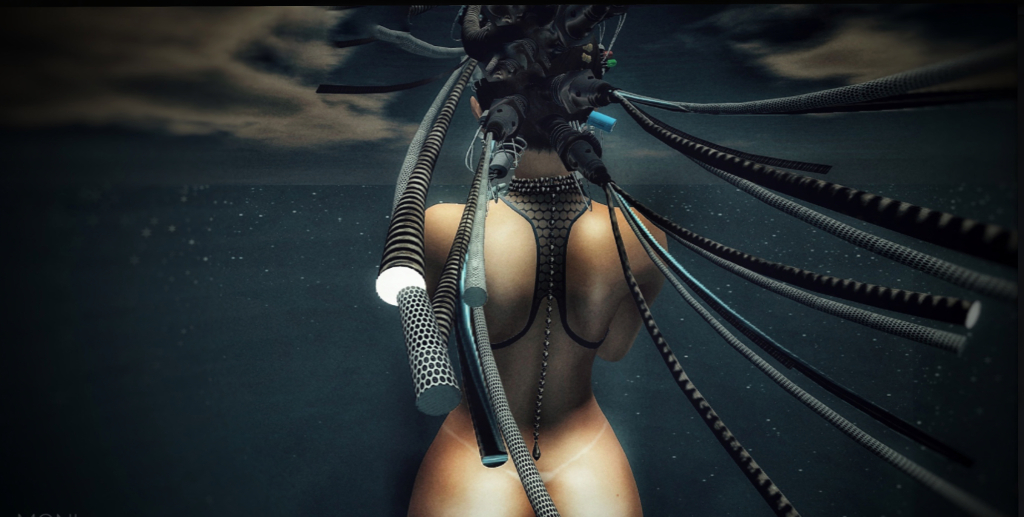
Monique “Moni” Beebe makes a further return to Dido Haas’ Nitroglobus Roof Gallery to mark the start of the year, with her latest exhibition Forbidden Fruit.

Moni is one of the most sensuous, evocative artist and – given she is generally the subject of her own work – models in Second Life, somthing I’ve noted in the past, as such I’ve been looking forward to seeing her latest exhibition since Dido tipped me the wink that Moni would be making a further return to Nitroglobus. She has the ability to present studies that are rich in mood, sensuality, nuance, story and sexuality – the latter without relying on being blatant provocation.  Rather, they are genuine works of art that would be fully at home in any physical world gallery as they would in a virtual setting.

Nitroglobus Roof Gallery: Forbidden Fruit

This latter point is very much proven with the selection of work forming Forbidden Fruit, which marks something of a departure from Moni’s previous exhibitions at Nitroglobus – Hidden Faces , Sensuality, and Changing Moods – in that for some of the pieces here, Moni has found inspiration in the work of a another artist, as Dido explains:

Moni got inspired by a RL exhibition of famous Dutch photographer Erwin Olaf, which she visited last Spring in the Gemeente Museum The Hague. Especially the mood of the early series Squares and Chessmen by Mr Olaf you will notice are reflected in some of the images of this present exhibition.

Such is Moni’s compositional eye that she presents a unique perspective on Olaf’s work (take Stone as an example) which is far from derivative – but which would nevertheless be completely at home in an exhibition such as Chessmen.

Nitroglobus Roof Gallery: Forbidden Fruit

For me, the power of Moni’s work is her ability to offer a tale of sensuality through pose and / or focus on bodily curve without necessarily utilising exposing nudity or full facial expression (which is not to say nudity is not present in some of the pieces here). Take the titular Forbidden Fruit, for example. It carries a rich sensuality that evokes feelings of desire bordering on lust, heightened by the use of clothing and the hiding of Moni’s eyes under the wrap. This particular piece also highlights another maturing aspect of Moni’s work: her ability to layer narrative and images; in this case the pairing of a woman with prominently placed apples offers a suggestiveness of story that reaches all the way back to Eve, the apple and a certain serpent – and what form the knowledge may have taken.

There is also a richness of self about Moni’s work that I again find attractive perhaps more than other artists who produce images using their avatars as models; Moni offers subtle insights into her personality and nature – with the emphasis on subtle. This heightens the response to her work that can reach beyond examining any single image or selection of images, to tickle the desire to know her personally.

Nitroglobus Roof Gallery: Forbidden Fruit

Rounded-out with lounge, a sculpture by Kaiju Kohime that sits perfectly with Moni’s images, this is again a marvellous exhibition by an exceptionally talented artist and visualist.

SLurl Details

Art in reflection of self and poetry in Second Life

Nitroglobus: Maloe Vansant, “The moon lives in the lining of your skin”

Available at Nitroglobus Roof Gallery, curated by Dido Haas, is an exhibition of art by Maloe Vansant that takes as its inspiration, words offered by Chilean Nobel Laureate Ricardo Eliécer Neftalí Reyes Basoalto – better known as poet Pablo Neruda.

In Ode to a Beautiful Nude, Neruda offers a song of love and appreciation for the flawless beauty of a model appearing before him. The poem offers a lyrical examination of the woman, initially acknowledging his desire to appreciate her in a chaste manner rather than giving into more carnal desires – although the praise he goes on to offer towards her beauty carries with it an undertone of that desire throughout, before culminating in the line:

The moon lives in the lining of your skin.

– Pablo Neruda, Ode to a Beautiful Nude.

Nitroglobus: Maloe Vansant, “The moon lives in the lining of your skin”

It is this line that Maloe takes as the title of her exhibition at Nitroglobus. Within it, she offers an exploration of self and beauty as reflected in the moods and words found throughout the poem, whilst at the same time offering insight into the relationship between artist and avatar.

After creating little Maloe, my barbie doll, my pixel soul, I discovered the possibility of making snapshots and I started to make a graphic diary of Maloe’s journey in Second Life, showing the emotions she experienced in this pixel world … I am not a woman of many words, I try to express myself, my feelings, my passion and probably my dark side through my pictures.

Maloe Vansant, describing her relationship with her avatar.

The use of Neruda’s words might suggest that Maloe is offering a visual homage to his poem  – something that has been done before in Second Life (see: Poems and art in Second Life, April 2016). However, this would not be a fair assessment. The art and poem stand apart from one another in the extent of their explorations, but at the same time they are entwined by common themes of giving for and depth to the the nature of natural beauty. Therefore, one is neither a homage to the other.

Nitroglobus: Maloe Vansant, “The moon lives in the lining of your skin”

One of the interesting contrasts been poem and art is in their examination of beauty. Whereas the poem perceives the beauty and reflection of the soul from without; Maloe’s art does so from looking out from within. One of the interesting links between the two is in their use of metaphor.

Take eyes, for example. In his Ode, Neruda acknowledges The two deep countries of your eyes, so often seen a a window into a person’s soul. Within The Face is a Picture of the Mind, focused as it is one the eye of her avatar, presents a similar examination of the eye and soul.

Elsewhere, each uses metaphor from somewhat different perspectives. With his poem, Neruda uses metaphor to encapsulate that push-pull between wanting to appreciate feminine beauty both from a celibate objectivity and that of a more carnal desire:

Flowering fire
Open chandelier
A swelling fruit
Over the pact of sea and earth.

– Pablo Neruda, Ode to a Beautiful Nude.

By contrast, Maloe uses metaphor more broadly. Take Leaving the Light, Gold Makes Monsters of Men, and The Apple that Changed the World. In three both in words and image, might be seen as metaphors for the way in which west religion has cast the female as being complicit in the Fall of Man (The Apple… and Leaving…) and the subjugation of women as a whole (Gold Makes Monsters…).

Nitroglobus: Maloe Vansant, “The moon lives in the lining of your skin”

Thought-provoking, rich in substance and meaning, The moon lives in the lining of your skin is another outstanding exhibition at Nitroglobus, and will run through until the end of the year. Also still on display at the gallery (at least at the time of my visit) is Kaiju Kohime’s CRISP, an examination of CRISPR gene editing, and which I wrote about in Art, science, and the future, October 2019.

SLurl and Links