The Culprit Console Piano in Second Life

Culprit Console Piano

Pianos have been – if you’ll pardon the pun – something of a theme for me over the last couple of years; particularly those made by Eku Zhong and Yure4u Sosa for their Culprit brand. In September 2018, I wrote about the Culprit upright piano, and then in March of 2019 year, I reviewed the Culprit baby grand (links below).

As I noted in writing about the latter, I have a Yamaha N1 piano in the physical world, a hybrid piano that allows me to have the richness of playing a grand piano in the compact form of an upright piano. And with their latest release, Yure4u and Eku have given me the opportunity to have a similar style of hybrid in Second Life, with the Culprit Sonata Console Piano.

Like the Culprit upright and baby grand before it, this is  Bento-configured piano, meaning it utilises the Bento skeleton and suitable animations to give a more realistic look to an avatar’s fingers when playing. However, unlike its predecessors, the console piano has some nips and tucks to the Bento system.

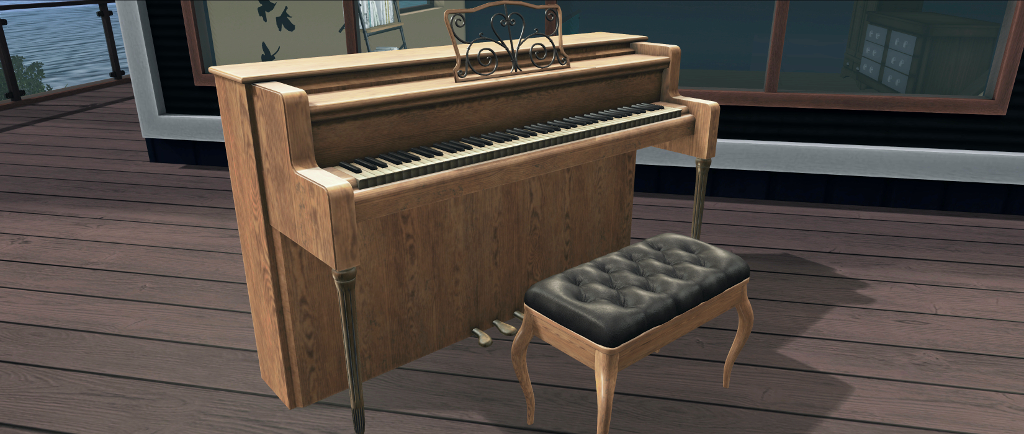
The Culprit Console Piano’s keyboard

Style-wise, the Culprit model resembles the Yamaha N2, offering a deeper body than my N1 – said to help provide a richer tone – with an upright-like keyboard. It’s provided with a range of finishes, with a default of wood for a freshly rezzed model. Texture options can be used to change both piano and stool together, or mixed between piano and stool to offer a custom look between the two.

As with the upright and the baby grand, the texture options are accessed via the piano’s menu. This also provides access to the piano’s playing options. These are divided up as follows:

  • Songs: 34 solo pieces to play, all public domain, representing a good cross-reference of music.
  • Christmas: 16 seasonal songs, all again public domain.
  • Muted: a total of 16 different playing styles without any associated music so you can set a style in keeping with the music you’re listening to out-world, or on your parcel stream.

The menu also includes options to adjust the seated position on the stool.
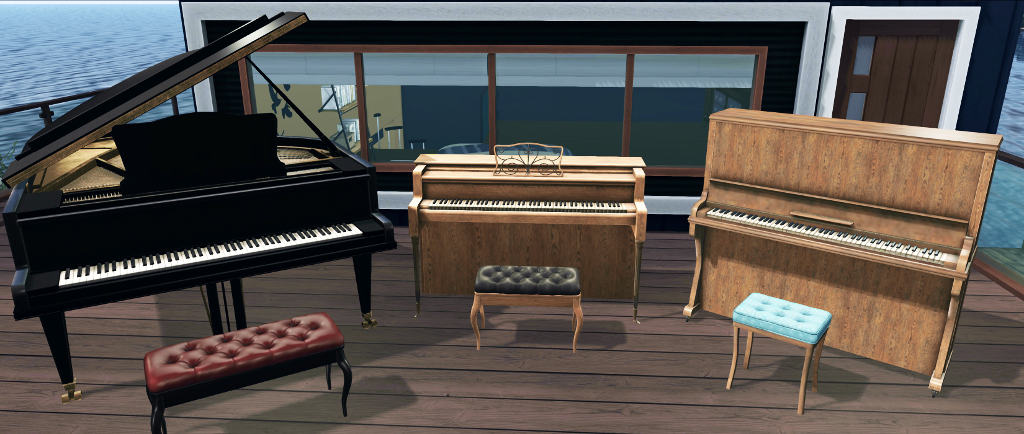
The Culprit Console Piano (centre) with the baby grand (l) and upright (r) for comparison

Play-wise the Culprit composite starts in a similar manner as the other two pianos in the Culprit Sonata range: sit on the stool and your avatar will be placed in an “idle” pose, performing a number of arms and finger loosening exercises. Selecting a piece of music from the menu will cue up the loop – and introduces the difference between this and the other Culprit pianos.

Like the Sonata baby grand and upright pianos, the Culprit Sonata Console piano uses Bento hand animations for a more realistic playing style with Bento avatars (footage taken from tests with the Culprit Sonata Upright)

Not only will the system adopt a playing style in keeping with the tempo of the selected piece and with individual finger movements for Bento avatars, the animations will actually adjust to the tempo within the piece – so that in sections where there is an increase in tempo, or if stronger emphasis in playing is required, the animation will attempt to replicate it; this presents something of a more fluid playing “style” for an avatar.

Those who have not swapped to using Bento-enabled mesh avatars can still use the Culprit Console Piano, just as they can the others in the Sonata range – the only difference is the finger movement will not be present in the animations.

In keeping with the Culprit upright and baby grand, there is no autoplay with this model. But as I note in my reviews of both of those models, the point about the Culprit Sonata range is the Bento capability – so having autoplay (allowing the piano to play tunes while not seated) misses that a bit.

One small point of note is that the piano is supplied both physical when rezzed and has a root prim base. The former means you can be catapulted ceiling-wards when standing from it, so setting it to phantom might be required. The latter means a little vertical adjustment when placing it in-world might be required to avoid the appearance of having it hovering above the floor. Neither of these points detract in any way from the piano’s attractiveness or playability.
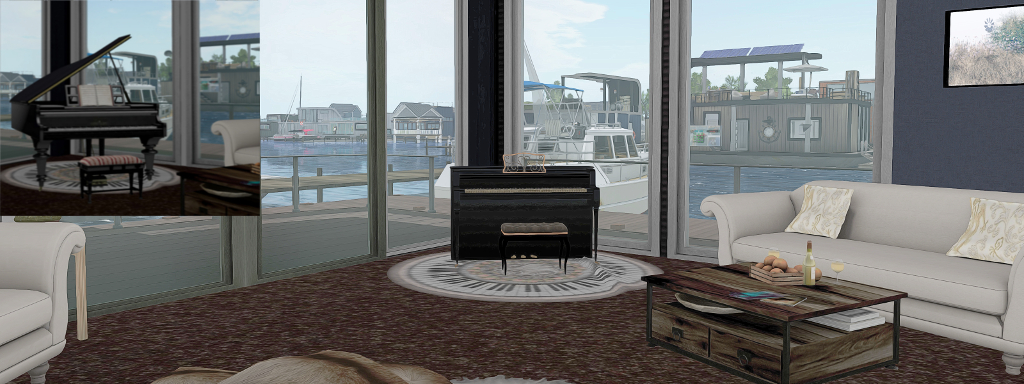
If you have limited space in which an grand piano can be a little over-powering (inset), and an upright a little too “traditional”; the Culprit Console Piano might offer a stylish alternative to the one offer a more modest footprint than the other

Those who have a grand piano – and room for it – might not be tempted by the Culprit Console Piano. However, if you are pressed for space and miss having a grand in the house / aren’t too enamoured with a “traditional” upright, then this model could be right for you. Small and attractive, it fits into confined spaces admirably, and at 7 LI, isn’t a capacity hog. I’ve already added it to my Evening Star Linden Houseboat rezzer, where it sits nicely within the small lounge space I’ve created with that particular houseboat design, without overpowering the room and making things feel cramped.

The Culprit Console Piano is currently exclusively available at the Tannenbaum shopping event through until December 23rd, after which it will be available directly from the Culprit main store.. The price is L$995.

SLurls and Links

More on a Sky Tower home in Second Life

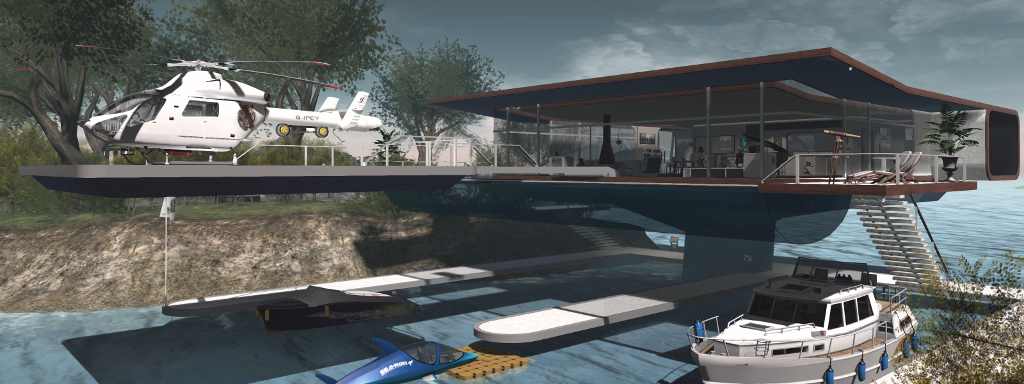
The Oblivion inspired Sky Tower house in situ at the home island, and with the landing pad in use, with moorings below

When I wrote about my fiddling with a personal interpretation of the Sky Tower house from the 2013 Tom Cruise vehicle Oblivion (see Of Sky Towers and SL homes) just a few days ago, I didn’t actually expect to be writing about it again quite so soon. But here we are.

Admittedly, when I wrote that first piece, the basic design was complete, and it was already semi-furnished as I tried to work out how things would fit. At the time, I was actually unsure if it house would find its way into personal use for a number of reasons (mainly the fact we both rather like the “Fallingwater” style house and home parcel layout in place).

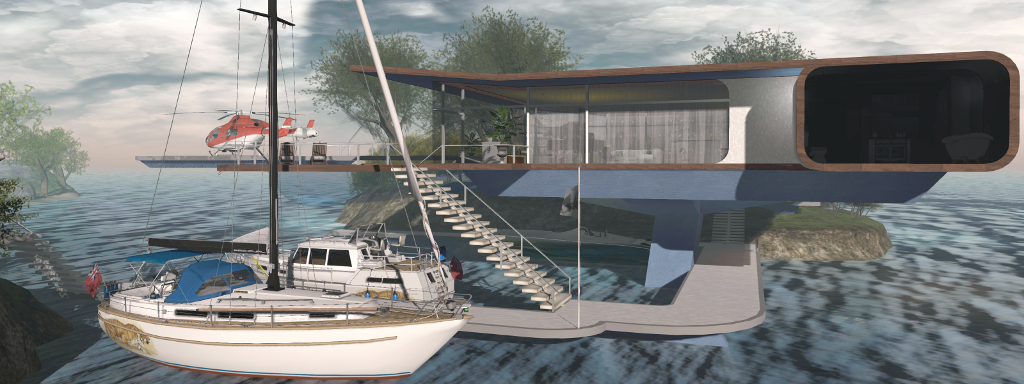
Looking at the house from the north island’s gardens

But as is often the way, everything came together quickly, and with the help of one of my preferred rezzing systems, it became very easy to complete a suitable home parcel layout with the new house (+ island designs) and drop it into a rezzer and also drop the “Fallingwater” layout (again, house, furnishings and islands) into another rezzer to make both pretty much “hot swappable”. So here’s a look at the results.

The house slots in between the “north” and “south” island, offering us a nice look to the west towards sunsets. This position means the house sits over the water, held aloft on a slightly off-centre pylon so that I could install moorings for boats and planes beneath it (and of course, the vehicle rezzer has been retained, to make swapping between what is moored there nice and easy). In doing this, I particularly wanted to ensure there was good clearance under the house, but the house itself would still sit below the height of the trees on the south island, so it’s not sticking out like a sore thumb.

The living space

The interior of the house offers compact living space: an open-plan lounge, dining area and kitchen, with what was in the film’s Sky Tower the medical bay / hygiene bay turned into a bedroom, while the section given over to the sleeping area in the film becoming a bathroom.

One of the things I like doing in SL is kitbashing – pulling items together from different builds to achieve a result. In this case, Alex Bader’s Skye Beach House, which I’ve had for some time, came into play. Specifically, I was able to pull apart the swimming pool and use a part of it, together with its animation system, to give some life to one of the major features of the Sky Tower – the swimming pool. Elements of the Skye Beach house and the Maven Homes Eco IV also help provide fixtures in the house: the fireplace, doors, and external furnishings.

A Side view with the darkened windows of the bathroom.

As I mentioned first time around, I skipped on including the upper level control deck from the original, and the low workshop area. This, to me, makes this design less distinctive than the original, but makes it nicely streamlined and more in keeping with the broad styles of houses found across the islands around us.

So that’s the new house for Isla Pey, and we can now happily swap between that and the “Fallingwater” derived house as the mood / season / year goes. Now if you’ll excuse me, I’m off to list to the Oblivion sound track. Again 🙂 .

Of Sky Towers and SL homes

In the sandbox: building a Sky Tower inspired home

As I’ve noted in assorted posts in these pages, I’m a bit of a science fiction fan – books, television and film. In particular in this case, I have a fascination with the 2013 Tom Cruise vehicle, Oblivion, a film that seems to fit in the “Marmite zone” – you either love it or hate it.

For me, the film has a pretty good storyline (if a bit overblown in places), an outstanding soundtrack by M83, Anthony Gonzales, Joseph Trapanese (that I’m listening to right now), and one of the most intriguing house designs seen in a film: the Sky Tower.

“Sky Tower” interior – trying to make it more of a contemporary home than “hard” sci-fi environment

Given my cursory interest in architecture and house design, I’ve always found the Sky Tower fascinating – particularly given the lengths the film crew went to make it. While there are a couple of commercial builds available in SL based on it, I’ve long wanted to see if I can take some of the core elements in the design and create a contemporary home that contains those elements, but moves the house out of hard-edged sci-fi and into something that could provide a comfortable living space.

I first entertained the idea well over a year ago and started on a design, but shelved it in a rezzer. However, it kept nagging at me, so over the last 10 days, I’ve been fiddling with it as time allows to see if I could build it out as a house that might sit within our current Balboa Estate home parcel.

The kitchen area with bedroom behind (beyond the smoked glass windows

The work isn’t finished yet, but the photos here give some idea of what I’ve been doing. The house intentionally doesn’t include the distinctive upper “Control” deck of the Sky Tower in the film, and while I’ve tried to retain some of the interior and exterior elements – the “back room” area (now converted to a bedroom space) and the iconic landing pad and “sky pool”, I’ve also done away with the workshop space sitting under the main house.

Unlike the film’s Sky Tower, this one isn’t intended to sit atop a 1,000ft tall tower. Rather, it is designed to sit between the “north” and “south” islands of our current home space, elevated above the water by a pylon structure I’ve yet to complete, and with moorings for boats and planes at water level below it. All of this is still to be finalised, as have the interior / exterior furnishings, fixtures and texturing, but these photos should give an idea of the overall look.

The design isn’t intended to replicate the full Sky Tower design – no upper deck Control unit, for example) and so has a “side entrance” and steps (foreground) that will connect it to one of the home islands

This isn’t intended to be a commercial build, but purely for personal use as an alternative to our current Fallingwater-inspired house. If all goes according to plan, the two houses will be “hot swappable” via rezzing systems and depending on which we fancy having in place at any given time of year.

I’ll probably bore you with more on this once the house is more in situ in our home parcel 🙂 . In the meantime, a nice little video of the original Sky Tower from the film.

Having a “well, duh!” moment with a Linden Houseboat

More changes for the Windlass version of my Linden Homes houseboat

As regulars here know, I’ve been playing around with the various versions of the Linden Homes houseboat designs on-and-off, creating and saving various interior layouts utilising rezzing systems, some of which I’ve bored people with in these pages – see: Saving your Bellisseria house designs for re-use with a rezzing system, More houseboat decorating in Second Life, and Still messing about in (house)boats in Second Life.

In particular with the last article, I wrote about converting the raised section of the Windlass design in a bedroom. This involved putting in a false floor and an additional stairway. While it worked to a point, having two staircases inside the houseboat was a bit weird, and while other things took me away from the houseboat (truth be told I barely set foot in it between that June 2019 article and the end of October), the issue nagged at me.

The problem, in short, was the “hard” stair railing that blocked any access to an upper floor put into the Windlass from the existing stairway – the stairs being intended purely to access the houseboat’s upper deck. However, in hopping back recently and swapping from my use of the Barnacle houseboat to the Windlass, I had one of those embarrassing “well, duh!” moments: Why even keep the existing stairway leading up to the upper deck?

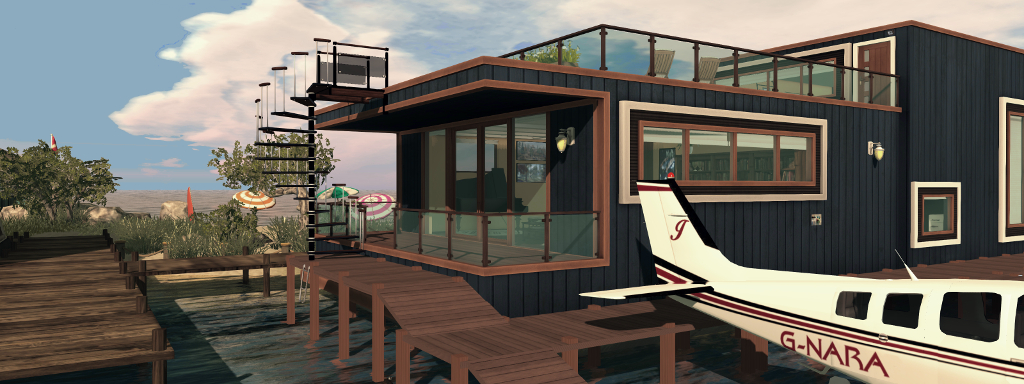
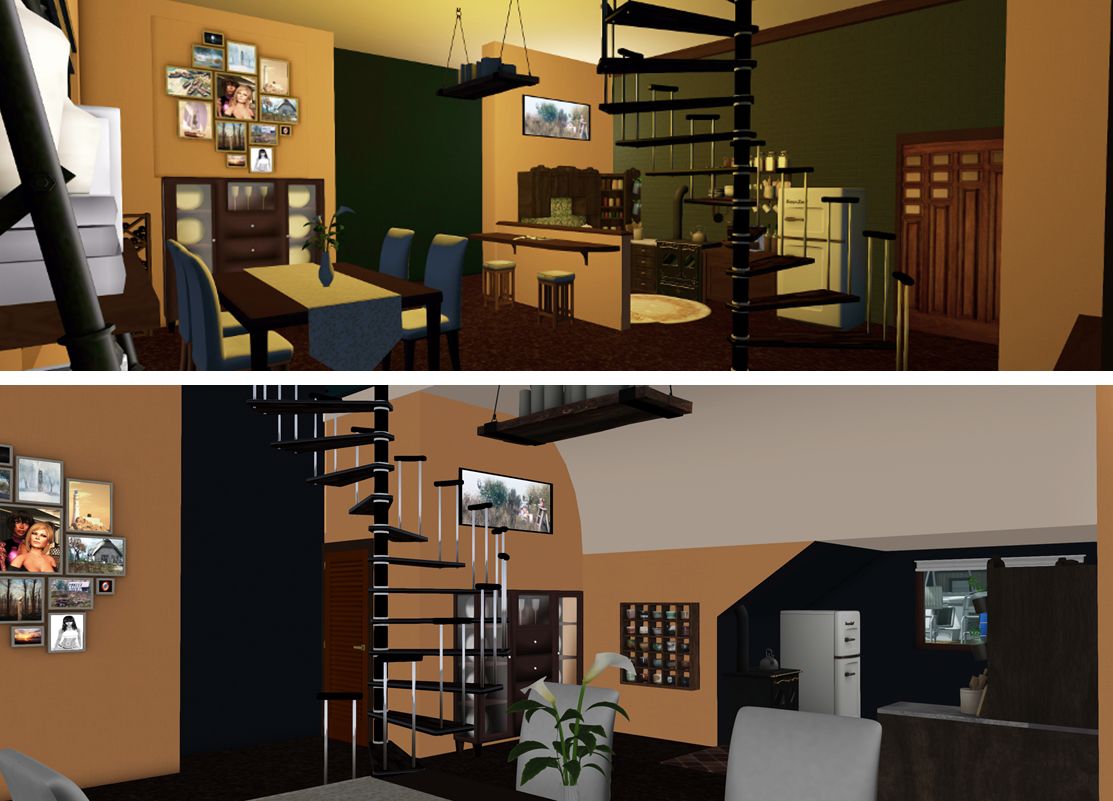
Top: the June 2019 build, showing the added spiral stairs while the “fix” stairs remain usable behind the kitchen walls. Bottom: as revised – just the one spiral staircase, the “fixed” stairs now boxed in to created a “bathroom”, while the cubbyhole under the stairs has been opened to create space for a galley-style kitchen

In the June design, I had already partially walled-in the fixed stairway, boxing-in the cubbyhole under the stairs in the process, to provide a “back wall” for a kitchen area and a false space to suggest a bathroom. By opening this out again, but keeping the stairway hidden behind a curved “ceiling”, and then completely blocking out the bottom end of the stairs allowed me to:

  • Hide the existing stairway and create the impression of a bathroom tucked into a corner of the houseboat.
  • Extend the “bedroom” space the full width of the upper section of the houseboat, while keeping the stairway door as a mean to access the upper deck.
  • Relocate the spiral stairs serving the bedroom so they don’t dominate the floor space of the houseboat so much.
  • Use the re-exposed cubby hole under the “fixed” stairway as the home for a galley kitchen.
  • Open out the rest of the available space for a roomier dining space (so much pace, I’ve yet to work out what I want to do with bits of it!
Extending the new bedroom floor both provides more space while allowing the upper part of the “fix” stairway to serve as an access way to the roof deck k(seen on the left)

The exterior view of the houseboat, vis window placement, doesn’t quite align with the interior layout (the stairway is marked by two large windows) – but dropping the blinds on these tends to help hide this, although I did toy with blocking the windows out complete. On the flip side, general access to the upper deck isn’t lost this way – it’s still possible to reach it via the simple expedient of an external stairway, as seen in the top photo, one easily accessed from the lower floor of the houseboat and the docks I dropped in for mooring my boats.

All of this isn’t a genius move; doubtless others arrived at the same solution well ahead of me – hence referring to it as a “well, duh!” moment. But it at least makes me happier 🙂 .


Remembering Darrius Gothly

Darrius Gothly

I received word from Torric Rodas today of the sad news of the passing of long-term Second Life resident and creator, Darrius Gothly.

Founder of the DG4SL range of products, Darrius had a wide range of interests in Second Life, and always sought to improve people’s SL experience through many of his products, whilst also being a very vocal member of the platform’s merchant community, offering both positive critiques of the Lab’s approach to its Marketplace environment and suggestions for improving it.

I did not know Darrius well, but I believe we became long distance friends outside of Second Life for long enough for me to appreciate him for his insight and integrity.

We first really got to know one another when he stepped in to try to address an age-old problem in Second Life: what happens when you pass out a load a landmarks for your store, club, region, etc., – and then are forced by circumstance / opportunity / whatever to relocate, other than to start revising all your LMs, push new ones out to visitors / customers / friends, try to get the word out through forums etc.

To explain: back in 2012, artist and creator Toysoldier Thor put forward an idea and feature request for “virtual landmarks” to present a means by which LMs need never go “stale” (see also: Virtual Landmarks: solving an age-old problem?).  As per Toy’s comments in a forum thread on the idea, for a time it looked like LL might be interested in implementing something along the lines of his suggestion (subject to other commitments / priorities). Sadly, nothing ever really came of this (nor of subsequent suggestions along similar lines). So, Enter Darrius.

I first got to know Darrius as he developed his Virtual Landmarks products

Taking a dive into things, he formulated a means by which Toy’s idea could be realised via an external service. In typical Darrius style, he also added elements such as web support (“VMurl”), stats reporting and support for “favourite places” to provide a comprehensive product. He dropped me a line about the product in December 2012, which resulted in my articleVirtual Landmarks: offering a solution to the age-old problem, and in my playing a very small role in testing the system.

As a result of that initial contact, Darrius and I became what might best be referred to as “pen friends” over the next few years, exchanging ideas and comments and holding forth with each other on a wide range of subjects, from “technical” chats about SL through to more esoteric matters – identity, anonymity and personal expression in VWs, the new user experience, perceptions about SL in other platforms / the worlds at large, etc. -, through to chatting about physical world home and family, health, and our mutual enjoyment of assorted film franchises, and even touching on politics on occasion.

Sadly, our conversations waned to the point of becoming non-existent for the last couple of years. At the time this happened, I was aware that Darrius was dealing with illness and couldn’t always get in-world / on-line perhaps as often as he would have liked, and I feel a certain amount of regret that I didn’t do more to keep our exchanges going. He didn’t believe in putting up walls between his SL persona and himself; whom you encountered through his avatar was very much Darrius himself: honest, up-front, friendly, caring, supportive and with a wonderful – and at times quite wicked (in a good way!) – sense of humour. He is someone who will be missed.

My sincere condolences to his family and to his close friends on their loss.


Note:

I understand from Torric and the London City website that the DG4SL team are attempting to ensure the popular Rental Beam service add-on for CasperLet is transitioned to new management so that it can continue to run as customers expect. Anyone with enquires about that service are asked to contact Mysti Nowles directly, rather than raising a support ticket. At this point, I do not have information on what will happen to other DG4SL products utilising back-end services (such as the VLM product) or who to contact about them. Should I come into such information, I will give an update here.

The Bloggies 2019: a thank you

This year marked (I believe) the 3rd annual Bloggies Awards, the presentations of which took place on Saturday, October 26th.

For those not in the know, the Bloggies are awards organised by the Blogger and Vlogger Network (BVN), a group and website built specifically for networking and education purposes. BVN strives to provide bloggers and vloggers (video bloggers) with the most pertinent, up-to-date, and interactive information available, and hosts live discussion panels, interactive forums and tutorials on a wide range of blogging and vlogging subjects.

The Bloggies are intended to recognise those producing written and video blogs on Second Life across a range of categories, the majority of which are decided via a public / popular voting system. Each year the organisers present special awards: the Founders Award and the BVN Member of the Year Award.

Unfortunately, I was unable to attend due to commitments in the physical world, so I was surprised and delighted to learn today that I had been awarded the Bloggies Founders Award for 2019. This is given to (and I quote):

The founders award can be any blogger or vlogger in SL and we look for those that have made a huge contribution to the SL community through Blogging or Vlogging.

Needless to say, I’m both genuinely honoured and thrilled to receive the award and the recognition of my peers in blogging Second Life, and for the glowing terms used to describe this blog at the ceremony, which I’m also going to reproduce here:

This year’s recipient has been on the grid since 2006 and began blogging in 2007. Her blog covers a range of topics from news, reviews, commentary, exploration and opinion, and her dedication to chronicling the social, cultural and technical aspects of Second Life is unsurpassed. She is the premier source for all Second Life information, a major proponent of the arts and one of the grid’s most prolific bloggers.

I include this word in a small part because I do feel a degree of pride in reading them (I’d be lying if I said otherwise) – but primarily because I don’t try to seek out recognition in any significant way outside of the occasional interview; I simply try to write about what I appreciate, enjoy and find fascinating in Second Life in the hope others find it enjoyable / of interest  / useful, and whilst trying to maintain an element of objectivity in my factual reporting. So having this blog recognised in public in terms like those above genuinely encourages me to keep writing and to also do better in the topics I strive to cover.

Many and sincere thanks to Kess and Dethly and BVN for this award – and congratulations to all of the winners and those who received special mention in this year’s awards.