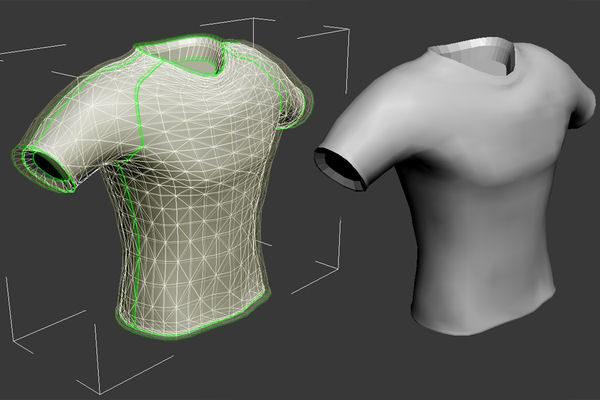
Mesh clothing deformation: alternative approach suggested

Updated June 26th 16:30 BST:  The discussion on this alternative continues on the SLU Forum thread (recommended reading for anyone interested, as a lot is explained succinctly and clearly). Darien Caldwell has summarised the technical aspects of both solutions (and in not having a deformation capability) in terms of who is the greatest impacted – consumers, creators and / or coders.  Similarly, in answering a question posed by Innula Zenovka on the relative advantages / disadvantages to the two ideas (RedPoly’s and the deformer), Adeon Writer commented

“This trick was created to address major problems with clothing, but it is a patch. And you can see the areas where it’s not patched: this only makes mesh follow a few more sliders, while the rest (especially the face) do nothing.

“Qarl makes mesh work with ALL sliders, even future ones that don’t exist yet. It is the correct solution to the problem, this is a quick workaround.

“Qarl gives the ability to make entire new human meshes fully removed from the system shape that still work with all sliders and avatar physics,

“That is not possible with this.”

This would seem to be a clear-cut differentiator that would suggest that if matters come down to a choice of one approach or the other, continuing with the deformer may well be the preferred course of action. Obviously, nothing further has been said on the matter by LL, but further updates will be posted as they become available.

Nalates Urriah brings news of a potential alternative to the mesh parametric deformer that has been under development by Qarl Fizz, and which has been reported upon extensively by Nalates, myself and others.

I’ll leave the in-depth technical explanation and quotes to Nalates – she broke the story, after all. However, to try to summarise:

  • The idea is the rather than weighting mesh clothes against the avatar “skeletal frame”, the clothes are weighted against the “collision volumes” – these are (I gather) used to detect when your avatar collides with a physical object in-world, and thus are designed to morph when you adjust your avatar’s shape
  • The approach isn’t perfect and has a number of limitations (female clothing won’t stretch with breast size changes, for example); extreme sizes cause issues (as they do with the deformer); weight painting during the construction of mesh clothing can be somewhat more problematical
  • Alpha masks will still be required in certain situations (but then, alphas were never going away anyway).

The developer of the approach, RedPoly Inventor has released a demo version of the approach using a dress, which can obtained from his store. There is also a demo video on YouTube:

RedPoly is the first to admit the approach is not perfect, but has also proposed an additional idea of developing a further set of avatar “bones”, which he calls “cbones” that would allow this approach to work a lot better. According to Nalates’ report on the mesh meeting where this all came out, RedPoly believes the development of such a new system would be relatively simple.

Interestingly, according to AshaSekayi Ra, commenting in an SLU Forum discussion on this development, the idea of using the collision volumes  was first raised in the mesh beta last year and that Prep Linden requested samples of clothes rigged to the avatar’s collision volumes, but it is unclear what happened with any tests LL may have carried out.

Right now, this doesn’t mean the end of the deformer, nor does it mean all mesh clothing issues are solved. It does, however, open-up new avenues of exploration and certainly new topics for discussion on the matter.

Reading Nalates’ report, it would appear that the idea has taken LL themselves a little by surprise, despite the fact it may well have been previously discussed, and their reaction is potentially best described as cautious.

As it stands, mesh designers such as AshaSekayi Ra and Ellie Spot will doubtless be looking at the idea, as will those with expertise in the avatar design, as well (one would hope) LL themselves. As Nalates states, there will be further news emerging on this as tests are conducted and feedback given.

Related Links

With thanks to Nalates Urriah.

Mesh deformer: interview with Qarl Fizz

Note this is a 4-page piece. Please use the page options at the bottom of the article to page through.

Wednesday June 20th was Mesh Day at SL9B, and featured speakers and presentations on the subject of – you guessed it – mesh. The day saw the auditorium area swamped with people anxious to hear all the news and join in with practical discussions (for future SLB events, it might be worthwhile putting the auditorium at the junction of adjoining regions if hot topics are to be featured as a part of events).

One of the discussions taking place featured Karl Stiefvater, aka Qarl Fizz (formerly Linden). Qarl is the man most closely associated with the mesh parametric deformer project and who was, while working for Linden Lab, both behind the sculpty and a member of the Lab’s early mesh team. He was talking with Saffia Widdershins and taking questions from the audience.

The following is a transcript of the discussion between Saffia and Qarl, which covered the deformer and a few other things as well. It is taken from an audio recording I made and includes questions from the audience given in open chat during the course of the talk and which are addressed by Qarl. Please note that I unfortunately had issues actually hearing / recording Saffia’s audio feed (depite efforts my end, her voice was extremely faint both on SL Voice and in the recording), and I’ve had to edit out those comments I could not clearly discern (my apologies, Saffia!).

====================

Saffia Widdershins (SW): I would like to introduce to you to Qarl Fizz, who many of you will remember as Qarl Linden. When Qarl was working at Linden Lab, he introduced very innovative tools and was working on mesh, I believe before you left the Lab, weren’t you?

Qarl Fizz (QF): I was on the mesh team.

SW: So when mesh came in … I’m not sure that the Lab actually expected mesh to be put to all the uses that the creators in Second Life probably put mesh to.

Qarl’s familiar prim mannequin at SL9B, where he discussed the mesh deformer

QF: I would say that the Lab was not expecting the clothing at all. I think some of the people in the mesh beta group had warned that clothing would be huge, but they didn’t see it coming, no. So it caught them by surprise. They thought houses, and you know, cars … well, the developers are all boys so, you know (laughs).

SW: And the next thing of course is that people say is, “It doesn’t work. The clothes don’t fit. We can’t get the clothes to fit” – and I can see the Lab going, “We didn’t actually mean it…” “I don’t care! Clothes don’t fit! Fix it!”

QF: Right, right, right, right, right. That’s exactly what I saw happen. Yeah, because mesh is traditionally – honestly, this isn’t a problem that shows-up in computer graphics often. It’s only in the setting of avatars and people customising their avatars and that doesn’t happen a lot in 3D. So I can forgive them for not seeing that coming. Although Blue Mars had faced the same problem so, you know, they could have learned something there.

SW: I think that quite often the Lab do seem to under-estimate the creativity of the residents … the whole OpenSpace thing was an example of that: you give people scripts and you give them homesteads and what do they do? They build! So, anyway – there was a problem; the mesh clothing has a problem with fitting. Could you explain, first of all, why it has a problem fitting? I mean if I wear a system skirt or a system blouse they fit whether my boobs are out to Christmas or not or if I change my height; my system blouse and my system skirt are going to fit. Why doesn’t mesh?

QF: Well, the system skirt and the system clothes are a part of your avatar, so when you change your avatar, they change as well; they were built-in. But The other mesh stuff that you build – like even you know, when you build with prims [because] it’s not just meshes – when you’ve made a prim skirt, you would have to readjust its size to make it fit. And that’s because these things are rigid; they are imagined to be rigid and other things can move inside and outside of them. That’s the way Linden Lab expected them to behave. So the problem is that you put on a blouse that’s meant for a small person, and you dial-up your sliders and your skin just comes through the blouse, because the blouse is a rigid shape and it doesn’t change when your avatar changes shape, and ideally you would want it to.

SW: If I get a prim skirt, say, and it doesn’t quite fit me, generally I can play with it to get it to fit. Sometimes – not always – I can move it in and out, I can change things around. But when I get mesh, I can’t change it at all; that’s the deal….

QF: That’s true to. But … a prim skirt is a very simple thing, and these mesh clothing items that we’re getting are very complex and they fit tightly in places and, you know, standard scaling would not have been enough to get the clothes to fit, so something needed to be done.

SW: And that came up, I believe, in quite a casual conversation … where you suggested something could be done.

QF: Yeah. Maxwell Graf was a developer for Blue Mars and he was making mesh clothes over there, and he saw – before Linden Lab even had mesh – he saw this clothing fitting problem, and he worked together with their developers – and I guess a bunch of people did,  I don’t want to short-change anybody – to develop a system that would work. And the system he developed he tried to get Linden Lab to pick-up as well, and they were less interested in doing that. So I mentioned, “Hey! Linden Lab doesn’t have to do it. We, the residents can take these things into our own hands.” And that’s how the project was launched.

Blue Mars users faced similar issues with mesh clothing

SW: We’re developing a habit of taking over projects for ourselves – like this birthday!

QF: And honestly, when we do, it tends to work-out pretty well. So maybe that’s a signal…

SW:  So the project was set-up and the money was raised really quickly…

Funding raised through Indiegogo (organised by Max Graf)

QF: Yeah, it was like a week or so, so that was nice; you know, the community was very, very strongly interested – which we kind-of knew from the JIRA, from the comments – but when people put their money where their mouth is, I think it speaks more loudly … Yeah, we got the money, we got the funding, we did the development, and it works pretty well …

Sunshine Spiritweaver (asking from the audience): So now we can resize the mesh clothes?

SW: OK, good question. What does this mean? How does it work?

QF: What happens is your mesh clothing is treated very much like the system skirt or your blouse or your system clothing. As you change your own avatar’s shape, like you make yourself fatter or taller or more muscular, the clothing will – “deform” is the the technical term – will deform with that shape so that it remains fitting. It’ll get bigger where you’re getting bigger and it’ll get smaller where you’re getting smaller. And you know, it’s as simple as that. It doesn’t work for everything, but it works OK. It works pretty well, you know – and its a lot better than nothing. So if you fire it up  – I think Linden Lab has a Viewer you can download and test – as you change your avatar parameters you’ll see your clothes change along with your body, you know, your clothes get bigger.

Mesh Deformer: updates and musings

I’ve largely backed away from covering the mesh deformer of late because Nalates Urriah is doing a good job of reporting back on the Mesh Content User Group where it gets discussed, and I don’t really get the time to attend the meetings myself.

On June 11th, Nalates provided a summary of the most recent meeting, which includes some interesting excerpts from the conversation on the deformer. Of particular interest are a couple of comments from Nyx and Oz Linden, notably:

Nyx Linden (replying to a comment from Ellie Spot that the deformer is now in LL’s hands & is a matter of “Fixes to make it work for more extreme shapes“): The issue of extreme shapes is definitely an issue that needs to be discussed.

Oz Linden (later in the conversation): We’ve given Qarl some feedback. In its present form, it’s not quite good enough, but I don’t think we should get into details. There are problems with the avatar, and there are problems with the deformer. It remains to be seen whether or not we can fix the avatar problems (I’m looking into it from a couple of angles). But, we hope that it’s possible to make some progress on the deformer even without those fixes.

As Nalates points out, Nyx’s comment is open to a number of interpretations, some of which could be positive (and given Nyx’s nature) fare more likely) while some might be potentially more negative; as no real expansion on the comment was given, it comes down to a matter of interpretation / speculation on the matter.

However, in this week’s Metareality podcast, Qarl does comment further on the matter, in  a discussion commencing at 34:10 into the podcast:

[36:04] Qarl: Now I have to say that he’s like one of my favourite Lindens, so I doubt he was saying anything bad.

Oz’s comment – and the fact he would not be drawn into saying who at LL is working on the deformer or what the overall priority for the project is within the Lab – drew further comment from Qarl:

[38:22] Qarl: So I’m dealing with “Linden X”, who I also like a great deal and is a very nice guy. And … I think we’ve come to a place where we have agreed – I think, although he didn’t respond to my last e-mail – I think we’re agreed on what needs to be done before we can ship. One of those ideas is to … is similar to the standard sizing business that everyone is talking about, but instead of having a fixed set of sizes – small, medium large – encode the actual avatar parameters into the mesh itself, so you can have any base or any avatar shape as your base, because linden Lab wanted to have a stick figure base, and I’m like, “Well if you encode the parameters, then you guys can do that”.  … So assuming there’s enough room in the mesh asset for that, then I think that’s what we’re going to do. And then the other issue is that the vertex matching needs to be tweaked a little bit  – for our tech listeners – to take into account the normals. So its going to look at both the position and the normals when it chooses the matching spot.

Qarl’s comments prompted special guest Eclectic Wingtips to ask:

[39:48] Eclectic Wintips: So how much work is this going to be for those of us who make mesh? … If there’s multiple sizing, are we still going to need to do multiple sizing in the 3D programme [used to create a mesh item of clothing] to bring it in?

[40:01]Qarl, Oh! no, no, no. You can totally not use that at all. You just leave all the parameters the same, and it just uses the default avatar and blah, blah, blah … BUT, if you want to make an outfit that fits really well on … an anorexic model, so you tweak it for the super skinny or something, then you can set those parameters to be like “fat”, and it matches the bases of extra, extra, extra, small. 

[40:36] Gianna: But you’re setting those parameters within your 3D content?

[40:39] Qarl: within your 3D content … So the issue then becomes the GUI, because you have like a thousand parameters now you have to enter … what I think … what we’re going to default to is, you’ll have like six radio buttons for those sizes … but with very little extra effort, the Third-party Viewers will be able to expose that stuff, so you’ll be able to do anything you want; just so long as it’s in the protocol, you can open that later.

Qarl’s explanation – assuming this is what happens with the deformer – seems to offer the most flexible solution to the question of base shapes and sizing. To hear the discussion in full (and the rest of this week’s topics), be sure to listen-in to the podcast itself.

Related Links

Mesh deformer and standard sizes: Qarl speaks

There has been much in the way of heated debate on the subject of the mesh parametric deformer and standard sizes for avatars of late. So much so that in this week’s Metareality podcast, Kimberly Winnington (Gianna Borgnine in SL), deformer coder Karl Stiefvater (Qarl Fizz in SL) and in-world content creator Cathy Foil discussed the debate at some length and touched on other aspects of the deformer project.

The following is a summary of the core aspects of the discussion, presented in the panelist’s own words. My thanks to Kimberly for allowing me to produce this piece.

[2:10] Kimberly Winnington (KW): As it stands now, mesh items have to be built to the default avatars like the Ruth Avatar and then be deformed.

[2:32] Karl Stiefvater (KS): There’s a slight difference between Ruth, the actual Ruth – a lot of people call different shapes “Ruth”,  so that’s a bad term to use – and the important shape, the one that you get when you say, “Hey, I want to do a shape!” and you don’t touch any of the other dials … and I call that the “default shape”.

[2:58]  KW: So as it is now, clothing has to be built to that default shape before it can be deformed.

[3:04] KS: Right.

[3:05] KW: And it’s been suggested it should … that group of things like the default avatar should include some sort of standard size as well, even though that’s not officially a feature at this time.

[3:22] KS: That is correct. The rationale there is the deformer isn’t perfect and if you start with a shape that’s closer to your end shape before you actually tweak it, you can get superior results … Even if the deformer worked perfectly, when you design a shirt with a floral print … and you put it on someone with their body weight turned all the way up … the floral print is going to be distorted … So with the new system, the artist could say, “I’m going to repaint that floral print so it doesn’t get stretched out.”

[4:19] KW: There’s this fight going on. Emma Gilmore, also known as Elie Spot – she is of course on the standard sizing side, she was one of the people who worked with a bunch of other designers and came up with the standard sizes. And then I guess on the other side of the argument is Maxwell Graf … he’s on the side that the standard sizing is a marketing ploy and is awful and we shouldn’t even tolerate its existence. And I guess I’m somewhere in the middle of those two arguments on the basis I kind of agree with the standard sizing – not as the official solution because I don’t want to change my avatar …  so I’m all for the deformer and do not want to have standard sizing as the only solution.  However, I would have a much better chance of fitting into something without a lot of stretching if I stretched from a size that was closer to my avatar than the default avatar …  But I still think that it’s at least a solution that should be discussed; where the starting-off point for the deformer should maybe be closer to a standard size.

[6:56] KS: It sounds like you and I are in agreement …

[7:15] KW: The other thing that came up was … Emma was talking to you about possibly having a way they could convert current meshes without having to re-upload, and you had suggested to her that she post on the JIRA and get some feedback from some other people. So the problem became she posted on the JIRA and she posted a Plurk about both these issues. like let’s discuss where we should start from and lets talk about whether we should be re-uploading or converting and how should we do that … So it started this huge fiasco where everybody kind-of attacked her both on the JIRA and totally all over Plurk, and were like, “you’re wrong, you shouldn’t be posting here…” … I actually agree with her and think she has a good point; but whether you agree with her or not, the topics she brought up are important for us to discuss as a community, especially designers and people who want to wear mesh. Because once the thing is final – you know how things go in Second Life; it will come out and everyone will be unhappy with it but it will be too late to do anything about it. So you have to do it now …

[9:59] KS: The deformer isn’t perfect. There are problems and what she’s proposing … is an extension … so it doesn’t take anything away from what you had before; it’s just adding new features. So how can you hate something that has everything you want but has this extra thing that somebody else wants? How does that engender white-hot hatred? I don’t understand.

[10:36] KW: I think there’s two things. I think the first on is not understanding that it works in collaboration with the deformer. So I think there’s a lot of people…they hear “standard sizing” and they are automatically like, “No”, without understanding that it’s not going to work like standard sizing is now … that you have to fit to that standard size.  This is just in collaboration with the deformer, and I almost want to name it something else….

[11:03] KS: How about “alternate bases”? … Alternate bases, everyone.

[11:14] KW: The other thing that comes up is that a lot of people feel like that if we make a solution that fits … then Linden Lab will stop trying to think about trying to create a new overall avatar mesh.

Karl Stiefvater (Qarl Fizz)

[11:47] KS: I don’t thing that we’ve forced them to do anything ever … They’ve never given in, ever! So I don’t see that as a smart strategy … One thing I want to add to this, tho, is this other aspect  that I don’t think anybody knows about. And that is, Linden Lab, internally, is … struggling with a question that is probably going to delay the deformer even more. And that is, they don’t know if they like the default avatar as the base. They think there might be a better base. … Then the question is, so how do you pick a better base? Some of them are suggesting … that adding curves is easier than removing curves, so if the base was something that had no boobs, that had no curves or shapes whatsoever, that might perform better … But they have no system in mind for making this call. So this is like one of those objections that can never be necessarily resolved, which is very dangerous for the project. So one of the things I like about this alternate bases idea is it neutralises this potential problem, because if they think there is a better base avatar, we can just add it later. As soon as they decide what that perfect base is, we’ll just add it to the list. So it’s beneficial for reasons completely unrelated to the whole fight right now, so that’s something to keep in mind. That’s mainly why I’m sort-of leaning this way … because it kills two birds, and one of these birds is otherwise potentially project destroying.

[14:23] Cathy Foil (CF): Is it possible to have the content creators load-up their own custom bases for their mesh? Would that be possible? Or would they have to create their own blend shapes so they work with the sliders?

[14:40] KS: No … they would have to use the existing shapes, the existing parameters. But they could specify their own set of parameters; that’s doable, but I’m a little bit afraid that that’s over-designed … so I think that maybe down the road that’s a good option, but I think for right now just a set … just six or seven different bases….

[15:16] CF: I did have a wackadoodle idea I wanted to put forward. I know it’s probably way too late in the development … right now you have the avatar mesh is driving the deformer of the mesh clothing, and I thought of the idea of having “deformer underwear” so to speak,  an invisible mesh that you wear so that the avatar’s mesh deforms the underwear but then the underwear deforms the clothing mesh … so that the designers could create custom underwear that would only fit over certain parts of the avatar if they wanted or they could have more vertices in the underwear that would spread out the deformer so that they would deform the clothing mesh maybe a little bit more evenly.

[16:08] KS: That’s a clever idea … but no it’s too late for that! [laughs] But that’s interesting and that could definitely be in version 2 … Then clothing could work on avatars that are completely alien, you know, something you couldn’t dial around … like an elephant .. you could create an elephant avatar and then your hoodie or your dress would fit…

From here, the discussion moved out to talk about design techniques before moving on to the remaining topics of the podcast. For those interested in the mesh deformer and the ongoing debate, I thoroughly recommend listing to the podcast in its entirety, which also includes issues such as DMCA, copyrights and a discussion about the use and impact of the SL Marketplace.

Related Links

Further call for deformer assistance: it’s needed, but don’t panic!

Last week Oz put out a call for help with testing the Mesh Parametric Deformer than Qarl Fizz has been developing, and which is now available in a Project Viewer (as well as some TPVs).

The response to that call has been somewhat slow, prompting Oz to pass a further comment on the JIRA related to the deformer (STORM-1716):

Oz Linden added a comment – 08/May/12 8:59 AM

Perhaps this issue really isn’t all that important, or worth the trouble to integrate.

So far, only one designer has responded with one test garment.

Let me be clear – the lack of test material is a major blocker for testing, and therefore accepting, this proposed feature. If you want it, step up and do it soon.

The comment has been reported elsewhere (and remarked upon in the comments following my original piece on the call), and has caused some consternation.

However before people start taking Oz’s comment to heart as a sign that he or LL want to “kill” or “drop” the deformer, I spoke to Oz directly on the matter after reading the comment and he wryly admitted that it was intended as an attention-grabber and that, indeed, several more mesh designers have come forward indicating that they wish to engage in the testing as a result. When I asked him about the shock value of the comment, he replied, “Yeah, it was certainly intentional, and I would not have actually dropped it. But it is true that it would have taken far, far longer (months maybe).”

So does this mean we should ignore the underlying call for help?

No – we just shouldn’t panic about the deformer being dropped. Help is still needed. So, if you are a mesh clothing designer, or know of a mesh clothing designer, then please consider getting involved in the work / asking them to get involved in the work.

Related Links

Mesh Deformer update: release from Qarl, request from Oz

Qarl has updated the mesh deformer. speaking in the Metareality podcast today, he states:

[57:15] I’ve pushed another version of the deformer today. It does male and female avatars; so that answers people’s questions who are upset about that. And I would say that we’re getting pretty close to the final product. If you … haven’t been following it closely, waiting for it you should check it out. 

He goes on to comment, in response to a question about what people should be looking for in using the deformer, “I don’t think regular people should check it out. Content creators should check it out, I should say that …. Because in order to use it you need to mark the mesh as being deformed, and the only way to do that is to create your own mesh and upload it.”

The update is available in a Linden Lab test build.

This may sound like, “Well, duh!” information, but the fact that the deformer is still in development and at this point really only applicable to content creators, is worth pointing out. It also leads-in nicely to the next piece of news.

At the same time, OZ has updated the mesh JIRA with the following request:

If you are a clothing designer interested in getting the mesh deformer integrated into all SL viewers, you can help both make it better and get it integrated more quickly:

We need a collection of test garments that we can use to evaluate this feature, and to form the basis of an ongoing regression test of it once it is integrated. These need not be “good looking”, and in some cases should not be (so we’re not asking you to give away your best commercial work). What we need is deformable mesh garments, based on either the unaltered “new shape” (female), or that shape changed to male; the garments should be designed to explore the limits of the technology as well as to showcase the normal easy cases.

Some examples I can think of (but I expect that you as designers and fashionistas can think of more and better):
a full length garment (ball gown, trenchcoat, kaftan)

  • garments designed to be close fitting around problem areas like the shoulders, breasts, and butt (or whatever areas you think are problems)
  • garments designed to stand away from the body in some areas (capes, high collars, flared or puffed sleeves and pants, hoop skirts)
  • very small garments that cover limited areas (gloves, shoes, scarves, shin and thigh pads)
  • garments designed to layer with each other (a close fitting shirt with a jacket to wear over it)

It would probably be useful for these test garments not to be textured for normal use — instead, give them simple high contrast patterns like checks or stripes that make it easy to evaluate how textures are altered by the deformations.

If you’d like to contribute items for this effort, please:

  • Upload them with the current version of the official Project Viewer for the Deformer. You can find a download link on the test build wiki page, and record the full version number of the viewer you used (from the Help > About Second Life floater).
  • Put a copy of the garment (no-modify is fine, but please allow copy and transfer) into a Notecard that describes what the garment is intended to demonstrate or test. Links to images of what you think it should look like would be useful; be sure to include the version number from the viewer in the Notecard.
  • Send the Notecard to Oz Linden
  • Optionally, attach the mesh file to this issue

I’d like to get Contribution Agreements from anyone submitting garments; contact me for details on that if you need them.

I will establish a way anyone can pick up copies of the test garments that we incorporate into the test suite.

The deformer itself has given rise to much debate on the current SL avatar – Nalates Urriah provides some solid insight into this; which has also lead to debates on “standard” sizing I’ve touched upon here. Part of this debate has also ranged on the JIRA – although there is a JIRA dedicated to matter of the avatar itself (STORM 1800) and Oz has requested that discussions pertinent to that aspect of things be carried out on that JIRA.

Related Links

With thanks to Pete Linden & Gianne Borgnine.