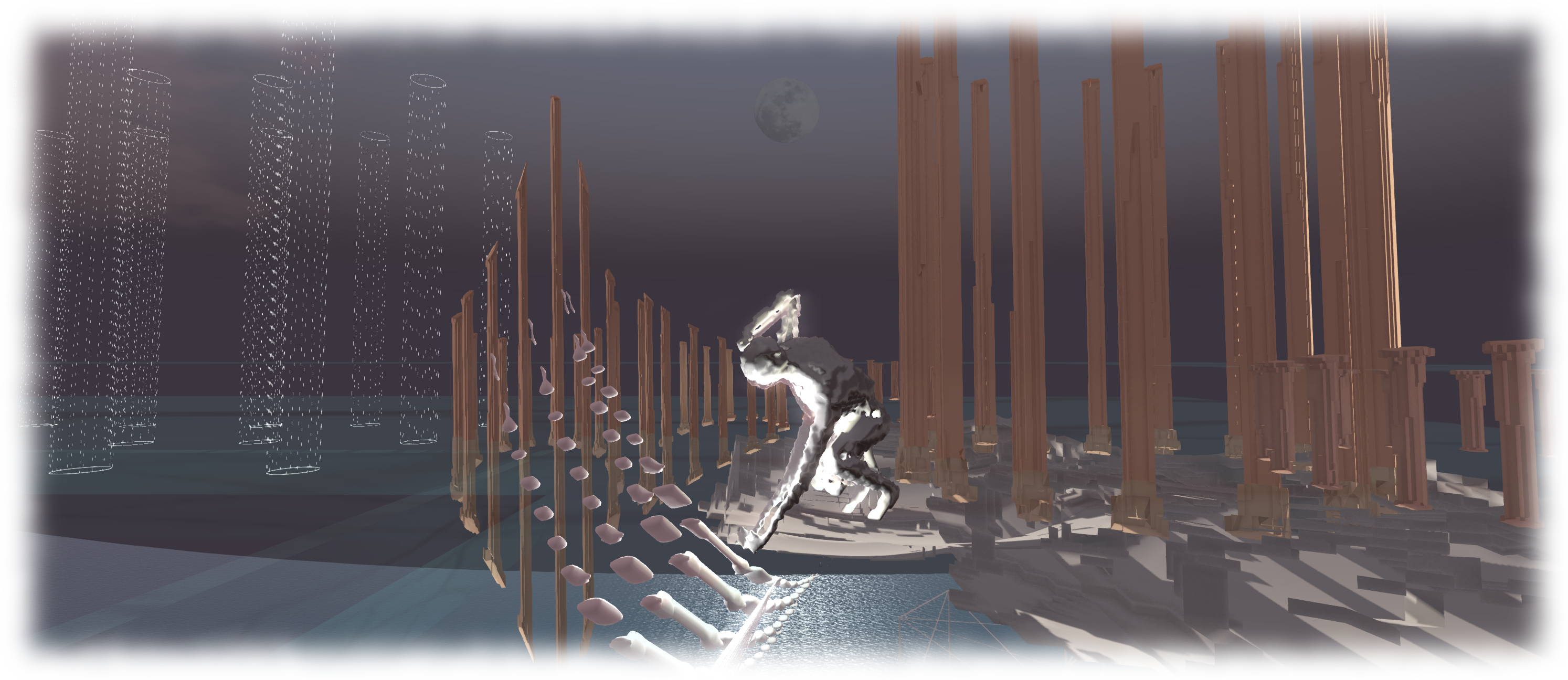
Making a welcome return to Second Life – for a limited period of time, at least – is Wendy Xeno’s HuMaNoiD, which can now be seen at LEA 6, having last been available on the grid a little over a year ago.
I first encountered HuMaNoiD far back in 2012, on the recommendation of Chestnut Rau. At the time, it was a fascinating, contemplative visit, and throughout several return visits over the years, I continued to find it an evocative place; I’m pleased to say this it still is.
For those who have visited HuMaNoiD in the past, all of the familiar elements are there: the ground level watery landscape, the cello awaiting a player as J.S. Bach’s Unaccompanied Cello Suite No. 1: Prelude can be heard. Around this stand five doorways inviting visitors to open each in turn and step through, and explore the realms in the sky on the other side of each one.
Beyond these, water breaks the landscape into a series of vignettes the visitor is invited to explore. Again, for those who have been to HuMaNoiD in the past, there will be a pleasant feeling of familiarity and comfort to most of them, although one or two nuanced changes have been made from the original, the result of working within the dome needed to give the installation a feeling of an infinite open space;. However, it’s fair to say the changes enhance the region’s aesthetic; I particularly like the bridge suspended beneath balloons (seen at the top of this piece).
The sky spaces are in places similarly reworked, but all present environments rich in context and colour, and once again offer places of contemplation and introspection. With the sky a little darker than previously, but the elements of poetry still to be found and read, a visit to HuMaNoiD offers much to all, whether you recall the original or make this opportunity a first visit.
One definitely not to be missed, I understand HuMaNoiD will remain at LEA 6 until the end of July.
On Friday, June 19th, 2015 the Linden Endowment for the Arts announced the successful applicants for the 9th round of the LEA’s Artist-in-Residence (AIR) programme.
Cocytus: the 9th circle of Hell – Frankx Lefavre, AIR round 8
The LEA received over 40 applications, and those selected were viewed as presenting “truly outstanding proposals that represent a diverse range of virtual art” – and it is pleasing to note some new names within the list of awardees.
The successful applicants will each be allocated a full region within the LEA for a 6-month period commencing on July 1st, 2015. They will then have up to four months to prepare their projects, which range from full-sim immersions, to innovative builds geared specifically for multimedia works such as sound and machinima.
Each installation must be open for a minimum of two months of the 6-month allocation, and it is expected that some will be open in advance of the four-month build deadline. All exhibits must be open to the public by the end of October 2015 at the latest.
City Inside Out Phase II: “Stories” – Haveit Neox, AIR round 8
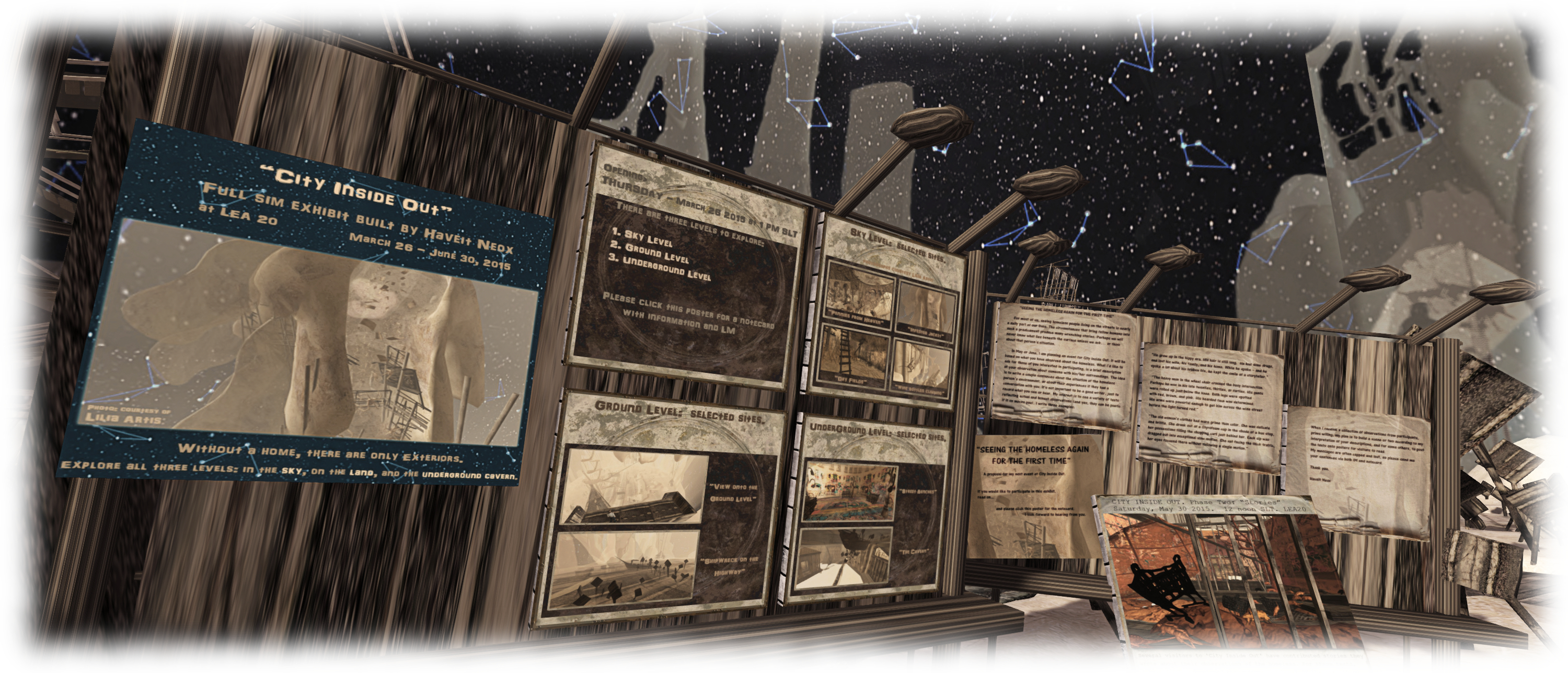
In March I wrote about Haveit Neox’s visually stunning City Inside Out, a full-region installation at LEA 20, which is displayed as a part of the 8th round of the Artist In Residence series.
On Saturday, May 30th, a new element in the installation, City Inside Out Phase II:“Stories” opened, and takes the visitor down under Haveit’s remarkable cityscape, where stories await.
To briefly recap on the original build, as per my initial post about it:
This is a city we’re asked to see through the eyes of the homeless, the dispossessed; those who have nowhere to be, nowhere to go. For these people, the city is a very different place to the one we know. It’s a place where everything is strange, alien, and threatening. A place bad enough in daylight, but as Haevit further explains, becomes much, much worse at night…
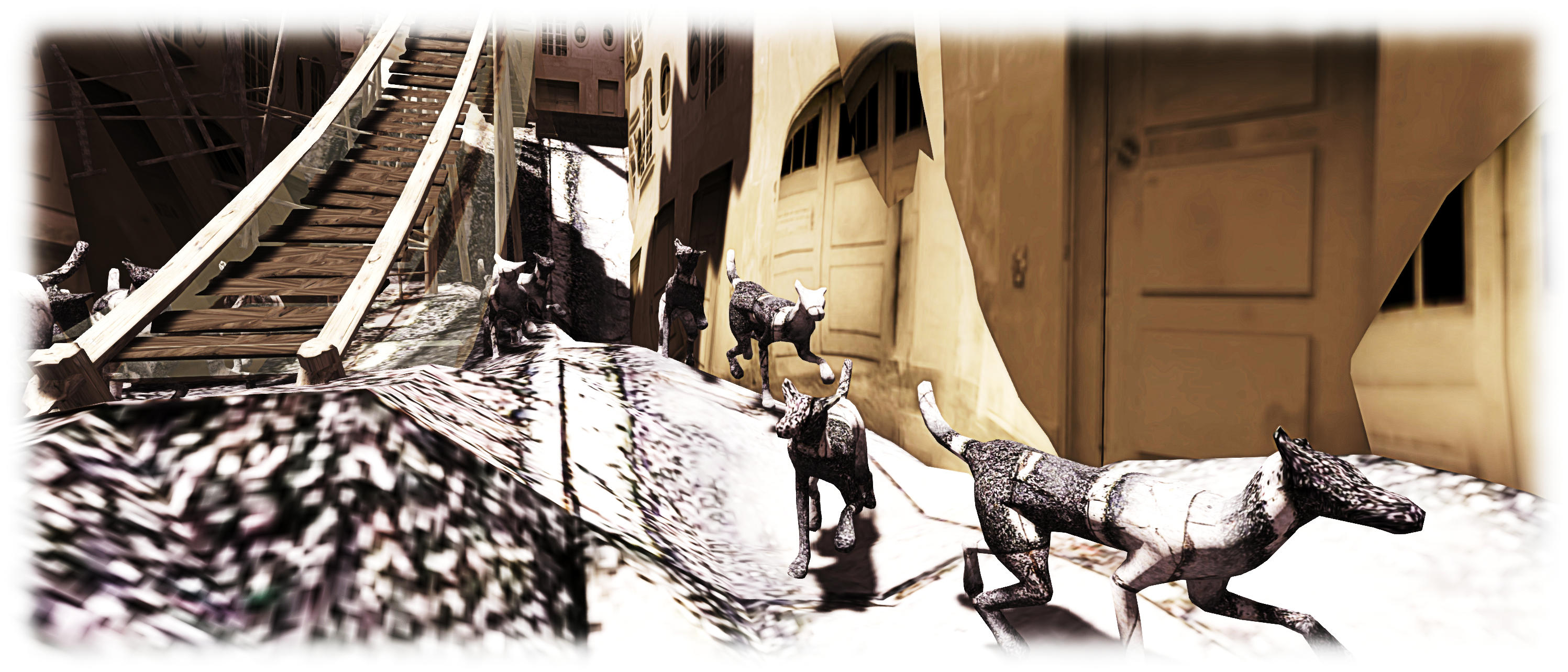
As I noted at the time, this premise of seeing a city somewhat in reverse, as a homeless person, makes for a remarkable – and is some places uncomfortable – place, where nothing is quite as it seems, be it the had offering money or the man walking his dog; threats real or imagined and spurred by fears and a sense of separation, can be found everywhere…
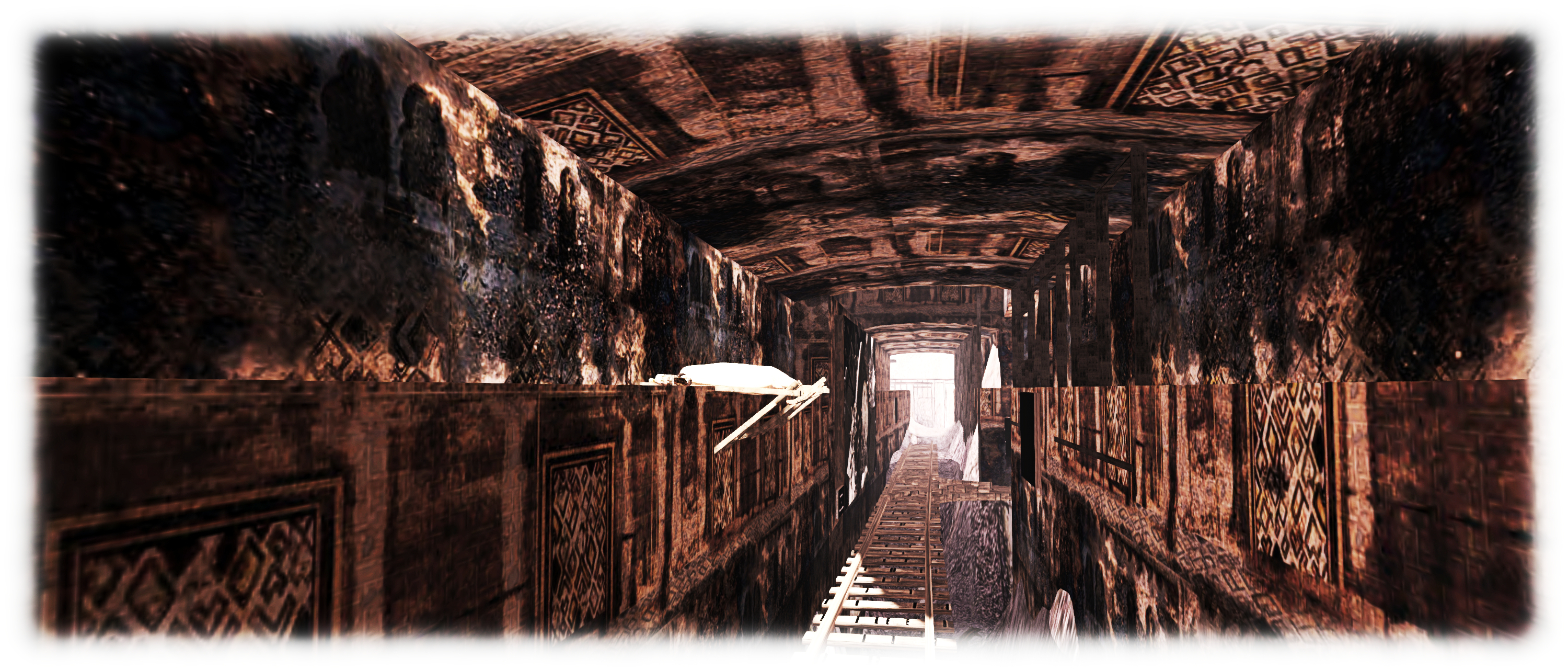
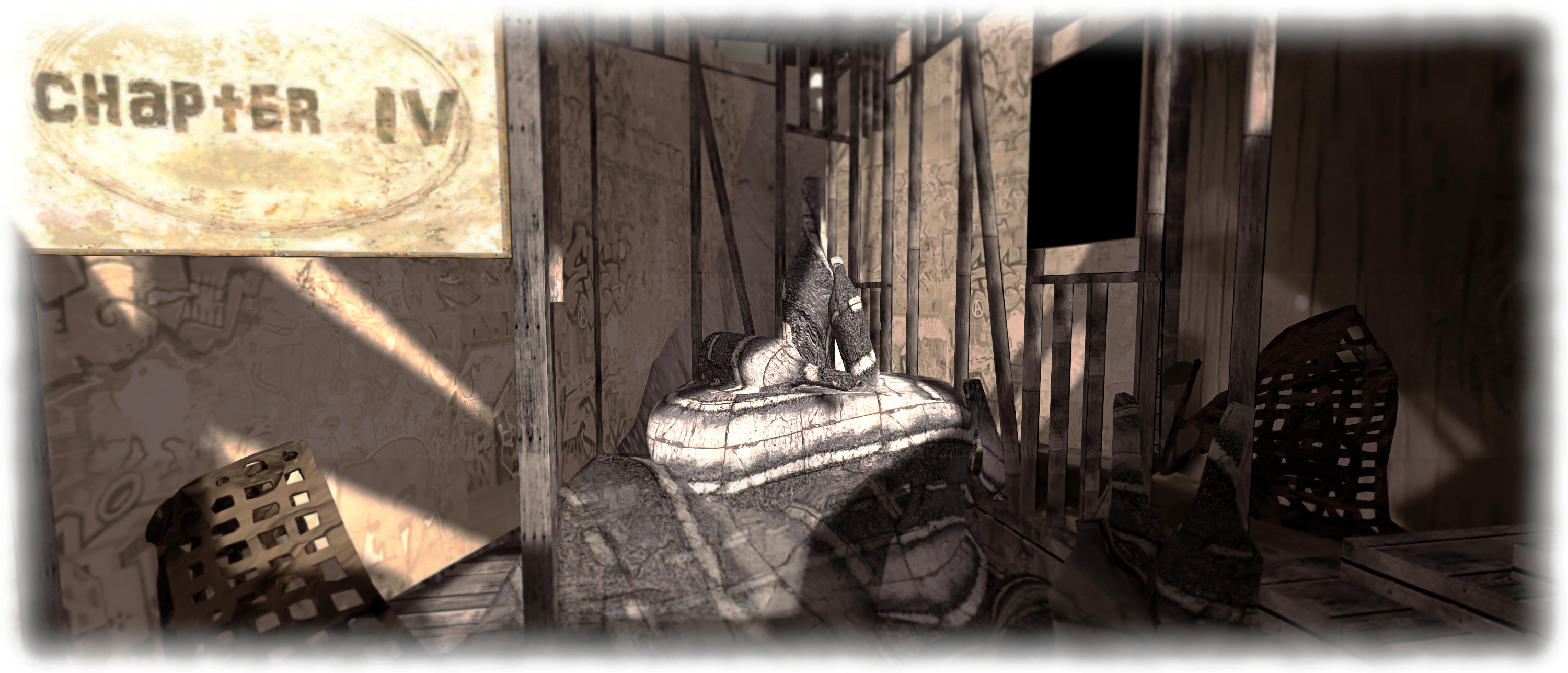
With Phase 2 of the build Haveit incorporates a series of short stories written by other Second Life residents on the subject of homelessness in the physical world as they perceive it. These are laid-out in an underground labyrinth sitting beneath the lowest level of the main build, and are arranged as a series of seven chapters reached by following subterranean paths.
There are a number of different entry points to these paths – simply walk onto one of the moving roadways and follow it, and you will drop into the underground world. However, to follow the chapters roughly in order, the best point to start is to walk to the dual carriageway that lies just behind the landing point information boards, and follow it eastwards. It ends in a slice in the ground that will lead you down to Chapter 1, which sits directly under the roads. Do note, however, that the route through the chapters from 1 to 2 to 3, etc., isn’t necessarily linear; spurs and turns can lead you through the middle chapters in different ways, depending on the route you take.
The paths also provide a hint of narrative as well the the story boards located along them. As you walk through them they change from a trench-like cutting to what could be long-abandoned mine workings or the underground vital intestines that keep a city alive, through to vast subterranean chambers suggestive of a city that has built over itself time and again, burying or hiding its past from view – just as we so easily can blot the homeless around us from our view.
This is a fascinating addition to what was already a brilliant installation, both in terms of the build and the stories it contains. It is also one in which you can play a role; Haveit is still accepting pieces on the subject of homelessness, and will add them to boards throughout the underground world as they are submitted. Simply send him your words via note card together with an IM notifying him you have sent something. Additions to the narrative will continue through until June 25th, and both phases of City Inside Out will remain open until June 30th.
If you haven’t already visited, I urge you to do so; and if you have been before, do make sure of a return visit and walk the underground paths.
Obedience is a new, mixed-media installation at the Jüdisches Museum, Berlin, created by Saskia Boddeke (Rose Borchovski in Second Life) and Peter Greenaway, which has an interesting cross-over with our virtual world.
The installation takes as its theme the story of Abraham and Isaac; a story which raises questions which are addressed differently by the three major religions – Jewish, Islamic and Christian – in which it can be found.
As the tale goes, Abraham is commanded by God to offer his son in sacrifice as proof of his devotion. Thus, the first question is framed: which is the stronger – devotion to the will of God, or the love of a father for his son? Within this sits a second question, one which holds relevance to us all today regardless of our religious leanings: which is the more important to us – obedience or trust, and where can the balance between the two be found?
Obedience seeks to explore these issues by leading the visitor through fifteen rooms in which Boddeke and Greenaway retell the sorry using a variety of mediums and approaches. In doing so, they offer a means of taking the narrative apart, creating emotionally charged scenes and vignettes which focus the visitor’s eye and thoughts.
The cross-over with Second Life comes via a special installation created by Bryn Oh and Jo Ellesmere at LEA 1, also entitled Obedience.
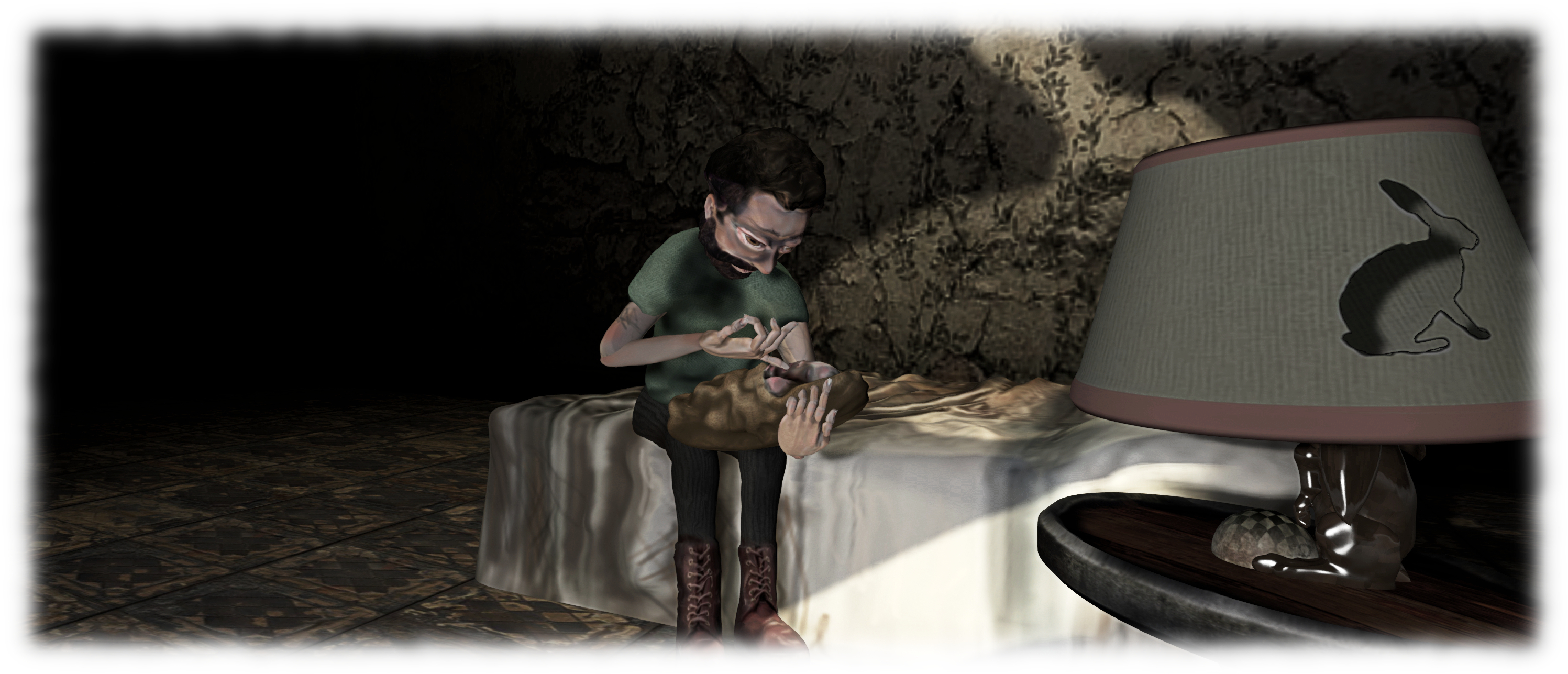
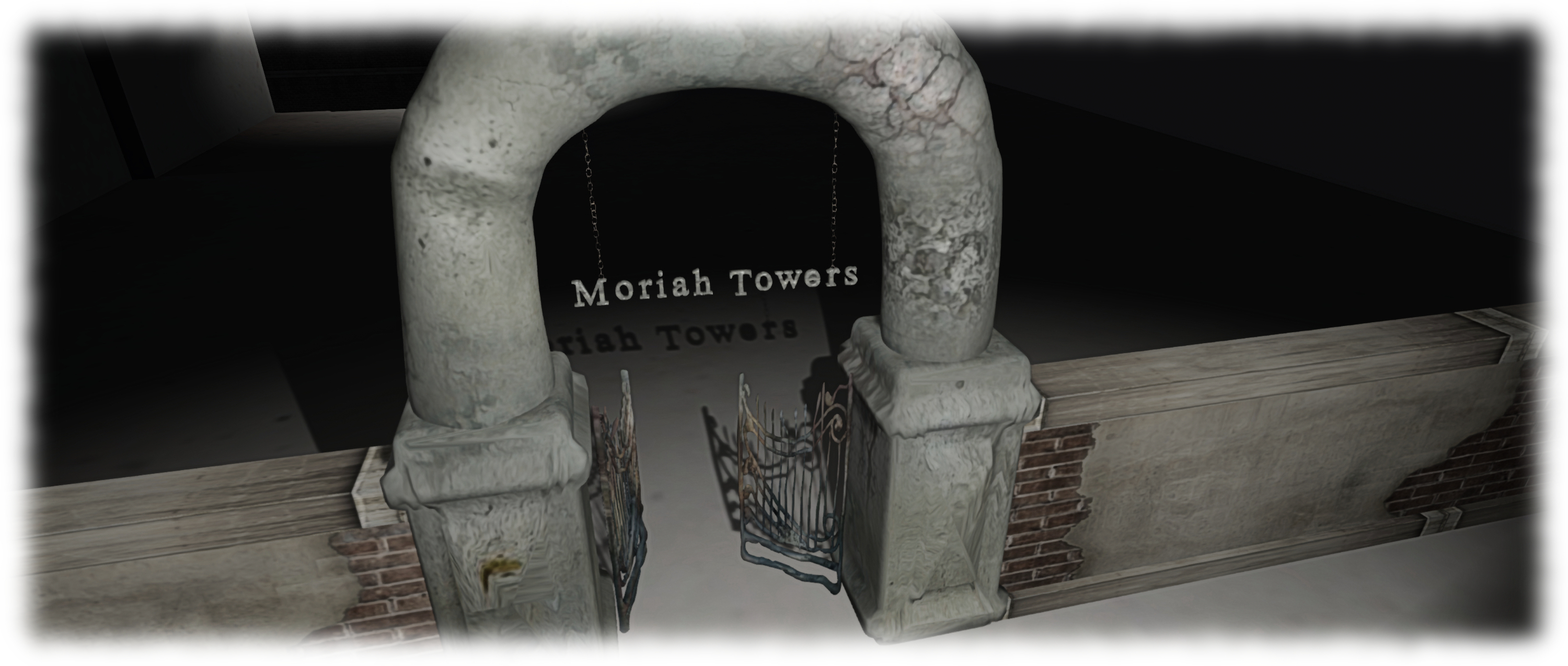
As with the exhibit at the Jüdisches Museum, visitors to the LEA 1 installation are encouraged to explore a series of “rooms” in which the story of Abraham and Isaac is presented through a set of distinct vignettes, all of which are given a contemporary turn – Abraham, see initially as a doting father, appears to hear the Voice of God through his television, for example, while the mountain range of Moriah from the Book of Genesis becomes a series of tall buildings called Moriah Towers.
Obedience, LEA 1: Abraham obeys the Voice of God, taking his young son out…
“This is a very important exhibition in that it is a high profile use of Second Life as an artistic medium and its mere presence within a museum of this calibre legitimises the virtual space as an art medium for some, who before now may not have associated it in this way,” Bryn states in her own introduction to the LEA 1 installation and its link to the Berlin work. “Credit for this should be given to both Saskia and Peter who are staunch supporters and believers in this medium, they could easily have created the work without using the virtual space yet pushed the idea on the Museum directors and have them interested as well. ”
The link comes not only in the presentation of the Abraham and Isaac story individually in the physical and virtual spaces, but also in fact that the virtual environment we can explore at LEA 1 is being shown on monitors within the Museum, and visitors there have the opportunity to to join us in-world and explore the installation here; through the use of two avatars, isaak001 and ishmael001. So if you see either of them wandering through the LEA 1 space, do keep in mind they are visitors to Second life from the Jüdisches Museum.
The story of Abraham and Isaac is not an easy read, and by bringing the story into a modern setting, Bryn underlines some of the more uncomfortable elements within it, whilst also drawing attention to the broader question of obedience and trust. It also raises an further uncomfortable questions, which I’ll come to anon. In terms of obedience and trust, the contemporary approach taken here offers potentially broader interpretations than the purely Biblical.
Take Abraham’s hearing the voice of God through his television. Here there seems to be a question lurking as to our relationship with the media upon which we rely; just how far can it be trusted? And what if it – say, as a state apparatus – demanded obedience? There are other possible subtleties here as well, such as the Lovecraftian nature of the chair in which Abraham sits, which seems to open doors into other lines of thought.
Nor does Bryn doesn’t stop short on showing Abraham’s willingness to sacrifice his son, either. This scene takes place atop of the aforementioned Moriah Towers,s and is brutal in its and terrifying in its vivid portrayal, despite God’s intervention, Abraham’s faith and trust having been demonstrated.
However, this is not the most powerful and poignant scene in the series. That comes last of all – providing you take the time to locate the teleport to reach it. Bryn carries the story forward in what, to me, is the most poignant scene of all. Here we see the aftermath of events. Abraham may well have proven his faith in God, but he has betrayed the trust of his son, who cowers against a wall, terrified. “What happens once Gods presence has withdrawn after testing Abraham’s faith?” Bryn asks, “How might the moments go when Abraham and Isaac are now alone and words are needed to explain?”
The Eternal Suspense is the title of Giovanna Cecise’s latest full region installation now open at the Linden endowment for the Arts, as a part of the 8th round of the Artist in Residence programme.
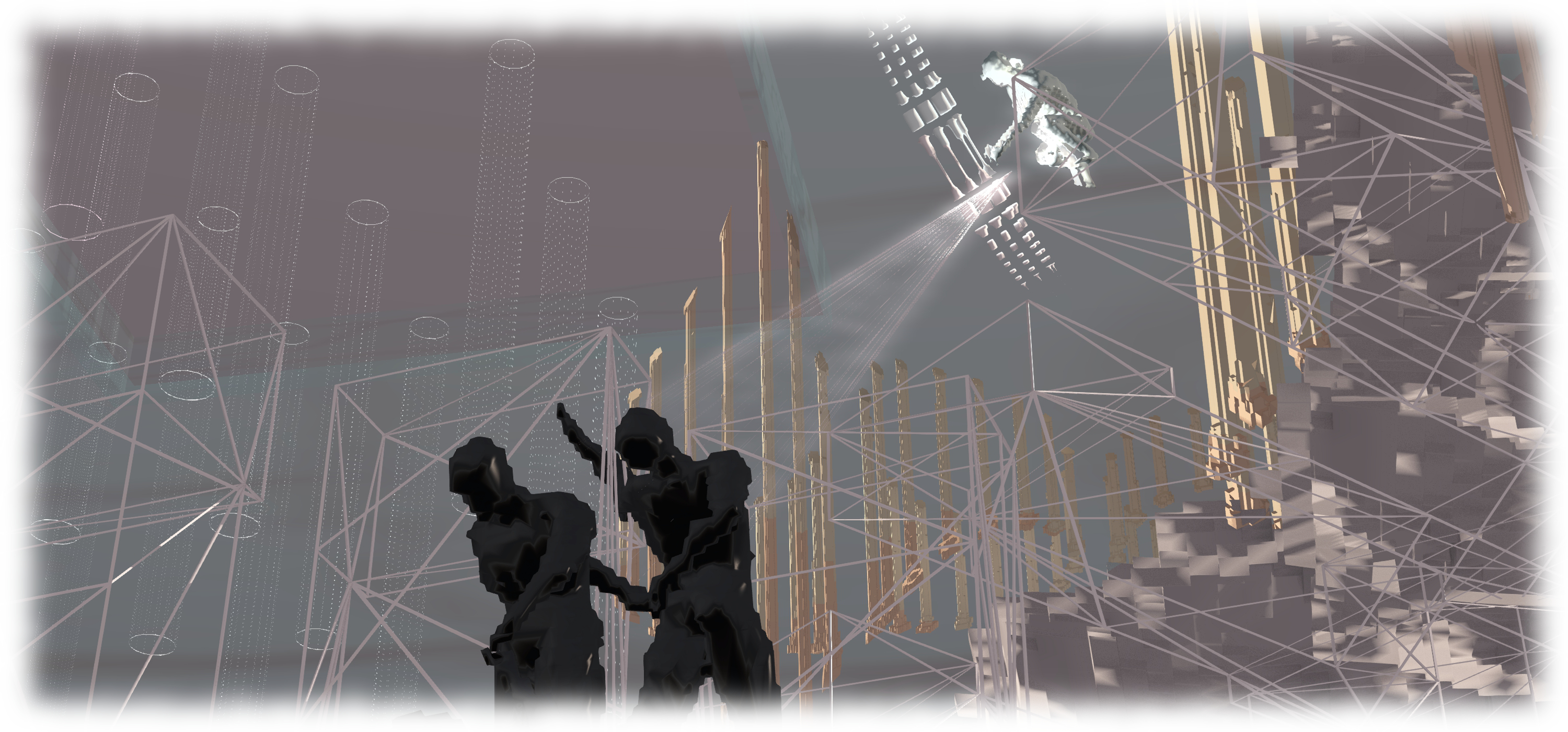
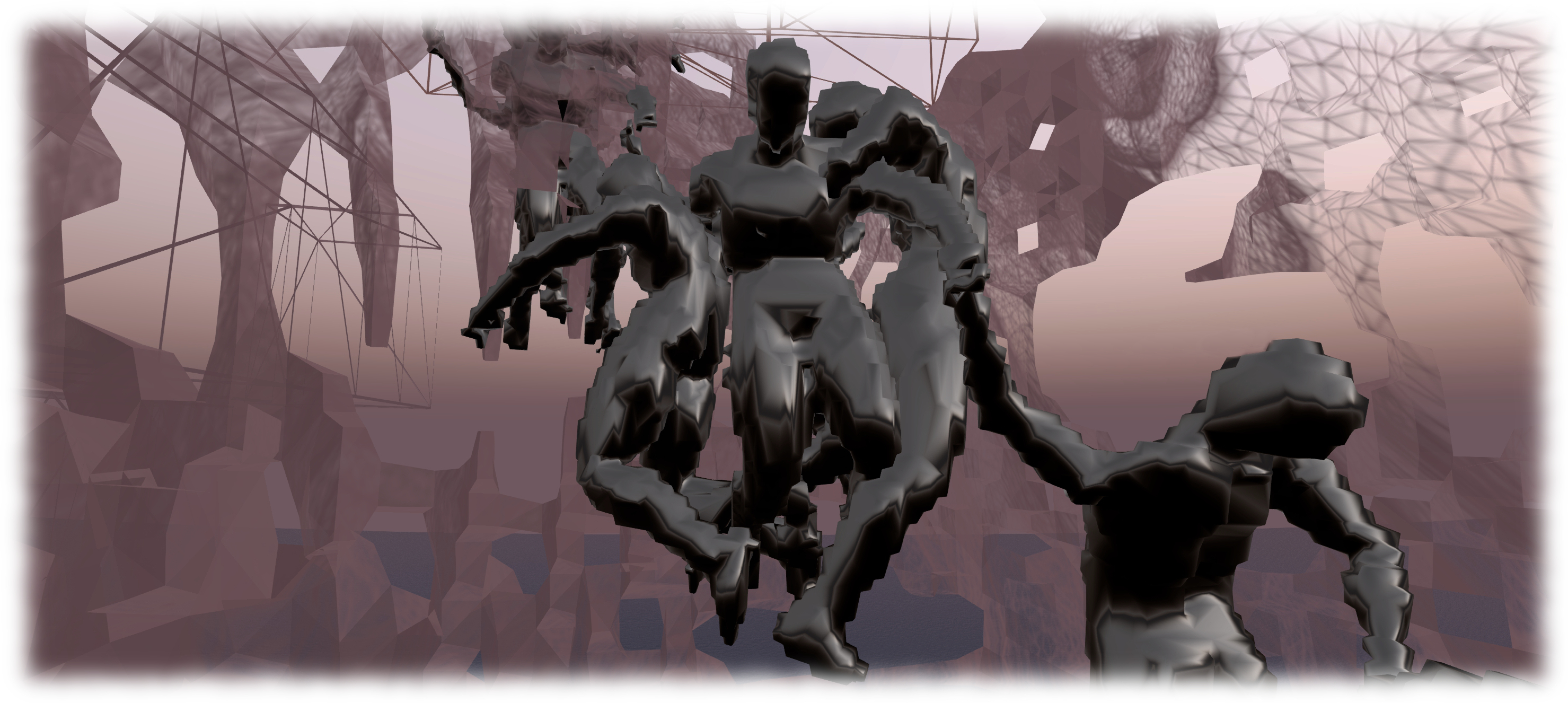
A complex piece mixing geometrical forms with human elements, the installation extends several hundred metres into the air, encompassing a number of distinct levels. Within the lattices and sphere which give a sense of order to the the build, there is also an element of disorder: human figures rising from the lowest platform, climbing the lattices upwards into the sky, stretching up towards a white figure crouched at the highest level.
Giovanna has taken as her theme the Apollonian and Dionysian philosophical dichotomy, perhaps most famously expounded within Friedrich Nietzsche in his 1871 study, The Birth of Tragedy. in which he examines the nature of Greek Tragedy before going on to use the Greek model to understand the state of modern culture.
The central concept of the Apollonian and Dionysian dichotomy is that Apollo is the god of reason and the rational, while Dionysus is the god of the irrational and chaos; therefore the core of all great tragedy grows out of the interplay between the differing world views they represent.
Within The Eternal Suspense Giovanna embodies and interprets this concept artistically. “Man is poised between two or more emotions, he is always in a delicate step,” she states, “in a hazardous environment. Its location is never easy, he is a tightrope imprisoned in constant tension between his Dionysian side and the Apollonian one. But [do] you have really to choose? Or you have really to find a balance?”
Thus, this interplay is defined between the lattice (ordered and rational) and the mass of figures climbing it (disorder, chaotic). But it also runs deeper. The figures themselves are rising from a scene somewhat chaotic in nature, with what appears to be roiling waves (or perhaps flames) mixed with revelry; but while their ascent up through the lattice may seem chaotic, it is both purposeful (rational) and encompasses cooperation (order), the figures all assisting one another. Thus the tension we can experience in trying to find a balance between our Apollonian and Dionysian “sides” is embodied in their form and efforts.
To get around the work, you can either fly, or use the teleport spinning tops (the first is located at the landing point). Right click on them and select TELEPORT, and they take you up through each level. Giovanna recommends a sunset windlight for the piece; I’d actually suggest something more towards a dusk level of lighting.
The Eternal Suspense will be open through until the end of June 2015.
Applications are now open for round 9 of the Artist in Residence (AIR) programme operated by Linden Endowment for the Arts.
Twenty regions (LEA10 through LEA29), donated by Linden Lab and managed by the LEA, are offered under the AIR programme, and successful applicants will be given the use of one full region for a period of five months. The region may then be used on an individual or group basis for such diverse activities as:
Full sim exhibitions and / or immersive installations
Curated projects, especially those which have a connection to physical exhibitions and events (mixed reality).
Artists are asked to take no more than 3 months to execute their build, so that their installation is open to the public for at least the last 2 months of their grant. However, artists may also open their installation ahead of the three-month build deadline, and many artists in the past have used their land to have multiple exhibits.
The timeline for application as it currently stands is:
Application deadline: May 30th, 2015
Notification by: June 14th, 2015
Sim handover and public announcement: July 1st, 2015
End of round: December 31st, 2015.
AIR 8: Haveit Neox – City Inside Out, LEA 20; review






 Inara Pey: Living in a Modemworld