A walk through an exquisite path

The exquisite corpse is the theme of a new full sim LEA exhibit called The Path, opening today in Second Life, which features the work of no fewer than eight of SL’s most talented artists.

Surrealists

The term “exquisite corpse” (also referred to as the exquisite cadaver) is a means by which a collection of words or images is assembled, with each collaborator in the piece adding to the composition in turn, either by keeping to a specified rule, or by being allowed to see the end of what the previous person contributed. If you think of it akin to the game of Consequences, in which each player contributes a line of a story then folding it to conceal part of the writing before passing the paper to the next player to continue, you’ll have the general idea.

As a form of art, the process was developed as a game by some of the leading Surrealist artists of the early 20th Century, including André Breton, Jacques Prévert, Marcel Duchamp, Yves Tanguy and Pierre Reverdy.

For The Path, the contributors of the piece are (in the order their work appears in the installation): Bryn Oh, Colin Fizgig, Marcus Inkpen, Desdemona Enfield / Douglas Story, Maya Paris, Claudia222 Jewell, Scottius Polke and Rose Borchovski. Bryn Oh explains how the order was decided upon:

[The] Eight artists were invited to stand upon one of eight different coloured boxes I had set up.  Once all had chosen a box to stand on, a chart was rezzed which listed the order of colours which would dictate the sequence of artists to compose scenes for the narrative. So if red was first on the chart, then the artist standing on the red cube would begin the narrative.  If blue were next then the artist on the blue cube would continue the story.”

It’s an intriguing approach to building a collaborative piece of art – and one I’ve been itching to journey through since first learning about it while interviewing Claudia222 Jewell in September.

The Landmark / SLurl for The Path delivers you to a darkened room together with a request for the region to control your Windlight settings – for the best visual impact, you should allow it to do so.

To your left are eight plinths introducing the eight artists who participated in The Path – clicking on these will give you a short biographical notecard and (in some case) a Landmark where you can see more of their work. There are also two large stone-like tablets introducing you to the concept of The Path and which give you some advice on how to enjoy things – such as making sure you have sound available, as the installation is an aural, as well as visual, experience.

Getting A Head
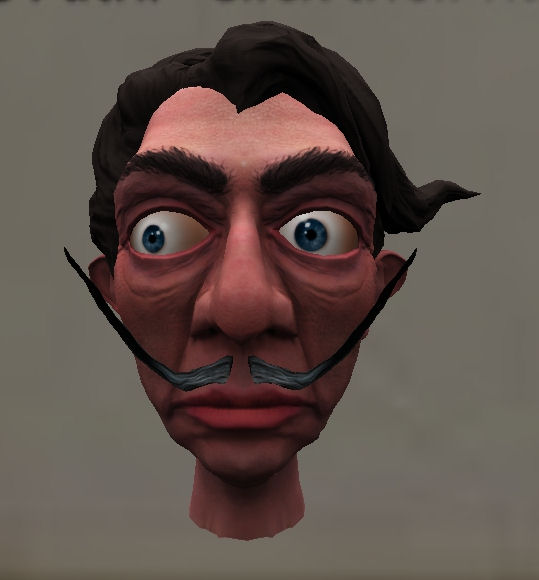
It’s all in his head

A head, resembling a young Salvador Dali, watches you from the bottom of one of these tablets – clicking on it will carry you to the start of The Path proper, and Bryn Oh’s work. Note, as well, that the head is your main clue as to how to proceed through the rest of the work.

Taking the teleport delivers you to a white room. A strange engine-like thrumming fills the air, together with soft piano music. On the floor lies a single, plaintive butterfly, while before you lies a black wall…a hole…beckoning you through.

Walking through the “hole” leads to another white room wherein the music and the thrumming are joined by a lonely wind and the sound of water drip-drip-dripping…another hole beckons. Passing through this brings you to a third room….

The lab – and the start of a journey

It’s a room of curios and oddities, partially flooded – hence the dripping previously heard, planks providing walkways over the water. This is the inventor’s lab. There is much to see here – and one or two things to touch; find them and you will be treated to  a side-story that accompanies the installation, told through YouTube – and which you might witness for yourself in part, should you find yourself in the field beyond the laboratory.
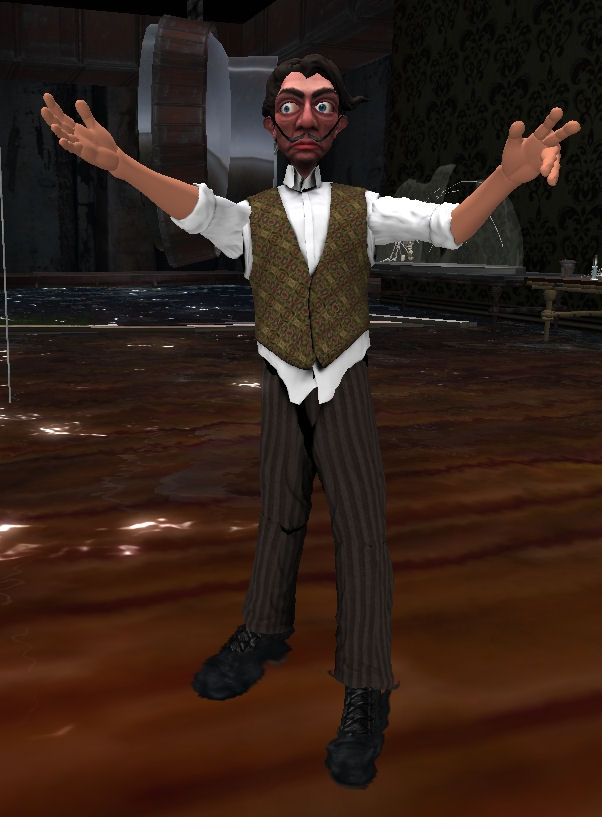
The inventor. Guide and … protagonist?

As you explore the lab, the inventor himself will materialise. You might recognise him – it was his head you clicked when commencing your journey, and thus you have a further clue as to how you must proceed. As he appears, a narrative beings, telling you about the inventor, his flooded lab and the portal he slipped through one day. Take it as your invitation to follow him.

Beyond the laboratory lies a misty, flooded field, water lapping around the trunks of trees. Here you can find the conclusion of Cerulean, the curio-accessed tale told via YouTube. Be warned, however, that if you step out into the field, you will not be able to return to the laboratory; instead you must find another way of continuing your journey along The Path. The only clue I’ll give you is not to wander too far from the walls of the laboratory itself…

Curiouser and Curiouser

With the inventor as your guide you will arrive at the second part of the story, created by Colin Fizgig. This is a hole-y place, with windows looking out on different scenes, different places – with some looking inward at you from the other side. As the narration resumes, it is through one of these windows  – these holes – that the inventor flew, and you must follow him as he dives towards one…
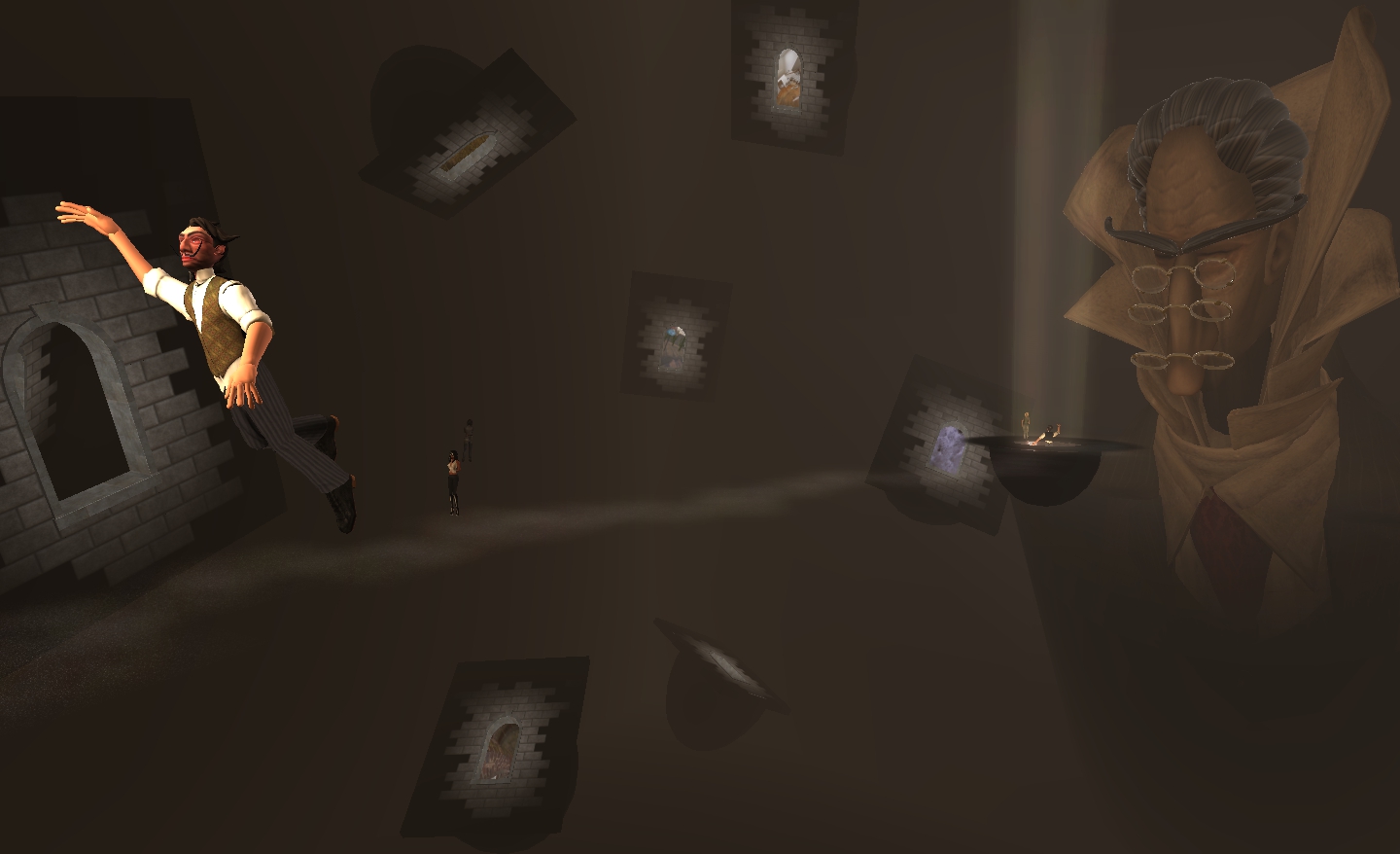
Windows onto worlds – which one is yours?

Marcus Inkpen provides the third part of the installation. Here stands the Overseer and his stout companion, conversing at the junction of several strange, door-lined hallways. Do you take one – and if so, which one? And what’s that about a key being in your pocket? Does it mean something… or…?
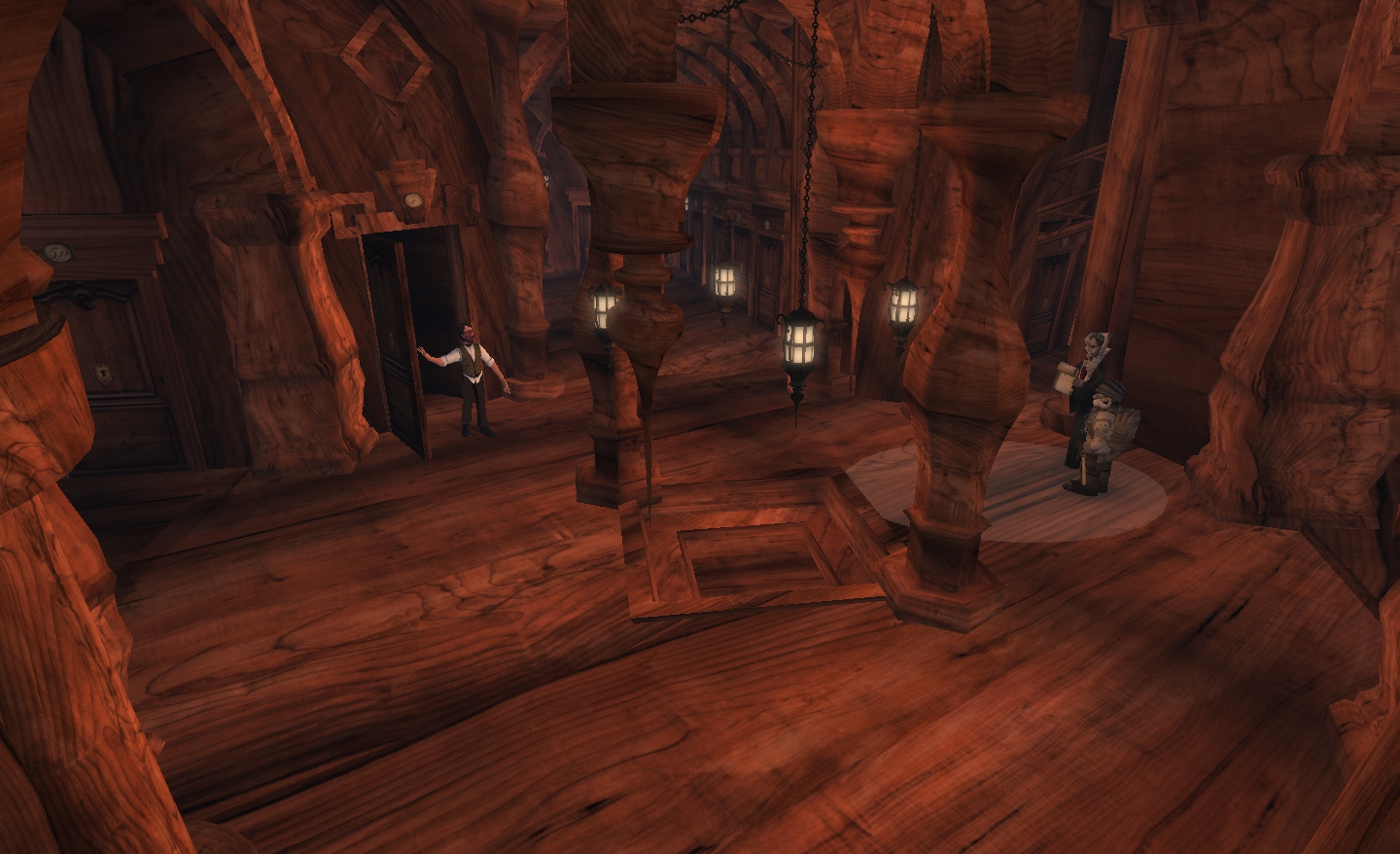
Your doorway awaits

Tonal sounds here give the place a brooding air, and if you wander the hallways, you’ll hear stranger sounds of life from the other sides of the many doors. But which door do you take…and what lies beyond?
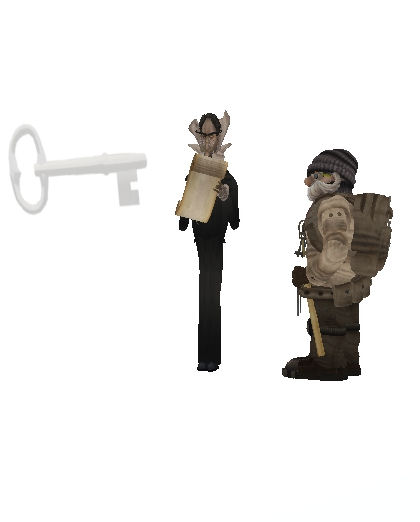
Follow the key – carefully

Find the door, and you’ll discover the contribution from Desdemona Enfield and Douglas Story. It starts in a white room, just like the start of The Path itself. Here stand the Overseer and his companion once more, together with an apparently simple and innocent suggestion that you follow the key. But as with so many things, appearances can be deceptive, and following the key may lead to things not quite so simple and direct.

Maya Paris provides an altogether different landscape – are those the shadows of ladders, or the shadows cast by some bizarre web? Is something lurking in the apparent calmness of this place? Climb the ladder and find out; although I hope your eyesight is in good order – and not just for finding the inventor!
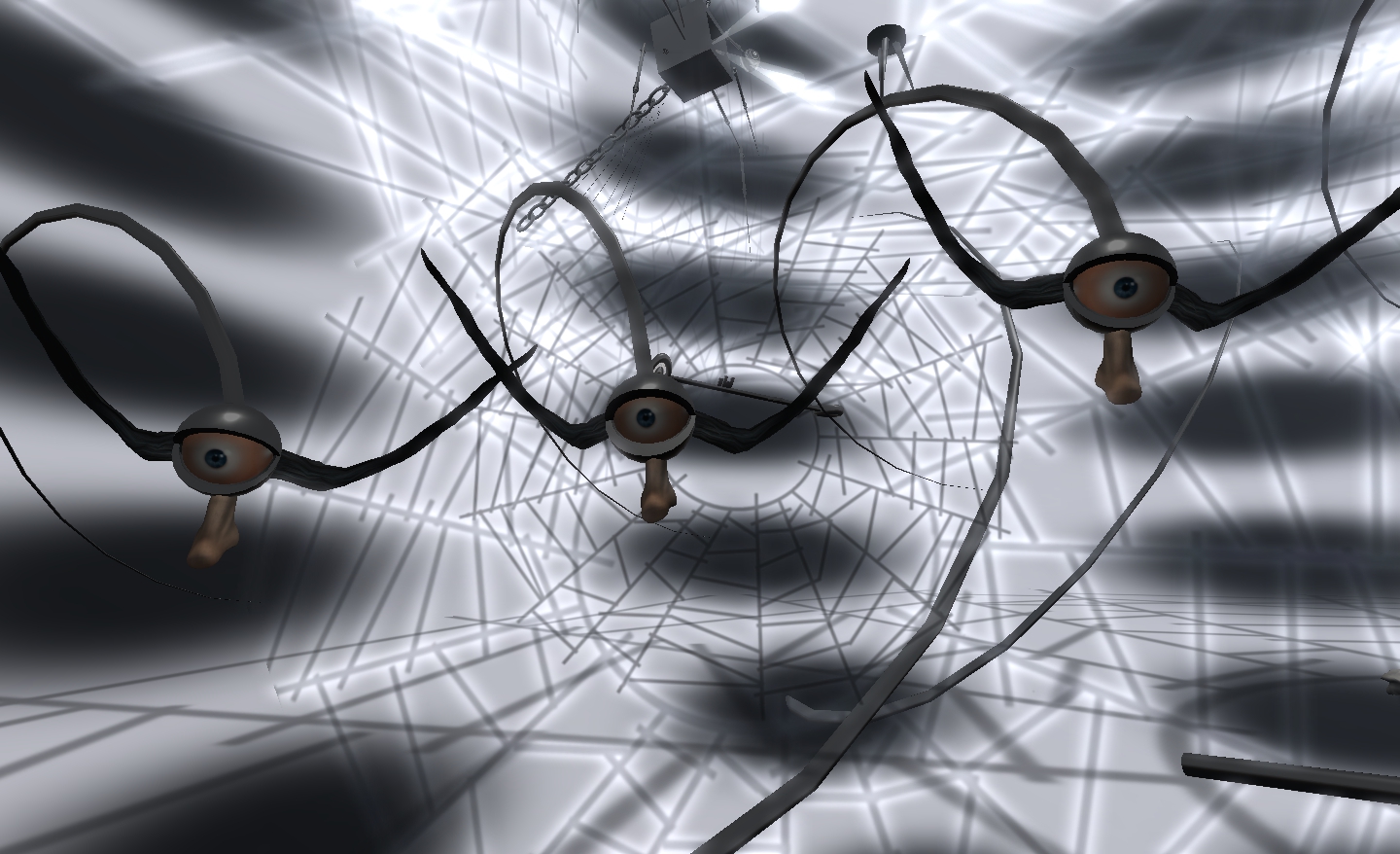
The eyes have it in Maya Paris’ piece

Feast

It is moving on to the sixth part of the installation that I confess to becoming a tad biased. This is because the sixth element features the vivid and beautiful imagination of one of my favourite artists in Second Life – that of Claudia222 Jewell.
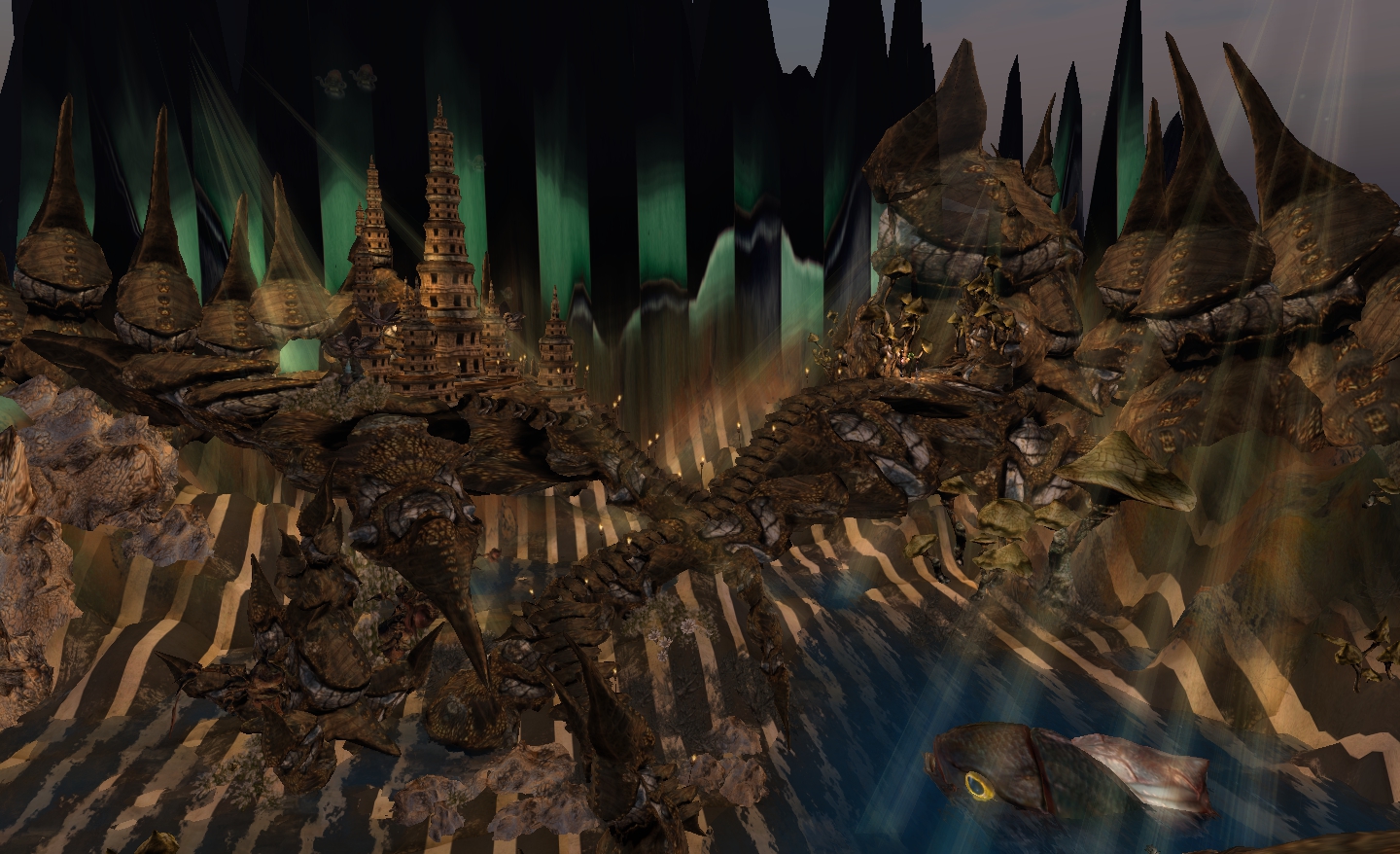
Claudia222 Jewell on The Path – amazing

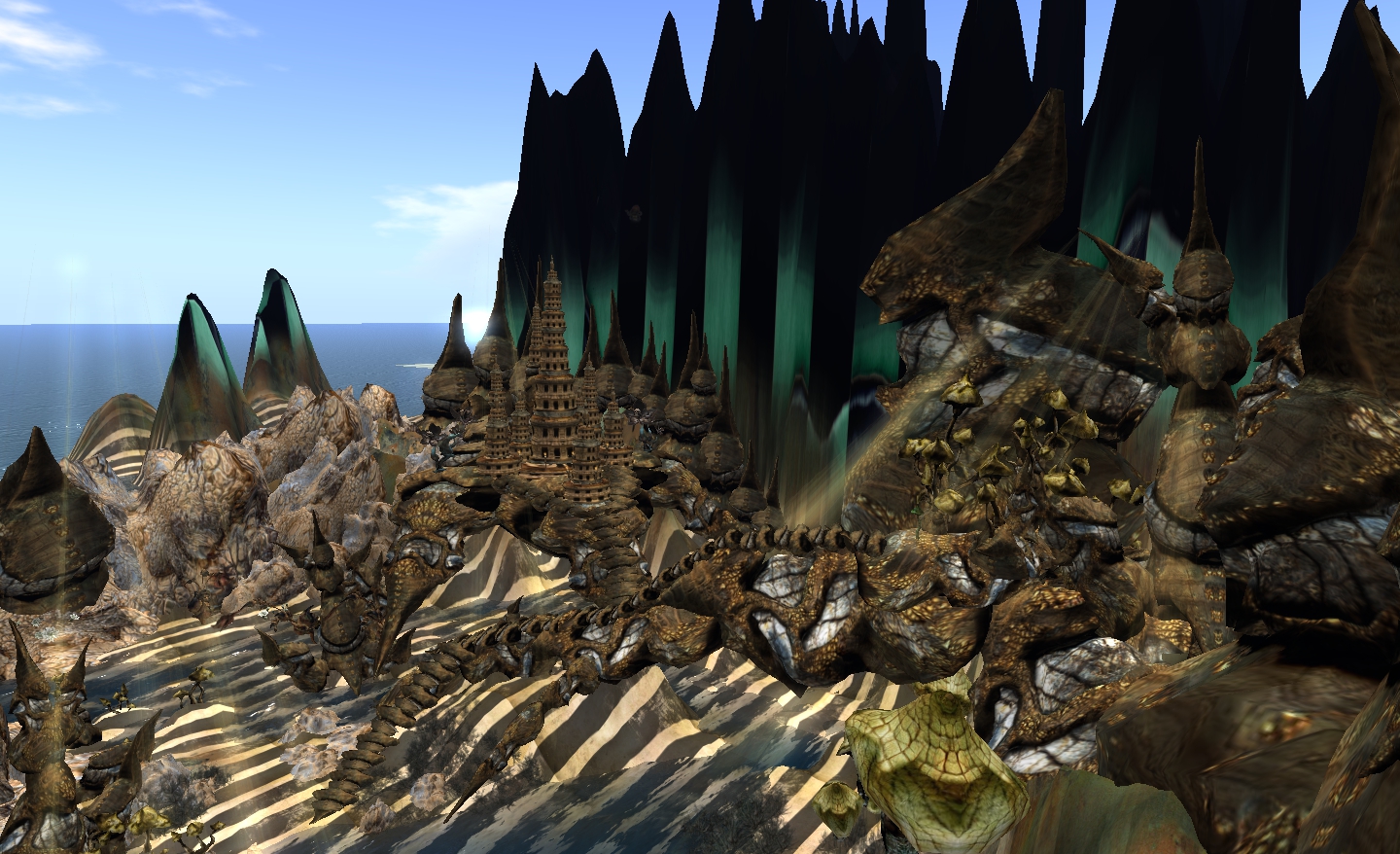
This is truly a visual feast and (as always with Claudia) a tour de force of what can be achieved in Second Life. Her City of Lost Souls is amazing in its complexity and beauty. Without detracting at all from the other works in The Path, one cannot help but feel this is another of her pieces that should be preserved and displayed for everyone to enjoy.
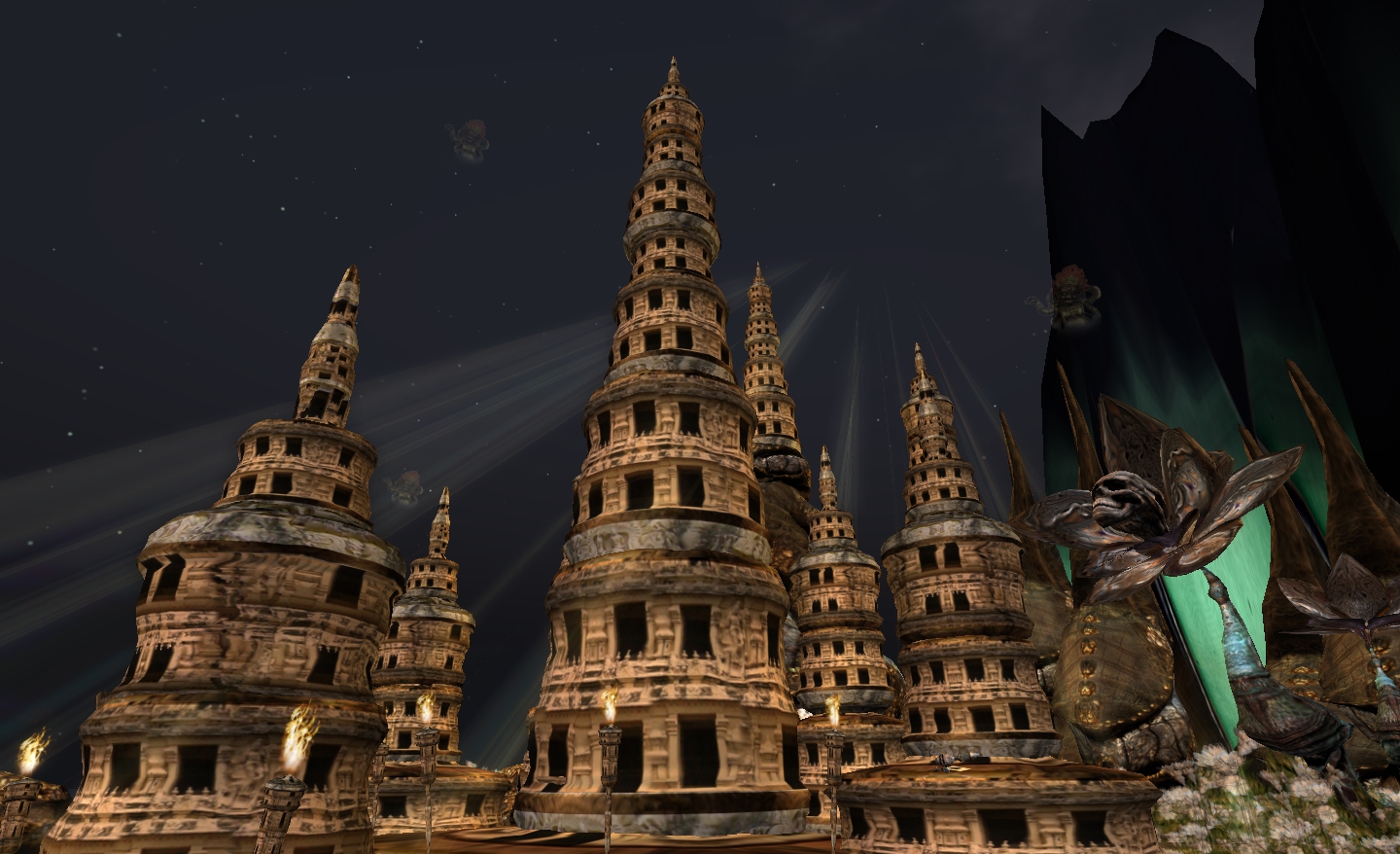
City of Lost Souls – will you be lost in Claudia’s contribution?

If I have one complaint here, it is simply this: Claudia’s work is too enticing. I wandered it for over 40 minutes drinking-in the detail and unwilling to leave. Perhaps that is why her city is inhabited by lost souls – many more may have visited and been unwilling to leave…

But leave one must – and this requires finding a head once more – but not necessarily the head of the inventor; although finding the right one will lead you to him.

Scottius Polke returns to the theme of the laboratory with his contribution to The Path, and on a grand scale. Here you must keep an eye out for the direction you should take, negotiating giant rulers, coiled pipes and other obstacles. This actually needs some care – the route you must take climbing some of the items is very narrow, and lag here and there can easily have you stepping off into thin air if you press a key for too long – as I found out.  And while you climb, be aware your every move is being watched from above, as the inventor himself gazes down upon you; but it is not his big head that will help you out of here.
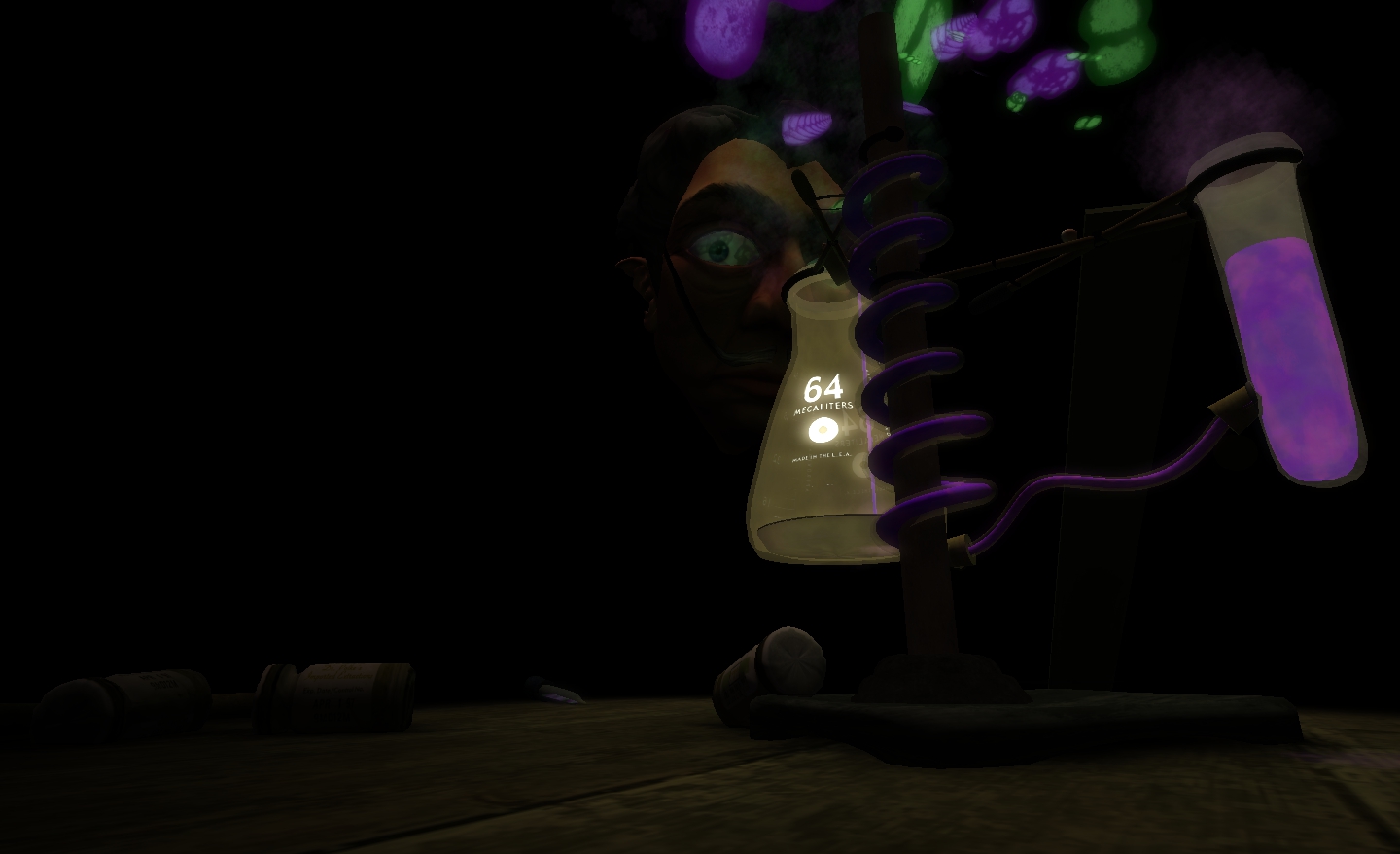
It’s a big world

The final part of The Path is by Rose Borchovski, and you might say it is an eye-opener. It’s also slightly unsettling for ways not easy to discern; it’s not the eyes that stare and follow you; or those heaped pyramid-like, eternally watching. It is more the child’s voice whispering forlornly and the strange circle of beds, each one an echo of the places you have seen and visited while journeying The Path, the occupants (or parts of them in some cases) pinned to them like items in a collection. Be careful with the beds in particular; you might find yourself going on an unexpected trip into the past….
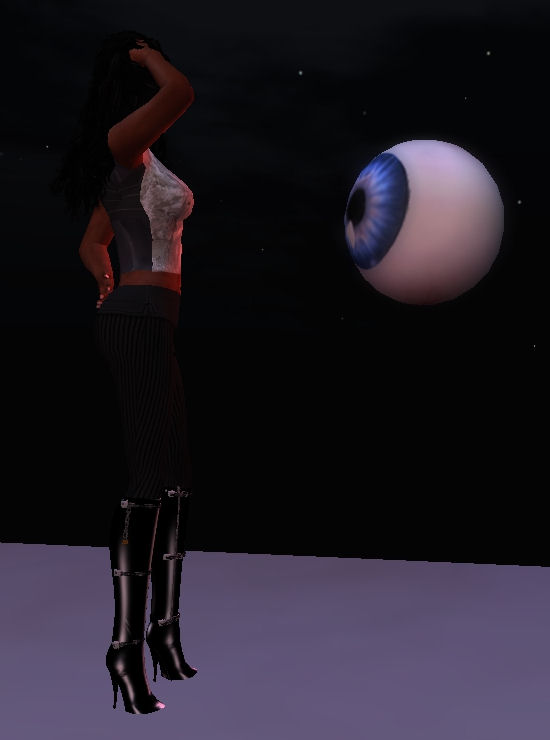
Rose Borchovski gives me an admirer

Overall, The Path is an amazing piece – one that requires a good deal of time to experience fully. Each element of the installation has been carefully considered, and the themes linking them are clear, een when the verbal narrative stops. Each of the sections of the installation is distinctive in both style and approach, while all come together to form a story that can be followed as you roam. Kudos to all those who participated in the installation, and to Bryn Oh for conceiving the idea.

You need to give the exhibit a fair amount of time; even with my joyful distractions in Claudia222 Jewell’s part of the installation, I still spent the better part of four hours roaming, poking, listening, prodding and generally losing myself (once quite literally) in walking The Path. But it was four hours I feel were well-spent. So why not take a walk along it for yourself?

The Path officially opens today for a 3-month period. My thanks to Bryn Oh for the preview opportunity.

LEA announce 20-sim deal with LL

The Linden Endowment of the Arts (LEA) have announced they have secured 20 sims from Linden Lab to promote the arts in Second Life.

The LEA Land Grant will make the sims available to the LEA for a 12 month period. These sims will be used as follows:

  • Two sims will be allocated via a Land Rush
  • Four sims will be reserved for exhibitions curated from LEA sandbox builds
  • Fourteen sims to be allocated on the basis of an application process, which closes on November 1st 2011.

The fourteen sims to be allocated on the basis of an application process will be made available to successful applicants for periods of five months before being transferred to the next set of awardees. Details on how the Land Rush and 4 “sandbox promotion” sims are to be allocated and for how long, have yet to be mad public by the LEA.

Separate

This deal, it would appear, is entirely separate from Mark Kingdon’s announcement, made in 2009, that some 70 sims would be made available within Second Life as a part of an effort to support the arts. At that time, given the amount of private effort – with absolutely no subsidy from Linden Lab  – that goes into supporting art and creativity in Second Life, Mark Kingdon’s announcement caused a fair amount of concern as to what such a grant would do to such privately funded efforts in support of the arts.

At risk: privately funded art support?

While this announcement from the LEA is smaller, it is likely that it will give rise to similar concerns, particularly given the superb work performed by the likes of Art Screamers in their promotion of sim-sized installations such as Through the Lens of Dreams, and other exhibits which are met entirely out of the sim owners’ own pockets.

Weakens?

Which is not to say the LEA do not provide stunning installations themselves – again as witnessed by Rebeca Bashly’s brilliant and immersive Inferno equally demonstrates. Even so, arrangements such as this – as well-meaning as they might be – do create an imbalance in the SL art community, which is still very much a limited pool of talent. If that talent is fully engaged in LEA efforts, then there is a risk that those who privately fund art activities may well be faced with no other option that to consider shutting down. This in turn potentially weakens art in SL on two fronts:

  • It reduces the number of venues available in which those not selected for such grants can display their work and talent
  • It runs the risk of what constitutes “art” for wider consumption within Second Life being defined by a small, closed group within SL – again leading to potentially fractious accusations of the infamous “feted inner circle” variety rumbling across the community.

The flip side to this is that it might be said that many aspiring artists within Second Life might be presented with a chance to gain an audience through their participation in the Grant. A chance that might otherwise elude them if they had to rely on other means of promotion.

For those wishing to participate in the LEA Land Grant, the application requirements are available on their website via the link above. All applicants must be familiar with, and agree to abide by, the SL Terms of Service, Community Standards and the LEA Code of Conduct in order to participate in the programme.

Second Life goes to hell – literally!

This month sees the launch of the Linden Endowment of the Arts (LEA) Full Sim Arts Series. The first exhibit in the series is by Rebeca Bashly, a stunning interpretation of Inferno, the first part of Dante’s 14th Century epic Divine Comedy which opens the Series in a truly grand style.

You arrive in darkness – the ambient lighting is intentional, so it is best to leave your settings thus. Beside you is a notecard giver; if you are not familiar with the Divinia Commedia, the card, graciously provided by Flora Nordenskiold, is a good place to start.

Allegorical Vision

The poem comprises three parts, Inferno, Purgatorio and Paradiso, and represents the medieval view of the afterlife, as developed by the Western Church of the time. As a purely linguistic note, it also helped to establish the Tuscan dialect – Dante was born in Florence, and wrote his poem in Tuscan – as the standardised Italian.

Inferno itself deals with Dante’s passage through hell guided by the Roman poet Virgil (Dante himself claims in Inferno XV, 76 that his family is of ancient Roman descent). As the poem opens, Dante is lost in a dark wood, unable to escape a lion, a leopard and a she-wolf, which prevent him finding the “right way” to salvation. Driven deeper into the woods, he is at last rescued by Virgil, and the two of them begin their journey to the underworld. And it is with Virgil, as he stands patiently just a few metres from the arrival point, that our own journey begins.

Virgil: our guide – and the path through the forest

Nine Circles

Virgil leads us first to the Gate of Hell, which bears the famous inscription, “Lasciate ogne speranza, voi ch’intrate” – “Abandon all hope, ye who enter here”, and through which we must pass and enter the “vestibule”. This is where the Uncommitted, souls who did neither good nor evil in life and who are neither in hell or out of it, reside on the banks of the River Archeron. And it is here that Charon awaits aboard his ferry, waiting to carry the damned across the river and into hell itself. For those visiting the exhibit, the way is a little easier: touch Virgil as he awaits beside Charon, and be teleported to the First Circle.

Charon and Virgil await for the journey to the First Circle

Limbo

Limbo is reserved for those who, while not sinful, did not accept Christ into their lives. It is sometimes described as a “deficient form of Heaven”, because without baptism, the soul cannot hope for anything greater. It is here, wandering green fields with the seven-gated castle (representing the seven virtues) close to hand, that Dante encounters the souls of Eclid, Ovid, Aristotle, Julius Caesar, Saladin, and many others. For us, and across an lawn of silent souls, Socrates and Homer wait at the entrance to the castle keep.

Homer and Socrates – two of many souls held in limbo

Within the castle, we encounter other souls as we climb the stairs – perhaps Electra and Camilla, both referred to in Dante’s poem – before meeting Virgil once more on the roof, and our journey continues to the Second Circle.

Lust

Turning in the winds of a violent storm for all eternity, are those who gave themselves over to the sin of lust. Here Dante witnessed Dido, Cleopatra, Helen of Troy, Achilles, Paris, Tristan and many others blown about needlessly and helplessly by the winds of hell that represent the aimless power of lust.

Gluttony

The third circle, illustrated by Stradanus

Cerberus stands guard over the gluttons, who lie sightless and heedless of those around them in a vile slush produced by an unending, icy and foul rain falling from a leaden sky.

The victims’  lack of awareness symbolises the cold, selfish, and empty sensuality of their lives. The slush itself represents the true nature of sensuality: overindulgence in food and drink and other forms of addiction.

In Dante’s poem, Virgil secures their onward journey by filling Cerberus’ three mouths with mud. The visitor faces no such risk with the beast – although we must navigate through the horde of silent, grasping bodies to reach Virgil, patiently waiting for us to touch him, so he can transport us to the penultimate of the five circles of self-indulgent sin.

Greed

In the Fourth Circle we encounter those who gave their lives over to greed, either through hoarding (the avaricious) or through squander (the prodigal), locked in a never-ending battle with one another pushing great weights as weapons against one another, which Dante describes as a form of jousting.

Greed: perpetual battle

Anger

The fifth circle, illustrated by Stradanus

From Greed we  fall to Anger, and a bitter, violent battle between the wrathful, fought in the swamp-like waters of the river Styx, where those so confined bite and rip the flesh from one another or withdraw beneath the brackish surface, “Into a black sulkiness which can find no joy in God or man or the universe”.

Here Dante and Virgil encounter Phlegyas, who reluctantly carries them across the Styx aboard his skiff while they observe the wailing and fighting all around them.

In crossing the Styx, Dante and Virgil journey from the first Five Circles, representing the self-indulgent sins, towards the walls of Dis, wherein lie the more active sins that are both violent (the Sixth and Seventh Circles) and malicious (the Eighth and Ninth Circles).

We have no Phlegyas, however, and so must walk among the eternally angry to reach Virgil id we are to reach Dis.

Heresy

Entering the City of Dis, one must pass the three furies, blood-covered guardians of those who eternally burn in their tombs of fire for their heresy. Here, as with Dante, we encounter Farinata degli Uberti and Cavalcante de’ Cavalcanti – although unlike Dante, we cannot converse with them.

The furies at the entrance to Dis

From here we descend to the Seventh Circle – Violence – itself divided into three rings.

Violence

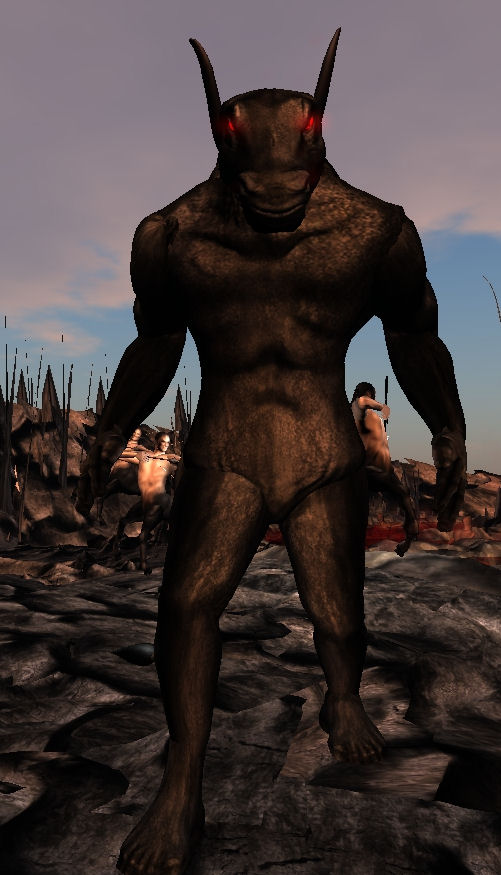
The seventh circle is guarded by a mighty minotaur and contains both centaurs and harpies. It is divided into three rings, depicting different forms of violence, and different punishments for those condemned therein.

  • The outer ring contains those who were violent towards people and property during their lives. They are immersed in a river of boiling blood – Phlegethon – to a level according to the severity of their sins, while centaurs patrol the banks of the river, using arrows to shoot any who attempt to rise higher in the river than their sins allow
  • The middle ring contains those who were violent against themselves, who have been transformed into gnarled bushes and trees and who are fed upon by harpies
  • The inner ring is reserved for those who have acted in violence against God (blasphemers) or nature (sodomites and usurers). They reside in a desert of flaming sand, under a sky raining flakes of fire; the blasphemers condemned to lie on the sand, the usurers to sit upon it and the sodomites to wander across it.

Fraud

Fraud covers a multitude of sins – so many, in fact that Dante envisioned no fewer than ten stone ditches, or Bolgie, to represent the various forms of punishment for fraud. These ditches in turn contain: seducers, flatterers, those committing simony, false prophets, corrupt politicians, hypocrites, thieves, fraudulent advisers, sowers of discord and various kinds of falsifiers.

Wisely, Rebeca hasn’t attempted to reproduce all ten Bolgie, but has selected a number to represent our journey through hell – but I will leave it to you to visit the exhibit and discover which they are!

Both Fraud and the Ninth Circle are reached by way of a Geryon, a creature comprising human, bestial and reptilian parts, said to represent the image of fraud: the face of an honest man, the body of wyvern and a snake-like tail with a nasty sting. Sadly, we must rely on Virgil to move us through the Bolgie and onwards to the Ninth Circle.

Treachery

The final circle of hell is reserved for those guilty of treachery, each entombed in the ice of lake Cocytus according to the degree of their sin. In all there are four “rounds” of treachery in which those found guilty are entombed to ever greater degree. Some are frozen up to their faces, others completely sealed by ice, their bodies distorted by the freezing walls of the prison that holds them.

The Ninth Circle

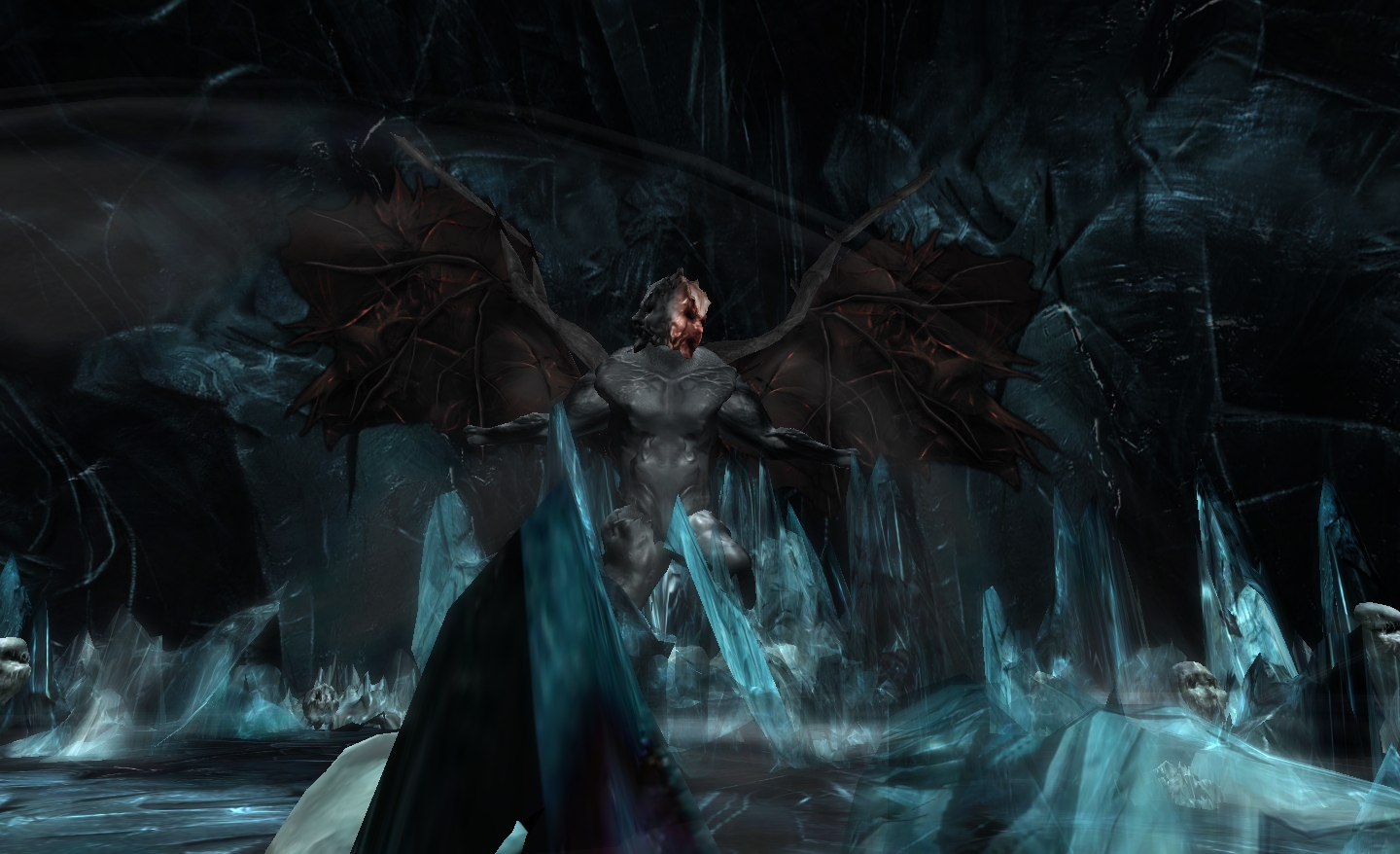
In the very centre of hell lies a three-faced Satan, trapped from the waist down in ice. All three faces weep in anguish, while the three mouths chew on those Dante considered the most treacherous of all – Brutus, Cassius and Judas Iscariot. Forever trapped, Satan’s six wings forever beat against the grip of the ice in a vain attempt to escape its grip.

Dante and Virgil escaped the Ninth Circle by climbing Satan’s back to reach another hemisphere, which Dante described in Purgatorio. For those of us visiting Rebeca’s work, however, the teleport offers a safer means of escape.

Opinion

This is a massive installation that is a great opening to the LEA Full Sim Art run – and I recommend you take time out to visit it. It is a tremendous visual interpretation of Dante’s work, and you should allow time for your visit as there is much to see; the attention to detail is wonderful. It is worth trying to keep to the ambient lighting throughout – but there are times when you need to add a little more light to scenes in order to appreciate them fully – as I had to do, in order to capture the wonderful minotaur seen in this piece.

Should you opt to change time-of-day settings, I really recommend you only use sunrise or sunset as alternatives, and then only for the particular element of the exhibit you are in – go back to midnight before you teleport on.

It is with regard to the teleports that I have my only complaint: some were a little less than smooth – one even threw me completely out of the installation when I ended up trapped in flying mode, unable to control where I was going!

This aside, however, and as stated, this is a piece really worth visiting. Kudos to Rebeca for an amazing interpretation of Dante’s work.

Rebeca Bashly’s Inferno will be open to visitors until the end of the month,  and will be replaced in November by ~(Not-A-Knot) by Tyrehl Byk and Forgiving by The Pink Tutu Ballet Group, said to be a piece inspired by Desmond Tutu!

With oodles of thanks to Spikeheel Starr for the title of this piece.

LEA announces 4 shows to see out the year

The Linden Endowment of the Arts has announced four 3-month long art shows that will see out 2011 and herald in 2012. The shows will each open in mid-October, and feature a range of themes and some of SL’s top artists.

The Survey of the Hyperformalists

  • Where: LEA1
  • Curated by: DC Spensley (aka DanCoyote)
  • Opening: October 15th, 2011

The Museum of Hyperformalism was founded in 2006 to “Promote the unique genre of metasculptural abstraction in simulated space”. The display at LEA1 will comprise work by Josina Burgess, Oberon Onmura, Ray FX, Sabine Stonebender, Selavy Oh, Suzanne Graves and Velasquez Bonetto.

Sneak peek: the impressive building that will house the Survey of the Hyperformalists 2011 (a work-in-progress at the time this picture was taken)

The Path

  • Where: LEA2
  • Curated by: Bryn Oh
  • Opening: October 14th, 2011

Based on the Surrealists’ exquisite corpse concept, each artist was randomly given a scene to compose. A narrative begins with the first scene, and then progresses scene-by-scene until the eighth scene  – and the conculsion of the narative – is reached. Artists participating in this piece are (in scene order): Bryn Oh, Colin Fizgig, Marcus Inkpen, Desdemona Enfield / Douglas Story, Maya Paris, Claudia222 Jewell, Scottius Polke and Rose Borchovski.

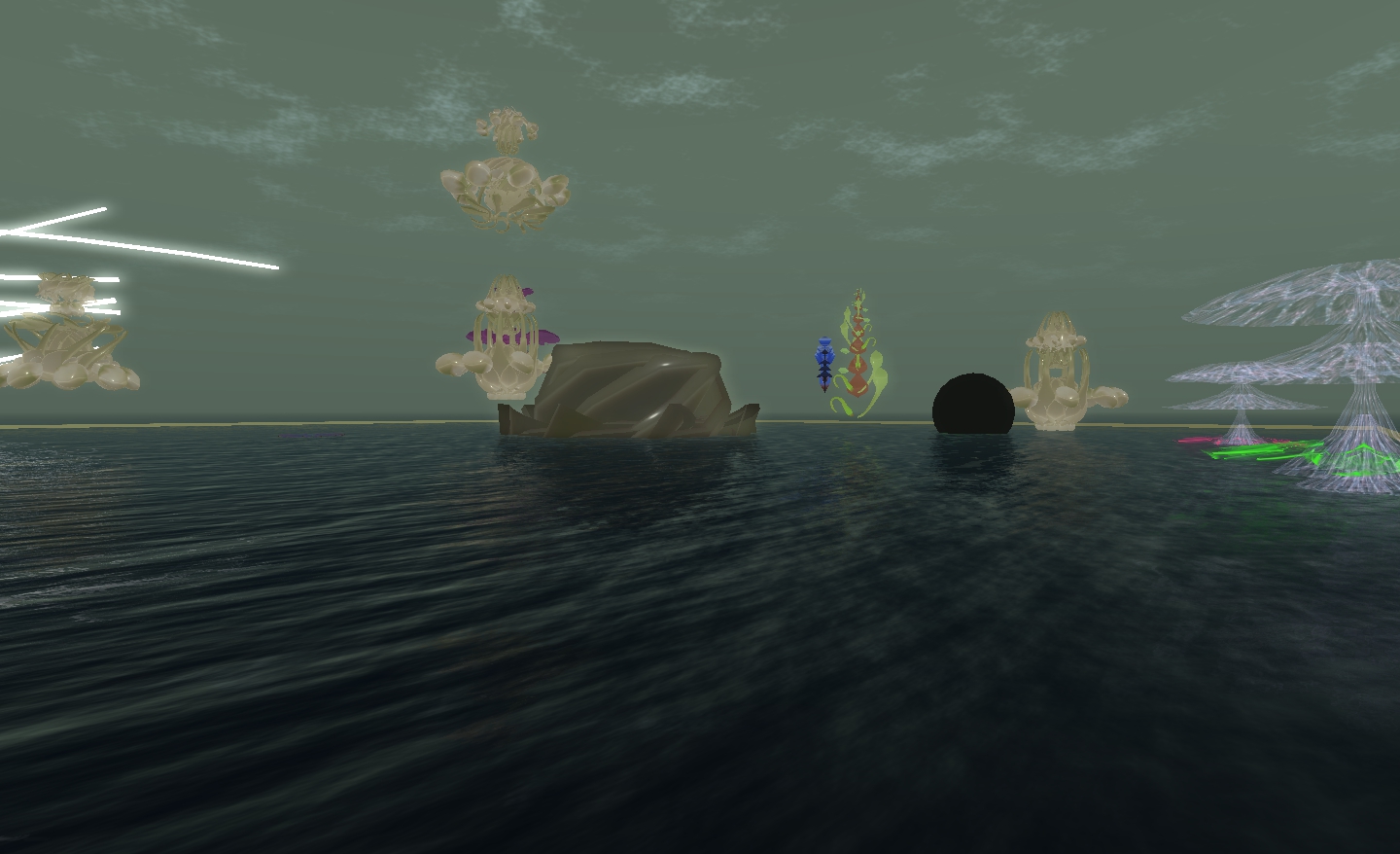
A look across a small part of The Path
FAST ART: Competitive Build Improvisation In The Virtual World
  • Where LEA3
  • Hosted by: Solo Mornington
  • Opening: October 15th, 2011

A series of twice-weekly speed build competitions that will each run until the sim is full. details in full have yet to be announced, but the events will be scheduled to allow artists from all time zones to participate.

Interact!

  • Where: LEA4
  • Curated by: curated by L1Aura Loire/Lori Landay
  • Opening: October 15th, 2011

One of the great qualities of virtual art is that it can encourage – even demand – interaction on the part of the observer. Interact! encourages participating artists to make art out of interactions between data, objects, actions and people both within and beyond the virtual world.

Installations in this exhibit are by: AM Radio, Glyph Graves, Lorin Tone, Maya Paris, Misprint Thursday, PinkPink Sorbet and Selavy Oh.

A peek at a part of Interact!, also a work-in-progress at the time the picture was taken

There will also be an interactive environment for audience participation, and interactive mixed reality cross-cultural performances by: Butler2 Evelyn / Senses Places. The sim will also include Mesh by Sage Duncan, Machinima Mutoscope Viewers by FreeWee Ling, Twitter Garden by Frans Charming, and the Inner Tube Ride of Your Life by UzzU Artful.

I very much look forward to previewing these shows in full later in the month, and covering each in turn in these pages.

LEA announces Full Sim Art Series participants

On Thusday September 15, the LEA announced the line-up for the Full Sim Art Series, which commences on October 1st.

The complete list of participants is:

  • October:  Inferno by Rebeca Bashly, inspired by the first part of Dante’s famous Divine Comedy
  • November: a joint entry comprising ~(Not-A-Knot) by Tyrehl Byk and Forgiving, by The Pink Tutu Ballet Group (Marmaduke Arado, Kikas Babenco, Sca Shilova, Cat Shilova, Saveme Oh, Eupalinos Ugajin, Luce Laval & Rose Borchovski) – a piece inspired by Desmond Tutu
  • December: Binary Green by Neox’s – in which bots take over the earth
  • January 2012: Research on Musical Instruments by Artistide Despres
  • February 2012: An Interactive History of Life by Romy Nayar & Ux Hax
  • March 2012: The Labyrinth by Kicca Igaly and Nessuno Myoo’s ‘The Labyrinth of Absurdity’

LEA report that the range and number of applications for the Series was such that the University of Western Australia (UWA) has converted one of its two sandboxes to provide additional display space for some of the other proposals received by the LEA.

The UWA’s Sky Sim Series will run concurrent to the LEA’s Full Sim Art Series, the major differences being artists are limited to the use of 5,000 prim rather than the full 15,000, with the exhibits being displayed on a sky platform.

The participants in the UWA Sky Sim Art Series are:

  • October: Organic Peace Sculpture by jjccc Coronet
  • November 2011: Mountain  by Katy Isodoo, in support  of mental health and wellbeing
  • December 2011: Interactive Zoo of Endangered Species by Luna Metamorphia
  • January 2012:  Between Orient and Occident by Asmita Duranjaya, Chapter ChapTer Kronfeld & Louly Loon
  • February 2012: Cyborg -Nature by Giovanna Cerise – where Nature rebels against the thoughtlessness of man
  • March 2012: Fiona Blaylock’s tribute to the poetry of Samuel Coleridge (Kubla Khan, etc.).

Related Links

MoM: September

September 7th saw the debut of this month’s Month of Machinima selecton by the LEA and showing at the LEA Theatre (SLurl). With the theme of “Seasons”, which can refer to the four seasons of the year, the seasons of your life, and so on, this month sees a range of imaginative and emotive films on offer.

This month’s entries comprise:

  • Unknowable Alien Isles:Chaffro Schoonmaker – a farewell to, and lament for, the Alien Isles installation at Unknowable
  • Duran Duran All You Need is Now by Ian Pahute an homage to the 80s, Duran, Duran and, particularly, their fans – and the passing years!
  • Curves by Hunk Huasner described as “Second Life machinima remixed with Akon’s Nosy Neighbour and other video clips”, a slightly risque mix of in-world machinima and live action film which is voyeuristically humourous.
  • A Pesto for all Seasons by Bleu Oleander, a lighthearted look at the making of the perfect pesto, complete with dancing basil…
  • Nature of Elements by Chic Aeon, which is described as “a video ‘coffee table book’ – there is a message of course, but mostly it is about the pretty pictures”. The message is clear – and one we should all consider
  • Why Now?  by Pooky Amsterdam – a moving question and answer session with Holocaust Survivor Fanny Starr demonstrating the power of Second Life and a world-wide educational and historical forum
  • Love Me Tender Rafale Kamachi, a whimsical tale of attempted murder, longing, magic and transformation in a steampunk setting
  • Visualizing Theorem at UTSA by lono Allen: “The creative forces of art, music and science collide in this new sim wide art exhibit at University of Texas at San Antonio (UTSA).” Combining imagery from Second Life and music collaboratively produced in a social media album called “Theorem” by ten musicians , the film celebrates sixteen installations in SL curated by UTSA, which are based on the science and math theories explored in the album.