Tone and ambience in Second Life

Lorin Tone
Lorin Tone

Lorin Tone is the name of a new aural installation, open through to the end of 2016, intended to to demonstrate the wide variety of uses in-world sounds can be put to within Second Life. The installation takes it name from the master of ambient sound, Lorin Tone, who shares the environment with Nance Clowes “and others” (one of whom I assume could be Lorin’s partner, Judi Newall).

For those who travel the grid extensively with local sound enabled, this might sound a “well, duh!”, kind of idea: many region designers spend a good deal of time adding a soundscape to their environment, so we’re accustomed to hearing them every day (although that in itself can cause us to “tune them out”).
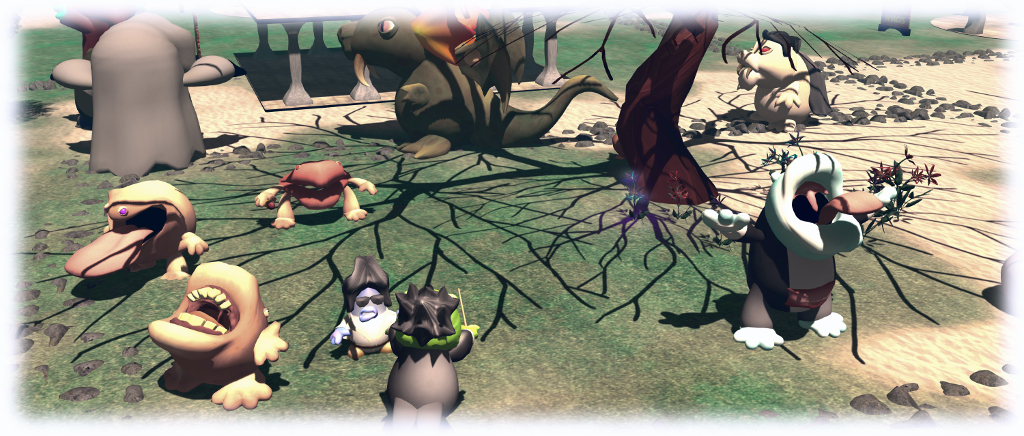
Lorin Tone - Madcow Cosmos' whimsical sound creatures
Lorin Tone – Madcow Cosmos’ whimsical sound creatures

But sounds are also more than just ambient background; they can be used in a wide variety of ways to add atmosphere to an environment, both passively and actively, triggered or experienced in a wide variety of ways – touch, collision, proximity, and so on.

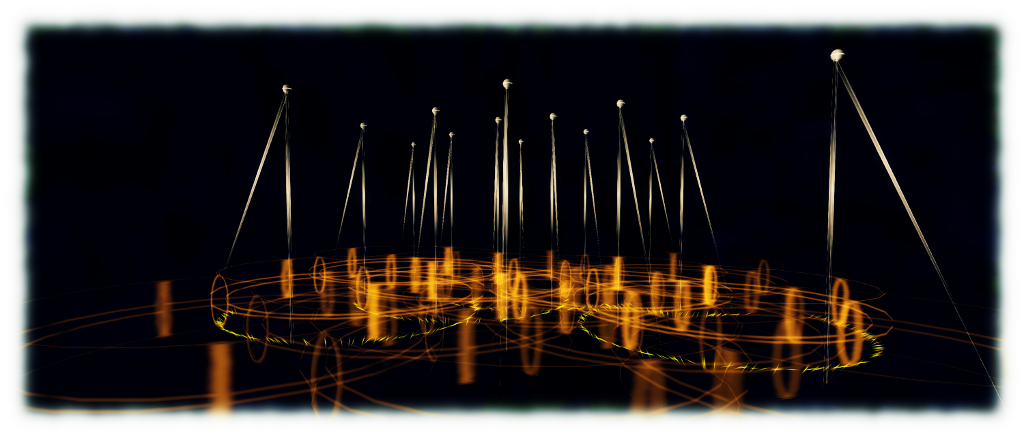
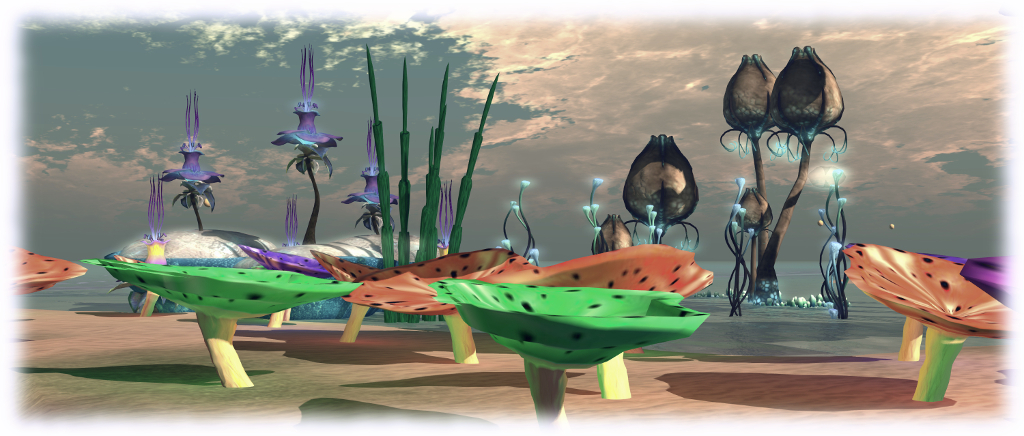
So it is that this installation offers a series of individual parcels (denoted by the stone paths running between them) in which various sound scape can be experienced. The layout might not be that visually appealing, but a slow exploration through it will reveal how aurally rich they are, and the cornucopia of sound options available for in-world use. There are things to touch, walk past and through; to step on, play, bounce across and ride.
Lorin Tone
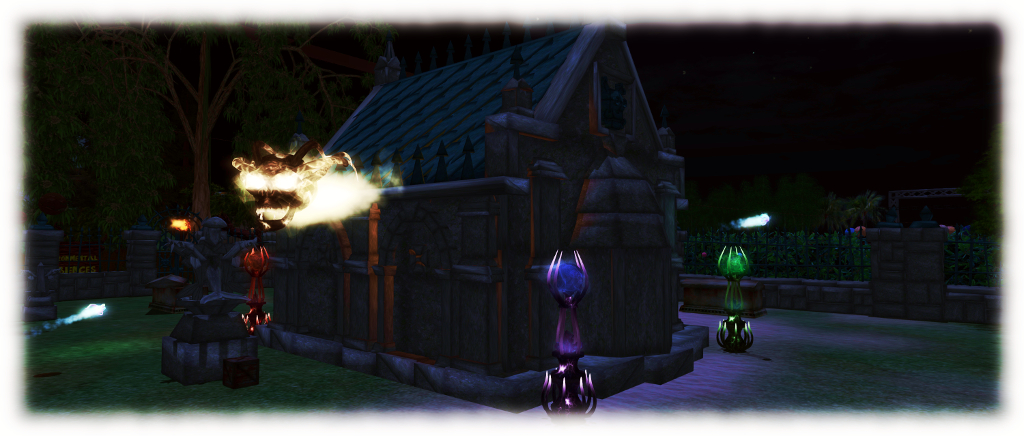
Lorin Tone – hunated graveyard (set your environment to midnight 🙂 )

Signs throughout the installation offer an introduction to each area and when touched will furnish some additional information on what is being achieved (and how to use each area). There is a certain degree of fun to be had in exploring and colliding with or touching things, and it is hard not to end up smiling. The bouncy (sand) castles got things off to a good start for Caitlyn and I (take the rope slide to the right of the landing point as you face them), while a skyborne race track offers something for petrol heads.

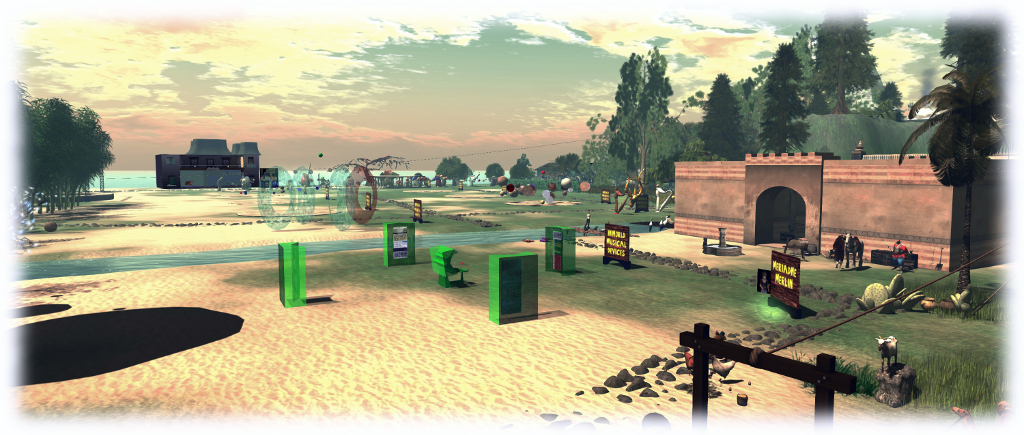
But – there is sadly a “but”, albeit a small one. The soundscapes largely stand as parcels without visual theme, and some might be seen as slightly repetitive in form. While this is intended to be an aural environment, I couldn’t help but feel more might have been gained by making it more visually immersive as well.
Lorin Tone
Lorin Tone

That said, for anyone interested in the depth and range to which in-world sounds can be put to good effect, the installation is well worth a visit. As noted, it will be open through until the end of December 2016.

SLurl Details

For EVRE in Second Life

EVRE
EVRE

“This sim was initially named EVER.” Tahiti Rae says of her latest full region installation, EVRE, now open through until the end of 2016. “While fervently researching a long and well-documented genealogy of my family … I thought how fun it would be to study the women who had married into the family. I learned that one of them had a second husband … When I researched him, I was astonished to discover that the “old tyme” spelling of his name was “Evre”. Hence, the R and the E were immediately swapped. Apparently, the correct trail was followed and at the right time. It’s connected.”

And thus we are introduced to her haunting, complex and highly photogenic study of consciousness, connectedness and time, as expressed in the installation’s sub-title: Are we Everywhere … At all Times? In this, the reversal of the R and the E in the region’s name could be seen as allowing it to serve a second purpose, as when separated to the two pairs of letters give us “ev” and “re” – a shorthand, almost for “everywhere”.

EVRE
EVRE

I’ve long been an admirer of Tahiti’s work. She is one of the more thought-provoking, consistently engaging and visually aware immersive artists in Second Life. The installations she creates draw from many sources and influences; they are always stunning to the eye and a source of considered contemplation for the mind. In this, EVRE is no exception. In keeping with Tahiti’s request, I’m not going to dwell too much on describing the installation – as she notes, this is a place to be discovered.

The core of the installation is a tour through twelve worlds, each accessed through a “memory clock” – a large fob watch hanging from its chain. Each world represents a different time and place, accessed by touching the “memory clock” and then using the map to teleport. The order in which the worlds are accessed is perhaps of less importance than ensuring all twelve are visited before making the jump to ALL TIME (via the large clock in the region), and thence to a final world, TIMELESS. However, for those seeking to explore the worlds in some semblance of an order, look for the signs with red lettering at the landing point. This will provide you with a note card list of all the “memory clock” SLurls.

EVRE
EVRE

In following the clocks, we effectively become dimensional travellers, visiting different point is time, witnessing events – becoming a part of events. I use “dimensional” rather than “time” deliberately, because of that question posed in the installations sub-title: Are we Everywhere … At all Times? If we are, then our journey here is not so much through time, as between the barriers separating the different periods in time represented here.

In doing so, we also encounter some anachronisms; some of these are more obvious than others, but none are accidental. In this, EVRE put me in mind of the philosophical question T.S Eliot throws to his reader in the opening of Burnt Norton, one of his Four Quartets, and a log-standing favourite of mine:

Time present and time past
Are both perhaps present in time future,
And time future contained in time past.
If all time is eternally present
All time is unredeemable.

EVRE
EVRE

Tahiti’s installation may offer a different slant to Eliot’s pondering, but they both raise the same underpinning question, and point us towards a contemplation of both all time (the eternity which surrounds us) and, with EVRE at least, a consideration of timeless – her final world. A place which encourages us to ponder the purpose of time, which is, to use the often ms-attributed phrase,  to “keep everything from happening all at once”.

Of the worlds themselves, as presented by Tahiti, and in keeping with her wish not to offer too many spoilers, I will say that time should be taken in visiting them; there are some exceptionally beautiful discoveries to be made, and nuances which might be easily missed on a hurried visit.

As noted, EVRE will remain open until the end of the year, and it will be the venue for a number of events, as outlined in the first world, Psi.

SLurl Details

  • EVRE (LEA 27, rated: Moderate)

Immaculate perceptions and reflections in Second Life

Immaculate Perception - Immaculate Reflection
Immaculate Perception – Immaculate Reflection

“There is no truth, there is only perception … immaculate perception,” Krystali Rabeni enigmatically states in her introduction to Immaculate Perception – Immaculate Reflection. “What you see is what you thought before you looked … The immaculate perception of it is an immaculate reflection of the viewer. A very interesting abstraction proving that there is no truth, only perception.”

It’s a provocative statement leading the way into a surreal and thought-provoking setting, one complete with touches of abstract and the absurd – but one which is also compelling, given the artist’s statement. Across a watery landscape sits a host of vignettes drawn from multiple sources. Pieces in some of them will be familiar to visitors, others will be wholly new.

Immaculate Perception - Immaculate Reflection
Immaculate Perception – Immaculate Reflection

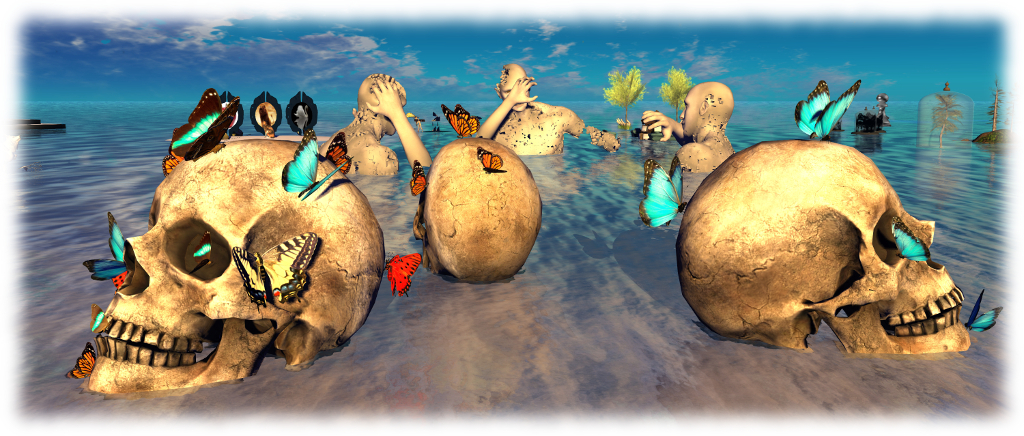
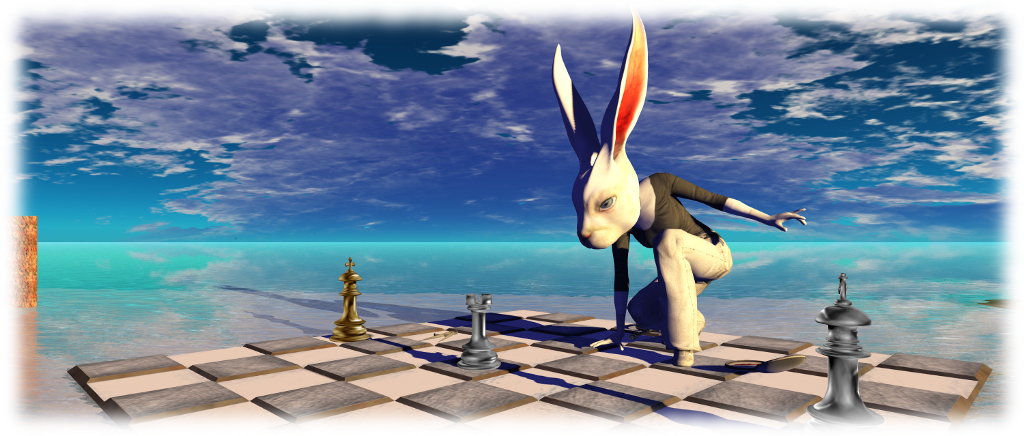
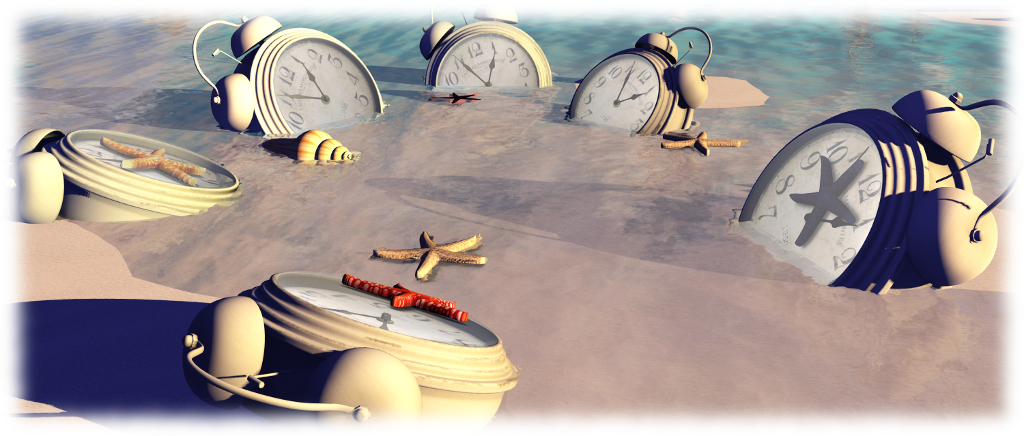
All present some curious scenes: animals hanging from balloons, a pair of women in 50’s style clothing walking a pair of hot-dogs, skeletons watching TV, chess pieces from one side pinning the king from the other side under a net, a pat of flamingoes examining images of other flamingoes; pocket watches with starfish, the list goes on.

However, what is important here is not from whence they came or even, necessarily, what the artist may have intended each to represent – but how we perceive them, and how that perception may be informed by the shadows of our own thinking even before we see what is in front of us.  Of course, how we perceive and interpret any art is a matter of personal reflection, but it is generally a subconscious process; here we’re being asked to consciously think about that process – which in turn further influences our perceptions.

Immaculate Perception - Immaculate Reflection
Immaculate Perception – Immaculate Reflection

In this, the track of thinking can become recursive: we question whether or not how much of what we’re perceiving in one vignette is shaped by our prior thinking, and then as we move on,  how much of that thinking is influencing our perception of the next vignette we see, which in turn calls into question our perceptions of the next vignette, and so on. Thus observation becomes as much introverted act, as it does a consideration of the art itself.
Within the installation, the potential recursiveness of our thinking  is perhaps enhanced by how the various vignettes are  placed. It is almost impossible to observe one without seeing two or perhaps three others, thus shifting our attention, directly or subliminally, influencing our thinking on the piece at hand, and thus influencing our perception of it.

Immaculate Perception - Immaculate Reflection
Immaculate Perception – Immaculate Reflection

However, and with all that said, we can leave the deeper considerations about Immaculate Perception – Immaculate Reflection to one side, and simply approach each vignette entirely on its own. Each offers a scene captivating to the eye which can be enjoyed in its own right, regardless of what is informing our perception, whilst also allowing us to tease ourselves with possible allusions which may appear to be in some of them which might otherwise be missed in any deeper appreciation / introspection.

However you approach this installation, it offers plenty of opportunity for visual appreciation and / or considered speculation.

SLurl Details

Storm Septimus: Invictus in Second Life

Invictus
Invictus

Update: To mark the anniversary of William Henley’s birth, Storm would like to hold a poetry event at Invictus at 15:00 SLT on August 23rd. She has a open invitation to Second Life poets and voice artists who would like to attend and read either their own work or that of their favourite poets (“even if it’s Dr. Seuss!” , she told me, eyes twinkling). If you are interested, please contact Storm via note card or via email.  

Invictus (Latin: “unconquerable“) is the name of the full region installation by Storm Septimus, which is now open through until the end of 2016. It is a stunning visual interpretation of William Ernest Henley’s famous 1875 poem of the same name.

The poem, untitled at the time of its writing (editor Arthur Quiller-Couch added the title when including it in The Oxford Book of English Verse in 1900), came at a time when Henley was facing severe challenges. Diagnosed at an early age with tuberculosis of the bone, he had lost half his left leg to the disease in 1869, when he was just 20. Rather than accept the loss of his right leg as well, he spent three years hospitalised between 1873 and 1875 while noted surgeon Joseph Lister (ultimately successfully) fought to save the limb, and it was at the time of these multiple surgeries that Henley wrote his poem.

Invictus
Invictus

It is this determination of the human will to overcome adversity, no matter how dark, even with the portal of death awaiting, which forms the central theme of the poem. It takes the reader on a journey through life’s hardship, enduring the battering of circumstance and chance, to the recognition that whatever circumstance we face, we alone determine our fate. Dark through the initial three stanzas, the poem emerges in an affirmation of spiritual fortitude; a triumphant proclamation of self-will over fate, and our ability to lay claim to our time on Earth.

It’s a powerful message, and one evocatively presented within the installation, which offers a visual journey through the poem. This begins on the upper floor of a tower. Notes on navigation are presented on a scroll, and touching it will deliver them in note card form – recommended lest you find yourself forgetting directions.

Invictus
Invictus

To descend the tower is to descend into the black pit of the poem’s first stanza, which awaits at the lowest level. Outside, the journey continues, winding down a mountain, passing the remaining stanzas along the way, their surroundings reflecting and interpreting each in turn through metaphor and symbolism.

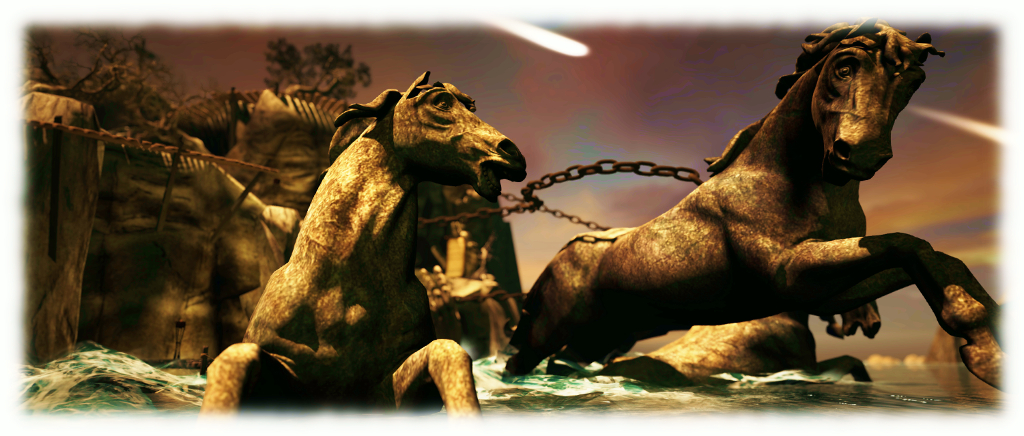
Any attempt to describe this journey is meaningless; it is something which is to be experienced first-hand. There is marvellously expressive symbolism to be found throughout; not only of the poem itself, but also the broader themes encompassed by its verses. Some of this is obvious, such as the giant hands grasping chain reins of great stallions, encapsulating the idea of taking control of one’s fate, reflecting the exultant final two lines of the poem.

Invictus
Invictus

Elsewhere, the symbolism is perhaps less obvious. Are the arrows found throughout the upper parts of the installation perhaps be a reference to “the slings and arrows of outrageous fortune”, a line from Shakespeare’s famous soliloquy on life and the nature of death? After all, the latter is not so very far removed from Henley’s own musings on the subject found within in the couplet, “Beyond this place of wrath and tears /   Looms but the Horror of the shade”.  Elsewhere we might also find reflections on the nature of life and death, and on he times in which Henley lived; the child-angels, for example, might be seen as a reminder of the high infant / child mortality rates in England in the mid-19th century.

This is also, I would suggest, something of a personal statement by Storm. Just as Henley used the poems written whilst hospital to explore his time as a patient, so Storm has used her art in Second life to explore her own circumstance through installations like 2015’s Failure to Thrive, exploring depression, or 2014’s examination of insomnia through The [Void] (which I wrote about here). Thus, within Invictus, it is hard to escape the feeling we’re being given a glimpse of Storm’s own self-affirmation the she, and not the challenges she faces, holds authority for her life.

Invictus
Invictus

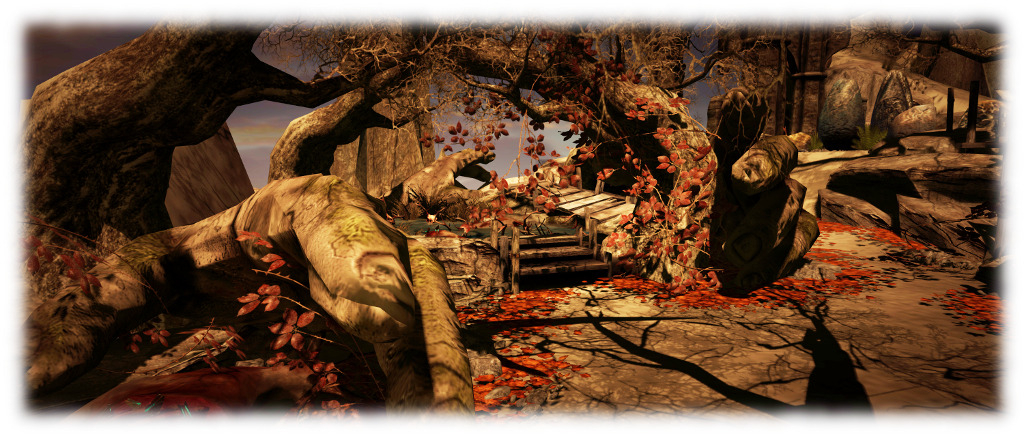
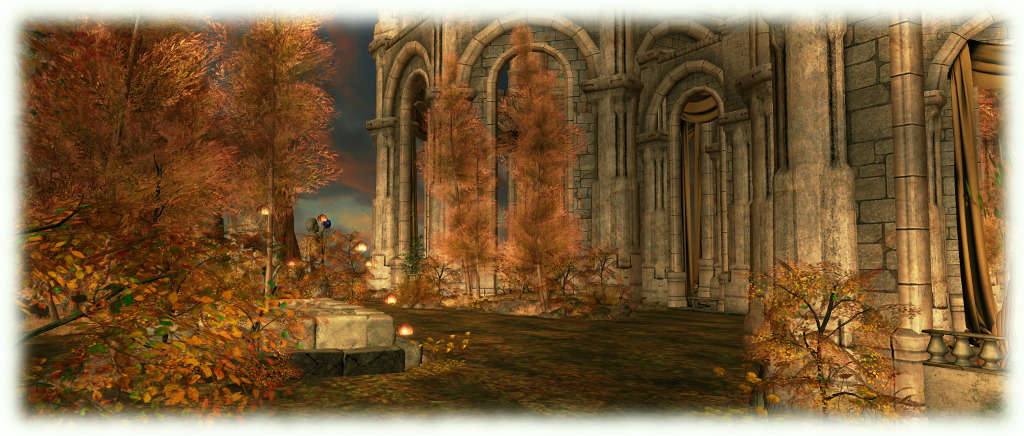
Across the water from the mountain and tower lies the ruins of a cathedral set within a garden. Storm indicates this is not strictly a part of the poem’s interpretation, being intended for photography and events. However, it would seem to offer both a further motif for the more spiritual lines from Invictus and a contemplation of the calm certainty which follows the poem’s final two lines. To reach it, visitors can either fly or – in a more light-hearted nod to those final lines – by taking the rowing boat waiting at the foot of the mountain, thus figuratively becoming the “captains of their souls”.

SLurl Details

A Watercolour Wander in Second Life

A Watercolour Wander

Physical world / Second Life artist Ceakay Ballyhoo has a new region-wide exhibition currently open in Second Life. A Watercolour Wander, which will run through until the end of the year, brings together art and storytelling guaranteed to awaken our inner child and bring back memories of childhood imaginings set free whenever a blank sheet of paper and palette of watercolours were place before us, or the unwritten page and sharpened pencil placed in our hands.

“The idea started to form some months ago when I started to paint watercolours,” CK (as she is known to friends) states. “I’d been playing with making my own textures through watercolour paint and watercolour pencils a while before that … The idea of walking into a painting has always been a very attracting and intriguing one. Ever since reading Stephen King’s Rose Madder and later watching Robin Williams in What Dreams May Come, the wish to do something with that concept has been on my mind.”

A Watercolour Wander

And thus, A Watercolour Wander is just that – a walk through a landscape rendered as a watercolour. But not just any watercolour; this one forms a part of a story, the text of which is provided as part of the introductory notes offered to new arrivals, and which should be read as an accompaniment to any exploration (you can also read the story on CK’s blog). In it, a little girl, tired from the exertions of the day is slowly drifting to sleep when she realises her bedroom has vanished, to be replaced with a newly painted watercolour landscape, a path on the ground running from her bedside and into the trees, inviting her on an Adventure.

Staring from the from the little girl’s bed, we are invited to follow that path, scenes from her adventure presented to us in both 2D paintings and unfolding across the landscape before us: Mr. Nut, the squirrel, Pinkie Papillon, the gurgling river. Each painting marks a step in a story which – as is the nature of a good children’s story – has by turn its lighter and darker moments before all turns out well in the end.

A Watercolour Wander

The story is engaging, and very much as part of the overall experience – but it is the paintings and landscape that capture the attention. Beautifully rendered, the colours slightly washed and the outlines of trees and rocks and buildings perhaps outlined a little heavily, they perfectly embrace the idea that they have been painted by the little girl of the story to illustrate her dreamworld adventure; the reflections of a personal story imagined by a young mind.

The images from the story are all available at the end of the walk, together with a painting of a mermaid. CK has also created a Flickr group for those wishing to post their own wanders through her watercolours.

SLurl Details

Giovanna’s Soul of Colours: a Magic Flute in Second Life

Soul of Colours: Variations in the Magic Flute
Soul of Colours: Variations in The Magic Flute

Now open at LEA 21 is the first part of Giovanna Cerise’s Soul of Colours, an installation which will unfold over the coming months. For this initial instalment, open through until the end of August, Giovanna presents Variations in The Magic Flute, based on the 2-act opera Die Zauberflöte (The Magic Flute, K620) by Wolfgang Amadeus Mozart, an opera which has, in my opinion at least, one of the most rousing and engaging overtures ever written.

This is an installation which first appeared in-world some four years ago, and which takes the visitor on an interactive, allegorical journey of light, colour and sound through key elements of the opera, complete with extracts of the music from some of the key events in the unfolding story.

Soul of Colours: Variations in the Magic Flute
Soul of Colours: Variations in The Magic Flute

Premiered just two months before Mozart died prematurely, on September 30th, 1791, The Magic Flute is, at its heart, a love story, focusing on handsome Prince, Tamino and Pamina, daughter of the Queen of the Night, and involving an additional tale of desire and love between Papageno and Papagena, as well as the aforementioned Queen of the Night and her handmaidens and the enlightened Sarastro and his retinue.

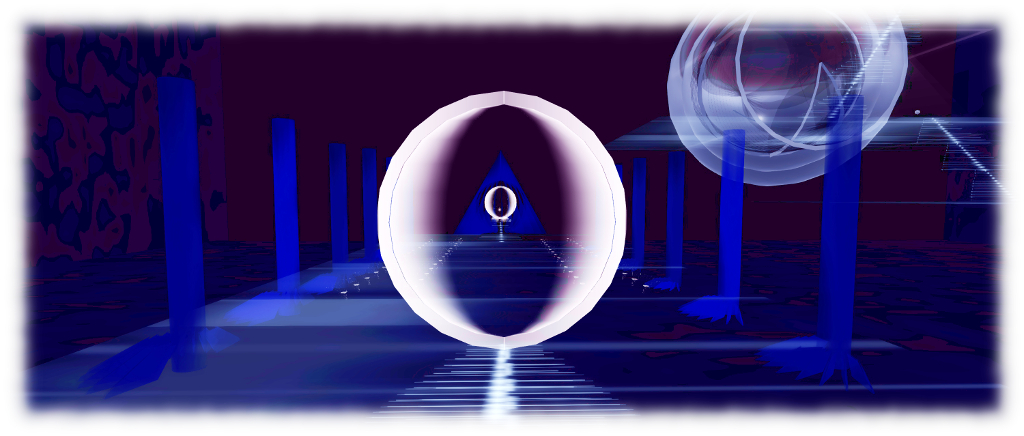
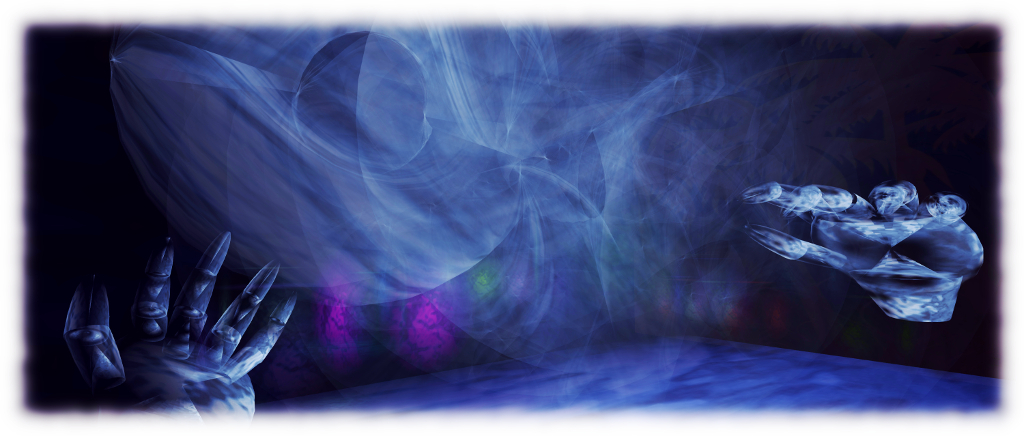
Within Variations in The Magic Flute, Giovanna invites visitors to engage on a journey through key scenes and events from the opera: the grove with its serpent, where Tamino is rescued by The Queen of the Night’s three ladies in the opening scene; an expression of the Queen’s anger from Act 2, Scene 3, Der Hölle Rache kocht in meinem Herzen (“Hell’s vengeance boils in my heart”); allegorical representations of Sarastro’s garden, pyramids and the Temple of the Ordeal / Temple of the Sun (which it is depends on your interpretation of the opera as you come to it).

Soul of Colours: Variations in the Magic Flute
Soul of Colours: Variations in The Magic Flute

Passage through these scenes and locations is a matter of ascension  – something which is itself an allegorical reflection of the opera’s story, following Tamino’s  rise from the Queen’s deception into the enlightenment of Sarastro’s benevolence and also the rising triumph he and Pamina share in overcoming their individual trials and tribulations to finally be united in their love.

Passage between the levels / scenes are via crystal staircases (also triangular in shape, reflecting the pyramids of Sarastro’s domain), although you can fly if you wish. I’d personally recommend the former, as the latter does run the risk of missing things.

Soul of Colours: Variations in the Magic Flute
Soul of Colours: Variations in The Magic Flute

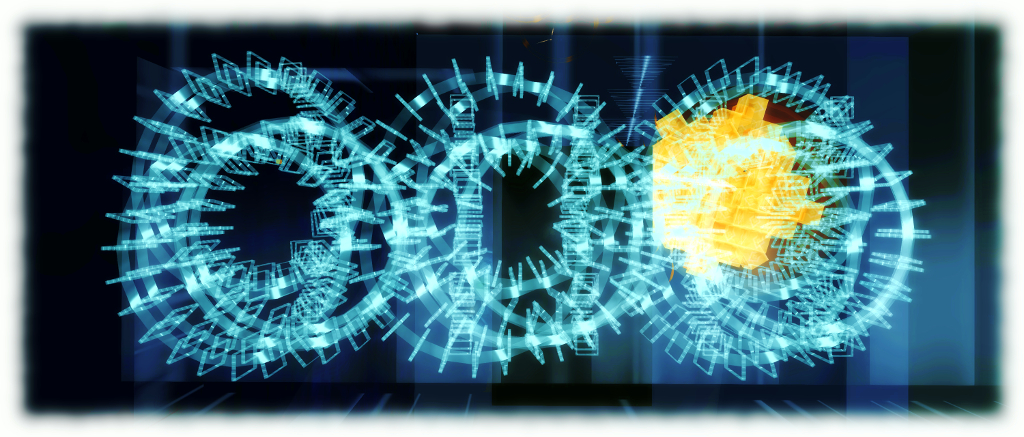
The interactive elements come in the form of music spheres which will play excerpts from the opera,together with locations where you can sit, and animations which will place you within some of the scenes. You can, for example, be tossed around by the vengeance which rocks the Queen’s dark heart.

I have no idea of the direction Soul of Colours will take from the start of September. I will, however, say that as I missed Variations in The Magic Flute when it was first displayed, I’m delighted to be able to visit it this time around; Giovanna and I appear to share something of the same taste for musical inspiration. With this piece, she has captured the essence of the story through a marvellous symbolism, while the use of light perfectly captures the heart of the music.

SLurl Details