When I was a teenager, many moons ago, a frequent insult passed around was, “If brains were dynamite, s/he wouldn’t have enough to blow her/his own ears off.” If a girl was particularly disliked, this sometimes became “….She wouldn’t have enough to blow her own tits off” (boys had a similar twist, which involved parts of their anatomy much lower than the chest).
So, any art installation that invites you to Blow Your Own Tits Off tends to ring bells of teenage years past in my noddle, and send me investigating.
The full title of the piece is “Celebrity Blow Your Own Tits Off”, and it is by Maya Paris with assistance from a number of other SL artists. It is located on LEA 10, and is modelled on a game show (proudly sponsored by “Braino, Ransom & Wow™”), with five interactive levels.
“Will the next contestant … COME ON DOWN!
The main part of the experience is to follow the dotted red arrows (well I had to get something that fits the metre of “follow the yellow brick road”) through the various exhibits looking for “holes” to pass through (or touch). You’re encouraged to touch anything else you come across as well, and to have sound on and your AO off (so your avatar can be animated).
“She’s a pinball wizard, there has to be a hole…”
Along the way you get the opportunity to pick up various items as well. Whether you wear the accessories or not is up to you…some are decidedly … novel!
Some of it is a little ominous … some a little confusing … some might be considered a tad rude – although one cannot help but be reminded of Kenny Everett’s Cupid Stunt and that really, “It’s all done in the best PASSSS-ABLE taste!” :).
“It’s all done in the best PASSSS-ABLE taste!”Careful, or I’ll show up on *your* doorstep like this….
Crash Bang Trollop, which is where you end-up on exiting Blow Your… is similar in theme, and is described thus:
Tired of being bombarded by the crazy tornado that is the beauty industry?
Time to CrashBangTrollop!
Now you have your ZAP suit, wear it and find the 7 Trollop gadgets in the “ZAP” boxes around the sim ( all free)
Run Wild, turn up your sound and click everything! Dodge the needlefish, tiptoe through the aggravated follicles, help those boobs escape the underwires, Wax on….and off….claw your way through the waters, dare to try the trollop-rocket? Spray yourself orange, and don’t forget to Vajazzzzz.
Aerosol a*se kisser?
Trollop is open-air, and opposed to enclosed, as with Tits, and offers a number of things to click on to animate your avatar or which give you further bits’n’pieces.
If I’m honest, I’m not at all sure what to make of either piece – apart from feeling decidedly silly when I emerged from Tits. As interactive experiences go, they are both certainly that; I’m just not sure if there is meant to be a commentary on the state of television today and / or the cosmetics industry, or whether it is all simply meant in fun.
Best thing, possibly, is that if you’re curious you go along and find out for yourself. I man, the worse that can happen is you do manage to Blow Your Own Tits Off, right ;-)?
Arrehn Oberlander recently contacted me concerning MetaHarpers and the -io- Team’s new Linden Endowment of the Arts installation, The Inspiring Orientation – a smaller version of which was recently displayed at SL9B.
The installation, which opened on June 22nd, is described as: “Part art walk, part tutorial – a vision of a future where new SL citizens are introduced to an interactive combination of gallery and orientation course.”
The inspiring orientation – from the outside
Teleporting to the venue brings you (a little wet-footed, but that seems par for the course at LEA venues!) to a greeting area, where you are welcomed in a wide range of languages and get to meet your guides for the tour – tablet-like creations that display information and instructions on their screens.
A guide
Following the path takes you through various rooms, each with a specific focus on using your viewer and interacting with the world around you, starting with the basics of movement. Each section is quite cleverly put together, and the section on sitting cleverly introduces the idea of sitting on objects directly (scripted or otherwise) and using poseballs. Elsewhere there are lessons on using chat, which uses a range of animals with which to interact on a basic level, and there is a section devoted to camera movement and control.
Talking to the animals: “If I were asked to sing in hippopotamus I’d say “whynotamous?” and I would!!
At the end of the walk there is the opportunity to explore SL itself, with a series of teleport alcoves. These are divided into categories: Music and Stage, Art and Fashion, Exploration, Games, and Social and Chat. Each of these has two (or more) vendor boards visitors can scroll through to see a range of destinations. Clicking on an image brings up the Place Profile floater, allowing the visitor to read more on the destination and, if they like it, click on the Teleport button and go visit.
Each alcove also has a notecard giver that explains a little more about the subject matter, and can provide additional help. The Art and Fashion notecard, for example, defines the major forms of clothing (system, prim/sculpted and mesh) and the differences between them. While one might grumble the presentation of this information could be better, it is nevertheless more informative than anything currently on offer to new arrivals in SL.
Where next?
Most importantly, this area of the installation offers a way back for those that need a little more assistance – something massively lacking in recent orientation offerings from LL, where once you leave, the way back is barred to you in a “Thank you, and good night!” approach.
There isn’t much else beyond this in terms of orientation – but its is enough to give a flavour of what might be achieved.
Not only is the tour a visual experience, it is also very aural: the various sections are filled with a range of atmospheric sounds or music. The section on flight features elements of Glyph Graves’ The Forest of Water and Strangers also Dance, which uses sounds and tones very cleverly and is definitely worth wandering around rather than simply flying straight through. Elsewhere sounds of the jungle accompany the animals in the chat section and Lily of the Lamplight provides an accompaniment as you learn about camera controls.
Given that sound is enabled by default on the official viewer, then the use of music and sounds adds a clear dimension to an orientation experience and helps demonstrate the rich immersive experience one can enjoy with SL.
Glyph Graves’ combined piece deep inside The Inspiring Orientation
Clearly, as a demonstration, the installation only offers up just a sampling of lessons that could be provided in order to provide a feel for the idea. It would seem to naturally lend itself to further lessons being added without over-burdening the new user, so I’m not going to critique the creators on the basis that it doesn’t show X or Y in terms of basic lessons – something easily fixed were this to go into production.
However, I would be a little concerned should the idea be used with some of the graphics as seen in this installation. The animals in the chat area and the cartoon bedroom used to demonstrate sitting and touching objects in-world may look cute – but they also run the risk of giving entirely the wrong first impressions about SL to the newcomer, who ends up simply turning around and walking out in the belief they’ve wandered into something aimed towards younger children, rather than a sophisticated immersive world.
Perhaps a little too much like a cartoon?
While the lessons don’t have to be totally rooted in the “reality” of SL, I can’t help but feel that they should at least have a greater rooting in what SL as actually like in terms of what the new user can reasonably expect to see and encounter once they pass on in-world. Doing so should help build familiarity and confidence in the user, and enable them to better respond to the things they see with greater familiarity.
Another area that isn’t really covered in the exhibit, which is perhaps more important, is that of language. Beyond the many greetings in the welcome area, The Inspiring Orientation is presented entirely in English – and that’s fine for a piece designed to stimulate the mind and demonstrate what might be achieved. But how would it handle multiple languages, given that those coming into SL do so from all over the world? Would multiple “tablet” screens be used? If so, the lesson areas might get a little crowed. Would screens operate in more than one language? That could easily lead to confusion were someone to start reading instructions in German, only to have someone else click the button for the French option to be displayed…
In fairness, the team behind the piece may have already considered this issue and have an answer – if so, it would have been nice to see something presented here, if only to further demonstrate the practicality of the the approach.
As a small aside, it would be nice to see an orientation system that actually points to the assistance that is available in the Viewer – particularly the How To guide, which even LL ignores (in favour of the Destination Guide). It’s a small niggle, but the built-in help is there, and there is no harm in pointing people towards it.
But leaving my niggles aside, The Inspiring Orientation does offer an interesting and entertaining attraction that takes a fair crack at answering a question that has stumped LL to the point where they have seemingly abandoned it entirely: just how do you get users engaged with the viewer and introduce them to Second Life in a visual and informative medium? This exhibit doesn’t have all the answers, but it does offer an immersive and engaging alternative to what has been offered-up recently elsewhere. As such, it is very much a worthwhile visit, whether you enjoy SL art or have an interest in issues of new user orientation.
I first came across Tyrehl Byk via his SL performance art pieces, Catharsis and Particle Phastasmagoria last year, and was completely enchanted in his use of particle effects and music to create marvellously immersive art shows. Now Tyrehl is back at the Linden Endowment of the Arts with a new full-sim feature, Almost Flat Land, which again uses particle effects, this time in an immersive environment in which you are very much a participant.
Arrival: take heed of the notes
On arrival at the installation, you will find yourself deep in a cavern – a foreword, if you will, to the piece itself. Here are instructions on setting your graphics particle and media settings to get the most out of your experience. High-end graphics do not need to be enabled, so long as you ramp-up the particle count to its fullest extent. You will, however, need both media and sound enabled to gain the most from Ultraviolet Alter’s soundscape – visiting the installation without either enabled with greatly diminish your experience.
Gallery
Once you are set, take the teleport down to the surface, where you will find yourself in the gallery, a hall that appears to have suffered the ravages of some geological event – and possibly something more. Here your task is to find a diary, one which offers a vivid tale of stranded explorers, missing team members and strange creatures from another dimension. It also perhaps carries a stark warning: the final pages incomplete and spattered with blood.
Diary
However, to consider Almost Flat Land a mystery waiting to be solved, would be a mistake. The diary isn’t a narrative device that guides you through a story. Rather it is a means of providing context for the rich soundscape and of encouraging you to explore; to simply stand and cam your way around would be a mistake, and would leave you missing out on a lot. And there is a lot to discover – far more than the water-encroached landscape might suggest, including a hidden portal taking you to another aspect of the piece.
Portal
The installation offers itself to a wide range of interpretations. There are stories to be told here, whether you chose to frame them with the passages of the diary or not. As an immersive experience, it offers images and sounds that will doubtless resonate differently and uniquely for each of us, even when using the diary as a guide for the imagination.
Why not take an hour to discover what it says to you?
Last week I was able to see Tyrehl Byk’s Catharsis (more than once in fact, it is so good). It is an amazing tour-de-force in the use of music, particles and images within second Life. This weekend I’ve been fortunate enough to witness the show that started it all, Particle Phantasmagoria – and it is a wonderful feast for both eyes and ears.
More abstract and free-form than Catharsis (although with a very subtle subtext to the images accompanying It’s the End of the World As We Know it), Particle Phantasmagoria is a fabulous ride marrying stunning particle effects and images with an inspired selection of music in a trippy rollercoaster of a ride that will not only have you watching in awe and whooping in delight, but also quiet probably seat dancing along to the soundtrack.
The show is running at LEA6, alongside Tyr’s Not -a-Knot, and shares the Event Horizon theatre with presentations of Catharsis. Words cannot really do the show justice – nor can still images; this is something that really has to be seen.
Until the LEA Full Sim Art series, I confess (and to my lasting shame) I’d never heard of Tyrehl Byk. Now I can’t get his work out of my head.
Catharsis is one of two pieces that have taken over at LEA6 from Rebeca Bashly’s stunning and evocative Inferno (the other being Quadrapop Lane’s Retrospective Highlights of 4 Years in SL).
In many respects, trying to review this piece is counter-productive because no amount of words is ever going to achieve the wonder of actually going along and experiencing a performance. Indeed, saying too much may actually serve to spoil things – so I make no apology if the rest of this review is light on details – although the images should hopefully speak volumes and serve to whet appetites.
Catharsis commences in a wonderfully scripted theatre that is very mindful of a planetarium. It’s best to go as lightly scripted as possible in order to reduce the server-side load: there is an awful lot going on throughout the show. Once seated – and in case you don’t get the notecard – set your draw distance to 250 metres, set particle count to maximum, sun to midnight, close all on-screen floaters and then tap ESC a couple of times to free-up your camera controls.
This last item is important, as it allows Tyrehl to take control of your camera and move you through various settings in order to witness the piece. I’d also add that if you can, watch the presentation in a darkened room; the effects are magnificent.
“Catharsis” itself is a term used in dramatic art to describe an emotional cleansing. In essence, it refers to an extreme change in emotion brought about through the experience of strong feelings and / or responses – fear, pity and sorrow being the most common forms, although it can equally come through laughter as a result of comedy.
As an immersive experience, Catharsis uses an eclectic mix of music and images to create an amazing visual and aural ride carefully and cleverly balanced – not that you are aware of it at the time – designed to guide you to a certain emotional point. Through the first half we are treated to images that inspire awe and which, with their irreverent pokes, also incite the audience to have a little laugh or two.
However it is in the latter half of the show that one is completely blown away. It is here that the clever deception – if I can use that term – comes to light. There is no warning of the coming change in emotional focus and context; as a result, the impact and the response it generates are both that much deeper. Here is the reason for the title of the piece, and I will only say that it is a perfect mix of images coupled with an inspired choice of Hans Zimmer’s most evocative soundtrack. They are brought together in a manner that left me – and others in the audience – in tears.
As the performance finished, so it also left many of us feeling intensely aware, alive, renewed.
Catharsis – emotional, cleansing and utterly superb. See it.
The exquisite corpse is the theme of a new full sim LEA exhibit called The Path, opening today in Second Life, which features the work of no fewer than eight of SL’s most talented artists.
Surrealists
The term “exquisite corpse” (also referred to as the exquisite cadaver) is a means by which a collection of words or images is assembled, with each collaborator in the piece adding to the composition in turn, either by keeping to a specified rule, or by being allowed to see the end of what the previous person contributed. If you think of it akin to the game of Consequences, in which each player contributes a line of a story then folding it to conceal part of the writing before passing the paper to the next player to continue, you’ll have the general idea.
As a form of art, the process was developed as a game by some of the leading Surrealist artists of the early 20th Century, including André Breton, Jacques Prévert, Marcel Duchamp, Yves Tanguy and Pierre Reverdy.
For The Path, the contributors of the piece are (in the order their work appears in the installation): Bryn Oh, Colin Fizgig, Marcus Inkpen, Desdemona Enfield / Douglas Story, Maya Paris, Claudia222 Jewell, Scottius Polke and Rose Borchovski. Bryn Oh explains how the order was decided upon:
” [The] Eight artists were invited to stand upon one of eight different coloured boxes I had set up. Once all had chosen a box to stand on, a chart was rezzed whichlisted the order of colours which would dictate the sequence of artists to compose scenes for the narrative. So if red was first on the chart, then the artist standingon the red cube would begin the narrative. If blue were next then the artist on the blue cube would continue the story.”
It’s an intriguing approach to building a collaborative piece of art – and one I’ve been itching to journey through since first learning about it while interviewing Claudia222 Jewell in September.
The Landmark / SLurl for The Path delivers you to a darkened room together with a request for the region to control your Windlight settings – for the best visual impact, you should allow it to do so.
To your left are eight plinths introducing the eight artists who participated in The Path – clicking on these will give you a short biographical notecard and (in some case) a Landmark where you can see more of their work. There are also two large stone-like tablets introducing you to the concept of The Path and which give you some advice on how to enjoy things – such as making sure you have sound available, as the installation is an aural, as well as visual, experience.
Getting A Head
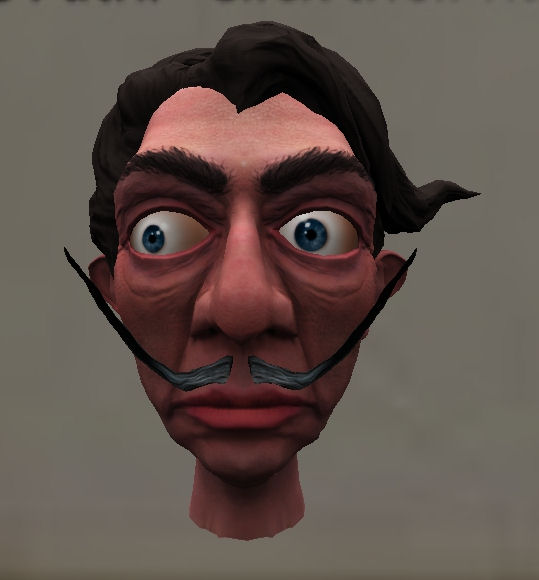
It’s all in his head
A head, resembling a young Salvador Dali, watches you from the bottom of one of these tablets – clicking on it will carry you to the start of The Path proper, and Bryn Oh’s work. Note, as well, that the head is your main clue as to how to proceed through the rest of the work.
Taking the teleport delivers you to a white room. A strange engine-like thrumming fills the air, together with soft piano music. On the floor lies a single, plaintive butterfly, while before you lies a black wall…a hole…beckoning you through.
Walking through the “hole” leads to another white room wherein the music and the thrumming are joined by a lonely wind and the sound of water drip-drip-dripping…another hole beckons. Passing through this brings you to a third room….
The lab – and the start of a journey
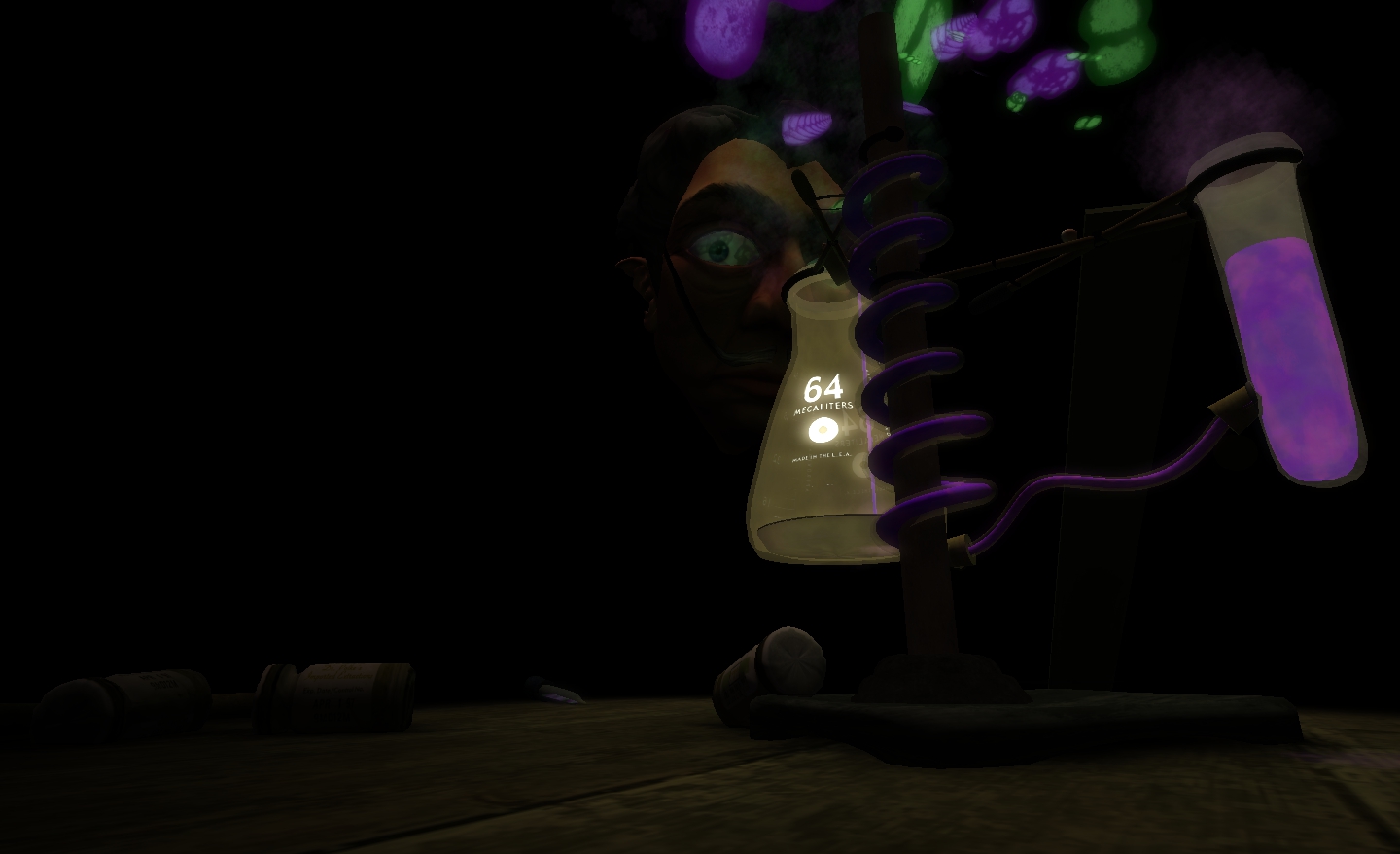
It’s a room of curios and oddities, partially flooded – hence the dripping previously heard, planks providing walkways over the water. This is the inventor’s lab. There is much to see here – and one or two things to touch; find them and you will be treated to a side-story that accompanies the installation, told through YouTube – and which you might witness for yourself in part, should you find yourself in the field beyond the laboratory.
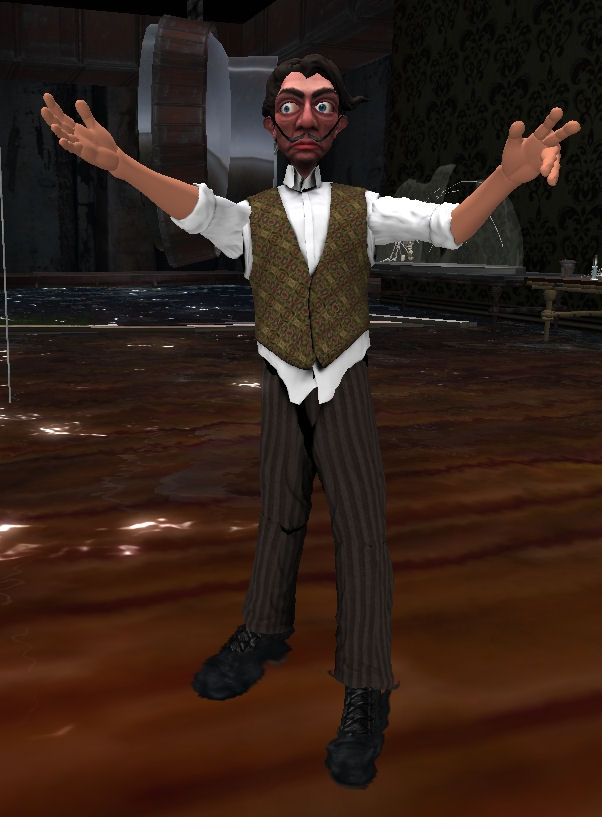
The inventor. Guide and … protagonist?
As you explore the lab, the inventor himself will materialise. You might recognise him – it was his head you clicked when commencing your journey, and thus you have a further clue as to how you must proceed. As he appears, a narrative beings, telling you about the inventor, his flooded lab and the portal he slipped through one day. Take it as your invitation to follow him.
Beyond the laboratory lies a misty, flooded field, water lapping around the trunks of trees. Here you can find the conclusion of Cerulean, the curio-accessed tale told via YouTube. Be warned, however, that if you step out into the field, you will not be able to return to the laboratory; instead you must find another way of continuing your journey along The Path. The only clue I’ll give you is not to wander too far from the walls of the laboratory itself…
Curiouser and Curiouser
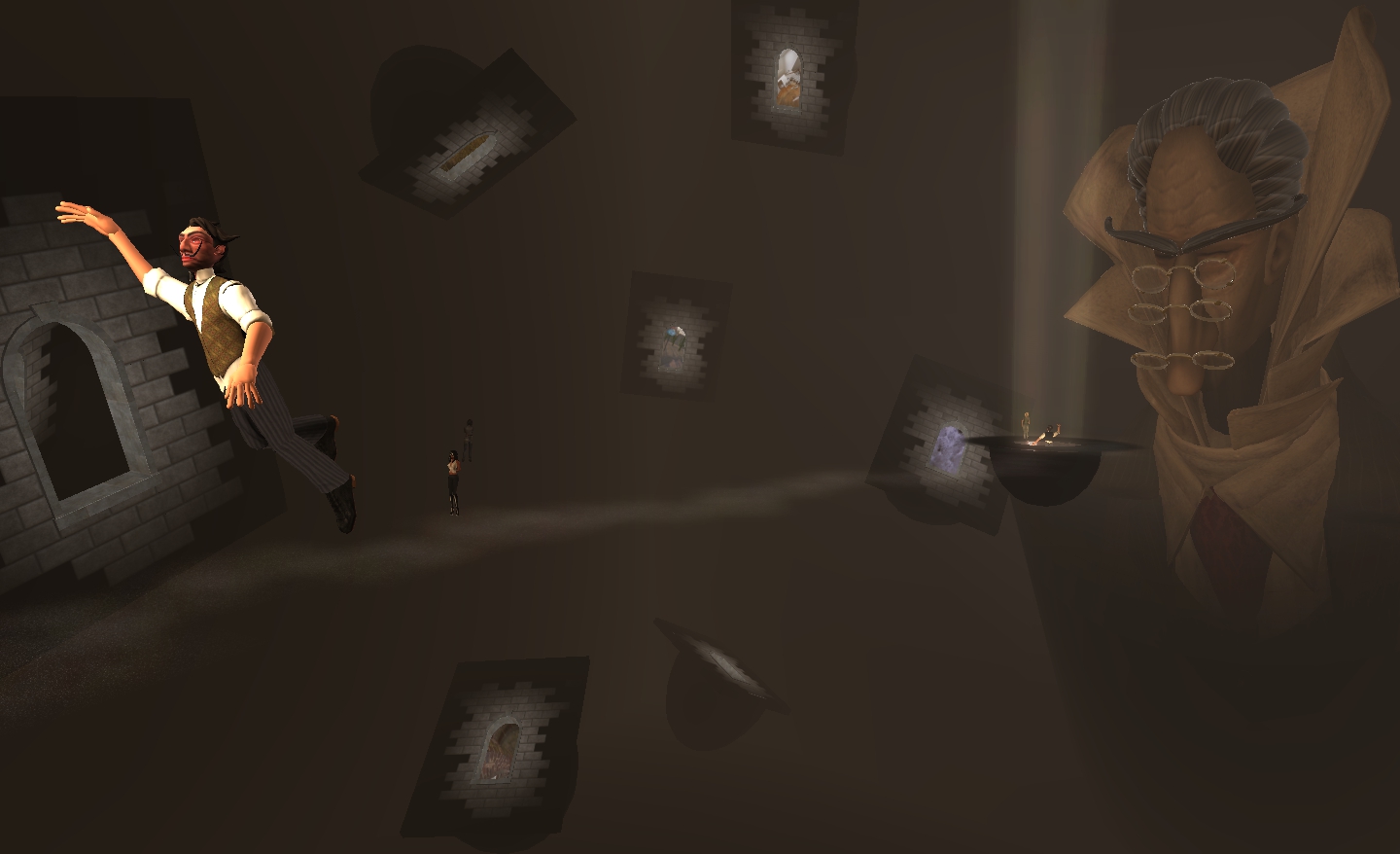
With the inventor as your guide you will arrive at the second part of the story, created by Colin Fizgig. This is a hole-y place, with windows looking out on different scenes, different places – with some looking inward at you from the other side. As the narration resumes, it is through one of these windows – these holes – that the inventor flew, and you must follow him as he dives towards one…
Windows onto worlds – which one is yours?
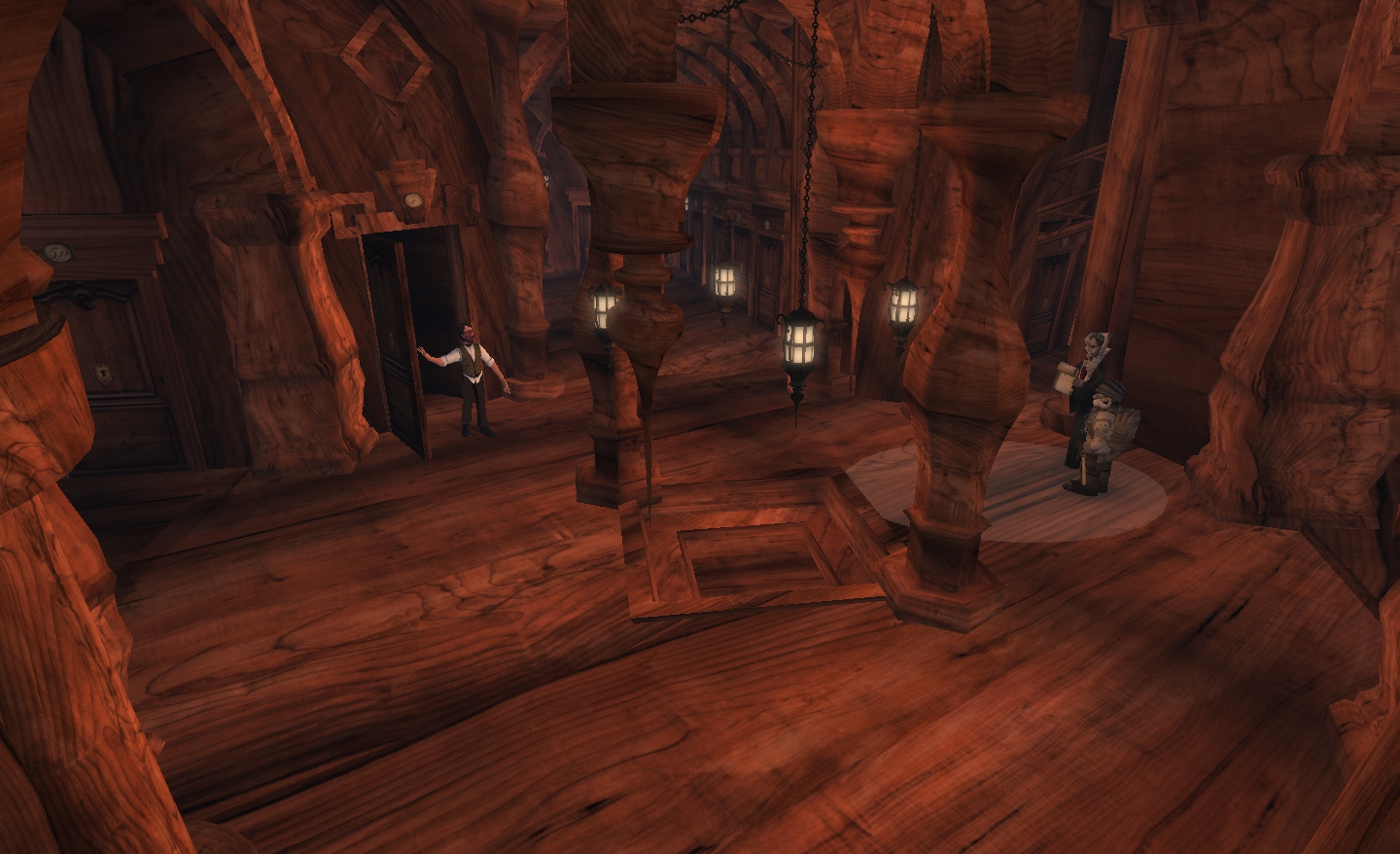
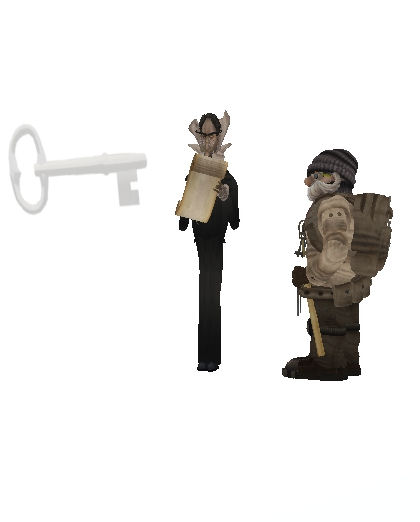
Marcus Inkpen provides the third part of the installation. Here stands the Overseer and his stout companion, conversing at the junction of several strange, door-lined hallways. Do you take one – and if so, which one? And what’s that about a key being in your pocket? Does it mean something… or…?
Your doorway awaits
Tonal sounds here give the place a brooding air, and if you wander the hallways, you’ll hear stranger sounds of life from the other sides of the many doors. But which door do you take…and what lies beyond?
Follow the key – carefully
Find the door, and you’ll discover the contribution from Desdemona Enfield and Douglas Story. It starts in a white room, just like the start of The Path itself. Here stand the Overseer and his companion once more, together with an apparently simple and innocent suggestion that you follow the key. But as with so many things, appearances can be deceptive, and following the key may lead to things not quite so simple and direct.
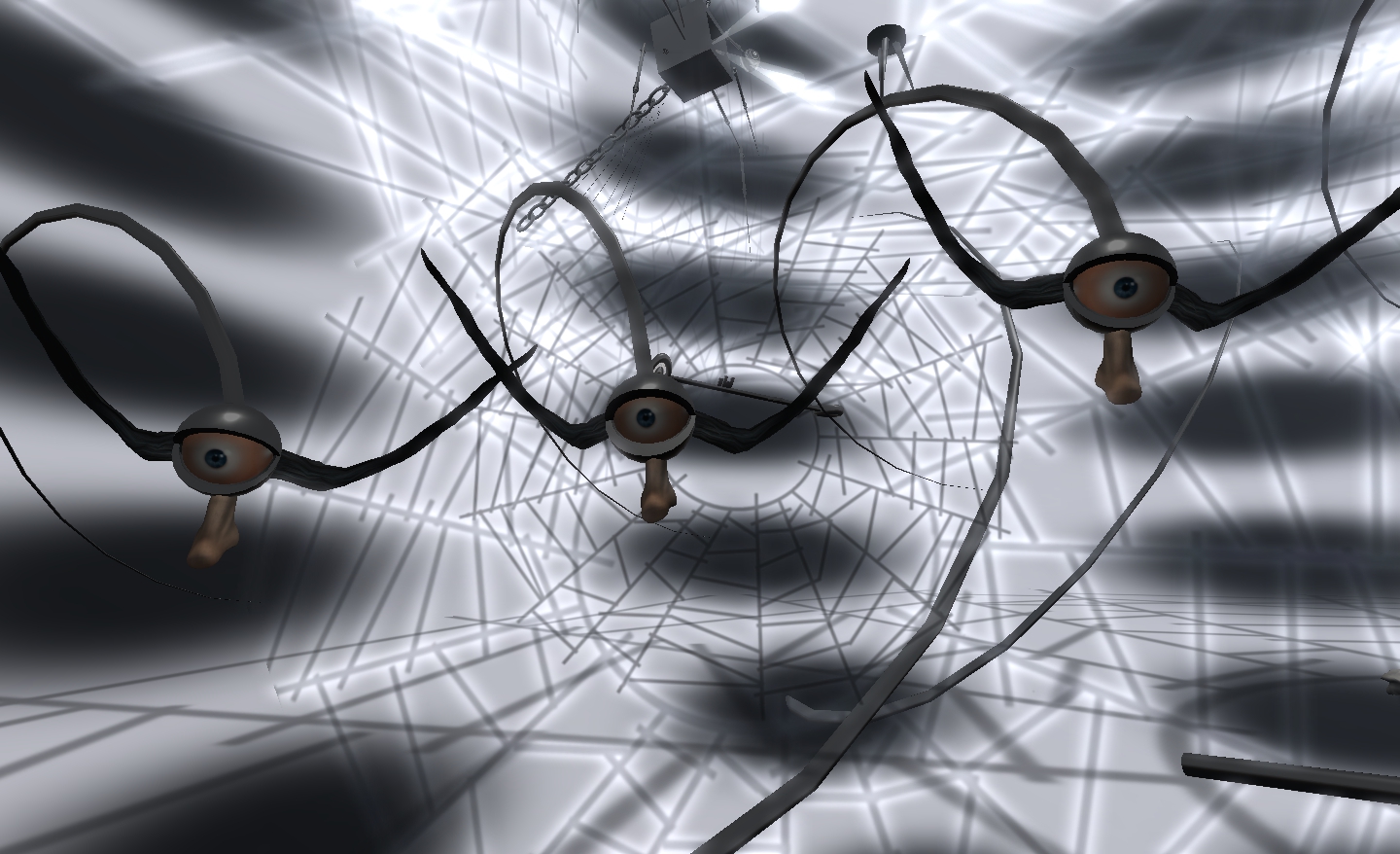
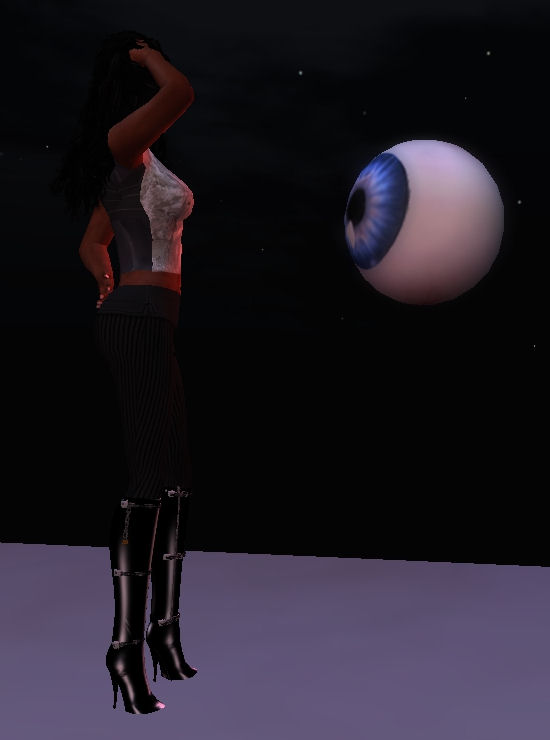
Maya Paris provides an altogether different landscape – are those the shadows of ladders, or the shadows cast by some bizarre web? Is something lurking in the apparent calmness of this place? Climb the ladder and find out; although I hope your eyesight is in good order – and not just for finding the inventor!
The eyes have it in Maya Paris’ piece
Feast
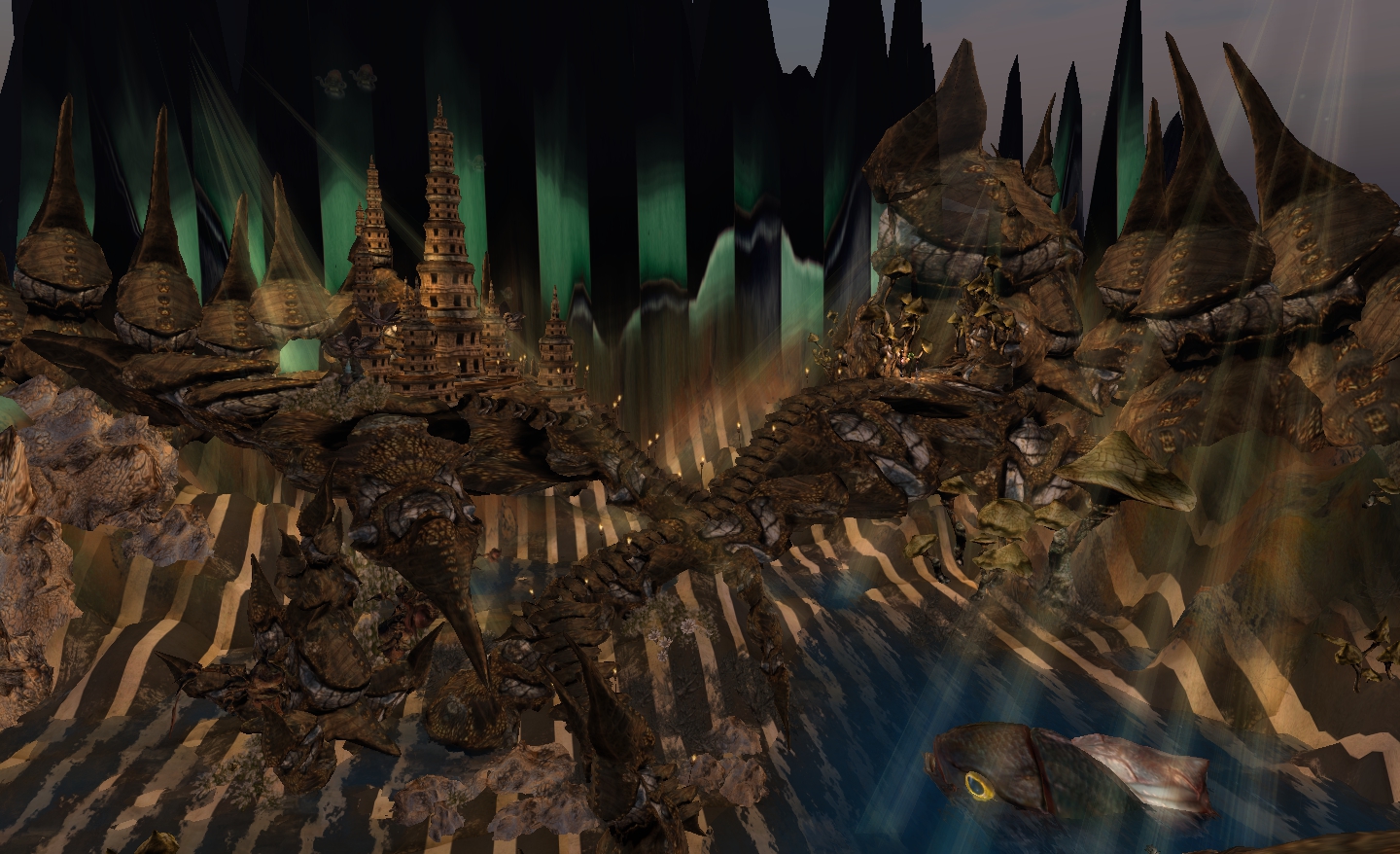
It is moving on to the sixth part of the installation that I confess to becoming a tad biased. This is because the sixth element features the vivid and beautiful imagination of one of my favourite artists in Second Life – that of Claudia222 Jewell.
Claudia222 Jewell on The Path – amazing
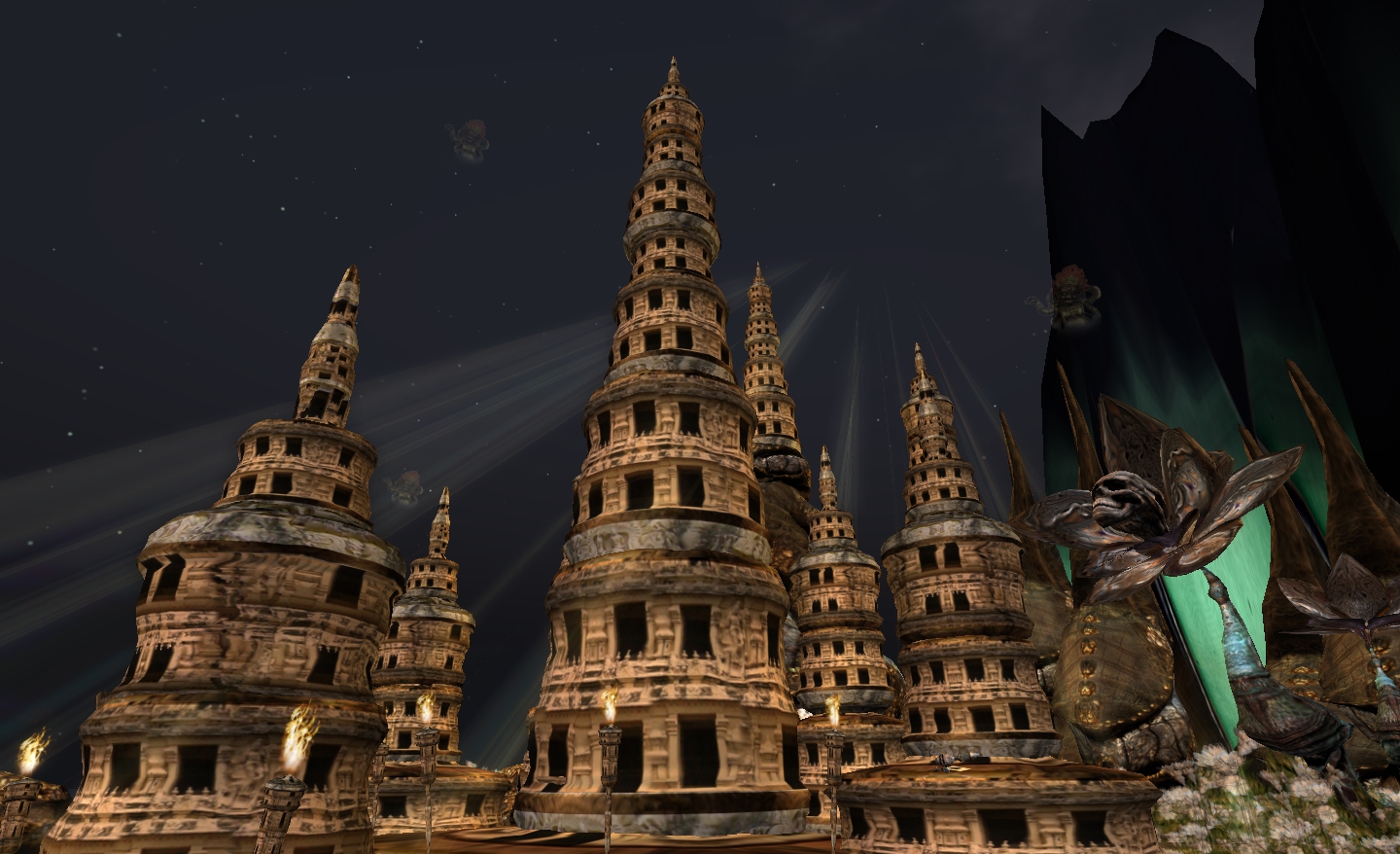
This is truly a visual feast and (as always with Claudia) a tour de force of what can be achieved in Second Life. Her City of Lost Souls is amazing in its complexity and beauty. Without detracting at all from the other works in The Path, one cannot help but feel this is another of her pieces that should be preserved and displayed for everyone to enjoy.
City of Lost Souls – will you be lost in Claudia’s contribution?
If I have one complaint here, it is simply this: Claudia’s work is too enticing. I wandered it for over 40 minutes drinking-in the detail and unwilling to leave. Perhaps that is why her city is inhabited by lost souls – many more may have visited and been unwilling to leave…
But leave one must – and this requires finding a head once more – but not necessarily the head of the inventor; although finding the right one will lead you to him.
Scottius Polke returns to the theme of the laboratory with his contribution to The Path, and on a grand scale. Here you must keep an eye out for the direction you should take, negotiating giant rulers, coiled pipes and other obstacles. This actually needs some care – the route you must take climbing some of the items is very narrow, and lag here and there can easily have you stepping off into thin air if you press a key for too long – as I found out. And while you climb, be aware your every move is being watched from above, as the inventor himself gazes down upon you; but it is not his big head that will help you out of here.
It’s a big world
The final part of The Path is by Rose Borchovski, and you might say it is an eye-opener. It’s also slightly unsettling for ways not easy to discern; it’s not the eyes that stare and follow you; or those heaped pyramid-like, eternally watching. It is more the child’s voice whispering forlornly and the strange circle of beds, each one an echo of the places you have seen and visited while journeying The Path, the occupants (or parts of them in some cases) pinned to them like items in a collection. Be careful with the beds in particular; you might find yourself going on an unexpected trip into the past….
Rose Borchovski gives me an admirer
Overall, The Path is an amazing piece – one that requires a good deal of time to experience fully. Each element of the installation has been carefully considered, and the themes linking them are clear, een when the verbal narrative stops. Each of the sections of the installation is distinctive in both style and approach, while all come together to form a story that can be followed as you roam. Kudos to all those who participated in the installation, and to Bryn Oh for conceiving the idea.
You need to give the exhibit a fair amount of time; even with my joyful distractions in Claudia222 Jewell’s part of the installation, I still spent the better part of four hours roaming, poking, listening, prodding and generally losing myself (once quite literally) in walking The Path. But it was four hours I feel were well-spent. So why not take a walk along it for yourself?
The Path officially opens today for a 3-month period. My thanks to Bryn Oh for the preview opportunity.


 More abstract and free-form than Catharsis (although with a very subtle subtext to the images accompanying It’s the End of the World As We Know it), Particle Phantasmagoria is a fabulous ride marrying stunning particle effects and images with an inspired selection of music in a trippy rollercoaster of a ride that will not only have you watching in awe and whooping in delight, but also quiet probably seat dancing along to the soundtrack.



 Inara Pey: Living in a Modemworld